Forecasting The NSIDC News
By Steven Goddard and Anthony Watts
Barring an about face by nature or adjustments, it appears that for the first time since 2001, Arctic Sea ice will hit the “normal” line as defined by the National Snow and Ice Data Center (NSIDC) for this time of year.
NSIDC puts out an article about once a month called the Sea Ice News. It generally highlights any bad news they can find about the disappearance of Arctic ice. Last month’s news led with this sentence.
In February, Arctic sea ice extent continued to track below the average, and near the levels observed for February 2007.
But March brought good news for the Polar Bears, and bad news for the Catlin Expedition and any others looking for bad news. Instead of ice extent declining through March like it usually does, it continued to increase through the month and is now at the high (so far) for the year.
If it keeps this trend unabated, in a day or two it will likely cross the “normal” line.

The Danish Meteorological Institute shows Arctic ice extent at the highest level in their six year record.

The Norwegians (NORSEX) show Arctic ice area above the 30 year mean.

And the NORSEX Ice Extent is not far behind, within 1 standard deviation, and similar to NSIDC’s presentation. Note that is hit normal last year, but later.

And JAXA, using the more advanced AMSR-E sensor platform on the AQUA satellite, shows a similar uptick now intersecting the 2003 data line.

Source: IARC-JAXA
WUWT asked NSIDC scientist Dr. Walt Meir about this event to which he responded via email:
It’s a good question about the last time we’ve been above average. It was May 2001. April-May is the period when you’re starting to get into the peak of the melt season for the regions outside of the Arctic Ocean (Bering Sea, Hudson Bay) and the extent tends to have lower variability compared to other parts of the year as that thinner ice tends to go about the same time of year due to the solar heating. Even last year, we came fairly close to the average in early May.
He also mused about a cause:
Basically, it is due primarily to a lot more ice in the Bering Sea, as is evident in the images. The Bering ice is controlled largely by local winds, temperatures are not as important (though of course it still need to be at or at least near freezing to have ice an area for any length of time). We’ve seen a lot of northerly winds this winter in the Bering, particularly the last couple of weeks.
As we’ve been saying on WUWT for quite some time, wind seems to be a more powerful factor in recent sea ice declines than temperature. Recent studies agree.
See: Winds are Dominant Cause of Greenland and West Antarctic Ice Sheet Losses and also NASA Sees Arctic Ocean Circulation Do an About-Face
You can watch wind patterns in this time lapse animation, note how the ice has been pushed by winds and flowing down the east coast of Greenland:

Dr. Meier also wrote:
This has very little implication for what will happen this summer, or for the long-term trends, since the Bering Sea ice is thin and will melt completely well before the peak summer season.
There’s certainly no reason to disagree with the idea that much of the Bering Sea ice will melt this summer, it happens every year and has for millenia. But with a strong negative Arctic Oscillation this year, and a change in the wind, it is yet to be determined if Arctic Sea ice minimum for 2010 is anomalously low, and/or delayed from the usual time.
In 2009, WUWT noted it on September 15th: Arctic sea ice melt appears to have turned the corner for 2009
Dr. Mark Serreze of NSIDC offered some hopeful commentary in a press release back on October 6th 2009, but still pushes that “ice free summer” meme:
“It’s nice to see a little recovery over the past couple of years, but there’s no reason to think that we’re headed back to conditions seen in the 1970s,” said NSIDC Director Mark Serreze, also a professor in CU-Boulder’s geography department. “We still expect to see ice-free summers sometime in the next few decades.”
Remember this 2007 prediction from The Naval Postgraduate School?
Arctic summers ice-free ‘by 2013’
|
By Jonathan Amos
Science reporter, BBC News, San Francisco |

 |
 Arctic summer melting in 2007 set new records
|

 More details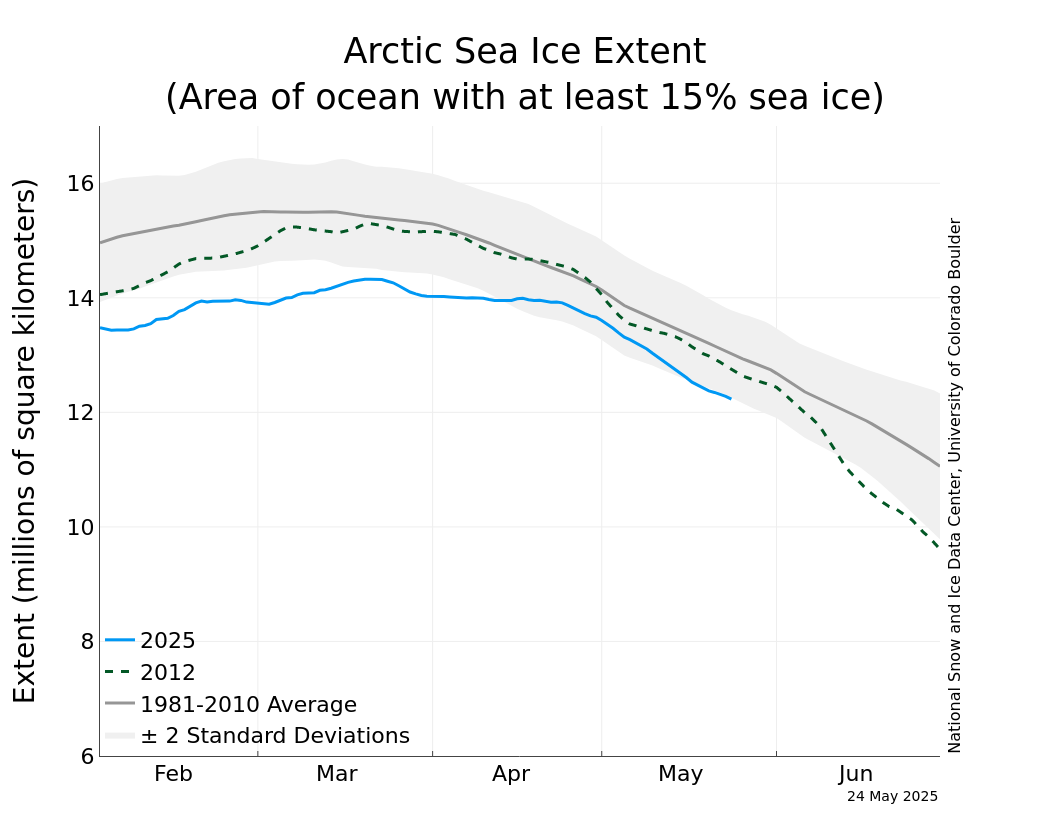

Scientists in the US have presented one of the most dramatic forecasts yet for the disappearance of Arctic sea ice.
Their latest modelling studies indicate northern polar waters could be ice-free in summers within just 5-6 years.
Professor Wieslaw Maslowski told an American Geophysical Union meeting that previous projections had underestimated the processes now driving ice loss.
Summer melting this year reduced the ice cover to 4.13 million sq km, the smallest ever extent in modern times.
Remarkably, this stunning low point was not even incorporated into the model runs of Professor Maslowski and his team, which used data sets from 1979 to 2004 to constrain their future projections.
|
 In the end, it will just melt away quite suddenly In the end, it will just melt away quite suddenly  Professor Peter Wadhams
|
“Our projection of 2013 for the removal of ice in summer is not accounting for the last two minima, in 2005 and 2007,” the researcher from the Naval Postgraduate School, Monterey, California, explained to the BBC.”So given that fact, you can argue that may be our projection of 2013 is already too conservative.”
========================================
Joe Romm wrote up a clever piece last year on this subject:
Exclusive: New NSIDC director Serreze explains the “death spiral” of Arctic ice, brushes off the “breathtaking ignorance” of blogs like WattsUpWithThat
June 5, 2009
I interviewed by email Dr. Mark Serreze, recently named director of The National Snow and Ice Data Center. Partly I wanted him to explain his “death spiral” metaphor for Arctic ice
So now that Arctic ice has returned to normal extent and area, we eagerly await the explanation from the experts about how that fits into the “death spiral” theory. Richard Feynman famously said “Science is the belief in the ignorance of the experts.”
Time will tell. 2010 is looking promising for sea ice recovery again. After all, who wouldn’t want the Arctic Sea ice to recover? WUWT is predicting a recovery again this year, which we started mentioning as a prediction last fall.
So given what we know today, what will NSIDC highlight in their April Sea Ice News?
And even more importantly, will the MSM cover it like they do the ‘terrible’ minimums?
NOTE: The poll code got messed up, duplicating an entry, press REFRESH if you see a double entry. -A
Forecasting The NSIDC News
NSIDC puts out an article about once a month called the Sea Ice News. It generally highlights any bad news they can find about the disappearance of Arctic ice. Last month’s news led with this sentence.
In February, Arctic sea ice extent continued to track below the average, and near the levels observed for February 2007.
But March brought good news for the Polar Bears, and bad news for the Catlin Expedition and any others looking for bad news. Instead of ice extent declining through March like it usually does, it continued to increase through the month and is now at the high (so far) for the year.
http://nsidc.org/data/seaice_index/images/daily_images/N_stddev_timeseries.png
The Danish Meteorological Institute shows Arctic ice extent at the highest level in their six year record.
The Norwegians (NORSEX) show Arctic ice area above the 30 year mean.
Joe Romm wrote up a clever piece last year on this subject:
Exclusive: New NSIDC director Serreze explains the “death spiral” of Arctic ice, brushes off the “breathtaking ignorance” of blogs like WattsUpWithThat
June 5, 2009
I interviewed by email Dr. Mark Serreze, recently named director of The National Snow and Ice Data Center. Partly I wanted him to explain his “death spiral” metaphor for Arctic ice
So now that Arctic ice has returned to normal extent and area, I eagerly await the explanation from the experts about how that fits into the “death spiral” theory. Richard Feynman famously said “Science is the belief in the ignorance of the experts.”
So what will NSIDC highlight in their April Sea Ice News?
-
The increase in both ice extent and quantity of multi-year ice
-
The long-term downwards linear trend line
-
The lack of 4+ year old ice
Sponsored IT training links:
Get free resources including 642-972 tutorial and 1z0-048 dumps questions for guaranteed success in JN0-532 exam.
@ur momisugly Jimbo 12:34:49
Though I much appreciated the story of a polar bear washing ashore on Mull island, I finally noticed, and wondered, that the pebbles and stones spread just in front of the bear have changed between pictures: that would imply the bear changed place, but not posture. Puzzling, if not a photoshopped April’s Fool prank …
Well, I nonetheless send the link to Countrylife to my friends (with a short comment)!
Thanks a lot !
Barry (23:50:39)
“I know what a negative feedback is, and that they exist in the biosphere, but you said they ‘dominate’. If they do, as in the example you gave, ice ages shouldn’t happen.”
In a quasi-chaotic non-linear system the effect of negative feedback (otherwise referred to as damping, friction or dissipation) is to favour emergence of complex spontaneous pattern and attractors or periodic states. Positive (global) feedback by contrast suppresses complex pattern and imposes regular periodicity. Thus the balance of negative and positive feedback is indeed critical. The log-log nature of global climatic temperature fluctuation indicates a significant chaotic component – further indicating a significant role of turbulence damping (i.e. negative feedback).
e.g.
http://pre.aps.org/abstract/PRE/v69/i1/e016202
http://pre.aps.org/abstract/PRE/v74/i1/e016612
http://pre.aps.org/abstract/PRE/v73/i5/e056303
Log-log fluctuation dynamics means frequent small changes, less frequent big changes, occasional really big changes – all generated spontaneously by the system’s internal dynamics, not necessarily needing a change in external forcing. Thus, in this context, jumping to an ice age state is completely consistent with the role of negative feedbacks (and with an appropriate mixture of negative and positive fedback).
Nice for the Inuits.
But it won´t help them, they think…
http://snardfarker.ning.com/profiles/blogs/the-tilting-of-the-earth
Well the Ice may be getting back to normal but Southern Scotland has set another record, it has now snowed on at least one day in 5 consectitive months. Thats looking out the window science not the looking at Windows XP software makeup science.
Dec 09, Jan Feb Mar Apr 10
I wonder how it felt like, being a “Climate Change Professor”, having a guy like this Lovelock fellow as ones bed-mate?
Shouldnt the BS meter start ticking?
And then, after enjoying this friendship with the Gaia Prophet for decades, he suddenly pops up again, now saying that AGW is …..a hoax?
All I can say is that me, I like it!
Winter again, and for decennia to come the Arctic ice extent will always hit near or maybe on ‘normal’ in February because of the enclosure by (cold) landmasses.
That is one more reason to concentrate on thickness/volume, not extent. Thickness is the main decider for extent in autumn.
The media will continu to miss this fact, presumably because it is too simple to comprehend!
barry (23:50:39) :
If you look at a graph of Arctic ice, you will see that the Arctic Ocean is saturated with high albedo ice through the sunny months of May-July, and the ice minimum occurs during September when the sun is setting for the winter. There is little or no absorption of solar energy in the water at that time. So loss of heat dominates. i.e. a negative feedback.
http://wattsupwiththat.com/2009/01/10/polar-sea-ice-changes-are-having-a-net-cooling-effect-on-the-climate/
Positive feedback is what all the measurements of arctic ice are currently displaying.
Negative feedback is caused by a sudden outflow of trolls through the Gavin and Jorom straits.
STOP feeding the trolls. Sometimes you need to be cruel to be kind.
RR Kampen (04:53:42),
When you were claiming the ice cover would continue to fall drastically, Charles the Moderator offered you a wager to settle the issue:
click
You said you were 90% sure you would win the bet. You talk the talk, but you don’t walk the walk. You chickened out. No doubt Charles would have taken any wager, even $100. Or $1.00.
Your excuses farther down the thread show that you don’t really believe what you’re saying. Lots of “the ice is all melting!” alarmists are like that. They know the climate is normal, just going through its usual natural fluctuations, but pride keeps them from admitting it.
From a financial perspective, it’s a good thing you didn’t take the bet, huh?
I made a chart of the sea ice coverage in march during the years 2003-2010 from the data here: http://www.ijis.iarc.uaf.edu/en/home/seaice_extent.htm .
See the chart here: http://www.dh7fb.de/marchice/image001.gif .
After calculating the linear trend I also correlated the slope of the trends vs. the Winter-NAO of JNF of the actual year. The correlation is very robust: R=-0,8.
This could mean, that the behavior of the arctic sea ice depends on the NOA of the winter before. We had a record- NAO of -5,0, so I think we could see a dramatic growing also of the arctic ice in the summer.
Greetings from DH7FB
NSDIC’s website is experiencing “technical difficulties”.
Are they shutting down in order to hide the incline?
Their error message does have two friendly polar bears on it.
Always promoting.
The message:
We’re experiencing technical difficulties. Please *bear* with us, we’ll have things up and running again as soon as possible.
Need to talk to us? You can always contact our friendly User Services Office at nsidc@nsidc.org
Just an FYI, arstechnica.com banned my account for bringing up this point. The article was in reference to recent solar activity not having ANY impact on global temperature increases according to some physicists. I simply asked what temperature increase they were referring to, seeing as the planet hasn’t gotten any warmer since 1997 and I mentioned that the GISS flawed temperature records and Snow and Ice Data measurements didn’t add up at all. About 15 minutes later, my comment was ambushed, they cut me up a few times and then banned my account lol. WOOPS! This to me, lends credence to the notion that the opinions over at arstechnica are very biased in regards to their climate articles. Anyway, just wanted to share that. Peace.
http://arstechnica.com/science/news/2010/03/solar-flare-activity-doesnt-account-for-recent-warming.ars
E Flesch (03:25:42) :
That pic is very hard to make out. Anyway, any new ice is bound to have fragments of the old. It’s kind of you, Phil, to fend off premature celebrations of ice recovery, but you’ll agree the proof is definitely in the pudding. Onwards to the summer minimum.
Sorry but that isn’t new ice. The proof of the pudding is indeed in the eating and the usual bottleneck in May/June means that there’s unlikely to be any significant change until July.
RR Kampen (04:53:42) :
29. April 2009: Research aircraft Polar 5 finishes Arctic expedition – Unique measurement flights in the central Arctic completed
An ice-thickness sensor, the so-called EM-Bird, was put into operation under a plane for the first time ever. To conduct the measurements, Polar 5 dragged the sensor which was attached to a steel cable of eighty metres length in a height of twenty metres over the ice cover.
Multiple flights northwards from various stations showed an ice thickness between 2.5 (two years old ice in the vicinity of the North Pole) and 4 metres (perennial ice in Canadian offshore regions).
All in all, the ice was somewhat thicker than during the last years in the same regions, which leads to the conclusion that Arctic ice cover recovers temporarily.
The researchers found the thickest ice with a thickness of 15 metres along the northern coast of Ellesmere Island.
http://tinyurl.com/yeyxpq4
Arctic ice will decrease at a lower rate rate than the mean for at least a few more days. Note that the areas of deficiency (Newfoundland/Okhotsk) are always the first to melt – so the median line will converge on the ice front over the next few days.
http://nsidc.org/data/seaice_index/images/daily_images/N_daily_extent.png
From 10 years ago:
http://www.independent.co.uk/environment/snowfalls-are-now-just-a-thing-of-the-past-724017.html
Yesterday a school bus crashed in the snow, killing one student.
http://www.timesonline.co.uk/tol/news/uk/article7083614.ece
Oh no, Anthony,
The Watts effect will probably melt the entire Arctic and most of Greenland because of this article. Couldn’t you leave well enough alone!!!!!
Catlin reports travelling over old, thick ice.
http://www.catlinarcticsurvey.com/blog.aspx?postId=118
NSIDC is not being updated. Off by three days now. Interesting.
What parameters are building that predict an above average summer ice melt? What parameters are building that predict an average summer ice melt? What parameters are building that predict a below average summer ice melt? These are the questions I would like to debate, not just that “It will be another [fill in] summer ice event”. Tell me why you think so.
Ice thickness is pretty good right now. The neutral to negative AO speaks against a fast conveyor belt. The temps are still well below freezing. These parameters are keeping the ice in place. If any one of these parameters change, would it be because of CO2 or would it be just a natural variation?
“RR Kampen (04:53:42) :
Winter again, and for decennia to come the Arctic ice extent will always hit near or maybe on ‘normal’ in February because of the enclosure by (cold) landmasses.
That is one more reason to concentrate on thickness/volume, not extent. Thickness is the main decider for extent in autumn. ”
Shifting goalposts.
Gary (17:59:07) :
World renown climatologist Joe Romm has given us the new definition of climate change
[JR: Yes, dry areas will tend to get drier — and wherever and whenever droughts occur they will tend to be hotter and longer. At the same time, wet areas are likely to get wetter. That is why they call it climate change.]
So I guess the ice is still increasing because cold areas are likely to get colder. I am still unsure what happens to temperate areas. Do they become more temperate?
Everything everywhere will get worse, of course.
Have you noticed that when sea ice decreases it is climate change, yet when it increases, it is weather, not climate. How convenient.
barry (23:50:39) :
There’s other factors than just ice at the poles and negative feedbacks. In this 5 part video series at YouTube Nir Shaviv hypothesizes about the Spiral Arms of the Milky Way having an effect on climate:
Apparently there are celestial factors in climate and not just terrestrial.
A few comments about the arctic sea ice “return” to normalcy:
1. The little “bump” upward during March is very interesting as a short-term phenomenon, and I’d like to see some data that compare this kind of behavior to year of previous extremely low AO indexes. Though it is still not at the 30 year running mean, it is almost there, and certainly may exceed it, and most of this comes from the Bering Sea and Sea of Okhotsk. This “bump” is still just that, and not as important as the longer down trend over the past decade. Pointing to this short bump as an indication of anything important is like looking at the Florida snow this winter as a sign of anything, other than an extreme negative AO index, which is a short term weather variation. Longer term trends are all thats important in AGW discussions.
2. While all the AGW skeptics are frothing at this bump upward, we’ve got a long summer melt season ahead, and the critical months of July & August are what will really tell the story of arctic sea ice, as we get the maximum daily melting going on. As I stated even before this March “bump”, I believe that we’ll see a lower summer minimum than last year, though not as low as 2007. However, I do believe we’ll see a new modern record summer low before 2015, and this current short-term “bump” will be just a curiosity of the spring of 2010– something probably related to the extreme negative AO of the winter, and something that got the AGW skeptics all excited, even though the longer term trend is still lower.