Via Eurekalert – New study debunks myths about Amazon rain forests – They may be more tolerant of droughts than previously thought
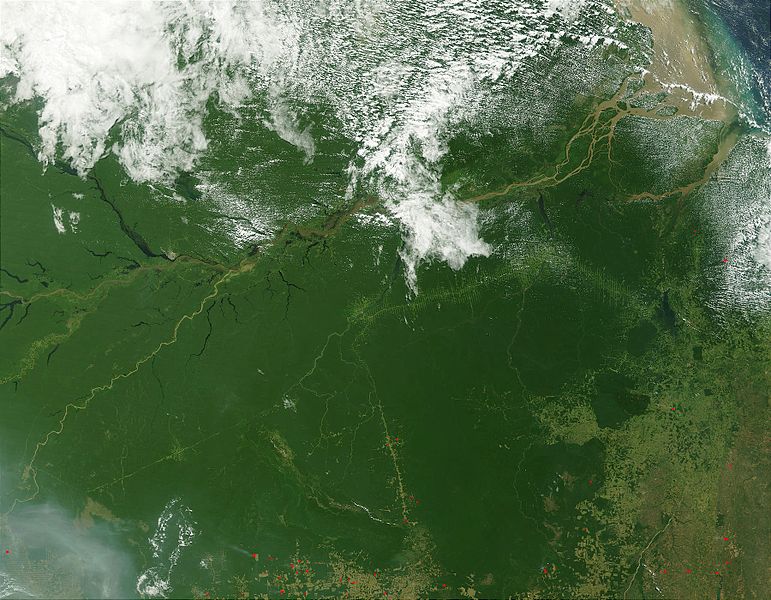
(Boston) — A new NASA-funded study has concluded that Amazon rain forests were remarkably unaffected in the face of once-in-a-century drought in 2005, neither dying nor thriving, contrary to a previously published report and claims by the Intergovernmental Panel on Climate Change.
“We found no big differences in the greenness level of these forests between drought and non-drought years, which suggests that these forests may be more tolerant of droughts than we previously thought,” said Arindam Samanta, the study’s lead author from Boston University.
The comprehensive study published in the current issue of the scientific journal Geophysical Research Letters used the latest version of the NASA MODIS satellite data to measure the greenness of these vast pristine forests over the past decade.
A study published in the journal Science in 2007 claimed that these forests actually thrive from drought because of more sunshine under cloud-less skies typical of drought conditions. The new study found that those results were flawed and not reproducible.
“This new study brings some clarity to our muddled understanding of how these forests, with their rich source of biodiversity, would fare in the future in the face of twin pressures from logging and changing climate,” said Boston University Prof. Ranga Myneni, senior author of the new study.
The IPCC is under scrutiny for various data inaccuracies, including its claim – based on a flawed World Wildlife Fund study — that up to 40% of the Amazonian forests could react drastically and be replaced by savannas from even a slight reduction in rainfall.
“Our results certainly do not indicate such extreme sensitivity to reductions in rainfall,” said Sangram Ganguly, an author on the new study, from the Bay Area Environmental Research Institute affiliated with NASA Ames Research Center in California.
“The way that the WWF report calculated this 40% was totally wrong, while [the new] calculations are by far more reliable and correct,” said Dr. Jose Marengo, a Brazilian National Institute for Space Research climate scientist and member of the IPCC.
Founded in 1839, Boston University is an internationally recognized private research university with more than 30,000 students participating in undergraduate, graduate, and professional programs. BU consists of 17 colleges and schools along with a number of multi-disciplinary centers and institutes which are central to the school’s research and teaching mission.
Geophysical Research Letters article citation: Samanta, A., S. Ganguly, H. Hashimoto, S. Devadiga, E. Vermote, Y. Knyazikhin, R. R. Nemani, and R. B. Myneni (2010), Amazon forests did not green‐up during the 2005 drought, Geophys. Res. Lett., 37, L05401, doi:10.1029/2009GL042154.
ABSTRACT: Amazon forests did not green-up during the 2005 drought
Paper available here (PDF)
The sensitivity of Amazon rainforests to dry-season droughts is still poorly understood, with reports of enhanced tree mortality and forest fires on one hand, and excessive forest greening on the other. Here, we report that the previous results of large-scale greening of the Amazon, obtained from an earlier version of satellite-derived vegetation greenness data – Collection 4 (C4) Enhanced Vegetation Index (EVI), are irreproducible, with both this earlier version as well as the improved, current version (C5), owing to inclusion of atmosphere-corrupted data in those results. We find no evidence of large-scale greening of intact Amazon forests during the 2005 drought – approximately 11%–12% of these drought-stricken forests display greening, while, 28%–29% show browning or no-change, and for the rest, the data are not of sufficient quality to characterize any changes. These changes are also not unique – approximately similar changes are observed in non-drought years as well. Changes in surface solar irradiance are contrary to the speculation in the previously published report of enhanced sunlight availability during the 2005 drought. There was no co-relation between drought severity and greenness changes, which is contrary to the idea of drought-induced greening. Thus, we conclude that Amazon forests did not green-up during the 2005 drought.
h/t to Dr. Leif Svalgaard
Sponsored IT training links:
Join pass4sure for absolute JN0-342 exam solution and get guaranteed success using F50-531 dumps and 642-359 study guide.
D. King (22:16:33) :
We find no evidence of large-scale greening of intact Amazon forests during the 2005 drought – approximately 11%–12% of these drought-stricken forests display greening, while, 28%–29% show browning or no-change, and for the rest, the data are not of sufficient quality to characterize any changes.
You have to love the way they parse this. What percentage of browning
and what percentage of no change?
Of course, 1% browning and 27-28% no-change… DOH!
Mike D. (23:16:30) wrote:
“What many people think of as “pristine” Amazon rainforest has actually been occupied by humanity for thousands of years.”
Thank you. I visit your site regularly. Ignoring the existence and impacts of humans in the ‘pristine wilderness’ is the first false premise of the alarmist pseudoscience called ‘Conservation Biology.’
Would also recommend the book ‘1491’ by Charles Mann as a nice primer on this topic. That would also shed light on the comment by
Ruth (07:12:52) about this bird “Amazona martinicana was described from Martinique (to France) by Labat in 1742, and by Buffon in 1779… Labat wrote that “the parrot is too common a bird for me to stop to give a description of it”, and so the species must have declined very rapidly to extinction in the latter half of the 18th century… Hunting is likely to have caused its extinction.”
This probably parallels the passenger pigeon story in North America. That bird’s population exploded only after the Native populations were decimated by smallpox, and the same thing happened in South America.
All those parrots and pigeons would have been a pest (and an occasional meal) to the farming people who once lived in both areas.
————-
owl (01:36:38) wrote :
“We are cutting down the amazon rain forest which causes dought condition. The Maya civilation collapsed because of all the forest they cut down.”
Funny, and such a convenient rationale. Actually it was the dreaded climate change, on a larger scale, which somehow occurred in the pre-SUV era!!!
Climate change and population history in the Pacific Lowlands of Southern Mesoamerica
Neff, Pearsall, Jones, Pieters and Freidel 2006.Quaternary Research
Volume 65, Issue 3, May 2006, Pages 390-400
Core MAN015 from Pacific coastal Guatemala contains sediments accumulated in a mangrove setting over the past 6500 yr. Chemical, pollen, and phytolith data, which indicate conditions of estuarine deposition and terrigenous inputs from adjacent dry land, document Holocene climate variability that parallels the Maya lowlands and other New World tropical locations. Human population history in this region may be driven partly by climate variation: sedentary human populations spread rapidly through the estuarine zone of the lower coast during a dry and variable 4th millennium B.P. Population growth and cultural florescence during a long, relatively moist period (2800–1200 B.P.) ended around 1200 B.P., a drying event that coincided with the Classic Maya collapse.
———-
owl hoots: ” WE are losing a 150 species daily to extinction…”
Funny. You actually believe anything the WWF invents, just like the IPCC.
Bjorn Lomborg expalined this fraudulent statistic in his book ‘The Skeptical Environmentalist.’
I believe that book is on the WWF’s banned reading list.
The WWF statement re: the IPCC Amazon claim follows:
“Another contested statement in the IPCC report is this claim: “Up to 40% of the Amazonian forests could react drastically to even a slight reduction in precipitation.” As its source, the IPCC cites a joint report by WWF and International Union for the Conservation of Nature (IUCN) entitled, “Global Review of Forest Fires [PDF],” published in 2000.
The WWF/IUCN study said: “Up to 40% of the Brazilian forest is extremely sensitive to small reductions in the amount of rainfall,” but failed to include the correct citation – a 1999 report titled “Fire in the Amazon,” by the Amazon Environmental Research Institute (IPAM). That report said: “Probably 30 to 40% of the forests of the Brazilian Amazon are sensitive to small reductions in the amount of rainfall.” Absent the reference to the IPAM report, readers assumed incorrectly that the source was a 1999 Nature article cited two sentences later.
However, unlike the statement about Himalayan glaciers, the reference was drawn from an authoritative source, was factually correct and is supported by the peer-reviewed literature. ”
We could not locate any 1999 report or study titled “Fire in the Amazon” at the IPAM site. But it seems reasonable to request IPCC to dismiss statements with broad subjective qualifiers such as “probably,” or at least note the qualifier in citations. Language like this should be picked up by peer review prior to publication.
Has NASA finally gotten their act together or are they trying to distance themselves from the IPCC?
owl> WE in the 70’s had 3 billion people and today we have almost 7 billion people.
owl> WE have used pesticides for decades which are causing people and animals to be sterile,
I wonder how those sterile people are multiplying to 7 billion?
KDK (08:31:17) :
I’d like to note that not all the activities of these foundations or the Environmental Grantmakers Assoc. are wrongheaded. Much of the funding unrelated to climate is perfectly sound and produces good conservation science or policy positions. I am not opposed to conservation either of resources or wildlife. It is a shame to watch sensitive wildlife habitat fall to development – but that is to be expected as population and standards of living increase.
Where the foundations and government have sorely mis-stepped is in shoving sound conservation under the global warming blanket. When finally the harsh reality that CAGW is false sinks in – many good conservation efforts will be tarnished by “climate change.” That doubles the tragedy as good efforts to preserve habitat and wildlife will be set back 20-30 years.
Someone wrote: “Exaggeration leads the coalition of disbelief.”
More giggles courtesy of Owl: (Guadeloupe Amazon)
“Two extinct species have been postulated, based on limited evidence.[6][7] They are the †Martinique Amazon (Amazona martinica)[8][9] and the †GUADELOUPE AMAZON (Amazona violacea).[6][10][11] Amazon parrots were described living on Guadeloupe by Jean-Baptiste Du Tertre in 1667 and by Jean-Baptiste Labat in 1742, and they were called Psittacus violaceus at that time. Labat also described Amazon parrots living on Martinique. There are no specimens or remains of either island population, so their taxonomy may never be fully elucidated. Their status as separate species is unproven and they are regarded as hypothetical extinct species.”
(Source, Wikipedia – requires verification)
So now CO2 caused the extinction of a HYPOTHETICAL species sometime in the last 260+ years?? So, yeah, there’s the proof – need to ban CO2!
OWL: If you don’t do some basic research (assuming you are capable), then you best not wade into this group preaching.
Also, something I didn’t see scanning the comments re the 100 year events: those are LOCAL events, right? A 100 year flooding event in BoringGore, Hebejebees, means it is a 100 year record for that particular location. Now, how many specific locations are there world wide. Thousands? Statistically, we should average 1% of those places having a 1 in a 100 year event, EACH YEAR. That’s a lot of 100-year events, worldwide, each year.
Glenn Tamblyn,
That quote,
“The IPCC is under scrutiny for various data inaccuracies, including its claim – based on a flawed World Wildlife Fund study — that up to 40% of the Amazonian forests could react drastically and be replaced by savannas from even a slight reduction in rainfall.”
Seems to be a tad out of context. The fellow who wrote it emailed Tim Lambert today:
Dear Tim
I did not know that Sangram would pass my comments for a blog.
I have exchanged few emails with him, and I agree with him about
his position on the greening of Amazonia as shown by Saleska et
al (1007). However, I have questioned him few times about his
conclusions on the IPCC 40% value. In his paper he does not show
anything that go against the 40%, and he did not mention IPCC at
all. So this comparison is out of of context considering the
finding of this high quality paper.
What I said is that the 40% was obtained qualitatively from a
map from Nepstad et al (2004), comparing the area burn during the
El Nino 1998 and the mean area. Nepstad considered the El Nino 1998
situation as an analogue of what the future could be, which may
not be entirely realistic. I said that between an eye calculation
to get the 40% reported by the WWF document and the calculations
from Samanta et al (2010), even though they refer to different things,
Samanta et al did more correct and raliable work.
Yes, I believe that the Amazon forests are vulnerable to rainfall
reduction, and high temperatures, and this would lead to what some
studies call the Amazon die back. However, the die back is still
somewhat uncertain, but without reaching a level in which the forest
would replaced by savanna, the forest is highly vulnerable to drought.
Sincerely
Jose marengo
Ack, pasted the wrong part. I meant:
“The way that the WWF report calculated this 40% was totally wrong, while [the new] calculations are by far more reliable and correct,” said Dr. Jose Marengo, a Brazilian National Institute for Space Research climate scientist and member of the IPCC.
Zeke Hausfather (15:32:48):
“The way that the WWF report calculated this 40% was totally wrong, while [the new] calculations are by far more reliable and correct…”
Replace ‘the WWF’ with “the Mickey Mouse Club” and the credibility would be the same.
The purpose of the paper was to refute another paper which claimed that the forest had increased during the drought of 2005. Here are the actual conclusions:
[we try] “to reconcile contradictory reports of increased tree
mortality [Phillips et al., 2009] and extensive biomass burning
[Aragao et al., 2007] with anomalous greening of Amazon forests
(SDHR07) during the 2005 drought. ”
“we conclude that there is no evidence of large-scale greening of the
Amazon forests during the 2005 drought in regions for which valid EVI
data exist.”
“we conclude that the speculation of light driven greening of Amazon
forests during the drought of 2005 by SDHR07 is without basis.”
“we conclude that there is no evidence of large-scale greening of the
Amazon forests during the 2005 drought in regions for which valid EVI
data exist.”
“we conclude that there was no co-variation between the severity of
drought and the spatial extent and magnitude of greenness changes of
Amazon forests in 2005.”
“our overall conclusion is that the Amazon forests did not green-up
during the 2005 drought.”
How this constitutes evidence of resilience escapes me.
As for whether it reflects badly on IPCC WGII; the “up to 40%” of the Amazon subject to relatively rapid decline was based on peer reviewed literature available at the time of compilation of the report. Nothing in the case of the current publication addresses that directly, although Dr. Marengo is quoted, correctly, as saying the present methodology is more precise and may yield better estimates in the future.
In other words, perfectly ordinary science and drastically vicious spin. So what else is new?
One last comment re 1 in 100 year events to add to my earlier remarks. Every locale can have more than one, 100 year event – 100 year snowstorm, 100 year flood, 100 year drought….
So globally, 1 in 100 year events should be extremely common each year. I guess that’s a great way to scare unsuspecting people.
BIODIVERSITY IN CRISIS
http://www.undp.org/biodiversity/biodiversitycd/bioCrisis.htm
Current World Population
http://geography.about.com/od/obtainpopulationdata/a/worldpopulation.htm
Environmental Causes of Infertility
http://www.chem-tox.com/infertility/
@Walter Dnes ‘0.4998’
That’s actaully very close to what most ordinary people assume with once in a hundred years, i.e. from the first time it is fifty years before to fifty years into the future to one hundred years into the future or to one hundred years into the past.
Simple folks keeps things simple like that.
Of course, had you been spot on it had actually been .5. But practice makes perfect. :p
Owl, you really are a hoot! I hope you’re not spotted.
From the ‘Biodiversity in Crisis’ link you posted – from the UN no less! LOL.
“Since the total number of species on earth can only be estimated, the exact rate of current species loss is difficult to gauge. The figure probably stands at between 50 and 150 extinctions per day.”
You stated “” WE are losing a 150 species daily to extinction…”
This states, for what this “difficult to gauge” statistic is actually worth, “probably… between 50 and 150.”
Of course, they never do provide details on these numbers, do they? So why not 50, or 150, or, go for it, 250? Choose your fiction.
And the UN goes on to this speculative extrapolation based on their allegedly “conservative estimate” backed by no evidence whatsoever:
“Working from the conservative estimate that earth is home to 10 million species in all, this means that between 0.2 and 0.6 percent of species are being lost every year. This rate is at least 10,000 times greater than the ‘background’ or natural rate of species extinction, as estimated using the fossil record.”
Wow, that sure sounds bad… like some kind of a crisis!!!
Now for the Big Lie:
“The World Conservation Union (IUCN) has estimated that over 5,500 species of animals… are currently threatened with extinction, together with 6,700 species of higher plants.”
Extinction!!! Or is it?
“Those considered vulnerable, threatened, or critically endangered include:
>> Close to 1,100 species of mammals… Over 1,100 birds… Over 750 species of fish… Around 290 species of reptiles… An estimated 157 species of amphibians…”
That adds up to 3397 species. I guess the other 2103+ are insects, molluscs, etc.
But here’s the problem. The vast majority of them are listed as “vulnerable” or “threatened.” The only ones actually “threatened with extinction” are the “endangered” ones.
Vulnerable species are threatened with becoming threatened; threatened species are threatened with becoming endangered; and endangered species are threatened with extinction.
All these national and international listing systems use this same basic system of different risk levels (with slight variations in terminology) and the whole eco-crisis industry uses the same Big Lie that they are all actually facing extinction.
And the Conservation Biologists who are an integral part of the eco-crisis industry are the people who come up with these lists!
In the US and Canada, once a species is listed as Threatened or worse, some Conservation Biologists have full time jobs ‘monitoring’ or ‘saving’ them.
Do you think that those looking at species might have a vested interest in finding that they are Threatened at least?
And did I mention that this same ‘science’ is then used to protect large areas or impose more regulations to protect the ‘critical habitat’ they say is needed to save their client species?
Or that some of these “species,” in fact most of them in the US and Canada, are not real species at all? They are often fuzzily determined “subspecies,” or even “distinct geographical populations” invented by the Conservation Biologists.
Unlike the ‘climate crisis,’ there are very real problems for the conservation of biodiversity and some species in some areas. But this whole ‘mass extinction’ scare is as wildly exaggerated as our planetary fever and the new pseudioscience of Conservation Biology as as bogus and self-serving as IPCC climatology.
“I’d like to note that not all the activities of these foundations or the Environmental Grantmakers Assoc. are wrongheaded.”… I totally agree.
This planet is awesome and we should, as the supposed most intelligent beings–deemed so by ourselves ;)–take care of it in any way possible.
Humans are the most destructive beings on this planet in my observation and it is mostly for this thing (fictional creation) called ‘money’; not the good of, or advancement of all species, including humans.
I do my part by composting, throwing out ‘organics’ that won’t compost for other species around, and all that type stuff that can be done on an individual level (not to mention I don’t buy my children every POS from china they see on TV, when they do watch it–haven’t had ‘programming (perfect description) for 2 yrs and no one in my family has died over it, not even my children :).
As for the original sentence above… yes, it is usually the peons and the manipulated that are in the front lines taking fire for some cause that is unknown, unreal (perhaps) and they’ve been suckered into it–we all have and we still probably still are because the hidden data isn’t just found in AGW, we are totally manipulated by MSM/GOV/EDU to believe/think in a certain manner (homogenized) for purposes largely unknown to us all.
It is a dream… what would the world be like if all the findings, facts, truths etc., were given to us all and we were all allowed to make our own conclusions? No telling how many myths are passed off as fact… no telling.
@ur momisugly Owl…
Owl, I am with you on the toxins issue. I will never let any amount of HG be shot into my system bypassing ALL safeguards humans have against letting contaminants into it. Vaccines aren’t what they appear to be and are a waste in large part. A few vaccines may serve a purpose but I am leery of those few as well.
The UN loves vaccines and fear, just like any controlling entity, not to mention the amount of $$$$$ involved. Again, something so very NEEDED should not be so profitable for the ones promoting fear.
Just like AGW it is the independent researcher/scientist that must point out what the industry sponsored studies do not find, and just like the agw, they are harassed and belittled, when their concern is truth. Not saying there aren’t fear mongers in every field promoting their own beliefs over facts, but….
Steveta_uk (00:55:23) :
Anu (22:20:15) :
An event that happened in 1999 was LAST century – so if it happens again in THIS century, then it’s “once in a century” (so far).
——-
I guess that explains Alan Greenspan’s overlooking of the Great Depression:
http://money.cnn.com/2008/09/14/news/economy/greenspan/
September 14, 2008: 1:08 PM EDT
Greenspan: Economy in ‘once-in-a-century’ crisis
Of course, it’s pretty optimistic about the next 90 years…
CodeTech (02:28:47) :
Anu, it’s because only recently have we been able to actually hear these things. Think about it… 20 years ago a weather event in Australia was never heard about in North America.
Only in the last two decades has the world been obsessed with weather and climate, and the media dutifully reports what they think people want to hear. Flood, fire, tornado, hurricane, snow, heat, it’s all news now.
———-
That’s a good point.
The Internet, and 24 hour news channels on cable, have certainly changed the “news” landscape.
But I’m pretty sure people in Great Britain have talked about the weather for millennia, even when others weren’t:
http://news.bbc.co.uk/2/hi/uk_news/politics/6911576.stm
PM warns over ‘weather extremes’
The siting of infrastructure needs to be reviewed in the wake of flooding across England over the past few weeks, Prime Minister Gordon Brown has said.
Mr Brown said: “This has been, if you like, a one in 150 years set of incidents that has taken place in both Yorkshire and Humberside and now in Gloucestershire and the Severn.”
Environment Secretary Hilary Benn said the scientific consensus was that the climate was changing, adding: “The world is going to have to come to terms, so the scientists are telling us, with more extreme weather events and that’s why we need to anticipate them and try and plan for them.”
Two years later:
http://www.msnbc.msn.com/id/34058376/ns/weather/
Britain sees record rain, ‘biblical’ flooding
Environment Secretary Hilary Benn told the BBC that flood defenses were meant to withstand a one-in-100-years flood — but could not cope with the volume of water.
“What we dealt with last night was probably more like one-in-a-1,000, so even the very best defenses, if you have such quantities of rain in such a short space of time, can be over-topped,”
Once-in-150-year flooding, then once-in-1000-year flooding.
On a small island. Not including sections like Scotland, or Wales.
Nothing to see here.
Roger Knights (11:21:37) :
Wren (00:16:08) :
The study was titled …..
Amazon forests did not green‐up during the 2005 drought
But the report on the study was titled …..
Another WWF assisted IPCC claim debunked: Amazon more drought resistant than claimed
Why ?
Because this is a partisan (or committed or engaged or risen-consciouness) site and the IPCC is one of its punching bags. So what?
====
So why does it say it’s a science site?
It is ironic isn’t it. Sceptics are spending hours struggling to find examples of where the IPCC misrepresented the underlying research, and then comes a press release that completely misrepresents the paper, and almost nobody notices. Samanta et al 2010 is a good paper, but it does not mention IPCC, WWF, or 40%. The authors may or may not agree with the IPCC conclusions, but nothing in their paper addresses them.
When is Watts going to change the headline to reflect reality?
Richard Telford (02:53:20) :
It is ironic isn’t it. Sceptics are spending hours struggling to find examples of where the IPCC misrepresented the underlying research, and then comes a press release that completely misrepresents the paper, and almost nobody notices. Samanta et al 2010 is a good paper, but it does not mention IPCC, WWF, or 40%. The authors may or may not agree with the IPCC conclusions, but nothing in their paper addresses them.
When is Watts going to change the headline to reflect reality?
Richard, the paper does not say those things, these are quotes from the authors
“We found no big differences in the greenness level of these forests between drought and non-drought years, which suggests that these forests may be more tolerant of droughts than we previously thought,” said Arindam Samanta, the study’s lead author from Boston University.”
“Our results certainly do not indicate such extreme sensitivity to reductions in rainfall,” said Sangram Ganguly, an author on the new study, from the Bay Area Environmental Research Institute affiliated with NASA Ames Research Center in California. ”
And this one
“”The way that the WWF report calculated this 40% was totally wrong, while [the new] calculations are by far more reliable and correct,” said Dr. Jose Marengo, a Brazilian National Institute for Space Research climate scientist and member of the IPCC.”
That last quote was from an actual member of the IPCC.
Unfortunately we have an administration that wants to believe the WWF over real science. The result of this can be seen in presentations given by Secy Chu. We have an administration that is intentially choking off the US energy supply that is critical to our economic future on the false hope that we can survive on expensive, unreliable, unproven, green fuels based on false claims from the WWF and other advocacy groups.
See Chu’s suicidal policy here: http://www.investors.com/NewsAndAnalysis/Article.aspx?id=527216
“With an economy struggling to regain sound footing, Chu advocated a starvation diet devoid of additional fossil fuels that are to remain under the ground and seabed. Instead, he supports 53% more funding for wind research and a 22% jump for solar research.”
“Subsidizing alternative energy fits the classic definition of insanity. Despite huge subsidies, it has proved to be neither cost-effective nor a reliable, significant contributor to our national power grid. Yet we keep subsidizing it, expecting a different result.”
Also.
“Interior Secretary Ken Salazar quietly told reporters on Friday that the administration’s six-month delay in approving new offshore drilling leases in federal waters will morph into a three-year total ban. We are forbidden from finding more oil and gas even though a December 2009 Rasmussen poll showed as many Americans want offshore drilling — roughly two-thirds — as oppose administration plans for health care.”
Any doubt the negative impact this will have on our enonomy both short term and long term as it will increase our dependence on foreign oil and natural gas?
It doesn’t — others do. (I.e., the awards.) This site claims to provide “commentary” and (in the About section) states that it is a forum for discussion of weather related issues. The curator states there that he is a skeptic. If this site listed itself in its own blogroll, it would be under the heading “Skeptical Views.”
Given its stance, there’s nothing improper about providing interpretive headlines. (Any more than it’s improper for ClimateProgress, etc. to do the same.) It’s not as though it’s pretending to be a strictly neutral, nothing-but-the-facts science-news provider — where explicit interpretation of the news would be a no-no. It provides interpretive commentary on various science-related issues. On CAGW, its stance is contrarian.