Via Eurekalert – New study debunks myths about Amazon rain forests – They may be more tolerant of droughts than previously thought
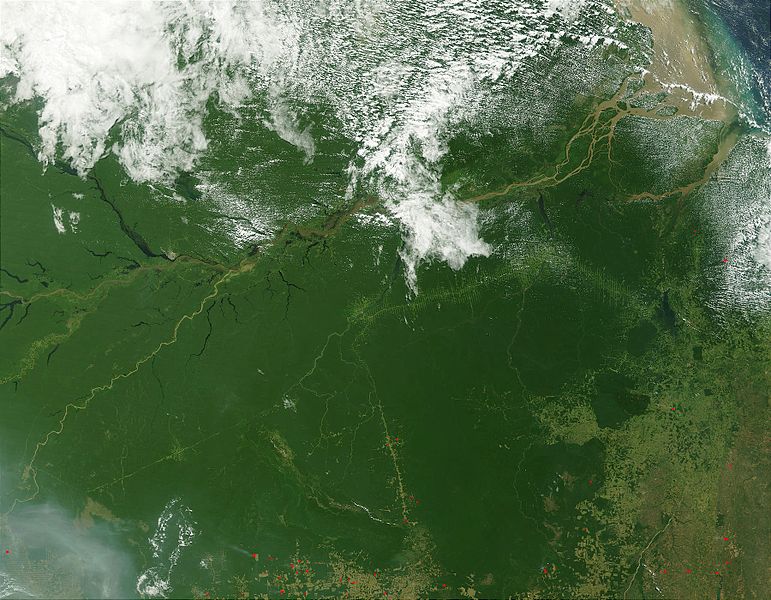
(Boston) — A new NASA-funded study has concluded that Amazon rain forests were remarkably unaffected in the face of once-in-a-century drought in 2005, neither dying nor thriving, contrary to a previously published report and claims by the Intergovernmental Panel on Climate Change.
“We found no big differences in the greenness level of these forests between drought and non-drought years, which suggests that these forests may be more tolerant of droughts than we previously thought,” said Arindam Samanta, the study’s lead author from Boston University.
The comprehensive study published in the current issue of the scientific journal Geophysical Research Letters used the latest version of the NASA MODIS satellite data to measure the greenness of these vast pristine forests over the past decade.
A study published in the journal Science in 2007 claimed that these forests actually thrive from drought because of more sunshine under cloud-less skies typical of drought conditions. The new study found that those results were flawed and not reproducible.
“This new study brings some clarity to our muddled understanding of how these forests, with their rich source of biodiversity, would fare in the future in the face of twin pressures from logging and changing climate,” said Boston University Prof. Ranga Myneni, senior author of the new study.
The IPCC is under scrutiny for various data inaccuracies, including its claim – based on a flawed World Wildlife Fund study — that up to 40% of the Amazonian forests could react drastically and be replaced by savannas from even a slight reduction in rainfall.
“Our results certainly do not indicate such extreme sensitivity to reductions in rainfall,” said Sangram Ganguly, an author on the new study, from the Bay Area Environmental Research Institute affiliated with NASA Ames Research Center in California.
“The way that the WWF report calculated this 40% was totally wrong, while [the new] calculations are by far more reliable and correct,” said Dr. Jose Marengo, a Brazilian National Institute for Space Research climate scientist and member of the IPCC.
Founded in 1839, Boston University is an internationally recognized private research university with more than 30,000 students participating in undergraduate, graduate, and professional programs. BU consists of 17 colleges and schools along with a number of multi-disciplinary centers and institutes which are central to the school’s research and teaching mission.
Geophysical Research Letters article citation: Samanta, A., S. Ganguly, H. Hashimoto, S. Devadiga, E. Vermote, Y. Knyazikhin, R. R. Nemani, and R. B. Myneni (2010), Amazon forests did not green‐up during the 2005 drought, Geophys. Res. Lett., 37, L05401, doi:10.1029/2009GL042154.
ABSTRACT: Amazon forests did not green-up during the 2005 drought
Paper available here (PDF)
The sensitivity of Amazon rainforests to dry-season droughts is still poorly understood, with reports of enhanced tree mortality and forest fires on one hand, and excessive forest greening on the other. Here, we report that the previous results of large-scale greening of the Amazon, obtained from an earlier version of satellite-derived vegetation greenness data – Collection 4 (C4) Enhanced Vegetation Index (EVI), are irreproducible, with both this earlier version as well as the improved, current version (C5), owing to inclusion of atmosphere-corrupted data in those results. We find no evidence of large-scale greening of intact Amazon forests during the 2005 drought – approximately 11%–12% of these drought-stricken forests display greening, while, 28%–29% show browning or no-change, and for the rest, the data are not of sufficient quality to characterize any changes. These changes are also not unique – approximately similar changes are observed in non-drought years as well. Changes in surface solar irradiance are contrary to the speculation in the previously published report of enhanced sunlight availability during the 2005 drought. There was no co-relation between drought severity and greenness changes, which is contrary to the idea of drought-induced greening. Thus, we conclude that Amazon forests did not green-up during the 2005 drought.
h/t to Dr. Leif Svalgaard
Sponsored IT training links:
Join pass4sure for absolute JN0-342 exam solution and get guaranteed success using F50-531 dumps and 642-359 study guide.
D MacKenzie (03:57:22) :
@ur momisugly owl
You got some good points there. There are a lot more immediate concerns for humanity than increasing CO2 and a couple of degrees of warming over the next century; general pollution, better land-use practices, etc. Just because someone doesn’t believe in AGW doesn’t mean they don’t care about the planet we live on.
True, but I’m not very sanguine about the probability of living long enough to see a litter-free world. One of my acquaintances on the -x side of the Law axis once told me the reason organized crimesters invest in funeral parlors and sanitation companies:
“People are always gonna do two things — they’re always gonna die and they’re always gonna make a mess.”
“The sensitivity of Amazon rainforests to dry-season droughts is still poorly understood,..”
———–
So true!
I think it’s time to make these words a universal fill-in-the-blank statement of fact:
“THE ________________________ IS STILL POORLY UNDERSTOOD.”
Human vanity and stupidity know no bounds. Pretend you are the human species (the whole sheebang) and look in the mirror for a brief moment. Take a good long look. Need I say more…?
Let’s STOP trying to save the planet. Let’s just do the best we can to live today doing the best we know how. The Amazon, the weather, the wildlife, the icecaps will do just fine if we don’t try to FIX them.
The next person to stand up on a soapbox in Hyde Park or Central Park or downtown at the local courthouse, needs to be totally ignored by everyone, especially the idiot media.
The only thing mankind needs to save is MANKIND –from itself.
owl (04:41:58) :
You list several “extinct species in 2009” – but when did they go extinct?
I realise that Wikipedia isn’t definitive, but its entry on one of your examples says:
“it can be concluded that the Mauritius Blue Pigeon became extinct in the 1830s.”
And a quick look at Wiki’s ‘extinct birds’ page suggests that extinctions in the late 20th century do not seem to be more frequent than at earlier times.
Blaming everything on CO2 is (as others have pointed out) a dangerous distraction from the real environmental problems that we face.
Is anyone keeping tabs with an IPCC summary checksheet summarizing all the claims and when they are refuted and a link to the study(ies),as well as the claims that aren’t refuted yet? I think this could be a nice reference for people.
owl (04:41:58),
I have a feeling you wouldn’t know a Kusaie Island Starling or a Ratas Island lizard if they bit you on the butt. And how do you prove a negative? “Extinct” species are routinely rediscovered.
Species go extinct All. The. Time. It’s nature’s way. But connecting that with CO2 or a fraction of a degree warming over a century is crazy talk, and you’ll get called on it here.
I suggest you go back to the realclimate or tamino or climateprogress echo chambers, where they’ll treat you like the prodigal son for nutty assumptions like that.
@owl (04:41:58) :
C’mon, Owl.
You were talking about 150 Species extinctions DAILY.
Most of your list of species becoming extinct in 2009 have (allegedly) been extinct for many years and climate change wasn’t the cause of any of them.
And your links are just the usual discredited alarmist crap.
Interesting to see that the PBS Nova site is funded by Exxon Mobile, Pacific Life & Merrill Lynch.
But I thought it was supposed to be us nasty ‘deniers’ who were the very well financed shills for Big Oil?
You’ll have to do very much better than that, my friend.
Owl, for your data of extinctions to make scientific sense, please statistically compare the 2009 extinction rate to the extinction rate prior to humans being on the planet.
From Bishop Hill,
http://www.inters.org/disf/sites/default/files/Onestà_nella_Scienza.pdf
Here are a few relevant NASA studies which find the Amazon goes green during the dry season!!!
http://earthobservatory.nasa.gov/Newsroom/view.php?id=29754
http://earthobservatory.nasa.gov/Features/AmazonEVI/
And another study here:
http://www.pnas.org/content/104/12/4820.full
owl
The Mauritius Blue Pigeon went extinct in 1790 and the Great Elephant bird in the 17th century–I didn’t look up the others–maybe you or someone else will.
@owl (04:41:58) :
I believe the 1 degree warming relates only to the urban environment.
Yet another IPCC error that worked in their favor. Still waiting to hear of an error in an IPCC report that underestimates the negative effects of global warming…
owl, here is a hint for your own assessment. This science oriented website works very hard to present interesting topics presented in posts geared towards a broad range of readers, including those without science backgrounds. The average range of intelligences can grasp most of what is said here and can make reasoned critiques about the veracity of said articles. If we can do it here, we are certainly capable of applying that same degree of critique to places like Wiki. To wit: Finding a list of the names of birds that “are” extinct during a certain time period would, to most of us here, simply mean these birds are extinct and remain so, not that they “went” extinct, during the period given.
OT but well worth reading the following brilliant speech from Vaclav Klaus:-
http://www.klaus.cz/clanky/2529
Owl,
Both of these issues have already been discussed and debunked:
Statistician debunks Gore’s climate linkage to the collapse of the Mayan civilisation
http://wattsupwiththat.com/2008/11/29/statistician-debunks-gores-climate-linkage-of-the-collapse-of-the-mayan-civilisation/
Land based bird and mammal extinctions: Where Are The Corpses?
http://wattsupwiththat.com/2010/01/04/where-are-the-corpses/
“owl (04:41:58) :
CO2 is a concern and has caused many of the problems I talked about. We are […]
List of extinct species in 2009”
owl, i share your concern for threatened species.
To help them survive, we need resources. Right about now the environmental movement concentrates on the polar bear (far from threatened) as a symbol for climate change. The polar bear is at the top of the WWF list of threatened species. This is silly. The polar bears are fine. They are thriving.
CO2 didn’t kill any pigeon and will IMHO not seriously threaten the polar bear. The environmental movement is misguided. All the resources wasted with, for instance, carbon sequestration projects or the giant amount of subsidies used for wind turbine and PV projects – imagine what you could do with that money to, for instance, improve conservation of the unique Madagascar flora and fauna. That would help a much more pressing need than trying to fight the fictitious nightmare scenarios by Hansen and Ehrlich.
The way the money is spent ATM i must say: It’s no use, it’s no use.
jeez (02:54:19) :
“Hey owl. Can you name 5 of the those species that went extinct in 2009?”
I was hoping for a list of the 150 that went extinct yesterday. Ah, well. (sigh…)
Do they know when it rains in the amazon basin, Do they know why does it rain on the amazon basin and not on the sahara desert?, they don´t care about it! and to argue if they are right or not it is a naive excercise because they do not know anything about it, and they do not want to know anything about it just because their objectives are ideological, political, and the climate issue it has been and it is just the convenient “script” of an imaginary scary “movie”.
The real question now is what are they doing now to achieve the same ideological/ political goals they were supposed to achieve with the climate tale.
Then, and OFF TOPIC, rains are OK on the amazon basin, as true as the earth rotates from west to east at the current velocity and as long as there is a high mountain bariier called the Andes at the west. And it rains on the andes from november to march every year, filling up the amazonian rivers. Begin to worry about the amazon basin when LOD lengthens or the andes sank in the pacific, but not to worry either because in such a case the Sahara would be the amazon basin replacement, so it has been and it will be.
A forest fire isn’t necessarily a catastrophe, the indigenous people of the Amazon used various slash-and-burn and slash-and-char agriculture which supported massive populations in pre-de Orellana times. Terra preta do indios, or black Earth of the Indian’s is fantastically fertile compared to surrounding soils. We probably will not hear much of it other than a few spotty articles like “Special Report: Inspired by Ancient Amazonians, a Plan to Convert Trash into Environmental Treasure” because it has some potential to actually solve many problems, real or imagined, caused by CO2 accumulation without eliminated man and civilization as we know it.
@ur momisugly Bill Tuttle: LOL, agreed!
New Zealand Owlet: “Despite a small number of reports of small owls being found in the 19th century that may have been New Zealand Owlet-nightjars, the species is thought to have become extinct around 1200 AD.”
http://en.wikipedia.org/wiki/New_Zealand_Owlet-nightjar
Hardly 2009, but then we all know how relaible wikipedia is… 😉
owl (04:41:58) :
CO2 is a concern and has caused many of the problems I talked about. We are not like a gnat when they finish a banana they can find another to eat. WE are using all the natural resources on this planet to extremes. Bottom line I doubt if we will survive to the end of the century. If every spider on this planet died tomorrow we would all be dead in 8 days.
List of extinct species in 2009
New Zealand Owlet-nightjar
Great Elephantbird
Mauritius Blue Pigeon
Rodrigues Pigeon
Matinique Amazon
Guadeloupe Amazon
Kusaie Island Starling
Ratas Island lizard
Santo Stefano lizard
Oi! What about the Norwegian Blue Parrot then, or is that just restin?
@owl ‘CO2 is a concern and has caused many of the problems I talked about.’
And apparently your proof is that everyone has to take your word for it.
Geez, you fail to prove it by yourself, or by reference, or by simple logic.
It’s never been co2 that’s been the problem, it’s the particles that’ve always been the problem, but of course the particles of all sizes tend to block out sun light and make the world a tad bit colder so they don’t count any more and hasn’t for about twenty years and counting. It’s the particles that screw with peoples respiratory system, with smell, with animals respiratory system, with water pollution, with plant life and acidity even. CO2 is frakking bone, that’s why it’s so heavily used as an additive in green houses.
But sure fear you the melting ice, I mean it’s only been melting for some 10 to 12 thousand years, and will, unless the recent, what, 10 year cold spell keeps on going, for another few thousand years. I mean run for the hills dude and never mind from where some two to three billion people get their fresh water from.
Ref – owl (04:41:58) :
“CO2 is……….”
____________________________
What the heck, evertbody else is talking to the PuddyCat’s friend..
Owl:
I ask that you think about this l……o…..n…..g and h…..a…..r…..d and get in a couple days and tell us what you think the answer is —
When you boil all the AGW stuff down to it’s lowest common denominator, what one surefire method will answer all the issues (some say ‘problems’) that humans have generated?
PS: There is ONLY one correct answer.
From http://www.birdlife.org/datazone/species/index.html?action=SpcHTMDetails.asp&sid=30083&m=0
” Martinique Amazon Amazona martinicana
Amazona martinicana was described from Martinique (to France) by Labat in 1742, and by Buffon in 1779, and named by Clark [1905] based on these descriptions. Labat wrote that “the parrot is too common a bird for me to stop to give a description of it”, and so the species must have declined very rapidly to extinction in the latter half of the 18th century.
…
Threats: Hunting is likely to have caused its extinction. ”
Not 2009, not CO2.
paul jackson (06:48:42) :
“A forest fire isn’t necessarily a catastrophe,…. or black Earth of the Indian’s is fantastically fertile compared to surrounding soils.”
I have used commercial fertilizer on my kitchen garden and then switched to wood ash from my wood stove. The difference was fantastic. Wood ash plus animal manure makes a great fertilizer but commercial fertilizer makes Monsanto (owned by the financiers) wealthy.