The Warning in the Stars
By David Archibald
If climate is not a random walk, then we can predict climate if we understand what drives it. The energy that stops the Earth from looking like Pluto comes from the Sun, and the level and type of that energy does change. So the Sun is a good place to start if we want to be able to predict climate. To put that into context, let’s look at what the Sun has done recently. This is a figure from “Century to millenial-scale temperature variations for the last two thousand years indicated from glacial geologic records of Southern Alaska” G.C.Wiles, D.J.Barclay, P.E.Calkin and T.V.Lowell 2007:
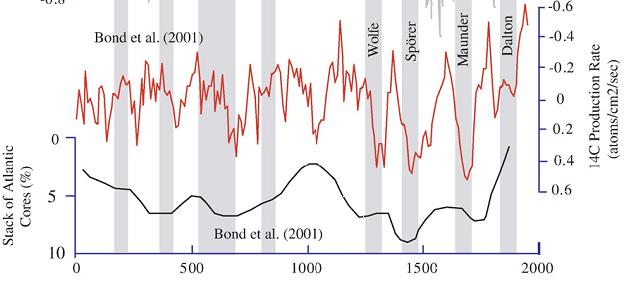

The red line is the C14 production rate, inverted. C14 production is inversely related to solar activity, so we see more C14 production during solar minima. The black line is the percentage of ice-rafted debris in seabed cores of the North Atlantic, also plotted inversely. The higher the black line, the warmer the North Atlantic was. The grey vertical stripes are solar minima.
As the authors say, “Previous analyses of the glacial record showed a 200- year rhythm to glacial activity in Alaska and its possible link to the de Vries 208-year solar (Wiles et al., 2004). Similarly, high-resolution analyses of lake sediments in southwestern Alaska suggests that century-scale shifts in Holocene climate were modulated by solar activity (Hu et al., 2003). It seems that the only period in the last two thousand years that missed a de Vries cycle cooling was the Medieval Warm Period.”
The same periodicity over the last 1,000 years is also evident in this graphic of the advance/retreat of the Great Aletsch Glacier in Switzerland:

The solar control over climate is also shown in this graphic of Be10 in the Dye 3 ice core from central Greenland:

The modern retreat of the world’s glaciers, which started in 1860, correlates with a decrease in Be10, indicating a more active Sun that is pushing galactic cosmic rays out from the inner planets of the solar system.
The above graphs show a correlation between solar activity and climate in the broad, but we can achieve much finer detail, as shown in this graphic from a 1996 paper by Butler and Johnson (below enlarged here)::
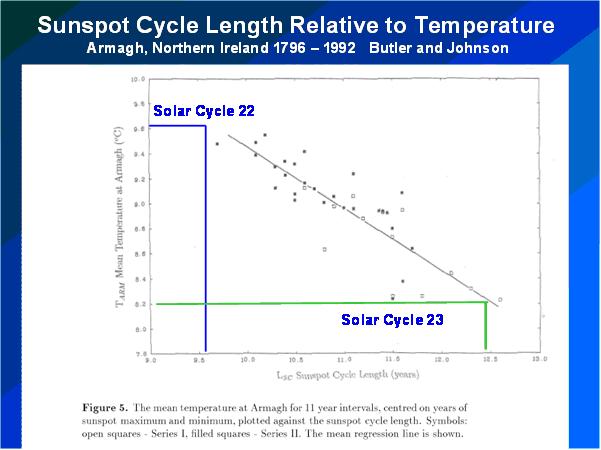

Butler and Johnson applied Friis-Christensen and Lassen theory to one temperature record – the three hundred years of data from Armagh in Northern Ireland. There isn’t much scatter around their line of best fit, so it can be used as a fairly accurate predictive tool. The Solar Cycle 22/23 transition happened in the year of that paper’s publication, so I have added the lengths of Solar Cycles 22 and 23 to the figure to update it. The result is a prediction that the average annual temperature at Armagh over Solar Cycle 24 will be 1.4C cooler than over Solar Cycle 23. This is twice the assumed temperature rise of the 20th Century of 0.7 C, but in the opposite direction.
To sum up, let’s paraphrase Dante: The darkest recesses of Hell are reserved for those who deny the solar control of climate.
This essay is also available in PDF form: TheWarningintheStars
Discover more from Watts Up With That?
Subscribe to get the latest posts sent to your email.
Leif Svalgaard,
I tend to believe my own eyes, not other people’s words. There were no significant orbital changes during the last 25 years, as there were no significant changes in Earth’s axial inclination.
In the 1990s, the Sun was exceptionally active. In the second half of 1990s, Earth temperatures rose (any additional bias introduced by AGW promoters notwithstanding).
During the last few years, the Sun has been very quiet, and now Earth temperatures are falling.
I don’t know, how exactly to explain this. Maybe Dr. Svensmark is right. Maybe there are other factors and feed-backs at play.
One thing is certain: using one simple formula to stipulate a complete lack of relationship between changes in solar activity and terrestrial climate is… How to say it in a way that wouldn’t offend your sensitive ego? Blear-eyed?
Just The Facts (20:22:55) :
The big picture view is that solar is more than 90% of changes in Earth’s climate, and the longer the period you use, the greater the solar portion. I don’t believe that climate is a random walk.
John Whitman (20:30:13) :
Yes indeed, there will be an increase in interest in matters solar. The AGW-focussed climate researchers realise that the funding will dry up soon. Expect some re-incarnations.
aMINO aCIDS iN mETEORITES (20:36:48) :
I am not alone in predicting a crash in solar activity. Here’s Dr Svalgaard from a New Scientist article 16th September, 2006: “Sunspot numbers will be extremely small, and when the Sun crashes, it crashes hard.” Where Dr Svalgaard and I part company is that he thinks that the Sun can go to activity extremes without any effect on the Earth’s climate.
Re: David Archibald (Mar 1 02:19),
I don’t believe that climate is a random walk.
Deterministic chaos is not a random walk. There are underlying deterministic non linear differential equations which nature solves by analogue . Correlations are not causations particularly in a chaotic system. Insolation depends on the sun, and possibly the accompanying changes in magnetic fields, but depends also on a multitude of other inputs that have to be studied with chaos mathematical tools, not ruler and compass. For example the work of Tsonis et al, discussed a while a go here, goes in this direction where with a neural net analogue of a chaotic system and inputs of the oceanic and atmospheric currents, they predicted the flattening in temperatures before it appeared. This has to be extended to include more inputs, but that is the way to go, imo.
Paul Vaughan (16:31:52) : Corbyn´s SLAM coincides perfectly with:
ftp://ftp.fao.org/docrep/fao/005/y2787e/y2787e08.pdf, related to LOD and ACI
Carla (17:00:36) :
Hi Carla
Thanks for the info. Saved both papers.
Cheers.
David Archibald (02:19:03) :
The big picture view is that solar is more than 90% of changes in Earth’s climate, and the longer the period you use, the greater the solar portion.
You mean that it will go up from 90% to maybe 94% or 95.21%?
I don’t believe that climate is a random walk.
Nobody believes that, so your statement is sort of void, like saying “I don’t have fourteen legs”.
“wakeupmaggy (20:58:00) : ”
A very creative description of our of very real and present reality. Thanks for posting that, I liked it a lot.
Have you seen Monty Python’s The Meaning of Life?
phlogiston (15:58:38)
I don’t think we have enough past data to assess my ideas so I’ve been waiting to see how well or not ongoing climate events fit the proposed scenario and it’s going pretty well so far.
I’d love to have an incentive to put together a shopping list of the data I’d need and to supervise a professional team in collating and interpreting it. I have made suggestions as to what would be necessary elsewhere.
The basic idea is set out here:
http://climaterealists.com/index.php?id=4433
but one can see how it developed over time and how it fits into the wider climate scenario by browsing others of my articles at the same site.
My presence here and elsewhere is part of an ongoing process of refining it and seeking out whether there is a simple rebuttal that has been missed.
Interestingly it seems to provide a skeleton mechanism on which one can hang the findings of quite a few others.
JonesII (05:10:15) “SLAM […] LOD […] ACI”
Yes, ACI was the first thing of which I thought. Corbyn uses a curve that is shifted about 7 years left, which corresponds more with AMO. A curve shifted about 7 years right corresponds more with PDO. This is a simple matter of integrals & derivatives (1/4 cycle lag or lead). Be careful when considering Corbyn’s decadal-timescale forecasts – his view is Atlantic-centric.
Here are the full references:
Klyashtorin, L.B.; & Lyubushin, A.A. (2007). Cyclic Climate Changes and Fish Productivity. Government of The Russian Federation, State Committee For Fisheries of The Russian Federation, Federal State Unitary Enterprise (FSUE), Russian Federal Research Institute of Fisheries and Oceanography (VNIRO). Moscow, VNIRO Publishing.
http://alexeylyubushin.narod.ru/Climate_Changes_and_Fish_Productivity.pdf
Klyashtorin, L.B. (2001). Climate change and long term fluctuations of commercial catches: the possibility of forecasting. FAO Fisheries Technical Paper No. 410, 98p., FAO (Food Agriculture Organization) of the United Nations, Rome.
html – main index:
http://www.fao.org/docrep/005/Y2787E/Y2787E00.HTM
pdf – directory of chapter-pdf-files:
ftp://ftp.fao.org/docrep/fao/005/y2787e/
Of particular interest:
Chapter 2. Dynamics of Climatic and Geophysical Indices
html:
http://www.fao.org/docrep/005/Y2787E/Y2787E03.HTM
pdf:
ftp://ftp.fao.org/docrep/fao/005/y2787e/y2787e01.pdf
3 major climate indices:
1) dT (global temperature anomaly)
2) Atmospheric Circulation Index (ACI)
3) LOD
Re: phlogiston (16:12:16)
They’ve overlooked higher derivatives:
http://www.sfu.ca/~plv/fh.png
Stephen Wilde (08:34:17) :
My presence here and elsewhere is part of an ongoing process of refining it and seeking out whether there is a simple rebuttal that has been missed.
Consider at least the possibility that after a certain point people don’t bother to rebut.
Alexander – “I don’t know, how exactly to explain this. Maybe Dr. Svensmark is right. Maybe there are other factors and feed-backs at play.”
The way I take Dr. Lief’s criticism of solar control of our climate, is exactly what you stated, “I don’t know”. There has not, as yet, been a proven causation of the sun being the “driver” of climate. So we can argue all day long about how many angels dance on a pin head, but this does not move the science forward. If a paper arrives that links some factor of the sun’s energy to the earth’s climate variability, then I think that the solar scientists, not only Dr. Lief, will be happy to tear into it.
Pamela Gray (17:54:16) “Given the extent of the noise in the temperature data, good luck finding a […] signal in the tiny span of years that make up our chaotic sensor data set.”
Noise isn’t always a problem and the data aren’t “uniformly bad” across all times & timescales. There’s the UHI (for land Ts) &/or/vs. CO2 &/or/vs. natural cycles controversy, but aside from that, signals can be isolated if the silly convention of working with “anomalies” (a goofy way to distort/complicate/obfuscate) is dropped and multi-timescale methods are applied.
In a nutshell:
Pattern is a function of spatiotemporal caliper setting – i.e. what we measure is a function of spatiotemporal sampling frequency and since we don’t have continuous sampling, we need to use DSP (digital signal processing):
DSP = Digital Signal Processing
http://www.dspguide.com/
http://www.dspguide.com/pdfbook.htm
(free online book – written with minimal math-formality so as to be accessible to a wider audience)
Can climate scientists learn to think more as digital audio & video experts (& an increasing number of landscape ecologists & physical geographers) do?
Perhaps a more pertinent question is:
Are they willing to do anything other than sit comfortably & complacently, dreaming of ever more elaborate computer fantasies?
Are they willing to do anything other than sit comfortably & complacently, dreaming of ever more elaborate computer fantasies?
A WII version would be funny ☺
Leif Svalgaard (12:31:25) :
DeNihilist (11:23:19) :
Less dark matter, more rays directly hitting the earth.
Jeez, that is so simple to understand!
just as easy as to understand that a candle does not give light, but rather sucks up the dark. Just look at the wick.
**********************************************************************
That was a joke, right?
Please confirm, because some of your other comments certainly come across as jokes, particularly the explanation of seasonal temperature differences between northern and southern hemispheres.
That explanation (perhaps better described as a statement of the bleeding obvious) certainly did not debunk the suggestion that solar output effects temperature on this planet.
I am just wondering if you sincerely believe that variation in the sun’s output has anything but the most significant impact on the planet’s temperature.
Why do I feel a huge difference in temperature as soon as cloud passes between me and the sun?
And a remarkably patronising answer will probably not help.
Leif Svalgaard (11:05:04)
I constantly consider that possibility but am inclined to dismiss it until there is a sound rebuttal in the first place.
I’m surprised that you raised that point since I have accepted and incorporated your solar work in preference to that of David.
However, above I indicated why I had reservations about certain aspects of the work of both of you and those reservations have been picked up by other contributors to this thread.
By the way, do you ever follow your own advice ?
Tony B (number 2) (13:35:28) :
“but rather sucks up the dark. Just look at the wick.”
That was a joke, right?
You be the judge. Read up on it: http://www.jtkdev.com/light.html
That explanation (perhaps better described as a statement of the bleeding obvious)
If it was so bleeding obvious, then perhaps the question was a joke…
I am just wondering if you sincerely believe that variation in the sun’s output has anything but the most significant impact on the planet’s temperature.
The statement makes little sense, either it is a joke or you meant ‘insignificant’
Why do I feel a huge difference in temperature as soon as cloud passes between me and the sun?
The amount of sunlight falling on you depends on the transmission of the atmosphere above you at the moment of ‘feeling’. This paper has more on that http://www.arm.gov/publications/proceedings/conf09/extended_abs/takara_ee.pdf
As I understand it the cloud absorbs about half of the light [Figure 2b]. So the temperature should drop by a factor of 2^0.25 = 1.19, but since you also receive radiation from other things, like the ground or structures near you, even the air, the temperature will be lees, perhaps only a third [although more research is needed on the exact number], or about 20C. Even this seems a bit high. Perhaps you should measure it and then we can go from there. Be sure to note what kind of cloud it is: some are thin, and some look almost black.
And a remarkably patronising answer will probably not help.
I hope my detailed answer was helpful.
Stephen Wilde (15:06:36) :
I constantly consider that possibility but am inclined to dismiss it until there is a sound rebuttal in the first place.
“sound rebuttal” is very much in the eye of the beholder. The right way to do this [if you think you have something] is to submit your theory to an appropriate scientific journal and see what response you get.
I’m surprised that you raised that point since I have accepted and incorporated your solar work in preference to that of David.
I presume you have done this on basis of merit.
By the way, do you ever follow your own advice ?
I usually defer to other scientists to judge my work and reject as appropriate. My very first paper was indeed rejected.
Re: Tony B (number 2) (Mar 1 13:35),
We have to isolate the influence of the sun as a constant energy input to the planet, call it W, and the small changes in it dW/dt. Nobody refuses that W is responsible for everything on the planet, including climate. The question is whether the small dW/dt observed over historical times with the changing solar cycle has a direct effect on the climate.
Leif excludes direct effects because of the small magnitude of the change and is skeptical of other solutions offered before they prove themselves.
The cloud you quote is a secondary effect, and yes, cloud cover changes albedo and a change in albedo of 3% changes temperatures by 2 degrees in simple models of energy in and out as can be tested in http://www.junkscience.com/Greenhouse/Earth_temp.html . So a mechanism exists here and now, and the connection to the sun is searched by various proposals that would help amplify the sun cycle changes into cloud cover changes and thus climate changes.
I tend to favor the chaotic models, i.e. many inputs contributing to the observed cycles in climate, not direct one to one correspondence.
Take a pot with water over a constant range source, say 2kw. The water boils at 100C. If you put a cover, the currents in the pot and the atmoshere above it behave differently. If it is a pressure cooker, temperatures go much higher. The change of the material and the distribution of the material changes the microcosm in the pot even though the source is constant.
Leif Svalgaard (16:09:32) :
“…………you also receive radiation from other things, like the ground or structures near you, even the air, the temperature will be lees, perhaps only a third [although more research is needed on the exact number], or about 20C.”
Clouds have a bit of split personality, day times reduce temperature, nighttimes protect from significant temperature drop (case of Sahara or other cloudless desert is good demonstration point from +45 C down to 0 C degrees).
However total solar eclipse is possibly more appropriate (have personally experienced two) since it cuts-out direct sunlight.
Here what NASA’s expert has to say:
“My guess would be that it would be equal to the typical daytime minus nighttime temperature difference at that time of the year and location on the Earth. It would be modified a bit by the fact that it only lasts a few minutes, which means the environment would not have had much time to thermally respond to its lowest temperature, so it would probably only be 3/4 or 1/2 the maximum day-night temperature difference. Because the patch of the shadow travels faster than the speed of sound, weather systems will only be affected very locally directly under the instantaneous foot print of the eclipse. The main effect is in the ‘radiant heating’ component which goes away suddenly at the moment of eclipse and produces a very fast temperature decrease. If the wind is blowing, your body probably exaggerates by evaporative cooling, just how large the actual temperature swing actually is. “
Leif Svalgaard (16:09:32)
It’s not yet complete enough or well enough verified to submit to a journal and I’d need experienced help to present it properly anyway.
It will be verified or not by the passage of time and if verified in that way it will be so obvious that a paper would be unnecessary.
Pamela Gray (17:04:30)
“By the way, 5 years ago I had some of my lip removed.”
I had half of the skin on the right side of my nose removed in 2006 for the same reason. I was lucky – pathology showed it was in mid-transition from nevus to malignant melanoma. Payback from too much sunburn in my teenage years. I still have to go in for checks every few months.
Stephen Wilde (01:42:24) :
I’d need experienced help to present it properly anyway
I would be glad to help in that regard. It is not hard to observe the proper format. The hard part is to express the ideas concisely.
Dr. Richard Gross of NASA’s Jet Propulsion Laboratory said all earthquakes have some effect on Earth’s rotation. According to a report Gross is quoted to say that the Chile earthquake may have shorten Earth’s rotation by 1.26 microsec due to a shift of the Earth mass for about 8 cm.
Leif Svalgaard (03:55:29)
Thank you Leif, that’s a very kind offer and I may take you up on it when I’ve filled in more detail and compared the predictive ability of my ideas with more ongoing climate events. It might need to await my retirement when more time will be available.
As you say, expressing the ideas concisely is the hard part and I’m only about half way there in view of the difficulties of explaining the various real world climate events that do not initially appear to fit the pattern that the underlying principles would predict.
The Oort Minimum during the MWP is one such but given that solar and ocean cycles seem to vary independently I don’t see it as insuperable especially if as I suspect the rate of energy loss to space is reduced when the solar surface is less active. Thus the Oort minimum would simply have partly offset the attempts of the more active sun either side of it to offset the warming effect of a longer term positive oceanic phase. That won’t make sense unless one has read my work elsewhere but this is not the place to reprise it all.
You haven’t actually commented on that issue of changing rates of energy loss to space other than to assert that the changes in the upper atmosphere do not transmit downward. I agree with that assertion but do not require transmission downward, merely the facilitating of a faster or slower upward flow of energy.
Leif,
It seems that the Oort Minimum isn’t much of a problem after all. It lasted some 40 years from 1010 to 1050 in the midst of a generally active spell for the sun during the MWP which ran from 800 to 1300 and the Oort Minimum was the shortest and least deep solar minimum in the past 1000 years.
So, it doesn’t invalidate my general assertion that, on average, periods of high solar activity generally coincide with periods of warm climate (mainly ocean driven) at least over much of the current interglacial.
One has to get back to the last glaciation to find a period when solar and oceanic cycles were not coinciding on average.
Thus during glaciations the oceanic and solar cycles supplement one another in cooling or warming the troposphere resulting in large swings in climate (Bond Events) whereas during interglacials they generally offset one another resulting in a relatively stable and equable climate as now.
They offset one another because warmer ocean cycles heat the troposphere whilst the more active sun facilitates loss of surplus energy to space and cooler ocean cycles cool the troposphere but the less active sun reduces the cooling potential by reducing the rate of energy loss to space.
The opposite occurs when they supplement one another resulting in large climate swings with heavy northern hemisphere snows that do not all melt in the summers.
This past winter is a small short term example of what happens when a warmer ocean surface coincides with a less active sun as I have explained in much more detail elsewhere. Both work towards a warming of the troposphere but emphasise the Arctic and Antarctic Oscillations causing cold air to invade mid latitudes despite the overall net warming of the troposphere.
If the sun had been active more of the energy from the El Nino would have been vented to space and the AO would have been less negative.
If there had been a La Nina there would have been less energy from the oceans to pump into the upper troposphere and the AO would have been less negative.
If the sun had been active with a La Nina there would have been a less negative AO allowing energy out to space faster and the lack of energy entering the troposphere from the oceans would have allowed a profound cooling.