From Spaceweather.com with apologies to Linus and Charles Schulz

The Solar and Heliospheric Observatory (SOHO) is tracking an enormous magnetic filament on the sun. It stretches more than one million kilometers from end to end, which makes it an easy target for backyard solar telescopes. For the seventh day in a row, an enormous magnetic filament is hanging suspended above the surface of the sun’s southern hemisphere. The Solar and Heliospheric Observatory (SOHO) has a great view. How long can it last? Solar filaments are unpredictable. If this one collapses and hits the stellar surface, the impact could produce a powerful Hyder flare.
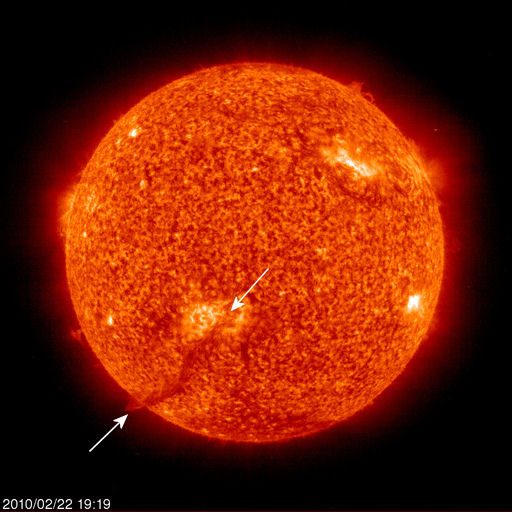


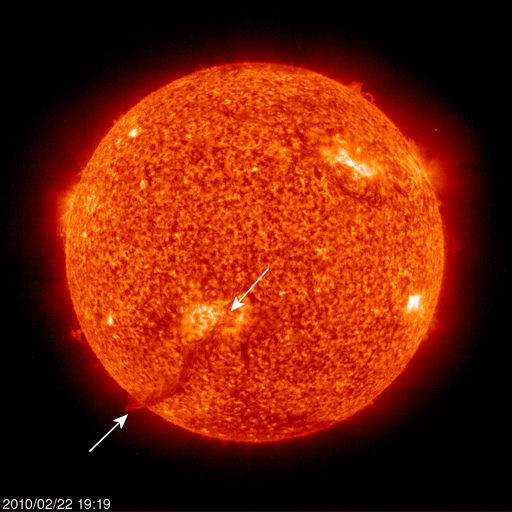
The most recent SOHO image is here
Hyder Flares: from Australian IPS 1. What is a Hyder flare?
Flares are intense brightenings that occur in the solar chromosphere. Flares are generally observed from Earth using narrow band filters, typically with a bandwidth of less than 0.1 nm, and often centred on the Hydrogen-Alpha wavelength of 656.3 nm. (Flares also have counterparts, that is, sudden outbursts, in the radio and X-ray spectrum).
Most flares occur around active regions associated with sunspot groups. However, occasionally a flare (sudden brightening) is observed well away from an active region or sunspot group. These flares are invariably associated with the sudden disappearance of a large (thick, long, ‘bushy’) dark solar filament, and are termed Hyder flares.
2. Why are Hyder flares so named?
Max Waldmeier wrote a paper in 1938 which described the phenomenon of suddenly disappearing filaments (disparition brusque), and mentioned that these can be associated with flare-like brightenings, but it was left to Charles Hyder to postulate the first comprehensive mechanism for the such flares.
Following on work from his doctoral thesis with the University of Colorado in Boulder (1964), Hyder published two papers in the second volume of the journal Solar Physics (1967) in which the mechanism by which Hyder flares might occur was discussed in detail. Hyder was then on the staff of the (US) Air Force Cambridge Research Laboratories at the Sacramento Peak Observatory in New Mexico.
It was these papers in Solar Physics by which Hyder’s name became associated with the flares in question, even though he was by no means the first to observe them.
3. What are the characteristics of Hyder flares?
As previously mentioned, the name Hyder flare is given to a flare that occurs away from an active region or sunspot group and that is associated with the sudden disappearance of a dark filament. The appearance of these flares can range from a string of bright knots on one or both sides of the filament (or rather, the position previously occupied by the filament, sometimes called the filament channel), to a single or double ribbon flare. The ribbons are parallel to the filament channel. If only one ribbon is present, it will lie to one side of the channel, whereas if two parallel ribbons occur, one ribbon will lie on one side of the filament channel, and the other ribbon will lie on the opposite side.
One interesting characteristic of Hyder flares is that they usually develop or rise to maximum brightness much more slowly than do the more common flares associated with active regions. The larger Hyder flares may take 30 to 60 minutes to rise to a peak intensity, and then they may last for several hours. Although they may attain a large area, they usually have a relatively low intensity. Thus, classifications for a large Hyder flare may read 2F, 2N or possibly even 3F. This contrasts to an active region flare in which 3F is very rare. An active region flare that attains sufficient area to put it into the importance class 3, will invariably have either a Normal or more usually a Brilliant brightness classification.
X-ray flares and radio (microwave) bursts associated with the optical Hyder flare, are also generally long lived phenomenon and are classified as the gradual rise and fall type of event (in contrast to the impulsive and complex events associated with large active region flares).
Generally Hyder flares are not associated with energetic particle emission or geomagnetic storms (implying that they may not be associated with a coronal mass ejection). However, this is not always the case, as a large halo CME observed by the LASCO solar coronagraph on board the SOHO spacecraft was most definitely associated with a Hyder flare (2N/M1) observed on 12 September 2000. This same complex also appeared to have produced energetic protons at geosynchronous orbit with energies in excess of 100 MeV, and in substantial numbers at energies of 10 MeV. It is believed that the sudden storm commencement observed at 0450UT 15 September, and the subsequent minor geomagnetic storm was produced by this particular CME.
4. What produces Hyder flares?
Hyder’s explanation of the flare type now named after him depended on the observational evidence that (1) often the flare was a parallel ribbon flare with one ribbon each side of the filament channel, and (2) that geomagnetic storms were not associated with these flares. This led to the speculation that the filamentary material was not ejected far into the corona, but in fact fell back to the chromosphere producing the flare.
Stable or quiescent filaments are believed to lie in and along a magnetic trough. It is thought that the sudden disappearance of such a filament is due to a reconfiguration of the field. In essence, the magnetic trough becomes a magnetic ridge (the bottom of the trough elevating in a period of tens of minutes to become the peak of the ridge). In this process, the filamentary material (cooler gas) is thought to be accelerated into the corona. Hyder’s explanation is that, in the case of the Hyder flare, some or even most of the filament material, instead of suffering acceleration and ejection, falls down the sides of the magnetic ridge and interacts with the lower chromospheric material producing the flare. If the infall process is symmetrical, then the double parallel ribbon flare will result, if asymmetrical, then only one ribbon results. If the infall is sporadic, or the material insufficient, then only bright knots of flare are produced. Hyder did calculations to show that the kinetic energy of the infalling material should be sufficient to provide the required flare energy release observed.
Of late, the Hyder mechanism has come into question. Some people (notably Zirin) have questioned whether infall occurs, stating that the magnetic reconfiguration must always produce ejection. The respective roles of flares and CME’s in solar active processes has also been hotly debated, and this has implications for the exact mechanism of Hyder flares. We certainly have enough observational evidence to show that Hyder flares can be associated with both CME’s and energetic particle production. For the moment, the question of Hyder flare production mechanism appears unresolved, and will probably be sidelined until the more significant (and undoubtedly related) issue of CME – flare production mechanism is sorted out.
The bottom line is that at this stage in solar physics we do not really know what produces a flare nor what produces a CME. There are competing theories, but all tend to have deficiencies with respect to matching the observational evidence. We certainly believe that they all depend on the reconfiguration of magnetic fields as their primary energy source, but in the final analysis, we really only believe this because we can conceive of no other solar energy source of sufficient magnitude.

Leif,
Hope you are online.
My lovely wife and I were sitting under a banana tree in the local park in Taipei last night. A beautiful evening and I could even see stars through both the banana leaves and the urban haze/glow. That is rare.
Anyway, I was thinking about distance from earth surface versus value of information on “global” temperatures of earth.
A) I imagined a case where there are (somehow) 3 (or more) spacecraft about 1au (just picked that number to imply distant) from earth. Say these spacecraft are optimally arranged so they continuously measure all spectrum of electromagnetism from the entire earth’s surface simultaneously and continuously over more than 50 years (just to pick a number).
B) Alternately, imagine multiple satellites in orbit (implies relative nearness) doing the same thing.
C) Thirdly, imagine well scientifically designed integrated system of temperature instruments that really does ‘scientifically’ measure all land, sea, ice and atmospheric temps. In other words an optimized temp measurement system, the one you want if money and effort was no object. Say this system has been in place for a period of say 50 yrs or more.
Assume that all of the data from each above is open-sourced to everyone and likewise codes for all analysis of data and openness of method.
Question: Which one has a better capability in theory to measure the global heat content of earth and therefore a meaningful measure of whether the earth is heating or cooling?
John
Jim Steele (16:33:15) :
However I can see that you have lumped me in with others with whom you disagree.
Jim, I sincerely apologize for lumping you in with the others. That was an unwarranted knee-jerk reaction of mine, for which I’m sorry and for which I hereby apologize.
Has Alfven fallen from his Nobel heights, and is now deemed to also be a “nut” by modern physicists?
No, Hannes Alfven was a god and dear friend of mine and although many of his ideas are no longer supported, his contributions were many and varied and often important. Some of them have been hijacked by the fringe which would make him cringe.
And mainstream explanations that refer only to magnetism always seem like only half of an explanation.
The reason is simple: An electric field depends on the reference frame of the observer while the magnetic field does not. So, the two are not ‘equal’. In a highly conducting plasma, a magnetic field is ‘frozen’ into the plasma and moves with the matter [this was Alfven’s great discovery]. If the conductivity in certain regions of the plasma for various reason drops, the magnetic field is no longer tied to the plasma; this ‘thawing’ of the field under the correct circumstances has important consequences for the interaction of the plasma with bodies embedded in it, as electric fields can briefly occur – Alfven railed against the idea that the field was ‘always’ and permanently ‘frozen’ into the plasma and stressed that the thawing of the magnetic field was at times important – something that people did not always appreciate some 40 years ago. Today we are heeding his words and do things correctly in ways he would certainly approve of.
I simply ask what causes the magnetic fields to change? Changes in plasma flow? Why does the magnetic fields create the filaments where they do?
Since the magnetic field near the surface of the Sun is controlled by the plasma [the magnetic energy is much less than the kinetic energy of the roiling solar plasma] when the plasma moves the magnetic field is dragged along and the magnetic configuration [the field lines show the shape of the field] can change rapidly. And the plasma is in constant motion, mainly because there are large convective motions [like in boiling water]. Imagine a magnetic field line going from one sunspot up into the atmosphere and then curving down into an adjacent spot [this is the typical configuration]. The density in the solar atmosphere decreases rapidly with altitude [just like in the Earth’s atmosphere], so the kinetic energy of the plasma decreases with height much faster than the magnetic energy to the point where eventually the magnetic field becomes the dominant force and guides the plasma flow [you have likely seen images of material flowing along the field lines]. This means that the magnetic field is now containing the plasma and the filament can form in the upper part of the magnetic loops. It also means that on either side of the filament the magnetic field will have opposite polarity [up one leg of the loop and down the other leg], so filaments marks large-scale ‘neutral lines’ between regions of opposite polarity. It is opposite polarities that can reconnect and interact, so filaments are places where explosions can occur, hence the flares.
Such explanations also imply there can not be separation of charges in space plasmas.
This is indeed correct, but with one important caveat: namely that the particles be allowed to stream freely [see below].
But that contradicts my understanding of the Van Allen belts in which it is observed that the outer belt is mostly negative electrons and the inner belt is mostly positive ions. Doesn’t that create an electric field?
The charged particles in the belt are trapped by the strong magnetic field of the Earth and are constrained to spiral along the field lines, bouncing from pole to pole, so are not moving freely and can therefore not neutralize. So you get an electric field from the charge separation, but this field does not control the movement of the particles – the magnetic field does.
The intensity of your reaction
I again apologize for the reaction
makes me wonder if there is a culture within mainstream astro/solar physics that has decided to only speak in terms of magnetism as a gate-keeping mechanism to keep out the fringe proponents of a more electric view.
There are no conspiracies here. It is Mother Nature that uses magnetism as the gatekeeper. All serious physicists are in agreement on this [there are always a few that have fallen off the cliff]. The Electric/Plasma Universe folks seem to be driven by underlying agendas of various kinds – religious, political, new-age, etc or simply by the urge to seek explanations that are easy and visual and does not require mathematics or any deeper knowledge [which is hard work to acquire]. These will of necessity be superficial and not represent real knowledge. This dumbing-down of the populace is dangerous to a society that ultimate must rely on since for survival, as we have exhausted the easy picking of the low-hanging fruit. A god example is the very next comment(s), where real knowledge is called ‘dogma’:
Suranda (16:37:34) :
Dogma is dangerously seductive. And anti-science.
James Evans statement above sounds like the voice of integrity. It should be addressed by you scientific dudes, I think.
Jim Steele (19:25:25) :
Another question about filaments. Is the magnetic polarity always the same, say south at the equator and north towards the poles, or does it vary randomly or does the polarity alternate each cycle along with the alternation of sunspot polarity?
Sunspots follow a set of polarity rules as you state [changing with the cycle, etc]. Filaments [as explained above] lie between regions of opposite magnetic polarities, so follow along with the changes of the spots.
Jim Steele (19:27:57) :
And 1 more, do filaments always align as seen here, assuming also a mirror image in the northern hemisphere. Or do they ever align parallel to the equator?
They can have any orientation, although at low latitudes the often go North-South. There is a special class of filaments called the ‘polar crown’ that encircle the North and South poles, along the boundaries of the polar coronal holes. Magnetic fields from decaying sunspots are swept [remember: the plasma moves the field around] by a meridional circulation [the Earth also has that] from lower latitudes towards the poles and a rather strong magnetic field then tends to build up there. This polar magnetic field eventually becomes the seed of the next sunspot cycle.
NickB. (21:39:27) :
whenever you take a drink of cool refreshing water chances are you’re drinking at least a few molecules of dinosaur pee
And of Jesus pee.
John Whitman (22:00:57) :
Assume that all of the data from each above is open-sourced to everyone and likewise codes for all analysis of data and openness of method.
Question: Which one has a better capability in theory to measure the global heat content of earth and therefore a meaningful measure of whether the earth is heating or cooling?
I think the specific configuration of the sensors doesn’t matter much. There are many ways a good system can be configured [BTW in my previous comment I mistyped good as ‘god’ – so beware of that. In my native language ‘good’ is in fact ‘god’].
One proposal I personally like is a system where satellites [e.g. at the L1 or L2 points] simultaneously ‘stare’ at 1) the Sun 2) the Earth and 3) some stars.
Leif Svalgaard (23:44:39) :
Leif,
It took me a moment, I had to look up Lagrange points L1 & L2.
So, I think you are suggesting that from the L1 & L2 at the same time,
a) measure the energy from the sun going to L1 and on the same satellite measure the energy from the daytime earth coming to L1
b) measure energy at L2 from the nightside of earth and on the same satellite measure the starlight
Correct?
Q1- why measure the starlight?
Q2 – You don’t see any advantage to spacecraft being more distant than L1 & L2? I personally cannot but just curious.
John
John Whitman (00:17:13) :
Correct?
Essentially, yes.
Q1- why measure the starlight?
There are stars that are VERY stable and whose output is VERY constant [over human lifetimes], so yo can check the calibration and produce a record that people hundreds of years hence than verify, since they can measure the SAME star.
Q2 – You don’t see any advantage to spacecraft being more distant than L1 & L2? I personally cannot but just curious.
The problem is to keep the satellite where it is. We want the satellite to stay put as much as possible. That can be done with a minimum of fuel if you place it at L1 and L2.
John
For DirkH:
I suggested that many “climate scientists” were from a physics background, because studying the atmosphere is either physics or chemistry and mostly it was physics.
DirkH said:
Here’s a few, a nice mixed bag. I didn’t have to look far.
Prof Richard Lindzen – Alfred P. Sloan Professor of Meteorology, Department of Earth, Atmospheric and Planetary Sciences
Degree – Physics, Phd – Applied Maths
Prof Richard .M. Goody – Mallinckrodt Professor of Planetary Physics, Emeritus (Lindzen’s supervisor)
Ph.D. in Geophysics
Prof. V. Ramanathan – Distinguished Professor of Climate and Atmospheric Sciences
Degree Engineering, Phd Atmospheric Physics
Dr. James E. Hansen, B.A. Physics and Mathematics, M.S. Astronomy, Ph.D. Physics
Prof V. Ramaswamy, Dept of Atmospheric and Oceanic Sciences
Prof John Christy, B.A. Mathematics, M.S. & Ph.D. in Atmospheric Sciences
Prof David A Randall, B.S. Aeronautical and Astronautical Engineering, Ph.D. Atmospheric Science
Prof Stefan Rahmstorf, B.S. Physics, PhD Oceanography
-I only found 3 that I thought might be from a Physics background but weren’t: 2 chemists – now studying the atmosphere – Solomon and Dessler, and 1 meteorologist which I thought you might not accept even though our host would.
Not sure why you think people studying climates aren’t physicists..
Atmospheric science is mostly physics.
Hope I helped.
And don’t forget to check out New Theory Proves AGW Wrong
Thought this might be interesting. Here is the original 1965 Charles L. Hyder scientific paper: Winking Filaments and Prominence and Coronal Magnetic fields:
http://articles.adsabs.harvard.edu/cgi-bin/nph-iarticle_query?bibcode=1966ZA…..63…78H&db_key=AST&page_ind=0&plate_select=NO&data_type=GIF&type=SCREEN_GIF&classic=YES
And another peer-reviewed, published scientific paper:
Title: The field and plasma configuration of a filament overlying a solar bipolar magnetic region
Authors: Low, B. C.
Journal: Astrophysical Journal, (1981):
http://adsabs.harvard.edu/full/1981ApJ…246..538L
Partial Abstract: “This paper presents an analytic model for a finite-size straight filament suspended horizontally in a steady state over a bipolar magnetic region. The equations of the magnetic equilibrium are integrated exactly. The solution obtained illustrates the roles played by the electric current, magnetic field, pressure, and plasma weight in the balance of force everywhere in space… The filament temperature can take values ranging from a small fraction to a few times the coronal temperature, depending on the internal electric current of the filament.”
Jim Steele, I hope you find these two papers interesting and enlightening. As the reader can tell, the description of the filament in the second paper is the same as in the instant post. The author clearly identifies the filament as being an “electric current”.
Leif Svalgaard (01:06:31) :
Leif,
Thanks for sharing your ideas.
John
John Whitman (05:03:56) :
Leif Svalgaard (01:06:31) :
Leif,
Thanks for sharing your ideas.
~
Thanks from me too, Dr. S.
Maybe you need some knee pads Leif, to help protect your bad self from those “knee jerk,” reactions. (joke) punch bozo
Thanks to Evans and the “bad boys,” who lurk here too!
James F. Evans (01:33:47) :
The author clearly identifies the filament as being an “electric current”.
This is a typical example of the twisting of science to conform to wrong physics. Such twisting occurs can occur when the physics is not understood. Nowhere does the author identify the filament as being an electric current. [one might ask for page and line number for such identification]. What does happen is that when external forces deform a magnetic field and the weight of the filament [caused by gravity] does just that, small electric currents are induced. This happens everywhere where there is a dB/dt [that is: a change of the magnetic field]. The fundamental issue is that electric fields are generated by plasma [a conductor] moving in a magnetic field. The electric currents are precisely the neutralization of this electric field preventing the electric fields building up.
Carla (06:34:00) :
Thanks to Evans and the “bad boys,” who lurk here too!
The dumbing down that he represents is a blot on the greatest human achiement: The understanding of our Universe.
Evans (01:33:47) : “The author clearly identifies the filament as being an ‘electric current’.”
Dr. Svalgaard (07:02:09) responded: “This is a typical example of the twisting of science to conform to wrong physics. Such twisting occurs can occur when the physics is not understood. Nowhere does the author identify the filament as being an electric current. [one might ask for page and line number for such identification].”
Happy to comply with the request:
From the paper, abstract, first page, page 538 of journal, starting at line 6 of the Abstract going on to line 7 and 8:
“The filament temperature can take values ranging from a small fraction to a few times the coronal temperature, depending on the internal electric current of the filament.”
And Section V. Discussion, ninth page, page 546 of journal, line 1 and 2 of Discussion:
“The physical state of the filament plasma and its associated internal electric current system required for force balance are determined by the specific heating and cooling processes taking place in the filament.”
http://adsabs.harvard.edu/full/1981ApJ…246..538L
Dr. Svalggard, what part of “…depending on the internal electric current of the filament…” do you dispute?
And, Dr. Svalgaard, what part of “The physical state of the filament plasma and its associated internal electric current system…” do you dispute?
And, of course, the filament’s electric current is discussed in the body of the paper with plenty of supporting mathematical equations.
Taking a step back and reviewing Dr. Svalgaard’s response: Notice Dr. Svalgaard never responds to the specifics in the paper or discusses the specifics of the paper.
Dr. Svalgaard, what specifics in the paper lead you to conclude I have misinterpreted the above two quotes and, indeed, the body of the paper which stands for the proposition that the filaments discussed consist of plasma flowing in an electric current?
Dr. Svalgaard, I suggest you take a step back and clear your head, it seems your animosity is leading you astray.
The quotes from the paper speak for themselves and Dr. Svalgaard’s response, also speaks for itself, but in a much less flattering way.
HI Leif, Your apology is greatly appreciated. Thank you. Likewise your in depth answers are greatly appreciated and informative. Indeed your answers have this a more scientific blog.
But it does generate a few questions if you have the time. The concept of “frozen plasma” makes sense to me only when I think in terms of the Van Allen belts and the earth/solar magnetic fields trapping the plasma. It is easier for me to conceive of this with more solid bodies helping to “freeze” and maintain the magnetic fields for extended periods. It becomes more difficult to understand in the roiling plasma of the sun.
So when you say “Magnetic fields from decaying sunspots are swept [remember: the plasma moves the field around] by a meridional circulation [the Earth also has that] from lower latitudes towards the poles and a rather strong magnetic field then tends to build up there. This polar magnetic field eventually becomes the seed of the next sunspot cycle.” I have difficulty picturing that and have more questions.
Your sunspot answer implies this “seed” magnetic field is “almost perpetually?” frozen in place and recycled. I have also read this I think from a David Hathaway explanation. The biggest question is what is the evidence to suggest a new sunspot has arisen from an old spot? I can’t imagine how that could be proven, so I suspect that notion is more of a logical extension of a model. Additionally then why do seeds change polarity? Where do they go during minimums, has the meridional circulation(solar conveyor belt?) slowed? Why doesn’t the roiling plasma disrupt the magnetic seed. I would assume there are tremendous instabilities much more than those experienced when trying to use magnetic fields to control sustainable nuclear fusion.
Thanks James I will read your links.
James F. Evans (09:26:58) :
what part of “The physical state of the filament plasma and its associated internal electric current system…” do you dispute
A dog has a flea on it and is thus identified as a flea according to your ‘logic’. The associated electric currents are the currents generated by changes in the magnetic field brought about by gravity pulling down on the filament and deforming the magnetic field supporting it. This does not mean that the filament is generated by an electric current. It would be refreshing if you would learn a bit about these things. You are given plenty of opportunity, and I’m always willing to assist.
Cosmology cowboys and girls ~ any ideas on what this is:
http://www.mijnalbum.nl/GroteFoto-YH7MMXEV.jpg
(downloaded from SOHO ~ they scrub them very quickly these days)
Better yet, this image ~ the three dots in a row ~ shows up with CME’s it seems (or so it did a few weeks ago to which that Joe Gurman ~ head of NASA dude said he didn’t know what it was):
http://stereo-ssc.nascom.nasa.gov/browse/2010/02/25/ahead/cor2/2048/20100225_100935_n7c2A.jpg
Thank you!
Skylurker Suranda
Will you cosmology cowboys help me please to discern what this is:
http://www.mijnalbum.nl/GroteFoto-YH7MMXEV.jpg
and this:
http://stereo-ssc.nascom.nasa.gov/browse/2010/02/25/ahead/cor2/2048/20100225_100935_n7c2A.jpg
Thank you!
Skylurker Suranda
Jim Steele (09:43:57) :
It is easier for me to conceive of this with more solid bodies helping to “freeze” and maintain the magnetic fields for extended periods.
‘Freezing’ is perhaps not a good word for this, but our language lacks words for things we do not experience; we do not live in a plasma, so have no word for this. What happens is that a changing magnetic field generates an electric field. In a highly conducting plasma, the electric field is shorted out immediately and there can thus not be a sustained electric field, thus no change in the magnetic field. In our daily life we never come across such phenomena and thus have no intuitive understanding of them. A little anecdote might illustrate that we can actually in rare cases observe this directly. I was once standing next to a cyclotron that used powerfull magnets to bend the trajectories of ions. Because of the magnets, no iron tools were used near the cyclotron. There was a bucket for the use of the janitor to clean up spills. The bucket was made of copper. By accident I caused the bucket to tip over. In ordinary life, it would take it but a fraction of a second to fall, but because copper is such a good electrical conductor and because the bucket was immersed in a strong magnetic field, the field was ‘frozen’ to the bucket and the bucket couldn’t fall but had to stay in its position. Copper, however, does have a finite resistivity and the freezing was not perfect, so the bucket did fall, but it took about five seconds to do it [as eddy currents in the copper slowly dissipated]. In cosmic plasmas the conductivity is much higher and the linear dimensions much larger [it turns out that is important too], so the freezing in much more effective.
The biggest question is what is the evidence to suggest a new sunspot has arisen from an old spot? I can’t imagine how that could be proven, so I suspect that notion is more of a logical extension of a model.
It is, of course, not the case that a specific new spot has arisen from a specific old spot. Raindrops are recycled water from previous raindrops, but that does not mean that a specific raindrop that falls on your head now has arisen from a specific drop that fell into a river, was carried into the ocean, evaporated, went into a cloud, and reformed to fall on your head. Same thing with the magnetic fields from old sunspots. A piece of the field is frozen into a blob of plasma and dragged over the solar surface. The plasma partakes in a circulation that carries it into the Sun near the poles and in there circulates to lower latitudes. Since magnetic fields have no ends, some segment of the field lines are outside the blob and are not dragged along with the blob [or dragged with a different speed or direction] and then become stretched and would around by solar rotation. Imagine it is wound around ten times then through a given area perpendicular to the field line, where there before were only one line, there are now ten, so ten times a many field lines results from the winding. Now, the magnetic field strength is simply the number of field lines per unit area, so the field is now ten times stronger. [some people don’t like the image of ‘field lines’, although it is very appropriate in this situation; they prefer to think of just the field strength being amplified as described by a mathematical equation – either way, the result is the same].
All this winding takes place inside the Sun where we cannot see it directly. But just as we can use waves from earthquakes [or man-made explosions] to image the interior of the Earth [and prospect for oil], we can also ‘see’ the distortions of the solar interior braought about by the wound-up field by observing sunquakes. We can, in fact, see ‘through’ the Sun and watch sunspots forming on the backside of the Sun.
A magnetic field exerts a pressure of its own [try to press two magnets together same polarity to same polarity] and so a wound-up strong field has an appreciable pressure of its own. A parcel of plasma surrounded by other plasma must be in pressure balance with its surroundings. If some of that pressure comes from the magnetic field that doesn’t weigh anything, the parcel must contain less material and is thus lighter than the surrounding parcels [with no magnetic field]. This like releasing a piece of wood in water from a depth of, say, a yard: the wood will rise to the surface. Likewise, the magnetic field and when it does a sunspot can form from it. So, as from one raindrop to another later on, it is from one magnetic field to another later on.
That the polarity changes is a bit harder to understand [but only a bit]. Sunspots occur in pairs [simplification, but close enough] with each spot of a different polarity. Observationally [and theoretically as well] we found that the line or axis connecting the two spots is tilted slightly so that one spot [we call that the ‘following’ spot] is at a higher latitude than the other spot. Imagine the fraying spots spreading the fields out over an area around the spots then there is a bigger chance that more of the field that is already at a higher latitude will survive the journey to the pole [it has a shorter way to go] and thus the poles will tend to accumulate preferentially the fields from the ‘following spots’. Now, drag that field inside the Sun, wind it up, and let it [like the wood] resurface years later. If you make a little drawing and keep track off the direction of the field lines, you’ll find that the direction reverses in this process [seen from the outside], so the new spots will have opposite polarities from the old spots.
Why doesn’t the roiling plasma disrupt the magnetic seed.
Because the magnetic field has a linear extension many times larger than that of the ‘roiling’. When you throw a pebble in the ocean you create small circular waves spreading out from where the stone hits the water. These little ripples do not disrupt the monster ocean waves that surfers ride.
Suranda (10:39:39) :
Cosmology cowboys and girls ~ any ideas on what this is:
http://www.mijnalbum.nl/GroteFoto-YH7MMXEV.jpg
These are artifacts resulting from data transmission errors and other technical glitches. Real data has those. They are not alien spaceships.
Leif Svalgaard (07:02:09
The fundamental issue is that electric fields are generated by plasma [a conductor] moving in a magnetic field. The electric currents are precisely the neutralization of this electric field preventing the electric fields building up.
That’s an interesting thought to hang on to for my next trip.
Thanks
Anybody check out the new 3D Mapping of the Local Interstellar Cavity that the solar system is embeddeded in? Did the southern heliosphere just pass thru some blob of G cloud or something.
Happy Friday with Rolling Stones, “Waiting on a Friend.”
gone
Carla (11:51:08) :
“The fundamental issue is that electric fields are generated by plasma [a conductor] moving in a magnetic field. The electric currents are precisely the neutralization of this electric field preventing the electric fields building up.”
That’s an interesting thought to hang on to for my next trip.
It is more than an interesting thought. It is how Mother Nature works, as every serious scientist knows, even Hannes Alfven knew that; although Birkeland did not [he did not know what a plasma was]. [Evans honors me by calling all serious scientists ‘my associates’ 🙂 ].
Thanks
Evans asked (09:26:58): “what part of ‘The physical state of the filament plasma and its associated internal electric current system…’ do you dispute?”
Dr. Svalgaard responded (10:09:56) :”The associated electric currents are the currents generated by changes in the magnetic field brought about by gravity pulling down on the filament and deforming the magnetic field supporting it.”
Dr. Svalgaard, if the “internal electric current” is not flowing along the length of the plasma filament from one foot to the other foot, where does the electric current flow to and from?
Dr. Svalgaard, your statement is not what the paper says. Please provide the specifics from the paper that supports your assertion.
Dr. Svalgaad, you didn’t answer this question: “what part of ‘…depending on the internal electric current of the filament…’ do you dispute?”
Evans (01:33:47) asked: “Dr. Svalgaard, what specifics in the paper lead you to conclude I have misinterpreted the above two quotes and, indeed, the body of the paper which stands for the proposition that the filaments discussed consist of plasma flowing in an electric current?”
Evans (01:33:47) previously commented: “Notice Dr. Svalgaard never responds to the specifics in the paper or discusses the specifics of the paper.”
Dr. Svalgaard continues this pattern of refusing to refer to the specifics of the paper.
Dr. Svalgaard if you can’t refer to specifics from the peer-reviewed paper (Did you read the paper?) I provided, after you were requested to do so (and, you claim to be the expert) and avoid explaining how an “internal electric current” of the filament is actually an “associated [external] electric current”.
Dr. Svalgaard, your analogy is wrong.
Dr. Svalgaard (10:09:56): “A dog has a flea on it and is thus identified as a flea according to your ‘logic’.”
An “internal electric current” is not analogous to a “flea” on the outside of a dog. Rather, it is an internal constituent of the plasma filament.
The plasma flows in the filament due to the “internal electric current”.
What readers get is a non-responsive word game from Dr. Svalgaard.
James F. Evans (12:42:12)
An “internal electric current” is not analogous to a “flea” on the outside of a dog
Here: A beautiful archimedes spiral of “fleas”
http://antwrp.gsfc.nasa.gov/apod/ap100219.html
James F. Evans (12:42:12) :
if the “internal electric current” is not flowing along the length of the plasma filament from one foot to the other foot, where does the electric current flow to and from?
This is the kind of question that stems from you not understanding the paper or the physics. The filament hangs in a magnetic ‘arcade’ which exists before and after the filament. The magnetic field [as the paper says] may be thought to be produced by a line current [“in the negative x-direction”] located at some distance below the surface. This is just a convenient way of describing the magnetic potential by ‘an equivalent current’ [just like the HCS] . Now, gravity is pressing the filament down across the horizontal field lines. That generates a current in the opposite direction [as the paper clearly describes “in the positive x-direction”]. This current induces “an image current” below the corona, and the resulting configuration is derived from the sum of all the Lorentz forces resulting from these currents. So, again, the currents are not generating the filament, but gravity pressing down on the filament is generating the currents. The arcade is there with or without the filament and does not owe its existence to the filament. So, your statement ‘The plasma flows in the filament is due to the ‘internal electric current” is backwards, as usual.
If you don’t like my analog with the flea, think of the bacteria in your stomach and its output channel forming an internal constituent of you, without which you couldn’t live.
Thank you Dr Svalgaard for your patience and attention here. There seems to be a humongous amount of transmission errors of late, yes? So many orbs, spheres, planet-sized objects around the failing Sun (I think we are still in a profound minimum) and although I’m a huge ET/UFO thinking person, I don’t think these are spaceships.
Something about the holographic nature of the universe ~ of the Sun. I think the physical aspect of our world is declining and the world upon which this one was superimposed is actually coming to the forefront.
Surely you don’t buy the compression artifact scenario, dear Sir? Artifact, yes. Compression, maybe. But the real holographic nature of this physical reality ~ it’s something our world of science has not ventured into. Yet. It’s time.