Count the number of ifs, mays, and coulds in this story, then look the rebuttal and other supporting information. The Telegraph is repeating alarmism.
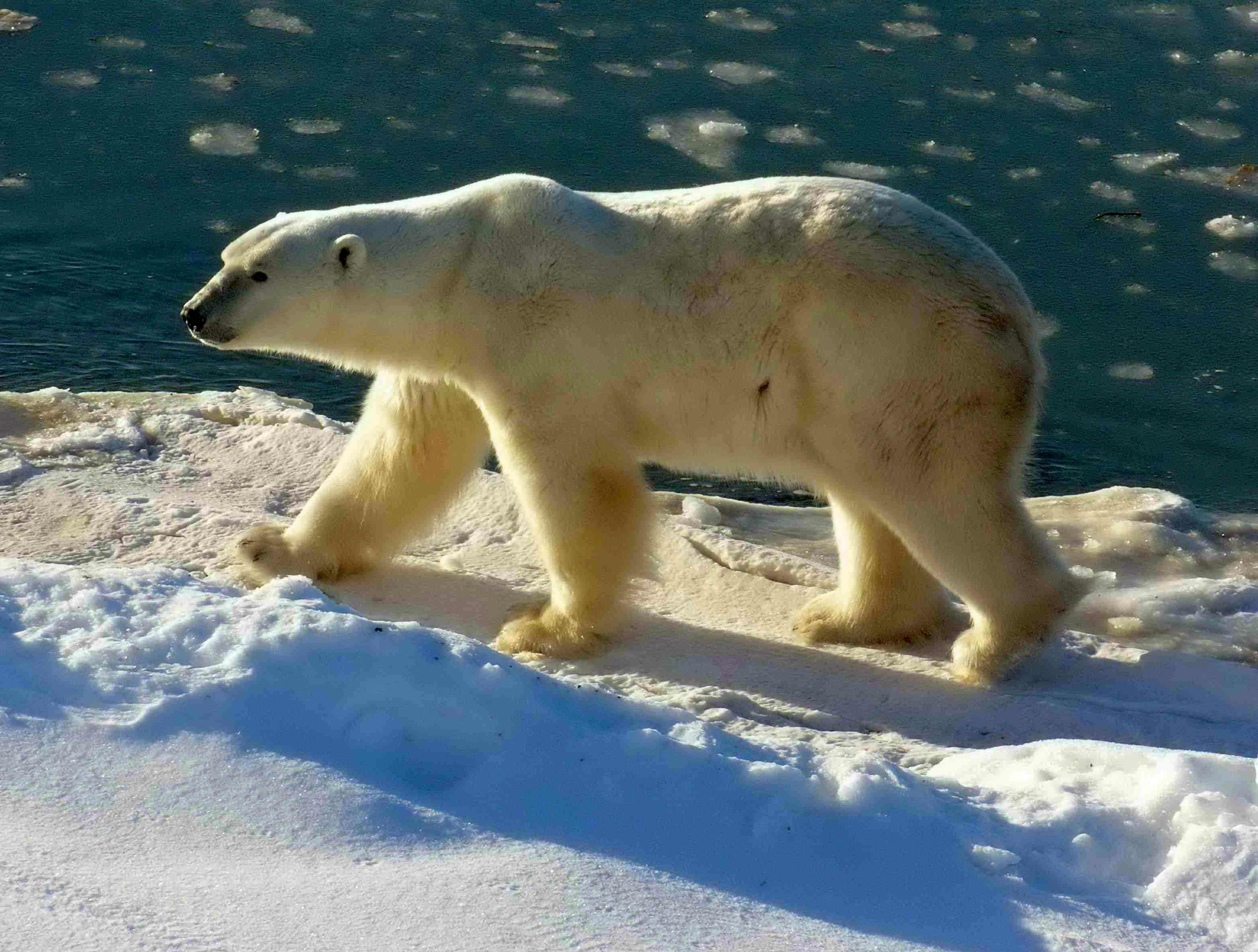
From the Telegraph By Kate Devlin, Medical Correspondent
Polar bears face extinction in less than 70 years because of global warming, scientists have warned.
Melting ice is causing their numbers to drop dramatically, they warn. Others also at risk include ivory gulls, Pacific walruses, ringed and hooded seals and narwhals, small whales with long, spiral tusks.
One of the problems is that other animals are moving north, encroaching on their territory, spurred by increasing temperatures, pushing out native species.
The animals are also struggling with the loss of sea ice.
“The Arctic as we know it may soon be a thing of the past,” said Eric Post, associate professor of biology at Penn State University, who led the latest study, published in the journal Science.
“Recent projections suggest polar bears could be extinct within 70 years.
“But we think this could be a very conservative estimate. The outlook is very bleak for them and other creatures such as ringed seals.”
He added: “The rate at which sea ice is disappearing is accelerating and these creatures rely on it for shelter, hunting and breeding. If this goes, so do they.”
Read the complete story in the Telegraph here
OK now for the other side of the story:
A few countering reports:
Christian Science Monitor, May 3rd, 2007 – Despite global warming, an ongoing study says polar bear populations are rising in the country’s eastern Arctic region.
Science Daily May 10th, 2008 – Federal Polar Bear Research Critically Flawed, Forecasting Expert Asserts
National Post March 6th, 2007 – Polar bear numbers up, but rescue continues
WUWT May 9th 2009 – The “precarious state of the U.S. polar bear population”
Dr. Mitchell Taylor, a biologist with Nunavut Territorial government in Canada wrote this letter (PDF) on April 6th, 2006 to the U.S. Fish and Wildlife Service:
Some excerpts:
At present, the polar bear is one of the best managed of the large arctic mammals. If all the arctic nations continue to abide by the terms and intent of the Polar Bear Agreement, the future of polar bears is secure.
…
Polar bears are believed to have evolved from grizzly bears during the Pleistocene era some 200-250,000 years ago (Amstrup 2003). Polar bears were well developed as a separate species by the Eemian interglacial approximately 125,000 years ago. This period was characterized by temperature fluctuations caused by entirely natural events on the same order as those predicted by contemporary climate change models. Polar bears obviously adapted to the changing environment, as evidenced by their presence today. That simple fact is well known and part of the information contained in the reference material cited throughout the petition, yet it is never mentioned. This fact alone is sufficient grounds to reject the petition. Clearly polar bears can adapt to climate change. They have evolved and persisted for thousands of years in a period characterized by fluctuating climate. No rational person could review this information and conclude that climate change pre-destined polar bears to extinction.
…
The petition admits that there is only evidence for deleterious effects from climate change for one polar bear population (Western Hudson Bay [WH]) at the southernmost extreme of polar bear range (Fig. 1). The petition argues that the likelihood of change in other areas is reason enough to find that polar bears should be regarded as a species at risk of imminent extinction. I hope the review considers the precedent set by accepting this argument. Climate change will affect all species to some extent, including humans. If the likelihood of change is regarded as sufficient cause to designate a species or population as “threatened,” then all species around the world are “threatened.”
Some data. With hunting no longer allowed, bear populations have increased 4-5 times:


Just had a look at the abstract from the source article in Science:
At the close of the Fourth International Polar Year, we take stock of the ecological consequences of recent climate change in the Arctic, focusing on effects at population, community, and ecosystem scales. Despite the buffering effect of landscape heterogeneity, Arctic ecosystems and the trophic relationships that structure them have been severely perturbed. These rapid changes may be a bellwether of changes to come at lower latitudes and have the potential to affect ecosystem services related to natural resources, food production, climate regulation, and cultural integrity. We highlight areas of ecological research that deserve priority as the Arctic continues to warm.
In other words “Give me some more grant money”
The Polar bears won’t drown or go extinct even if the Arctic were to totally melt and never freeze again. They are Brown Bears, and that’s what thier cubs turn into if born without ice.
Polar Bears are really just monstrously big bears with white coats that will attack anything that moves.
I posted this in another thread, but I think it is more relevant here:
New coral species in Galapagos
Meh… Species from the subclass Hexacorallia have been living on Earth since the Paleozoic and have evolved and survived through harsh climate variations. Thinking they will disappear after one niño is naive.
Same happens with polar bears. They have been on Earth for more time than we had.
Who would say that, that with Arctic ice-free in 2013 the polar bears will extinct in 2080. Good swimmers, ain´t they?
The shame is that the Telegraph, which used to be a sensible right-of-centre newspaper, seems nowadays to be staffed by lunatics (other than Christopher Booker that is). In doing this, it has merely copied the example of the Guardian, which used to be a sensible left-of-centre newspaper.
We live in a world ruled by laws formulated from visions glimpsed at
the heart of speculative mathematical models.
Look at this alarmist story about an endangered specie!!
http://www.theonion.com/content/news/area_man_unsustainable_experts?utm_source=a-section
It would be impossible for the Polar bear to become extinct because they are a sub-species of Brown bear. They are an arctic adaptation. duh!
There are two things going on here, one local to the Telegraph the other to do with Copenhagen.
The DT and its sister the ST have both been got at by the green agenda. Whilst they still have some excellent columnists including the indefatigable Booker, the paper has swallowed AGW hook line and sinker. Its business section includes a whole page produced with the Carbon Trust, a front for government money to promote AGW propaganda. It has the absurd Geoffrey Lean (see Saturday’s paper for junk about mobile phones) and its news columns invariably produce tripe like the article cited.
The more insidious agenda however is to do with Copenhagen. As the prospects of any form of real binding commitment to reduce CO2 as opposed to the usual false promises looks more and more unlikely, so the shrill propaganda increases.
Last week, we had heavy mainstream reporting of sea level rise threatening Bangladesh based of course upon models with no reference to the real problem. There have been a number of polar bear articles all saying that only one of the populations is thriving when we know the truth to be the opposite. We’ve had the Arctic disappearing faster than ever and a story about a commercial German boat using the NWP for the “first time” and on and on. My theory is that the greens are panicking and feel they have to fill the media with a relentless diet of AGW junk to help Copenhagen.
Fortunately, the Chinese and the Indians are not listening.
In my business – the London Insurance Market – the AGW religion is ever more pernicious and intolerant of rationalist views. Still, the refusal of global temps to cooperate and the deluge of real science contradicting AGW hysteria give one hope.
Regards
Paul
Richard111 23:27:41
Daily Telegraph: dtnews@telegraph.co.uk
Sunday Telegraph: stnews@telegraph.co.uk
http://www.telegraph.co.uk/topics/about-us/form/
It’s become predictable. This is what happens when real data moves in opposition to their “forecasts.”
First, NSIDC throws in the towel preemptively, basically saying “no story this year, call us in 2010 when we the data lines up.” Then Kaufmann comes out with some bogus analysis that shows the Arctic virtually on fire. Then we get this. Interesting timing, all in late August, early September, mmm?
All the while, ice grows (along with polar bear populations), temperature continues to follow the norm or even lower, the comical Catlin team almost freezes to death…
Mark these words, next will be multiple stories in the MSM of pleasure craft sailing through the Northwest passage, like it’s become the latest warm weather cruising destination (there will be no mention of icebreakers saving their hides).
Guess what else faces extinction in 70 years…”scientists” who predict Polar Bears will be extinct. And they know it. Fear not. When you see this type of story, you know, they are the ones with the fear.
Keep the faith. Keep up the fight. And remember, if you don’t like the news, go out and make some of your own.
The evidence from the IUCN Polar Bears Specialist Group shows that:
-where removals are less than 3%, 3 out of 4 sub-populations are stable or increasing,
– where removals are 3% to 4%, 3 out of 4 sub-populations are stable,
– where removals are more than 4%, 3 out of 4 sub-populations are declining.
http://www.climatedata.info/Impacts/Impacts/polarbears.html
It is hunting not climate change which is the problem.
I’ve been a Daily Telegraph reader for the last few decades, and I’m very sorry to see the depth it’s sunk to. Pretty well every day there’s a report about climate change. Without exception the reports are biased and they only give one side of the story, this one about polar bears being a good example.
.
They did print a letter of mine (about Al Gore) in 2007, but I think even since then they’ve become more biased, maybe due to a new editor. I’ve sent quite a few letters, but nothing printed since. I suspect I may be on a black list, as twice I threatened to lodge a complaint with the Press Complaints Commission – I really wish I had continued, particularly with the first one. It was a demonstrably absurd report about how one Pacific island could disappear ‘within decades’ due to the rising sea level. However, they included a photo of the island’s coast, which showed cliffs and steeply rising terrain. This immediately caused alarm bells to ring. A quick check with Google Earth showed that most of the island was in fact tens of meters above sea level, probably peaking around 100 meters. Ironically, the Telegraph offices in London are far more threatened by sea level rise than this island!
.
The Telegraph’s sister publication, the Sunday Telegraph, is totally different. After all, it’s the home of Christopher Booker, who has shone a merciless light of inconvenient truth on this nonsense.
I hope that one day the Daily Telegraph will apologise to its readers for its part in perpetuating what is quite possibly the biggest confidence trick in history. But I’m not holding my breath.
Chris
Aron (23:40:17) :
us who are always credited with destroying life but because of us many species have a chance of survival that they never had before.
Could you expand on this a little please.
Here’s the study from another source.
The change in Arctic nature foreshadows the global environment of the future.
Many original species of Arctic areas are in jeopardy, as global warming causes species from southern areas to migrate north, where they occupy the living space of the original species.
I just love the way they spin this into a story of impending doom. Anyone who has observed nature knows of it’s cyclical movements even on a yearly basis. When we have warm years plants and critters move onto terrain they would not normally inhabit and replace those that are more adapted for the cold. When the cold years return the tables are turned and the cold adapted plants and critters move into the terrain etc.
Nature is never static. The life that has been advantaged by the last few warmer years in the arctic region will already be on the retreat. Of course if these idealists had decided that the present temperatures were the norm then this retreat would morph into a catastrophe in the making. Here’s the problem.
With mathematical models, the researchers showed that the drastic change in the population dynamics of collared lemmings is explained by the fact that snow melts sooner than before:the lemmings do not procreate as long as before below the snow, and are also easier for predators to hunt.
These people spend their lives toying with mathematical models and don’t have even a basic knowledge of biology and nor have they even consulted the ample literature on the life cycle of the lemming and it’s extraordinary population dynamics.
This is just another sham study, designed to compliment the torrent of shame studies that will hit the press before Copenhagen.
http://notes.helsinki.fi/halvi/tiedotus/pressrelease.nsf/e1e392ad852e72f5c225680000404fa8/78a4c6ca61b92751c225762e002fcf6f?OpenDocument
With global warming, will there still be sea ice in the Arctic?
There will still be 6 months of darkness in the winter. The average annual temperature at the north pole is -25C. The ice really only melts back for about 2 months out of the year. If the ice melts back a little further and a little earlier, the Arctic will still be frozen solid for at least 9 months out of the year.
The bears will adapt. There is even a Polar Bear Provincial Park in Ontario at 55N where the average annual temperature is 25 degrees warmer than the north pole.
http://en.wikipedia.org/wiki/Polar_Bear_Provincial_Park
“deadwood (23:38:04) :
I am amazed that anyone is out there that still believes this stuff. The AGW faithful, sure, but the rest?”
“rbateman (23:47:52) :
Oh no, Global Warming reruns.
Isn’t that special?
Writer’s cramp, no doubt brought on by befuddlement as nature turns to bite them.
Sun in a coma, ice recovering, volcanoes popping off, ,weak El-Nino, short summer, early fall.”
A dumbed down, media hungry, lazy, ignorant, self-centered, paranoid, short attention span, issues with short term memory loss (If it’s not about Paris Hilton and the likes that is) society can be easily manipulated. Communities isolated. Families isolated. Parents isolated. Children isolated (Almost nationalised in Aus and NZ for want of a better description). Divided, “they”, rule.
So there were some 5,000 Polar bears in the 1960,s, and some 28,000 today. The 28,000 figure comes at a time of arctic dimishment. Therefore, the smaller the Arctic, the greater the number of Polar Bears. Oh well, it is a correlation. If the Arctic expands way over the recorded average, they may well be extinct in 70 years is the correlation proves accurate
We all agree global temperatures (and specifically Arctic temperatures) have risen in the last 50 years. And it is known that polar bears have increased approx 5 fold in the same period …….
Another perfect example of an alarmist prediction that is the ‘polar opposite’ of the observational data …..
The Independant talked yesterday about the North East Passage being free for the first time for commercial ships?
The link to the bbc below is as good but you need to read the articel to get the nonsense and I quote :-
“Both ships left South Korea in late July, negotiating the passage off north-eastern Siberia behind two Russian icebreakers. ”
http://news.bbc.co.uk/1/hi/world/europe/8251914.stm
The poor polar bears are probably having their ecosystem destroyed by the Ice breakers ;-O
Living in bear country (not polar bear, but brown faced grizzly and black bear) has shown me that bears are like crows and in-laws as far as adaptation is concerned. Even though huge swaths of habitat are cleared away to make room for the condo’s built to house the sprawling urban eco-elite, the bears around here still proliferate; if anything, they seem to be thriving due to the influx of “ready to eat” goodies like garbage and house pets. I cannot see a bear -that just so happens be be cute and white and chooses to live where the pickings are actually quite good even without ice- is any different from those that still take a dump in the woods. Do people really believe that a polar bear would just lay around and starve to death if the ice went away? I’m thinking they would quickly adapt and begin to feed on all the researchers studying the ice loss and their garbage and house pets just as eagerly as their urban cousins do in the south!
This was a wonderful article by Ms. Kate Devlin, the Telegraph’s “medical correspondent.” Hard-hittng, incisive, and ground-breaking. Didn’t you just love the balance in her article by the fascinating quote from thea scientist with a contrary point of view! A testament to her journalist prowess, Ms. Devlin has clearlly moved the ball forward on the public’s awareness of the dire threats facings those adorable polar bears. We all owe Ms. Devlin a ton of thanks.
But let’s give credit to where the real credit is clearly due. Ms. Devlin based her article on research led by Dr. Eric Post of Penn State University. I wanted to learn more about Dr. Post and his research so I went to the PSU website at http://live.psu.edu/story/41357/rssResearch. I think I got to the core of the matter. The university’s official news source says that “Post’s team calls for the establishment of a pan-Arctic series of integrated baseline studies to monitor the physical drivers of climate change and the biological responses to them over the long term.”
Hey, I wonder if Dr. Post would be interested in conducting these vital studies!
If those people who believe we are on the verge of another little ice age turn out to be right there may be some in northern Europe who would wecome fewer polar bears. They were reported as far south as the Shetland islands. Presumably there was sea ice in the north sea.
Perhaps there will be Inuit explorers kayaking to Scotland again??
Why are “environmentalists” always so loathe to accept when they have accomplished their goals? Polar bears are protected by an international agreement signed by all relevant countries and are at record or near-record population levels (at least in modern times). For those alarmed by sea ice, it has increased for two straight years, even through that is not the determining factor in polar bears’ survival anyway. So why continue to attempt to rile people up over this? Certainly it’s not about polar bears, so the only other explanation is fundraising. “Green politics,” if you will.
Why is the ‘medical correspondent’ writing on this subject?
“Kate Devlin, Medical Correspondent”
Very odd