The Solar and Heliospheric Observatory (SOHO) satellite is back in operation after some required downtime to keep it operating.
Alas, it didn’t miss anything, the sun remains spotless.

From Spaceweather.com
According to NOAA sunspot counts, the longest stretch of spotless suns during the current solar minimum was 52 days in July, August and Sept. of 2008. The current spate of blank suns is putting that record in jeopardy. There have been no sunspots for almost 42 days and there are none in the offing. Deep solar minimum continues.
Spotless Days
Current Stretch: 42 days
2009 total: 184 days (79%)
Since 2004: 695 days
Typical Solar Min: 485 days
There’s some contention over that claim, as WUWT readers may recall that SIDC in Belgium last year retroactively counted a sunspeck from a drawing by Catainia observatory, nullifying the stretch of sunspotless days in August 2008. NOAA’s SWPC appears not to recognize that sunspeck and so their claim is for a 52 day stretch.
Will SIDC pull another sunspeck stunt this August? I’m sure they are “poreing” over the sketches now.
Joe D’Aleo puts this current stretch in perspective:
Today, Thursday, August 20th marked the 41st straight day without a sunspot, one of the longest stretches this solar minimum.

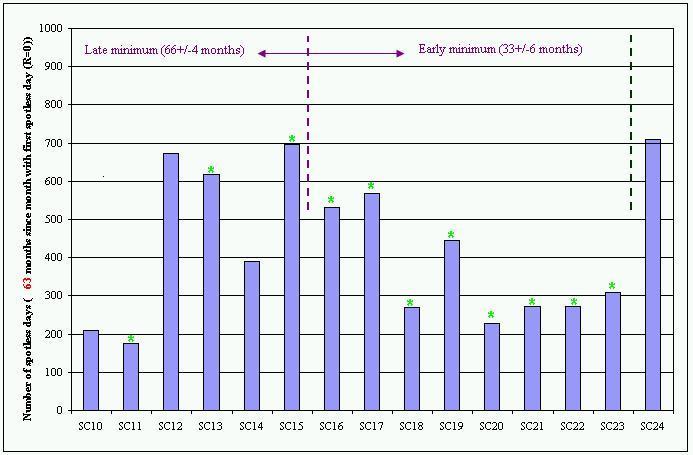
In fact it rises into 10th place among all spotless periods since 1849 (first table here). The total number of spotless days this transition from cycle 23 to 24 is now 694 rapidly approaching the approximate number leading into cycle 15 in the early 1900s (below, enlarged here).

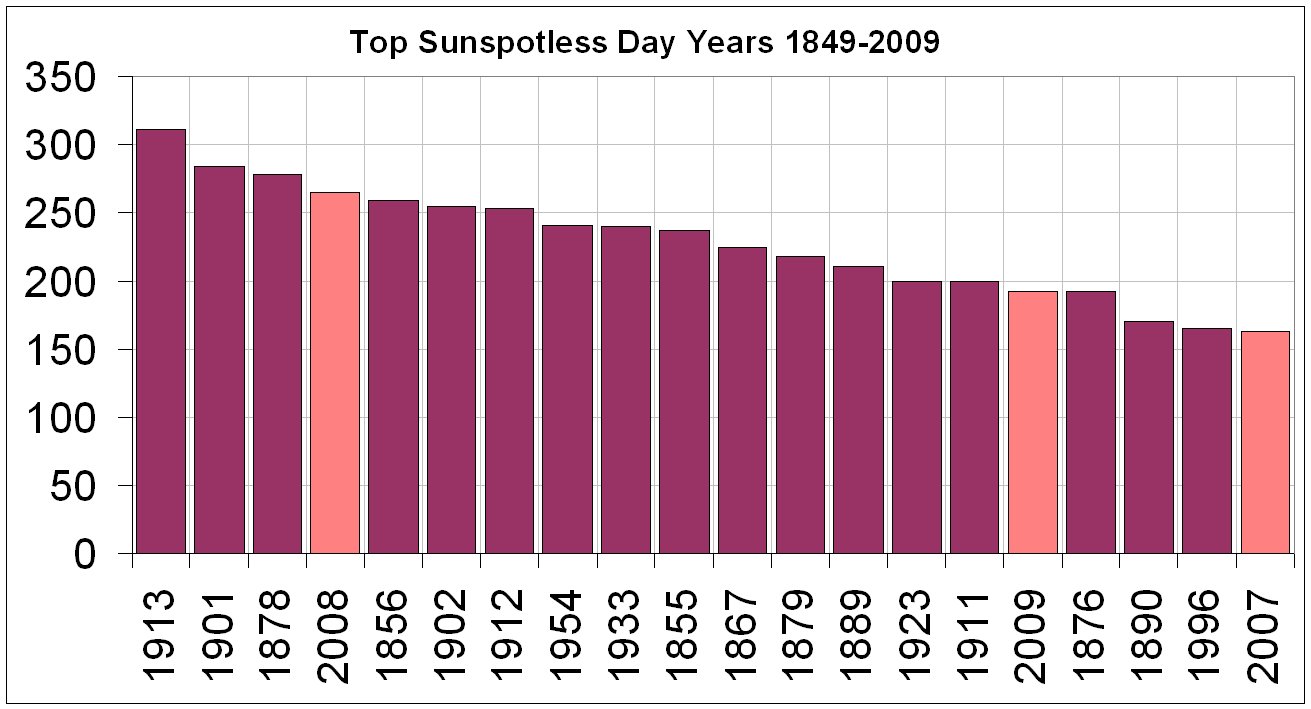
We have had 183 spotless days this year (79% of the days). We are in the top 20 years in 17th place. We will very likely rapidly rise up the list in upcoming weeks and rival 2008’s 265 days and likely end in the top 5 years. 2007, 2008, 2009 will only have 1911, 1912, 1913 in the top 20 as string of 3 per transition (below, enlarged here).

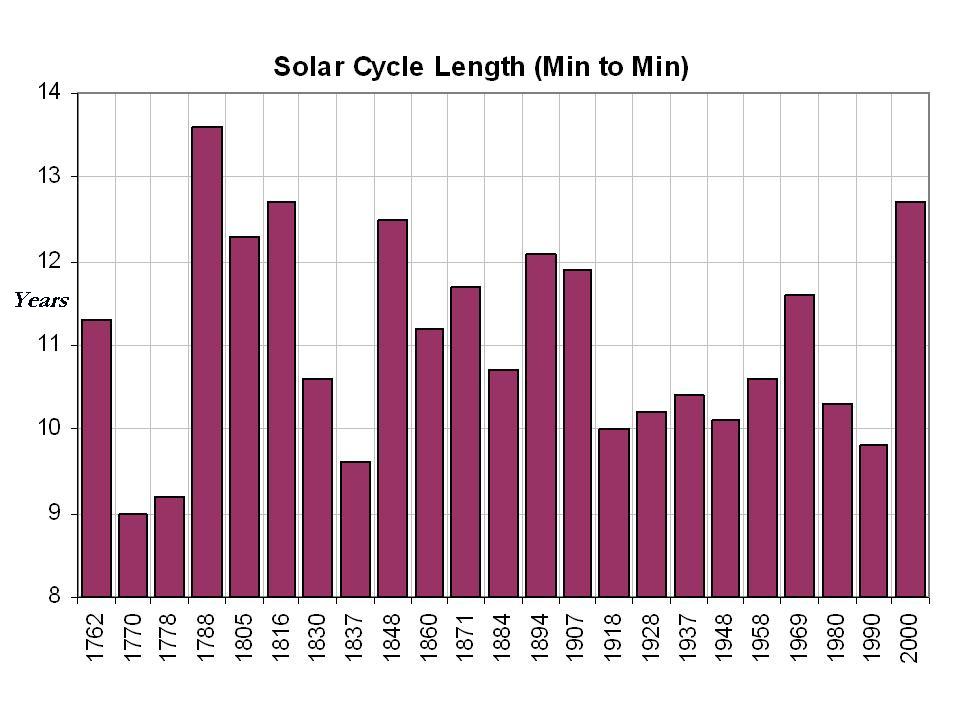
The cycle minimum probably was December, 2008. January 2009 13 month average came up a bit due to slight bump in activity in June and July but if August should end up sunspotless and September low, we could have a double bottom. The 12.7 years assuming December 2008 was longest in two centuries (below, enlarged here).

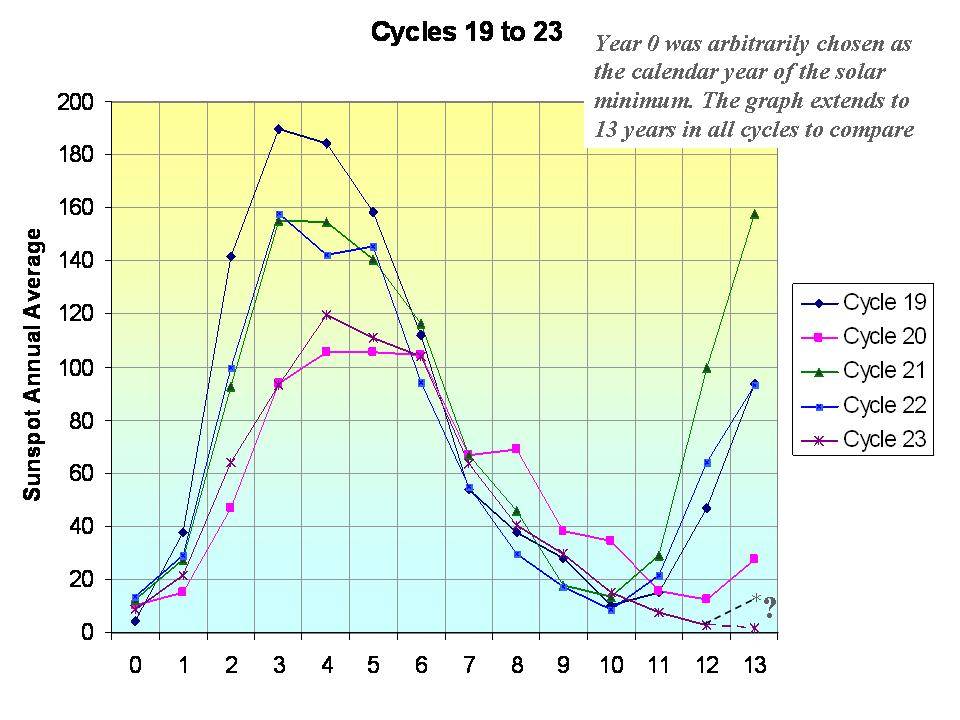
You can see on this chart, by 13 years after the solar minimum year, most of the last 5 cycles already had recovered, in one case already to the solar max (below, enlarged here).

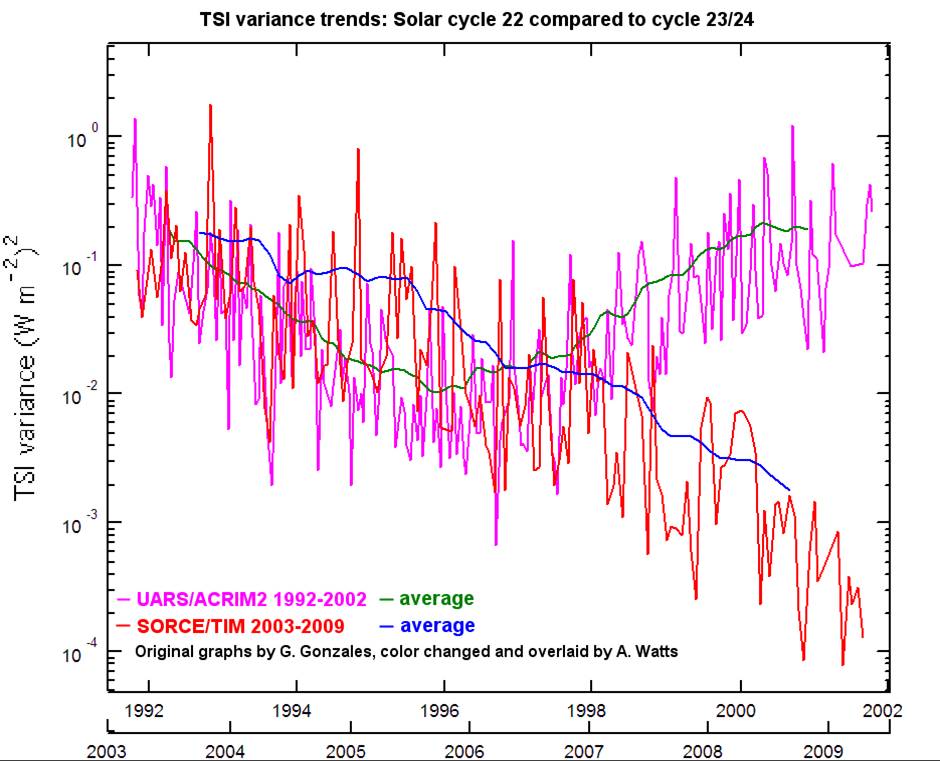
This cycle has continued to decline in the solar irradiance, solar flux, sunspot number and geomagnetic activity after 10 years. On the following chart produced by Anthony Watts, you can see the Total Solar Irradiance declining whereas the prior cycle was rebounding(below, enlarged here).

Clilverd et al 2006 suggests using a statistical analysis of the various cycles (11, 22, 53, 88, 105, 213, and 426 years) shows the next two cycles will likely be very quiet much like those of 200 years ago in the early 1800s, the so called Dalton Minimum, the time of Dickens (with snows and cold in London like last winter) (below, enlarged here).
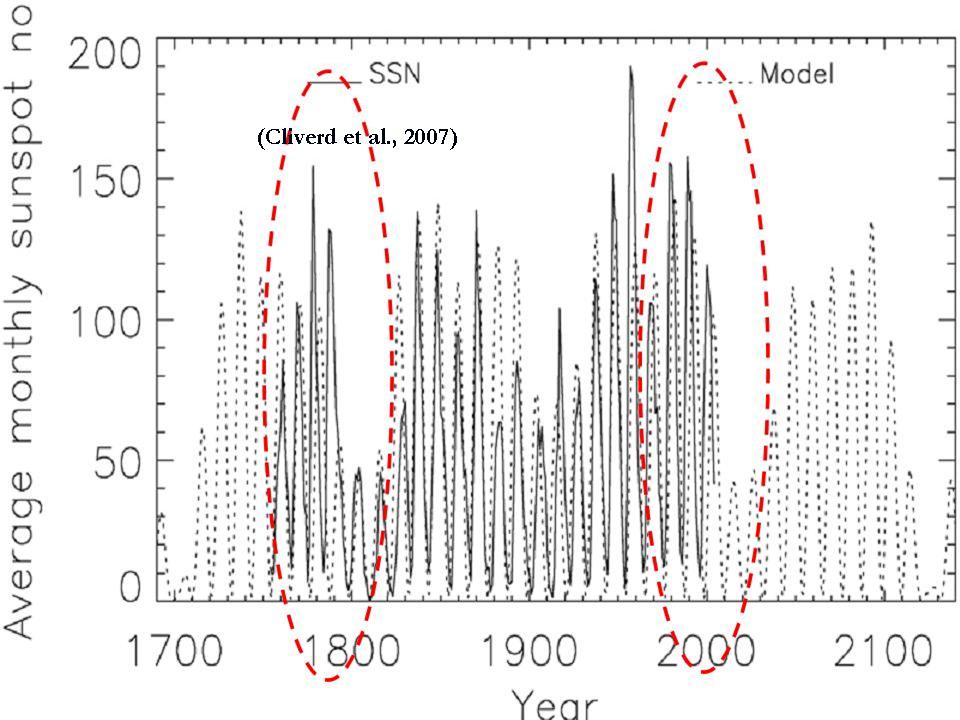

See what David Archibald shows what the result might be if Clilverd is correct here. Some have not ruled out an even stronger Maunder like Minimum. See more complete PDF here.
Discover more from Watts Up With That?
Subscribe to get the latest posts sent to your email.
So good o’l D Archibald was right. Where are those who said he was wrong? The silence is deafening….
But I am curious why Leif’s site shows are recent sunspot here while I don’t see any such spot listed at spaceweather.
“Will SIDC pull another sunspeck stunt this August? I’m sure they are “poreing” over the sketches now.”
Even the most desperate of searches among all the images produced in the last 21 days will yield nothing. Solar Minimum lives.
thanks goodd
I don’t know what the spotless sun means in the grand scheme of things but I bet that so many computer screens have never been so spotless before either. A new proxy for ‘The Mann’ perhaps?
What odds on neither the NE Passage NOR the NW passage being navigable this summer?
What odds the arctic ice minimum extent paralleling 2005 i.e. recoiling from 2007 local minimum?
What, if any, evidence exists concerning cumulative effect of an El Nino and a concomitant solar minimum?
What evidence, if any, exists concerning long-term oceanic cooling (15 – 20 years) and weak solar activity concomitantly?
What progress, if any, to report on the agreement of a global rural temperature measurement network to eliminate UHIs from the ‘global’ ‘temperature record’?
There is no end of predictions being made, most of which will be wrong in some respect or another. It will be interesting to see what a year from now looks like.
I am most troubled by the fact that this deep solar minimum is getting minimal coverage in the mainstream media. If it wasn’t for the global warming narrative, this would be front page news. The world may be entering a period of potentially significant and extended cooling and much of the mainstream media refuses to report on it. If cooling leads to crop failures and food shortages, mainstream media outlets and their editors will be culpable for misleading the public and delaying study and preparations for this eventuality. Several editors, especially at the BBC, might even get to see the inside of a prison cell…
Lets hope it keeps going as this Test series is a good’n & certainly seems to be helping us out at cricket!
Now what was it Prof Mike Lockwood was saying something about no evidence of cooling……….3 poor summers in a row completely against the flow of official information, the first October snow in 74 years, a bad winter that caught the state run Met Office completey off guard, all major long-range forecasts for winter 08/09 north & south were fooled, record cold temps all over the place, forecasts were complety wrong & it appears their computer models clearly have issues predicting long-range weather forecasts, (so what hope global climate) another milder than usual winter forecast/predicted again for 09/10, global cooling for 8 years, have they no shame or are they going for the law of averages again? Yep , I guess that’s no evidence then.
If Stacy Stephens spied a septuplet of semiquaver sunspots, how many serendipitous sunspots did Stacy Stephens sight?
Alan the Brit (09:48:23) :
“Lets hope it keeps going as this Test series is a good’n & certainly seems to be helping us out at cricket! ”
Hear hear! Broad played a blinder there for a Michelle – what a session! 4 wickets for Swann and one for Freddie. This is no flat Oval pitch! I think Broad will end up as one of the great all rounders.
CMJ has been talking about Wilfred Rhodes who used to ‘watch’ cricket long after he went blind. He knew what was happening just by the sound of the bat on the ball. Isn’t it a pity that ‘climate scientists’ and ‘climate modelers’ do not have the same perspicacity?
What is that old saying about a “watched pot?”
Seriously, this has to be taken more seriously than the historical record. Has anyone done a most recent minimum period survey using the detection thresholds available a century plus pervious?
VG (09:15:16) :
So good o’l D Archibald was right. Where are those who said he was wrong? The silence is deafening….
Right about what? I said he was wrong – not about the solar cycle length – but about the 2 deg decline in temperatures. Many, including Leif Svalgaard, were predicting that solar cycle 24 would be weaker than recent solar cycles.
Don’t worry you won’t get silence from me. I’d like to David to tell us how is predicions for Armagh are progressing. I’ve asked the question at least twice but perhaps he’s not seen it.
Could this be a rare double solar minimum minima?… or is it minima minimum?
Robert Coté said:
“What is that old saying about a “watched pot?”
Seriously, this has to be taken more seriously than the historical record. Has anyone done a most recent minimum period survey using the detection thresholds available a century plus pervious?”
I’ve been wondering that myself…
Alan the Brit
If our lot don’t do anything stupid the Ashes will be ours…all ours!
This extended solar minimum as well as the current financial crisis are both examples of how the expert consensus was off track in its predictions. It will take more time to see how expert predictions turn out in the case of AGW, but one thing is for sure, the world is going to do this experiment. We will all know the answer in a couple more decades. It is a bonus that our Sun is getting involved in the experiment too. If the solar cycle stays weak, we will see if there can be warming independent of what the Sun is doing.
I am currently a skeptic, but if the temperature goes up significantly in the next decade I will likely convert to the other side. On the other hand, if the temperature stays relatively flat or declines, it becomes harder with each passing year for the AGW experts to excuse the lack of temperature increase as natural variability while pointing to past warming as being unnatural.
The 42 day spotless daus stretch may be inaccurate. there have been a few very small less than 1 day spots that have got a count but there seems to be some disaggreement if they should count.
I think we should do the same with those sunspots that last for less than 1 day the same thing as we did with Pluto, demote them.
I suggest those short lived sunspots that where not observed 100+ years ago as “Dwarf spots”.
Then we will still count them, which we should, but they get their own classification and thus we can easier compare the sunspot data with the past.
Here comes the WATTS effect again to be tested!
Rewording the title:
The SUN…is back in operation after some required downtime to keep it operating….
However, as David Archibald said, this will take a bit longer. Interesting times indeed.
Or…Is it CO2 which shines every morning (…not down here-el Nino 1+2 zone-, of course, because of the curse made by Svensmark et al.) 🙂
So now that this article is out, do we have a metric for “average days post article for first return of a sunspot”? IIRC, it’s been between 1/2 day and 2 days… Maybe you need a daily sunspot article so we can warm up a bit! (I’m planting peas and potatoes a bit early, having given up on a significant bean yield and while I’m getting tomatoes at last, they are slow to ripen. Oh, and the “summer squash” has gone all “fall mouldy leaves” on me already; about a month early. Kale and collards doing great, though! They usually get burned in August…)
It will be great fun to see what a Major Minimum 😉 really does. The “warming” of our present thermometer record can not be caused by the sun (the thermometer records do not warm in summer, only in winter… not so the sun…) but I still hold out (slim?) hope that the solar cycle can be tied to minor cyclical changes on a longer time scale. And I certainly expect we will get lots of interesting answers to all sorts of questions from this quiet sun…
http://chiefio.wordpress.com/2009/08/09/co2-takes-summers-off/
http://chiefio.wordpress.com/2009/08/05/agw-is-a-thermometer-count-artifact/
Now that it is reported in Watts Up With That, we should have a new sunspot any day.
We live in interesting times. Is this a blessing or a curse?
This are my data of spotless days for Sidc and Noaa, and i have count them many times, so i’m very sure that the right count is this:
Updated today, 8/21/2009
For Sidc: total days spotless in 2009: 185
total days spotless since 2004: 694
For NOAA: total days spotless in 2009: 186
total days spotless since 2004: 699
This is my link that i update every day: http://daltonsminima.wordpress.com/dati-sole-in-diretta/
Simon from Italy
The current stretch is 42 for noaa and 22 for sidc (update 8/21/2009)
crosspatch (09:19:03) :
But I am curious why Leif’s site shows are recent sunspot here while I don’t see any such spot listed at spaceweather.
I was thinking the same thing. 2 small cycle 23 spikes since that big cycle 24 spot went across the Sun. I was thinking there hadn’t been any spots since the last big one. The 2 cycle 23 “sunspots” must have been pretty small and shortlived because the spikes are much smaller than any other on the graph, which I find interesting because I think back to some of the specks that have been counted (maybe not by Leif).