Many of you have already seen this footage below, but I thought it would be interesting for WUWT readers to get a look at the cause behind it. Meteorologist Mike Smith, from WeatherData, sent an interesting picture and description of the incident vua email that I wanted to share. I’ve added some links and visuals also. – Anthony
Mike Smith writes: A “downburst” is a unique form of extreme winds unknown to meteorologists prior to 1977 when it was discovered by Drs. Ted Fujita and Horace Byers. While they can occur anywhere, the Dallas area has bitter experience with downbursts.

Delta Airlines’ flight 191 crashed in a downburst at DFW International Airport August 2, 1985, killing 135. In the quarter century since that horrible August day, meteorologists have made tremendous strides forecasting and warning of these small, but deadly, storms.
WeatherData Services, Inc., (an AccuWeather Company), applied that knowledge at 2:50pm May 2, 2009 when we issued a SkyGuard® warning of 65 mph winds for a client located in the Dallas suburb of Irving, TX. Based on radar, the winds struck between 3:10 and 3:15pm.
A post-storm survey by the National Weather Service determined winds were “nearly 70 mph.”
These winds collapsed the Dallas Cowboys’ practice facility where a “mini-camp” was in progress. According to NBC Sports, Cowboys’ owner Jerry Jones stated, “We did not get [a] good warning.” This may be because governmental sources did not issue a warning until 3:06pm, 16 minutes after WeatherData’s and just moments before the winds occurred.
Here is some background info on downbursts:

A downburst is created by an area of significantly rain-cooled air that, after hitting ground level, spreads out in all directions producing strong winds. Unlike winds in a tornado, winds in a downburst are directed outwards from the point where it hits land or water. Dry downbursts are associated with thunderstorms with very little rain, while wet downbursts are created by thunderstorms with high amounts of rainfall. Microbursts and macrobursts are downbursts at very small and larger scales respectively. Another variety, the heat burst, is created by vertical currents on the backside of old outflow boundaries and squall lines where rainfall is lacking. Heat bursts generate significantly higher temperatures due to the lack of rain-cooled air in their formation. Downbursts create vertical wind shear or microburst which is dangerous to aviation.
 Definition:
A downburst is created by a column of sinking air that, after hitting ground level, spreads out in all directions and is capable of producing damaging straight-line winds of over 150 mph (240 km/h), often producing damage similar to, but distinguishable from, that caused by tornadoes. This is because the physical properties of a downburst are completely different from those of a tornado. Downburst damage will radiate from a central point as the descending column spreads out when impacting the surface, whereas tornado damage tends towards convergent damage consistent with rotating winds. To differentiate between tornado damage and damage from a downburst, the term straight-line winds is applied to damage from microbursts.
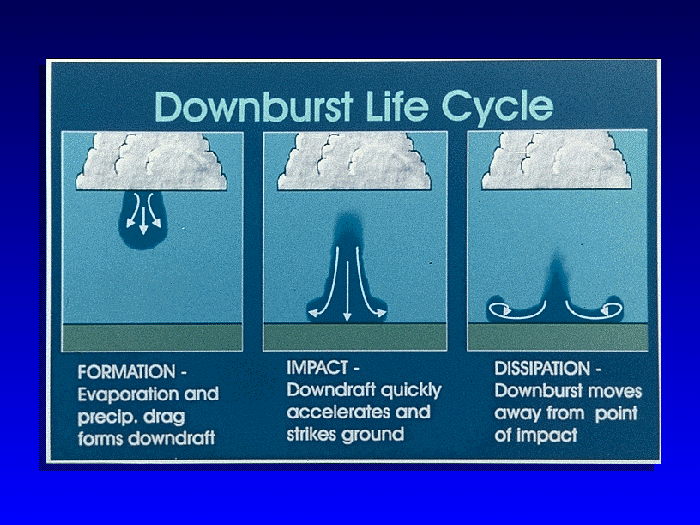 Downbursts are particularly strong downdrafts from thunderstorms. Downbursts in air that is precipitation free or contains virga are known as dry downbursts;[1] those accompanied with precipitation are known as wet downbursts. Most downbursts are less than 2.5 miles (4 km) in extent: these are called microbursts.[2] Downbursts larger than 2.5 miles (4 km) in extent are sometimes called macrobursts.[2] Downbursts can occur over large areas. In the extreme case, a derecho can cover a huge area more than 200 miles (320 km) wide and over 1000 miles (1600 km) long, lasting up to 12 hours or more, and is associated with some of the most intense straight-line winds,[3] but the generative process is somewhat different from that of most downbursts.
Here is why a downburst is so dangerous to aviation.

Source: NOAA
ohioholic (06:32:27) …Here is a link to it. I have read that it was Hurricane Ike related (not Hugo, oops), but I don’t know how it is related. I was hoping Anthony would know.
Oh Ike. You bet it was related to Ike.
What I was saying is that derechos and downbursts often originate from thunderstorms or thunderstorm complexes…not from hurricanes turning extratropical.
But you were right about this unusually widespread wind event…and I see why you would call it a “dry hurricane”.
Here is a GREAT explanation from Dr. Greg Forbes [severe weather expert] from his blog.
Definitely check it out.
http://www.weather.com/blog/weather/8_17237.html
Also, and interestingly this June in Atlanta there is the AMS Conference on the Inland Impacts of Tropical Cyclones.
I see a couple of Ike presentations are on the schedule.
http://74.125.93.132/search?q=cache:SpCzO-T7gaUJ:www.ametsoc.org/chapters/atlanta/IITCagenda.pdf+inland+effect+on+hurricanes&cd=3&hl=en&ct=clnk&gl=us&client=safari
Chris
Norfolk, VA, USA
About 25 years ago I experienced a Number 10 Typhoon in Hong Kong, that’s one with very destructive wind speeds. I was involved in the clear-up operations and noticed that a fairly large number of trees in certain limited locations had been blown down in directions describing a circle. Typhoon winds come from one direction and then, after the eye has passed, from the opposite direction. Some of these downed trees were at right angles to either wind direction.
My Chinese co-workers told me that this was the work of the ‘Dai Fung’, the phenomenon which gives the storm its English name. The Chinese name is reserved for the incredibly strong bursts of wind which wreak so much localised damage. I wonder if the circular damage patterns I saw could have been the result of some sort of localised downburst within a typhoon event?
Here is an account about observations of “crop circles” and a weatherman’s view. Could microdownbursts also occur in straight line patterns?
——-
Crop Circles in Hyde Park
by Ben Hogwood
HYDE PARK Sean Hill was driving to his friend’s house, with his
girlfriend, Kaitrin Arnot, and sister in the car, when Arnot saw
something a little strange. “Did you guys see that?” She said to the
others in the car.
When they pulled over to look, they saw a whole hayfield covered with
what looked like crop circles. A huge portion of the field was
completely flattened, with the hay laid flat across the floor with the
stems all bent approximately six inches up from the ground. The
direction which the hay laid, often changed directions and some areas
had what Arnot described as ‘cowlicks’ with the wheat pushed out in
every direction in a circular pattern. Separate from this main
flattened portion were smaller circles, or almost circles, completely
unconnected from the rest. Hill didn’t know what it was, but it didn’t
look man-made.
But if it were aliens, they clearly didn’t use a meter stick or
protractor. The patterns were disorderly and didn’t seem to make any
specific shapes. A few weeds, with stronger stems than the wheat,
remained standing in areas where everything else was completely
flattened. It didn’t make sense: why would aliens, possessing the
technology to fly thousands of light years, come to Vermont to leave the
equivalent of a two year old’s drawing on a field?
The answer, obviously, is a little closer to home. Vermont Public
Radio’s Steve Maleski, a well known meteorologist, gave a number of
possibilities as to what it could be. One possibility, he said, is a
small tornado, another being a downburst, which is a blast of wind which
comes down and leaves a starburst pattern. However, given the night on
which it probably occurred (Monday, July 21) Maleski said it was most
likely a microburst. “This is a rapidly accelerating downdraft which
smacks into the ground and spreads out,” he said. “That would be the
most probable,” he said. This explanation would account for the large
flattened area, the smaller circles and why the weeds with thicker stems
remained standing.
aurbo (21:58:46) :
Ball lightning has been proposed as a means of long-term plasma confinement for fusion power plants. Paul Koloc has done a lot of work, but not recently. See http://www.prometheus2.net/ for lots of fascinating stuff.
Stephen Brown (14:49:09) :
Check out http://findarticles.com/p/articles/mi_m1200/is_n6_v143/ai_13434075/ which says in part:
Fujita proposes that the eye wall of the hurricane-the region of strongest winds surrounding the calm “eye”-spawns small, swirling eddies that measure only 500 feet in diameter. If these eddies drift into the eye, they are harmless. But if they pass under the fast-growing clouds outside the eye, the cloud convection pulls air upward, stretching the vortex skyward and causing it to tighten. Like spinning skaters who pull their arms inward, the tightening vortex swirls faster, reaching speeds of up to 80 miles per hour during Hurricane Andrew. Because these spinning features were carried along by the 120-mile-per-hour winds of the hurricane, they produced combined winds of 200 miles per hour, Fujita says.
Here’s an account of a downburst near Spokane last night, that
caused severe damage to exactly one farm.
http://www.spokesman.com/stories/2009/may/07/wind-tears-through-north-spokane-property/