Guest post by Steve Goddard
Yesterday, Dr. Walt Meier from NSIDC again graciously updated us about the NSIDC sensor problem, and also about his current thinking with respect to polar ice trends. The key concepts being that Arctic ice continues to decline, and that Arctic and Antarctic ice are separate entities – so the current near normal global sea ice area “has no meaning in terms of climate change.” This article examines both of those concepts.
NSIDC is still having sensor problems on their satellite, as seen below on 2/28/09. Note the speckled white areas, and the large dark gray sliver in the Sea of Okhotsk near the top.
http://nsidc.org/data/seaice_index/images/daily_images/N_daily_extent_hires.png
Fortunately there is another ice extent data source, AMSR-E which has not suffered sensor problems and their data is unaffected. NSIDC also explains on their web site that “AMSR-E has a lower absolute error” than the NSIDC sensors, even when functioning properly. AMSR-E (below) has been recording sea ice since 2002. The maximum ice extent for 2009 (red) and 2008 (orange) are both in the top three on the AMSR-E record, at more than 14M km2. The only year which had greater ice extent than the last two years was 2003. So clearly we are on a recent trend of higher Arctic ice maximums, which is a fact that is rarely if ever reported by the main stream media. Also note in the NSIDC map above, all of the ice basins are close to the 1979-2000 normal.
If there is a dramatic downwards trend in maximum Arctic extent, it certainly isn’t visible in either the map or the graph.
 http://www.ijis.iarc.uaf.edu/seaice/extent/AMSRE_Sea_Ice_Extent.png
The NSIDC graph below also shows Arctic ice extent nearly back to the 1979-2000 mean.

http://nsidc.org/data/seaice_index/images/daily_images/N_timeseries.png
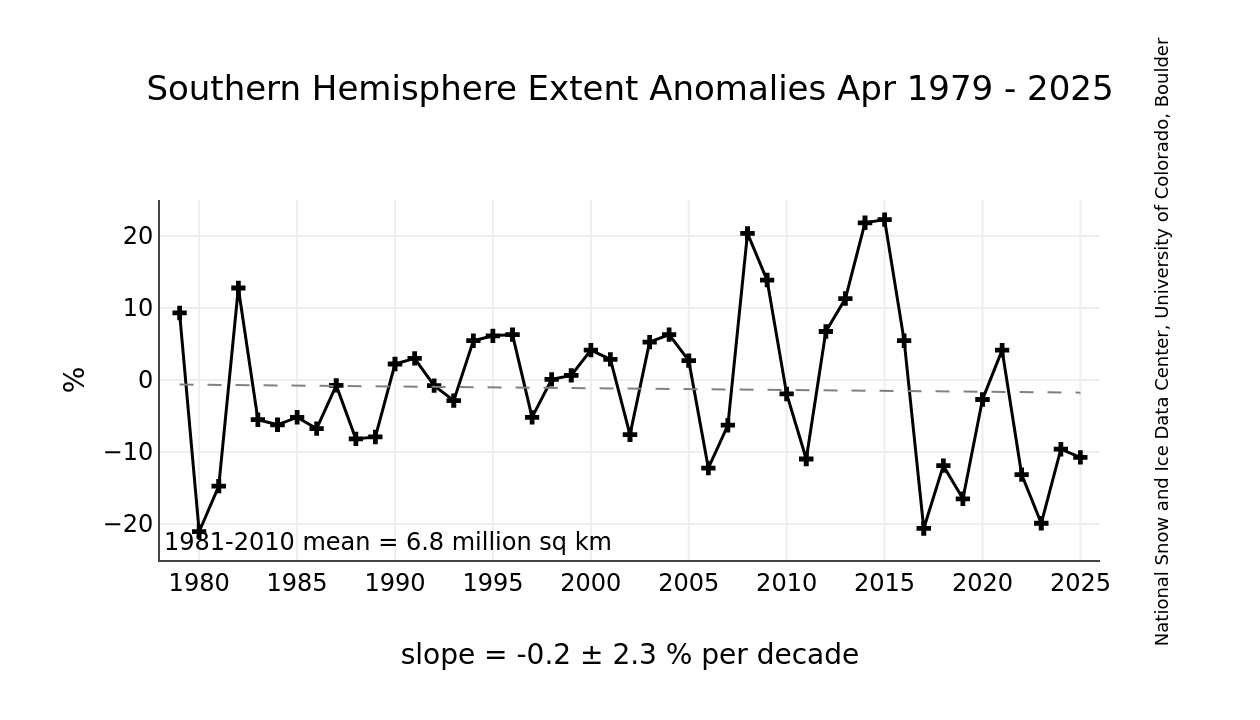
Turning our attention to Antarctica. Dr, Hansen predicted in 1980 that ice loss in Antarctica would be symmetrical to the Arctic. But the current thinking, as expressed by Dr. Meier, indicates that view is no longer valid. In fact, NSIDC data shows that Antarctic ice extent has actually increased substantially, as seen below.

http://www.epa.gov/climatechange/effects/downloads/Challenge_chapter2.pdf
It was reported last week that the IPY (International Polar Year) released a study claiming that both polar ice caps are melting “faster than expected.” Given that NSIDC shows Antarctica gaining ice at a rapid pace, I find myself surprised that IPY would release a study saying exactly the opposite. But then again, an IPY official reportedly forecast that last summer (2008) might have an “ice free Arctic.”
Columnist George Will reported that overall global sea ice area is normal, and was correct. Dr. Meier confirmed that on January 1 global sea ice levels were normal.
Walt Meier (16:04:59)
1. He (George Will) was factually incorrect on the date that he reported his “daily
global ice” number. However, he was merely out-of-date with his facts
(it was true on Jan 1, but wasn’t 6 weeks later).
The UIUC graph shows global ice levels well within one standard deviation of the 1979-2000 mean. Dr. Hansen was correct that according to global warming theory, both poles should be losing ice – though we know now it theoretically should be happening more slowly in the Antarctic. Yet 20 years later we actually see the Antarctic gaining ice, which is contrary to Dr. Hansen’s theory, contrary to IPY claims, and probably contrary to Steig’s questionable temperature analysis .
The main trend I see in polar ice is an increasing disconnect between hype and reality. Given that the AO (Arctic Oscillation) has been neutral this winter and polar drift has been less than last year, I forecast that the summer Arctic ice minimum in 2009 will show more ice than either of the last two years. What do you think?
Discover more from Watts Up With That?
Subscribe to get the latest posts sent to your email.
Just want truth… says
You are always going to be able to play this game of, at any given time, pointing to some given piece of research that is new enough…or whatever… that it has not yet been proven to be wrong and, by elevating it above all the other research that goes the other way, arguing that your position is correct.
Let me put it to you this way: Either Roy Spencer is the smartest climate scientist of his generation OR he is fooling himself. And given his past track record ( http://tamino.wordpress.com/2009/01/19/a-bag-of-hammers/ , http://www.tcsdaily.com/article.aspx?id=080805I , and all the problems over the years with the UAH temperature record satellite analysis), I think the second possibility is considerably more likely.
I should also mention that there was already a posting from Tamino that explained the way in which he believed that Spencer is fooling himself in this particular instance. While the folks here on WUWT seem to believe that Spencer’s two sentence response was some sort of definitive counterargument ( http://wattsupwiththat.com/2008/10/08/dr-roy-spencer-evaporates-taminos-critique/ ), I think that Tamino’s basic notion of what might be wrong with Spencer’s analysis is still very much alive albeit not rigorously proven.
I read at a nature museum that Florida was not in deep freeze during the last ice age. Does anyone think that the general area would still be okay in the event of continued warming or a sudden reactive shift to deep freeze?
Joel Shore said:
To paraphrase: during the limited window of time between citing research, and having it inevitably proven wrong by smart folks like yourself, skeptics get to play the ‘game’ of temporarily, and incorrectly, claiming they’re right. Isn’t that about the gist of it?
This fallacious argument, as usual, turns the Scientific Method completely on its head. So let’s go back to square one: the burden is on the promoters of the AGW/CO2 hypothesis to show by convincing evidence that their new hypothesis explains reality better than the theory of natural climate variability. They have failed.
The plain fact — that the believers in the AGW/CO2 hypothesis have failed to falsify the long-accepted theory of natural climate change — leads to arguments begging the question like the one above.
For the umpteenth time, the Scientific Method states that the entire burden is on the AGW promoters to show how their hypothesis explains reality better than the natural ebb and flow of the climate.
Skeptics do not have to prove anything. If it were not that way, then every conjecture or hypothesis that comes along, no matter how silly or outlandish, would force the existing theory — whether of natural climate variability, the law of gravity, or the theory of evolution — to prove itself again and again. This is plainly nonsensical.
Rather than always trying to re-frame the argument by demanding that the accepted paradigm must be constantly shown to be correct over and over again, try arguing according to the Scientific Method. Show conclusively that the AGW/CO2 hypothesis explains reality better than natural climate change. If you can, you’ll be the first one to do so, and on the short list for the Nobel Prize.
Hi Joel 7 413 01
I went over to Taminos following your link-its no wonder you like to hang around here so much 🙂
This is an extract;
“We’ve put huge quantities of CO2 into the atmosphere from fossil-fuel burning, and atmospheric CO2 has increased. In fact the atmospheric increase has only been about half the anthropogenic output, so not only are our emissions responsible for atmospheric increase, they’re increasing some other carbon reservoir as well. The evidence is pretty strong that most of the rest of the fossil-fuel CO2 is going into the oceans. As a result, not only is the atmospheric 13C fraction decreasing, so is the ocean 13C fraction. If atmospheric CO2 increase is coming from the oceans as Spencer claims, the how is it possible for both the atmosphere and the ocean to show declining 13C?”
Theres nothing I’d particularly disagree with here, but the overall notion that an increase in a trace gas that isn’t even the main greenhouse gas will cause all sorts of computer modelled feedbacks that will push a theoretical 0.6C logarithmic increase up to 4.8C or more, does nothing for me.
Can I ask you a direct question-Do you believe our current temperatures and current ice melt is unprecedented in mans recorded time on earth? I will assume you know enough about history to say no (but if you believe otherwise please say so).
So can you explain how past temperature episodes managed to reach or exceed current temperature levels when co2 -supposed to be the major driver- remained a constant 280 ppm according to the ice cores? What were the drivers for all the numerous warming and cooling episodes back to say the bronze age?
As a secondary question, do you believe the global temperature record to 1850 has any scientific basis as a concept, or fulfils any practical method of measuring temperatures consistently and reliably when they are derived from an ever shifting pattern of surface stations?
Thanks
TonyB
1. The times of the datasets are too short to be engaging in meaningful arguments. We can lay bets, vote in polls and have hunches, but we’re 500 years shy of the data sets needed to start being serious in our predictions.
2. We’re still way short of concensus on what an appropriate set of measuring stations for temperature globally is. Until that is sorted out, any debates about ‘global warming’, ‘climate change’ etc are fairly stupid.
3. There are, in my humble opinion, serious questions to be raised about whether tree rings etc actually measure temperature or whether they measure rapid tree growth. As several eminent tree experts have predicted excellent tree growth in the UK this year due to A COLD WINTER KILLING PESTS and A DAMP WINTER LEADING TO HEAVY SEEPAGE OF MOISTURE INTO THE GROUND, I don’t think growth in the UK equates to temperature. It equates, all else being equal, to temperature. The only problem is, all things aren’t equal…..and moisture is far more important….
4. At least this site promotes vigorous debate about all these issues. Oh but Govts and weathermen were similar…..
5. I await the official stats for the Swiss winter this year – much colder, much snowier and the albedo effect may influence the summer as well…is that what you call ‘positive feedback’?
Wy cant we have someone report the facts that the sea ice has increased or decresed without a lopside view about global warming. This seems like people are afraid to report that it has increased without some BS explain and or if it declines the sky is falling nuts.
Lake superior last froze over in 2003
Joel Shore (20:04:46) :
Steve, since you wrote that primer on the greenhouse effect, let me ask you: Do you think it is helpful (even to the “skeptic cause”) that there are so many people around who do not accept the basic settled science regarding the anthropogenic nature of the CO2 rise and the basic physics of the greenhouse effect? Couldn’t these people be investing their energy more wisely if they were asking about legitimate scientific issues such as cloud feedbacks instead?
Joel, I have to admit that I have not seen the skepticism to which you allude. What impresses me, as someone who has gone from being a “true believer” in AGW theory, to one who now is agnostic on the subject, is how little credence the warming advocates pay to all kinds of documentable data about natural climate variation that may well be responsible for some part (or even all) of the observed temp. increases since 1979. I am also shocked, I must say, by the brazen thuggery of some advocates of the orthodoxy (not you, and not most of those who speak up to join the conversation here), who often seem to feel that the ends justify the means and do not hesititate to degrade the debate into a mudfest.
It seems to me that most skeptics understand full well the science behind the greenhouse warming model. I first studied it in 1981 as a undergraduate. To understand it is neither to accept that it is valid science (there are reasons to believe that the alleged forcings are not nearly so great as are claimed) nor that there are not other natural forces that ultimately could dwarf its impact.
P Folkens (09:32:55) :
The essence of the post was expressed in the short 4th paragraph: “If there is a dramatic downwards trend in maximum Arctic extent, it certainly isn’t visible . . .”
It draws attention to the unbridled use of hyperbole in the climate debate. Dr. Meier wrote recently here, while emphasizing his #1 of two major points, “The ice extent is declining significantly . . .”
Charged words like “significantly,” “dramatic,” “fastest in history,” and so on, as well as inappropriate ad hominem arguments have supplanted the necessary exercise of comparing data and rigorous studies.
Here’s another example for you:
“NSIDC data shows that Antarctic ice extent has actually increased substantially, as seen below.”
when referring to a slope of 2.8±4.7%/decade!
Joel Shore (06:01:59) :
The more difficult question to answer is this: If our climate system is dominated by negative feedbacks…
The climate system is not dominated by negative feedbacks. It’s not dominated by positive feedbacks either. If either one were dominant, then our fair planet would either be a snowball or a flaming inferno. The planets climate is overall a stable environment which is where we get natural variability from. There is chaos within this variability that is so very difficult for models to reproduce. The climate models that are the basis for the IPCC’s catastrophic predictions cannot be accurate because of this. Papers that use these models are therefore fundamentally flawed.
Furthermore, rolling out Tamino as a basis for your arguments is also fundamentally flawed. Tamino defends against his scientific(!) findings by ignoring those who question him. On that basis, his conclusions mean diddly squat until he is scientific enough to allow feedback and scrutiny for his own work.
Smokey says:
There are two main errors in what you say here. First, of all “natural climate variability” is not a theory. If you let go of an apple and I tell you that the accepted theory is that it falls because of “natural forces”, I haven’t really explained very much. When you say “natural climate variability”, are you talking about solar forcing, changes in cosmic rays, spontaneous changes in global forcings (due to some mechanism that needs to be specified) from oscillations such as PDO? Which explanation is it this week?
Second of all, you are confused about the current status of AGW/CO2. It is not a “hypothesis”. It is a part of the currently accepted theory that we have for climate. (I think it is more accurate to refer to it as part of a theory than as a separate theory itself.) And, that accepted theory encompasses both natural and anthropogenic forcings on the climate system (as well as the concept of some unforced internal variability in the climate system).
Again, you have it backwards. Your analogy with evolution and gravity goes the other way. AGW/CO2 is a part of the accepted paradigm of climate. And, the reason for this is that there are multiple lines of evidence that support this paradigm (which is why I pointed out, for example, how Spencer’s ideas about the cloud feedback would require not only a change in our understanding of that one aspect of how clouds respond to a change in climate but also a sea-change in our entire understanding of the paleoclimate record, the climate response to the eruption of Mt Pinatubo, etc., etc.) To displace this, you have to come up with a new paradigm and show that it fits the evidence better. To understand how it become part of the accepted paradigm, you would probably want to read this: http://aip.org/history/climate/
In summary, it is alas not you who gets to decide what the current dominant theory or paradigm is in science. It is decided by the scientific community themselves. And, in fact, it is not even so much consciously decided by them but rather evolves from the accumulation of evidence and the attempts to explain this evidence in various ways.
Finally, “natural variability” is not a theory…It is simply a meaningless mantra.
Paul S says:
First of all, you’re statement implies a misunderstanding of the terminology “positve feedbacks” and “negative feedbacks”. “Positive feedbacks” are those that act in the same direction as some change (whether toward warming or cooling) whereas “negative feedbacks” are those that act in the opposite direction. An instability in EITHER the cold or the warm direction would thus be due to positive feedbacks.
Second of all, as I have already explained, positive feedbacks only lead to instabilities if they are sufficiently strong. If they are weaker, they just produce magnification of the original perturbation without instability. (Even in the case where positive feedbacks lead to instability, it is not clear how far the climate will change until it finds a point that is again stable.)
Third of all, the history of the climate system in fact gives a fair bit of evidence for a “snowball earth” in the past ( http://en.wikipedia.org/wiki/Snowball_earth ), as well as some considerably warmer climate states.
The models in fact do show the same sensitivity to initial conditions (which is the hallmark of “chaos”) that seems to be present in the real climate system. It is true that, because of this, it is very difficult to predict the individual jiggles up and down in the future climate (e.g., due to ENSO). However, that does not mean that it is not possible to predict the general trend in the climate in response to a forcing such as an increase in greenhouse gases. To put this another way, if you take a climate model and run it several times with slightly different initial conditions each time, the pattern of the up-and-down jiggles will be different every time but the general response to a forcing such as an increase in CO2 levels will be basically the same once you look over a long enough period of time.
To put it still another way, the chaos in the climate system makes it impossible for me to predict the weather here in Rochester on, say, July 3rd of this year. It also makes it quite difficult (although not necessarily impossible) to predict if this summer will be unusually warm or cold relative to the average. However, it does not make it difficult for me to say with confidence that the average temperature this July is extremely likely to be at least 20 C warmer than it was in January. Hence, the climate system still has a certain amount of predictability in response to the seasonal forcing even though it is chaotic.
Tamino answers plenty of questions. You may not like his answers or the fact that he gets impatient after a while when people just repeat the same wrong things over and over again, but that is a different matter. Nobody is perfect in their response to scrutiny. For example, I think that Roy Spencer should clearly come clean on the fact that his post of approximately a year ago regarding the natural origin of the rise in CO2 (which people here seem to continue to refer to approvingly) indeed suffered from a serious error that renders the results meaningless rather than simply posting up new arguments in favor of this same hypothesis (which seem to have their own flaws…but that is another story).
Joel Shore (11:13:39) :
First of all, you’re statement implies a misunderstanding of the terminology
I don’t think so. My conclusion of a stable overall environment sufficiently covers this.
Third of all, the history of the climate system in fact gives a fair bit of evidence for a “snowball earth” in the past ( http://en.wikipedia.org/wiki/Snowball_earth ), as well as some considerably warmer climate states.
Yes, but it wasn’t a permanent state which if there is a dominant would have resulted. Once again, this leads me to believe it is a stable environment.
To put this another way, if you take a climate model and run it several times with slightly different initial conditions each time
And that’s the crux of climate models. They are not able to accurately predict. They have to be tweaked. There are thousands of modelled outputs, but how do we decide which one is correct? By comparing it to the past? Rubbish! The chaos within the variability rules out making a model correct to history guarantees it is correct in the future.
For example, I think that Roy Spencer should clearly come clean
I agree. I believe Steig et al should come clean over the Antartic warming paper too, but will it happen? Only time will tell!
Tamino answers plenty of questions. You may not like his answers or the fact that he gets impatient after a while when people just repeat the same wrong things over and over again
You’re right. I don’t always like his answers. But his failure to answer questions based on repeating himself is a non starter. There are new people looking into this debate on a daily basis. Repetition is part of the course in the blogosphere. However, it is his failure to debate new studies that go against the agw hypothesis that is the basis for my dismissal of him as a credible source. You may not like that idea, but that’s life.
E M Smith
These Hudson bay records compiled by John Daly stretch back several hundred years and may be of help to your project.
http://www.john-daly.com/p-bears/hudson%201769-2002.gif
Hudson bay-sporadic temperatures bacjk to 1769
TonyB
Joel Shore still doesn’t get it, and probably never will. “Natural climate variability” indicates the climate parameters prior to modern industrial society. The climate today is well within those same natural parameters, and the burden is on the AGW promoters to show that it isn’t.
But if there’s anyone else who didn’t understand what is meant by natural climate variability, this will help: click
Contrary to what plenty of AGW proponents assert, CO2 was never in a steady state of 280 ppmv prior to the SUV age. In fact, it naturally fluctuated all over the place: click
Finally, the failed attempt to promote the AGW hypothesis to the status of a theory would be laughable if it weren’t so desperate. Everything I said in my post above has been taken by Joel, turned around, and psychologically projected back by him. The only thing he left off was a “neener, neener.”
AGW may exist in a minor way, but there is no empirical proof that can be shown. Whatever minor effect that CO2 may have on the climate is clearly overwhelmed by many other effects.
The AGW hypothesis only exists in computer models and on paper. It may in fact exist, but if so it’s such a minor player that as CO2 rises, the temperature continues to fall. So who are we gonna believe, Joel Shore? Or our lyin’ eyes: click
Everyone else seems to understand what’s happening to the AGW doom ‘n’ gloom hypothesis: click
It’s a mystery why someone would argue incessantly and contrary to most everyone else — and then cite “consensus” as an argument. But some folks have wired around their on/off switch, and there’s no convincing them of the facts right in front of their face: click
First of all, you’re statement implies a misunderstanding of the terminology “positve feedbacks” and “negative feedbacks”. “Positive feedbacks” are those that act in the same direction as some change (whether toward warming or cooling) whereas “negative feedbacks” are those that act in the opposite direction. An instability in EITHER the cold or the warm direction would thus be due to positive feedbacks.
Actually, you misunderstand the term “feedback,” as do most AGW proponents (most people in general), and the alarmist terminology does NOT support the idea of any instability. Pauls S is 100% correct in this assessment. The only way there can be TRUE instability is if there is a pole in the right half of the complex plane, which implies a feedback term of greater than unity. Unfortunately for your hypothesis, this situation cannot physically exist without adding energy, i.e., energy cannot be created, so it must be coming from somewhere else. The overall gain of any stable system is fixed, or decreasing, by definition.
Alarmists would do well to study two fundamental topics that address these concepts: system theory and control theory.
R. E. Ziemer, W. H. Tranter, D. R. Fannin, Signals and Systems: Continuous and Discrete, Macmillan, NY, 1983.
G. H. Hostetter, C. J. Savant, Jr., R. T. Stefani, Design of Feedback Control Systems, 2nd edition, Saunders College Publishing, FL, 1989.
Mark
Paul S says climate models cannot accurately predict. This is clearly shown in Lucia’s chart of computer model results: click [for abbreviations: click]
Yet it is primarily these same computer models and inaccurate surface station readings that form the basis of the [repeatedly falsified] AGW/CO2-tipping point-runaway global warming-climate catastrophe hypothesis that climate alarmism is based on.
Smokey writes: “When models show previous decades to be much cooler than the present, then the change in temperature going forward will be an alarming increase, no matter what the planet’s temperature does.”
Wasn’t this the entire idea behind the infamous hockey stick?
ICE melting trek says arctic ice may be gone 4 years from now
http://cosmos.bcst.yahoo.com/up/player/popup/?rn=3906861&cl=12301749&ch=4226724&src=news
With Lake Superior frozen over in 2003 and 2009, that puts this rare event (every 20 years or so) occurring more frequently even with our alleged AGW.
Google Lake Superior Ice Cover and almost all the hits have to do with the warming of the lake and the lack of ice. These hits are clearly MSM and AGW alarmist driven.
I have no doubt the MSM will ignore this rare freeze over now.
The massive ice cover this winter is a good thing in that it decreases evaporative losses from the lakes and should further stabilize lake levels throughtout the entire lake system.
The link below is a nice picture of yesterday’s ice cover. What with temperatures over most of the lake being -20 F last night, undoubtedly any little bit of open water has frozen over now.
http://www.crh.noaa.gov/mqt/?n=lake_superior_ice
Mark T says:
Really? So you agree with the part where he says, “If either one [positive or negative feedbacks] were dominant, then our fair planet would either be a snowball or a flaming inferno”?
Darn! Why didn’t I think of that?!? Like when I said, “as I have already explained, positive feedbacks only lead to instabilities if they are sufficiently strong. If they are weaker, they just produce magnification of the original perturbation without instability” or in the previous post that I was refering to when I said, “The distinction basically is the distinction between a diverging geometric series like 1 + (3/2) + (3/2)^2 + … and a converging one like 1 + (1/2) + (1/2)^2 + … (which converges to 2 and hence leads to a doubling of the original effect).”
Hmmm…Well, that is certainly a problem as I can’t think of any possible external source of energy for our climate system! [Pauses to look at the window on one of our few sunny winter days here…] Oh, wait a minute!
Of course, why you are even calling an instability a part of my hypothesis when I am the one explaining how a positive feedback does not necessarily lead to instability, I am not exactly sure. My actual hypothesis (which happens to coincide with the currently-accepted theory) is that the feedbacks are positive enough to result in a magnification of the “bare” effect by about a factor of 2 to 4 but are not strong enough to cause an actual instability.
Paul S:
I have no idea what you are saying here. I suggest that when you are in hole, stop digging. (You could just say, “Thank you for the clarification on how this terminology of positive and negative feedbacks is used.”)
I suggest that rather than just honing in on one phrase, you concentrate on the entire sentences and paragraphs that I wrote. I explained this to you in three ways: First, by explaining the theoretical difference between what you can and can’t predict. Second, by explaining how this applies to climate model projections of future warming due to GHGs in particular. And, third, with an analogy, explaining how it applies to something that I think is a little less controversial, which is the notion of seasonal cycles in our climate.
Now that I have seen how you responded to the substance of my post, I can well understand why Tamino would not have very much patience with you! People want to get the feeling that they are communicating with someone who is willing to read carefully enough and digest what they write thoroughly enough to actually learn from it. You certainly have not given me that feeling.
REPLY: heh’ that’s funny! You assume much. Tamino has patience with nobody, except perhaps, his cat. – Anthony
Hmmm…Well, that is certainly a problem as I can’t think of any possible external source of energy for our climate system! [Pauses to look at the window on one of our few sunny winter days here…] Oh, wait a minute!
That’s the INPUT, and the point I made is that you cannot have any more energy than is input to the system. There’s no physical way for this to happen.
Yes, btw, I understand the geometric progression of a feedback system, and my specific comment was that Paul S is 100% correct in the assessment of stability, which was apparently obvious given the previous sentence (but not to you I guess).
Your statement:
An instability in EITHER the cold or the warm direction would thus be due to positive feedbacks.
Is extremely misleading. Neither positive nor negative feedbacks are unstable by themselves. They are only so if their feedback coefficients are greater than unity, which requires additional energy to “amplify” the CO2 contribution (or whatever contribution is being considered). For low frequencies, positive feedback is a gain and negative feedback is an attenuation. For frequencies with periods twice the “lag” (the delay in the feedback path), it is the reverse. As long as their feedbacks are unity (which is necessary for conservation of energy), there is NO SUCH THING AS A TIPPING POINT!
And also:
My actual hypothesis (which happens to coincide with the currently-accepted theory) is that the feedbacks are positive enough to result in a magnification of the “bare” effect by about a factor of 2 to 4 but are not strong enough to cause an actual instability.
Is complete nonsense. There needs to be some way to get the amplification of 2 or 4 increase (which results in an increase in energy) above and beyond the simple insulation, or “greenhouse effect,” (which is nothing more than an accumulation of energy due to an imbalance between incoming and outgoing, with consideration for the work done within the system).
Mark
“As long as their feedbacks are unity (which is necessary for conservation of energy), there is NO SUCH THING AS A TIPPING POINT!”
Should read “…feedbacks are less than unity…”
Mark
With my (08:42:41) I said
“Hi Joel 7 413 01
I went over to Taminos following your link-its no wonder you like to hang around here so much 🙂 ”
I hope you find the time to answer the questions I posed to you about climate variability in the past. Thanks
TonyB