Guest post by Steve Goddard
Yesterday, Dr. Walt Meier from NSIDC again graciously updated us about the NSIDC sensor problem, and also about his current thinking with respect to polar ice trends. The key concepts being that Arctic ice continues to decline, and that Arctic and Antarctic ice are separate entities – so the current near normal global sea ice area “has no meaning in terms of climate change.” This article examines both of those concepts.
NSIDC is still having sensor problems on their satellite, as seen below on 2/28/09. Note the speckled white areas, and the large dark gray sliver in the Sea of Okhotsk near the top.
http://nsidc.org/data/seaice_index/images/daily_images/N_daily_extent_hires.png
Fortunately there is another ice extent data source, AMSR-E which has not suffered sensor problems and their data is unaffected. NSIDC also explains on their web site that “AMSR-E has a lower absolute error” than the NSIDC sensors, even when functioning properly. AMSR-E (below) has been recording sea ice since 2002. The maximum ice extent for 2009 (red) and 2008 (orange) are both in the top three on the AMSR-E record, at more than 14M km2. The only year which had greater ice extent than the last two years was 2003. So clearly we are on a recent trend of higher Arctic ice maximums, which is a fact that is rarely if ever reported by the main stream media. Also note in the NSIDC map above, all of the ice basins are close to the 1979-2000 normal.
If there is a dramatic downwards trend in maximum Arctic extent, it certainly isn’t visible in either the map or the graph.
 http://www.ijis.iarc.uaf.edu/seaice/extent/AMSRE_Sea_Ice_Extent.png
The NSIDC graph below also shows Arctic ice extent nearly back to the 1979-2000 mean.

http://nsidc.org/data/seaice_index/images/daily_images/N_timeseries.png
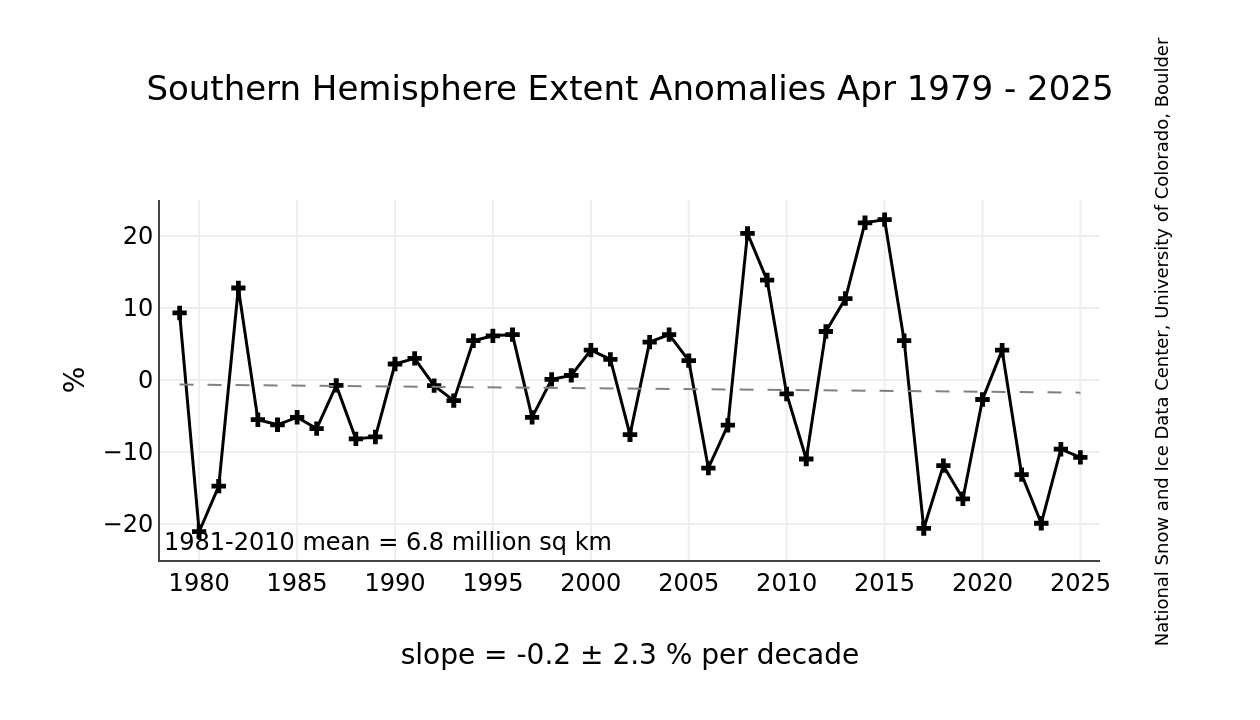
Turning our attention to Antarctica. Dr, Hansen predicted in 1980 that ice loss in Antarctica would be symmetrical to the Arctic. But the current thinking, as expressed by Dr. Meier, indicates that view is no longer valid. In fact, NSIDC data shows that Antarctic ice extent has actually increased substantially, as seen below.

http://www.epa.gov/climatechange/effects/downloads/Challenge_chapter2.pdf
It was reported last week that the IPY (International Polar Year) released a study claiming that both polar ice caps are melting “faster than expected.” Given that NSIDC shows Antarctica gaining ice at a rapid pace, I find myself surprised that IPY would release a study saying exactly the opposite. But then again, an IPY official reportedly forecast that last summer (2008) might have an “ice free Arctic.”
Columnist George Will reported that overall global sea ice area is normal, and was correct. Dr. Meier confirmed that on January 1 global sea ice levels were normal.
Walt Meier (16:04:59)
1. He (George Will) was factually incorrect on the date that he reported his “daily
global ice” number. However, he was merely out-of-date with his facts
(it was true on Jan 1, but wasn’t 6 weeks later).
The UIUC graph shows global ice levels well within one standard deviation of the 1979-2000 mean. Dr. Hansen was correct that according to global warming theory, both poles should be losing ice – though we know now it theoretically should be happening more slowly in the Antarctic. Yet 20 years later we actually see the Antarctic gaining ice, which is contrary to Dr. Hansen’s theory, contrary to IPY claims, and probably contrary to Steig’s questionable temperature analysis .
The main trend I see in polar ice is an increasing disconnect between hype and reality. Given that the AO (Arctic Oscillation) has been neutral this winter and polar drift has been less than last year, I forecast that the summer Arctic ice minimum in 2009 will show more ice than either of the last two years. What do you think?
The AGW hypothesis only exists in computer models and on paper. It may in fact exist, but if so it’s such a minor player that as CO2 rises, the temperature continues to fall. So who are we gonna believe, Joel Shore? Or our lyin’ eyes:
Who indeed? Click. for a less cherry-flavoured plot.
That plot is about as cherry-flavored as it gets.
Mark
John Philip
Perhaps you’d like to remind me how many weather stations the 1850 figure is based on and also explain to me the validity of a global temperature where the goalposts are being continually moved, changed or removed.
TonyB
Steve,
Thanks for bringing my attention to this article:
“Richard Kerr of Science magazine reports on a presentation at the recent fall meeting of the American Geophysical Union in a News Focus article entitled: ‘Galloping Glaciers of Greenland Have Reined Themselves In’”
I’m guessing you didn’t read it, just looked at the headlines, because the artilce doesn’t state that melt in Greenland has stopped and it goes on to state that there are real problems in Antarctica. Here are two of the more interesting paragraphs from the article:
‘A short-lived speed-up makes sense if something had given the glacers some sort of jolt at their lower ends, says glaciologist Richard Alley of Pennsylvania State University is State College. Two possiblities for a disturbance are the warmer air over southern Greenland in recent years and warmer coastal seawater. Either could have eaten away, weakened, and begun to break up the floating seaward ends of outlet glaciers, he says. That would have weakend the glacier’s grip on its bounding rock and sent a wave of glacier thinning and acceleration inland. But given time, a glacier would regain its footing-like a fighter rolling with a punch-thicken again, and slow down to its original speed he says.
…
Not that Greenland’s ice is safe, says Alley. “If you turn the thermostat too high, it will melt,” he notes. And the glaciers of the West Antarctic Ice Sheet (WAIS), some of which have already picked up speed, don’t have the shallow rocky underpinnings that allow Greenland’s glaciers to regain their equilibrium. “With nothing to hold on to,” he syas, “we think [WAIS] will run away.”‘
Joel Shore (14:18:39) :
I have no idea what you are saying here.
So I gathered.
I suggest that when you are in hole, stop digging. (You could just say, “Thank you for the clarification on how this terminology of positive and negative feedbacks is used.”)
You’re funny! I’m not in a hole my friend, I know what I’m saying. Honestly, I find your comment to be very condescending and frankly, I see no reason to thank you for it.
I suggest that rather than just honing in on one phrase, you concentrate on the entire sentences and paragraphs that I wrote. I explained this to you in three ways: First, by explaining the theoretical difference between what you can and can’t predict. Second, by explaining how this applies to climate model projections of future warming due to GHGs in particular. And, third, with an analogy, explaining how it applies to something that I think is a little less controversial, which is the notion of seasonal cycles in our climate.
I’m not sure what you’re getting at with the first sentence here. I did concentrate on the entire sentences and paragraphs as you suggest. I don’t see you point.
First: Theoretically, you can predict an outcome using climate models. There are thousands of predicted outcomes dependent on the tweaking of the parameters. As I said, what outcome do you take to be an accurate model?
Second: relates to First.
Third: Is a lame comparison as we are dealing with the tilt of the planet retaining varying daylight hours depending on the time of the year vs greenhouse gases. Come on Joel, I expected better than that.
I can well understand why Tamino would not have very much patience with you!
I don’t have much patience with Tamino either, so I’m not concerned. People want to believe that they can put new studies forwards to people like Tamino and not just get plain ignored. They want his input, to validate what is being proposed, to further their understanding. This is how science works, Joel. Maybe Tamino doesn’t want to talk to people like me because I’m inconvenient to cause, because I might challenge his beliefs. But lets just agree to disagree on this, mainly because I’m bored talking about him.
“So: Is there more, or less, TOTAL REAL ICE in ALL of Antarctica NOW than in the last few years? That’s NET of everything.”
Mass balance = accumulation – melt. So there is now less total real ice in all of Antarctica, around 100 billion tons each year, enough to raise sea levels by 0.5 mm per year.
And the melt is accelerating. Keep your eyes on the Admunsun sea area. That’s where the Pine Island and Thwaites glaciers drain.
John Philip (14:34:45) :
Who indeed? Click. for a less cherry-flavoured plot.
Come on John, don’t insult our intelligence. A plot from the LIA to now is the worst kind of cherry picking! Do you have a plot from the MWP or the Roman Optimum? That would be more credible.
Joel Shore (11:13:39) :
However, it does not make it difficult for me to say with confidence that the average temperature this July is extremely likely to be at least 20 C warmer than it was in January.
Just a nit pick here, true in the NH, False in the SH, False around the equator.
I wonder when the sea level rises will start?-Mike
Frank Lansner (15:26:11) :
OT (sorry, its just so interesting…!)
No change in ocean level around Denmark in 115 years…
http://www.dmi.dk/dmi/ebovandstand1.gif
I wonder how this squares with the satellite data?-Mike
One of the more interesting attributes of the weather atmospheric forecasting community is its evolutionary skill. As we have previously seen the “idea”of increased computer power and model integration is seen as the solution of the open problem of forecast, or predictive capabilities.
At first glance this would be seen as logically correct, however the atmosphere (weather –climate system) is a complex system not in thermodynamic equilibrium(often far from TDE) and in a perpetual state of reorganization .Here the rules of the game, where idealistic assumptions for the instantaneous state of the atmosphere are not valid when the equations of motion(transformation) to a future state are presently applied.
This is evident when seen in the evolution of the weather forecast model ability of the ECMWF.A widely used model producing forecasts in the range for a few days to a number of weeks. The preparation base is a n-day forecast with n= 10 days of the global atmospheric state.
In any forecast there is an error dependent on initial conditions (due to arbitrary assumptions/estimates of unknown qualities) with the ECMWF model over the last 20 or so years in a paradox the model error has increased.
In 1982 in a seminal paper in which ECMWF data was first used ,to measure predictive ability. Edward Lorenz found the mean error evolution (doubling time of initial error) was two days, presently has dropped to 1.2 days.
This suggest that there is a limiting of predictive capabilities for long range weather forecasting with models of increasing sophistication ,owing to interconnected complexity in the atmospheric dynamics.
Sensitivity to the initial conditions-the principle signature of deterministic chaos-is thus not an artifact arising from when lower order models are used but is, rather, deeply rooted in the physics of the atmosphere.
Nicolis and Nicolis Foundations of complex systems page 223.
Paul S:
It was not condescending. It was a fact that someone who writes “The climate system is not dominated by negative feedbacks. It’s not dominated by positive feedbacks either. If either one were dominant, then our fair planet would either be a snowball or a flaming inferno” must be confused about the terminology among other things. So, I politely pointed this out and explained it to you.
Yes…which might prevent us from predicting all the up-and-down jiggles in the climate. But, that is not what we are interested in. What we are interested in is the trend in the climate that is produced over a long enough period by a forcing such an an increase in GHG levels.
See, that’s the thing about analogies: they are about similar but not exactly the same thing. The tilt of the planet produces local variations in the solar forcing throughout the year and these have climatic effects. Just like it is possible to predict that the summer climate will be warmer than the winter climate by modeling this even though predicting the exact weather (or even whether the season will be unusually hot or cold) is more difficult because it is more strongly dependent on the initial conditions, so it is that it is possible to predict the general climatic response to greenhouse gas forcings even though it is more difficult to predict all of the exact jiggles up-and-down in the climate due, e.g., to ENSO.
Do I have to put “in Rochester” in every single sentence or can it be understood that since it was in the first sentence of the paragraph, I was continuing to use Rochester as an example throughout the paragraph?
Joel, I disagree with your summations, we are going round in circles and I bored with your constant misrepresentations of the science and how I’m perceived to understand said science.
Rochester, Australia
REPLY: Don’t be too hard on Joel, since he’s here almost 24/7 it appears WUWT is all he has. – Anthony
“Those who have knowledge, don’t predict. Those who predict, don’t have knowledge. ”
–Lao Tzu, 6th Century BC Chinese Poet
“Prediction is very difficult, especially if it’s about the future.”
–Nils Bohr, Nobel laureate in Physics
“An unsophisticated forecaster uses statistics as a drunken man uses lamp-posts – for support rather than for illumination. ”
–After Andrew Lang
“An economist is an expert who will know tomorrow why the things he predicted yesterday didn’t happen today. ”
–Evan Esar
“If you can look into the seeds of time, and say which grain will grow and which will not, speak then unto me. ”
–William Shakespeare
“Forecasting is the art of saying what will happen, and then explaining why it didn’t! ”
–Anonymous (communicated by Balaji Rajagopalan)
“If you have to forecast, forecast often. ”
–Edgar R. Fiedler in The Three Rs of Economic Forecasting-Irrational, Irrelevant and Irreverent , June 1977.
“Forecasting future events is often like searching for a black cat in an unlit room, that may not even be there. ”
–Steve Davidson in The Crystal Ball.
” I never think of the future, it comes soon enough. ”
— Albert Einstein
I believe that the above quoted gentlemen have a much better grasp of the trustworthiness of predictions, whatever they are based upon, than global climate modelers do…
Tony B says:
First of all, the no-feedbacks value is around 1.0 to 1.2 C. I haven’t seen the 0.6 C anywhere. Second of all, the IPCC estimate for equilibrium climate sensitivity is that it is likely between 2 to 4.5 C. (Hansen has mentioned 6 C over the longer term due to land ice melt and the resulting albedo feedback…but I am not sure that such a value is generally accepted.) Finally, I don’t think intuition is a good guide here unless the intuition is grounded in experience or other knowledge…and since the feedbacks are independent of what actually causes the initial forcing, I don’t see what the issue about CO2 being a trace gas that is not the main greenhouse gas comes into it. In fact, one of the major feedbacks involves water vapor, which is the main greenhouse gas.
To be honest, everyone has their areas they like to read up more or less on and this is an area that I haven’t really kept up with in detail as it has not been one of the more compelling questions in my view. As I understand it, the current view based on proxy data is that the Northern Hemisphere temperatures are likely the warmest that they have been in at least the past 1300 years. Obviously, there are issues with proxy data…but that is the way it is interpretted currently. (Note that this does not mean that certain regions, especially the North Atlantic, have not had periods of greater warmth during this time. However, the evidence is that the periods of warmth in various different places was not that well synchronized so that the total hemispheric warmth at any one time was less pronounced.) Data for the Southern Hemisphere is more scarce.
Going back further, it is believed that several thousand years ago, there was some greater warmth…at least in some regions…although it seems like we will likely overtake this in a matter of a few decades. (Again…This is based on my minimal reading of the literature in this area.)
Going back to the Bronze Age is far enough back for there to be a difference in the orbital parameters (see Milankovitch forcing). The more recent episodes such as the Medieval Warm Period and Little Ice Age were likely due to variations in solar forcing, in the frequency of major volcanic eruptions, and perhaps a small degree of internal variability. Unfortunately, we are still struggling to determine the various forcings (such as solar) over time accurately enough to nail this down.
Note that CO2 is not the only forcing around. It just happens to now have become the dominant one because of the very rapid (on a geological timescale for sure) rise in its level in the atmosphere.
Yes. The data aren’t perfect but scientists have been able to able to obtain a fairly accurate and consistent picture. It is not quite as bad as you might imagine since the temperature anomaly field has much nicer properties than the temperature field itself and maintains a significant positive correlation over fairly significant distances. (See “Anomalies and Absolute Temperatures” here: http://data.giss.nasa.gov/gistemp/ ) We also have verification of the temperature record by other means…e.g., from the history of glaciers, from borehole analysis, and since 1979 from satellite data.
Arctic ice is getting very close to the 1979-2000 mean, in all basins.
http://nsidc.org/data/seaice_index/images/daily_images/N_daily_extent.png
Paul S says:
Whatever. I now definitely understand why you feel about Tamino the way you do. He is probably less patient than I am (being as smart as he is, he tolerates foolishness less well than I do)…And you are definitely very trying on a very patient person.
Well, if you were honestly confused about which Rochester I was talking about when I said “here in Rochester”, would have it not been easier to ask or note the need for the clarification rather than post a snarky comment?
Smokey, since I seem to be wearing out my welcome here, I will restrict my comments to your last post to just a few things. First of all, I am sad to see that no amount of explanation can keep you from continuing to link to deceptive graphs whose issue have been explained to you many times. Second of all, it might interest you to know that AGW proponents do not assert that CO2 was steady at 280ppm over timescales of hundreds of millions of years.
Since you gave me similar advice, I might point out to you the WUWT is a small and very self-selected part of the blogosphere and even a smaller part of the whole universe. I think if you actually tried posting at a site that wasn’t filled with people already sympathetic to your point-of-view (let alone one that was actually filled with people that had quite a bit of animosity toward your point-of-view), you might find it an enlightening and somewhat humbling experience. Believe me, the sort of arguments that you use here won’t give you a lot of credibility out there!
Cryosphere Today posted a PDF on the main page titled,
Statement related to Daily Tech article of January 1, 2009
Those guys must be dizzy from all the spinning…
Also, still no images from 2009 on the Comparison Product.
How embarrassing…
Steven Goddard (17:53:09) :
Arctic ice is getting very close to the 1979-2000 mean, in all basins.
http://nsidc.org/data/seaice_index/images/daily_images/N_daily_extent.png
Looks more like about -2 STD from the 1979-2007 mean.
http://arctic-roos.org/observations/satellite-data/sea-ice/ice-area-and-extent-in-arctic
Phil,
Look carefully at the map, and tell me where you think the missing ice is? Remember, never trust your own eyes when you can instead trust the three day old graph you linked to.
If the current trend continues, Arctic ice will be at the 1979-2000 mean in about a week, and George Will will have a field day with his clueless detractors.
http://nsidc.org/data/seaice_index/images/daily_images/N_timeseries.png
Yes. But even so it is immensely bigger and more credible, in addition to being far more fair, even-handed and honest, than the George Soros-bankrolled RealClimate, Tamino, etc.
And like numerous other posters here, I have tried to post facts contrary to the AGW/CO2 hypothesis at those sites — and I’ve been deleted without explanation by the insecure owners of those wannabe-Best Science sites. But you get to post here non-stop 24/7. See the difference?
Finally, it’s amusing to see you claim the charts and graphs I’ve posted are “deceptive” — when you didn’t utter a peep about John Philip’s chart @14:34:45. [Try changing the units in that chart from tenths of a degree to degrees, or start the ppm of CO2 at zero on the y-axis, and you’ll see what I mean.]
Joel, when you can demonstrate through solid, real world, empirical evidence that the climate is acting differently now than it has for the past couple of millenniums, I will certainly sit up straight and listen. But “what if” scenarios don’t cut it. To mix metaphors, show me the money, because I’m a doubting Thomas. The proof of the pudding is in the eating. Put up or shut up. I’m from Missouri, etc.
Where’s the runaway global warming? Where’s the tipping point? Where’s the warming??
Show me.
Did a quick plot on the NSIDC charts today. Looks like the Antarctic is up by .2 and Arctic down by 0.5. So we are down at this point 0.3 M sq. km. net, within the range of variance. So much for major sea level rises.
Forgot one more item. The NATICE.NOAA Great Lakes section noted today that Lake Superior is no longer “ice free”. There is a thin sliver of open water (~5% ice), on the eastern end of the lake. The rest is solid ice (90-100%). For those who know Lake Superior, this does not happen often.
To support Smokey, the “what if’s” really are stale. I am reminded of the crude saying, “If my aunt had testicles, she’d be my uncle.”
Maybe it is crude and trite, but it says a lot about that hackneyed state of the myriad of unsupported climate “what ifs.”
[Mods you can nuke this if it’s off base. ☺]