Guest post by Steve Goddard
Yesterday, Dr. Walt Meier from NSIDC again graciously updated us about the NSIDC sensor problem, and also about his current thinking with respect to polar ice trends. The key concepts being that Arctic ice continues to decline, and that Arctic and Antarctic ice are separate entities – so the current near normal global sea ice area “has no meaning in terms of climate change.” This article examines both of those concepts.
NSIDC is still having sensor problems on their satellite, as seen below on 2/28/09. Note the speckled white areas, and the large dark gray sliver in the Sea of Okhotsk near the top.
http://nsidc.org/data/seaice_index/images/daily_images/N_daily_extent_hires.png
Fortunately there is another ice extent data source, AMSR-E which has not suffered sensor problems and their data is unaffected. NSIDC also explains on their web site that “AMSR-E has a lower absolute error” than the NSIDC sensors, even when functioning properly. AMSR-E (below) has been recording sea ice since 2002. The maximum ice extent for 2009 (red) and 2008 (orange) are both in the top three on the AMSR-E record, at more than 14M km2. The only year which had greater ice extent than the last two years was 2003. So clearly we are on a recent trend of higher Arctic ice maximums, which is a fact that is rarely if ever reported by the main stream media. Also note in the NSIDC map above, all of the ice basins are close to the 1979-2000 normal.
If there is a dramatic downwards trend in maximum Arctic extent, it certainly isn’t visible in either the map or the graph.
 http://www.ijis.iarc.uaf.edu/seaice/extent/AMSRE_Sea_Ice_Extent.png
The NSIDC graph below also shows Arctic ice extent nearly back to the 1979-2000 mean.

http://nsidc.org/data/seaice_index/images/daily_images/N_timeseries.png
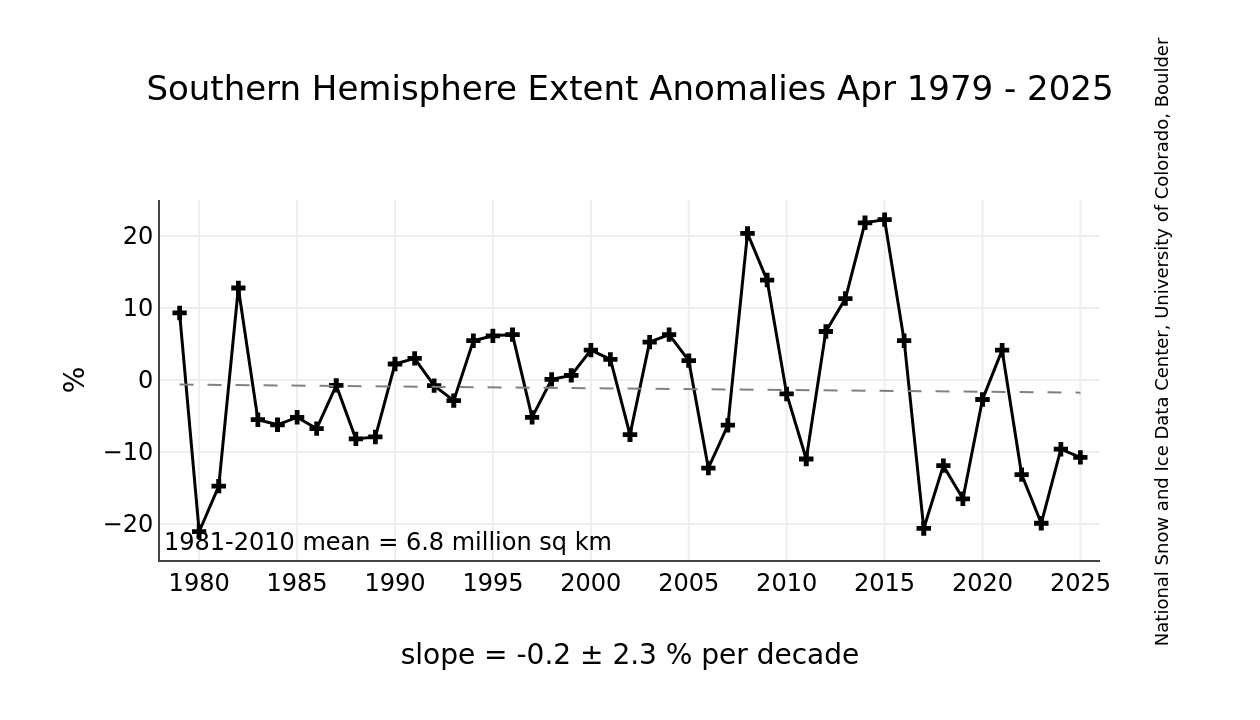
Turning our attention to Antarctica. Dr, Hansen predicted in 1980 that ice loss in Antarctica would be symmetrical to the Arctic. But the current thinking, as expressed by Dr. Meier, indicates that view is no longer valid. In fact, NSIDC data shows that Antarctic ice extent has actually increased substantially, as seen below.

http://www.epa.gov/climatechange/effects/downloads/Challenge_chapter2.pdf
It was reported last week that the IPY (International Polar Year) released a study claiming that both polar ice caps are melting “faster than expected.” Given that NSIDC shows Antarctica gaining ice at a rapid pace, I find myself surprised that IPY would release a study saying exactly the opposite. But then again, an IPY official reportedly forecast that last summer (2008) might have an “ice free Arctic.”
Columnist George Will reported that overall global sea ice area is normal, and was correct. Dr. Meier confirmed that on January 1 global sea ice levels were normal.
Walt Meier (16:04:59)
1. He (George Will) was factually incorrect on the date that he reported his “daily
global ice” number. However, he was merely out-of-date with his facts
(it was true on Jan 1, but wasn’t 6 weeks later).
The UIUC graph shows global ice levels well within one standard deviation of the 1979-2000 mean. Dr. Hansen was correct that according to global warming theory, both poles should be losing ice – though we know now it theoretically should be happening more slowly in the Antarctic. Yet 20 years later we actually see the Antarctic gaining ice, which is contrary to Dr. Hansen’s theory, contrary to IPY claims, and probably contrary to Steig’s questionable temperature analysis .
The main trend I see in polar ice is an increasing disconnect between hype and reality. Given that the AO (Arctic Oscillation) has been neutral this winter and polar drift has been less than last year, I forecast that the summer Arctic ice minimum in 2009 will show more ice than either of the last two years. What do you think?
@joel Shore (06:01:59) : “It’s not that difficult to answer actually. The water vapor feedback is positive enough to magnify the warming. However, it is not of sufficient magnitude to create an instability. The distinction basically is the distinction between a diverging geometric series like … and a converging one.”
That is not my understanding of positive feedback. A simple example of positive feedback would be population growth. The growth rate will depend on the characteristics of the critters involved — mice have multiple births every few weeks; elephants have a single birth once every few years. But, the curve of the population size always has an increasing slope, because it is exponential. Population growth is always stopped by a negative feed back, such as predation or food scarcity.
If water vapor in the atmosphere is the most abundant, and important greenhouse gas, (see the figure in Steve Goddard’s post of a few days ago), and if warmth causes the amount of water vapor in the atmosphere to increase, which it does, what provides negative feedback to limit that effect? If nothing does, why doesn’t the effect of the water vapor go exponential and autoclave the whole planet?
Like I said, my role here is just asking stupid questions.
Sgteven Goddard wrote
If the current trend continues, Arctic ice will be at the 1979-2000 mean in about a week, and George Will will have a field day with his clueless detractors.
http://nsidc.org/data/seaice_index/images/daily_images/N_timeseries.png
And I say no chance !
£5 bet to the charity of your choice or mine?
Regards
Andy
Joel
As far as I am concerned you haven’t worn out your welcome here-if there is to be a scientific debate it is important to haver someone you can debate with! That is not possible when mostly everyone else here agrees with my own point of view. The more rational bloggers such as yourself and Mary Hinge are very welcome as far as I am concerned.
I said in part earlier;
“Can I ask you a direct question-Do you believe our current temperatures and current ice melt is unprecedented in mans recorded time on earth? I will assume you know enough about history to say no (but if you believe otherwise please say so).”
You replied (in part);
“To be honest, everyone has their areas they like to read up more or less on and this is an area that I haven’t really kept up with in detail as it has not been one of the more compelling questions in my view.”
As a historian, this is my main area (apart from sea levels) and surely the question”Have we been this way before” is at the very heart of the AGW debate? Closely tied in to this belief that everything these days is ‘unprecedented’ when it’s not, is the notion that we can parse fractions of a degree back to 1850 to demonstrate that temperatures are rising (marginally)
Can I again ask you some direct questions?
1) If you were to be presented with evidence that demonstrated that we have been this way before throughout our recorded history, would that give you pause for serious thought?
2) If you were to become convinced that the 1850 records-based on a tiny number of unreliable and ever changing surface records- were not a scientific basis on which to ‘prove’ a warming hypotheses, would that give you pause for serious thought?
Incidentally, I don’t know if you caught my post on the other thread thanking you for one of your links which appears to show that Charles Keeling believed the 1800 year tide cycle was of more consequence than co2 in forcing our climate?
Thanks for your time here
TonyB
Fat Man says:
The answer is because the feedback is not strong enough. Let me expand in more detail on my statement about the distinction between a diverging and converging geometric series: Let’s assume that the first-order effect for the water vapor feedback on a 1 degree rise in temperature is to produce an additional 1/2 degree rise in temperature (which is an approximately realistic figure). This means that if the temperature of the atmosphere rises by 1 C due to an increase in CO2 levels, solar irradiance, or whatever, then this 1 C rise will cause enough of an increase in water vapor to produce an additional rise of 1/2 C.
However, you will now say, “But, wait! It doesn’t stop there because now this 1/2 C rise in temperature will cause an additional increase in water vapor.” And, indeed you are correct…The increase in water vapor due to the 1/2 C rise will cause an additional 1/4 C rise. And, then the increase in water vapor due to this 1/4 C rise will cause 1/8 C rise. And, you could continue this ad infinitum.
However, what is important to realize is that the sum of the infinite series 1 + (1/2) + (1/4) + (1/8) + (1/16) + … is not itself infinite. In fact, it is equal to 2. So, at the end of the day, the initial 1 C rise is magnified by a factor of 2 by the water vapor feedback. There is no negative feedback needed to stop the water vapor feedback…It is simply not strong enough to do anything more than double the effect of the initial perturbation.
Of course, if we had assumed instead that the first order effect of the water vapor feedback on a 1 degree rise in temperature is to produce an additional rise of greater than 1 deg, say 1.5 degrees, then we would instead have a diverging series [1 + 3/2 + (3/2)^2 + …]. This would be a true instability and lead to the sort of exponential divergence that you were worrying about that could only be stopped by some negative feedback (or the positive feedback weakening to the point where it no longer produced a first-order effect greater than the original cause). This is the situation that presumably occurred on Venus but is, fortunately, not the situation that we face here on earth (modulo some recent claims from James Hansen in regards to positive feedbacks in the carbon cycle itself if we really go-to-town with our burning fossil fuels…But at this point, I don’t think many people can say with certainty exactly what Hansen is talking about).
Of course, you still have yet to invent a method that increases the energy, i.e., where the “gain” due to feedback comes from, to keep from violating the law conservation of energy. It is all nonsense, Joel. The only thing that can happen is an imbalance between incoming and outgoing energy (to the earth) plus work.
Basic physics indeed.
Mark
Of course, if we had assumed instead that the first order effect of the water vapor feedback on a 1 degree rise in temperature is to produce an additional rise of greater than 1 deg, say 1.5 degrees, then we would instead have a diverging series [1 + 3/2 + (3/2)^2 + …]. This would be a true instability and lead to the sort of exponential divergence that you were worrying about that could only be stopped by some negative feedback (or the positive feedback weakening to the point where it no longer produced a first-order effect greater than the original cause).
This is impossible in a passive system, Joel. You do understand that, right?
Mark
Smokey says:
Well, I guess that depends on where you sit. I doubt you would find more than a handful of climate scientists actively working in the field who would agree with this.
Well, I do give Anthony credit for having a relatively open posting policy. However, without knowing the details of what has been deleted on the sites that you speak of, I can’t comment on their policy. I have certainly seen quite a few “skeptical” comments on those sites. And, I also might note that even here, those of us espousing our point of view have to put up with a considerable amount of name-calling such as use of the term “alarmists” whereas we have to be very careful of the terms that we can use.
You are just inventing silly arbitrary reasons why you think that chart is deceptive. Those are distinguishable from REAL scientifically-justifiable reasons. In fact, that chart is quite informative…It plots temperatures over the full range of the available global temperature record (which is also most of the range over which CO2 has been rising significantly) and it uses a relative temperature and CO2 scale that would correspond to a transient climate response of about 2.4 C / doubling, which is a realistic number if not even a little on the high side of the best estimate.
Mark T says:
There is a source of energy, Mark. It is a star that we commonly refer to as “the sun”.
Yes…The greenhouse effect indeed causes an imbalance between incoming and outgoing energy, which cause the earth to warm until such a point as the balance is again restored (by the Stefan-Boltzmann T^4 law).
Trend of Arctic Ice extent for month of February:
http://nsidc.org/images/arcticseaicenews/200903_Figure3.png
Still shows a decreasing trend (if their measurements are accurate…)
There is a source of energy, Mark. It is a star that we commonly refer to as “the sun”.
Alright, I made this clear TWICE now but you clearly do not understand. The sun is the source of the INPUT to the system, you need to provide a mechanism to “amplify” the energy supplied by the sun. Get it? Try to think rationally and read what I have said, it is basic physics: the sun supplies X amount of energy, the earth (system) can retain that energy (a mechanism similar to an RC circuit), or expel that energy. In any case, the most that energy can increase is represented by the gain of a STABLE feedback system. In order to increase that energy above and beyond what is simply stored, there needs to be another source of power, i.e., something other than the sun.
Yes…The greenhouse effect indeed causes an imbalance between incoming and outgoing energy, which cause the earth to warm until such a point as the balance is again restored (by the Stefan-Boltzmann T^4 law).
BINGO! That’s a first order system with a feedback constant of less than unity – a basic physical concept, devoid of any divergence. Now, again, what is the source that allows the divergent behavior you explained in your quote above?
Mark
The point you don’t get Joel, is that there needs to be some other source of power besides the sun to do this:
Of course, if we had assumed instead that the first order effect of the water vapor feedback on a 1 degree rise in temperature is to produce an additional rise of greater than 1 deg, say 1.5 degrees.
I dare you to find that source. Keep in mind, you cannot void the laws of thermodynamics. Really, I dare you.
Mark
Mark T, while I’m not a fan of Joel, in the case in the case of a hypothetical positive water vapor feedback, Joel is right and you are wrong. Think of the added water vapor as simply decreasing the Earth’s albedo. No additional source of energy necessary.
jeez says:
However, a hypothetical does not a reality make, and the devil is always in the details.
I think that there is a race between the additional outgoing LWR absorption by H2O in the atmosphere and the increase in albedo that clouds produce along with the increased transport of energy to higher places in the atmosphere where some (perhaps a great deal) can be radiated upwards when that H2O undergoes a phase change.
I don’t agree that the hypothetical positive feedback exists. I was merely correcting incorrect understandings of such.
Mark: Of course, in the real world, the divergence doesn’t continue forever. Have I or anyone else ever claimed that Venus is at infinite temperature? (In fact, in a previous thread I had to explain to someone why it was incorrect to believe that if Venus has had a greenhouse effect instability, we should see its temperature continuing to rise today.)
Think of a rigid-rod pendulum. If you turn it upside-down and try to balance it there, you will find this very hard because that is a point of unstable equilibrium. However, once it starts swinging, it won’t run off to infinity and, in fact, in any realistic system with friction, it will eventually settle down to the stable equilibrium point at the bottom.
You are arguing points that the scientific community (including myself) understands. At best you have some quibbles over pedagogy which you are amplifying to try to make it appear that the scientists don’t know what they are talking about. They / we may not be thinking about it in exactly the narrow confines of your system theory / control theory point-of-view but they / we have the science right.
Mark T, while I’m not a fan of Joel, in the case in the case of a hypothetical positive water vapor feedback, Joel is right and you are wrong. Think of the added water vapor as simply decreasing the Earth’s albedo. No additional source of energy necessary.
Sorry, but you are both wrong and I’ll explain. First, both of you are missing my point, and simply decreasing the albedo merely serves to increase the imbalance between input and output. No amplification, just a simple change in the flux. Here’s a technical explanation of what I’m referring to:
Given an input X and output Y, for a first order system indexed at time n the relevant input/output relationship for a first order, single pole system can be expressed as
Y(n) = X(n) + a*Y(n-1)
The transfer function, i.e., the function that relates the input X to the output Y is found as:
Y(n) – a*Y(n-1) = X(n)
then taking the z-transform we have
Y(z) – a*z^-1*Y(z) = X(z)
Y(z) * (1 – a*z^-1) = X(z)
H(z) = Y(z)/X(z) = 1/(1 – a*z^-1)
where z is a delay element (immaterial how large for this point). You can clearly see the 1/(1-a) magnitude component that I’ll admit Joel understands.
This is intentionally simple, but exactly what is being described. The feedback term a is positive always, so questions of “positive” or “negative” feedback revolve solely around whether there is a + or – in the above equation(s). Now, this equation simply says that at time n, the input X is added to the output Y from time n-1, after it is multiplied by constant a.
If a is less than unity the system is unconditionally stable. This is the same as saying that all of the energy stored at time n-1 fed back into the system at time n, but there is some loss along the way (due to work, for example). If a is unity the system is conditionally stable, i.e., it is stable only at certain frequencies, then this equation says that all of the energy stored in the system at time n-1 is fed back into the system at time n. Simple enough. If a is greater than unity, then the system is unstable. Joel seems to understand this, too. 2 for 2 so far.
However, this is where both Joel and you go wrong, jeez. In last example, this is the same as saying that all the energy in the system at time n-1 is added back into the system at time n, but increased by a factor of a-1, i.e., there’s a-1 additional units of energy that were created above and beyond what was added by the input. Say for example that a = 2, and at time n=0 s there are 100 units of energy in the system (Joules, actually) and the input is 100 Joules every second (Watts). Plugging and chugging for time n-1 you get:
Y(1) = X(1) + 2*Y(n-1) = 100 + 2*100 = 300
Now, we just added 100 J to the system, yet somehow there are 200 extra J in the system. We just created energy in violation of the 2nd law of thermodynamics. This is what I mean when a MUST be less than unity.
Joel and you are wrong simply because this is not possible, at least, not without an additional energy source. Feedback is not an energy “source,” it merely operates on existing energy.
This is a simple concept, twice I’ve tried to explain. If you cannot be bothered to research the physical implications of your statements, then I’m sorry, but you aren’t interested in the truth.
Mark
Yes the hypothetical feedback simply modifies the flux and the radiative equilibrium.
That last equation should have had a 0 instead of n-1, i.e.:
Y(1) = X(1) + 2*Y(0) = 100 + 2*100 = 300
Mark
Oh, also, first law of thermodynamics. That’s what happens when you don’t review before submitting.
Mark
Yes the hypothetical feedback simply modifies the flux and the radiative equilibrium.
Exactly. Oh, and jeez, I was not referring to you when I mentioned not wanting to learn the truth…
Mark
Mark,
There is something that is getting messed up in the translation between the world of the climate system and your world of control theory that is causing some miscommunication. I can’t right now figure out why your translation into the control theory lingo is yielding something that you say is impossible within that framework. And, part of it may have to do with the way the term “feedback” is being used to mean subtley different things in the two fields.
Could you be clearer on what you think physically cannot happen in the climate system world? For example, are you saying that a greenhouse effect instability such as is believed to have happened on Venus cannot occur and therefore that the current theory of what happened on Venus is incorrect? Or, are you just saying that the temperature won’t continue rising forever (which I think we will all agree on)?
Richard Sharpe:
Well, I think we all basically agree that an instability involving the water vapor feedback is not in the cards for the Earth. So, the question is necessarily a hypothetical one…although it can be made more concrete by talking about the case of Venus where in fact such an instability is believed to have occurred in the past.
Joel
I understand that you appear much more comfortable with theoretical science than historical facts, but bearing in mind that I’m generally pretty nice to you I would appreciate an answer to my earlier post repeated for your convenience
“I said in part earlier;
“Can I ask you a direct question-Do you believe our current temperatures and current ice melt is unprecedented in mans recorded time on earth? I will assume you know enough about history to say no (but if you believe otherwise please say so).”
You replied (in part);
“To be honest, everyone has their areas they like to read up more or less on and this is an area that I haven’t really kept up with in detail as it has not been one of the more compelling questions in my view.”
As a historian, this is my main area (apart from sea levels) and surely the question”Have we been this way before?” is at the very heart of the AGW debate? Closely tied in to the AGW belief where everything these days is ‘unprecedented’ when it’s not, is the notion that we can parse fractions of a degree back to 1850 to demonstrate that temperatures are rising (marginally)
Can I again ask you some direct questions?
1) If you were to be presented with evidence that demonstrated that we have been this way before throughout our recorded history, would that give you pause for serious thought?
2) If you were to become convinced that the 1850 records onwards-based on a tiny number of unreliable and ever changing surface records- were not a scientific basis on which to ‘prove’ a warming hypotheses, would that give you pause for serious thought?
Incidentally, I don’t know if you caught my post on the other thread thanking you for one of your links which appears to show that Charles Keeling believed the 1800 year tide cycle was of more consequence than co2 in forcing our climate?
Thanks for your time here
TonyB
Mark T says:
I suspect that the AGW crowd thinks that the gain is so close to 1 that CO2 can push it over the edge into instability.
Since the atmospheric pole temperatures remain cold enough to freeze alcohol (don’t go there, I am just trying to make a point), melt is likely caused by wind and sea temperature sources. Has the wind pattern been unusual in the Arctic? Yes. Strong patterns pushed a LOT of old multi-year ice out to warmer temperatures, leading to a fresh and more abundant supply of thinner less aged multi-year ice. Has the Atlantic source Arctic Oscillation been in its warm phase? Yep again. That should, by itself, predict thinner ice. Why is this such a puzzle? There are well understood natural processes at work that have great affects and that can be modeled. It isn’t as glamorous as CO2 and it would be hard to convince people to tax the Earth Goddess, whatever her name is (Gia? Gaia?).
Back to the topic of Northern Hemisphere sea ice extent, I done a few more charts and (understanding that the Southern Hemisphere sea ice is increasing and seems to have already reached the peak melt-back this year, one month ahead of schedule) …
Here is the monthly NH sea ice extent data back to 1972.
http://img519.imageshack.us/img519/7721/nhseitotalsa.png
I imagine someone could produce a model which shows there will be no sea ice at the pole on September 10th, 30 years from now, but I wouldn’t believe it.
Here is the seasonally-adjusted NH sea ice extent.
http://img519.imageshack.us/img519/9072/nhsaseaiceextent.png
Here is the anomaly chart.
http://img230.imageshack.us/img230/894/nhseanom72.png
Here is the average seasonality in the NH sea ice extent. One might want to print this chart out and keep track of where we are each month when the NSIDC puts out the monthly data a few days after month end.
http://img14.imageshack.us/img14/1042/nhseisa.png
Here are a number of selected years. Note we are now at a slightly higher sea ice extent than 1974 for example. 1979 was the highest sea ice extent year although 1996 beats it out for the lowest melt-back.
http://img264.imageshack.us/img264/6061/monthlynhsiebyyear.png
There are a number of recent papers which propose the NH sea ice extent is driven by the AMO and there is certainly a suggestive (although not clear enough) relationship between the two. The AMO has recently gone negative for the first time on a sustained basis since 1994.
http://img15.imageshack.us/img15/8510/nhse72anomamo.png
TonyB:
As a physicist, I haven’t found this the most interesting question. It is certainly of some interest…but ultimately it doesn’t tell us that much. For one thing, as evidence in favor of AGW, it is pretty circumstantial (i.e., one could argue that the fact that it is warmer now than it has been in 1300 years is a coincidence). For evidence in understanding climate variability, there seems to be enough uncertainty in the natural forcing variations (such as solar) to tell us that much. You learn more from, say, the ice age – interglacial transitions where forcings and temperature changes can actually be better estimated (because they are larger).
I’m not saying that I am not in favor of its being studied…It just doesn’t tend to be the area that I am attracted to reading a whole lot about.
As answered in my post above, I don’t think this tells you that much without also having better knowledge of the forcings during that time. Of course, we are better able to measure today how the solar irradiance is changing…so we have more confidence in saying whether or not we believe it to be a factor now than we can say about back then when we only have some proxy data for solar variations.
I think there is a reason why the IPCC concluded that the warming since 1850 is “unequivocal” and that is because it is seen from such a diversity of different pieces of data, not just the instrumental temperature record.
I’m not sure which link of mine that was in. [I linked to a few different things…including a Newsbuster article, which is not usually my favorite source of info, but was useful because it actually contained a less cherry-picked list of popular media articles than was in the IBC(?) report.] I did go to google and glance at the Keeling paper from around ~2000 that you seem to be talking about and it didn’t really look like he was claiming it to be that much of an either-or thing, i.e., he was suggesting that there might be some cycles on top of the general warming trend due to CO2 but I didn’t have the time to read it in much detail.
Thank you for your supportive words. And, just as an FYI, I am going to be mainly away from my computer for the next several days, so please don’t take it personally if I am not able to respond.
Richard Sharpe:
I haven’t heard that argument made, have you? It certainly is not what the IPCC is basing their projections on. (It could have something to do with Hansen’s thinking when he talks about the possibility of some sort of runaway, but my impression is that he was more concerned about large carbon cycle feedbacks…which I suppose you can lump together with this in a way, but I would tend to think of them as somewhat distinct.)
Mark T: I haven’t found the time to think much more about the issues that you raised with your control theory statement of the problem. One thing that did occur to me that could be a source of confusion though: The use of the term “feedbacks” in climate science is sort of at a meta-level that is a level removed from actual energy in – energy out considerations. I.e., the question being asked is the feedback on the change to the EQUILIBRIUM temperature…The fact that such an equilibrium temperature does exist at each stage is due to the Stefan-Boltzmann Eqn., which can probably be thought of as a strong negative feedback down at the energy in – energy out level. So, there are sort of two different levels of discussion here from a control theory point-of-view…and hence the potential for confusion.
At any rate, I am quite confident that once you iron it all out, you will find that the standard understanding of the feedback effects, including ones strong enough to lead to a runaway instability on Venus, do not violate the Laws of Thermodynamics. I think if such a violation did occur, it would have been already obvious before any translation into the control theory lingo…I think instead any problem is in the translation.
Mark T you need to rethink your analysis.
Consider the following:
You have a black surface and shine a visible light on it (100 units), the temperature of the surface will rise until it emits 100 units to achieve balance.
Now put a dichroic mirror (transmits 100% visible, reflects 50% IR) between the light source and the surface. The surface temperature will rise until the IR leaving the mirror balances the incoming, at that point 200 units are leaving the surface, 100 units are being reflected, and 200 are incident on the surface (100 vis, 100 IR).