Guest post by Steve Goddard
Yesterday, Dr. Walt Meier from NSIDC again graciously updated us about the NSIDC sensor problem, and also about his current thinking with respect to polar ice trends. The key concepts being that Arctic ice continues to decline, and that Arctic and Antarctic ice are separate entities – so the current near normal global sea ice area “has no meaning in terms of climate change.” This article examines both of those concepts.
NSIDC is still having sensor problems on their satellite, as seen below on 2/28/09. Note the speckled white areas, and the large dark gray sliver in the Sea of Okhotsk near the top.
http://nsidc.org/data/seaice_index/images/daily_images/N_daily_extent_hires.png
Fortunately there is another ice extent data source, AMSR-E which has not suffered sensor problems and their data is unaffected. NSIDC also explains on their web site that “AMSR-E has a lower absolute error” than the NSIDC sensors, even when functioning properly. AMSR-E (below) has been recording sea ice since 2002. The maximum ice extent for 2009 (red) and 2008 (orange) are both in the top three on the AMSR-E record, at more than 14M km2. The only year which had greater ice extent than the last two years was 2003. So clearly we are on a recent trend of higher Arctic ice maximums, which is a fact that is rarely if ever reported by the main stream media. Also note in the NSIDC map above, all of the ice basins are close to the 1979-2000 normal.
If there is a dramatic downwards trend in maximum Arctic extent, it certainly isn’t visible in either the map or the graph.
 http://www.ijis.iarc.uaf.edu/seaice/extent/AMSRE_Sea_Ice_Extent.png
The NSIDC graph below also shows Arctic ice extent nearly back to the 1979-2000 mean.

http://nsidc.org/data/seaice_index/images/daily_images/N_timeseries.png
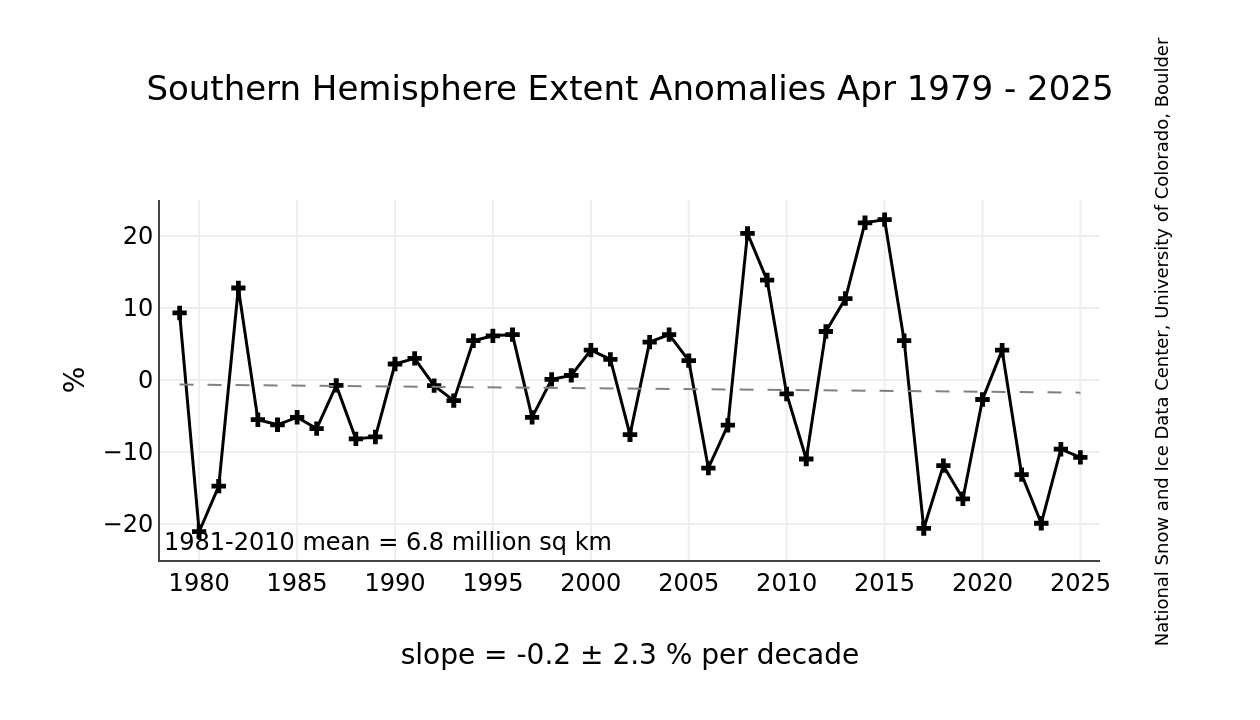
Turning our attention to Antarctica. Dr, Hansen predicted in 1980 that ice loss in Antarctica would be symmetrical to the Arctic. But the current thinking, as expressed by Dr. Meier, indicates that view is no longer valid. In fact, NSIDC data shows that Antarctic ice extent has actually increased substantially, as seen below.

http://www.epa.gov/climatechange/effects/downloads/Challenge_chapter2.pdf
It was reported last week that the IPY (International Polar Year) released a study claiming that both polar ice caps are melting “faster than expected.” Given that NSIDC shows Antarctica gaining ice at a rapid pace, I find myself surprised that IPY would release a study saying exactly the opposite. But then again, an IPY official reportedly forecast that last summer (2008) might have an “ice free Arctic.”
Columnist George Will reported that overall global sea ice area is normal, and was correct. Dr. Meier confirmed that on January 1 global sea ice levels were normal.
Walt Meier (16:04:59)
1. He (George Will) was factually incorrect on the date that he reported his “daily
global ice” number. However, he was merely out-of-date with his facts
(it was true on Jan 1, but wasn’t 6 weeks later).
The UIUC graph shows global ice levels well within one standard deviation of the 1979-2000 mean. Dr. Hansen was correct that according to global warming theory, both poles should be losing ice – though we know now it theoretically should be happening more slowly in the Antarctic. Yet 20 years later we actually see the Antarctic gaining ice, which is contrary to Dr. Hansen’s theory, contrary to IPY claims, and probably contrary to Steig’s questionable temperature analysis .
The main trend I see in polar ice is an increasing disconnect between hype and reality. Given that the AO (Arctic Oscillation) has been neutral this winter and polar drift has been less than last year, I forecast that the summer Arctic ice minimum in 2009 will show more ice than either of the last two years. What do you think?
Addendum:
(1) Davis et al, published by Sciencexpress/www.sciencexpress.org/science.1110662
I am so glad the poll was put in place. The results will settle once and for all whether the ice is coming or going. Skeptics have been hard pressed to counter the AGW crowd’s religious beliefs with only facts in their arsenal. The poll results will prove the AGW crowd wrong, using their own methods.
One must take care not to be seen in public waving the poll about. Save it as your super weapon for brandishing in private discussions only.
Walt Meier 9:59:52
If there is a concern about preserving Polar Bears why not just stop hunting them? I’ll wager that there were a whole lot more Polar Bears who died died last year of gunshot wounds than died because the ice they were diving off of was 2 feet thick instead of 4 feet thick.
Anthony
As I view the NSIDC graphic as filtered though the eyes of a vintage electronic design type, I see the telltale signs of a dynamic loop on its way toward instability. Regarding the relatively small humps riding upon the major form of the ice accumulation curve, note the quasi periodic nature of the hump peaks. Additionally, note that the peak period appears to decrease with time. In my world decreasing period = increasing frequency. In dynamic systems when such characteristics persist, the frequency of the excursions accelerates until the response exceeds the ability of the affected medium to respond. At that point the loop LOCKS UP, often but not always, at the UP limit sustainable by the constituent medium. My best guess would be that the loop system/s involved are the prevailing oceanic current thermal content vs. ice-melt thermal feedback. What ever the feedback source is, it is a positive variable. Should I make a appointment with my Optometrist?
REPLY: I saw and reported the very same thing, using the same electronics analogy to Walt Meier. He dismissed it.
Anthony
@Steven Goddard
The ice road truckers have a system to measure and record ice thickness on the Arctic ice roads. “Diesel Cowboy” posts at the bottom of this column, says he is working in the Arctic.
we open the road to trucks with half loads at 38 inches of ice full loads at 48 inches (road opend this year jan 26)
http://www.tv.com/ice-road-truckers/show/73782/summary.html
Can you have an ice age in one hemisphere but not the other? Anybody ever looked at that possibility. We are headed into an ice age in the southern hemisphere with a moderate cooling in the north. Interesting thought.
Even if it’s true that ice thicknes has been “decreasing substantially in recent years,” is CO2 at fault or is the decrease due to numerous natural factors? An increase in human CO2 emissions coinciding with a decrease in ice doesn’t automatically prove that CO2 is melting ice. Anyway, I’m convinced CO2 can’t catastrophically warm the planet. Physicists R.W. Wood and Neils Bohr conducted experiments in the early 20th Century demonstrating that CO2, and other “greenhouse gases,” by nature, have a minimal warming potential. The warming potential of CO2 is logarithmic, not linear or exponential. A runaway “greenhouse effect” due to increasing CO2 levels is pure fantasy. Our paltry CO2 emissions are a drop in the bucket. I will continue to burn fossil fuels with no guilt whatsoever, enjoying the warmth and convenience they offer me.
From the National Post this morning:
“I had been fully prepared for the alarmists to take credit for the cooling once it became undeniable. What I had not predicted was the hubris and intellectual dishonesty that permitted the warmers to insist they knew all along of facts contrary to their theories, but believed those facts reinforced, rather than undermined, the validity of their earlier claims.”
“Now, a similarly Orwellian doublethink is happening over Arctic sea ice. Since last fall, Arctic ice has been expanding faster than at any time since satellite records became available in 1979. The ice cap is now only a fraction smaller than in 1980 — when it was at its largest.”
“Not only has this news not received much reporting, but the fact that ice sensors in the North have been malfunctioning, which has very likely led to a further underestimating of the amount of ice around the pole, has set off another we-never-claimed-it-was-an-emergency moment among greenies.”
Steve said, “The key concepts being that Arctic ice continues to decline, ”
This should always say “The key concepts being that Arctic ice continues to decline since 1979”. Before that it was increasing and in the 1930’s is was also declining. However, some will not accept the possible existence of a cycle.
Walt Meier
Thanks for your posts. You commented:
I found:
NSIDC BIST: Compare data: Sea Ice Index: Extent and Concentration Trends?”
This shows extent trends individually for the Arctic and Antarctic.
However, it gives no concentration trends.
The main page shows Artic ice extent declining while the Antarctic is increasing.
I did find Global Sea Ice Area”
This appears to show the global extent anomaly in 2009 to be within 1% of the long term average.
May I encourage you to:
1) Add an option to see the trend line for TOTAL extent;
2) Provide a default page show in all three of Artic, Antartic and Global trend lines.
3) Provide a trend line for TOTAL ice – with extent weighted by “concentration” or specific ice of tons ice/km2.
We would welcome a followup post addressing your comment. e.g.,
4) Please address “concentration”, Old ice vs new ice, and Total ice.
5) Please provide graphs online of TOTAL ice, not just extent and concentration.
6) Graphs of total Precipitation in Arctic and Antarctic would be very useful to see the actual trends. e.g., glaciers in Alaska are now expanding after contracting for many years.
It would be useful to develop graphs that continually update and compare these parameters with temperature, current, wind, Total Solar Insolation, Solar Cycle parameters (sunspot counts, magnetic field etc.), and Galactic Cosmic Rays compared to atmospheric CO2 and H2O.
This would help educate on how significant which parameters are.
Thanks for your efforts to provide data to assist in understanding our climate and to provide objective evidence on which to address policy issues.
Does open water at the North Pole in summer allow more energy to be lost to space than is reflected to space when the water is ice covered ?
It seems to me that very little energy would be absorbed by the Arctic Ocean in summer due to the low position of the sun in the sky but a good deal of energy could be lost from the open water because it is essentially the final resting place of warmed water originally flowing from the Pacific and other warmer ocean areas.
On the basis that open water in the Arctic accelerates global energy loss then a period of increased open water in the Arctic in summer could be a self limiting process by virtue of that acceleration of energy loss to space.
Combine that with a negative PDO and a weak solar input to the oceans and the results should be both interesting and contrary to AGW theory.
I would be interested in Dr. Meier’s view on that specific point.
Dr. Meir says that the long term trend is for decreasing Arctic ice. Could he, or someone else, point me to a graph that shows winter max and summer min ice extent vs. time from 1979 on? I looked through the NSIDC site but couldn’t come up with the like. I’m not doubting his statement, but like most scientists I like to see the data for myself.
Same comment I had in the previous Dr. Meier piece:
I still want to know why…and if confounds me…why the NSIDC uses the 1979-2000 as the numerical average (mean) in their trend lines. They basically throw out 30% of their 30 years worth of data as if 1979-2000 is some sort of holy grail “normal” period of time. At least Artic ROOS uses 1979-2007. This is a small point, but showing the full 30 year average doesn’t make 2007 look like such a radical departure from the best “normal” of which we have very limited data. Remember, most news reporters are not well paid, nor are they good at science and graphs and charts, when they say “OMG! 2007 was really bad compared to normal years!”
Has Dr Meier provided and explanation as to why land masses surrounding the Arctic Ocean have been increased recently in his agency’s portrayals of ice extent?
Is this another example of data tampering ala GISS?
Why can’t Dr Meier comment on the IPY statement?
I urge Dr. Meier to clarify that the IPY statement contradicts his position.
“so the current near normal global sea ice area “has no meaning in terms of climate change.”
Arctic Sea Ice
Re. your comments about closeness to 1979-2000 normal. It is better than this – I have copies of the old NAVAIR US climate voumes from the mid 70s. The Arctic Sea Ice this year is almost identical to the ice cover depicted in that volume – I can’t see a period mentioned in them that ice data is gatherered over so it is either late 40s to mid 70s or all possible observations up to mid 70s!
Bill Illis found these and posted them yesterday:
December 1979 ice extent, S.H.
December 1979 ice extent, N.H.
December 2008 ice extent, S.H.
December 2008 ice extent, N.H.
They tell a somewhat different sea ice story:
Total sea ice extent, Dec. 1979 = 23.9 milliom sq. kilometers
Total sea ice extent, Dec. 2008 = 24.7 million sq. kilometers
Tim G.
What exactly is first year ice ?You make it sound as if this is the first time this ice has ever existed .And another thing if ice is 15 in thick it’s thick would you not say .Why would it matter if it had been ther for 5 months vs 5 years.Try this at home .The fact is ice is extending and there’s nothing that can be done to stop it .Check out daily artic sea ice maps for comparison .
I think a careful reading of Dr. Meier’s comments will reveal a shift in semantics. He refers to declines in “sea ice” rather than “sea ice extent” and then begins to focus on “ice thickness”, a less documented and document(able) parameter.
My mind, having been driven into a paranoid state by the award of a certain Nobel Prize, suspects Dr. Meier may be obfuscating in the tradition of “Manmade Global Warming” versus “Manmade Climate Change”.
MattN (10:42:26) : and many others.
“The reason why the maximum extent doesn’t get as much as attention is because it doesn’t deserve as much… ”
Sorry Dr. Meier, I just don’t buy that. That sounds like someone just simply made that up to rationalize why maximum extents are not dropping off
If the North pole were surrounded completely by land at say 83deg North then this smaller ocean would freeze 100% every year so the maximum sea ice area would flatline. Do you agree?
Also assume that air temperature required to freeze JUST this sea is -25C at the periphery (It will of course be even colder at the centre). Presumably this tempreature is therefore low enough to keep the ICE-SEA interface at a temperature where melting=refreezing.
Now assume the normal periphery temperature is -30C in mid winter. Should the temperature rise to -25C at midwinter through “warming” (man made or otherwise) obviously the sea ice area will not change.
No look at the north polar map the arctic sea is surrounded on 3 “sides” by Russia, Alaska, Canada, Greenland, Finland etc. Once this area is full of ice (especiall the enclosed bays – hudson etc) it can only grow by freezing the other side of landmass (alaska side) or between Greenland and Norway.
However, between Greenland and Norway is the end of the “gulf stream” which makes it difficult to form ice.
Taking this lot into account makes the maximum ice extent variation less than the minimum extent.
Mike
Jack Green (11:02:15) :
Can you have an ice age in one hemisphere but not the other? Anybody ever looked at that possibility.
Yes.
Strong asymmetry of hemispheric climates during MIS-13 inferred
from correlating China loess and Antarctica ice records
Z. T. Guo, A. Berger, Q. Z. Yin, and L. Qin1,
Abstract. We correlate the China loess and Antarctica ice records to address the inter-hemispheric climate link over the past 800 ka. The results show a broad coupling between Asian and Antarctic climates at the glacial-interglacial scale. However, a number of decoupled aspects are revealed, among which marine isotope stage (MIS) 13 exhibits a strong anomaly compared with the other interglacials. It is characterized by unusually positive benthic oxygen (18O) and carbon isotope (13C) values in the world oceans, cooler Antarctic temperature, lower summer sea surface temperature in the South Atlantic, lower CO2 and CH4 concentrations, but by extremely strong Asian, Indian and African summer monsoons, weakest Asian winter monsoon, and lowest Asian dust and iron fluxes. Pervasive warm conditions were also evidenced by the records from northern high-latitude regions. These consistently indicate a warmer Northern Hemisphere and a cooler Southern Hemisphere, and hence a strong asymmetry of hemispheric climates during MIS-13. Similar anomalies of lesser extents also occurred during MIS-11 and MIS-5e. Thus, MIS-13 provides a case that the Northern Hemisphere experienced a substantial warming under relatively low concentrations of greenhouse gases. It suggests that the global climate system possesses a natural variability that is not predictable from the simple response of northern summer insolation and atmospheric CO2 changes. During MIS-13, both hemispheres responded in different ways leading to anomalous continental, marine and atmospheric conditions at the global scale. The correlations also suggest that the marine 18O record is not always a reliable indicator of the northern ice-volume changes, and that the asymmetry of hemispheric climates is one of the prominent factors control-ling the strength of Asian, Indian and African monsoon circulations, most likely through modulating the position of the inter-tropical convergence zone (ITCZ) and land-sea thermal contrasts.
The correlation reveals a number of decoupled aspects between the loess and ice records. Among them, a strong anomaly is observed for MIS-13 compared with the other interglacials. Comprehensive examination of the relevant geological records consistently suggests a significantly cooler Southern Hemisphere, but an unusually warmer Northern Hemisphere with reduced northern ice volume, and hence, an enhanced asymmetry of hemispheric climates. During this interglacial, both hemispheres responded in different ways to the northern summer insolation and atmospheric CO2 changes.
MIS-13 is therefore a real case of a substantial northern hemispheric warming under relatively low concentrations of greenhouse gases. Smaller northern ice-sheets would have also occurred during MIS-11 and MIS-5e, with apparently a lesser hemispheric asymmetry than for MIS-13. These also suggest that the coupling of hemispheric climates at the glacial-interglacial scales was significantly unstable in the Mid-Pleistocene and that marine 18O records may not be always reliable indicators of northern ice-volume. These findings may also have implications for the evolution of the climate system during other periods of the Quaternary.
http://www.clim-past.net/5/21/2009/cp-5-21-2009.pdf
When I study the ASMR-E graphs, it seems that the anomalies occur primarily at the max and min extents. With the exception of the last 2 years, the min seems to have less range than the max. It would also seem that the dates of the max and min are pretty consistant over time, the melt isn’t beginning earlier or lasting longer. Interesting observations, but what really catches my attention is the remarkable consistantcy of extent in the Apr-Aug time frame. No doubt the fact that the Arctic is a confined basin results in a consistant meltback, since the melt starts about 2 weeks before the Spring equinox every year.
Polar bears wouldn’t really care about Max extent, they are sleeping then. Nor would the min extent be of particular interest, by the time anomolies in min extent manifest themselves, the ice is already well offshore throughout most of the basin. I am having trouble understanding the dire threat to the bears, It would seem that the time of the ice breaking up at any given location along the shore (where a given bear may live) is remarkably predictable from year to year regardless of annual variation in the max and min.
It also strikes me that, due to the high latitude, albedo changes from year to year would not have much significance unless they occured around the time of the summer solstice. There is almost no annual variation in extent during that period.
Walt Meier (09:59:52) :
“What is of interest in winter is the ice thickness – how much is thick old ice vs. how much is thinner first-year ice. And that has been decreasing substantially in recent years.
walt”
Walt, thanks once again for your insightful contributions. I would be quite keen to learn however, what exactly constitutes multi year ice. Clearly, more than 1 year of thickness is the obvious answer, but let’s ay for the sake of arguement that summer 2009 again shows less reduction than summer 2008. By my reckoning, this would constitute 2 successive years of additional ice since the low point in 2007. I do realise that it’s probably not quite that simple. Clearly there were gains in total area in 2008 in some parts, while there were losses elsewhere over 2007, but the net result was greater area. However, in those areas where there might end up being some overlap, there may be 2 years of successive survival in 2009 in the same areas, surely this must begin to constitute “multi year” ice?
Also, given the early recovery of ice pack in Fall 2008, this ice although only one season’s worth has already been there for a longer period this winter and would therefore be comparitively thick by comparison with the normal one might expect of single season growth.
Personally, I would prefer to see more balanced reporting. For example, the headline NSIDC was keen to force home at the end of last summer was that despite net gain in sea ice extent over 2007, “this did not constitute a recovery”. While I understand your concern over ice volume, surely the reporting should be less emotive. This WAS after all a recovery in sea ice area over 2007. This is fact and it should be expressed as such. Your concerns over loss of volume etc, while valid, should remain as conjecture until there is a reliable way of measuring it when it may also be reported as a fact, should it prove to be the case.
Ben
I must say the sharp upward tick in NSIDC data this late in the freeze season does give the appearance of either the result of a manual “catch-up correction”, continuing instability in data collection or algo, or both.
“If there is a concern about preserving Polar Bears why not just stop hunting them? I’ll wager that there were a whole lot more Polar Bears who died died last year of gunshot wounds than died because the ice they were diving off of was 2 feet thick instead of 4 feet thick.”
I have played with the numbers and the ONLY significant population that is in decline is the West Hudson population, and that happens to be the only one that gets significantly hunted by natives. This is not a coincidence. I’ve run the numbers and determined that had there been zero hunting, that population would have increased by ~17%. Very simply, more bears are being hunted than are born each year. This has absolutely nothing to do with ice.
IIRC, all of the Alaska populations are in fine shape, and their ice disappears every summer for months. Always has, always will. No summer ice, they’re fine.
Why is that?
They’re not hunted…