Guest post by Bill Illis
We have often wondered what really causes the El Nino Southern Oscillation (ENSO) climate pattern. It is generally understood and this post will demonstrate that it is really driven by the Trade Winds over the ENSO region.
The Trade Winds blow East to West at the equator. Most of us living in other latitudes expect the wind and the weather to primarily come from the West but, at the equator, the weather comes from the East.
When the Trade Winds are stronger than average for a sustained period of time, the Trades literally blow or drag the warm surface water across the Pacific and it is replaced by colder upwelling ocean water from below. If the Trades are strong enough for a long enough period of time, we have a La Nina.
When the Trades are weaker than average for a long enough period of time, the ocean surface stalls in place and gets heated day after day by the equatorial Sun and we have an El Nino. Sometimes, this stalling even results in warmer ocean water from the Western Pacific moving backwards into the Nino region and this also contributes to El Nino conditions.
Let’s look at the data to see how true this assertion is.
Here is a chart of the Nino 3.4 region temperature anomaly (which is the most consistent measure of ENSO conditions) versus the Trade Winds from 120W to 175W. The Trade Wind data is for 850 MB pressure or about 3,000 feet.

Click for a larger image
To see this correlation a little better, I’ve reversed the sign so that weaker Trade Winds are shown as positive values and stronger Trade Winds are shown as negative values. I’ve reduced the anomaly in meters per second by half as well so the scale is roughly the same as the ENSO.

Click for a larger image
I can’t imagine seeing a better explanation of what drives the ENSO than this.
For some perspective on the Nino regions and the latitude, longitude figures in question here, this is a map of the region produced by the Climate Prediction Centre.

I think you can see this impact in action if you watch an animation of the ENSO region over time. Let this SST anomaly animation load up, then speed it up as fast as your computer will allow and you can see the Nino region waters and temperature anomalies literally move across the Pacific with the Trades.
http://www.osdpd.noaa.gov/PSB/EPS/SST/anom_anim.html
But what drives these Trade Winds? I don’t really have an answer for that question.
The Southern Oscillation Index (SOI) was previously used as an indicator of these winds over the Nino regions. The SOI is a measure of the difference in air pressure between Tahiti and Darwin, Australia. The theory being that high pressure blows toward lower pressure which can provide some indication of the Trade Winds in the Nino region. There is certainly a correlation of this measure to the Nino 3.4 anomaly. In fact, the measure even lent its name to the ENSO.
I’ve found, however, the SOI consistently lags a little behind the Nino region temperatures and the Trade Wind measures so I believe it is more a result of the overall climate pattern rather than a leading indicator. I’ve also found no real correlation to the Pacific Decadal Oscillation or any of the other Oscillation Indices which are sometimes used to predict or measure the ENSO.
There is one leading indicator, however, which provides some predictive power – the Trade Winds just to the West of the Nino area. These Winds are, most often, concurrent with the Nino region Trade Winds but occasionally, they provide a ramp-up which might kickstart the ENSO. The West Trade Winds were a leading indicator of the Super El Ninos of 1982-83 and 1997-98 for example.

Click for a larger image
Unfortunately, I don’t know what drives these Western Trade Winds either, but they are currently pointing to a strengthening of the La Nina conditions which currently exist.
I also wanted to show more closely how the ENSO impacts global temperatures.
The warm or cold ocean conditions of the ENSO eventually impact the Tropics troposphere temperatures and this seems to be quite a direct impact with a lag of 2 to 3 months.

Click for a larger image
The Tropics temperatures then propagate out to the rest of the world with a small lag that may be up to 1 month but is more commonly concurrent with the Tropics anomalies.


Click for a larger image
The Trade Winds drive the ENSO, and the ENSO directly impacts the Tropics temperatures and the Global temperatures.
Who would have thought that Winds in some small region of the Globe could be so important. You can keep track of these Trade Winds on a daily basis at the Climate Prediction Centre.
http://www.cpc.ncep.noaa.gov/products/precip/CWlink/daily_ao_index/zw/zw.obs.gif
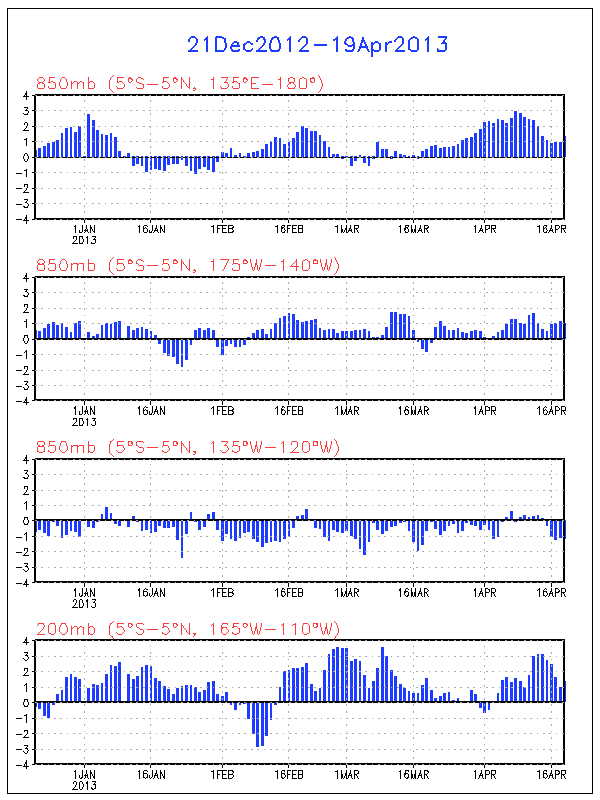
So, I think that provides a nice perspective on the ENSO.
The data used in this post can be obtained here.
http://www.cpc.ncep.noaa.gov/data/indices/
http://www.cpc.ncep.noaa.gov/data/indices/sstoi.indices
Discover more from Watts Up With That?
Subscribe to get the latest posts sent to your email.
Bill, that is an excellent observation. Thanks for posting it. It appears to me the trade winds and surface ocean currents are electrically driven, more or less simultaneously.
The Earth’s magnetic field interacts with the solar wind over a volume much greater than the size of the Earth. The energy from this interaction gets channeled to the magnetic poles of the Earth and initiates a current through it. Just as current flowing through a wire causes a torqued magnetic field around the circumference of the wire, the current passing through the rotating Earth produces an electric current about the equator in the direction of rotation.
http://www.springerlink.com/content/l5618xjmt127xq62/
The salt water oceans are conductive at their surface. The atmosphere is also conductive. Being fluids, the atmosphere and oceans would be pushed along by the force of the electric current at the equator. These are probably the same mechanics driving Jupiter, Saturn, and the other gas planets.
I have performed experiments a couple years ago, which demonstrated the flow of water vapor can be controlled by the electrostatic field gradient between the Earth’s surface and ionosphere.
There is a bulge in the ionosphere apparently caused by the positively charged sun acting on the negatively charged Earth. This bulge gets dragged around the planet as the Earth turns relative to the Sun. You can see this by watching the TEC data at JPL.
http://iono.jpl.nasa.gov/latest_rti_global.html
The dragging of this electron cloud around the Earth may also affect the ground currents.
As I have been studying and experimenting in meteorology and paleoclimatology, it has become apparent the electrical forces in the atmosphere and oceans are just as important as the mechanical forces dependent upon pressure, temperature, and volume.
Increased or decreased solar activity would increase or decrease the amount of energy being transferred to the Earth’s magnetic field. This would increase or decrease the current passing from pole to pole, and the induced current around the equator. The induced current around the equator would drive the atmosphere and surface ocean currents simultaneously, although being lighter, the atmosphere might show a change before ocean currents.
Dave
Leif Svalgaard (09:12:34) :
tallbloke (05:52:23) :
According to the Scotese et al graph posted by Anthony on the Hansen thread, the temperature was about 10C higher when the co2 level was at 8000ppm 550M years ago. When was the co2 level ever at the 30-50 times you state? (Pardon my ignorance)
8000 ppm / 300 ppm [pre-industrial value] = 27 times and earlier than 550 Ma the concentration was even higher. Possibly 100-1000 times higher in the first billion years [to compensate for a Sun being 35% dimmer than today.
Ah, ok, we’ve moved from your “today’s value”, to the “pre-industrial value”; 25% lower.
I’m left wondering what evidence we have for co2 levels billions of years ago. Is it a theoretical value based on an assumption that the temperature of the earth was around the same as today’s? Wasn’t geothermal heat more of a factor back then?
I’ll assume that my maths was right after all since you seem to have dropped the issue. 🙂
Dave (Volantis)
great to see you posting here, and that you’ve put Tinsley’s paper to good use. 😉
You may not get much response from the oceanographers on this, but don’t be discouraged, Leif may have something to say.
“You, sir, are one of the worst offenders against that goal.”
That’s right, when your assertions of fact are silly, indefensible and given in a supercilious tone obstructing other’s discussions, cast allegations of ‘bad behavior’ and hope to confuse a few of the spoon-fed.
Let’s see, we have a recurrance of global temps rising to 72 degrees F, high CO2 counts an order of magnitude greater than today, and singular continental formation/ocean formations. The cause? Why CO2, obviously.
tallbloke (11:37:31) :
Ah, ok, we’ve moved from your “today’s value”, to the “pre-industrial value”; 25% lower.
In order to have a stable base value. Today’s value changes all the time as does the temperature and there is debate as to what is due to what. Going pre-industrial removes us from that.
I’m left wondering what evidence we have for co2 levels billions of years ago. Is it a theoretical value based on an assumption that the temperature of the earth was around the same as today’s?
There is a good body of evidence. One of the simpler one is that the Sun was 30% dimmer back then and we know we had liquid water, because there a sedimentary rocks from then. So we need a greenhouse effect to account for that.
Here is one account: http://www.sciencedaily.com/releases/2003/09/030918092804.htm
I’ll assume that my maths was right after all since you seem to have dropped the issue. 🙂
I may have misunderstood you, as you started out with 20ppm and I thought you were talking about future levels up from there. If it was just to tell us how much 2^5 and 2^6 was, then everything looks fine.
gary gulrud (13:20:05) :
silly, indefensible and given in a supercilious tone obstructing other’s discussions,
you are true to form.
gary gulrud (13:31:57) :
Let’s see, we have a recurrance of global temps rising to 72 degrees F
Global temps were once 70C, and of course due to CO2.
Thanks Leif, informative as always. Kastings model estimates 10-200x todays levels. Quite a range. Only two datapoints beyond 1/2 billion years ago, and one suggests the level was at the lower end of the range through a soil sample study. If there was a lot more volcanic activity on the young earth blocking out a weaker sun, it seems to me something else was keeping the oceans from freezing. What could it be? Geothermal heating the water from below? Lots more methane? Volcanic aerosols trapping geothermal heat?
Please do give some feedback to Volantis’ post above. I know David and he is a deep thinker.
tallbloke (15:03:39) :
Thanks Leif, informative as always. Kastings model estimates 10-200x todays levels. Quite a range. Only two datapoints beyond 1/2 billion years ago
No. there are many other pieces of evidence. I don’t feel like doing ALL the work here. Do a little research yourself.
Please do give some feedback to Volantis’ post above. I know David and he is a deep thinker.
Unfortunately the post is flawed in so many places that it pains me to go through them all. Just a very glaring one: the Sun is not positively charged [surplus of ions] and the Earth is not negatively charged [surplus of electrons]. The electric force is about1,000,000,000,000,000,000,000,000,000,000,000,000,000 stronger than gravity and the slightest imbalance would wreak havoc with the Earth’s orbit.
the Sun is not positively charged [surplus of ions] and the Earth is not negatively charged [surplus of electrons].
If the outer reaches of the Sun are not positively charged, then is it your view that the solar wind is made from something other than protons? And if the Earth’s ionosphere is not the outer layer of electric charge for the Earth then what is? Also, how would you explain the consistent attraction of the concentrated electrons in the Earth’s ionosphere toward the Sun?
These are not rhetorical questions, but a sincere attempt to understand your explanation for observed phenomena.
Dave
tallbloke (15:03:39) :
Kastings model estimates 10-200x todays levels. Quite a range. Only two datapoints beyond 1/2 billion years ago
same range here:
Nature 425, 279-282 (18 September 2003) | doi:10.1038/nature01902;
High CO2 levels in the Proterozoic atmosphere estimated from analyses of individual microfossils
Alan J. Kaufman & Shuhai Xiao
Solar luminosity on the early Earth was significantly lower than today. Therefore, solar luminosity models suggest that, in the atmosphere of the early Earth, the concentration of greenhouse gases such as carbon dioxide and methane must have been much higher1, 2. However, empirical estimates of Proterozoic levels of atmospheric carbon dioxide concentrations have not hitherto been available. Here we present ion microprobe analyses of the carbon isotopes in individual organic-walled microfossils extracted from a Proterozoic ( 1.4-gigayear-old) shale in North China. Calculated magnitudes of the carbon isotope fractionation in these large, morphologically complex microfossils suggest elevated levels of carbon dioxide in the ancient atmosphere—between 10 and 200 times the present atmospheric level. Our results indicate that carbon dioxide was an important greenhouse gas during periods of lower solar luminosity, probably dominating over methane after the atmosphere and hydrosphere became pervasively oxygenated between 2 and 2.2 gigayears ago.
Kastings model estimates 10-200x todays levels. Quite a range. Only two datapoints beyond 1/2 billion years ago
This region of paleoclimate has a significant problem called the Faint sun paradox.
This is not only in the change in GHG /luminosity as evolution tells another story.So one cannot use the former explanation without constructing a new evolutionary theory.Hence the paradox.
eg Pavlov 2001
Organic haze in Earth’s early atmosphere: Source of low-13C Late Archean kerogens?
Alexander A. Pavlov*,1, James F. Kasting*,1, Jennifer L. Eigenbrode*,1 and Katherine H. Freeman*,1
1 Department of Geosciences, Pennsylvania State University, University Park, Pennsylvania 16802, USA
High concentrations of greenhouse gases would have been required to offset low solar luminosity early in Earth’s history. Enhanced CO2 levels are probably at least part of the solution, but CH4 may have played a significant role as well, particularly during the Late Archean era, 2.5–3.0 Ga, when methanogenic bacteria were almost certainly present. Indeed, biological CH4 production should have led to CO2 drawdown by way of a negative feedback loop involving the carbonate-silicate geochemical cycle. We suggest here that the atmospheric CH4/CO2 ratio approached the value of ~1 needed to trigger formation of Titan-like organic haze. This haze was strongly depleted in 13C relative to 12C and was produced at a rate comparable to the modern rate of organic carbon burial in marine sediments. Therefore, it could provide a novel explanation for the presence of extremely low-13C kerogens in Late Archean sediments.
http://geology.geoscienceworld.org/cgi/content/abstract/29/11/1003
Titan answers some open problems
http://sci.esa.int/science-e/www/object/index.cfm?fobjectid=36370
Leif, yes, it was mostly Xiao’s work which was in the article you linked.
I’ll accept your admonition and seek more info. A lot of stuff written on the early earth seems conflicting and outdated, it’s hard to know what’s the real deal.
I guess David will have to find a different source for his equatorial electrical currents then. You’d think the earth might generate quite a lot of it’s own juice though, with it having a spinning iron core and all that electrolyte in the oceans.
tallbloke (17:14:30) :
You’d think the earth might generate quite a lot of it’s own juice though, with it having a spinning iron core and all that electrolyte in the oceans.
It does as far a the core is concerned. That is what creates the main magnetic field of the Earth. The contribution from the oceans is minuscule [not measurable on a global scale]. There are internal currents in the Earth about 300 km down and in the oceans corresponding to the external daily variation of the geomagnetic field [this is about 1/1000] of the main field. These currents are permanent [because the Sun always shines somewhere] and stay fixed in relation to the Sun, the Earth rotating under’above them. More here: http://www.leif.org/research/CAWSES%20-%20Sunspots.pdf
But the effect on climate and atmosphere is negligible. Of course, you’ll always find ‘electric universe’ enthusiasts that have other ideas, but that is pseudo-science.
The earth’s magnetic field is quite strongly modulated by changes in the strength of the solar wind though, so although those electric currents in the ocean and atmosphere are only 1/1000 of the main field, they will vary quite a bit. I agree that pressure differences are going to be much bigger drivers of trade winds. Would the electric effects make much of a difference to cloud formation/distribution and the triggering of precipitation events I wonder? They cause cooling and pressure changes. I seem to remember diagrams of storm clouds in old encyclopedias which had lots of ++++ and —– signs at the top and bottom.
tallbloke (17:14:30) :
I’ll accept your admonition and seek more info.
There is a fair amount of stuff at
http://www.fas.org/irp/imint/docs/rst/
especially Section 19, from which this has been lifted:
http://www.leif.org/research/Changes%20in%20Earth's%20Atmosphere.png
Wow, great resource, thanks! I love the positivistic nature of the intro to section 19. Only one ‘probably and one ‘may have’ in the whole paragraph. 😉
Volantis (10:15:31) :
the Sun is not positively charged [surplus of ions] and the Earth is not negatively charged [surplus of electrons].
If the outer reaches of the Sun are not positively charged, then is it your view that the solar wind is made from something other than protons?
The solar wind is EQUAL amounts of protons and electrons [with a little bit of other stuff thrown in].