A guest post by Jeff Id
Well John Christy gave me a lot to think about in satellite temp trends as far as an improved correction over my last post. Steve McIntyre pitched in some comments as well. It is going to take a bit to work out the details of that for me but I think I can produce an improved accuracy slope over my last posts. In the meantime, I downloaded sunspot numbers from the NASA.
Cycles are interesting things. There are endless cycles in nature, orbits, ocean temp shifts, solar cycles, magnetic cycles the examples are everywhere. What makes a cycle unusual is also an interesting topic. Some solar scientists have claimed that our current solar cycle is not unusual by the record. They are certainly the experts but recently the experts have been forced to update their predictions for the next solar cycle.
Well, I’m no expert on the sun but I do find the data regarding sunspots interesting, particularly in the fact that we are again in at least a short term cooling at the same time sunspots and solar magnetic level have plunged.
Here’s an article from our all understanding US government.
What’s Wrong with the Sun? (Nothing)
And a few beginning lines.
July 11, 2008: Stop the presses! The sun is behaving normally.
So says NASA solar physicist David Hathaway. “There have been some reports lately that Solar Minimum is lasting longer than it should. That’s not true. The ongoing lull in sunspot number is well within historic norms for the solar cycle.”
Cool picture …….

See where the tiny little 2009 tick is. We should be increasing now and well on our way by 2010. By the way, this is an updated graph from the original predition.
Hathaway said, well within historic norms. Forecasting is the most dangerous sport, but I am as curious about this claim as any —he is the expert after all. Here’s a plot of the sunspot data from NASA NOAA numbers.

I did a sliding slope fit to the data to find when the slopes shifted from negative to positive in each cycle. I placed a red line above each point identified. These points are not intended to mean the beginning of a cycle( that is for the experts) but rather to be a consistent software identified point between each cycle.

The red lines represent solar minima. The only line which may not be a minima is the most recent in Jan 09 which we need to reference how unusual solar activity is.
Below is a list of the years the red lines are centered on.
1755.667, 1766.250. 1775.583, 1784.500, 1798.167, 1810.583, 1823.167, 1833.833, 1843.833, 1856.167, 1867.167, 1878.750
1889.500, 1901.750, 1913.167, 1923.417, 1933.750, 1944.167, 1954.250, 1964.833, 1976.250, 1986.250, 1996.417, 2009.041
The years between each minima are currently
10.583, 9.333, 8.916, 13.666, 12.416, 12.583, 10.666, 10.000, 12.333, 11.000, 11.583, 10.750, 12.250, 11.416, 10.250, 10.333,
10.416, 10.083, 10.583, 11.416, 10.000, 10.166, 12.625
So far there has been only one solar cycle which has exceeded the length of the current one. The cycle extended extra long (13.66 years) from 1784 – 1798 and was the last cycle leading into the Dalton Minimum.
A histogram of the distribution of the time between solar cycles looks like this.
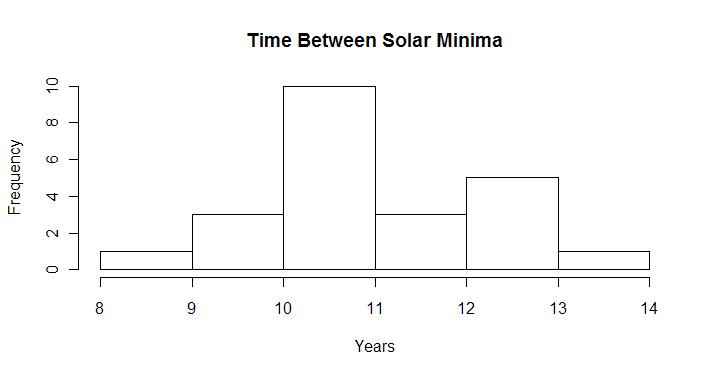
The standard deviation of the total record is 1.18 years the mean is 11.01. Well there’s the eleven year solar cycle we hear about.
Two sigma (two standard deviation) difference from the mean corresponds to a 95% certainty of something unusual in our current situation. The numbers this year at mid Jan correspond to about 1.37 sigma of all time records, which is getting close. But that’s not the end of the story, after all I just included the dalton minimum cycles in the data right after we identified the solar cycle prior to the dalton minimum as the one with the longest time span on record. That means, I treated it as though it were a normal event. —– Well I do believe (on faith in nature) this length is normal, the sun isn’t doing anything different from before but there is only one of these long events on record and were we to look for a similar event it would be stupid to include it in the standard deviation dataset. We should only look at data which is not related to another potential dalton minimum from Figure 2 this would be after the dalton minimum and before present day (from 1833 – 1996).
The standard deviation of the cycle start after the dalton minimum 1833 and before 2009 was only 0.79 years. The average Jeff Id solar cycle in the same period is 10.83 years. This puts the two sigma limits of the solar cycle at 9.26 years on the short side and 12.42 years on the long side.
Of course this puts my reasonable analysis of solar cycle outside of the last 176 year normal to a two sigma 95% interval 12.6 years has crossed the limit. With little sign of the next cycle beginning yet, this might get worse. I tell you what, I prefer the taxes from global warming to the cost of glaciers in my yard, it seems like a balance of evils to me. I hope this solar cycle changes soon but we can no more effect the sun with a dance than we can effect global warming with a tax so what choice do we have.
In Dr. David Hathaway’s defense, he made his statement above in July which put the current minimum at 2008.583 which comes to 12.166 years and just inside the 95% two sigma certainty of 12.42.
Now that we’re at 12.6, I wonder if they’ll extend the predictions for the beginning of the next cycle again.
Chris Schoneveld (00:40:41) :
If the length of a cycle has no physical importance why then is it of interest that cycle 24 is late? Is the lateness of a cycle not the direct consequence of the length of the previous cycle or the length of the overlap of two consecutive cycles?
It is the difference between science and numerology. If we consider a solar cycle as a physical entity defined as consisting of all the spots that have the same Hale polarities, then one can talk about the birth of the cycle as the time of the first occurrence of one of these spots, and the death of the cycle as the last occurrence of one of these spots. The length of the cycle [15-17 years] is the duration between these two times. One can at least imagine [and it almost happened some 350 years ago], that there are no more spots of either polarity-pair for an extended period [say 50 years]. So the new cycle has not been born yet, but the old cycle is definitely dead. Then, finally the new cycle starts. In this situation, I would not say that the old cycle lasted 60 years, but rather that there was no cycle for a period of time. In 1810 there were no spots at all. Does that year belong to the previous cycle or to the following? It would seem arbitrary to say that it is half and half.
All that said, one can still do numerology with the existing sunspot number series. An example is this paper http://www.leif.org/research/On%20solar%20cycle%20predictions%20and%20reconstructions.pdf of which I’m a co-author.
matt v. (08:11:14) :
Prof. Easterbrook went back 500 years found repeating temperature cyclesl but he excluded specific solar cycles in his analysis.
There is no doubt that cool/warm periods come and go, i.e alternate. To call them ‘cycles’ is too much in my opinion and seemingly also in Easterbrook’s.
matt v (15:16:04)
Just as the recent cooling tends to reinforce the argument that CO2 only plays a minor role in climate and temperature regulation, so might careful observation of temperature, with or without lag, to sunspots over the next few years might be able to demonstrate the extent to which the sun’s input determines climate and temperature, and with real luck, may even suggest a mechanism.
I can’t see, matt, what we both wished I could. There’s got to be a pony in there somewhere. It’s just very well wrapped. I think the solution to Leif’s agony about hypersensitivity will also be a big clue to mechanism.
=====================================
OK, my agony about Leif’s point about hypersensitivity of climate to solar input. I presumed too much about his feelings.
==========================================
Leif (08:39:35)
I’d happily add observation and analysis of ‘assymetry parameter of Method 1’ to the routes to the solution. I see that wonderful referenced paper hedges on the meaning of the sunspot record. Dr. Livingstone, I presume, will soon help us with some answers.
===========================================
kim (08:57:31) :
OK, my agony about Leif’s point about hypersensitivity of climate to solar input. I presumed too much about his feelings.
It is not me that is hypersensitive, but the climate that must be if the tiny solar variations have any effect.
I’m also waiting for Livingston’s gauss measurement of that poor wimpy 11010. And I do use CCD cameras for astrophotograpy, and I know about image stretching schemes and deconvolution techniques. I also see some pretty bad examples of dust donuts from lack of calibration in the white light and h-alpha images.
E.M.Smith (03:11:03) :
Do what you want with it. I hereby copyleft it with the provision that I may someday use it in a short book on GW errors…
After sleeping on it, I think ‘copyleft’ has more restrictions than is deserved…
So I hereby place it in the public domain. May it only have merit to deserve it.
I believe that the surface carbon is not really the issue per se, it’s the extra stuff being pulled up out of sequestration en masse and dumped into the ecosphere. Along with all the toxins that took so many aeons to filter out. To me, AGW is giving out the right warning for all the wrong reasons.
Irreplaceable energy sources are being squandered in a frivolous manner and very little effort is being made to filter the toxins at the source.
To put it in the ancient story of the ants, winter preparation is being blown off for the ease of today.
I get your gist about SC24 being late & lame, Leif.
It’s struggling mightily for a good reason.
Simply being late is a poor excuse, even for a solar cycle.
Leif Svalgaard (07:15:20) :
b) that cycle 24 is one with weak solar activity
I hope so, as I have predicted precisely that: http://www.leif.org/research/Cycle%2024%20Smallest%20100%20years.pdf
So maybe we ought to be calling it the Leif Minimum … how do these things get sorted out between the guy who predicted it first and the guy who predicted it for the best reasons?…
E.M.Smith (11:51:13) :
So maybe we ought to be calling it the Leif Minimum … how do these things get sorted out between the guy who predicted it first and the guy who predicted it for the best reasons?…
None of the previous Grand Minima were named for any of the two reasons you mentioned, but for Solar System scientists that have had an impact [positive]. I suggest the Eddy Minimum.
Thanks, Leif
I got your point.
E.M.Smith (11:51:13) :
Leif Svalgaard (07:15:20) :
b) that cycle 24 is one with weak solar activity
I hope so, as I have predicted precisely that: http://www.leif.org/research/Cycle%2024%20Smallest%20100%20years.pdf
So maybe we ought to be calling it the Leif Minimum … how do these things get sorted out between the guy who predicted it first and the guy who predicted it for the best reasons?…
Sorry If I have to upset Dr. Svalgaard. His article was Received 3 October 2004; revised 10 November 2004; accepted 9 December 2004; published 11 January 2005.
My equation which is predicting New Dalton was published 1 year and 3 days earlier.
Report number astro-ph/0401107, Title Evidence of a multi resonant system within solar periodic activity Author(s) Vukcevic, M A
Imprint 8 Jan 2004.
http://cdsweb.cern.ch/record/704882?ln=fr
Sorry Dr. Svalgaard !
Leif (11:14:19)
Yes, I understand. It wasn’t your hypersensitivity I was presuming, but your agony. I agonize over it, because I believe the sun is dominant in the cycling climate, and believe that unknown cycles from the sun cause that dominance, but can’t solve the hypersensitivity problem. I can smell a solution, but can’t see it. Not very scientific, at least not very productive of mechanism.
==================================
Lets not get carried away…Svalgaard has predicted one low cycle around 75 SSN, which is far from predicting a grand minimum. My vote is for the Jose Minimum, he will be recognized for making the biggest discovery.
The whole idea behind discussing things that are not yet understood or understood poorly, is to open the doors to fresh thinking, and to open the window to let some fresh air into the room.
Analysis paralysis.
For those interested in grand minima….I am currently going back 5000 yrs and mapping out all the previous grand minima and maxima and mapping it against the 11000 year C14 record, and its looking exciting. I will publish the results on here soon.
If we get a new spot that forms in the opposite hemispere of the Sun, it has the same polarity/leading of the No. Hemisphere plage we now see, that then makes it an SC23. What does a SC23 spot this late in the game change, if anything?
Just look at this exhihit from D. Hathaway’s last slide show. What is the sunspot trend ? minor variation?
http://sprg.ssl.berkeley.edu/RHESSI/napa2008/talks/MonI_
Sorry that complete refernce did not come through on previous post. See
http://sprg.ssl.berkeley.edu/RHESSI/napa2008/talks/MonI_Hathaway.pdf
see SECULAR TREND SLIDE
Robert Bateman,
The analysis paralysis post is good. Your point about squandering resources is taken, although the devil is in the details.
One of the resources we need to pass on to the future is an accurate history of what is happening now. If they decide what we recorded is not good enough for them to use, and they need to adjust it because they decide it’s wrong, they may as well throw it out the window and start over, as this whole AGW fiasco painfully indicates.
Jumping off soapbox…
…NOW 😉
Andrew ♫
Both Learmoth and Mauna Loa have the new spot on White Light images, though I must use Equalized stretch to see it. Much like 07/19 and 07/20 spot, which were counted.
An SC23 is NOT what I was expecting to see, but I’ll be out tomorrow with scope & paper.
Thank you, Andrew.
The Ghost of Solar Cycles Past.
====================