A guest post by Jeff Id
Well John Christy gave me a lot to think about in satellite temp trends as far as an improved correction over my last post. Steve McIntyre pitched in some comments as well. It is going to take a bit to work out the details of that for me but I think I can produce an improved accuracy slope over my last posts. In the meantime, I downloaded sunspot numbers from the NASA.
Cycles are interesting things. There are endless cycles in nature, orbits, ocean temp shifts, solar cycles, magnetic cycles the examples are everywhere. What makes a cycle unusual is also an interesting topic. Some solar scientists have claimed that our current solar cycle is not unusual by the record. They are certainly the experts but recently the experts have been forced to update their predictions for the next solar cycle.
Well, I’m no expert on the sun but I do find the data regarding sunspots interesting, particularly in the fact that we are again in at least a short term cooling at the same time sunspots and solar magnetic level have plunged.
Here’s an article from our all understanding US government.
What’s Wrong with the Sun? (Nothing)
And a few beginning lines.
July 11, 2008: Stop the presses! The sun is behaving normally.
So says NASA solar physicist David Hathaway. “There have been some reports lately that Solar Minimum is lasting longer than it should. That’s not true. The ongoing lull in sunspot number is well within historic norms for the solar cycle.”
Cool picture …….

See where the tiny little 2009 tick is. We should be increasing now and well on our way by 2010. By the way, this is an updated graph from the original predition.
Hathaway said, well within historic norms. Forecasting is the most dangerous sport, but I am as curious about this claim as any —he is the expert after all. Here’s a plot of the sunspot data from NASA NOAA numbers.

I did a sliding slope fit to the data to find when the slopes shifted from negative to positive in each cycle. I placed a red line above each point identified. These points are not intended to mean the beginning of a cycle( that is for the experts) but rather to be a consistent software identified point between each cycle.

The red lines represent solar minima. The only line which may not be a minima is the most recent in Jan 09 which we need to reference how unusual solar activity is.
Below is a list of the years the red lines are centered on.
1755.667, 1766.250. 1775.583, 1784.500, 1798.167, 1810.583, 1823.167, 1833.833, 1843.833, 1856.167, 1867.167, 1878.750
1889.500, 1901.750, 1913.167, 1923.417, 1933.750, 1944.167, 1954.250, 1964.833, 1976.250, 1986.250, 1996.417, 2009.041
The years between each minima are currently
10.583, 9.333, 8.916, 13.666, 12.416, 12.583, 10.666, 10.000, 12.333, 11.000, 11.583, 10.750, 12.250, 11.416, 10.250, 10.333,
10.416, 10.083, 10.583, 11.416, 10.000, 10.166, 12.625
So far there has been only one solar cycle which has exceeded the length of the current one. The cycle extended extra long (13.66 years) from 1784 – 1798 and was the last cycle leading into the Dalton Minimum.
A histogram of the distribution of the time between solar cycles looks like this.
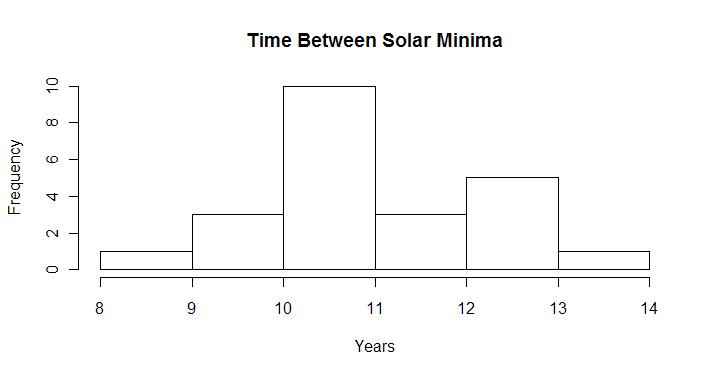
The standard deviation of the total record is 1.18 years the mean is 11.01. Well there’s the eleven year solar cycle we hear about.
Two sigma (two standard deviation) difference from the mean corresponds to a 95% certainty of something unusual in our current situation. The numbers this year at mid Jan correspond to about 1.37 sigma of all time records, which is getting close. But that’s not the end of the story, after all I just included the dalton minimum cycles in the data right after we identified the solar cycle prior to the dalton minimum as the one with the longest time span on record. That means, I treated it as though it were a normal event. —– Well I do believe (on faith in nature) this length is normal, the sun isn’t doing anything different from before but there is only one of these long events on record and were we to look for a similar event it would be stupid to include it in the standard deviation dataset. We should only look at data which is not related to another potential dalton minimum from Figure 2 this would be after the dalton minimum and before present day (from 1833 – 1996).
The standard deviation of the cycle start after the dalton minimum 1833 and before 2009 was only 0.79 years. The average Jeff Id solar cycle in the same period is 10.83 years. This puts the two sigma limits of the solar cycle at 9.26 years on the short side and 12.42 years on the long side.
Of course this puts my reasonable analysis of solar cycle outside of the last 176 year normal to a two sigma 95% interval 12.6 years has crossed the limit. With little sign of the next cycle beginning yet, this might get worse. I tell you what, I prefer the taxes from global warming to the cost of glaciers in my yard, it seems like a balance of evils to me. I hope this solar cycle changes soon but we can no more effect the sun with a dance than we can effect global warming with a tax so what choice do we have.
In Dr. David Hathaway’s defense, he made his statement above in July which put the current minimum at 2008.583 which comes to 12.166 years and just inside the 95% two sigma certainty of 12.42.
Now that we’re at 12.6, I wonder if they’ll extend the predictions for the beginning of the next cycle again.
vukcevic (11:52:50) :
But do you really believe that the equations on:
http://www.vukcevic.co.uk/combined.gif
are just product of sheer coincidence.
The point is if the two or three curves or wiggles match up or are correlated. To my eye they are not, only only very weakly. There are standard ways of deciding such questions. E.g. make a scatter plot. If you would email me the yearly [or monthly] values that went into the plot, then I can make the scatter plot and discuss the correlation.
leif
Yes, there are other causes for climate change other than PDO’S but your comment does in no way eliminate PDO as being one of the possible and principal factors.Durning your comment around, prove that it is not?
E.M.Smith (13:12:26) :
Good stuff.
If you don’t mind, I’d like to make this a post on the air vent. It’s what it is for lettin’ the pressure out.
matt v. (15:34:31) :
your comment does in no way eliminate PDO as being one of the possible and principal factors.
Of course not. My comment was only intended to show that you can’t draw your conclusion about low/high solar cycles and cool/warm climate from the meager examples you provided.
E.M.Smith (13:12:26) :
WOW!
Passion & accuracy don’t often come together.
I thank you.
DaveE.
Jeff Id (14:22:47) :
I wonder why it isn’t the accepted method, what argument against it could there be other than it takes a bit of work.
The main reason is that solar physicists do not attach any physical meaning to the length of the cycle. The length is just the result of near random and unrelated events. A solar cycle extends physically for about 16 years and adjacent cycles overlap. The precise minimum is the result of accidental happenings and means nothing special, so doesn’t really natter, so why get hung up on a ‘better’ way of determining something that doesn’t matter. For SC23=>24, what is of interest is that 24 is late and lame.
If I could be permitted to go “off topic” here to ask Leif a question.
What might happen because of the sun absorbing heavy matter from “impacts”?
Logically, such impacts would be very different than for any other body in the solar system since the sun would vaporize anything falling into it and sweep what remained along with its outer atmosphere (at least until it settled); however, such could be (for example) one source for heavier matter.
I’m not meaning to imply that a rock even a hundred miles across would mean anything to the sun (pebble, meet ocean), only that it must be subjected to some level of bombardment and that such may have a meaningful effect over time.
Has anyone done work with spectrographs that suggested when or if the sun has ‘suffered’ one of these ‘collisions’?
I’m thinking that the matter associated with a larger object absorbed would take time to fully dissipate, and therefore might show up as a localized phenomenon for a time.
Lee Kington (18:35:10) :
What might happen because of the sun absorbing heavy matter from “impacts”?
The Sun suffers a blow from a comet every couple of weeks:
http://sungrazer.nrl.navy.mil/index.php
Not much happens because the Sun is so big.
Robert Bateman (14:01:14) :
Hmm, I don’t think I’ve heard you or Carsten mention contrast degradation before. I was going to ask when you last saw a decent sunspot, but one of the groups last month or so almost made it to decent.
Here’s a thought – a large part of astrophotography is contrast enhancement. I wonder if all the electronic imaging going on will gradually adapt to the loss of contrast and not notice the progress Cheshire Cat is making. OTOH, Bill Livingston is looking at and documenting the contrast, so there will be a good instrumental record.
One telescope, two eyes, one pencil, one paper. Worked for centuries, consistency in observation is important. How do you document tough-to-draw?
Jeff Id (14:22:47) :
Only problem is that we’ve stepped up to fascinating times.
vukcevic (11:52:50) :
Mr. Sharp I wonder what you would make of my comment on
http://www.vukcevic.co.uk/graph1.gif
relating to 1968 (SC20)?
To be honest I dont understand mechanism in your graph. For a theory to get traction it must be understandable, perhaps on your website you could set up some kind of very simple explanation that a layperson could understand.
When was the last time I saw a really good spot?
late March, 2008.
They just get harder to pick up initially with each suceeding spot afterwards.
I know at what radius from the Sun’s center the spot should be, but it takes several minutes of sliding the paper back & forth and checking in a circle to pick it off.
When I say they are ghostly, it’s because if you aren’t looking very close to them, you don’t see them.
Tough to draw means that a lot of patience is required to pick off the tiny outliers when the contrast is that bad and the normal seeing turbulence is going to play hell with one’s efforts.
If all you have is 1 ghostly spot that is fading away, one is likely to come away empty handed. And that is what happened the last 2 days of 11010 for me. Mt. Wilson whiffed the last day of 11010.
I sincerely hope I have made clear what I mean by ghostly and tough to observe/draw.
Regular observers of faint/extended galaxies will know what I mean by a tough observation.
How do you document tough-to-draw?
Communication. Try M33 in an 8″ scope with an apparent FOV of 1/2 degree.
The darned thing will make you swear under your breath in a crowd.
Leif,
Thank you for taking a moment to respond to the off topic question. The question was actually poised to me by another and my response was similar. Hence it was more of a conformation.
Despite our differences on some topics I do respect your knowledge and work as a solar physicist.
Thanks again,
Lee Kington
Leif Svalgaard (17:45:25) :
On the one hand Leif says: “The main reason is that solar physicists do not attach any physical meaning to the length of the cycle.” And on the other: “For SC23=>24, what is of interest is that 24 is late and lame.”
This sounds contradictory, but I may misunderstand the point he made. If the length of a cycle has no physical importance why then is it of interest that cycle 24 is late? Is the lateness of a cycle not the direct consequence of the length of the previous cycle or the length of the overlap of two consecutive cycles?
Alex (04:13:49) :
Interesting article, I am not sure we can scream Dalton minimum just yet though…
Not yet. Right now we’re still at the furtive whisper stage… 😉
Henry Galt (14:42:14) :
Seriously dude, that was some treatise. I am going to steal it verbatim unless you complain here and now
Do what you want with it. I hereby copyleft it with the provision that I may someday use it in a short book on GW errors… (If I ever stop reading this blog and start doing all that work that’s been piling up… addicting thing. That and trying to learn what vukcevic has written.) If anyone makes any money off of it, drop some in the ‘tip jar’ for WUWT.
My only reservations with it are:
In #4 I assert all stations can have made up data, when I’m not really certain if that is true for the automated stations. It might only be ‘all manned stations can have made up data”.
In #10 I assert “vast majority” of papers, yet since I haven’t read all of them I’m really just asserting from the small sample I have read. A bit hyperbolic.
In the ‘more technical’ bits, I ought to have said “you have three faucets, they are not labeled and are non-linear” and “There is another person in the shower who wants the water warmer than you like. Sometimes.”
That must be the most concise encapsulation of the salient factors at play I have seen with these weary eyes anywhere. Ever.
Sometimes I’m prolix. Sometimes not. I appreciate the compliment!
It must have taken a while to assemble, but it lacks for nothing as a primer for exposing the group-think of the “members” of all our divvy-nations and once great institutions that allows the heaping of praise upon vandals.
Like the PeeCe Prize of AlGore?
It’s a ‘from memory’ summary of a pamphlet I’ve been working on for about a year (on and off, mostly off) with the complicated parts omitted (he wanted ‘basics’). Fundamental structure is to start with the data and follow it through the macerator… and into dreamland…
Jeff Id (15:50:08) :
Good stuff.
If you don’t mind, I’d like to make this a post on the air vent. It’s what it is for lettin’ the pressure out.
Feel free. And thank you!
Just plain late is no comparison to the excuse offered by being wounded while heroically fighting off a horde of barbarians at the edge of town.
SC24 pulls up lame after beating off the savage horde of mutant SC23 spots.
Needs a ticker-tape parade and a chest full of medals.
We must never forget those who sacrificed themselves for the good of the Solar Cycle.
The Dog ate my Sunspots.
actuator wrote:
Katherine,
Could the reason we would all be dead if we burned all the combustible material available to us be that we’d starve to death? I believe just about everything we eat can be burned. It would just be a slower death.
IF we burned all the combustible material available to us, the CO2 released would simply be used by plants. If it gets to the point of mass hysteria and self-immolation, then you have what? Steak on the grill? 😉
Katherine (04:36:07) :
If we burned all the combustible material, there wouldn’t be any plants left to take up the CO2. This would be a Bad Thing. Algae to the rescue. The genetic engineering to turn algae into a forest is left as an exercise to the reader.
Ric Werme (20:07:10) :
Hmm, I don’t think I’ve heard you or Carsten mention contrast degradation before. I was going to ask when you last saw a decent sunspot, but one of the groups last month or so almost made it to decent.
I am not a very regular solar observer, unfortunately. At 60N and tall trees to the south where I live it is not so easy during the winter period. Not to mention the fact that I am at work when (if) the sun is up.
So until the spring I am mostly watching SOHO.
Ric Werme (20:07:10) :
Here’s a thought – a large part of astrophotography is contrast enhancement. I wonder if all the electronic imaging going on will gradually adapt to the loss of contrast and not notice the progress Cheshire Cat is making. OTOH, Bill Livingston is looking at and documenting the contrast, so there will be a good instrumental record.
In my opinion any competent astrophotographer will notice a difference in contrast if it is real. Proper astronomical CCD cameras have a very linear behaviour and the only setting you can control is the exposure length. With webcams adapted to astronomical use it is slightly more complex, but having complete control over the camera settings is always important. So measuring changes in sunpot contrast over time is probably easier with a camera than just visually, if done right.
I am also waiting to hear what comes out of Livingston’s measurements…
LEIF
I went back to 1850 in my analysis and the pattern of cooling and warming was similar to the two periods that I already posted , This is a total of 5 periods spanning 165 years of data This is not meagre amount of support data . It would be too much to post all here although I can post the other three periods from 1850 to 1944 if there is sufficent interest. There is limited data about PDO,AMO and ENSO beyond say 1850. Prof. Easterbrook went back 500 years found repeating temperature cyclesl but he excluded specific solar cycles in his analysis.
Dave Wendt,
“…we’ll send them at night”
Now that’s the kind of “thinking outside the box” that Al Gore can appreciate!!
HAHAHAHAHAHAHAHAHA