A guest post by Jeff Id
Well John Christy gave me a lot to think about in satellite temp trends as far as an improved correction over my last post. Steve McIntyre pitched in some comments as well. It is going to take a bit to work out the details of that for me but I think I can produce an improved accuracy slope over my last posts. In the meantime, I downloaded sunspot numbers from the NASA.
Cycles are interesting things. There are endless cycles in nature, orbits, ocean temp shifts, solar cycles, magnetic cycles the examples are everywhere. What makes a cycle unusual is also an interesting topic. Some solar scientists have claimed that our current solar cycle is not unusual by the record. They are certainly the experts but recently the experts have been forced to update their predictions for the next solar cycle.
Well, I’m no expert on the sun but I do find the data regarding sunspots interesting, particularly in the fact that we are again in at least a short term cooling at the same time sunspots and solar magnetic level have plunged.
Here’s an article from our all understanding US government.
What’s Wrong with the Sun? (Nothing)
And a few beginning lines.
July 11, 2008: Stop the presses! The sun is behaving normally.
So says NASA solar physicist David Hathaway. “There have been some reports lately that Solar Minimum is lasting longer than it should. That’s not true. The ongoing lull in sunspot number is well within historic norms for the solar cycle.”
Cool picture …….

See where the tiny little 2009 tick is. We should be increasing now and well on our way by 2010. By the way, this is an updated graph from the original predition.
Hathaway said, well within historic norms. Forecasting is the most dangerous sport, but I am as curious about this claim as any —he is the expert after all. Here’s a plot of the sunspot data from NASA NOAA numbers.

I did a sliding slope fit to the data to find when the slopes shifted from negative to positive in each cycle. I placed a red line above each point identified. These points are not intended to mean the beginning of a cycle( that is for the experts) but rather to be a consistent software identified point between each cycle.

The red lines represent solar minima. The only line which may not be a minima is the most recent in Jan 09 which we need to reference how unusual solar activity is.
Below is a list of the years the red lines are centered on.
1755.667, 1766.250. 1775.583, 1784.500, 1798.167, 1810.583, 1823.167, 1833.833, 1843.833, 1856.167, 1867.167, 1878.750
1889.500, 1901.750, 1913.167, 1923.417, 1933.750, 1944.167, 1954.250, 1964.833, 1976.250, 1986.250, 1996.417, 2009.041
The years between each minima are currently
10.583, 9.333, 8.916, 13.666, 12.416, 12.583, 10.666, 10.000, 12.333, 11.000, 11.583, 10.750, 12.250, 11.416, 10.250, 10.333,
10.416, 10.083, 10.583, 11.416, 10.000, 10.166, 12.625
So far there has been only one solar cycle which has exceeded the length of the current one. The cycle extended extra long (13.66 years) from 1784 – 1798 and was the last cycle leading into the Dalton Minimum.
A histogram of the distribution of the time between solar cycles looks like this.
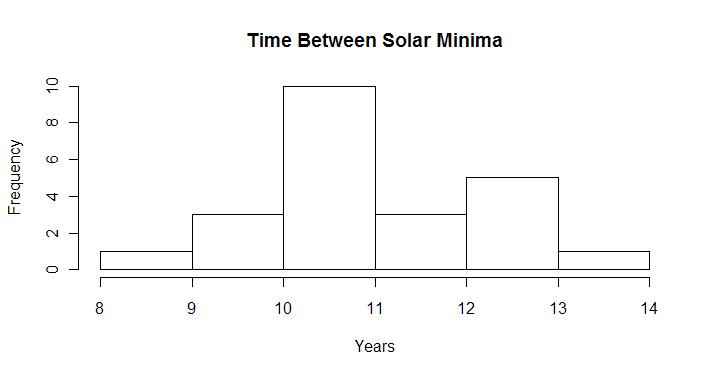
The standard deviation of the total record is 1.18 years the mean is 11.01. Well there’s the eleven year solar cycle we hear about.
Two sigma (two standard deviation) difference from the mean corresponds to a 95% certainty of something unusual in our current situation. The numbers this year at mid Jan correspond to about 1.37 sigma of all time records, which is getting close. But that’s not the end of the story, after all I just included the dalton minimum cycles in the data right after we identified the solar cycle prior to the dalton minimum as the one with the longest time span on record. That means, I treated it as though it were a normal event. —– Well I do believe (on faith in nature) this length is normal, the sun isn’t doing anything different from before but there is only one of these long events on record and were we to look for a similar event it would be stupid to include it in the standard deviation dataset. We should only look at data which is not related to another potential dalton minimum from Figure 2 this would be after the dalton minimum and before present day (from 1833 – 1996).
The standard deviation of the cycle start after the dalton minimum 1833 and before 2009 was only 0.79 years. The average Jeff Id solar cycle in the same period is 10.83 years. This puts the two sigma limits of the solar cycle at 9.26 years on the short side and 12.42 years on the long side.
Of course this puts my reasonable analysis of solar cycle outside of the last 176 year normal to a two sigma 95% interval 12.6 years has crossed the limit. With little sign of the next cycle beginning yet, this might get worse. I tell you what, I prefer the taxes from global warming to the cost of glaciers in my yard, it seems like a balance of evils to me. I hope this solar cycle changes soon but we can no more effect the sun with a dance than we can effect global warming with a tax so what choice do we have.
In Dr. David Hathaway’s defense, he made his statement above in July which put the current minimum at 2008.583 which comes to 12.166 years and just inside the 95% two sigma certainty of 12.42.
Now that we’re at 12.6, I wonder if they’ll extend the predictions for the beginning of the next cycle again.
nobwainer (Geoff Sharp) (15:16:10)
vukcevic (09:11:11) :
I agree. If one method doesn’t work maybe we should consider something new.
And the current method is not working is it vukcevic. But everyone keeps their head in the sand. You might enjoy this bit I wrote in another thread on this website that is near dead. Its related to Jose’s work.
Thanks for the note: I will look up P.Jose’s work.
But everyone keeps their head in the sand…
I say with a bit of coercion as well. When I submitted my article in 2003 (http://www.vukcevic.co.uk )
response was that it would not be accepted since it refers to the Jupiter’s and Saturn’s orbits. In my second attempt, the J & S are not mentioned, although all numbers are clearly there, and it was passed ?!
I am only an amateur and intruder in this field of science, but I am surprised that even most reputable scientists are not excluded (as just indicatedin posts above).
I just hope that the global temperatures and CO2 effect data are not subject to the same treatment.
As for that ‘leak’ that we really don’t know the full story on yet:
I had my pickup stolen from in front of my house. Imagine what it’s like to get up, step out the door, and walk towards where your vehicle is supposed to be. In disbelief, I thought I had maybe parked it on the other side of the garage instead of the street (just out of view) but no, I found myself wandering around in a daze for about 5 minutes.
It slowly sank in, and at the time, I knew my pickup had been stolen, but didn’t know how or exactly when.
So it is with this onsetting cold and leak/lack of input.
Disbelief is hard to get over.
We don’t know the full story of how yet, but it’s sinking in.
New IPS min. of April, 2009.
IPS has changed predicted smoothed sunspot numbers for
solar cycle 24. The modification was to reduce predicted
smoothed values in 2009 to improve the merging of old
cycle 23 and new cycle 24. If no further new sunspot groups
appear soon, IPS may again move the forceast cycle away
by another 6 months.
Hathaway isn’t the only one having to move graphs and minimums forward.
They are all getting undercut. SIDC is also eroded.
Yes, it’s late, but disbelief is a tough thing to get over. It’s human nature, nobody is immune.
It will stop messing with your mind when you accept that it’s out-of-control and out of bounds. SC24 is late.
It’s mid-Jan 2009, and there’s nothing going on up there.
“E.M.Smith (00:08:46) :
crosspatch (22:29:57) :
All you need to do is plot the GISS global anomaly against a satellite-based global anomaly. If the difference between those two jumps at the same time the stations were removed, then you are onto something and the additional work is justified.
Ooooohh! Nice idea!”
See http://gallery.me.com/wally#100002/GISS%20vs%20UAH%20trend&bgcolor=black Just looks like divergent slopes to me no jump.
Warmers avert your eyes from Icecap today, because you will end up frothing at the mouth. I have made a prediction of -0.4 degrees for May UAH MSU.
I suppose “frothing at the mouth” could be confused with “sniggering uncontrollably”.
I suspect the reaction of most warmers will be “roll on June”.
Anthony, I thought the Morlet wavelet transform analysis was a really unique way of analyzing SSN data. I’d be interested to see what the latest transformed data looks like…
For reference, I’m referring to this post:
http://wattsupwiththat.com/2008/09/22/new-cycle-24-sunspot/
I wonder if the patterns first observed in the wavelet transform have continued since the original post.
Ross (22:34:32) :
That’s okay – I missed Dave’s post.
Note there’s a risk that they’ll mishandle the units in the thrust calculation s and crash into the Sun rather than land on it.
@george M
Hun, you nailed it.
After my old brain’s attempt to slog through the serious science here – a brilliant crack like Fred’s and then Ross’ crack about the dollars arriving at night when the sun is off . . . . .
Comic relief when we reeaally need it.
RE: Precipitation
We have good data on precipitation, arguably much better data than for temperature. Not least because we have objective precipitation measurements for quite large areas from dam and catchment flows. Something we don’t have for temperatures.
While the models may incorporate increased water vapour and hence precipitation from the observed warming (as a feedback), that’s not the picture we get from the real world. For example, this comprehensive study from Japan shows a clear decline in precipitation over the 20th century.
http://www.mlit.go.jp/tochimizushigen/mizsei/water_resources/contents/issues.html
The precipitation data supports the theory that the observed warming results from decreased cloud cover, which means the precipitation data supports Svensmark’s GCM/cloud link.
Speaking of comic relief…
http://ifglobalwarmingisrealthenwhyisitcold.blogspot.com/
Neil Crafter (00:14:10) :
Try these 2 as well: http://nsidc.org/data/seaice_index/images/daily_images/N_timeseries_thumb.png
http://nsidc.org/images/arcticseaicenews/200901_Figure5_thumb.png
Warning: JAXA was 0.87 million short on SIE mean compared to NSIDC/NCDC for December 2008. Every month a similar shortfall, so know which source to consider when drawing conclusions.
Jeff Id (13:32:54) :
Ed Scott,
My money job is in optics. I am interested in getting the absorption spectra for gaseous CO2 for the full range of solar wavelengths, yet so far I can’t find it. It has to be out there.
If anyone knows where I can find the data I have seen plotted so many times, it would be appreciated. I’d like to try and reproduce those greenhouse calculations for my own understanding.
Does this help?
http://brneurosci.org/co2.html
DaveE.
@crosspatch (21:24:32) :
You wrote in part: “Global warming should work by retarding the amount let out at night. Looking at the long term satellite temperature observations since 1979, I don’t see any trends that look anything like the IPCC projected trends.”
The whole pinhole leak analogy puts it all in the neatest little nutshell I’ve seen to date. To your summary statement I’d add that it’s always night somewhere on the planet, the surface of the planet is always different wherever it is night, the GHG cover (H2O, CO2, etc.) where it is night is always changing, and the inputs during the day are always changing as we proceed through the year as well as other planetary cycles. To top it all off, the ocean currents are always moving the heat to different points under the heat-escape retarding blanket and on geologic scales the land is moving to different locations during the night.
No matter. The models can simply all of that with the assumptions of well-mixed gasses, ignoring contintental drift, assuming stable TSI, and other simplifications about ocean currents and whatnot. Or maybe it does matter. Aren’t the modelers in essence trying to model where the leaky pinholes are over time and how much is entering and leaving through the pinholes?
There’s quite a bit more in your analogy that can be kicked around to get an understanding of the climate. I’ll be mulling it over. Good on you for posting that.
Chris Schoneveld (02:41:02) :
a) an anomalously long lul in sunspot numbers between cycle 23 and cycle 24,
The longest period with no sunspots has been about a month. This is not unusual: http://users.telenet.be/j.janssens/Spotless/Spotless.html
There has been times in the past where no spots were reported for more than a year [1810] or more than a decade ]Maunder Minimum]. Those were anomalous.
b) that cycle 24 is one with weak solar activity
I hope so, as I have predicted precisely that: http://www.leif.org/research/Cycle%2024%20Smallest%20100%20years.pdf
AND c) that there is a link between solar activity and climate, whatever mechanism may be responsible.
And I wish this were true [would improve the relevance of my work]
Jeff Id (16:49:26) : “It wouldn’t really be a good definition for this calculation since I can’t see the magnetic field of the historic sunspots and therefore can’t compare the whole trend”
Magnetic field of spots is available back to 1917: ftp://howard.astro.ucla.edu/pub/obs/drawings/1917/dr170104.jpg
But is really not necessary to have that data. The separation in latitude between old cycle and new cycle spots is so clear that ~97% of the spots can be classified just based on that.
Trevor (02:50:25) :
Is it believed that during the Maunder the 11 year solar cycle in fact continued but the solar max levels were so low
We know from cosmic ray radionuclide data that the solar cycle continued. The cycle length was slightly longer [12.5 years] than the 11 years.
Sorry, but this is totally off topic, but I’m frustrated by my own lack of knowledge, and am asking a very basic question. First, belated congratulations on the Web award. I’ve only recently started reading WUWT on a regular basis, and enjoy it, although I must admit that much of the discussion is over my head. I am a skeptic for 3 reasons: 1) I’m almost 60, and I’ve seen some massive “scientific” blunders (any pregnant women readers want some thalidomide to calm you down a little bit?); 2) In fifth grade (that would be in about 1960) I was taught that the world would be out of oil in 30 – 40 years; 3) I’m a civil litigation lawyer and have seen people testify, under oath, to false facts, either knowingly (lying) or unknowingly (simply have things wrong in their memory, simply wrong in calculations or methodology, delusional or subconsiously “shading the facts” for a myriad of reasons). Plus, anytime a bunch of self-described “smart guys” tell me that they are, indeed, the smartest guys in the room and we need to do “X” right now or the world will come to an end, I get antsy (see, massive bailouts given to the “smart guys” who are, to one degree or another, the reason we need the bailouts).
When it comes to AGW, and many of the discussions here, I am woefully ignorant, but I can comprehend some of the basic facts. Which brings me to my current frustrating question: What are the basic facts? To narrow it down a bit, is the AP article, partially quoted below, correct – and if so, when put in historical context, what the hell does it mean?
http://www.google.com/hostednews/ap/article/ALeqM5hRlyPqtO9N4jswg9LJYsBxcVmwzwD95OEUSG1
Last year ranked in top 10 for heat
18 hours ago
WASHINGTON (AP) — Last year was the eighth warmest year on record, according to the National Climatic Data Center. The world’s temperature in 2008 tied that of 2001 according to the center, a division of the National Oceanic and Atmospheric Administration.
Preliminary calculations show the world’s average temperature for 2008 was 0.88 degree Fahrenheit above the 20th Century average of 57.0 degrees F.
The ranking means that all of the 10 warmest years on record have occurred since 1997.
Climate scientists around the world have raised concerns about global warming caused by the so-called greenhouse effect in which chemicals, largely generated by human activity, trap solar radiation.
Researchers fear far-reaching effects ranging from changing storm patterns, damage to crops and wildlife, droughts to spread of disease.
I thank anyone, and everyone, in advance for replies.
Trevor (02:50:25) :
A query regarding the Maunder minimum for the experts out there.
Is it believed that during the Maunder the 11 year solar cycle in fact continued but the solar max levels were so low that either the size or number of sunspots were not generally detectable with the equipment of the time OR was it that during the Maunder the 11 year cycle simple “fell to pieces”?
Great question…I am no expert, but do know there is only proxy evidence for this timescale, short term proxy information of this particular type in my opinion is sketchy and not able to be reasonably quantified. There are reports of reduced rotation, increased rotation, sunspots in one hemisphere only, both poles being the same polarity and 22 yr Swchabe cycles, but nothing concrete. I suspect in times of grand minima the solar poles are so close to zero strength and anything is possible. We have see some of that briefly at SC20 and the poles are not far from neutral right now. The test will happen probably in the next 12-24 months, modern equipment for the first time is ready to record the results.
vukcevic (03:29:14) :
Hang in there vukcevic, Galileo was in the same boat.
Katherine,
Could the reason we would all be dead if we burned all the combustible material available to us be that we’d starve to death? I believe just about everything we eat can be burned. It would just be a slower death.
Trevor (02:50:25) :
A query regarding the Maunder minimum for the experts out there.
Is it believed that during the Maunder the 11 year solar cycle in fact continued but the solar max levels were so low that either the size or number of sunspots were not generally detectable with the equipment of the time OR was it that during the Maunder the 11 year cycle simply “fell to pieces”?
Hi Trevor
This is from an amateur (for what is worth, some might say not much)!
During Maunder sunspots did not totally disappear. According to C14 records magnetic activity associated with the sunspot cycle was apparently going as normal, see
http://www.vukcevic.co.uk/1600-1700.gif
there were even some sunspots, but very few. I do not think that it is possible to blame observations, since years 1630-1645 show good numbers recorded.
M. Waldemeier. who was in charge of date assembly and compilation at Zurich centre in 1940s-50s?, even set dates for the minima during the Maunder (1645,1655,1666,1679,1689,1698 etc., on personal note, if I am allowed to be immodest my equation, as seen on the quoted website, gives calculated values for minima at 1645, 1656, 1667, 1679, 1689, 1699 which compares well with predictions we get from professionals even for the current minimum).
I personally believe that Maunder type of minimum is very rare, while Dalton minimum is frequent and it is possible that one may be on cards around 2030 (I hope not, do not like much cold winters).
http://www.vukcevic.co.uk/combined.gif
For believers in coincidences, it is interesting that in the middle of Maunder in 1666, there was the Great Fire of London, not to mention ravages of the Great Plague.
nobwainer (Geoff Sharp) (15:16:10) :
And the current method is not working
It is working fine, the Sun is behaving as predicted.
Thank you for responding to my question, I have a follow up.
Leif said “Yes, this is well-understood and monitored. The total power input [includes flares and CMEs] is of the order of tens of GigaWatt, which is about a million times less than what TSI gives.”
Could you explain how that calculation is made? Is there a link to the monitoring process?
Trevor (02:50:25) :
A query regarding the Maunder minimum for the experts out there.
nobwainer (Geoff Sharp) (08:04:58) :
Hang in there vukcevic, ……..
Trevor, my note about possible forthcoming Dalton should be taken with caution, that one it is wiser to take from the experts. It is only there in the abstract form, as a by-product of my equations. By the way, the equations are not result of a heavy scientific endeavour; they are product of a straightforward intuition. Some years ago, my daughter as part of her science homework, told me of a ‘Sunspot cycle’ something new to me. As a half-ignorant electronic engineer, in its pattern I recognised beat of two close frequencies. After looking-up some astronomical numbers, 19.859 was there, I made up 2×11.862, the rest took a bit longer, and hay presto, the equation was there. However, I keep telling my daughter (I am proud to say, she now studies science at one of the world’s top universities), the success is a product of hard work not of a serendipity.
“Please say this isn’t so… please… How can you use a data series where the data are simply made up, imaginings… Does he then use these made up numbers to ‘adjust’ the trends and averages and via them the past? GAK!”
GISSTEMP does not include any readings from the polar region, at least not in the NH. As far as I know, it uses the temperatures that the model says “should” be present. As for being an article begging to be written, it is well known and been complained about for some time.
As for O3 at the poles and solar minimum, the way I understand it working is something like this:
In winter the pole is in darkness in perpetual shadow of the Earth. There is a fairly stable “circumpolar jet” that sequesters polar air from the rest of the atmosphere. O3 is generated by solar UV reacting with the atmosphere. If an area gets no sunlight, it makes no O3 and if it is prevented from mixing with the rest of the atmosphere, O3 from elsewhere can not flow in to refresh the depleted zone.
O3 isn’t particularly stable. It really wants to react with just about anything it might touch. According to recent research by Leon Sanche and Qing-Bin Lu of the University of Sherbrooke, Canada, cosmic rays might be a major factor in breaking down O3. At solar minimum, the solar wind is generally weaker. When the solar wind is weaker, it can allow more cosmic rays into the inner solar system. So according to their hypothesis, when you have periods of more cosmic radiation, you should have a larger polar “ozone hole”. In spring, the circumpolar jet destabilizes allowing the ozone depleted air to “spill out” from the polar region and mix with the rest of the atmosphere and the ozone content is eventually restored at the pole.
Jim Steele (09:10:12) :
“The total power input [includes flares and CMEs] is of the order of tens of GigaWatt, which is about a million times less than what TSI gives.”
Could you explain how that calculation is made? Is there a link to the monitoring process?
http://www.swpc.noaa.gov/pmap/index.html
has more info.
Pages 17-18 of http://www.leif.org/research/IAGA2008LS.pdf
shows the variation of solar wind power input since 1978. We know what this has been since the 1840s.
Leif Svalgaard (08:19:26) :
It is working fine, the Sun is behaving as predicted.
Lots of predictions out there….who’s prediction are you talking about. My prediction is on track, if we get a grand minimum this cycle your prediction is looking sad?
As a side note….did you have a prediction for SC20, i would be very surprised if you got that one right 10 yrs before the event?