From the “language gives away the intent of the study” department comes this clear attempt at a headline.
Long-term global warming not driven naturally
Study “debunks” argument that warming is driven by natural factors

DURHAM, N.C. — By examining how Earth cools itself back down after a period of natural warming, a study by scientists at Duke University and NASA’s Jet Propulsion Laboratory confirms that global temperature does not rise or fall chaotically in the long run. Unless pushed by outside forces, temperature should remain stable.
The new evidence may finally help put the chill on skeptics’ belief that long-term global warming occurs in an unpredictable manner, independently of external drivers such as human impacts.
“This underscores that large, sustained changes in global temperature like those observed over the last century require drivers such as increased greenhouse gas concentrations,” said lead author Patrick Brown, a PhD student at Duke’s Nicholas School of the Environment. Natural climate cycles alone are insufficient to explain such changes, he said.
Brown and his colleagues published their peer-reviewed research Feb. 1 in the Journal of Climate.
Using global climate models and NASA satellite observations of Earth’s energy budget from the last 15 years, the study finds that a warming Earth is able to restore its temperature equilibrium through complex and seemingly paradoxical changes in the atmosphere and the way radiative heat is transported.
Scientists have long attributed this stabilization to a phenomenon known as the Planck Response, a large increase in infrared energy that Earth emits as it warms. Acting as a safety valve of sorts, this response creates a negative radiative feedback that allows more of the accumulating heat to be released into space through the top of the atmosphere.
The new Duke-NASA research, however, shows it’s not as simple as that.
“Our analysis confirmed that the Planck Response plays a dominant role in restoring global temperature stability, but to our surprise we found that it tends to be overwhelmed locally by heat-trapping positive energy feedbacks related to changes in clouds, water vapor, and snow and ice,” Brown said. “This initially suggested that the climate system might be able to create large, sustained changes in temperature all by itself.”
A more detailed investigation of the satellite observations and climate models helped the researchers finally reconcile what was happening globally versus locally.
“While global temperature tends to be stable due to the Planck Response, there are other important, previously less appreciated, mechanisms at work too,” said Wenhong Li, assistant professor of climate at Duke. These other mechanisms include a net release of energy over regions that are cooler during a natural, unforced warming event. And there can be a transport of energy from the tropical Pacific to continental and polar regions where the Planck Response overwhelms positive, heat-trapping local effects.
“This emphasizes the importance of large-scale energy transport and atmospheric circulation changes in restoring Earth’s global temperature equilibrium after a natural, unforced warming event,” Li said.
###
Jonathan H. Jiang and Hui Su of NASA’s Jet Propulsion Laboratory, managed by the California Institute of Technology, co-authored the new study.
Funding came from the National Science Foundation (#AGS-1147608) as well as the NASA ROSES13-NDOA and ROSES13-NEWS programs.
CITATION: “Unforced Surface Air Temperature Variability and Its Contrasting Relationship with the Atmospheric TOA Energy Flux at Local and Global Spatial Scales,” Patrick T. Brown, Wenhong Li, Jonathan H. Jiang, Hui Su, Feb. 1, 2016, Journal of Climate; DOI: http://dx.doi.org/10.1175/JCLI-D-15-0384.1
Climate model-based study: disregard.
So, a model of how El Niño causes global temperature to go up is not a model?
.If I create a model that continuously tells me that you are an idiot, does that make it an accurate ” MODEL ” ??
Wagen, there are few to no El Nino-related, coupled ocean-atmosphere processes that climate models simulate properly. Many have difficulty with the basic ocean-atmosphere feedback in the tropical Pacific called Bjerknes feedback…and last time I checked, they do not properly simulate teleconnections associated with El Ninos.
Again, Climate model-based study: disregard.
If I make a model of a B52 using a mass manufactured kit, does the model in question which only uses their prefabricated parts at a scaled size make it any more accurate?
No not at all, but that’s what they’re asking us to do.
There’s a fine line between the ‘digital world’ and ‘reality’, the sooner you realize that…
Marcus, based on all of the empirical evidence, yes! LOL Models that imitate actual events accurately=good. Models that cannot imitate actual events=”better than throwing darts” but not a whole lot.
@Bob
“ocean-atmosphere processes that climate models simulate properly.”
Well apparently they don’t if we lack the data to properly simulate them to the point in which policies are being generated.
Bob, you say:
“Climate model-based study: disregard.”
Meanwhile you present your own models. Should I disregard you? Can’t have it both ways.
So humans are having wonderful success in keeping the earth’s Temperature constant for the last 18 years and eight months, despite natural force efforts to drive it up; like a 30% increase in atmospheric CO2 which is a well known natural driver upper of Temperature.
Now I’m not saying we humans aren’t entirely responsible for any increase in CO2; we are of course [responsible] for all of it.
Yet despite that behavior by some of us (Not me; hell no) the rest of us are able to keep it constant. (especially me).
G
[“all of it”? .mod]
So Aphan, are you saying that my model that tells me that he is an idiot is correct ? Woohooo , where’s my grant money !!
Sorry honey. It’s already been proven here. So no grant money necessary. But I’m sure you’ll come up with some other model…:P
Wagen – what Bob Tisdale was saying is that not the least of the deficiencies of climate models is that they cannot accurately predict El Ninos. That’s not ‘having it both ways,’ it’s ‘knowing what you’re talking about’. Try to upgrade your comments from little sister snark.
Don’t have it both ways Wagen, disregard both. Should you keep one and not the other, lets discuss the reasoning.
Wagen-
Let me keep this simple for you. Simple models work relatively to extremely well. Like models that only have one or two well understood, known, predicable factors. This is how specific scientific principles like gravity and physics and thermodynamics are tested. You control all of the factors except one, and then you ONLY adjust that one factor to see how that adjustment plays out in the system. Then you control that factor, and adjust another one. The more factors the model involves, and the more each of those factors can and does vary in and of itself, the less accurately we can control it and the less accurate it becomes.
There IS NO CURRENTLY EXISTING global climate model. We simply do not have the ability, at this current time, to accurately MODEL (and thus accurately predict) how a change in one specific “factor” of our climate system is going to affect every other uncontrollable, highly variable factor. So ANY “study” done that contains the words “global” or “earth’s climate” or ANYTHING that involves all of Earth’s system simply cannot determine anything to the degree of certainty that such a study claims it does. Period.
Bob Tisdale, as far as I know, rarely (if ever) uses models at all, but I KNOW he never uses “global” ones. He tracks and plots temperature measurements/data using the data that other sources provide, but he does not, as far as I know, “model” interactions between say the oceans and the atmosphere.
But thanks for the irrelevant accusation directed at Bob. It permitted me a chance to teach you something.
Aphan,
Bob is using models. At the same time he says “Climate model-based study: disregard.”
Your choice who to defend, Bob or models.
A model is nothing more than a mathematical implementation of your current understanding of a given process. It is not the process. Using models is fine, such as for decision making purposes (like whether to bring an umbrella tomorrow). However, using the output of the model to conduct further analyses gives you no further insight into the process itself. That’s what a “climate model-based study” does, and that’s why it can be disregarded.
Sounds like it’s time once again to bring out the Dyson quote:
“In desperation I asked Fermi whether he was not impressed by the agreement between our calculated numbers and his measured numbers. He replied, “How many arbitrary parameters did you use for your calculations?” I thought for a moment about our cut-off procedures and said, “Four.” He said, “I remember my friend Johnny von Neumann used to say, with four parameters I can fit an elephant, and with five I can make him wiggle his trunk.” With that, the conversation was over.”
“Bob is using models. At the same time he says “Climate model-based study: disregard.”Your choice who to defend, Bob or models.”
Wagen…do you know the difference between a “model” and a “climate model”? Because only climate models model climate. Other models, model other things. SO….when Bob says “Climate model-based study:disregard”…..he’s only talking about disregarding what….come on…you got this….CLIMATE MODELS. Wagen, the man wrote a book called “Climate Models Fail”. That one word…”climate” is an important descriptor word.
I believe that in my post I defended the use of models…simple ones. I have NOTHING against basic models in which parameters can be controlled and upon which REPLICATIONS are possible by other people. Models are valuable for many things.
Climate models are NOT controllable, replications are NOT possible, and at this point in time, are of limited, if any value. Bob may or may not use simple models. I don’t know. This is why I said :
“Bob Tisdale, as far as I know, rarely (if ever) uses models at all, but I KNOW he never uses “global” ones. He tracks and plots temperature measurements/data using the data that other sources provide, but he does not, as far as I know, “model” interactions between say the oceans and the atmosphere. ”
A climate model, in MY view/definition Wagen, would have to be a global model. So I very easily and logically can, and did, and will continue to defend Bob from your idiotic insinuations, AND defend the use of simple, basic models, while rejecting “climate models/global models”. And you will most likely continue to lie and make stupid statements about Bob.
@Aphan,
You might like this assessment of a current GCM
http://www.romanfrigg.org/writings/UKPC09_Synthese.pdf
They have trouble modelling ENSO, its too unpredictable.
So a model of how La Nina causes global temperatures to go down is not a model?…. Circular arguments are just that.
@Wagen,
From the paper in my link above (and this a paper by Warmers reviewing a MET Model).
p. 3894
“Even today’s powerful computers take a long time to make a run of ϕCt (x; α), and so a less complex model is used for most calculations. To this end an ocean model consisting of a so-called slab model is adopted (i.e. an ocean with no currents and a uniform effective depth of 50 m). The role of the oceans in transporting heat is nevertheless represented by an applied atmosphere/ocean heat flux. The result of this manoeuvre is HadSM3, a computationally less demanding model.”
It’s a model that has zero value until verified by observation. The scientific method is rather simple
1) You study some phenomena
2) A hypothesis is developed that may explain it, this is where your model sits
3) The results of your hypothesis are tested against observation
4) If observation verifies your hypothesis then its proven and may considered a theory.
To date all climate models have failed at step 4
As Richard Feynman said rather eloquently
“It doesn’t matter how beautiful your theory is, it doesn’t matter how smart you are. If it doesn’t agree with experiment, it’s wrong.”
All models are wrong. Some are useful. Attributed to George Box, who said of the PV=nRT model for ideal gasses “For such a model there is no need to ask the question “Is the model true?”. If “truth” is to be the “whole truth” the answer must be “No”. The only question of interest is “Is the model illuminating and useful?”.
So there we are. No point asking is the model true or is the model completely accurate. The answer is always NO, even for the well used and extremenly useful gas equation. If we need closer to reality models for gases we use Van Der Waals or Peng Robinson models. But even these are not exact. They are wrong, but they are very useful.
Aphan says “We simply do not have the ability, at this current time, to accurately MODEL (and thus accurately predict) how a change in one specific “factor” of our climate system is going to affect every other uncontrollable, highly variable factor.” Yet exactly the same is true for the behavior of any real gas. Do we abandon the gas models? No, of course not, because they are very useful and they are accurate enough to obtain useful results.
All models will be wrong, but are they useful?
Keith Willshaw says “1) You study some phenomena
2) A hypothesis is developed that may explain it, this is where your model sits
3) The results of your hypothesis are tested against observation
4) If observation verifies your hypothesis then its proven and may considered a theory.
To date all climate models have failed at step 4”
All models fail step 4 as they are not supported exactly by observations. Even the gas equation.
Look at two approaches to this argument. First the “warmists”.
1) On studying the climate, it is observed to change over time.
2) Hypothesis. The climate changes due to forcings and movement of energy. Invent models that try to replicate these energy inputs, outputs and movements, one of which is CO2.
3) Test against observation – do the models accurately fit the observations? Not exactly, but a reasonably good fit. We can explain some things but not others.
4) Go back and refine your hypothesis.
Now those that say climate change it is natural.
1) Observe that climate changes over time
2) Hypothesis: “it is natural”. Climate will change, always has and always will. We do not need to ask why because, er, well, it is natural.*
3) Test against observation. This hypothesis has zero explanatory power because any observation can be explained. Temperature goes up? It is natural. Temperature goes down? It is the natural cycle. Sea ice melts? Natural cycle. Sea ice grows? Natural. Always has and always will grow and shrink. Something that explains everything explains nothing.
4) Er, thats it. The hypothesis is not disprovable, as it is not really a hypothesis at all. It cannot be refined because it explains everything.
If anyone disagrees, please explain what the “null hypothesis” actually is. And if you could do so without reference to a model of the climate that would be consistent and avoid instant rejection under Bob’s criteria.
*I have seen this written here many, many times. The “null” hypotheses that change is natural. The hypothesis that some claim removes the need to support the claim with evidence.
Since climate models are unable to accurately reflect any aspect of the real climate, they qualify as both wrong, and not useful.
“Since climate models are unable to accurately reflect any aspect of the real climate, they qualify as both wrong, and not useful.”
All models fail to predict accurately the real world. Did you read my comment? Do you believe that climate models fail utterly to predict anything? Do they predict the world gets colder if solar irradiation reduces? Why, yes they do! Clearly they do in fact reflect some aspects of the real climate.
Seaice1 (06.18): an excellent comment but flawed in my view. The two sides of the argument cannot be neatly partitioned between those supporting the anthropogenic hypothesis and those who take the view that climate is driven by natural forces. Few skeptics would argue that Carbon Dioxide and human emissions are not important – the argument is about how important. I accept as my prior that temperature changes and other climatic events are not unusual given the history of the planet of the last 2000 years. I would need very strong evidence to change my view. The contrary position is that human emissions have driven excessive climate change over the last 50 years and therefore even very weak evidence is all that is needed to reinforce your conviction. Where we differ is that I have used historical evidence and data to inform my prior where you have used the prevailing theoretical orthodoxy embedded in various models to inform yours. That for me sums up the ‘warmist’ versus the ‘skeptical’ positions.
Bob Ryan – I was careful to say “two approaches” rather than “the two sides”. There are of course other views, as you have expressed. However, I don’t see how we can have some intermediate view without using some sort of model for the global climate.
“Few skeptics would argue that Carbon Dioxide and human emissions are not important – the argument is about how important. I accept as my prior that temperature changes and other climatic events are not unusual given the history of the planet of the last 2000 years. I would need very strong evidence to change my view.”
There must have been some reason for the climate to change in the past. In order to explain these changes we must use a model. The alternative is to just say “it is all nature” and leave it at that.
It follows that we cannot dismiss any conclusion that uses a climate model
Seaice1 – thank you for the courtesy of your reply. I do see where you are coming from but from my perspective I do not need a model to explain past variability. It is an observable fact that I do not try to explain, it just is. Given that, I would need, as I said, very strong evidence to convince me that something extraordinary has occurred over the last 50 years that requires any further explanation. As a strong empiricist I prefer to start from what is observed, much of climate science comes from the opposite direction and is based on the idea that the product of human reason in the form of theories or models is where true knowledge lies. What is being played out here is that old debate between Plato and Aristotle, between Rationalists and Empiricists and, as in so many of the quasi-sciences, it is where the debate has stuck.
Wagen that’s a really flippant remark. Most readers will take Tisdales flippant remark over yours because he goes to great lengths to inform with carefully compiled data from cited sources in his ongoing El Niño updates among other useful articles while you have none, at least that I can see.
@seaice,
GCM’s are fundamentally different from applied science models (ex. mechanical engineering).
You have to remember, we built heat engines and flew airplanes long before we could model them with any rigor. We can tune applied science models by building engines and airplanes and then measuring whether or not the goals were met. An exhaustive model of a system is NEVER done in engineering – you only model those aspects that you have learned, through trial and error, to be important. Yes, the models are idealized (as you noted), but they work. And the DATA used to construct these types of models is both empirically gathered and replicable anyone, anytime, anywhere.
Climate Science and GCM’s have inadequate, non-replicable historical temperature records, no ability to physically make changes to the earth’s climate or measure feedback. GCM’s are ab initio models (models constructed from first principles). In some highly controlled, linear systems, models of this type can be of used in expanding knowledge. However, the climate is not highly controlled. The output of GCM’s are not capable of being used to set CO2 emission targets, with the intent of controlling the earths temperature. Nor will they ever be.
The issue is much more fundamental than just needing better GCM’s.
Bob Ryan and jmarshs. Thank you also for a considered reply and engaging in constructive discussion. To jmarshs, we are not trying to make a new Earth, so comparing this to systems we are trying to build is not appropriate. The climate is more like the behavior of gases- it happens whether or not we understand it. The model for gas behavior is close to being accurate. It describes much behavior but fails in the fine detail. The climate models are vastly more complicated, and hence they fail in more of the detail. Yet they do replicate the broad brush behavior of the climate. The paper that is the subject of this post used actual measurements to confirm the model prediction about the Planck Response: “Using global climate models and NASA satellite observations “. It is observed in both the measurements and the models.
The gas equation assumes molecules occupy no volume and do not have forces acting between them. The improved gas equations such as Van der Waals takes the basic one and adds components for volume taken by molecules and for forces to exist between molecules. This is how climate models have evolved. Take a simple system like a sphere in space and add the complications on top. We are confident that we can model the temperature of an Earth sized black body sphere in space 1AU from the sun. That is our basic model.
Bob Ryan says no model is needed to observe previous climate fluctuations, which is true. No model is needed to observe that bodies fell in the past. We need some model if we want to say things will fall in the future. Say I let go of my pen and it rose to the ceiling. Is that extraordinary? Well. I have seen things rise before. Rockets, thrown things, aeroplanes. Is my pen one of those, or has something extraordinary happened? I decide because I have a model. In my model there is gravity, and things must have a means of overcoming this force if they are to rise. The pen rising is extraordinary. Without the model it is exceedingly hard to say. I must perhaps list everything I have seen rise, and try to classify them, then see if my pen fits into these categories. It is the same with climate.
You may argue that our models are not good enough, but I don’t see how you can dispense with models if current conditions are. And it is certainly not correct to say that the models fail in all respects, as this paper itself demonstrates.
@Seaice1,
When we are told that reducing CO2 emissions to ‘X’ that it will result in a temperature reduction of ‘Y’ over a time ‘T’, we are engaging in Geoengineering – but doing so with First Principle Models, something that Engineers never do. The following is from Kevin Trenberth’s climategate email. And the word that truly stood out to me at the time was “geoengineer”. In this, Trenberth was prescient, but not for reasons that I would agree with:
““We can’t account for the lack of warming at the moment and it is a travesty that we can’t,” and “any consideration of geoengineering [is] quite hopeless as we will never be able to tell if it is successful or not!” – Kevin Trenberth
CO2 reduction is about Geoengineering.
seaice1,
I think there are some weaknesses in your arguments.
Your opening comment all “models are wrong, some are useful” was responded to by another commenter’s outline of the scientific process ending with…
You then contrasted different approaches concluding that the natural causes approach is not valid because its hypothesis is not provable. I think you mean not falsifiable, but that’s not my point.
The hypothesis “It is natural” is not specific enough to be falsifiable. Had you specified natural causes that drive climate change, such as cloud and solar effects, a more equitable comparison of the hypotheses would be achieved.
Regardless of whether something is being built or already exists, a model can be useful for evaluating the thing. The problem is different models can correlate the same data. That doesn’t mean either one is a correct model. The models have to be tested against new data to see if they continue to be consistent.
Am I correct in assuming that you and I have not read the paper? If so, we don’t know whether or not the model was created apriori, as opposed to being developed by correlating it to the existing data. There are plenty of models that correlated past data, but failed to predict more recent temperatures. To use the ideal gas equation as an example, what contribution does it make to show that model fits data for an ideal gas? What would be worthy of publication is are new models predicting the behavior of non-ideal gases.
seaice1 says:
All models will be wrong, but are they useful?
GCMs are very useful — for misdirecting funds to universities and their pet scientists. But since they can’t even model clouds, the answer is: No.
And Wagen, you need to define ‘model’. By one definition, 2+2=5 is a model.
Those blessed with common sense know that climate models are failures. Not one GCM was able to predict the most significant temperature event of the past century: the fact that global warming has stopped.
Lots of skeptics are amused by the consternation this has caused among the true believers in the ‘dangerous AGW’ scare. The climate alarmist crowd was flat wrong, but very few of them will admit it. Instead, you’ve turned into serial liars, claiming that satellite data is no good, that the so-called “pause” never happened, and insisting that skeptics have something to prove.
You have no credibility left. But the entertainment value is worth something. Every honest scientist knows you will Say Anything, in hopes of keeping the Narrative going. But it’s a false alarm — as everyone here knows, whether they admit it or not.
“Using global climate models…”
Planck? No big deal. Using GCMs I could undermine Newton, Einsteinian relativity and cosmological red shift theory too.
..All of them with same model I bet !! LOL
And the alarmists don’t like the satellite data so this passed “peer review”?
Amazing, isn’t it? They completely disregard all the past billions of years of climatic changes and temperature variations and claim that without man’s influence, the planet would be in a “steady state”. The only people who could claim this is valid science is the insane, the stupid, and liars.
Andyj, “The only people who could claim this is valid science is the insane, the stupid, and liars.”
I would only note that when discussing CAGW, that there is a very high amount of overlap among those three sets.
Tamino has a model that removes el niño and la niña and volcanic influences, and smooths the surface and satellite records. Pretty interesting stuff.
Tamino has a model that removes el niño and la niña…
Michael Mann has a model that removes the LIA and the MWP.
I see a pattern here…
But I always have to shower after being exposed to his “open mind”….shudder.
Hey, my model does the same thing, traf… It consists of a pencil, paper, and straight edge. I’m drawing all sorts of “smooth” lines.
However, I wouldn’t call it interesting.
That’s not a very sensible answer. Why not highlight and discuss any errors/contentious points there may be in the paper? Or do you just assume all “climate model-based” studies are wrong? If so that is also not a very sensible approach without explaining why they are wrong.
Here’s why they are wrong.
20,000 years ago there was a mile of ice sitting over Chicago, New York City, Toronto, London, and Stockholm.
18,500 years ago, that ice began to melt. Planet warmed 10C over the next 6500 years.
During that entire time, a small population of humans were living in caves, wearing animal skins, with banging on rocks and carving bone and antlers as their highest technology.
How in the HELL can all warming be man’s fault?
I’d just like to know who these folks are and if I’m supposed to be one of their number:
I want to know when we became external to the Earth system, It seems humans are actually INTERNAL drivers.
Funny but I’m a skeptic and my understanding is that long term global warming occurs in a predictable manner. Every 100,000 years or so, the Earth warms and that lasts about 10,000 years and then goes back to glaciation.
I love it when they put words in my mouth that are totally divorced from reality.
Wagen, there is always a moley who pops up when a model is criticized. Unwritten is “a model that has shown no signs of working, so therefore it is not a model of the system”. I can make a paper airplane model in 3 minutes that could form the basis of a crappy design that could work. Climate models aren’t that good. If they were, why is there so much arguing about it? If they were predicting the temperature we’d have to shut our mouths. ‘Model’ in itself is not a sacred thing, sorry. It has to work like the system it’s supposed to be designed for.
I disregarded it half way through. I have a degree in physics, yet can make no sense of what they were trying to say. I don’t think they have proven anything.
T. Gednalske- Prove? Oh, I see you’re in Physics, there things are proven. Well, in CliSci, nothing is proven (but things are settled).
Another hint on CliSci, you can gauge the quality of the latest “study” such as this one by the quality of the trolls who come here to defend it (or more precisely, to change the subject). Here we see Wagen and Trafy, so that tells us the Study from NASA is low quality.
What is that term, more ‘playstation science’.
Excellent term – will use that if you don’t mind.
X-Box as well; even better made by Bill Gate$.
g
Dear me, where does one start with stuff like this?
Well, you might mention that since climate never changed before, then this model showing that the current change must not be natural, must be correct.
/sarc
Well, we can’t imagine what else may be causing it! (/sarc)
Yea, the last ice age was ended by Fred Flintstone having an SUV :).
What Ice Age? Never happened. That would mean natural variability; can’t have that.
Exactly James the Elder! Do these people NOT realize…..think through their declarations?….Let’s see…either the climate never, ever changed at all prior to the human species learning how to manufacture stuff, or it did, but whatever changed it were alien, freaky, “outside” influences. (outside of WHAT? Earth’s system? The solar system? The atmospheric system?…but all of those would be idiotic and unscientific assumptions in the first place….)
And then there’s this little blurb of stunning genius-
“This emphasizes the importance of large-scale energy transport and atmospheric circulation changes in restoring Earth’s global temperature equilibrium after a natural, unforced warming event,” Li said.
A climate forcing is defined as-“Climate forcings are different factors that affect Earth’s climate. These “forcings” drive or “force” the climate system to change, according to NOAA. There are natural forcings and man-made forcings.”
What the crap? It’s not POSSIBLE for there to be a “natural unforced warming event!!!!”
Now I’m trying to figure out what sculpted Yosemite valley. Maybe it was carved by bulldozers instead of ice.
It just goes to show how truly ignorant many of these so-called “climate scientists” really are.
..Hey, don’t forget Dino farts !!
The Spanish have an apt response, as good a place to start as any:
Ja Ja Ja Ja
Paging RGB, paging RGB…
Yes, rgb must know why they think @Duke that without external forcings temperatures meander around a balance, and when there is external forcing they do not.
I was looking if Patrick Brown was directly family of Robert G. Brown, our regular guest here. It seems not the case (and I hope not for Robert’s sake)… Robert has a son Patrick O’Dowd Brown, b. 1987, but this Brown is Patrick T. Brown…
On the other side Patrick T. Brown made an interesting opening towards the more skeptical side at Judith’s blog:
https://judithcurry.com/2013/07/13/unforced-variability-and-the-global-warming-slow-down/
with lots of comments…
I am not really interested in rgb’s family, just why he has not been able to tell the other people @Duke that they are wrong.
Some definitions-
“Forcing factors are environmental processes that influence Earth’s climate. They may be:
– external to Earth and its atmosphere or may be
– internal to the planet and its atmosphere.”
Biosphere-“The part of the earth and its atmosphere in which living organisms exist or that is capable of supporting life. The living organisms and their environment composing the biosphere.”
So, by definition that human beings are part of Earth’s biosphere. We are biological, carbon based mammals that evolved as part of Earth’s biosphere, and are thus, a natural part of the Earth’s system.
So, are forcings that come from the biosphere considered to be “external to Earth and its atmosphere” or “internal to the planet and its atmosphere”?
Wagen if you If you want to read a great explanation of why the climate models are broken beyond belief there was a great article describing that and all the other problems with climate science by Dr Brown of Duke university
http://wattsupwiththat.com/2014/10/06/real-science-debates-are-not-rare/
That would be a good place to start. RGB included his posting on slashdot at the end that sets out the complexity of the subject quite nicely. Enjoy.
Wgen, I checked with RGB, he is extremely busy teaching these days and simply has no time left to interfere with others at Duke and here…
Yes, a ‘Brown at Duke’ threw me for a minute.
Such an uncommon name! 🙂
What they’re basically saying is that they can 100% predict snd analyse chaotic fluctuation. That is, thay can predict in advance the exact signal from a Geiger counter.
M.
0.
R.
0.
N.
S.
Zika virus strikes climate science!
@belousov 2:16 pm. About the ZIKA virus, don’t give them any ideas! Unless there already has been a connection to “climate change” mentioned somewhere. ( and this after NASA’s report about solar magnetism which was excellent they put out this?)
Of course there has: http://www.climatecentral.org/news/zika-virus-climate-change-19970
How to make a complete and utter fool of yourselves and the various places they work for.
I am embaressed for them.
It’s a student-generated piece of felgercarb. Lower your expectations. I sure did. Before reading the article, I searched it for “model.” Bingoid! “Using global climate models and [other stuff], the study finds that…” I stopped reading at that point. No matter how good the [other stuff] may be, once you add global climate models to the mixture, it’s no longer science; it’s a witch’s brew. The models have never been validated; they consistently read too high. Drivel in, drivel out.
When I did my PhD in physics quite a bit ago, there was a rule: if it’s a study then it’s a good bet t’s theory and it should be treated as “meh, might be interesting”. If it’s experimental and actual measurements have taken place it’s “ummm, might be interesting”. You always listen for more “umms” than “mehs”.
Sadly this skill of seeing through to the heart of what a paper is, or even recognising what a paper is in the body of scientific knowledge is lost on a lot of people. Hence the “it’s peer reviewed so must be true” crowd.
I’m sure this nugget will appear as scientific confirmation of AGW in some report coming soon.
So, natural warming such as the MWP leads to cooling, due to this “Planck Response”, but “manmade warming” doesn’t. Different type of warm particles, I guess.
Warmist “physics”.
Different type of warm particles, I guess.
Correct! Crimatologists stuff their models with Phlogiston, a tasty breakfast food for normal people, but a weapon of obfuscation in the climate masters’ hands.
So good to see you insert cobalt – Co into the discussion about carbon dioxide – CO2
I’ve been thinking for some time that phlogiston might be to blame. I’m sure that the MSM would welcome a new proof that CAGM is real and dangerous. Phlogiston is scary stuff.
Did they just discover than human Co2 molecules produce an entirely different degree/type of warming that “natural CO2” molecules do?*insert image of insane person rubbing hands together and cackling* MUhahahahahahahahha now we can control the world!
Aphan, you’ve been listening to me and Janice too long !! LOL
This is the Achilles heel of the paper.
To respond the Earth climate cannot ‘see’ the source of CO2 or sulphates to ‘know’ how to respond.
If it reflexively responds, the response must be the same to the atmospheric change independently of its origin.
Unless you tell the computer algorithm that this is not the case.
Which brings us back to the problem, do the GCM’s Model the Earth’s climate, or just what they are told to do in some virtual world?
I saw the word m-o-d-e-l and that tells me everything about nothing.
They just used another bad model to verify a bad model.
Similarly Audubon used the (bad) climate models to make a (bad) forecast suggesting that birds will lose habitat due to “warming”
Yes. On a serious note, they create models based upon their warming theories and then point to their output as proof of warming.
It’s not their habitats that birds might lose to warming, but their heads they lose to whirlygigs.
Global climate models that are clearly broken and “seemingly paradoxical changes” suggests that the results would have been binned if they were real scientists.
Not to mention, isn’t the granularity of the flux measurements too coarse to establish the trends with sufficient precision to support this claim?
How does one publish this with a straight face? We have, as per the “consensus”, only about 65 years during which global temperatures might have been influenced by human generated CO2, and only a few decades of satellite measures. The geologic, fossil, ice core, and sedimentary records however show dramatic swings in global temperature and biosphere productivity that all precede human civilization. How can they claim any significant global temperature shifts must have unnatural external forcing to blame?
@ur momisugly andrew 225 pm: Well this is on BBC:http://www.bbc.com/news/science-environment-35444838, so it is full bore everywhere!
“The researchers say that there are significant uncertainties in the range of their findings – The 43% figure for the increase in the risk of a once-in-a-century wet January is a best estimate in a range that runs from 0-160%.”
This is amazing to me. This is from the link above. Well, I guess it’s not all that surprising, is it.
Simple.
Warmists would believe that duck farts in Canada are going to cause tidal wives that will wipe out all of Italy, leaving the Appenines as islands… in the next ten years.
You can sell those morons anything if you make a doomsday scenario out of it. Make it into the fault of mankind or fossil fuels and they eat that crap up like a bunch of frat boys at a pizza party.
Armageddon addiction.
..My only question is….How long will it take to repair the damage these morons have caused to the reputation of actual science ??
A very long time. It could take a hundred years or more to escape from the descent into superstition and mumbo jumbo.
‘A new study from NASA and Duke finds natural cycles alone aren’t sufficient to explain warming trends observed over the last century.’
The first assertion of an Argumentum ad Ignorantium.
They can’t figure out how natural cycles do it, so it MUST BE Man!
Gamecock, they’re wrong from the get-go. Past natural cycles and the current warming cycle are exactly the same:
http://jonova.s3.amazonaws.com/graphs/hadley/Hadley-global-temps-1850-2010-web.jpg
Might be helpful to mark the consensus view (of the warmists) of the beginning of any potentially observable human footprint on global warming (AGW); e.g., 1950ish.
“…there are other important, previously less appreciated, mechanisms at work too… restoring Earth’s global temperature equilibrium after a natural, unforced warming event,”
I thought a ‘forcing’ could be either natural or man-made. But who am I to argue with…
…Wenhong Li, assistant professor of climate at Duke ?
An ‘assistant professor of Climatology’! My, my. That boy is on the fast track.
Younger Dryas much?
How about getting their names and faces on this site or on Climate Depot?
15 years is an extremely short period time for climate change. The results are almost entirely model-based.
But 15 years is probably most of the authors’ lives.
How can anyone expect them to study stuff that happened before they were born?
Fifteen years of data? They can tell all that from just 15 years of data?
Don’t you know there is a pause in satellite data from 1998? /sarc
There is. Can you not read graphs? See that horizontal part on the graph from 1998-2016?
The article states-“Using global climate models and NASA satellite observations of Earth’s energy budget from the last 15 years, the study finds that a warming Earth is able to restore its temperature equilibrium through complex and seemingly paradoxical changes in the atmosphere and the way radiative heat is transported.”
See? In the past 15 years, Earth was able to restore it’s temperature equilibrium!
I got the feeling from the above that the ONLY real data was from the radiation balance measuring satellites. If I am correct, they only used the CERES data and not the microwave sounder data. They appear to have been testing Trenbreth’s cartoon of the energy budget by comparing model outputs to the measured energy outflows. Of course they forget that there are some pretty significant error bars on the real data and that the models don’t reflect the actual Earth, but other than that I am sure it was a good effort (to please advisers and gain favor in the department).
I like how they keep saying Planck Response, Planck Response over and over again yet climate science goes out of its way to ignore this reality or sweep it under the carpet. As energy/forcing goes up, temperatures go up but then the outgoing radiation from Earth will also go up, to the fourth power even. This is the missing energy (it is only missing because climate science tries to ignore.
On the lead author’s homepage, there is summary of the paper.
http://patricktbrown.org/2016/01/31/the-stability-of-unforced-global-temperature/
Quoted ” It is accepted that ΔT should be stable in the long run mostly because of the direct blackbody response of outgoing longwave radiation to ΔT change, which is often referred to as the Planck Response,
where Te is the effective radiating temperature of the Earth (≈255K) and σ is the Stefan-Boltzmann constant (12). The negative sign indicates increased energy loss by the climate system with warming. λPlanck is typically incorporated into λ in [1] as the reference sensitivity, e.g., λ=(1−fa)λPlanck, where fa denotes the feedback factor sum of the fast-feedbacks in the system (i.e., water vapor, lapse rate, surface albedo, and cloud feedbacks)”
So can the feedbacks overwhelm the Planck Response. Well only if the feedbacks are very strong (which does appear to happening so far to date) and the the theory is based on carefully crafting the expected feedback values so they are higher than the Planck. But then climate science ignores it in the first place.
Nobody ignores the Plank response. Not the warmists and not the skeptics. The Plank response is the reason why temperature will not go up forever, but only until some new equilibrium is reached, which warmists and skeptics put at a different temperature for sure.
They don’t ignore ? Maybe. So why do some of them write such nonsense as “where Te is the effective radiating temperature of the Earth (≈255K) […]. The negative sign indicates increased energy loss by the climate system with warming. ” ?
“effective radiating temperature of the Earth (≈255K)” is a rather simple function of earth geometry, solar constant (not so constant, but, still…), and albedo ; you may add quite a few things (*) that DO affect the way equilibrium is, or is not, reached, most of them for effects too small to be seen.
So Te won’t change with climate warming ! It may change only insofar as “climate change” affects the sun (?), the earth geometry (?), or its albedo (which may happen or not), but warming in itself has no part in it.
(* geothermal energy, energy in living or dead things, energy in oceans …)
As important to the discussion is the energy distribution of that power response. Planck only gives the absolute power in the frequency distribution, the Maxwell-Boltzmann tells at what frequencies most of the energy will travel in. In the greenhouse gas game, energy is absorbed in very narrow bands, and it doesn’t take much temperature change to move a band from a major impact (because it sits in the narrowish peak area of the M-B distribution) to not a factor (because the peak shifted away so not much energy is there to absorb). Of course water is kind of the exception here since it has many absorption lines across the infrared band.
An unforced warming event I suppose is some rearrangement of the state of the atmosphere, oceans, land surface in a way that changes equilibrium temperature (i.e. earth mean temperature) without change of input. The very thing that most of the CAGW crowd tell us can’t possibly happen, and that is why the insist CO2 must be invoked as the cause of warming (of which we are no longer certain of magnitude because of endless fudging and adjustment).
I am not sure that this research, if summarized accurately in the news article, has bolstered CAGW, or bolstered the view of skeptics, or just added more noise into the debate.
I would be hard to force a Little Ice Age into that theory, let alone an Ice Age..
Oh, because the long run data is more reliable than the near term problematic data.
.. I have a model of a model that tells me that my model is better than your model !! So there…Pluthhhhhhht ………….!!
Another pal reviewed paper where they ignore real data in favor of bogus models. The CFSR data are showing a downward global temperature trend this century so far despite what is probably an El Niño associated upward spike from October 2015 through January 2016.
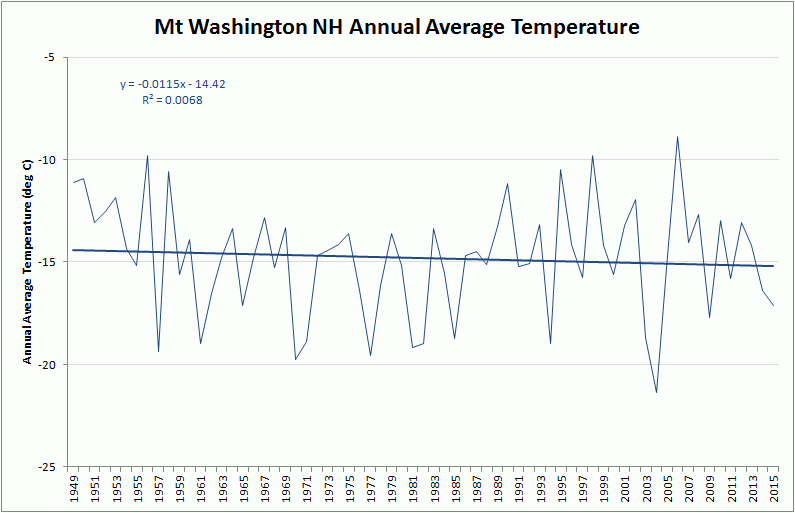
So I guess all that increasing CO2 lately is causing a downward global temperature trend? It couldn’t possibly be natural causes.
Based on the man-made CO2 induced global warming hypothesis, Mt Washington should have rapidly rising temperatures since it is at high latitude where most of the warming is supposed to take place. Instead, Mt Washington shows a slight downward trend since 1949.
Here’s a preliminary January 2016 CFSR global temperature update:
https://oz4caster.wordpress.com/2016/02/01/cfsr-global-temperature-january-2016-preliminary/
Announcements of the results of this “study” appear to be the bullshit du jour, here in the U.K.
Once again, the contents of a computer model are mistaken for reality, and reported on accordingly. Actually the uncertainty range provided with the study results is absurdly large – but that detail is not clearly explained by the BBC. Cryptically mentioned perhaps. Since the people don’t need to be shown the uncertainty in the science. Confident declarations and the steady trickle of mass brainwashing are all that is required in service of the grand project…
http://www.bbc.co.uk/news/science-environment-35444838
Your link is to an item on a paper dealing with winter rainfall in the UK, not the above paper. It’s still garbage though:
“We found that extreme rainfall, as seen in January 2014, is more likely to occur in a changing climate,” said lead author Dr Nathalie Schaller, from the University of Oxford.
“This is because not only does the higher water-holding capacity lead to increased rainfall, but climate change makes the atmosphere more favourable to low-pressure systems bringing rain from the Atlantic across southern England.”
But, but, but, this year the rainfall in the South has been normal whilst the North and Scotland have got soaked. Back to the models….
I would really like to know, when did the climate STOP changing ??
Hi Old’Un. Yes apologies for not being clearer. I simply intended to draw attention to this not dissimilar topic and its presence today in the media.
I expect that somebody here will post a header article on the specific study that I linked to.
At least I hope that they will.
I am intrigued as to where or how the atmosphere will be more favourable for low pressure across the Atlantic and anywhere in the mid latitudes for that matter. AGW theory states the poles should warm faster than the tropics. This means weaker thermal gradient, weaker jet streams and weaker and probably fewer low pressure systems although there is some argument for the jet streams becoming less zonal. Dr Schaller is from the Uni of Oxford and probably has a great academic CV, but I suggest she knows very little about the actual processes that bring rainfall to S England like a lot of these so called experts. I once sat through a presentation by a PhD at Reading Uni in the UK which covered at new model simulation for predicting rainfall and at the end he said “and that is why it is dry outside today” …..there was a pause and someone yelled out from the back of the room ” its been raining for 3 hours non stop outside”…..his response was……”that shouldn’t be happening because my model says it should be dry” . Enough said.
I got a computer model that says you are all going to die tomorrow unless you all send me lots of money via Palpal. Can I publish it? Please…
Can you publish it? Shr you can Nfr and wide.
Funny, mine says we all died yesterday !! Might need a few ” ADJUSTMENTS ” !! …LOL
PalPal? Is that related to CanCan?