Guest essay by Jim Steele
Director emeritus Sierra Nevada Field Campus, San Francisco State University
For 25 years I’ve lived in the beautiful town of Pacifica, California situated about 15 miles south of San Francisco. It was a wonderful place to raise a family. Its great expanse of green space is a delight for an ecologist. My daily hikes vary from coastal bluffs to watch feeding Humpback Whales or migrating Gray Whales, to inland mountain trails with abundant deer, coyotes and bobcats. Oddly this past week I received emails from friends around the country asking if I was “all right”, thinking my little slice of heaven was falling into the sea. Not to disrespect their concern, I had to belly laugh. The news of a few houses, foolishly built on fragile land too near the sea bluffs’ edge, were indeed falling into the ocean and were now providing great photo-ops for news outlets around the world. See a video here. It is fascinating how such an isolated event covering 0.5% of the town of Pacifica would suggest to friends that the whole town was endangered.
But it was more bizarre that this dot on the map could be extrapolated into an icon of CO2 climate change. I could only laugh as ridiculous CO2 alarmists who metamorphosed a local disaster, brought about by ignorance of natural coastal changes, into a global warming “crystal ball”. NBC news reported the Pacifica event as “a brief window into what the future holds as sea levels rise from global warming, a sort of a crystal ball for climate change.” The SF Chronicle suggested “increased global warming and rising sea levels due to climate change would double the frequency of those severe weather events across the Pacific basin.” The result would be “more occurrences of devastating weather events and more frequent swings of opposite extremes from one year to the next, with profound socio-economic consequences.”

Such apocryphal stories fueled a menagerie of bizarre blogging alarmists. I was recently interviewed by James Corbett, which incurred the wrath of a few internet snipers trying to denigrate my scientific background. Not knowing I also live in Pacifica, bd6951, a skeptic‑bashing poster, linked to a video of threatened apartments in Pacifica and commented, “What we are observing is run away climate change/planetary warming. This is just a guess but, the architecture of these apartment buildings suggest they are at least 20 years old. That means the people who built these units had determined the site was suitable for construction. They clearly were not thinking that an increasingly warming Pacific Ocean would cause their buildings to crash into the ocean 50 or more feet below. Oops. So I want to hear how the climate change denier crowd is going to explain this phenomenon.”
But like so many other alarmists, bd6951 blindly believes every unusual event must be due to rising CO2. Because the media rarely tries to educate the public about natural changes, paranoids like bd6951 perceive every weather event as supporting evidence for their doomsday beliefs, despite a mountain of evidence that it is all natural. Sadly when you try to educate them about documented natural change, paranoids feel you are “disarming them and exposing them to even greater dangers of rising CO2. But anyone familiar with Pacifica’s history understands this coastal erosion hotspot has nothing to do with global warming, and everything to do with the local geology and the natural El Nino oscillation.
So let’s put California’s eroding coastline into both a long term and recent framework. About 72% of California’s coastline consists of steep mountains slopes or raised marine terraces that are being relentlessly chipped away by Pacific Ocean waves. However the geology of the coast is complex due to varied depositional events, colliding plate tectonics and earthquake faults. At one extreme are erosion-resistant metamorphosed submarine basalts, greenstones, formed over 100 million years ago during the age of dinosaurs, and often forming headlands that defy the battering waves. Similarly the granites of the Monterrey Peninsula endure with very little erosion. On the other extreme are unconsolidated sandstones that were deposited during the past 12,000 years of the Holocene. Due to vastly different resistances to erosion, California’s presents a majestically steep and undulating coastline. The Pacifica locale has eroded more rapidly because the sea cliffs consist mostly of weakly or moderately cemented marine sediments from the more recent Pleistocene and Holocene. And because Pacifica has long been known as a hot spot of coastal erosion, it has been studied for over 100 years. For a more detailed geology read a 2007 USGS report Processes of coastal bluff erosion in weakly lithified sands, Pacifica, California, USA . As always, before we can blame catastrophic CO2 climate change, we must understand the local setting and the effects of natural change.

Since the end of the Last Glacial Maximum sea levels have risen about 120 meters. During the past 18,000 years most of California’s coast retreated 10 to 20 kilometers eastward at rates of 50 to 150 centimeters per year. The San Francisco/Pacifica region was much more susceptible to erosion and retreated about 50 km. After the Holocene Optimum ended about 5,000 years ago and sea level rise slowed, and California’s current rate of coastal erosion decreased to about 10 to 30 cm/year. Undoubtedly rising sea levels have driven coastal erosion. But based on San Francisco Bay Area’s sea level change posted at the PSMSL, since the end of the Little Ice Age this region has undergone a steady rise in sea level of less about 2 mm/year and counter-intuitively, the rate of sea level rise has slowed the past few decades as seen in the graph. Sea level rise varies most between El Nino and La Nina events.
Assuming a 150-year rate of local coastal erosion of 30 cm/year, any structure built within 20 meters of the sea bluffs’ edge in 1950, was doomed to fall into the ocean by 2015. But homebuyers that were new to the region were typically naïve about the natural geology and climate. Fortunately when I was shopping for Pacifica homes in 1982, my background allowed me to recognize that developers had ignored all the signs of natural climate change. They unwisely built homes too near the cliffs’ edge to ensure a spectacular view, or they had built in the flood plains and filled tidal marshes. Awareness of the power of El Niño’s is critical. Sea cliffs crumble and flood plains flood during El Nino events. Indeed during the 1982 El Nino, Pacifica’s Linda Mar lowlands flooded as heavy precipitation filled the banks of San Pedro Creek and high tides resisted the creek’s flow to the ocean. Inspecting Linda Mar’s homes, we could still smell the dampness in every house located in those lowlands. Along the bluffs of Esplanade Drive we likewise saw a evidence of coastal retreat during the 1982 El Nino, but not enough to undermine homes and apartments. That did not happen until the El Nino of 1997/98. Wisely we bought our home further inland on a solid ridge. As seen in the picture below from a USGS report, homes in the Esplanade area still had backyards until the 1997/98 El Nino struck. Residents were well aware of the imminent threat as revealed by the boulders, or riprap, placed at the base of the crumbling cliffs to discourage erosion, but those remedies were no match for the ensuing El Nino storm surge.
Unfortunately scientific measurements of coastal erosion did not begin until the 1960s led by Scripps Institute of Oceanography. So early developers had to guess how far back to set their homes from the bluffs’ edge. Due to recent research we now know that those cliffs had “retreated episodically at an average rate of 0.5 to 0.6 meter (1.5 to 2 feet) per year over the past 146 years.” But lacking geologic backgrounds and unaware of natural weather cycles, developers’ ability to estimate a “safe distance” was hampered by the episodic nature of coastal erosion that could lull people into believing erosion was minimal.
Minimal erosion may happen for decades when La Ninas divert the storm tracks northward, during which time naïve homebuyers and builders are not alerted to inevitable future threats. Those mild periods are soon followed by rapid losses during El Nino events. Thus ill informed in 1949, developers constructed several homes at the top of a 20-meter sea cliff along Esplanade Drive in the city of Pacifica. During the heavy winter storms of the 1997/1998 El Niño, 10 meters of local coastline were rapidly eroded, eliminating the last vestiges of the backyards that had survived the 1982 El Nino (see pre-1997 photograph below). In 1997/98, seven homes were undermined and three others threatened. All ten homes were eventually condemned and demolished.

Nonetheless early developers should have been more cautious and alerted by past catastrophes. Early entrepreneurs in California were eager to develop its vast potential. The Ocean Shore Railroad was built, hoping to link San Francisco to Santa Cruz and entice more immigration into the area, as well as to transport lumber and agricultural products. Where the terrain was too daunting to go up and over, they chiseled out ledges that circumscribed the coastal cliffs. Scheduled to open in 1907, the 1906 San Francisco earthquake disrupted those plans. Pacifica lies just south of the San Andreas Fault, and its movement dropped a length of 4000+ feet of right-of-way along Pacifica’s fragile sea cliffs into the sea along with all their railroad building equipment. The surviving railroad ledges can still be seen today.
If you spend enough time walking along Pacifica’s beaches, you would recognize an annual pattern of beach erosion. Heavy winter storms carry the smaller grains of sand offshore restructuring a sandy beach into a bed of rocky cobble. The gentler waves during the summer return the sands to the beach and bury the cobble. The currents will also carry some displaced sand down the coast, while those same currents also carry sands from further upstream. When not enough sand is delivered to replenish a beach, it undergoes rapid erosion. So in addition to natural changes, the damming of rivers that halt the seaward supply of sediments can starve a beach and promote erosion. Likewise when naturally eroding cliffs are armored at their base by boulders, the lack of local erosion can starve adjacent beaches of needed replenishing sediments. Because of that possible impact on neighbors, the California Coastal Commission now requires a permitting process before any seawall can be built. Finally jetties that are built to protect harbors often block the transport sand along the coast, starving beaches down stream from the jetty and causing amplified erosion. In many locations, governments dredge regions of sediment build-up, and dump those sediments where beaches are now starving, such as being done by San Francisco just north of Pacifica.
This region’s coastal erosion is episodic for well-understood reasons. When a cliff face collapses it leaves a pile of rubble at the cliff’s base, sometimes called the “toe”, which raises the beach and acts to naturally buffer the cliff face from further erosion. After several years, waves and currents carry the buffering toe away, and eventually exposes the cliff to another “bite” from the ocean.
Furthermore the Pacific Decadal Oscillation is expressed as a 20 to 30 year negative phase with more frequent La Nina’s alternating with a positive phase with more frequent El Nino’s. The relatively stationary high-pressure systems prominent during La Nina’s, forces storm tracks to the north of California. Fewer storms mean less coastal erosion, but also result in more California droughts. The current return of El Nino now allows storm tracks to attack the California coast. Snow is currently above average in the Sierra Nevada and reservoirs are filling, but simultaneously coastlines are more heavily eroded.
In addition, the effect of higher rates of precipitation associated with El Nino also cause greater slippage between geologic layers that differ in their ability to handle subsurface water flows. Heavier precipitation caused episodic collapses of coastal Highway 1 at Devil’s Side at the south end of Pacifica. A tunnel was just built to re-route the highway away from that geologically unstable area.
For millennia El Nino cycles have caused these natural extreme swings that alternate between droughts and floods and episodic coastal erosion. Changing your carbon footprint will never stop the process. But knowledge of these natural processes will keep people out of harms way. One of the greatest sins of the politics of the climate wars is that people are not being educated about natural climate change. They are not being taught how to be wary of natural danger zones. Instead every flood and every drought, every heat wave or snowstorm is now being hyped as a function of global warming. After every catastrophic natural weather event, yellow journalists like the Washington Post’s Chris Mooney or APs Seth Bornstein, seek out CO2 alarmist scientists like Kevin Trenberth or Michael Mann, to make totally unsubstantiated pronouncements that the event was 50% or so due to global warming. After centuries of scientific progress, Trenberth and his ilk have devolved climate science to the pre-Copernican days so that humans are once again at the center of the universe, and our carbon sins are responsible for every problem caused by an ever-changing natural world.
You can recognize those misleading journalists and scientists who are either totally ignorant of natural climate change, or who are politically wedded to a belief in catastrophic CO2 warming, when they falsely argue, as NBC news did, that “frequent swings of opposite extremes” are due to global warming. El Nino’s naturally bring these extremes every 3 to 7 years, as well as the 20 to 30 years swings of the Pacific Decadal Oscillation. These swings have occurred for centuries and millennia! The same storms that bring much needed rains will also batter the coast and increase episodic erosion. But by ignoring natural change, climate fear mongers delude the public into believing La Nina-caused droughts of the past few years were due to CO2 warming. And now as El Nino returns the rains to California, those same climate fear mongers want us to believe CO2 warming is causing an abrupt swing to heavy rains and coastal erosion. One needs only look at the historical records to find Pacifica’s coastal erosion was much greater around the 1900’s, and that El Ninos have caused natural extreme swings for millennia.
Honest science, useful science, must educate people about our natural hazards and natural climate oscillations; so that people do not build too close to fragile cliff edges or build in the middle of a flood plain. It is not just the coast of California that is eroding. The politicization of climate change is eroding the very integrity of environmental sciences. Reducing your carbon footprint will never save foolishly placed buildings in Pacifica or stop the extreme swings in weather induced by El Nino’s and La Nina’s. It was the end of the Ice Age that initiated dramatic coastal erosion and only a return to those frozen years will stop it. Pacifica’ eroding bluffs are simply evidence that most of California has still not reached an equilibrium with the changes that began 18,000 years ago. Pacifica is truly an icon of natural climate change.
But the ranks of climate alarmists are filled with legions of scientific ignoranti who blindly see such coastal erosion as another “proof” of impending CO2-caused climate hell. This group lusts for climate catastrophes to prove they are not blindly paranoid. Other self-loathing CO2 alarmists simply lust for climate catastrophes that will deal humans their final “come-uppance.” So they too lust for climate catastrophes. Only a solid of understanding of natural climate change can prevent this climate insanity and pave the way to truly scientifically based adaptive measures.

Jim Steele is author of Landscapes & Cycles: An Environmentalist’s Journey to Climate Skepticism
“For millennia El Nino cycles have caused these natural extreme swings that alternate between droughts and floods and episodic coastal erosion. Changing your carbon footprint will never stop the process. But knowledge of these natural processes will keep people out of harms way”.
Just plain old common sense.
Outstanding read!
It’s just natural conflict between water and land. Water tends to erode the land, and it wasn’t for tectonics, after billion or two of years we wouldn’t have had any dry soil to walk on.
Climate change through ice ages to MWP, LIA and if you wish ‘warmest year everrrrr’ is just the sun’s and tectonics’ doing.
just the sun’s and tectonics’ doing
Much too simplistic and misleading [as usual].
Let’s just be grateful to the tectonics that we are not cetaceans.
Meaningless OT nonsense
“Much too simplistic and misleading [as usual].”
Yes, life (particularly photosynthesizing and shell-building organisms) is also important.
@ur momisugly Lief,
Good to hear from you.
The man means well, do ya gotta be so nasty ?
Well-meaning is not enough. One also has to be at least somewhat plausible, and Vuk’s stuff is pure pseudo-science.
lsvalgaard adds nothing to a very good article by Jim Steele. lsvalgaard typifies “too simplistic and misleading.”
My remarks were directed at Vuk, not at Steele. So, explain to me how Vuk’s utterances adds anything of value to Steele’s.
Lief, you can’t really complain on one hand about someone being OT and then on the other hand go OT yourself with your diatribes, without looking like a complete hypocrite. You started another fight. Own it.
So be it. Pseudo-scientific nonsense has to be stamped out as soon as it rears its ugly head. Now, if you want to subscribe to Vuk’s nonsense, admit it.
Bob Weber 12:49 is, of course, ON topic, talking about what he considers to be off topic.
Hey boys and ladies throttle back a bit.
Dr. Svalgaard is a good friend of mine, he gets me data whenever I ask. He finds my comments irritating because he knows there are based on good data.
I find Dr. S’s comments amusing because I know he is concerned that data challenges his view of the natural world.
Given how MANY times Mr. Vukcevic has mindlessly continued to assert his half-truths, how MANY times V. has ignored intelligent, well-informed, instruction, he brings the blunt response upon himself.
Perhaps, a bucket of cold water dumped on V.’s head? Nah. He’d just grin and say, “There! You see? Since what I say makes you annoyed, I must be correct! Wheeee! Sun and tectonics ALONE, foreverrrrrr!…..
…… and people feel sorry for me, too. So THAT means I must be RIGHT!”
Lief,
You sound more and more like a bitter old man who flings abuse at anyone who doesn’t agree with you.
Please try to be a bit more civil.
Re: “bitter old man”
To me, Dr. Svalgaard just sounds like a typical Dane or Norwegian.
And only an angel (who knows as much about the subject matter at issue, here) could suffer a fool (on this subject matter) like Vukcevic with a smile. Dr. S. is just human.
And, as I told a commenter who seems to have disappeared, Ger@n, when he rebuked Dr. Svalgaard for being blunt, perhaps, I am a bit defensive out of an unconscious guilt at my OWN harsh criticism of Dr. Svalgaard when I first encountered his responses on WUWT about 2 years ago. I yelled at him more than once for being rude and harsh… . Over time, I have, I think, come to understand him and his position on AGW better. Ah, well. So, I UNDERSTAND all the “don’t be so mean to V.” comments above, but I still stand by what I wrote. V. would try the patience TO THE LIMIT of anyone who had Dr. Svalgaard’s knowledge and who had made as many attempts to correct V.’s mistakes as he has.
Dear Ms. Moore
Thank you for your observations, you are being far too kind, ‘a man of superior ignorance’ as once was said, might be more apt. To the contrary I try not to comment on personality traits of anyone. Challenging established concepts by relying on the best available data is far more fascinating and a better use of my time and limited ability.
Jim’s well-written article lays out how the CO2 people just don’t think things out, and how they don’t learn anything from history. CO2 does not cause sea level to rise or fall, no warmist has demonstrated how that could happen, and there is no evidence for that happening. Further, it looks like very few understand how natural climate change occurs, or that it even happens at all.
http://wattsupwiththat.files.wordpress.com/2016/01/clip_image0045.png
I’ve seen many SLR graphics with a similar profile, which does coincide very well with the overall ocean temperature rise since the solar Dalton minimum of the early 1800s. This slowly happened as a result of thermosteric SLR, which occurs from the expansion of sea water from a reduction in density of warmed up water vs more dense cooler water that sinks. The warmed up water expands and rises to and stays on the surface. Most of the heat in the ocean heat content data is in the top ocean layer.
Gradually increasing solar activity from low levels during the Dalton minimum to higher levels thereafter warmed the oceans. Accumulating heat in the ocean from the net increase in energy input from the sun over many solar cycles over the past few hundred years brought the sea level up through thermosteric expansion.
One can even see the ‘pause’ at the tail end of Jim’s graphic, which was caused by the slowdown in solar activity post-2003. The latest upswing in sea level since 2008 is solely from the recent solar cycle maximum and higher temps. SL will go negative into the next solar minimum as temps drop, and so on.
If we experience a few low level solar activity cycles back-to-back as we did during the Dalton, sea level will drop again as it did during the Dalton, until sufficient solar activity finally kicks it back up by depositing and accumulating more energy into the top ocean layer over time again, and so on.
In case someone isn’t clear on the power of the sun. 2015 was a warm year even in the lowest solar cycle in 100 years because 2015 was the highest TSI ranking year since 2003, after several years of increasing levels since the 2008/9 solar minimum:
Year TSI
2015 1361.4321
2014 1361.3966
2013 1361.3587
2016 1361.3484
2012 1361.2413
2011 1361.0752
2003 1361.0292
2004 1360.9192
2010 1360.8027
2005 1360.7518
2006 1360.6735
2007 1360.5710
2009 1360.5565
2008 1360.5382
That means Vuk was right about the sun. Tectonics? that’s another thing…
http://lasp.colorado.edu/data/sorce/tsi_data/daily/sorce_tsi_L3_c24h_latest.txt
“2015 was the highest TSI ranking year since 2003” — SINCE 2008
I see leif is still trying to push the simplistic notion that the sun plays no role in climate changes.
That must be the null-hypothesis until compelling evidence is found.
lsvalgaard,
“That must be the null-hypothesis until compelling evidence is found.”
I fail to see how that could be true, for it seems to me that a great deal of compelling evidence already exists which renders the Sun the reason we have weather/climate (turbulence in the atmo/hydrosphere). No one has to prove that the Sun makes each and every individual variation in that turbulence, it seems to me.
I think you are confusing matters. The sun is the primary heat source of the atmosphere and as such drives all the interesting Weather/Climate effects we see every day. The question is whether solar magnetic activity has any detectable effect, and, so far, no compelling evidence for that has emerged in spite of almost 400 years of looking for such.
“The question is whether solar magnetic activity has any detectable effect …”
That was not what the comment it seems you were responding to said;
“… the simplistic notion that the sun plays no role in climate changes.”
It’s just the “no role in climate changes” aspect I was concerned about, in terms of the “nul hypothesis” being a “must” against.
When one is claiming that a very small effect possibly exists, the NULL-hypothesis must be that it doesn’t.
https://en.wikipedia.org/wiki/Null_hypothesis :
“In inferential statistics, the term “null hypothesis” usually refers to a general statement or default position that there is no relationship between two measured phenomena, or no difference among groups”
Perhaps, also, JohnKnight, Dr. Svalgaard and you guys are talking past each other a bit. The two ideas being discussed are:
1. long-term climate shifts
2. short-term weather/climate effects
That is, you likely are in quite close agreement. The Sun causes short-term effects, but, the long-term shifts in climate, those of centuries-long endurance, are “not-proven” driven by the Sun which is, so far as we can prove, only the maintainer of the homeostasis of earth’s climate (versus weather).
“When one is claiming that a very small effect possibly exists, the NULL-hypothesis must be that it doesn’t.”
Right, I just didn’t want anyone to think it applied to something like the Sun, which is not a small effect.
If it is not a small effect we would not be discussing it as we have been for 400 years without coming to a conclusion everybody can agree on.
Possible translation to aid communication:
“Small effect” = small effect as to a climate SHIFT (versus short-term weather effects).
That is, the Sun = BIG overall steady heat source, and the maintainer of homeostasis of earth’s climate generally, yes. However, as to the Sun having a big effect in terms of driving a long-term climate SHIFT, apparently, it is too small to be ascertained.
Janice,
This is hard to put into words . . partly because changes in effects, have come to be spoken of as effects themselves, it seems to me..Are the sea cliffs of Pacifica changing . . or are they continuing as before? ; )
“That is, the Sun = BIG overall steady heat source, and the maintainer of homeostasis of earth’s climate generally, yes.”
Yes . . and as the ocean continues apparently to be about the same, and the big overall steady source of cliff change at Pacifica, the Sun could be the source of climate change on earth, while itself remaining about the same. The Sun has many effects on the Earth, including things like allowing reefs and forests to grow, waves to erode shores turning coastal mountain range tops into small offshore islands and so on. Stasis is not a given, even if the Sun remains essentially the same.
“However, as to the Sun having a big effect in terms of driving a long-term climate SHIFT, apparently, it is too small to be ascertained.”
I don’t know that is true, both for reasons I just tried to touch on, and because we have only recently been able to observe changes in the Sun with much precision, and we have not experienced any long-term climate SHIFT while we were “watching”. For instance, if the Sun goes to sleep sunspot-wise, we might now be able to detect a increase in cloud cover, which would be something big enough for us to ascertain, but could not have determined in the past.
I find the V. vs L.S. petite feud ammusing, but somewhat distressing. Both are good folks. Both think well. Both present interesting things.
Yet L.S. can’t stand to let an innocent statement pass without dumping on it with a slur. Sad, really.
V. states a truth in a slightly poetic way, and L.S. attacks it as too simple? Well that is what any summary understanding less than an encyclopedia will be. So what.
There ARE only two major agents of land change on the planet. Geology derived from atomic decay heat makes the land and raises it up. Solar driven wind , rain, snow, ice, and waves wear it down. Whenever one of these wins the race, the earth as we know it will end. Decay heat is likey to become too little in the next billion years as the sun becomes larger. We leave, die, or become aquatic. (IFF whatever we have evolved into by then can be called human…) V. is right on that.
Too simplistic? Yes. L.S. is right on that. There IS biological driven geology (carbonate cliffs …) and more. Yet isn’t life just solar energy on a longer detour to space return? The other details can similarly be assorted.
So I am left to ponder why L.S. feels so deterimned to crush a POV on planetary life and future that sees the whole in a gestalt and summarises it in a haiku analog, despite it being a truth. Too focused on here and now? To hypersensitive on any solar cauality attribution for Global Warming? Too much history with V.? Too little poetry of the soul in his employment? Who knows. …
And V. still likes to speak in poetic bits (or sometimes riddle style) knowing it lights L.S. fuse. Why? Non-native speaker? Gun shy from prior “eruptions” from L.S.? Limited time? Or maybe just likes to ring the doorbell and run 🙂 is hard to say…
Ah, well. The Show Must Go On! I love both of them being here and would not change a bit of it.
E.M. :
Pseudo-science has to be countered even if disguised as levity. Although Vuk provides some entertainment it is at the expense of a diminished WUWT. Some people are OK with that, I am not. So, go ahead and be sad for my trying to uphold at least a minimum standard.
lsvalgaard,
“So, explain to me how Vuk’s utterances adds anything of value to Steele’s.”
I read it as a continuation on the comment above it (Kenny’s), which spoke of what was not driving the “change”, and then Vuc added a bit about what is. Quit yer bitchin’ ; )
Dear JohnKnight,
You were so kind as to address your remarks to me that I am responding (for the last time on this thread — I’m not at all worth your time discussing this topic — I only hoped to enable the conversation a little). Thank you for taking the time to try to explain your thoughts about Sun and climate shifts. I am far too ignorant (in the strict sense of that word) to even begin to assess them. Many bright, far more informed, and scientifically educated than I, thinkers pose the same or similar arguments/thoughts as you have.
A man whose mind I highly respect persuaded me that there is much to learn and good reason (though not proven, yet) to believe the Sun may drive climate shifts (he focuses on solar chemistry). I can have no opinion on it, I say CAN-not, for I simply do not know enough to say anything except that some of the arguments sound plausible and some… not.
I hope that you can find someone of Dr. Svalgaard’s calibre to discuss this science with — he is not likely to devote much time to that, here, I think. Hey! Maybe you could find out where he is teaching a class or seminar, take it and then, talk with him afterward. If he is as generous (with data sharing) as Vuk (who would do well to LISTEN to Dr. Svalgaard at times) says, you would likely find him open to your honest, thoughtful, questions. Above all, he is a teacher. THAT is his joy. That is why, gruff as he is at times, he comes here.
Well! I am (yawn) tired. Glad YOU are here. Sincere seeking after science truth such as you demonstrate, here, is what makes reading the comments on WUWT worthwhile.
Take care.
Janice
Thanks, Janice, I appreciate your encouraging words, to me and others around here. (didn’t scroll down to this section earlier, and missed your response). ‘ll bear in mind your and Vuk’s admonitions about Mr. lsvalgaard . . (but he’s lucky you guys held me back… ; )
Speaking of solar chemistry, have you noticed Mr. Robitaille? (I almost asked Mr. Isvalgaard to comment on his stuff) . . This one seems to have his ducks all in a row, so to speak, and may be on the verge of changing everything “we” thought we knew about Mr. Sun. Take look when you get a chance, I suggest, I haven’t been able to find anyone disputing his ideas . . and they could change everything . .
I haven’t been able to find anyone disputing his ideas . . and they could change everything . .
He is a crank of highest order. Nobody really cares about disputing such nonsense. It is like if somebody claimed the Earth was flat: nobody would spill ink or breadth disputing that.
Dear Mr. Knight,
I’m glad you were encouraged. I wasn’t going to post on this thread again, but, seeing your name in the recent comments just now, I came back to see if you read my remarks to you above. Thank you for your kind words.
Just so you can know not to bother, I am (please forgive me) not going to look at that info. you posted. I just do not have the interest in it that you do, nor do I likely have the knowledge to intelligently assess its accuracy or plausibility. This article, just FYI, is one I DID read and took notes on. It seems to make quite a bit of sense. Don’t bother to comment on it to me, here, I really don’t want to try to discuss an issue about which I know SO little. But, thanks for thinking of me!
Article I liked (text below is just copied/pasted from my notes about it):
Link: http://pubs.giss.nasa.gov/docs/2010/2010_Gray_etal_1.pdf
Abstract – with my edits — (this paper IS available – I summarize it below)
Gray et al. 2010
Gray, L.J., J. Beer, M. Geller, J.D. Haigh, M. Lockwood, K. Matthes, U. Cubasch, D. Fleitmann, G. Harrison, L. Hood, J. Luterbacher, G.A. Meehl, D. Shindell, B. van Geel, and W. White, 2010: Solar influence on climate. Rev. Geophys., 48, RG4001, doi:10.1029/2009RG000282.
Understanding the influence of solar variability on the Earth’s climate requires knowledge of 1) solar variability, 2) solar-terrestrial interactions and the 3) mechanisms determining the response of the Earth’s climate system. We provide a summary of our current understanding in each of these three areas. ***
From what I have read of Dr. Svalgaard’s writing, you would do well to listen carefully to what he says. Try to ignore the tone (at times).
Your Ally for Science Truth,
Janice
I don’t do human authority worship, lsvalgaard.
It is fitting to give credit where credit is due.
lsvalgaard,
Credit sure, but not blind faith. Present a rebuttal and I will consider it. Point me to a rebuttal/ and I will consider it.
Tell me he is being ignored and I am unimpressed. If the current experts on the Sun have no strong rebuttal, they will ignore him, I figure. They have much to lose if what their status/career is based on, becomes a passe notion about the very nature of the Sun. They become non-experts on the Sun . . ya know?
and I am unimpressed
What you are is of no concern to anybody.
It is fitting to give credit where credit is due ; )
Good post. I used to weekend south of there some years ago, and the cliffs would change every year. Devil’s Slide is appropriately named.
Thanks to the tunnel, that 1.5 mile section of Highway 1 at Devil’s Slide is now a park that you can walk, and I do so several times a week. On a clear day you can see the Farallon Islands on the horizon. Those islands were the tops of California’s coastal hills at 18,000 years ago. Current vastness of intervening ocean is a tremendous visual illustrating the power of natural erosion.
Farallon Islands
http://sfcitizen.com/blog/wp-content/uploads/2008/09/img_4457smallb-copy.jpg
*********************************************
Thanks for another great article, Jim Steele! And, thank you, so much, for all you do for freedom. Truth sets us (and animals, too) free.
Janice
With less (or zero?) telephoto compression, for perspective: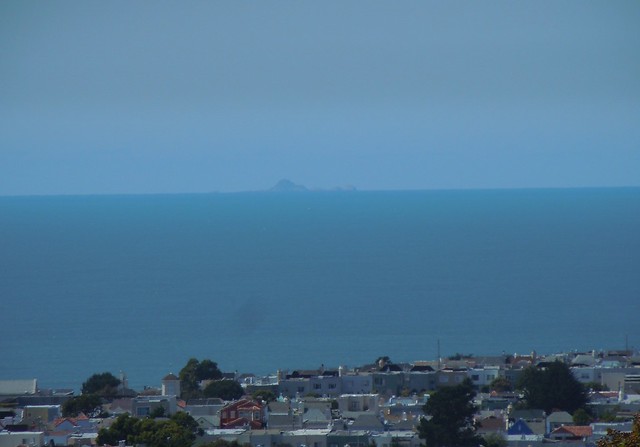
Farallon Islands
Thanks Janice,
And thanks for posting the pictures of the Farallons.
Wow!
Back in ’96-’98 I worked for a company officed in the top floors of Spear Street Tower, adjacent to One Market in San Francisco. When we’d bring recruits in for interviews I always made it a point to take them onto the roof–from which on a clear day one could see the Farallons (and a tremendous expanse of the Bay, Marin, etc.) It always closed the deal. I’m assuming those doors were well-locked after 9/11!
”..coastal erosion hotspot has nothing to do with global warming, and everything to do with the local geology and the natural El Nino oscillation.”
Jim, with this rapid an erosion, I’m surprised there wasn’t a good seawall, bulkhead or other coastal protection built as is common for coastal cities worldwide. It would seem that significantly more of Pacifica is doomed to be destroyed in the next 100yrs without it. I’m also surprised that there isn’t some municipal code that would prevent construction in such a vulnerable location.
California coastline is about 840 nautical miles/1,350 km.
Here’s a look at a shoreline CAP study to address 7 Pismo Beach miles of shoreline. The Study costs alone are over a million dollars.
What we’ve got is regulatory overreach which impedes an overall solution.
pismobeach.org/DocumentCenter/View/6716
0.5 to 0.6m/year isn’t something to worry about, just something to be aware of. 100 years of erosion means 50 to 60 metres of ‘loss’ so building 100m in from the edge will give you a home that will survive you and your immediate families lifespan.
Seawalls and/or bulkheads pander to the ‘worriers’, less so the ‘thinkers’.
Actually, sea walls enhance the erosion of the area in front of them due to the dynamics of what happens when large waves hit them. The transported mass of water has to go someplace, and the surface transport is toward the wall. The transported mass thus goes down to the bottom and creates a reasonably strong current that moves sand, etc. out to sea. This accounts for the undermining that Mr. Steele notes for his boulders.
But this is assuming that extrapolating past erosion rates to the future is valid. If I were locating within 100 meters of the edge of a cliff, I’d want wheels under whatever I live in.
Rockaway Beach has a extensive rip rap seawall. There have been periodic placement of riprap at the base of more threatened cliffs attempting to imitate a natural toe, but those boulders are eventually undermined. So its an ongoing process.
Due to the geological complexities, each municipal government now has their own building codes in conjunction with the Coastal Commission’s. Before the 1960’s there were no reliable measurements so the most threatened buildings were constructed before then. The distance one can build from a cliff’s edge can vary between municipalities and within a city’s limits, depending on the geology,
Gary, In the Newark quake, some cliff areas rose several feet. California is a very dynamic place and attempting to freeze it is doomed to failure.
It is a very bad idea to insert yourself, or seawalls, between 50 foot waves, tsunami, mag. 9 quakes, feet of uplift in a moment or hundreds in millenia, falling cliffs (and houses and trains and boulders and …), tons of migrating beach sand, fires floods and mud sliding hills, along with the every 30 years or so “reimagining” bulldozers and constuction crews.
Better is just to accept what is, hang on, and enjoy the ride….
In 30 years it will be something else anyway…
(BTW, I am a native Californian. Though currently in Florida.)
Beautifully written post. Good for calling out Mooney and Borenstein. As for the local tide gauge SLR, the California coastline they are placed on does not stand still–labeled San Andreas fault is sufficient evidence. Need differential GPS land motion adjustments in many, but not all, global tide gauge locations. The recent SLR slowdown in the post chart is more likely the land rising, itself a possible earthquake precursor.
Perhaps but it is also is a function of the Pacific Decadal Oscillation and the strength of the winds. Either way the lack of a relative sea rise minimizes that effect as an explanation for the current erosion.
Photographs of these houses are popping up on message board fora now with extra-expressive and emphatic no attached comments as though to say “what more evidence could any reasonable person want!” The profound levels of displayed ignorance are a little sad to see of course but also just hilarious. Thanks for the informative and entertaining essay.
Thanks for presenting the facts. As an infrequent left coast visitor; it’s exactly what it looks like from the plane; Cliffs eroding into the ocean. Then you look at the cliffs that appear like some kind of clay and rock and wonder how can any of this stand. Then you see the cliff fencing to constrain the slides. I suspect that if it rained more, it would be a lot gentler slope to the water.
America’s west coast is still in active uplift.
Much of the debris carried up in the uplift is not solid rock, but literally soil and rock that eroded in earlier times.
Attempts to fence off cliffs is not attempts to constrain the cliff, but to prevent people and animals from merrily walking off or jogging off.
Building on slopes or cliff sides anywhere on the west coasts on North or South America is an exercise in Darwinism. If the land doesn’t slide down, there is always a chance that a tsunami will come visit.
They belong next to the close-ups of garbage floating in Hong Kong bay when discussing ocean plastic scares.
Thanks for the essay. Any minute we can expect Gov. Moonbeam to announce federal and state aid to Pacifica property owners and tenants for Climate Change reparations. He’ll add it to the list of nasties CO2 is heaping on us poor Californians as proof we’re all doomed.
The only part of the story that is missing doesn’t relate to science. At some point in time the coastal land was put into private ownership ($100,000). Some years later a wealthy individual or group bought the land for $1M. They then subdivided (permitted by government) it to increase the value to $10M. It was sold to a developer for $50M, who subsequently built residential structures and sold them for $100M. The municipality assured building codes were met, collected permit fees, and added to the tax base. As the buildings now topple into the sea, insurance (a collective) or climate mitigation monies (a collective) will compensate for losses. That’s one heck of a lot of “profit” and “compensation” with no enforceable responsibility. Common sense is trumped by profit. Hmmm- Jersey Coast? New Orleans?
Another great article by my favourite author.
The moral of the story, erosion happens.
Great article.
The Chinese are currently building islands in the South China Sea and California is whining about erosion caused by natural forces and red tagging coastal properties.
Wouldn’t a simple solution like extending the beaches, adding breakwaters, and planting the hillsides ….
This reminds me of a recent trip to Catalina. Catalina is surrounded by water yet relies on rainfall for its water supply.
English were great railway lines builders , but even they couldn’t plan for the ocean’s destructive forces.
http://i.dailymail.co.uk/i/pix/2014/10/13/1413211625576_wps_6_Archive_photo_of_the_stor.jpg
And Flagler had the same problem in Florida!
Well actually they could, and now they do.
Jim Steele – a really good post – I loved your book and lend it to others to explain why natural processes are much more important than AGW etc.
Now – about the UK railway builders planning for natural forces. Certainly they did learn that they had to do it and perhaps now they do. but the preeminent example in UK of lack of such planning is Folkestone Warren.
I worked for British Rail in the early 1970’s and as their only geologist – was given responsibility for the monitoring of the Folkestone Warren landslide. The railway from Dover to Folkestone was built along the undercliff on the toe of the landslide which is a series of enormous circular slips of the chalk cliffs on the underlying Gault clay. These have been happening since England was joined to France and the Channel opened. So they should have known better.
in 1915 they found out the hard way as the line was destroyed (with a train on it) by a failure of the undercliff following erosion of the toe of the landslide. Since then, British Rail and their successors have tried to keep the line open by a series of tow weighting schemes and sea walls. In the end the sea always wins and I was looking at it following seaward displacement of the wall. We never solved it and I was happy after two years to move on to a career as Engineering Geologist in South Africa then Australia, where I am now.
With regard to Folkestone Warren – we found that it was metastable and a small increase in the water table would tip it into instability and in the end, there was not a lot they could do. I haven’t followed its fate for a long time, but it illustrates the difficulties of trying to compete with natural erosion of a cliff.
Keep up the good work
KM
The power of water!! In Southern England the Isle of Wight was attached to the mainland…but a channel was wased in to existence. Hense we now have the Isle of Wight!
washed
These failures are mostly a result of a lack of maintenance.
They are mostly due to building in the convenient (coastal) places and ignoring the stability of the strata they have cut into – but then most of the UK railways were sited during the Victorian boom years when they had no understanding of soil science or rock mass stability
Just down the road from me the coastal erosion over a few centuries has famously removed an entire village. Here is a time-lapse photo of a famous church (All Saints Church, Dunwich, Suffolk, UK) gradually disappearing since 1736. The cliffs are static most of the time, but when there is a once-in-a-decade storm several metres of cliff fall into the North Sea. Conversely, at Rye and other places on the South Coast (and, strangely, other parts of Suffolk), coastal deposition has “moved” mediaeval ports a mile or so inland. This has been happening for centuries, but when the BBC interview farmers and house-owners whose property is about to disappear, the reporter always splices in “caused by climate change”!
It is like those people in the Carolina’s that build on barrier islands…what happens when there is a surge or other catastrophe caused by a hurricane? Must be climate change!
When Lake Ontario was at a high point in the 70s and backyards began to fall in, what was the cause? It surely couldn’t have been ill informed developers building too close to the bluffs…could it?
I suspect that NBC will not be posting a retraction.
People here in Vancouver talk about rising sea levels, so I downloaded the daily max and min tides from Victoria (from 1909 to present) and Juneau (from 1993 to present). Victoria is dead flat – the only change in sea level is a negative trend that is smaller than the noise. In Juneau, sea level is decreasing at 13mm / year.
Am I correct to understand that we will soon have a satellite observing global sea levels? That would be good I think – when we put up a satellite to measure air temperature, the warming trend stopped.
Juneau land is rising more than 13mm/year. Tectonics. I used the example in essay PseudoPrecision about SLR.
Might also be an after-effect of the melting of the Cordilleran ice-sheet. Northern Europe and northeastern North America are still rising, so it is likely that BC and southern Alaska are too.
Tty, maybe a bit. Sure. But nowhere else is isostatic rebound >13mm/year. Alaska is mostly tectonics.
http://www.vukcevic.talktalk.net/L-u.gif
ristvan you said “Alaska is mostly tectonics.” That set off a few questions. Most of Beringia was ice free other than the highest mountains. That would suggest that there would be very little rebound. Do you have links explaining why there would be so much uplift? Are there GPS studies showing that amount of uplift?
The weight of Arctic glaciers depressed the Arctic but caused a rise at the periphery in the sub-Arcitc/temperate regions. The New England. eastern USA coast is believed to have risen during the Last Glacial Maximum but those coasts areas are now sinking. If Alaska was affected similarly perhaps there is not so much uplift.
Jim, yes, and yes. They are in footnotes to ebook essay By Land or by Sea. For Alaska specifically, start at Alaska Earthquake Information Center, geophysical Institute, UAF (University Alaska, Fairbanks). Sorry that my really old iPad won’t post direct links. The image from that source in my ebook essay shows a roughly 8meter beach height increase in about 800 years, in four major terrace ‘events’. The vertical from ocean uplift from the 1964 earthquake alone was measured at 3.6 meters at the UAF pictured beach location!
So Alaska’s uplift is not due to glacial isostatic rebound but due to tectonic activity?
According to this illustration from University of Cambridge,
http://www.qpg.geog.cam.ac.uk/research/projects/englishchannelformation/1453389260_3dcecb561c.jpg
for some reason apparently most of Siberia and large parts of Alaska were free from ice sheet. This is hard to explain simply by drop in insolation.
Associated article (lecture by Professor Phil Gibbard) has no details on the matter.
http://www.qpg.geog.cam.ac.uk/research/projects/
Jim,
The Pacific Plate is subducting under North America. That is why we have the volcanic arc and uplift (and the Coastal Range mountains and the Alaska volcanoes and..,)
Put a couple of miles thick slab of rock under a place, it uplifts…
Oh, and an earlier subduction (of the Farralon Plate?) likely gave us the Rockies, gold in California and Colorado, and the uplift that let central USA drain out the inland sea.
We then rode over a spreading zone that created the Basin and Range stretching (making Nevada and Utah flatter and giving N. America the classic bent bulge west coast shape) but it also means a crack between Baja California and N.American plate will eventually extend to Mono Lake (Tahoe region)…
Hey, it’s geology… things change 🙂
If a whole tectonic plate can be rising (even the part under water) and if all of Hudson Bay can be rebounding (even the part under water) then that implies that melting ice is not the only phenomenon that affects sea level. I can see how climate change (both natural and anthropogenic) has influenced glacier melt and thus influenced sea levels. But perhaps tectonic movement is an even greater influence?
I cannot imagine how CO2 levels can influence tectonic movement, so an important question for the Warmers to address is: what fraction of observed sea level rise is due to melting ice vs uprising land?
It is much worse than they thought, they will say. All of it will be anthropogenic.
there is more to it than the ‘status quo’ science is prepared to consider
(see: http://wattsupwiththat.com/2016/01/30/pacifica-californias-natural-coastal-erosion-and-the-lust-for-climate-catastrophes/#comment-2133619)
Another great article and thanks, also to vukcevik for the picture of Dawlish on the West Coast of Devon. Pacifica is far from unique. Parts of the East Coast of England has actually eroded faster than the West Coast of California. The following is extracted from Wikipedia.
“Walton in the Naze
Originally, Walton was a farming village situated miles inland. Over the centuries large quantities of land were lost to the sea due to coastal erosion. The mediaeval village of Walton now lies nine miles out to sea with its old church finally succumbing in July 1798. Its last service was held on 22 July 1798. This loss of land to the sea is a fact recorded on a Canon’s stall in St Paul’s Cathedral with the inscription Consumpta per Mare.
The Naze continues to erode rapidly (at a rate of approximately 2 metres per year) threatening the tower and wildlife. The Naze Protection Society was formed to campaign for erosion controls. The Naze has become popular for school fieldwork into erosion and methods to protect the coast. Protection includes a sea wall, a riprap, groynes and a permeable groyne as well as drainage. Millions of tons of sand have been added to the beach to replenish it and stop the cliff eroding. However, the cliff near Naze Tower is greatly eroded. The cliff is receding fast and within 50 years Naze Tower may have tumbled into the sea like the pill boxes that can be seen on the beach.”
In the case of the Naze the erosion is actually a scientific boon since the eroding material contains a lot of interesting Eocene fossils which are otherwise unaccessible.
Since the Early Eocene was extremely warm and is often used as an Awful Warning no right-thinking CAGW:er should begrudge a bit of erosion there.
Good point that most of the anthropogenic change we see has nothing whatsoever to do with CO2 emissions. I blame the local education system which conflates all anthropogenic influences into a unified cause. This makes it difficult to distinguish between influences which have a mostly positive impact, for example producing energy, and those which have a mostly negative impact, for example, habitat destruction.
“And so castles made of sand slips into the sea,
Eventually”
Jimi Hendrix: “Castles Made Of Sand”
Fond remembrance. If his wish for the power of love to overcome the love of power had come true, we wouldn’t need to blog here about this apostasy in science.
““a brief window into what the future holds as humans build in stupid areas and governments give them insurance when private companies won’t ” – There. Fixed it for them.
Yes
In the 1950s about 5 houses in Daly City, just north of Pacifica, similarly went over the edge. In 1962 I went on a field trip with an Engineering Geology class from UC Berkeley to see the San Andreas fault where it goes out to sea. We were all shocked to see a housing development being built directly on top of the fault. I think the houses are still there and if so I wonder if the people living in them know of their peril.
To be fair, if you own a section of cliff top and you want to build there in order to take advantage of the view across the ocean, that’s ok. As long as you don’t expect public funding to protect your spot of heaven, and you don’t complain when nature does what was inevitable.
spot on–
Agreed. If governments did not alter the real risk/reward ratios by subsidizing insurance for buildings placed in knowing potential natural disasters, then to protect their investment people would need to be more careful about estimating the risks. People would naturally avoid such sensitive environmental areas when given the facts.
I have spent all (so far!) of my life in areas that once were glaciated, and most of that time in New Hampshire, the Granite State.
On my first trips to California I was amazed at the mountains of sedimentary rock, or material that might have been sedimentary once upon a time but were now more akin to dirt. In New Hampshire, when we make a rock cut, it either stays put or the whole side falls down. I’ve alway thought you guys needed a good glaciation to put those hills in their place, in the valleys.
Of course, we also have sand piles left by terminal moraines, e.g. Cape Cod, Martha Vinyard, and Nantucket along with filled in areas away from the mountains that support things like cranberry bogs.
It turns out that some people here seemed to think that building for ocean views is a good thing. Our nor’easters think otherwise.
Excellent article. Thanks.
Back in the 60’s any local building commissioner would allow any moron to build on the edge of the dunes along Lake Michigan, without much provision for siting or foundation requirements. The shoddy practices stopped when some rather aggressive dune legislation was enacted. But starting in the 80’s houses, one-by-one, started to slide into the lake. From South Haven, north, to Manistee, there were over 30 homes that were violently deconstructed by the forces of nature. Fortunately, back in the 80’s, no blamed it on climate change.
“Fortunately, back in the 80’s, no blamed it on climate change.”
Back in the 80’s there was no mass use of the internet enabling widespread and instantaneous infection of FUD and cargo cult climate change culture.
My theory is that the great majority of Warmist believers are addicted to their own adrenaline. They get their daily fix by reading the alarmist spewings of Mooney, Borenstein, and others. Ignorant and malignant journalists act as pushers, feeding an addiction that turns people into mindless zombies, immune to logic, science, and common sense, ready to swallow even more odious propaganda.
“He gives the kids free samples,
Because he knows full well,
That today’s young innocent faces
Will be tomorrow’s clientele.”
–The Old Dope Peddler, Tom Lehrer
Good post…The devil’s slide on Highway 1 in that area I’m sure acquired that moniker sometime in the 18th century. There should be some record of the number of times the highway has collapsed fully or in part into the Ocean at that location. I remember from my youth at least one occasion of it being closed. Due to the Missionary development of California there is a great deal of recorded observation of west coast topography and Climate by the Franciscans and the land grant civil service (Of course one would probably have to study those in Spain)
Paging Lewendowsky. A line from Mr Steele’s critic, bd6951
“Seeing is believing, much like WTC7.. You’re watching climate change in real time. Get over it.”
9/11 was an inside job – Therefore climate science is correct. Get to work, Lew.
Reblogged this on Climate Collections and commented:
Excellent essay by Jim Steele.
“History shows again and again how Nature points out the folly of men.”
–Soft White Underbelly (aka BÖC)
Thanks!
Thank you, thank you, thank you! A wonderful blend of science and sociology! I especially loved: “After centuries of scientific progress, Trenberth and his ilk have devolved climate science to the pre-Copernican days so that humans are once again at the center of the universe…” This statement sums up the whole paradigm of modern environmentalism. which sees ‘nature’ as a perfectly balanced, static equilibrium, that is only disrupted by the presence of humans and their ‘unnatural’ behaviors. ANY change, therefore, must be the fault of humanity.
This unspoken, foundational assumption of modern environmentalism is a completely religious concept and requires an ignorance of science and true environmentalism to be accepted. And it is accepted far and wide, especially in politics, journalism and academia. The acceptance in these circles is not because of any cognitive or spiritual insights, as they would have us believe, but simply because the belief in the assumption empowers their circles. They all gain power, prestige and/or wealth as long as people believe humans are the cause of most ‘changes’ seen in nature. These three groups are in a symbiotic relationship in which they promote and defend each others actions (often subconsciously) for the strengthening of their own positions, at a terrible cost to the rest of humanity. Since much of humanity sees these three groups as completely separate, the support of one for the other appears to be independent, lending authority to the message and strengthening their own faith in the false paradigm.
Throughout human history, the masses have always created concepts of authority for the purpose of avoiding chaos. This is also known as exchanging freedom for safety. We submit to authority in order to be safe. But power corrupts and authority will naturally begin to exaggerate threats to the masses in order to gain more power. As H. L. Menken put it: “The whole aim of practical politics is to keep the populace alarmed (and hence clamorous to be led to safety) by menacing it with an endless series of hobgoblins, all of them imaginary.” To that end, we can now add scientific academia (now largely funded by practical politics) and the media (largely funded by the belief in hobgoblins).
Since the whole thing is based on a false ‘pre-Copernican’ assumption of the nature of the world, it is doomed to fail. The cost to the rest of us, however, may be staggering!
Yes, there is an implicit assumption of stasis (equilibrium, balance) in the whole notion of ‘ecology’. Sure, among biota (not counting geology) there might be tendencies toward equilibrium in micro-environments, but the concept has been elevated in the popular mind to an overarching myth, where the whole ‘planet’ would be an Eden-like Paradise were it not for the evil machinations of mankind.
And then this myth becomes the basis for all manner of policies, regulations, laws. A neighbor was afraid to cut up a fallen tree near his river dock, lest the neighbors complain to the local Conservation Commission that he is disturbing the waterway.
/Mr Lynn