Guest Post by Willis Eschenbach
I keep reading these claims that we’re all going to starve because of global warming. People say it’s going to be the death of agriculture, that increasing temperatures will cause significant drops in crop yields. Here’s a typical bit of alarmism (emphasis mine):
A study by the International Food Policy Research Institute (IFPRI), indicates that climate change would hit developing countries the hardest, leading to massive decline in crop yields and production.
Whoa, a massive decline in crop yields due to increasing temperatures, sounds scary. So I thought I’d review the facts. Here is the global situation, showing the global yields of rice, corn, and wheat, along with the change in global temperature.
 Figure 1. Changes in global grain yields and global temperatures 1961-2011. Data Sources: FAO, BEST, Photo
Now call me crazy, but what I see going on there is not a global crisis. Nor is it “massive declines”. Notice that (according to BEST) the global temperature has gone up one full degree centigrade … anyone remember any thermal crises that have resulted from that one degree of warming? Since two degrees is supposed to bring untold sorrows, where are the sorrows of one degree? Where is the lethal sea level rise? Where are the disasters? ¿Où sont les neiges d’antan? And most of all, where are the decreases in yield from that one degree of warming?
Of course, you could say that this is just because it’s a global average, and not all countries produce wheat, so we wouldn’t expect good agreement between global temperature and global grain production. And you might be right. So … here’s the same chart, only this time just for the US;
 Figure 2. As in FIgure 1, except for the US rather than for the whole globe. BEST US temperature data.
Again, there is no thermal related decline in yields. According to BEST the US, like the globe, has gone up about a degree since 1960 … where are the climate refugees? Where are the corpses? Where are the thermal catastrophes? And more to the current point, where are the declines in food production? I don’t see them.
Finally, I thought “Well, maybe if I detrend all of the US data and then see how well related the change in annual temperature is to the change in annual crop yields” … no joy there either. Below are the measurements for those relationships. The strength of a relationship between two variables is measured by something called “R squared” (written “R2“), which varies from 0.0 for no relationship between the variables, up to 1.0 for perfectly related variables. Here’s the relationship of US temperature and US crop yields:
R2, US BEST Land Temperature and US Maize (corn) yield : 0.001
R2, US BEST Land Temperature and US Rice yield : 0.000
R2, US BEST Land Temperature and US Wheat yield : 0.022
In other words, no relationship at all. I gotta confess, I don’t see what folks are screaming about. If you believe the BEST data, we’ve seen a full degree of temperature rise in the last half century, and it hasn’t done us any harm—no atolls gone underwater, no millions of climate refugees, no increases in extreme weather. And through all of that temperature rise, the crop yields have kept going up. Will they reach a maximum? Assuredly they will … but it doesn’t seem like that maximum yield is going to be much affected by the temperature.
So I fear that once again we’ll have to postpone Paul Ehrlich’s celebration. He’s been predicting the global Malthusian food crisis for decades now, to no avail. Near as I can tell, according to the Malthusian philosophers like Ehrlich, the problem is that this continued increase in crop yields works in practice, but it doesn’t work in theory …
w.
Further Reading: I put up a post a while ago called “Border Transgressions“, about wheat production and temperature in Mexico. I also discussed how much food people actually have to eat in “I am so tired of Malthus“.
[UPDATE] Some people seem to have understood me as saying that because temperatures were rising and crop yields were rising as well, that the rising temperatures were causing the rising yields. I am not saying that. It may indeed be true that in a warmer world, the general yield would be better, and I see no reason it would not be better … but that’s not what I’m saying.
Some people seem to have understood me as saying that crops are not affected by temperatures above their optimum range. I am not saying that. All crops have preferred temperatures, above or below which they do not produce as well.
People are over-thinking this. What I am saying is simple. It is the answer to the question in the subject of the post—do increasing temperatures lower crop yields? I say no.
Note that I am not saying that increasing temperatures increase crop yields, although they may do so. Instead, I am falsifying the alarmists forecasting things like “massive drops” in crop yields. I’m not saying yields will or won’t go up if it gets warmer … I’m saying they won’t go down.
Here’s what lowers crop yields. Bad weather forecasts lower crop yields. If the farmer knows it will be colder next year, don’t worry, she’ll make money, she’ll plant later, use a different variety, plant beans instead of corn, get a bumper crop, be the envy of her neighbors. Same thing in reverse if she knows it will be hotter, she’ll plant early and have her crop in while the neighbors’ crops are wilting in the field.
But a bad forecast, she puts in hot weather seed and it turns out to be a cold year, the yield will go down.
So increasing temperatures, particularly predicted increasing temperatures, particularly predicted gradual increases over a century, will be lost in the noise of the thousands of changes that farmers do each and every year to account for the much larger interannual variations and interdecadal variations. Every year, the farmers successfully deal with the fact that not next century but next year may be two or three degrees warmer or cooler than this year … do you really think a degree’s rise spread over decades will affect those farmers’ crops? It’s lost in the noise, they’ve got three degrees to think about. Here’s the part that I think many folks don’t understand.
At the end of the day, crop yield is a measure of the farmers, not of the temperature.
In evidence of this, I offer the fact that the above analysis of the detrended US temperature data and detrended US crop yield data showed only an insignificant relationship between the two.
w.
[UPDATE 2] Someone downthread asked about the yields in the poorest countries. Here is that data.

As you can see, progress has been much slower in the developing world. However, even in the worst off countries on the planet, even with the warming of the last 50 years, the yields are still rising. And it is worth noting that the worst countries are all at or above the global average yield rates in 1961. In my lifetime, the poor of the world have moved to where the global average was when I was a kid …
And obviously, of course, at this end of the spectrum even the simplest of improved methods and seeds would double the yield … which is why temperature is not the issue, and never was.
But you’re using empirical data, Willis. We mustn’t forget that the models tell a different story (after all, they were made to) and that is why we must continue to be alarmed and wet our beds.
Well done Willis. I spotted another alarmist piece about heat effects on maize production by MET Office scientist Ed Hawkins and Leeds Earth Sciences Prof. Andy Challinor recently which had some obvious flaws:
It was written up in a Guardian piece entitled:
Global food crisis will worsen as heatwaves damage crops, research finds.
So I spoofed the title and wrote a quick review here:
http://tallbloke.wordpress.com/2013/01/14/global-scaremongering-will-worsen-as-revelations-damage-research-funds/
🙂
Willis: I love your posts. Here’s a question in the form of some thoughts, but please bear with me, maybe you can help answer or correct where I’m going.
I too do not believe an increase in temperature would lead to an overall reduction of plant growth. That’s too broad sweeping a statement from the left. However, I do believe temperature has an affect on the life cycle of plants and may shift growing climates around (more growth in upper latitudes etc. But I digress: My question: Is there a way to separate the causes for increased “production” of crops as related to: advances in agricultural science, demand for more food leads to more supply, subsidies to grow certain crops etc etc. In other words, isn’t some of the increase in crop production due to more farming?
But one more piece here is that has a significant affect on plant growth is available CO2. There seems to be good evidence that extra CO2 increases efficiency of plant growth, Given that CO2 (and H20) are the molecules that plants need for their energy storage –and that their mass (protein, carbs and fats) is made up primarily of these molecules that are essentially rearranged using the energy of the sun.
So, how can we separate temperature from the rest of this puzzle? Your answer would be especially interesting to me.
Around 1975 when AGW was just getting started, Australia’s CSIRO successfully persuaded the Western Australian government that they shouldn’t open up the lands to east of the Vermin Fence (called the Rabbit Proof Fence in the Eastern States) to agriculture, because declining rainfall due to climate change would make wheat growing not viable and would make wheat growing across the whole the Western Australian Wheatbelt less viable.
A couple of years ago I got into a debate on this forum from someone from CSIRO who claimed this was a successful prediction.
Since 1975 the value of WA wheat production has increase more than 5-fold, with no increase in area.
http://members.iinet.net.au/~rgcason/cropsv/wheatvxstait/wawheatvgraf.gif
Couldn’t find a graph for volume, but from memory it’s more than doubled.
I have another crazy idea: If temperatures become too high for a crop, farmers will change to a different one that’s better suited to higher temperatures. It won’t happen overnight, there will be time to adapt.
massive decline in crop yields due to increasing temperatures?
Obviously the fool that wrote that does not have a lawn,
Mow once in 3 months in winter, mow once every 3 days in spring.
Have to agree. It is so obvious that increasing temps lower crop yeild.
Just look at the proliferation of vegation at the poles compared to the equator.
Poles win every time
/sarc
Our plant geneticists have demonstrated a great capacity to adapt plants to areas they are not native to, and now they also have the added and speedier tool of GM technology at their disposal… So warming is the best case scenario, if there must be a change, as I am pretty sure they cannot possibly breed plants to thrive in frozen ground.
Some (really simple!) geography …
The ends of the planet are currently permanently frozen and completely unproductive.
The ‘middle’ of the planet is currently warm, and mostly highly productive.
At the worst a shift towards a warmer world may (possibly, but not certainly) make some warm lands unproductive, but must make some frozen lands productive. (ie, we are buffered).
But, a shift to a colder world would only make the frozen ends bigger, with no possible compensatory buffering effect ….
Stupid they are not more not less.
In Holland there are lots of glass boxes were they grow plants, in those boxes its hot and often there is a lot of CO2 up and over 1000 ppm and there is plenty of light.
They do that for an better grow d of the crop and you now that they call it greenhouses? You bet scientist who call CO2 a pollutant greenhouse gas don’t even now what a greenhouse is.
And then they don’t even now what happened in the years long gone when there was a climate optimum.
Sometimes I even wonder how they came to the 2 degrees to be the maximum the temperature may rice.
Higher temperature more CO2 and more water vapor make it only better.
tallbloke says:
January 31, 2013 at 12:35 am
That’s great stuff, Rog. I find their claim that warm temps in France are a huge danger to French maize production to be trez bizarre, particularly given the following:
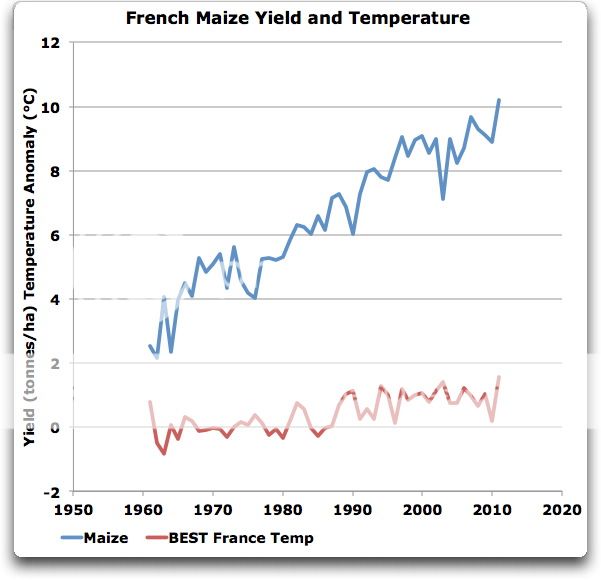
France
isn’t evenhas warmed about a degree, according to BEST, yields continue to rise, and your author is all atwitter … you were right to skewer him.I just don’t see how there’s anything to support any “global food crises” in there, but hey, what do I know? I was born yesterday …
All the best,
w.
So called green house gasses make a hugh difference.
CO2 – Plant food – bring it on
H2O – Add this – the rest is insignificant
The two primary considerations when growing plants and things are: frosts and water. I don’t recall temperature being one. Whenever it gets hot that would indicate plants need more water and if you don’t get the water right the plants die. I don’t suppose those who wish to draw the conclusion that higher temps lower yield have done any gardening or farming, in other words, get their hands dirty?
I wonder whether Wills, it is important measuring yields versus temperature, because it has been shown in a number of papers that temperatures in the Californian and Australian small country towns have not risen as much as in the large cities, if at all.
As I revealed in a previous blog, the temperatures in our tomato growing area of Echuca have actually gone down slightly. Since 1984, our tomato yields have increased three fold, mainly due to better hybrid varieties, better irrigation using underground drip, better fertigation using this drip technology, and better management techniques.
Willis believes that these increases must reduce at some time in the future, but work on soil microbes will continue to produce enormous yield increases.
It might be worthwhile looking at yield versus CO2, but CO2 has not increased threefold since 1984.
Regards, Ian
Here’s an even crazier idea. Scientists will continue breeding crop varieties that have better yields in warmer/colder/unchanging climatic conditions.
Agriculture has adapted for thousands of years to meet the needs of changing climates since neolithic times. We currently grow crops across many climates, from cold wet Wales to hot and dry California. I cannot for the life of me see how we cannot adapt to a changing climate as we have done for millennia. We may lose the potential for crops in one area, but gain in another. The change in numbers of bird species in the UK is good example of nature adapting, I’m sure we will do the same. I must admit though, going back to growing traditional Welsh crops like Cabbages, Leeks and root crops on our land works fine, but I do miss growing our own Sweetcorn, French beans and crops more suited to warmer climes. The Met office promised us a warmer and drier climate, we looked forward to being able to grow wonderful crops. In the event it got colder and wetter. We are deeply disappointed.
They say the Sahara was Savannah 6,000 years ago, was that because the rain patterns changed?
I also heard some statistic that Africa has something like 60% of the Worlds arable land, which really surprised me.
Willis Eschenbach says:
January 31, 2013 at 1:13 am
[…]
Thanks Willis.
Their premise seems to be that ‘hot days’ damage the crop, and AGW means there will be more of them. They don’t stop to consider than less frosty days might help even more than hot days hinder though…
But the main flaw is their naive belief in the claims of the fertiliser, pesticide, tractor and seed companies that the increased yields are all down to their products.
Sure, modern methods make for bigger yields, but longer sunshine hours have a lot to do with it too…
Here’s another amusing one for you to check out, Willis. The migratory birds are arriving 4 days earlier, so a wildlife corridor must be set up to save them from climate change or something. 20 years of research too. West Australian Science once again/sarc: http://pindanpost.com/2013/01/31/tell-that-to-the-birds/
Wouldn’t a rise in temperature improve food production further North and South of the Equater? And do recent years’ food production figures take account of the huge areas of land taken out of food production for bio fuel purposes?
Willis, This is 2009 stuff.
They say the areas to be hit the hardest are in the developing world.
Can you bring data from Sahara, Africa, India and such?
To Ian: I think Willis’ point is this: Just looking at the evidence, shows that the claim that higher temperatures will reduce crop yields is unsubstantiated. It’s to me no different than saying living naturally will lead to a longer healthier life… when in fact the life expectancy of people living in civilization live longer than people living in the wild. Willis’ point is right on, I think.
Excellent work Willis … simple common sense tells us warmer temps and increased CO2 are generally beneficial to plant growth – and you show that in the simplest terms.
True as tallbloke notes – some of the gains are an increase in productivity through science, but it seems pretty clear that all things factored crop production is benefited by warmth and CO2.
When we dip back into the inevitable, and looming, descent into the next glacial cold cycle we will want and need all the crop production we can get.
.
In answer to the title question, wouldn’t that depend on the starting point?
I mean, the Prairie Provinces in Canada could easily benefit from a 5-10C rise in temperature for production of almost everything we grow. Can’t say the same would benefit wheat or corn producers in Texas.
Good job again Willis! You might check out AgPHD.com
Those Hefty boys are kind of smart!
Alfred
Another piece of common sense, thanks.
Anyone with half a brain can see that warmer is better as far as food crops are concerned. I do not care about biofuel crops they can die in the fields and let the food prices revert to the level that is affordable to the developing world.