Teaming up with Jo Nova to answer The Team down under: “Professor Sherwood is inverting the scientific method”
Guest post by Alec Rawls
My leak of the draft IPCC report emphasized the chapter 7 admission of strong evidence for solar forcing beyond the very slight variance in solar irradiance, even if we don’t know the mechanism:
The forcing from changes in total solar irradiance alone does not seem to account for these observations, implying the existence of an amplifying mechanism such as the hypothesized GCR-cloud link.
One of the fifteen lead authors of chapter 7 responded that the evidence for one of the proposed mechanisms of solar amplification, GCR-cloud, indicates a weak effect, and proceeded as if this obviated the IPCC’s admission that some such mechanism must be having a substantial effect:
[Professor Steven Sherwood] says the idea that the chapter he authored confirms a greater role for solar and other cosmic rays in global warming is “ridiculous”.
“I’m sure you could go and read those paragraphs yourself and the summary of it and see that we conclude exactly the opposite – that this cosmic ray effect that the paragraph is discussing appears to be negligible,” he told PM.
Sherwood uses theory—his dissatisfaction with one theory of how solar amplification might work—to ignore the (admitted) evidence for some mechanism of solar amplification. Putting theory over evidence is not science. It is the exact definitional opposite of science (see Feynman snippet above).
Since Sherwood is Australian, it seemed a visit Down Under was due, so Jo Nova and I teamed up to issue a reply on her website.
Jo knows Sherwood
Here is Jo Nova’s take on Sherwood’s shenanigans:
The IPCC are now adding citations of critics (so they can’t be accused of ignoring them completely), but they bury the importance of those studies under glorious graphic art, ponderous bureacrat-speak, and contradictory conclusions.
When skeptics point out that the IPCC admit (in a hidden draft) that the solar magnetic effect could change the climate on Earth, the so-called Professors of Science hit back — but not with evidence from the atmosphere, but with evidence from other paragraphs in a committee report. It’s argument from authority, it’s a logical fallacy that no Professor of Science should ever make. Just because other parts of a biased committee report continue to deny the evidence does not neutralize the real evidence.
Alec Rawls pulls him up. Sherwood calls us deniers, but the IPCC still denies solar-magnetic effects that have been known for 200 years. This anti-science response is no surprise from Sherwood, who once changed the colour of “zero” to red to make it match the color the models were supposed to find. (Since when was red the color of no-warming? Sure you can do it, but it is deceptive.) That effort still remains one of the most egregious peer reviewed distortions of science I have ever seen. — Jo
Earlier this week Nova posted about Sherwood’s glowing support for recent claims that the IPCC’s predictions of global warming have been accurate. Obviously Sherwood needs to take a closer look at the Second Order Draft which, in particular the following graph (SOD figure 1.4 on page 1-39, with a hat tip to Anthony):

Absolutely NOT falsified says Sherwood, but guess what he thinks IS falsified?
Steve Sherwood, Co-Director, Climate Change Research Centre at the University of New South Wales said the paper showed “that if you take natural year-to-year variability into account in any reasonable way, the predictions are as close as one could reasonably expect.”
“Those who have been claiming ad nauseum that the climate models have been proved wrong, should read this paper, even though for most of us it is not very surprising,” said Dr Sherwood, who was not involved in the Nature Climate Change paper.
“Though there is no contrarian analogue to the IPCC, individual contrarians have made predictions over a similar time frame that the warming would stop or reverse. The data since then have probably falsified many of those predictions (which the deniers continue to make today).”
Predictions that warming would stop have been falsified? By what? By the fact that, according to HadCRUT4, there has been no statistically significant warming for 16 years? Falsification in Steve Sherwood’s dictionary: “whatever preserves Steve Sherwood’s presumptions.” Just what we’d expect from a definitional anti-scientist.
My own response to Sherwood gets into the back-story on the Second Order Draft. Readers might be interested to know that the SOD admission of substantial evidence for solar amplification seems to be in response to my submitted comments on the FOD. I had charged them with, you guessed it, inverting the scientific method. That’s why Sherwood, in pretending that the new admission never happened, is also inverting the scientific method. He’s reverting to the FOD position. Well, some of his co-authors are apparently not willing to go there any more, and hopefully they will speak out.
My guest post at Jo Nova’s:
Professor Steven Sherwood inverts the scientific method: he is an exact definitional anti-scientist
My submitted comments on the First Order Draft of AR5 accused the IPCC of committing what in statistics is called “omitted variable fraud.” As I titled my post on the subject: “Vast evidence for solar climate driver rates one oblique sentence in AR5.”
How vast is the evidence? Dozens of studies have found between a .4 and .7 degree of correlation between solar activity and various climate indices going back many thousands of years, meaning that solar activity “explains” in the statistical sense something like half of all past temperature change (citations at the link above).
Solar activity was at “grand maximum” levels from 1920 to 2000 (Usoskin 2007). Might this explain a substantial part of the unexceptional warming of the 20th century? Note also that, with the sun having since dropped into a state of profound quiescence, the solar-warming theory can also explain the lack of 21st century warming while the CO2-warming theory cannot.
Now take a look the radiative forcing table from any one of the IPCC reports, where the explanatory variables that get included in the IPCC computer models are laid out. You will see that the only solar forcing effect listed is “solar irradiance.” In AR5 this table is on page 8-39:
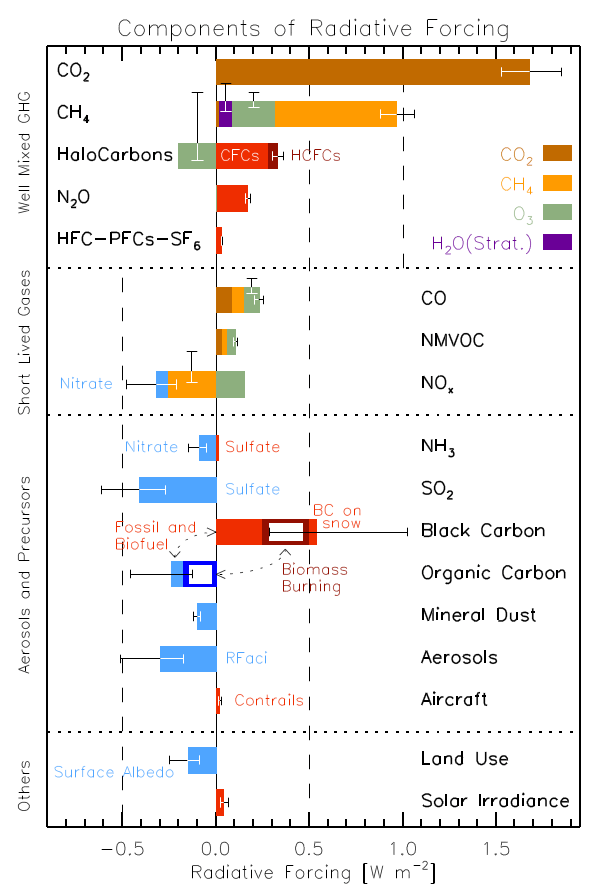
Why is the solar irradiance effect so tiny? Note that Total Solar Irradiance, or TSI, is also known as “the solar constant.” When solar activity ramps up and down from throwing wild solar flares to sleeping like a baby, TSI hardly varies a whit. That’s where the name comes from. While solar activity varies tremendously, solar irradiance remains almost constant.
This slight change in the solar radiation that shines on our planet is known to be too small an energy variation to explain any substantial change in temperature. In particular, it can’t begin to account for anything near to half of all past temperature change. It can’t begin to account for the large solar effect on climate that is evidenced in the geologic record.
Implication: some other solar effect besides TSI must also be at work. One of the solar variables that does vary when solar activity ramps up and down, like solar wind pressure, must be having some effect on climate, and this is certainly plausible. We in-effect live inside of the sun’s extended corona. When the solar wind is going full blast the earth’s immediate external environment is rather different than when the solar wind is down, and even if we don’t know the mechanism, we have powerful evidence that some solar effect other than the slight variation in TSI is driving global temperature.
This is what the IPCC admits in the Second Order Draft of AR5, which now includes the sentence in bold below (page 7-43, lines 1-4, emphasis added):
Many empirical relationships have been reported between GCR or cosmogenic isotope archives and some aspects of the climate system (e.g., Bond et al., 2001; Dengel et al., 2009; Ram and Stolz, 1999). The forcing from changes in total solar irradiance alone does not seem to account for these observations, implying the existence of an amplifying mechanism such as the hypothesized GCR-cloud link. We focus here on observed relationships between GCR and aerosol and cloud properties.
Sherwood’s response is to consider only one possible mechanism of solar amplification. He looks at the evidence for Henrik Svensmark’s proposed GCR-cloud mechanism and judges that the forcing effect from this particular mechanism would be small, then concludes that a greater role for the sun in global warming is “ridiculous.”
Hey Sherwood, read the added sentence again. It says that the evidence implies the existence of “an amplifying mechanism.” Presenting an argument against a particular possible mechanism does not in any way counter the report’s new admission that some such mechanism must be at work. (Guess he didn’t author that sentence eh? Since he doesn’t even know what it says.)
Sherwood is trying to use theory—his dissatisfaction with a particular theory of how solar amplification might work—to dismiss the evidence that some mechanism of solar amplification must be at work. The bad professor is inverting the scientific method, which requires that evidence always trump theory. If evidence gives way to theory it is not science. It is anti-science. It is the exact opposite of science.
The new sentence was added specifically to avoid the criticism that the authors were inverting the scientific method
My submitted comments on the First Order Draft ripped the authors up and down for inverting the scientific method. They were all doing what Sherwood is doing now. Here is the same passage from the FOD. It lacks the added sentence, but otherwise is almost identical (FOD page 7-50, lines 50-53):
“Many empirical relationships or correlations have been reported between GCR or cosmogenic isotope archives and some aspects of the climate system, such as SSTs in the Pacific Ocean (Meehl et al., 2009), some reconstruction of past climate (Kirkby, 2007) or tree rings (Dengel et al., 2009). We focus here on observed relationships between GCR and aerosol- and cloud-properties.”
The first sentence here, citing unspecified “empirical relationships” between cosmogenic isotopes (a proxy for solar activity) and “some aspects of the climate system” is the only reference in the entire report to the massive evidence for a solar driver of climate. Not a word about the magnitude of the correlations found, nothing about how these correlations are much too strong to possibly be explained by the slight variance in solar irradiance alone, and almost nothing (“many”) about the sheer volume of studies that have found these correlations. And that’s it: one oblique sentence, then the report jumps immediately to looking at the evidence for one proposed mechanism by which solar amplification might be occurring.
The evidence for that particular mechanism is judged (very prematurely) to indicate a weak effect, and this becomes the implicit rationale for the failure of the IPCC’s computer models to include any solar variable but TSI. Readers of the FOD have no idea about the mountain of evidence for some solar driver of climate that is stronger than TSI because the report never mentions it. A couple of the citations that were included mention it (in particular, Kirkby 2007, which is a survey paper), but the report itself never mentions it, and the report then goes on to ignore this evidence entirely. The enhanced solar forcing effect for which there is so much evidence is completely left out of all subsequent analyses.
In other words, the inversion of the scientific method is total. In the FOD, the authors used their dissatisfaction with the GCR-cloud theory as an excuse for completely excluding the vast evidence that some mechanism of enhanced solar forcing is at work. Theory was allowed to completely obliterate and remove a whole mountain of evidence. “Pure definitional anti-science,” I charged.
At least one of the co-authors seems to have decided that this was a bridge too far and added the sentence acknowledging the evidence that some mechanism of solar amplification must be at work. The added sentence declares in-effect, “no, we are not inverting the scientific method.” They are no longer using their dissatisfaction with a particular theory of how enhanced solar forcing might work as a ruse to pretend that the evidence for some such mechanism does not exist.
So good for them. In the sea of IPCC dishonesty there is a glimmer of honesty, but it doesn’t go very far. TSI is still the only solar effect that is included in the “consensus” computer models and the IPCC still uses this garbage-in claim to arrive at their garbage-out conclusion that observed warming must be almost entirely due to the human release of CO2.
One of the reason I decided to release the SOD was because I knew that once the Steven Sherwoods at the IPCC realized how the added sentence undercut the whole report they would yank it back out, and my submitted comments insured that they would indeed realize how the added sentence undercut the whole report. Now sure enough, as soon as I make the added sentence public Steven Sherwood publicly reverts to the FOD position, trying to pretend that his argument against one proposed mechanism of solar amplification means that we can safely ignore the overwhelming evidence that some such mechanism is at work.
We’ll find out in a year or so whether his co-authors are willing to go along with this definitional anti-science. Evidently there is at least some division. With Sherwood speaking up for the FOD position, any co-authors who prefer the new position should feel free to speak up as well. Come on real scientists, throw this blowhard under the bus!
In any case, it is good to have all of them stuck between a rock and a hard place. They can invert the scientific method and be exact definitional anti-scientists like Steven Sherwood, or they can admit that no one can have any confidence in the results of computer models where the only solar forcing is TSI, not after they have admitted strong evidence for some mechanism of solar forcing beyond TSI. That admission is a game changer, however much Sherwood wants to deny it.
He piles on with more of the same at the ridiculous “DeSmog Blog” (as if CO2 is “smog”), and is quoted front and center by the even more ridiculous Andrew Sullivan. Sherwood has become the go-to guy for the anti-science left.
The two dozen references documenting strong correlations between solar activity and various climate indicies
Jo wanted to include references so I sent along the list of citations that I had included in my FOD comment. Worth seeing again I think:
Bond et al. 2001, “Persistent Solar Influence on North Atlantic Climate During the Holocene,” Science.
Excerpt from Bond: “Over the last 12,000 years virtually every centennial time scale increase in drift ice documented in our North Atlantic records was tied to a distinct interval of variable and, overall, reduced solar output.”
Neff et al. 2001, “Strong coherence between solar variability and the monsoon in Oman between 9 and 6 kyr ago,” Nature.
Finding from Neff: Correlation coefficients of .55 and .60.
Usoskin et. al. 2005, “Solar Activity Over the Last 1150 years: does it Correlate with Climate?” Proc. 13th Cool Stars Workshop.
Excerpt from Usoskin: “The long term trends in solar data and in northern hemisphere temperatures have a correlation coefficient of about 0.7 — .8 at a 94% — 98% confidence level.”
Shaviv and Veizer, 2003, “Celestial driver of Phanerozoic climate?” GSA Today.
Excerpt from Shaviv: “We find that at least 66% of the variance in the paleotemperature trend could be attributed to CRF [Cosmic Ray Flux] variations likely due to solar system passages through the spiral arms of the galaxy.” [Not strictly due to solar activity, but implicating the GCR, or CRF, that solar activity modulates.]
Plenty of anti-CO2 alarmists know about this stuff. Mike Lockwood and Claus Fröhlich, for instance, in their 2007 paper: “Recent oppositely directed trends in solar climate forcings and the global mean surface air temperature” (Proc. R. Soc. A), began by documenting how “[a] number of studies have indicated that solar variations had an effect on preindustrial climate throughout the Holocene.” In support, they cited 17 papers, the Bond and Neff articles from above, plus:
Davis & Shafer 1992; Jirikowic et al. 1993; Davis 1994; vanGeel et al. 1998; Yu&Ito 1999; Hu et al. 2003; Sarnthein et al. 2003; Christla et al. 2004; Prasad et al. 2004; Wei & Wang 2004; Maasch et al. 2005; Mayewski et al. 2005; Wang et al. 2005a; Bard & Frank 2006; and Polissar et al. 2006.
The correlations in most of these papers are not directly to temperature. They are to temperature proxies, some of which have a complex relationship with temperature, like Neff 2001, which found a correlation between solar activity and rainfall. Even so, the correlations tend to be strong, as if the whole gyre is somehow moving in broad synchrony with solar activity.
Some studies do examine correlations between solar activity proxies and direct temperature proxies, like the ratio of Oxygen18 to Oxygen16 in geologic samples. One such study (highlighted in Kirkby 2007) is Mangini et. al. 2005, “Reconstruction of temperature in the Central Alps during the past 2000 yr from a δ18O stalagmite record.”
Excerpt from Mangini: “… a high correlation between δ18O in SPA 12 and D14C (r =0.61). The maxima of δ18O coincide with solar minima (Dalton, Maunder, Sporer, Wolf, as well as with minima at around AD 700, 500 and 300). This correlation indicates that the variability of δ18O is driven by solar changes, in agreement with previous results on Holocene stalagmites from Oman, and from Central Germany.”
And that’s just old stuff. Here are four random recent papers.
Ogurtsov et al, 2010, “Variations in tree ring stable isotope records from northern Finland and their possible connection to solar activity,” JASTP.
Excerpt from Ogurtsov: “Statistical analysis of the carbon and oxygen stable isotope records reveals variations in the periods around 100, 11 and 3 years. A century scale connection between the 13C/12C record and solar activity is most evident.”
Di Rita, 2011, “A possible solar pacemaker for Holocene fluctuations of a salt-marsh in southern Italy,” Quaternary International.
Excerpt from Di Rita: “The chronological correspondence between the ages of saltmarsh vegetation reductions and the minimum concentration values of 10Be in the GISP2 ice core supports the hypothesis that important fluctuations in the extent of the salt-marsh in the coastal Tavoliere plain are related to variations of solar activity.”
Raspopov et al, 2011, “Variations in climate parameters at time intervals from hundreds to tens of millions of years in the past and its relation to solar activity,” JASTP.
Excerpt from Raspopov: “Our analysis of 200-year climatic oscillations in modern times and also data of other researchers referred to above suggest that these climatic oscillations can be attributed to solar forcing. The results obtained in our study for climatic variations millions of years ago indicate, in our opinion, that the 200- year solar cycle exerted a strong influence on climate parameters at those time intervals as well.”
Tan et al, 2011, “Climate patterns in north central China during the last 1800 yr and their possible driving force,” Clim. Past.
Excerpt from Tan: “Solar activity may be the dominant force that drove the same-phase variations of the temperature and precipitation in north central China.”
Saltmarshes, precipitation, “oscillations.” It’s all so science-fair. How about something just plain scary?
Solheim et al. 2011, “The long sunspot cycle 23 predicts a significant temperature decrease in cycle 24,” submitted astro-ph.
Excerpt from Solheim: “We find that for the Norwegian local stations investigated that 30-90% of the temperature increase in this period may be attributed to the Sun. For the average of 60 European stations we find ≈ 60% and globally (HadCRUT3) ≈ 50%. The same relations predict a temperature decrease of ≈ 0.9°C globally and 1.1−1.7°C for the Norwegian stations investigated from solar cycle 23 to 24.”
Those two dozen there are just the start. Scafetta hasn’t even been mentioned. (Sorry Nicola.) But there is a lot in those 24.
some other solar effect besides TSI must also be at work. One of the solar variables that does vary when solar activity ramps up and down, like solar wind pressure, must be having some effect on climate, and this is certainly plausible. We in-effect live inside of the sun’s extended corona.
In the decade, we have figured out how to derive solar wind properties from the geomagnetic record. The bottom line is that the solar wind in the 20th century has not been significantly different from that in the 19th and 18th centuries. Neither has solar UV. In particular solar activity [and solar wind] at present is very much like it was a century ago. So the Sun has not varied enough to cause a significant climate influence, regardless of all the papers mentioned.
To which list of recent sun-climate linking scientific papers, I’d add these, from Herschel, one of the greatest astronomers & physicists (discoverer of Uranus & infrared radiation) ever, & an 18th century Mexican antecedent:
http://longstreet.typepad.com/thesciencebookstore/2012/02/william-herschel-adam-smith-sunspots-and-wheat.html
http://www.scielo.org.mx/pdf/rmfe/v54n2/v54n2a18.pdf
It would seem self-evident that the variable sun exerts more influence on terrestrial climate than the fluctuations of a trace gas, the atmospheric concentration of which lags ocean temperature.
Dr. J. Dickey from NASA-JPL (see link below) thinks there is more to the sun-climate relationship than the TSI. I was at a point of abandoning my ‘wayward’ crack-pot geomagnetic idea, when I came across her article. That was the inspiration to put together a draft for an article on the subject, which greatly irks with and apparently made the ‘flat sun’ expert loose his cool.
http://www.vukcevic.talktalk.net/EarthNV.htm
(Alec I’ll be in touch once you had well deserved break from all the pressure).
Wow! My hat off to you on this rebuttal.
Regarding falsification, here it is from the Warmists’ own mouths. Look at the graph above for the lack of warming and look below at 15 years and 17 years and the model errors. The panic has set and they think people are not looking.
http://www.agu.org/pubs/crossref/2011/2011JD016263.shtml
http://www1.ncdc.noaa.gov/pub/data/cmb/bams-sotc/climate-assessment-2008-lo-rez.pdf
http://www.pnas.org/content/early/2012/11/28/1210514109
Dr. Svalgaard:
Solar magnetic flux has fluctuated significantly in recent decades.
http://www.agu.org/journals/abs/2002/2001JA000503.shtml
This, combined with the obvious correlation between C & Be isotopes & the Little Ice Age during the Maunder & Dalton sunspot minima, strongly suggest to me a significant & arguably controlling solar influence. In any case, the evidence for this influence, both observed & derived experimentally at CERN & in other lab tests, constitutes actual scientific practice, as opposed to government-funded “consensus”, anti-scientific GIGO models based upon demonstrably false assumptions.
There are a lot of studies (including mine of course) that show a strong correlation between solar and climate records for centuries and millennial.
People usually state that the sun did not vary much to produce the change, but this is not correct. The truth is that it is not know how much TSI changed last centuries. TSI proxy models used in the GCM (e.g. Lean’s model) are based on specific observable that are unable to properly recnstruct the background solar radiation, which is what causes the multidecadal/secular millennial trending.
So, it is not known how much TSI changed during the centuries.
In this case the only way to proceed is to use the methodology adopted in my papers. That is a careful study of the harmonics to deduce a driving process. My papers demonstrate that both climate and solar activity present common harmonics, which are characteristic of the solar system oscillations. Thus, the origin of these harmonics in the climate system can be ultimately associated with solar/astronomical mechanisms. The harmonic can be used to reconstruct grand part of the climate variability, and also forecast it.
The approach of the IPCC to ignore the empirical studies and promote the highly reductionist approach applied in the GCMs, which do not reconstruct the climate variability (as also demonstrated in my papers), is surely contrary to the scientific method.
Please, contact hem and let them to know about the empirical studies.
lsvalgaard says:
December 16, 2012 at 2:28 pm
“So the Sun has not varied enough to cause a significant climate influence, regardless of all the papers mentioned.”
That still leaves the solar-magnetic strength, Leif. What about that?
Judith Curry covered this well a few months back,
http://judithcurry.com/2012/09/27/effects-of-solar-variability-on-climate/
Looks like some, so called, scientists still have there fingers in there ears while shouting “NO, NO, NO” over and over when it comes to looking at anything outside of their CAGW toy box…
Dr. Svalgaard:
Apologies for posting wrong link, although that one (no doubt from colleagues known to you), does point out that effects near earth could differ.
Has this 1999 study, with follow on papers, been IYO opinion found false?
http://www.ukssdc.ac.uk/wdcc1/papers/nature.html
Personally, I’m sticking with Herschel until I can see conclusive evidence against his insight & the sunspot cycle correlation.
Lief, I’m having a bit of difficulty with that. Which one are you asserting:
* All of the independent papers cited, by different authors — and note that there are quite a number of them, using different proxies, tied to different phenomena — discover a statistical relationship between things that are usually correlated with solar state and climate variables that is accidental or otherwise mistake? This seems — unlikely. In the literal meaning of the term in statistics.
* All of the papers cited are deliberately misrepresenting the evidence to arrive at a predefined conclusions, basically cherrypicking or engaging in some other sort of confirmation bias? If so, this is a very serious charge — not that it isn’t made fairly regularly in the direction of scientists who are labelled “warmists” by skeptics. I think you’d have to back this up in some way other than just saying “it can’t be the sun therefore you are lying”. In fact, I’d think you have to do this on a case by case basis, since they use different proxies correlated with different effects.
Indeed, I don’t know how you could tell what solar state was in the 19th century without the use of some of the proxies, given the probable unreliability and variability of naked eye observations and their probable correlation with things that no instrumentation existed to detect, such as cosmic radiation rates, but it would be very interesting to see how you support the assertion that you can be certain that things like sunspot counts can be correlated with all aspects of relevant solar state over their entire record, or what other variables or e.g. radioactive proxies you invoke — clearly distinct from those in the papers above, that seem to span the entire Holocene and beyond — you use to support the assertion.
* There is some other proximate cause that explains both the correlation between things that appear to be varying or are believed — incorrectly, according to you — to be varying with the sun and the observed variations in rainfall, temperature, the southerly drift of calved icebergs before they melt? Something that modulates (say) the Earth’s magnetic field directly and hence produces the effect but that is actually independent of solar state? If so, would you care to state a hypothesis that is more specific than “something else” is causing the apparent correlation determined by (one hopes) good faith statistical analysis on the part of a rather largish number of independently working scientists publishing on entirely different things?
Bear in mind that I’m not a “warmist”, not a “denier”, but that I do want to see things stated clearly. One of the three things above seems as though it must be true — a lot of people working in good faith who are somehow in error, a lot of people working in bad faith who are deliberately in error, or a secondary cause such that the first is true but it does not matter because there is some other ignored proximate cause for the variations in climate observed in correlation with e.g. radiometric proxies.
When you assert that it can’t be the sun, are you also asserting that there is no actual correlation with radioactive proxies commonly associated with solar state (whether or not the papers claim that there was), or something beyond that?
rgb
I haven’t read all of this leaked document, but from a skeptic that looks at this science with an open mind; this document has what the warmist want to see, and just enough to get the skeptics excited. In the end; I believe the parts that excite the skeptics will be rewritten or removed by the final draft.
Scientifically the way to deal with this is to say that there is a possibility of a solar forcing amplification effect, although we don’t know the cause we can bound it’s effect and come up with ways to disprove or bound the effect with experiments or more data. The incorrect way to deal with it is to say that we don’t understand how it could happen that solar has more than a minimal effect so we will discount it until proven wrong. That’s wrong. They have uncertainty about the causes of temperature forcings. None of the “assumed” relationships are acting like they should. In spite of the fact they can create models without a solar amplification that explain the temperature record for a certain period of time, our understanding of these things is so naive that it is critical that the IPCC and scientists in general allow for what is not known and be studiously working to eliminate those uncertainties with experiments and science. That’s the scientific method.
When we predict something like the Higgs Boson we don’t assume that our science is right. We have lots of alternative theories being brewed, we have skeptical scientists, we have experiminents dedicated to finding if our theory is correct. Scientists don’t proclaim its existence until there is a 6 sigma level of certainty. In climate “science” the models based on unproven assumptions are taken as data that is proven virtually. They say things like 99% certainty, 95% certainty when we know of no basis for making such claims of certainty.
The IPCC in the fourth IPCC report used the models fitting to temperature records that were adjusted to proclaim they had bounds on natural variability. This allowed them to conclude they actually knew what caused the warming because they knew what other things could do and none could account for the temperature record. They had explanations for the variations from a straight AGW curve. Therefore they felt confident to reduce their uncertainty but since we have 16 years of zero trend in temperature and because there is no explanation for this variation the basis for their confidence has disappeared and needs to be reassessed. Given the variation in the last 15-16 years it is clear “something” is not in their models or in their ideas of what forcings can happen naturally. Therefore we have to presume that there is at least the possibility that some of the forcing in the previous period observed was not because of AGW.
Reblogged this on sainsfilteknologi and commented:
IPCC AR5
Dr. Scafetta:
Besides solar magnetic flux mentioned above, what about the precise wavelength & energy composition of the total irradiance? While the total energy doesn’t vary much, there could be an effect from distribution within that total of UV, visible colors & IR frequencies. Also, characteristics of the atmosphere could affect the effects of the entering TRI at various altitudes, such as ozone prevalence.
It is the height of hubris (& self-interested greed & ideological motivation) to assume that we understand enough about climate to claim CO2 as the primary driver. (Absurd, IMO.) Look how much has been learned about this science in its infancy just in the past 20 years.
Climatology is at about the same level of development now as biology in 1812, chemistry & geology in 1712, physics in 1612 & astronomy in 1512 (when Copernicus secretly had already convinced himself that the earth goes around the sun, but dared not publish). The CO2 hypothesis is to climatology as phlogiston is to chemistry & special creation to biology.
and even if we don’t know the mechanism, we have powerful evidence that some solar effect other than the slight variation in TSI is driving global temperature.
Could El Ninos and La Ninas be influenced by the changes of the solar wind speed? See:
http://snag.gy/UtqpX.jpg
When the wind speed is low such as 1998 and 2010, we had El Ninos, but when the wind speed is high, such as 1989 and 2000, we had La Ninas.
(This is from the following at Dr. Spencer’s site: Ulric Lyons says:
December 14, 2012 at 4:14 PM
El Nino unforced? I don’t think so. Check for the big drops in solar wind speed in 1997 and 2009: http://snag.gy/UtqpX.jpg)
….a lot of people working in bad faith who are deliberately in error…..
Yes I believe this part of your comment, one has to look no further and the endless stream of grant money to prove CAGW is real – and throw in the climategate emails for good measure.
Fraud walks the hallow halls.
Sometimes I get this gnawing feeling that the experts might be wrong, and the average, illiterate Joes might be right when they say “it’s the Sun stupid”. You see, the average Joes don’t know a damned thing about solar science – they are just guessing. Sometimes the simplest explanations fly right past the experts. Only time will tell. Just food for thought.
rgbatduke says:
December 16, 2012 at 3:08 pm
Something that modulates (say) the Earth’s magnetic field directly and hence produces the effect but that is actually independent of solar state?
I did analysis of the Earth’s magnetic field frequency spectrum, at the boundary between outer core and the mantle (based on data from Jackson-ETHZ and Bloxham-Harvard University). It shows identical main component to that of solar magnetic cycle at 21.3 years (RGB se page 14), in addition the bi-decadal change of the Earth’s magnetic field at the south pole has high correlation with the solar variability
http://www.vukcevic.talktalk.net/TMC.htm
milodonharlani says:
December 16, 2012 at 3:00 pm
Has this 1999 study, with follow on papers, been IYO opinion found false?
http://www.ukssdc.ac.uk/wdcc1/papers/nature.html
Yes: http://www.leif.org/research/Reply%20to%20Lockwood%20IDV%20Comment.pdf
rgbatduke says:
December 16, 2012 at 3:08 pm
Indeed, I don’t know how you could tell what solar state was in the 19th century without the use of some of the proxies
That argument cuts the other way too. If I can’t tell because they are all so unreliable, then nobody can. And there are not that many proxies of solar activity. Everybody uses the same ones or obsolete [and perhaps carefully picked] versions of same. Try this: http://www.leif.org/research/Solar-Activity-Past-Present-and-Future-Notes.pdf
DirkH says:
December 16, 2012 at 2:55 pm
That still leaves the solar-magnetic strength, Leif. What about that?
That is what all the proxies ‘measure’, e.g. http://www.leif.org/research/Heliospheric%20Magnetic%20Field%201835-2010.pdf
Regarding falsification, here it is from the Warmists’ own mouths. Look at the graph above for the lack of warming and look below at 15 years and 17 years and the model errors. The panic has set and they think people are not looking.
Personally, I think it is just great. We have only 33+ years of satellite data, being more than generous. Before 1997, temperatures were nearly flat. After 1998, temperatures were nearly flat. Almost all of the warming observed in the satellite record is associated with a single discrete event, the 1997-1998 El Nino! Try to find an anthropogenic cause for this El Nino, and you’ve got an argument. Without one, you are waving your hands a rather lot because the curves associated with CO_2 concentration and the actual 33 year record look nothing alike! Nor do the CO_2 concentration curve against the temperature for the last 100 years. Or 500 years. Or 1000 years. Or 10,000 years. On a 100,000 year timescale, they do look alike, but CO_2 lags temperature in a well-understood way.
Also, as they stretch the interval out to 17 years it gets to be more difficult to get the signal they require. In fact, it is rather plausible to think that they will need a strong El Nino this year to get a temperature bump large enough to restore anything like the rise rate predicted as a “anthropogenic warming signal” in seventeen years, or for that matter in eighteen years. The ENSO meter is near-neutral and dropping — it looks like the latest “El Nino” may have already happened and if so, been a serious dud. If so, there is probably going to be at least 3-4 years before another chance emerges (who knows, since ENSO is highly irregular) and well within that time frame solar cycle 24 will have peaked and be on the downhill side (again, if it hasn’t peaked already). One has to wonder — respectfully of course — if the lack of strong El Nino is at all related to the weak solar cycle, and whether or not the succession of La Nina’s are at all responsible for the lack of warming, with the little observed in coincidence with El Nino strength such as it is.
But it is early to read anything into the data either way. Ten years, seventeen years, thirty four years — these are “days” as far as climate variation is concerned. Wake me when we get to half-centuries of reliable data on both the atmosphere, the sun, and the ocean at depth and truly globally, all at the same time. That would be in about forty more years (we’ve barely started as far as the oceans are concerned, although we have satellite based global SSTs for somewhat longer than we’ve had anything at all globally at depth).
rgb
Both CO2 and Earth’s magnetic fields were mentioned. Arctic is as good place as any, if not better since there is something called ‘polar amplification’, i.e. where the warming is at its steepest. I did a comparison:
http://www.vukcevic.talktalk.net/CO2-Arc.htm
The choice is yours.
Dr. Svalgaard:
Thanks for your slide show link.
To me there appears to be a decadal sunspot activity (however measured) correlation with global temperature, as in your slide 8. The cycle centered on 1970 corresponds with the cold winters I remember from the late ’60s & early ’70s (before, during & after attending your present institution) & the current cycle, with sideways trending temperature, as measured by various book-cooking agencies, but in fact probably actually declining.
Alec Rawls says:
‘Hey Sherwood, read the added sentence again. It says that the evidence implies the existence of “an amplifying mechanism.” Presenting an argument against a particular possible mechanism does not in any way counter the report’s new admission that some such mechanism must be at work. (Guess he didn’t author that sentence eh? Since he doesn’t even know what it says.)
Sherwood is trying to use theory—his dissatisfaction with a particular theory of how solar amplification might work—to dismiss the evidence that some mechanism of solar amplification must be at work. The bad professor is inverting the scientific method, which requires that evidence always trump theory. If evidence gives way to theory it is not science. It is anti-science. It is the exact opposite of science.’
Not just the science holding up here, it’s the words. And for an oldie who’s a words person rather than a numbers person, that’s deeply satisfying.
One of the best Gotchas I’ve enjoyed for a long, long time.
Thanks Alec and Jo.
Is there an update available for Nicola Scafetta’s Global Temp predictions ?