
By WUWT regular “Just The Facts”
I recently came across a January 21st, 2012 Peter Gleick article 2011 Climate Change in Pictures and Data: Just the Facts, which appears to mimic the format and approach of my January 1st, 2012 article A Big Picture Look At “Earth’s Temperature”.
What I find particularly amusing about Peter’s article is that a week after noting that, “Lost in this verbal debate are often the simple facts and data of climate change and the immense and definitive global observations of the ways in which our climate is actually changing around us.” Peter Gleick was perpetrating Fakegate. Why, if the “simple facts and data” support his viewpoint, would Peter resort to subterfuge and fakery?
If you read through Gleick’s article, you’ll see some of his “immense and definitive global observations”, like “anyone watching or reading the news or looking out the window probably had a sense that 2011 was a weird year with one bad, extreme weather disaster after another”…
Anyway, in honor Peter’s reinstatement as President of the Pacific Institute I figured that an update on the “simple facts and data” was in order.
Please note that WUWT cannot vouch for the accuracy of the data/graphics within this article, nor influence the format or form of any of the graphics, as they are all linked from third party sources and WUWT is simply an aggregator. You can view each graphic at its source by simply clicking on it.
Global Surface Temperatures:
Generally, when referring to Earth’s “climate” warming, proponents of the Catastrophic Anthropogenic Global Warming (CAGW) narrative, refer to Earth’s Surface Temperature, e.g. “Global warming is the unusually rapid increase in Earth’s average surface temperature over the past century primarily due to the greenhouse gases released by people burning fossil fuels.” NASA Earth Observatory
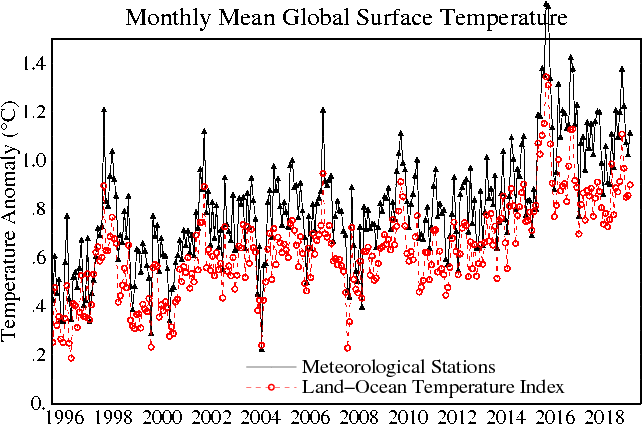
As such, here’s NASA’s Goddard Institute for Space Studies (GISS) Monthly Mean Surface Temperature Anomaly – 1996 to Present;
NOAA’s National Climate Data Center (NCDC) Annual Global Mean Temperature Anomaly Over Land & Sea – 1880 to Present;

Note: The chart above hasn’t been updated with 2011 data for unknown reasons. The chart resides here and the data to update it is here.
It appears that a significant decline in temperatures occurred during the last 17 months:
2010 1 0.6335
2010 2 0.6708
2010 3 0.7815
2010 4 0.7518
2010 5 0.7064
2010 6 0.6764
2010 7 0.6581
2010 8 0.5783
2010 9 0.4975
2010 10 0.5655
2010 11 0.7182
2010 12 0.4226
2011 1 0.3962
2011 2 0.4200
2011 3 0.5226
2011 4 0.5894
2011 5 0.5093
2011 6 0.5882
2011 7 0.5687
2011 8 0.5401
2011 9 0.5264
2011 10 0.5739
2011 11 0.4347
2011 12 0.4800
2012 1 0.3630
2012 2 0.3678
2012 3 0.4477
2012 4 0.6514
(Source: NOAA NCDC)
UK Met Office’s – Hadley Center – Climate Research Unit (CRU) Annual Global Average Land Temperature Anomaly – 1850 to Present;

and the UK Met Office – Hadley Center – Climate Research Unit (CRU) Monthly Global Average Land Temperature – 1850 to Present

Depending on the time frame, it certainly seems that Earth’s Surface Temperature has increased, but it does not appear to be warming rapidly and there is no indication of acceleration. Furthermore, the surface temperature record is burdened with issues of questionable siting, changes in siting, changes in equipment, changes in the number of measurement locations, modeling to fill in gaps in measurement locations, corrections to account for missing, erroneous or biased measurements, and the urban heat island effect. Thus to see the big picture on the temperature “Earth’s Temperature”, it also helps to look up.
Atmospheric Temperatures:
Since 1979 Earth’s “temperature” has also been measured via satellite. “The temperature measurements from space are verified by two direct and independent methods. The first involves actual in-situ measurements of the lower atmosphere made by balloon-borne observations around the world. The second uses intercalibration and comparison among identical experiments on different orbiting platforms. The result is that the satellite temperature measurements are accurate to within three one-hundredths of a degree Centigrade (0.03 C) when compared to ground-launched balloons taking measurements of the same region of the atmosphere at the same time.” NASA
The following are 4 Temperature Anomaly plots from Remote Sensing Systems (RSS), each one increases in altitude as is illustrated here:
RSS Temperature Lower Troposphere (TLT) – Brightness Temperature Anomaly- 1979 to Present;

RSS Temperature Middle Troposphere (TMT)- Brightness Temperature Anomaly- 1979 to Present;

RSS Temperature Troposphere / Stratosphere (TTS) -Brightness Temperature Anomaly- 1987 to Present;

RSS Temperature Lower Stratosphere (TLS) – Brightness Temperature Anomaly – 1979 to Present:

According to Remote Sensing Systems, “For Channel (TLT) (Lower Troposphere) and Channel (TMT) (Middle Troposphere), the anomaly time series is dominated by ENSO events and slow tropospheric warming. The three primary El Niños during the past 20 years are clearly evident as peaks in the time series occurring during 1982-83, 1987-88, and 1997-98, with the most recent one being the largest.” RSS
Also, the 2009 – 10 El Niño event is also called out on this RSS Latitudinal Temperature Lower Troposphere (TLT) Brightness Temperature Anomaly from 1979 to Present;

and the 1998 El Niño event, along with the tropospheric cooling attributed to the 1991 eruption of Mt Pinitubo, is called out on this University of Alabama – Hunstville (UAH) Lower Atmosphere Temperature Anomalies – 1979 to Present:

Note: Per John Christy, RSS and UAH anomalies are not comparable because they use different base periods, i.e., “RSS only uses 1979-1998 (20 years) while UAH uses the WMO standard of 1981-2010.”
The May UAH Lower Atmosphere Temperature Anomaly was 0.29 degrees C above the 30 year average. Keep this mind the next time you see claims that recent weather was caused by Global Warming.
There are also regional variations in Lower Troposphere that contribute nuance to the picture. For example, RSS Northern Polar Temperature Lower Troposphere (TLT) Brightness Temperature Anomaly;

shows a .337 K/C per decade increase, whereas the The RSS Southern Polar Temperature Lower Troposphere (TLT) Brightness Temperature Anomaly;

shows a .011 K/C per decade decrease. I am still not aware of a compelling explanation for the significant divergence in the Lower Troposphere temperature trends between the poles.
The satellite record seems to show slow warming of Lower and Middle Tropospheric temperatures, overlaid with the El Niño/La Niña Southern Oscillation (ENSO) cycle, including four comparatively large El Niño events. Lower Tropospheric temperatures appear to have flattened since the large El Niño in 1998 and offer no indication of Earth warming rapidly.
Moving higher in the atmosphere, RSS Temperature Troposphere / Stratosphere (TTS) – Brightness Temperature Anomaly- 1987 to Present;


has been incredibly flat since, with a trend of just -.010 K/C per decade. The 1997-98 and 2009 – 10 El Niño events are still readily apparent in the plot, as is a spike from the 1991 eruption of Mt. Pinatubo. Note that the effect of Mt. Pinatubo is the opposite in the Lower and Middle Troposphere versus the Troposphere / Stratosphere (TTS), i.e. “Large volcanic eruptions inject sulfur gases into the stratosphere; the gases convert into submicron particles (aerosol) with an e-folding time scale of about 1 year. The climate response to large eruptions (in historical times) lasts for several (2-3) years. The aerosol cloud causes cooling at the Earth’s surface, warming in stratosphere.”
Ellen Thomas, PHD Wesleyan University
It is interesting that, incorporating the impact of three significant surface driven warming events, Troposphere / Stratosphere Temperatures (TTS) have been quite stable, however there is nuance to this as well.
RSS Northern Hemisphere Temperature Troposphere / Stratosphere (TTS) – Brightness Temperature Anomaly- 1987 to Present;

has been increasing by .046 K/C per decade, whereas the RSS Southern Hemisphere Temperature Troposphere / Stratosphere (TTS) – Brightness Temperature Anomaly- 1987 to Present;

has been decreasing by -.066 K/C per decade.
Moving higher still in the atmosphere, the RSS Temperature Lower Stratosphere (TLS) – Brightness Temperature Anomaly – 1979 to Present;
“is dominated by stratospheric cooling, punctuated by dramatic warming events caused by the eruptions of El Chichon (1982) and Mt Pinatubo (1991).” RSS
The eruptions of El Chichon and Mt Pinatubo are readily apparent in the Apparent Atmospheric Transmission of Solar Radiation at Mauna Loa, Hawaii:

“The stratosphere” … “in contrast to the troposphere, is heated, as the result of near infrared absorption of solar energy at the top of the aerosol cloud, and increased infra-red absorption of long-wave radiation from the Earth’s surface.”
“The stratospheric warming in the region of the stratospheric cloud increases the latitudinal temperature gradient after an eruption at low latitudes, disturbing the stratospheric-troposphere circulation, increasing the difference in height of the troposphere between high and low latitudes, and increasing the strength of the jet stream (polar vortex, especially in the northern hemisphere). This leads to warming during the northern hemisphere winter following a tropical eruption, and this warming effect tends to be larger than the cooling effect described above.” Ellen Thomas, PHD Wesleyan University
The Lower Stratosphere experienced “dramatic warming events caused by the eruptions of El Chichon (1982) and Mt Pinatubo (1991).” RSS “The long-term, global-mean cooling of the lower stratosphere stems from two downward steps in temperature, both of which are coincident with the cessation of transient warming after the volcanic eruptions of El Chichon and Mt. Pinatubo.” … “Here we provide observational analyses that yield new insight into three key aspects of recent stratospheric climate change. First, we provide evidence that the unusual step-like behavior of global-mean stratospheric temperatures is dependent not only upon the trend but also on the temporal variability in global-mean ozone immediately following volcanic eruptions. Second, we argue that the warming/cooling pattern in global-mean temperatures following major volcanic eruptions is consistent with the competing radiative and chemical effects of volcanic eruptions on stratospheric temperature and ozone. Third, we reveal the contrasting latitudinal structures of recent stratospheric temperature and ozone trends are consistent with large-scale increases in the stratospheric overturning Brewer-Dobson circulation” David W. J. Thompson Colorado State University
Above the Stratosphere we have the Mesosphere and Thermosphere, neither of which have I identified current temperature time series for, but of note is that on “July 15, 2010” “A Puzzling Collapse of Earth’s Upper Atmosphere” occurred when “high above Earth’s surface where the atmosphere meets space, a rarefied layer of gas called “the thermosphere” recently collapsed and now is rebounding again.”

“This is the biggest contraction of the thermosphere in at least 43 years,” says John Emmert of the Naval Research Lab, lead author of a paper announcing the finding in the June 19th issue of the Geophysical Research Letters (GRL). “It’s a Space Age record.”
The collapse happened during the deep solar minimum of 2008-2009—a fact which comes as little surprise to researchers. The thermosphere always cools and contracts when solar activity is low. In this case, however, the magnitude of the collapse was two to three times greater than low solar activity could explain.
“Something is going on that we do not understand,” says Emmert.
The thermosphere ranges in altitude from 90 km to 600+ km. It is a realm of meteors, auroras and satellites, which skim through the thermosphere as they circle Earth. It is also where solar radiation makes first contact with our planet. The thermosphere intercepts extreme ultraviolet (EUV) photons from the sun before they can reach the ground. When solar activity is high, solar EUV warms the thermosphere, causing it to puff up like a marshmallow held over a camp fire. (This heating can raise temperatures as high as 1400 K—hence the name thermosphere.) When solar activity is low, the opposite happens.” NASA
In summary, Earth’s Lower and Middle Troposphere appear to have warmed slowly, overlaid with the El Niño/La Niña Southern Oscillation (ENSO) cycle, including four comparatively large El Niño events, and tempered by the cooling effects of the eruption of El Chichon (1982) and Mt Pinatubo (1991). Lower and Middle Tropospheric temperatures appear to have flattened since the large El Niño in 1998 and offer no indication of warming rapidly or warming at an accelerating rate. Tropospheric / Stratospheric temperatures appear to have been influenced by at least three significant surface driven warming events, the 1997-98 El Niño, and the eruptions of El Chichon in 1982 and Mt Pinatubo in 1991, but to have maintained a stable overall trajectory. Stratospheric temperatures appear to have experienced two “dramatic warming events caused by the eruptions of El Chichon (1982) and Mt Pinatubo (1991).”, and “unusual step-like behavior of global-mean stratospheric temperatures” which has resulted in a significant stratospheric cooling during the last 30 years. Lastly, “during deep solar minimum of 2008-2009” “the biggest contraction of the thermosphere in at least 43 years” occurred and “The magnitude of the collapse was two to three times greater than low solar activity could explain.”
Ocean Temperatures:
“The oceans can hold much more heat than the atmosphere. Just the top 3.2 metres of ocean holds as much heat as all the world’s air.” Commonwealth of Australia – Parliamentary Library
As such, changes inOcean Heat Content are important in understanding Earth’s “Temperature”. Here is NOAA’s NODC Global Ocean Heat Content from 0-700 Meters – 1955 to Present;

and here is the same from Ole Humlum’s valuable climate data site Climate4you.com, NODC Global Ocean Heat Content – 0-700 Meters – 1979 to Present:

It seems apparent from the plots above that Global Ocean Heat has increased over the last several decades, however Global Ocean Heat doesn’t appear to be warming rapidly. Furthermore, there is no evidence or indication of an accelerating rate.
Sea Level:
“Global sea level is currently rising as a result of both ocean thermal expansion and glacier melt, with each accounting for about half of the observed sea level rise, and each caused by recent increases in global mean temperature. For the period 1961-2003, the observed sea level rise due to thermal expansion was 0.42 millimeters per year and 0.69 millimeters per year due to total glacier melt (small glaciers, ice caps, ice sheets) (IPCC 2007). Between 1993 and 2003, the contribution to sea level rise increased for both sources to 1.60 millimeters per year and 1.19 millimeters per year respectively (IPCC 2007).” Source NSIDC
Global Mean Sea Level Change – 1993 to Present:

Global Mean Sea Level Change Map with a “Correction” of 0.3 mm/year added May, 5th 2011, due to a “Glacial Isostatic Adjustment (GIA)” – 1993 to Present:

Snow and Ice:
A proxy often cited when measuring “Earth’s Temperature” is amount of Snow and Ice on Earth. According to the United States Geological Survey (USGS), “The vast majority, almost 90 percent, of Earth’s ice mass is in Antarctica, while the Greenland ice cap contains 10 percent of the total global ice mass.” Source USGA
However, there is currently there is no generally accepted measure of ice volume, as Cryosat is still in validation and the accuracy of measurements from Grace are still being challenged. Sea Ice Area and Extent are cited as proxies for “Earth’s Temperature”, however there is significant evidence that the primary influences on Sea Ice Area and Extent are in fact wind and Atmospheric Oscillations. With this said, here are
Global, Arctic & Antarctic Sea Ice Area from 1979 to Present;

Global Sea Ice Area Anomaly – 1979 to Present:

Northern Hemisphere Sea Ice Area Anomaly, 1979 to Present;

Southern Hemisphere Sea Ice Area Anomaly, 1979 to Present;

Arctic Sea Ice Extent – 15% or greater

Antarctic Sea Ice Extent – 15% or Greater

There appears to have been a negative trend in Northern Hemisphere Sea Ice Area and Extent and a positive trend in Southern Hemisphere Sea Ice Area and Extent, thus the resultant Global Sea Ice Area trend appears to be slightly negative.
In terms of land based data, here is 20 Year Northern Hemisphere Snow Cover with 1995 – 2009 Climatology from NCEP/NCAR;

Northern Hemisphere Snow Cover Anomalies 1966 – Present from NCEP/NCAR;

Northern Hemisphere Winter Snow Extent – 1967 to Present from Rutgers University;

Northern Hemisphere Spring Snow Extent – 1967 to Present:

Northern Hemisphere Fall Snow Extent – 1967 to Present:

While none of the Snow plots offers a global perspective, when looking at the Northern Hemisphere, there appears to have been a slight increase in Snowcover and Winter Snow Extent, a decrease in Spring Snow Extent and no change in Fall Snow Extent over the historical record.
Based on the limited Global Ice and Snow measurements available, and noting the questionable value of Sea Ice Area as a proxy for temperature, not much inference can currently be drawn from Earth’s Ice and Snow measurements. However, there does not appear to be any evidence of rapid warming in Earth’s Ice and Snow measurements.
Conclusion:
“Earth’s “Temperature” appears to have increased during the last several decades, but there does not appear to be any evidence of rapid or accelerating warming.
Additional information on “Earth’s Temperature” can be found in the WUWT Reference Pages, including the Global Temperature Page and Global Climatic History Page
Discover more from Watts Up With That?
Subscribe to get the latest posts sent to your email.
Reblogged this on Climate Ponderings and commented:
All on one page!! MUST READ!
Okay, any bets as to which of the Usual Suspects will be the first to chime in and remind us that Gleick was exonerated by that HR investigative team?
The “selection on the dependent variable” problem is well recognized in other fields. In climate science, temperature is the independent variable and trees (growth rings) are the dependent variable.
Climate science selects only those cases where the dependent variable correlates with the independent variable. Substitute “climate science” for “comparative politics” in the paper below:
How the Cases You Choose Affect the Answers You Get:
http://cooley.libarts.wsu.edu/schwartj/pdf/Geddes1.pdf
….
Most graduate students learn in the statistics courses forced upon them that selection on the dependent variable is forbidden, but few remember why, or what the implications of violating this taboo are for their own work. And so, comparativists often ignore or forget about it when carrying out or assessing nonquantitative comparative research.
….
This is not to say that studies of cases selected on the dependent variable have no place in comparative politics. They are ideal for digging into the details of how phenomena come about and for developing insights. They identify plausible causal variables. They bring to light anomalies that current theories cannot accommodate. In so doing, they contribute to building and revising theories. By themselves, however, they cannot test the theories they propose and, hence, cannot contribute to the accumulation of theoretical knowledge (compare Achen and SnidaI1989). To develop and test theories, one must select cases in a way that does not undermine the logic of explanation.
If we want to begin accumulating a body of theoretical knowledge in comparative politics, we need to change the conventions governing the kinds of evidence we regard as theoretically relevant. Speculative arguments based on cases selected on the dependent variable have a long and distinguished history in the subfield, and they will continue to be important as generators of
insights and hypotheses. For arguments with knowledge-building pretensions,however, more rigorous standards of evidence are essential.
This is not to say that studies of cases selected on the dependent variable have no place in comparative politics. They are ideal for digging into the details of how phenomena come about and for developing insights. They identify plausible causal variables. They bring to light anomalies that current theories cannot accommodate. In so doing, they contribute to building and revising theories. By themselves, however, they cannot test the theories they propose and, hence, cannot contribute to the accumulation of theoretical knowledge (compare Achen and SnidaI1989). To develop and test theories, one must select cases in a way that does not undermine the logic of explanation.
If we want to begin accumulating a body of theoretical knowledge in comparative politics, we need to change the conventions governing the kinds of evidence we regard as theoretically relevant. Speculative arguments based on cases selected on the dependent variable have a long and distinguished history in the subfield, and they will continue to be important as generators of insights and hypotheses. For arguments with knowledge-building pretensions,however, more rigorous standards of evidence are essential.
Lastly, “during deep solar minimum of 2008-2009″ “the biggest contraction of the thermosphere in at least 43 years” occurred and “The magnitude of the collapse was two to three times greater than low solar activity could explain.”
========
It cannot be explained if you rely on TSI as the measure of solar activity.
The sun varies in wavelength more than it varies in intensity. Einstein showed in 1905 that photon energy levels are determined by frequency, not intensity and won the Nobel for this work. And the solar magnetic and particle activity varies even more.
Yet the notion persists that intensity is the measure of solar activity. Even though it cannot explain what is observed. In climate science, theory trump observation once again.
The NODC global heat content and the following global mean sea level look like the same chart on this page!
I left a blog over at Open Mind yesterday and I received some interesting replies. I was told I was ignorant and that I was suckered by skeptics. Not much room for suckering on this post. “Shot with his own gun” probably isn’t the right phrase but it’s the first one that comes to mind. Thanks for the post, “Just the Facts” I appreciate the information.
Conclusion:
“Earth’s “Temperature” appears to have increased during the last several decades, but there does not appear to be any evidence of rapid or accelerating warming.
——————
So, is this the first sighting of a new “skeptic” meme? “Yes, it’s warming, but at least it’s not getting any faster”.
Of course, it if does get faster, you can always move on to “yes, it’s getting faster, but the rate of increase isn’t increasing.” And so on to ever higher differentials…
🙂
It boggles the mind one can seriously discuss ‘warming’ when it’s expressed in numbers smaller then 1. That’s only warming in the absolute sense, like the economy of Jemen rose by 10% ffrom 0.1 to 0.11. A totally meaningless number arrived at by very iffy means. No data input is free from contamination.
On a more realistic scale it’s flat. No change, we are just ants and there need to be a whole lot more of us to make a real difference in the long run.
I’m glad it all ends in december 2012, or was that retracted too?
Lots of useful info here and much water shall pass by below the bridge before my little brain has sorted it all out. – But at my first reading I have, so far, found no clear (or smudged) fingerprint proving the nasty CO2 as being the major temperature driver on any occasion. – Then again, what should that “fingerprint” look like?
JohnB says:
June 10, 2012 at 9:54 am
To-day, when I awoke it was ~510 Rankine. Right now it is ~540 Rankine. Is it warming or cooling? What will the temperature be in 8 hours?
I eye-strapolated the GISS chart’s 2009→ trend, and it’s clear the anomaly will reach 0.0° in 2015. Seems about right.
“California Penal Code Section 528.5.
(a) Notwithstanding any other provision of law, any person
who knowingly and without consent credibly impersonates another
actual person through or on an Internet Web site or by other
electronic means for purposes of harming, intimidating, threatening,
or defrauding another person is guilty of a public offense punishable
pursuant to subdivision (d).
(b) For purposes of this section, an impersonation is credible if
another person would reasonably believe, or did reasonably believe,
that the defendant was or is the person who was impersonated.
(c) For purposes of this section, “electronic means” shall include
opening an e-mail account or an account or profile on a social
networking Internet Web site in another person’s name.
(d) A violation of subdivision (a) is punishable by a fine not
exceeding one thousand dollars ($1,000), or by imprisonment in a
county jail not exceeding one year, or by both that fine and
imprisonment.
(e) In addition to any other civil remedy available, a person who
suffers damage or loss by reason of a violation of subdivision (a)
may bring a civil action against the violator for compensatory
damages and injunctive relief or other equitable relief pursuant to
paragraphs (1), (2), (4), and (5) of subdivision (e) and subdivision
(g) of Section 502.
(f) This section shall not preclude prosecution under any other
law.”
“California Penal Code Section 530.
Every person who falsely personates another, in either his
private or official capacity, and in such assumed character receives
any money or property, knowing that it is intended to be delivered to
the individual so personated, with intent to convert the same to his
own use, or to that of another person, or to deprive the true owner
thereof, is punishable in the same manner and to the same extent as
for larceny of the money or property so received.”
Why has Peter Gleick not been arrested and all the computers he might have used been seized for forensic examination? Which person or people in the police and state authorities has failed to make a public decision and why?
JTF”
Here you wrote:
” however there is significant evidence that the primary influences on Sea Ice Area and Extent are in fact wind and Atmospheric Oscillations.”
There you wrote:
“I can help to alleviate these concerns. There is abundant evidence that wind and atmospheric oscillations have a major influence on Arctic Sea Ice. In this October, 1 2007 NASA article;
http://www.nasa.gov/vision/earth/lookingatearth/quikscat-20071001.html
Son V. Nghiem of NASA’s Jet Propulsion Laboratory, said that “the rapid decline in winter perennial ice the past two years was caused by unusual winds. “
Do you not understand the difference between explaining that the rapid decline in TWO years
is not the same as explain the decline over the whole period.
The arctic has warmed, most significantly the surrounding SST has warmed over this period.
That contributes to a decline in ice cover. IN ADDITION, there were years ( like 2007) where
winds played a significant role. The fact that winds played a significant role in the record year is NOT evidence that the winds explain all of the decline from 1979 on.
Just as CAGW folks often try to attribute all warming to C02, do not make the same mistake of simplifying what is happening in the arctic.
Erratum:
USGS Refers to the the United States Geological Survey, not Geographical.
Sorry, being a geologist it sort of jumps out at me.
JohnB says:
June 10, 2012 at 9:54 am
He didn’t say what you think he said. Earth’s temperature appears to have increased… is not the same as … it’s warming, but at least it’s not getting any faster … except in your head.
Regarding the second chart (http://www.ncdc.noaa.gov/sotc/service/global/global-land-ocean-mntp-anom/201001-201012.gif), the link (ftp://ftp.ncdc.noaa.gov/pub/data/anomalies/annual.land_ocean.90S.90N.df_1901-2000mean.dat) to the relevant data shown in the paragraph directly below the graph appears to be incorrect. The correct link : ftp://ftp.ncdc.noaa.gov/pub/data/anomalies/monthly.land_ocean.90S.90N.df_1901-2000mean.dat is shown below the last 17 month anomalies.
@JohnB:
You appear to have bought the “climate change” meme. The argument has never been that the climate is changing, because it always does. Nor has there been an argument against the plain and observable fact that the Earth has undergone a gradual warming trend for the past 12,000 years or so. The argument is whether recent observed changes are caused by human activities that accelerate what Nature has always been doing. Mann’s “hockey stick” was an attempt to make that argument. But based on the graphs shown here, nothing unusual is going on. Get it?
JohnB says:
June 10, 2012 at 9:54 am
So, is this the first sighting of a new “skeptic” meme? “Yes, it’s warming, but at least it’s not getting any faster”.
Of course, it if does get faster, you can always move on to “yes, it’s getting faster, but the rate of increase isn’t increasing.” And so on to ever higher differentials…
I have discovered a correlation between a warmie mentality and a lack of comprehension of the English language. My hypothesis, based on several decades of observation, is that both phenomena result from exposure to what has been oxymoronically described as “progressive education”…
My take on the global outlook starts with ‘polar amplification’
compare illustrations #2 &3.in this link
http://www.vukcevic.talktalk.net/Arctic.htm
Climate science view:
“Polar amplification is thought to result primarily from positive feedbacks from the retreat of ice and snow. There are a host of other lesser reasons that are associated with the atmospheric temperature profile at the poles, temperature dependence of global feedbacks, moisture transport, etc.”
Or in short they don’t know.
I think “Justthefactcs” forgot to add http://www.esrl.noaa.gov/gmd/ccgg/trends/#mlo_full
showing CO2 increase from 310ppm in 1960 to 394.16ppm in May 2012.
Personnally I am a sceptic along the lines of Prof. Lintzen and Dr Spencer because simply I cannot see any acceleration in the determining indicies and without that all the alarmism is totally misplaced. To me the lack of acceleration towards 3C warming by 2100 and the wild forecasts of sea level rises to 1-5 meters (depending on who you believe) just does not make sense when there is no acceleration and a general opinion is that the effect of CO2 is logarithmic so that most of the effect of a doubling has already been felt within the first 100ppm since 100 years ago.
I would like to see a post November US Congress to investigate GISS for the gradual lowering of temperatures in the thirties in order to produce “man made global warming” as a start on returning to fact based science.
Kelvin Vaughan says: June 10, 2012 at 9:47 am
The NODC global heat content and the following global mean sea level look like the same chart on this page!
Corrected, thanks.
Steven Mosher says:
June 10, 2012 at 10:55 am
“Just as CAGW folks often try to attribute all warming to C02, do not make the same mistake of simplifying what is happening in the arctic.”
Any argument is moot until the greatly revered climate scientists can demonstrate in the laboratory the warming of the atmosphere by addition of any amount of CO2.
A wonderful collection of temperatures. data and information all in one tidy package. This is a great resource/reference I shall keep.
JohnB says:
June 10, 2012 at 9:54 am
So, is this the first sighting of a new “skeptic” meme? “Yes, it’s warming, but at least it’s not getting any faster”.
You’re new to WUWT aren’t you! Your ignorance is showing!
JohnB
You said;
“So, is this the first sighting of a new “skeptic” meme? “Yes, it’s warming, but at least it’s not getting any faster”.
Of course, it if does get faster, you can always move on to “yes, it’s getting faster, but the rate of increase isn’t increasing.” And so on to ever higher differentials…”
Let’s look at the warmists meme: “It’s hotter than it’s ever been due to mans CO2” Then skeptics bring up the MWP and the warmists reply; “Not hotter but the rate of warming has never been seen before and can only be explained by mans CO2”. Then the skeptics bring up that the rate has been flat for XX years. The warmists now say that the heat is being stored in the ocean and we are going to be in real trouble in a few years because of man’s CO2.
This would actually be a fun debate if it wasn’t for the politics and money involved.