There’s a new paper in PNAS worth having a look at. It seems the authors found some very strong evidence for a comet or asteroid impact during the period known as the Younger Dryas. According to Wikipedia:
The Younger Dryas stadial, also referred to as the Big Freeze, was a geologically brief (1,300 ± 70 years) period of cold climatic conditions and drought which occurred between approximately 12,800 and 11,500 years BP (Before Present). The Younger Dryas stadial is thought to have been caused by the collapse of the North American ice sheets, although rival theories have been proposed.
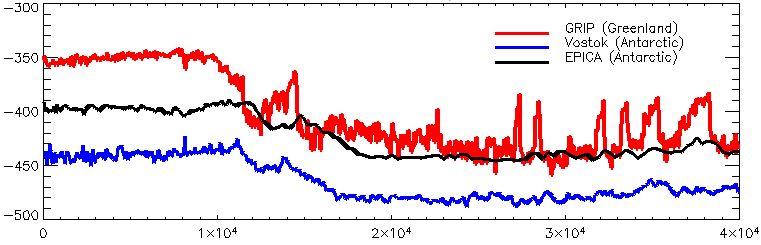
With this new paper, this may be one of those “case closed” moments in science showing that “climate change”/ice sheet collapse itself wasn’t to blame for the cold event, but the climate changed due to the impact event. This rather undoes the claims last year covered on WUWT in the story Sudden Clovis climate death by comet – “bogus”. I’d say it is pretty hard to argue with micro magnetic impact spherules dated to the time.
Evidence from central Mexico supporting the Younger Dryas extraterrestrial impact hypothesis

Abstract
We report the discovery in Lake Cuitzeo in central Mexico of a black, carbon-rich, lacustrine layer, containing nanodiamonds, microspherules, and other unusual materials that date to the early Younger Dryas and are interpreted to result from an extraterrestrial impact. These proxies were found in a 27-m-long core as part of an interdisciplinary effort to extract a paleoclimate record back through the previous interglacial.
Our attention focused early on an anomalous, 10-cm-thick, carbon-rich layer at a depth of 2.8 m that dates to 12.9 ka and coincides with a suite of anomalous coeval environmental and biotic changes independently recognized in other regional lake sequences.
Collectively, these changes have produced the most distinctive boundary layer in the late Quaternary record. This layer contains a diverse, abundant assemblage of impact-related markers, including nanodiamonds, carbon spherules, and magnetic spherules with rapid melting/quenching textures, all reaching synchronous peaks immediately beneath a layer containing the largest peak of charcoal in the core. Analyses by multiple methods demonstrate the presence of three allotropes of nanodiamond: n-diamond, i-carbon, and hexagonal nanodiamond (lonsdaleite), in order of estimated relative abundance.
This nanodiamond-rich layer is consistent with the Younger Dryas boundary layer found at numerous sites across North America, Greenland, and Western Europe. We have examined multiple hypotheses to account for these observations and find the evidence cannot be explained by any known terrestrial mechanism. It is, however, consistent with the Younger Dryas boundary impact hypothesis postulating a major extraterrestrial impact involving multiple airburst(s) and and/or ground impact(s) at 12.9 ka.
…

…
Summary
Synchronous peaks in multiple YDB markers dating to 12.9 ka were previously found at numerous sites across North and South America and in Western Europe. At Lake Cuitzeo, magnetic impact spherules, CSps, and NDs form abundance peaks within a 10 cm layer of sediment that dates to the early part of the YD, beginning at 12.9 ka. These peaks coincide with anomalous environmental, geochemical, and biotic changes evident at Lake Cuitzeo and in other regional records, consistent with the occurrence of an unusual event. Analyses of YDB acid-resistant extracts using STEM, EDS, HRTEM, SAD, FFT, EELS, and EFTEM indicate that Lake Cuitzeo nanoparticles are dominantly crystalline carbon and display d-spacings that match various ND allotropes, including lonsdaleite. These results are consistent with reports of abundant NDs in the YDB in North America and Western Europe.
Although the origin of these YDB markers remains speculative, any viable hypothesis must account for coeval abundance peaks in NDs, magnetic impact spherules, CSps, and charcoal in Lake Cuitzeo, along with apparently synchronous peaks at other sites, spanning a wide area of Earth’s surface. Multiple hypotheses have been proposed to explain these YDB peaks in markers, and all but one can be rejected. For example, the magnetic impact spherules and NDs cannot result from the influx of cosmic material or from any known regular terrestrial mechanism, including wildfires, volcanism, anthropogenesis, or alternatively, misidentification of proxies. Currently, only one known
event, a cosmic impact, can explain the diverse, widely distributed assemblage of proxies. In the entire geologic record, there are only two known continent-wide layers with abundance peaks in NDs, impact spherules, CSps, and aciniform soot, and those
are the KPg impact boundary at 65 Ma and the YDB boundary at 12.9 ka.
If you’re interested, the paper is published with unrestricted access on the PNAS website.
Or, you can read a full PDF copy that’s been mirrored on Dropbox.com at: http://dl.dropbox.com/u/2268163/Mexico%20YD%20Paper.pdf
h/t to reader Dennis Cox
See… THIS is Science. No observation-free modelling, or cherry picking… “We have observational findings, it relates to previously known observational findings, there is no other explanation which includes all relevant data, it’s falsifiable and reproducable (go dredge up another core sample and check for the same materials, or find an alternative hypothesis that includes all known observations)…
If Climate Science was done like this, there wouldn’t be a need for so devoted a skeptical community, because they scientists would be providing the healthy skepticism themselves.
I’ve been reading about this theory for many years. So I guess it has finally gained enough credibility to be mainstream? Which climate science worked like this too.
Any connection to the Carolina Bays?
http://en.wikipedia.org/wiki/Carolina_Bay
It would seem to me that a multiple impact event, or a single large impact with the ejecta coming back down on top of ice sheets, instantly evaporating them could leave what we now can observe. Rings of sand, possibly part ejecta and part flash evaporated ice sheets (they carry a great deal of sand and debris.) The shallowness of the bays could also be a result of the impact having to melt through the ice sheet.
?
I followed a link on another WUWT post to some interesting ideas about frozen wooly mammoths. For what it’s worth: The link suggested that, in order for a body as massive as a mammoth’s to be frozen without rot occurring in the middle they had to be subjected to ultra cold temperatures, in essence flash-frozen at 150 below. Yet they were frozen in a standing position, with unchewed summer beans still within pods in their mouths. There was the suggestion they were buried in a strange hail, unseen by modern scientific observers in modern times.
Here is the link: http://www.grahamkendall.net/Unsorted_files-2/A312-Frozen_Mammoths.txt
The caption for the first figure is wrong. (Never trust wikipedia!)
http://en.wikipedia.org/wiki/File:Epica-vostok-grip-40kyr.png
The Vostok and EPICA Dome C data are deuterium, not O-18. As a result, the graph proves, beyond all doubt, that if one (either deuterium or O-18) is a temperature proxy, then the other can not be. Yet the “official” position is that they both are. Using deuterium, there were about 4 ice ages in the last 420,000 years while O-18 suggests that there were from 8 to 12.
From deutnat.txt
Yet 15 (± 5) years of global warming [now stalled] means a Mann made calamity. This is what I call geological time shape shifting to suit one’s purpose. 😉
[My bold emphasis]
ah, music to my ears.
Younger Dryas, impact event. Carolina Bays implicated. Geomagnetic excursions. Iridium. Nanodiamonds. Charcoal & coal. Magnetic spherules. Yes. Fullerenes too? Orthodoxy shutting its ears and making rude noises because the theory implicates (a) catastrophism (b) a degree of rehab for Velikowsky (c) also, electric universe material is also obliquely implicated. Can’t have that can we?
One of the most interesting books I know came through a recommendation here a few years back. Magnetic Reversals and Evolutionary Leaps by Robert Felix. I really cannot recommend it too highly. Looking at the Amazon reviews I see a familiar two-tail rating ie some top, some bottom ratings tho mostly top. Must look carefully at one of the “intelligent” low ratings some time. Certainly, last time I reinvestigated the claims of “poor science” “lies” etc from an “intelligent” debunker on another two-tail rating, I started believing it, then as I investigated further, found I was soundly debunking the debunker’s debunks. After a while I thought, case closed. It was Cook’s Skeptical Science all over again. Thimblerigging a speciality.
That Wiki graph shows Greenland and Vostok proxies. Funny how both proxies ‘fail’ to show the Medieval Warm Period. Pick and choose. 😉
I should have added………..
Because the MWP was a northern hemisphere event.
What’s interesting to me is that previously a large freshwater flood was the consensus explanation of the Younger Dryas … and people found a bunch of evidence to support it.
Also of note is that the Younger Dryas is often cited as evidence of fast climate change from postulated natural “tipping points” … whereas it now appears to be a meteor impact.
Dang, climate science is fun. Always something new in this most settled of sciences …
w.
Sure there could have been an extraterrestrial event at the beginning of the Younger Dryas, but that doesn’t mean that it caused the YD (post hoc fallacy). If you look at most isotope proxies like the Greenland Ice cores and high resolution oceanic sediment cores ie Santa Barbara basin Cf, the fingerprint is always the same to the Dansgaard Oeschger events, this is especially true for the deuterium excess in the ice cores. This would suggest that these events have similar causes and that would require a lot of near identical terrestrial events.
Also interesting to note that the typical start date of the YD, 12,900 years (from the Caracio grey scale and GISP-II ice core) ago is now under pressure. In Europe researchers long knew that the YD started some 12,700 years ago, because of 200 varve counted years difference between the Laacher sea tephra dated 12,900 years ago and the start of the YD. Nowadays a new carbon dating calibration table (INTCAL09) shows a large discrepancy with the old one (INTCAL04) which suggest that indeed the YD started around 12,700 Cal BP.
The Younger Dryas lasted 1300 years, which is a very long time for a single event cause.
This study throws serious doubt on the Forcings model/theory which dictates that the Earth’s climate changes at the rate that forcings change, in effect slowly (at least in the pre-anthropogenic CO2 era).
This study indicates that the climate flips between more or less stable states irrespective of changes in forcings.
FYI the Younger Dryas also ended rapidly.
From wikipedia,
Measurements of oxygen isotopes from the GISP2 ice core suggest the ending of the Younger Dryas took place over just 40 – 50 years in three discrete steps, each lasting five years. Other proxy data, such as dust concentration, and snow accumulation, suggest an even more rapid transition, requiring about a 7 °C (12.60 °F) warming in just a few years.[6][7][20][21] Total warming was 10 ± 4 °C (18 ± 7 °F).
Interesting – next step, locating the impact location? Or do we have any leading theories? I know it took a long time for people to settle on the Chicxulub impact for the 65 mya event.
I agree with the commenters above… nice to see some actual Science. And I bet that if someone else had a credible competing theory, the authors would actually be interested in hearing it.
Willis: “….Always something new in this most settled of sciences …”
Ha ha!
Is Younger Dryas really so particular?
http://oceanexplorer.noaa.gov/explorations/05stepstones/background/paleoclimate/media/paleoclimate_fig1_600.html
As if they used m for the scale in the first picture to mean microns. I thought that they were huge at over 10 meters in diameter. The µ symbol should be easy to use now-a-days. — John M Reynolds
The big problem so far has been where to find some reasonably big crater(s) that are young enough. My feeling is that easily identifiable craters are missing because the impact area was covered by some kilometer of ice. The result would be seemingly very old craters the result of a billion years of weathering because the typical thick layers of ejecta are missing. I think two areas in SW finland should be checked. Mossala fjaerd is a crater like formation where broken edges still are sharp, experts say the crater is of volcanic origin and extremely old. My view is that what we see is the very bottom of an impact in a 1…2 km thick ice layer. No ejecta is found because it melted soon after the impact. The size of the Mossala crater is ca 6 km diameter. In the Aland area some 40 km towards WNW there is another slightly smaller crater 5.5 km in diameter. Again with broken surfaces that still seem fresh. Some 15 km south of Mossala I have found glazed sea bottom fragments similar to material found in the old Swedish Siljan krater (dia 50 km). If there is interest I could create a web page with some pictures. It is easy to see that two impacts like these would have injected tens of km^3 of water into the stratospere probably causing an extended “atomic war” like winter. /Lars Silen, physicist Finland.
Isn’t there also a paper that looked at mammoth bones from that time and found high speed particulate impact pits? I recall comments seemed to be leaning toward it being a stretching of the data.
Hey, I posted a link to UniverseToday about this several days ago — thought I might get a hat-tip (never had one). Oh well….
Willis, a large-enough impact near or on the N American glacier could cause a massive fresh-water flood — faster than any natural melting.
So where did the evidence of the Gulf Stream slowdown that supposedly provided the mechanism for the temperature drop come from?
And then there was recent post on a mass-extinction event where Smokey posted a link to somebody’s site that examined some very strange instances of Mammoth flash-freezing (in-cased in ice) across Siberia. An impact on a massive glacier in NA could have vaporized & flung extraordinarily large amounts of ice that precipitated out on the other side of the earth as a massive hail/rain storm. Sounds like science-fiction, but who knows?
Settled science unsettled, again. Looking forward to reading the trolls comments on this one.
Also, a little prediction for you. Richard Black will not even tweet this paper, let alone write a piece on it.
Heard a great one today. Why were economists made? To make climatologists look good.
This study indicates that the climate flips between more or less stable states irrespective of changes in forcings.
As predicted by chaos theory.
I believe, a single event, the eruption of Mount Toba not only caused a 1,000 year cold event but the near extinction of Humanity.
You dont need an impact for such events, a bolide atmospheric explosion will do the business.
‘