Ah, once again in response to a fearmongering press release, we see the obligatory “NYC is flooded” photoshop trick.

But guess what? I’ve already debunked that photo as impossible for the time frame. More on that later after we do the math on the press release that prompted this.
First the press release, from the University of Copenhagen
Sea levels will continue to rise for 500 years

Rising sea levels in the coming centuries is perhaps one of the most catastrophic consequences of rising temperatures. Massive economic costs, social consequences and forced migrations could result from global warming. But how frightening of times are we facing? Researchers from the Niels Bohr Institute are part of a team that has calculated the long-term outlook for rising sea levels in relation to the emission of greenhouse gases and pollution of the atmosphere using climate models. The results have been published in the scientific journal Global and Planetary Change.
“Based on the current situation we have projected changes in sea level 500 years into the future. We are not looking at what is happening with the climate, but are focusing exclusively on sea levels”, explains Aslak Grinsted, a researcher at the Centre for Ice and Climate, the Niels Bohr Institute at the University of Copenhagen.
Model based on actual measurements
He has developed a model in collaboration with researchers from England and China that is based on what happens with the emission of greenhouse gases and aerosols and the pollution of the atmosphere. Their model has been adjusted backwards to the actual measurements and was then used to predict the outlook for rising sea levels.
The research group has made calculations for four scenarios:
A pessimistic one, where the emissions continue to increase. This will mean that sea levels will rise 1.1 meters by the year 2100 and will have risen 5.5 meters by the year 2500.
Even in the most optimistic scenario, which requires extremely dramatic climate change goals, major technological advances and strong international cooperation to stop emitting greenhouse gases and polluting the atmosphere, the sea would continue to rise. By the year 2100 it will have risen by 60 cm and by the year 2500 the rise in sea level will be 1.8 meters.
For the two more realistic scenarios, calculated based on the emissions and pollution stabilizing, the results show that there will be a sea level rise of about 75 cm and that by the year 2500 the sea will have risen by 2 meters.
Rising sea levels for centuries
“In the 20th century sea has risen by an average of 2mm per year, but it is accelerating and over the last decades the rise in sea level has gone approximately 70% faster. Even if we stabilize the concentrations in the atmosphere and stop emitting greenhouse gases into the atmosphere, we can see that the rise in sea level will continue to accelerate for several centuries because of the sea and ice caps long reaction time. So it would be 2-400 years before we returned to the 20th century level of a 2 mm rise per year”, says Aslak Grinsted.
He points out that even though long-term calculations are subject to uncertainties, the sea will continue to rise in the coming centuries and it will most likely rise by 75 cm by the year 2100 and by the year 2500 the sea will have risen by 2 meters.
http://dx.doi.org/10.1016/j.gloplacha.2011.09.006
Contact:
Aslak Grinsted, PhD glaciologist, Centre for Ice and Climate, Niels Bohr Institute, University of Copenhagen. +45 3532-5893, aslak@gfy.ku.dk
================================================================
First, there has been no evidence of accelerating sea level rise. Willis writes in a previous entry:
Does increased CO2 cause increased sea level rise?
Short answer, data to date says no. There has been no acceleration the rate of sea level rise. Sea level has been rising for centuries. But the rate of the rise has not changed a whole lot. Both tidal stations and satellites show no increase in the historic rate of sea level rise, in either the short or long term. Fig. 1 shows the most recent satellite data.

Figure 1. Change of sea level over time. Radar data from the TOPEX satellite. The light blue line is sea level with monthly anomalies removed. The interval between data points is usually ten days. The gray line is the 1993-2004 linear trend projected to the end of the timeline. Gaussian average using a 71-point filter. Photo taken at Taunovo Bay Resort, Fiji.
Up until about the end of 2004, there was little change in the rate of sea level rise. Since then the rise has slowed down. The average (dark blue line) does not stray far from the trend (black line) up until 1994. Since then, it is well below the projected trend (gray line). We were supposed to be seeing some kind of big acceleration in the sea level rise caused by increased CO2. Instead, we are seeing a decrease in the rate of sea level rise. So the first claim, that increasing CO2 will cause increased rates of sea level rise, is not supported by the evidence.
Note that I am not saying anything about the future. The rate of sea level rise might go up again. What we can say, however, is that there is no hint of acceleration in the record, only deceleration. The claim of CO2 induced sea level rise is false to date.
=================
Second, these guys can’t even show math that matches the claims. Since there appears to be no acceleration in the record, and the average rate is 3mm per year we get this for they year 2100, 89 years from now:
89 years x 3 mm/year = 267 mm or 26.7 cm by the year 2100
Compare that to:
Even in the most optimistic scenario, which requires extremely dramatic climate change goals, major technological advances and strong international cooperation to stop emitting greenhouse gases and polluting the atmosphere, the sea would continue to rise. By the year 2100 it will have risen by 60 cm…
Even if nature doubled the rate of sea level rise to 6 mm/year we still wouldn’t make it:
89 years x 6 mm/year = 534 mm or 53.4 cm by the year 2100
60cm by 2100? FAIL
=====================
Third let’s have a look at that photo of NYC again, since I’ve covered it before:

Below is a repost of an analysis I did on Nov 28th, 2010 on a photo from this “NYC is flooded” photoshop trick set. Guess how long it takes to get the results shown in that photo?
Freaking out about NYC sea level rise is easy to do when you don’t pay attention to history
One of the more common visual tactics used by AGW proponents to scare people into thinking that AGW induced sea level rise is a big threat is to show altered photographs and GIS models of a city near the ocean (take your pick, New York, London, San Francisco etc.). These futuristic images demonstrate what the city might look like once global warming kicks in and kicks our butt, apparently without anyone noticing the advance of the sea. Take for example, lower Manhattan, one of the more common targets. The top image is a future shock rendition from the History Channel “Armageddon Week” and the bottom image is a photo of present day reality from Wikimedia.


Scary huh? And it’s not just photos, now that most anyone with a PC can run Google Earth, there’s a veritable cottage industry of people who make sea level inundation KML files using the 3D buildings feature for major cities. It works very well to get people’s attention. But how much of a looming threat is it when compared to the reality of measured sea level rise? Let’s find out.
 New York City under a 3-5 meter rise in sea-level due to global warming. Source: Inhabitat.com
Will Manhattan really look like that in the future? You can even interactively freak yourself out here, at Climate Atlas, and see what it looks like in NYC when the entire Greenland Ice Sheet melts:

Gosh.
Well, I can see how people must be terrified. Just look at this plot of sea level rise at the Battery Park tide gauge from NOAA:

Yeah, it’s headed up, wayyyy up. 2.77 millimeters per year. So, to get the levels in the photo and 3D GE model shown above, we’d need to do some simple calcs.
The Google Earth 3D model is easy. It specifies a 3-5 meter sea level rise, so we’ll call it 4 meters.
For calculation purposes, we’ll assume sea level rise to be linear, and round up the Battery Park tide gauge rate to 3.0 mm per year, which puts it closer to the 3.1 mm per year measured by satellite and published at Colorado State University’s Global Sea Level Page.
4 meters = 4000 millimeters
4000 millimeters /3.0 millimeters per year = 1333 years

Now, how about the doctored image from the History Channel? There’s no reference given on the height of sea level rise on the web page, but fortunately, we have built-in yardsticks in the image. The story height of buildings in the photo can easily be estimated from the before and after photos shown at the top of this post.
I’ve selected the white building on the northeast side of Battery Park, along South St. I counted 18 stories of that building as being underwater using the hi-res image here , and I’ll estimate from other objects in the photo (like the water to pier to street height) that it is an additional 2 stories from street level there to the present day sea level (PDSL).
So what is the height of a story? The Council on Tall Buildings and Urban Habitat gives a handy guide on story height for office buildings like that one. They say that an office building like that one has a story height of 3.9 meters , so we’ll use that.
History Channel photo submersion = 20 stories
Story height = 3.9 meters
Sea Level Rise in the photo 20 x 3.9 meters = 78 meters
78 meters = 78,000 millimeters
78,000 millimeters / 3 millimeters per year = 26,000 years

26,000 years to get that? Would those buildings still be standing then? And even more important, wouldn’t we be in a new ice age by then? If we did enter another ice age, sea level would be lower, as demonstrated in this graph below. Note the level 24,000 years ago.
 Image: Global Warming Art – click
This demonstrates the folly of assuming that climate change, and hence sea level rise, is linear. As we all know, it isn’t, yet that doesn’t stop many AGW proponents from using present day measurements to project linearly into the future and then generate scary scenarios and visuals from it.
Even on the short-term, such predictions fail miserably. Take for example Dr. James Hansen of NASA GISS. Read his prediction 20 years ago about sea level rise in New York City, which I previously covered on WUWT in A little known 20 year old climate change prediction by Dr. James Hansen – that failed badly.
He said that [in 20 years]:
“The West Side Highway [which runs along the Hudson River] will be under water.(which has been “updated” now, even with the update it still fails)
Problem is, here it is 20 years later, and people still drive that highway today without the use of Jet-Skis.
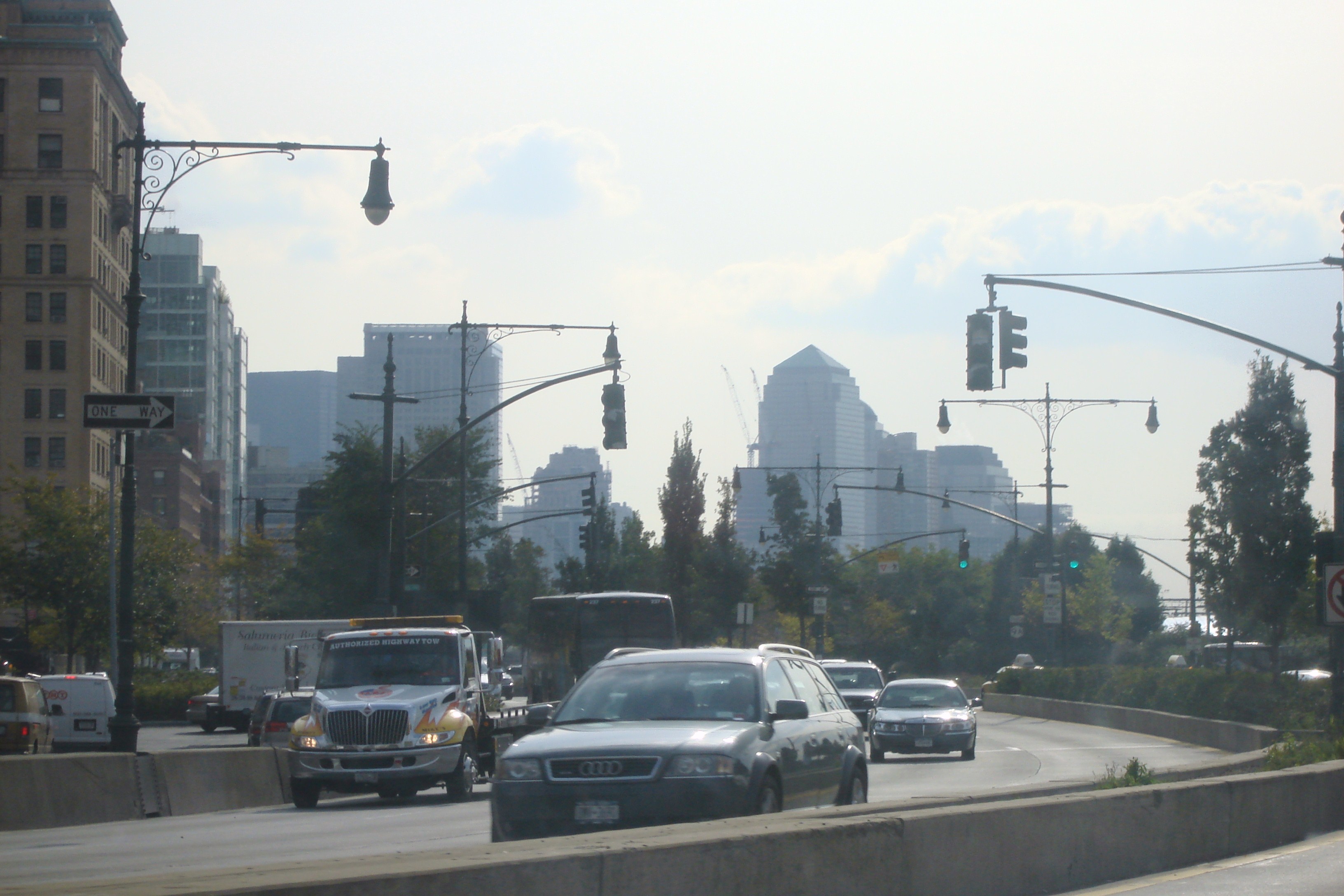 West Side Highway in 2007. Image: Wikimedia
What got me started on this post was a comment left on WUWT by “Rascal”
Submitted on 2010/11/26 at 7:46 pmCopy the following address in to your browser, and observe the expansion of lower Manhattan since 1660.
http://www.racontours.com/archive/coastline_anim.php
Note that the West Side Highway (West Street) over half of the World Trade Center site, and the South Street Seaport were “under water” in 1660!
He’s right. And one thing many AGW proponents don’t consider (in addition to the non-linearity of climate) is the adaptability of humans. For readers here, I’ve taken that Flash animation at Racontours.com and made it into an animated GIF below:
 Flipbook of lower Manhattan harbor and city adaptation from 1660-2004. Images from Racontours.com
They write about this historical account of lower Manhattan:
Based on our study of historical maps of Manhattan, Racontours has been able to create this simulation of the expansion of the island’s coastline. This topic is covered in both our South St. Seaport and Lower Manhattan tours, and most people are amazed at the transformation that’s taken place. Pearl St, named for the seashells that washed up there, once ran along the river. (Click here for a view of Captain Kidd’s house at the corner of Pearl & Wall Streets)
The first land reclamation was undertaken by Peter Stuyvesant upon taking over as the colony’s governor in 1646. Hoping to facilitate waste disposal and transportation, he organized the excavation of the canal along what is now Broad St. Back then, this was still called New Amsterdam, and the Dutch were great believers in canals.
By the American Revolution, the city’s population had grown to 30,000, and land had become scarce and cramped in the city center. That’s when the city began to sell ‘water lots’, wherein entrepreneurs would seek to use landfill to create additional lots for use.
The most recent landfilled area led to the creation of Battery Park City, built in the 70′s on the earth excavated from the World Trade Center’s foundation.
Based on the 2.77 millimeters per year (call it 3 mm) of current sea level rise as shown by that Battery Tide gauge, in the 344 years (1660-2004) the sea level would have risen by:
344 years x 3 millimeters/year = 1032 millimeters or 1.032 meters.
Clearly, New Yorkers have been able to stay well ahead of that 1 meter rise since the city was founded.
The next time your friends get freaked out about sea level rise, or “high water”, show them this.
Discover more from Watts Up With That?
Subscribe to get the latest posts sent to your email.
Year 2100 is 89 years from now, no big deal about the results, but you might want to fix the typpo 🙂
REPLY: It was fixed before your comment was completed, noticed it right after posting, but thanks – Anthony
I like how they introdice the report by saying:
“…We are not looking at what is happening with the climate, but are focusing exclusively on sea levels”
Then the very first projection?
“A pessimistic one, where the emissions continue to increase. This will mean that sea levels will rise 1.1 meters by the year 2100 and will have risen 5.5 meters by the year 2500.”
According to measurements, the difference between the earth reference and the average sea level in NYC will be 28 cm more over the next 100 years… regardless of what humanity does.
1) How much is the earth reference subsiding?
2) How can this be any different than the planetary levels?
3) What does this have to do with Human activity?
We live in a dynamic world.
These geniuses do not imagine that small adjustments over 100s of years will be made, almost transparently, such that sea level change will be a non-issue.
Just as Battery, NY saw 45 cm in 160 years, it is fine. Every time a pier, sea wall, or dock is rebuilt, which they will be many times over 500 years, small adjustments are made.
It should be a crime to abuse science and misinform the public, particularly as there is a monetary gain to be had by panicking people into supporting bad policies which always seem to benefit somebody behind the scenes.
This is the usual “Sea level rise porn of the week”.
A simple look at Envisat measurements, the most precise to date altimetry satellite, the rate is barely 1.5mm/y.
http://www.real-science.com/wp-content/uploads/2011/10/HidingEnvisat1.gif
EOM
I must be missing something. The Hansen article that you quote and link in the above article says 40 years not 20 years! The real problem is that the AGWs let something other than science control what they say. Dr. George Abell said that,” sometimes we take ourselves to seriously.” They allow what they want to see be what they believe.
Some cities are sinking. Venice (-0.5 mm/y), New Orleans (-0.25 mm/y), and Amsterdam (-0.2 mm/y) have not been abandoned.
But sea levels can not rise forever, there’s only so much water and clouds will be wanting their quota too.
Do you not think that the sea level rise is more of a worry for the likes of place that receive a tidal surge during a cyclone, 60cm might make a large difference to places like Burma and Bengal.
REPLY: So might tides which can be as large or larger. Shall we then modify the orbit of the moon to prevent high tides? It is about as plausible as the claims on CO2 emissions equating to sea level – Anthony
How can they presume to sully the name of Niels Bohr with this stuff?
blockquote>higley7 says:
October 18, 2011 at 9:38 am
These geniuses do not imagine that small adjustments over 100s of years will be made, almost transparently, such that sea level change will be a non-issue.
Just as Battery, NY saw 45 cm in 160 years, it is fine. Every time a pier, sea wall, or dock is rebuilt, which they will be many times over 500 years, small adjustments are made.
It should be a crime to abuse science and misinform the public, particularly as there is a monetary gain to be had by panicking people into supporting bad policies which always seem to benefit somebody behind the scenes.
You mean we won’t just wake up one day and find NYC under 20 feet of water? The Peak Oil people think that’s what going to happen with oil — one day we won’t have any more oil but we won’t realize we’re running low until the last Hummer is filled from the last drop of gas from the last Texxon-Mobile-Shell-BP-Total-Chevron-Big-Oil convenience store.
Instead, if sea levels rise as predicted, people will notice the gradual changes and adapt. Wow!
If you go to the top of the Prudential Tower in Boston, they have a very nice narrated display that shows how the city has grown since 1630. The original tiny city on the Shawmut peninsula is now quite far from the Atlantic. The airport is on Governer’s island, which is island no more, and Deer Island, now home to a huge waste treatment plant, was once separated from the mainland by a channel big enough for naval battles during the Revolutionary War. Sea level rise just can’t keep up with those darned people.
So, essentially, in the hippie reality, rising sea levels would just bring NYC back to 17th century normal level. Question then becomes, why don’t the crazy climate communist hippies want to go back to what was normal land levels for NYC?
Sir…..I have seen studies in which Antartica and Greenland, when melted, increases sea
level by five meters. And then from where comes the added water..?
26,000 years from now the earth will be sliding into its next ice age. Milankovich cycles and all that. Should cancel out the CO2 influence (if there is much).
Zac makes a good point, if all the world’s glaciers and both ice caps did melt completely, it must be possible to calculate what the sea levels would be. With no more ice available, presumably that would be the upper limit. It is also relevant that if it really got warm enough to melt all this ice, Greenland, Antarctica and quite a lot of areas of Canada and Russia that are too cold at present would then become habitable. As this big melt is going to happen very gradually, surely people will just slowly migrate northwards.
@Allan M
Very good point, he was a very clever man.
Or southwards.
I recall seeing a fairly long term graph showing the peaks and troughs of the sea level. The height/depth at the various glacial maximums and minimums seemed fairly consistent. Currently we are near the top of such a peak and so I’d expect the sea level “rise” to taper off in short order and perhaps even reverse.
I simply don’t think, barring massive climate change, much more water will be freed or up much more thermal expansion will take place in the coming centuries. The pattern simply doesn’t show it.
What a brilliant, lucid, readable essay. For me, it encapsulates Anthony’s genius. It includes a “knock down” criticism of a pal-reviewed article that should never have been published by a reputable scientific journal and a nice healthy dose of natural history. Who knew that Pearl Street was that close to the river at one time?
As for the publishers of the article, would you please find a good dictionary and look up that good old Scandinavian word ‘shame’? As for the authors, would you please find a math text from the second year of grammar school and study it thoroughly?
Speed says:
October 18, 2011 at 9:35 am
“We live in a dynamic world.”
According to Warmista, human evil caused the dynamism and must be reigned in through totalitarian government. Then we can return to The Golden Age. Just ask any communist.
When I first started looking into this AGW business a few years ago, one of the first things I ran into was a pdf written by a California geologist. The pdf is long gone as are my notes (an old dead machine) but he pointed out, among other things, the high stands visible in CA from sea levels of times past. He said that before the next ice age the sea level should be a good 30-40 meters higher than it is today.
So the alarmists are taking something that will happen no matter what we humans do or don’t do and turning it into a humongous scary story.
Even in the most optimistic scenario, which requires extremely dramatic climate change goals, major technological advances and strong international cooperation to stop emitting greenhouse gases and polluting the atmosphere, the sea would continue to rise. By the year 2100 it will have risen by 60 cm and by the year 2500 the rise in sea level will be 1.8 meters.
For the two more realistic scenarios, calculated based on the emissions and pollution stabilizing, the results show that there will be a sea level rise of about 75 cm and that by the year 2500 the sea will have risen by 2 meters.
Wow! These guys presume to know what type of power supply we will have 500 years from now. Let’s ask Juan Ponce de Leon, who had not yet sailed from Spain to explore Florida, what our industry would look like.
wanting their quota too.
“SteveE says:
October 18, 2011 at 10:23 am
Do you not think that the sea level rise is more of a worry for the likes of place that receive a tidal surge during a cyclone, 60cm might make a large difference to places like Burma and Bengal.
REPLY: So might tides which can be as large or larger. Shall we then modify the orbit of the moon to prevent high tides? It is about as plausible as the claims on CO2 emissions equating to sea level – Anthony”
Anthony,
Won’t need to change the Moon’s orbit as it is presently receding at about 23.6 miles per million years. As it does its tidal effect is reduced. Of course that recession is at the present rate which is also decreasing so it may take even longer to have any noticeable effect. Let’s see, gravity is reduced by the square of the distance……..Someone better at math than I will need to work out the tides. But all the same, CO2 is probably similar in its ability to have any effect upon our planet.
re : 78m sea level rise
A back-of-the-envelope calculation I did a few years ago indicated that even if every single last gram of ice on the planet melted there still wouldn’t be enough to raise the oceans by 78m. I seem to recall around 16m was the max. That calculation only considered current sea & ocean area and didn’t allow for sea area increasing due to encroachment onto low lying land.
Don’t have those figures anyway but 16m fits in well with the 3-5 meter rise from melting the entire Greenland icesheet mentioned in the article.
Mike (whose house is close to the New Jersey shore standing at 25m above sea level and who therefore stands to gain a lot in home value *if* a 16m rise is realized)