UPDATE: New graphs from David Archibald added. See below.
The NOAA Space Weather Prediction Center (SWPC) has released their latest charts on solar activity and the news is not encouraging for solar watchers. Today, the sun has but a couple of anemic “sunspecks”.

Last month I wrote about how May had not continued the advances seen in March and April. Now according the the latest SWPC graphs of the three major metrics of solar activity, June appears to have slipped even further.


I see NASA’s Hathaway making another adjustment to his forecast soon. He wrote on July 1st:
The current prediction for Sunspot Cycle 24 gives a smoothed sunspot number maximum of about 69 in June of 2013. We are currently over two and a half years into Cycle 24. Three consecutive months with average daily sunspot numbers above 40 has raised the predicted maximum above the 64.2 for the Cycle 14 maximum in 1907. The predicted size would make this the smallest sunspot cycle in over 100 years.
More near real-time information on the state of the sun is available on our WUWT solar reference page
UPDATE: My friend in Perth, David Archibald, sends along this information.
Solar Update July 2011
Now that the UK Met Office is half way to admitting that solar activity is the main driver in climate, it is appropriate to check up on how the Sun is going.

Two and a half years after solar minimum, the Ap Index remains below the minima of previous solar cycles.

Dr Svalgaard provides a useful daily update on the F 10.7 flux at http://www.leif.org/research/TSI-SORCE-2008-now.png What the above graph shows is the ramp up of Solar Cycle 24 F 10.7 flux relative to the previous five solar cycles, aligned on the month of minimum. The current cycle has a very flat trajectory.
 Similar to the Ap Index, the Interplanetary Magnetic Field is now up to the levels of previous solar minima.
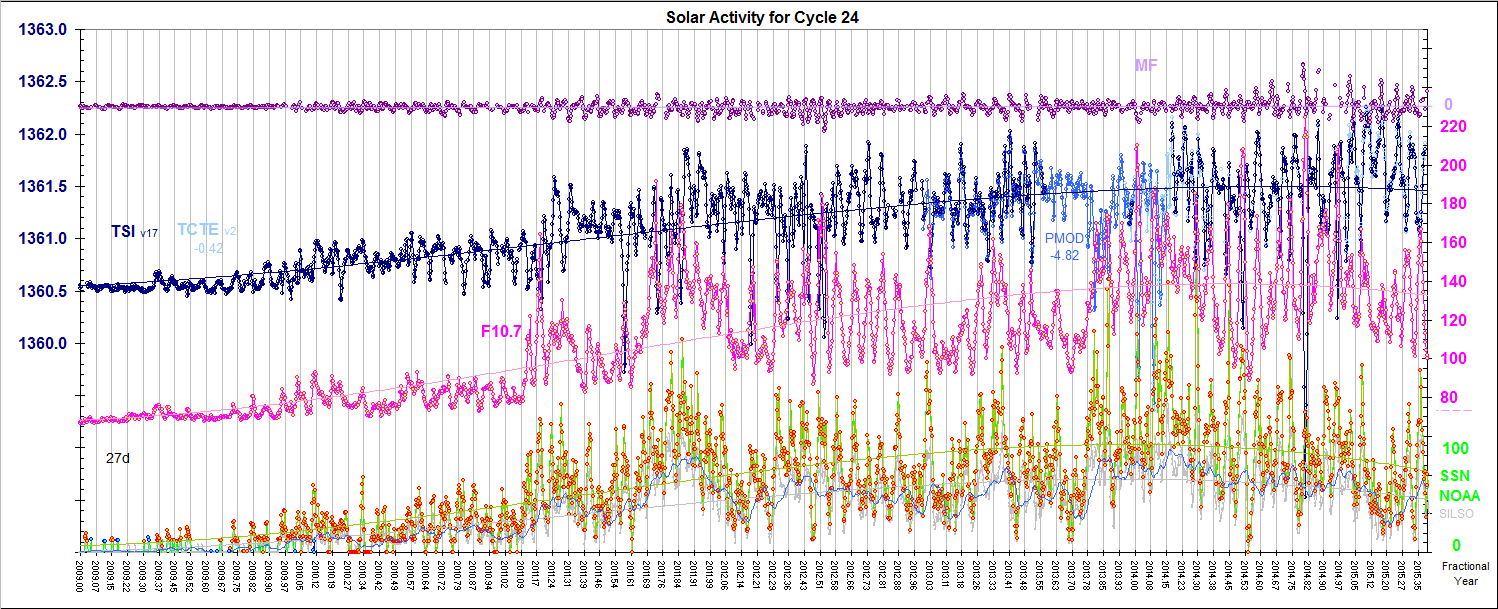
This chart compares the development of Solar Cycle 24 with the last de Vries cycle event – the Dalton Minimum. The Solar Cycle 24 ramp up in terms of sunspot number is tracking much the same as that of Solar Cycle 5 but about a year ahead of it. All solar activity indications are for a Dalton Minimum repeat. There has been no development that precludes that outcome.

This graph shows the sum of the north and south polar magnetic fields on the Sun. It has yet to get down to the levels of previous maxima, and solar maximum may be still two to three years off.

David Archibald
July 2011
At this rate, soon no-one will be able to ignore who much climate forcing is from the sun.
Currently half-way through a USB-recorded sci-fi called ‘Sunshine’ (not much cop, by the way). In this film, our sun is dying: prophetic or watt?
Better bundle up. Some cold times are a comin!
At this rate, soon no-one will be able to ignore who much climate forcing is from the sun.
oops, schoolboy typo there.
Bloke down the pub says:
July 9, 2011 at 10:57 am
At this rate, soon no-one will be able to ignore who much climate forcing is from the sun.
_____
Indeed, and this cuts both ways. IF we should go into a Maunder type minimum, what excuses will the AGW skeptics have if we don’t get their much talked about and anticipated new “LIttle Ice Age”, but rather, on a decade to decade basis, global temps continue to rise.
Have the ‘team’ told us yet how this is the fault of AGW yet, becasue until they do I refuse to accept its happening .
R. Gates says:
“IF we should go into a Maunder type minimum, what excuses will the AGW skeptics have if we don’t get their much talked about and anticipated new “LIttle Ice Age”
Not everyone here attributes a lot of forcing to solar cycles. Just because we don’t fully understand the dynamics of long term climate change doesn’t prove the increase in CO2 is now the dominant factor.
“Indeed, and this cuts both ways. IF we should go into a Maunder type minimum, what excuses will the AGW skeptics have if we don’t get their much talked about and anticipated new “LIttle Ice Age”, but rather, on a decade to decade basis, global temps continue to rise.”
A lot of sceptics will re-access the position in that scenario – including me. That said I changed my mind in 2007 as it became clear that the warming had stalled – I don’t see any real evidence of it accelerating again at the moment.
What about if we cool though – some of the warmists in that scenario ought to be criminally prosecuted due to the public money that would have been wasted.
To repeat what I said in the other solar minimum article. There has been only one Maunder Minimum since sunspot records were kept after the invention of the telescope. We cannot be 100% sure that this MM caused the little ice age. We have had two very cold winters here in UK, but let us not go down the route of the AGW brigade who tell us that every non-average weather event is caused by AGW. Climate is not the same as weather and trends need to be measured for much more than one decade to have any useful scientific value.
This is why I am so p****d off with successive UK governments destroying our economic competitivity by “carbon taxes” on power, fuel and transportation.
Didn’t anyone such as Landscheidt produce a graph from years ago to compare with Hathaway’s graphs ? Has Hathaway even heard of Landscheidt ?
It would be an interesting comparison if someone can produce a graph from the work done by Landscheidt and others many years ago.
Why haven’t Hathaway and others taken on board the work of Landscheidt and others. Perhaps once this is all over and they see how wrong they’ve been then they might start to move away from the co2 groupthink and return to real science, that is open minded science that embraces a wide range of other ideas and isn’t afraid to question received (conventional) wisdom.
R. Gates says:
July 9, 2011 at 11:09 am
No scientist has claimed that a Maunder Minimum necessarily causes a Little Ice Age. On the other side of the coin, what if five years down the road Hansen, Schmidt and the other Dwarves still have their heads in the computer and no new physical hypotheses that describe natural processes such as the effect of China’s aerosols on albedo (aka SnowWhite)?
D Caldwell says:
July 9, 2011 at 11:28 am
R. Gates says:
“IF we should go into a Maunder type minimum, what excuses will the AGW skeptics have if we don’t get their much talked about and anticipated new “LIttle Ice Age”
Not everyone here attributes a lot of forcing to solar cycles. Just because we don’t fully understand the dynamics of long term climate change doesn’t prove the increase in CO2 is now the dominant factor.
____
Fair enough, and of course, neither does WUWT represent the views of the entire AGW skeptical community, though I believe it has a fairly accurate sampling, and I’m especially impressed with the professional and self-taught scientists who sometimes frequent here.
But here’s the larger point: Global Climate models, while far from perfect, have accurately predicted some of the earliest effects of increased CO2, namely the decline of Arctic sea ice and general warming of the Arctic. Now AGW skeptics would love to say this has all happened before and show pictures of submarines coming up in open water at the N. Pole, etc., but any reasonably well-educated person who studies this issue in depth knows that the changes going on in the Arctic right now have not happened in at least 2,000 years, and probably much longer. GCM’s have shown this will occur based on CO2 and related positive feedbacks. To what do AGW skeptics ascribe it? It’s been happening now for far too many decades to be “natural variability”. And if it the Arctic does not recover, but continues to decline, despite a quiet Maunder Minimum sun, what will AGW skeptics continue to ascribe it too? GCM’s have shown it will occur based on CO2 increases, yet skeptics seem to be without an explanation other than “natural variability”. That excuse works for one or two years, or maybe up to a decade of out of the “normal” weather, but when it goes on 20, 30, or more years, and across multiple ups and downs of solar cycles, ENSO, PDO, NAO, etc. etc. that excuse fails.
Andrew Harding says:
July 9, 2011 at 11:31 am
Nor do we know if the Livingston and Penn fading sunspot/weakening magnetic field occurred during the Maunder Minimum. (BTW, I think history will record only one Maunder Minimum, I’m sure the Sun has had several “Maunder-like minima.” Sorry for the pedantry….)
Does anyone have the predictions for SC24.
Suspect looking at the original forecast would better show how far things are out of tilt.
Theo Goodwin says:
July 9, 2011 at 11:41 am
R. Gates says:
July 9, 2011 at 11:09 am
No scientist has claimed that a Maunder Minimum necessarily causes a Little Ice Age. On the other side of the coin, what if five years down the road Hansen, Schmidt and the other Dwarves still have their heads in the computer and no new physical hypotheses that describe natural processes such as the effect of China’s aerosols on albedo (aka SnowWhite)?
_____
Theo, not sure how much you know about the very complicated Global Climate models, but I’m sure you know that they are constantly being improved upon. Once a forcing dynamic is known and quantified, it is added to the model and as such, increases in aerosols are no different. In that regard, I highly anticipate some additions to the models to come in the next few years based on quantifiable effects of solar output in the areas of GCR’s/Cloud formation, high energy UV and global circulation, etc. These additions may make some minor differences in future climate scenarios but will not change the overall anticipated major trends such as an ice free summer Arctic, etc.
Of course, as they are modeling a non-linear system, the GCM’s will always miss the important tipping points, hence why the rapid decline of sea ice in 2007 was missed, and other future tipping points will also be.
R. Gates says:
July 9, 2011 at 11:47 am
Just because their models ,produce a graph that nearly mimics observed temps (not nearly really according to Lucia’s rather good analysis) doesn’t mean that CO² was the cause. It could mean that they had a bit of luck and that the graph was ‘forced’ well.
But here’s the larger point: Global Climate models, while far from perfect, have accurately predicted some of the earliest effects of increased CO2, namely the decline of Arctic sea ice and general warming of the Arctic
===============================================================
Let’s see………the climate computer games predicted temperatures would go up, and geee whizz they did. Right after the Little Ice Age.
They did not predict the missing hot spot in the tropics, they did not predict over a decade of temperatures not going up…..they did predict warmcold, wetdry, snowrain, droughtflood…
If you remember correctly, the earliest effects, they were hindcasting and retuning their computer games……to make them match what was really happening
If Arctic sea ice had increased, they would have retuned their climate computer games to show it.
You don’t need a computer to extend a trend, and so far that’s all we’ve paid for…………
….namely the decline of Arctic sea ice and general warming of the Arctic…To what do AGW sceptics ascribe it?
Mr. Gates,
We meet again. Certainly not to CO2, I shall write about it soon, but here is a primer (note warning at the top of the web page)
http://www.vukcevic.talktalk.net/CO2-dBz.htm
R. Gates says: July 9, 2011 at 11:47 am
[, ENSO, PDO, NAO, etc. etc]
Do you realize that all those things (and many others) except volcanoes are effects.
In the absence of energy from the Sun none of these effects [, ENSO, PDO, NAO, etc. etc] would occur.
In the absence of energy from the Sun the Earth would be about 3 Kelvin. It is about 288 Kelvin (cold + 285). One percent of 285 is 2.85, a small change in the energy output from the Sun may have a significant Effect on the Earth.
Many people think that 100% ‘normal’ output from the Sun yields an average Earth temperature of 15 degrees C, so 1% of the Suns output causes 0.15 degrees C, it’s not, and it is not that simple.
So the question is: How does the energy from the Sun, in all of its forms, and at different levels, cause these effects that affect the climate over the millennia.
Are there a ‘tipping-points’ in solar output that cause step changes in the above mentioned effects? I doubt that the relationships are liner all the way from 3 to 288 Kelvin, so where are the step changes.
We shall see is there is one close by, history indicates that there likely is.
Mr. Gates, three decades is not “too many.” Further, there is evidence that it was warmer in the arctic during the Medieval Warming Period, which occured less than 2000 years ago. And we know that 6-7000 years ago the arctic was ice-free and I hope you will not claim it wasn’t due to “natural variaility.”
stephen richards says:
July 9, 2011 at 12:09 pm
R. Gates says:
July 9, 2011 at 11:47 am
Just because their models ,produce a graph that nearly mimics observed temps (not nearly really according to Lucia’s rather good analysis) doesn’t mean that CO² was the cause. It could mean that they had a bit of luck and that the graph was ‘forced’ well.
_____
If multiple GCM’s, running vastly different simulations, but using the basic physics of CO2, happened to have the same bit of luck, I would encourage those model makers to head out to Las Vegas. Maybe, rather than luck, it is simply a case that it they are fundamentally correct, though poor on specifics, and horrible at seeing tipping points in this non-linear system of climate.
M.A.Vukcevic says:
July 9, 2011 at 12:26 pm
….namely the decline of Arctic sea ice and general warming of the Arctic…To what do AGW sceptics ascribe it?
Mr. Gates,
We meet again. Certainly not to CO2, I shall write about it soon, but here is a primer (note warning at the top of the web page)
http://www.vukcevic.talktalk.net/CO2-dBz.htm
____
Your ideas do at least intrigue me, and your pages do remain a great resource for general climate data.
“They [computer models] did not predict the missing hot spot in the tropics, they did not predict over a decade of temperatures not going up…..they did predict warmcold, wetdry, snowrain, droughtflood…”
Yes, but did they predict the manbearpig?
My prediction:
SC 24 maximum – not before ~2014/15
SC 24/25 shift (next minimum) – not before 2021/22 (SC 24 is not going to be shorter than ~12 y, maybe even significantly longer).
Cooling ahead.
“Today, the sun has but a couple of anemic Sunspecks”.
OK just count them! all 65 of them??? SFI at 86. Does not justify half!
“I see NASA’s Hathaway making another adjustment to his forecast soon.”
Why ? counting like that,what can’t he correctly predict.