via Physorg.com with h/t to Dr. Leif Svalgaard and Indur Goklany
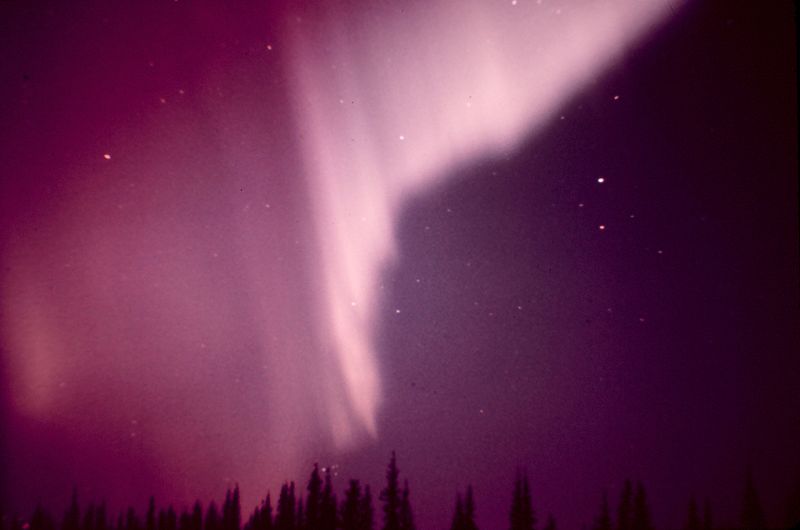
The Northern Lights have petered out during the second half of this decade, becoming rarer than at any other time in more than a century, the Finnish Meteorological Institute said Tuesday.
The Northern Lights, or aurora borealis, generally follow an 11-year “solar cycle”, in which the frequency of the phenomena rises to a maximum and then tapers off into a minimum and then repeats the cycle.
“The solar minimum was officially in 2008, but this minimum has been going on and on and on,” researcher Noora Partamies told AFP.
“Only in the past half a year have we seen more activity, but we don’t really know whether we’re coming out of this minimum,” she added.
The Northern Lights, a blaze of coloured patterns in the northern skies, are triggered by solar winds crashing into the earth and being drawn to the magnetic poles, wreaking havoc on electrons in the parts of the atmosphere known as the ionosphere and magnetosphere.
So a dimming of the Northern Lights is a signal that activity on the sun which causes solar winds, such as solar flares and sun sports, is also quieting down.
Full story at Physorg.com
Living in Scotland, it ought to be possible occasionally to see the northern lights. Strangely the only time I’ve seen them was when I visited Scotland in the 1980s and since I moved here permanently over a decade ago I’ve never seen them (despite having a telescope and being out on those starry nights when it ought to be possible!)
“The Northern Lights, or aurora borealis, generally follow an 11-year “solar cycle”…”
What??? Are you telling me there is something called “natural cycles” ????
but,but,but……. what about CO2 ???
Take as many photos and videos as you are able to, in 10 -15 years time the event will be a very rare occurrence.
http://www.vukcevic.talktalk.net/LFC2.htm
Global Borealis Disruption evidently.
Does “sun sports” in the last line include beach volleyball? Shame.
I blame Bush!
The uplift in solar winds in April gave some fantastic displays;
http://www.spaceweather.com/aurora/gallery_01apr10.htm
I find science is very funny at times.
Our atmosphere rotates with the planet giving us this protective shield that deflects.
Yet, rotation is not even considered. So, it must be a magnetic event say the scientists.
> “Only in the past half a year have we seen more activity, but we don’t really know whether we’re coming out of this minimum,” she added.
http://www.spaceweather.com/aurora/gallery_01sep10.htm sounds more optimistic:
I am hoping that the UN will intercede with whoever is causing this problem.
http://www.nationalpost.com/opinion/columnists/finds+niche+little+green/3593995/story.html
Okay, so maybe Mazlan Othman, the Malaysian astrophysicist who heads the United Nations Office for Outer Space Affairs (UNOOSA), didn’t claim she was about to be made Earth’s ambassador to visiting aliens. Maybe London’s Times on Sunday misinterpreted what she said she would tell delegates at next week’s meeting of the prestigious Royal Society in Buckinghamshire, England.
Should the guilty party or parties be found we now have a way of dealing with the diplomatic issues.
What??? Are you telling me there is something called “natural cycles” ????
Who has ever said there are no such things as “natural cycles”? Of course there are, which is why even when there is a strong long term warming trend there can be shorter periods within that where temperatures will flatten or even fall slightly. This is exactly what some us have been trying to explain to people who say things like “it hasn’t warmed since 1998”.
Thanks Indur and Leif for pointing Anthony toward this post.
More popularization of what the interactions are between the sun system and the earth system help to promote science. That is needed in the recent trend of loss of credibility for climate science.
John
Leif
Does one of your graphs at
http://www.leif.org/research/TSI-SORCE-2008-now.png
show the Aurora variation, directly/indirectly? Is there a regularly updated graph that shows this variation?
Seems such a graph would best show some actual impact/variability of whatever solar ‘x’ over time.
Mike Haseler – you’ll never see aurorae through a telescope. All you need is the naked eye. According to spaceweather.com quite a few people have seen aurorae in Scotland this year. Perhaps you’re too close to city lights.
vukcevic – there’s no reason at all to think that aurorae will become rare. Records from central Europe, far from the geomagnetic pole, show that they were seen a few times a year even there during the Maunder Minimum.
Joe Lalonde – please, elaborate on by whom exactly “rotation is not even considered”.
andrew adams
Ok, so how many of these natural cycles show up in the temperature projections? None. How can they claim that the models are accurate if they can’t model these natural cycles?
Nuff said!
MikeEE
I can see the funding submission now – “To study how AGW has also been the reason for the end of the Northern Lights”.
Chris Knight says:
September 29, 2010 at 4:03 am
Does “sun sports” in the last line include beach volleyball? Shame.
It most certainly does! All that extra Co2 from vigorous exercise causes global waffling! Sorry that should be warming, I think?
andrew adams says:
September 29, 2010 at 5:26 am
What??? Are you telling me there is something called “natural cycles” ????
Who has ever said there are no such things as “natural cycles”? Of course there are, which is why even when there is a strong long term warming trend there can be shorter periods within that where temperatures will flatten or even fall slightly. This is exactly what some us have been trying to explain to people who say things like “it hasn’t warmed since 1998″.
That’s precisely why it is called Climate Change, it’s the perfect heads I win tails you lose version of Global Warming. If the climate system warms, it’s Climate Change. If the climate system cools, it’s Climate Change! Simples! One cannot have one’s cake & eat it you know, it’s just not cricket old boy! From what I can see in the ice-core data this so called “long-term warming trend” is nothing of the kind, & in fact the Earth has been in an even longer-term cooling trend for around 10,000 years rather as it did in at least the last 4 inter-glacials! Even the mighty Phil Jones has (not so) openly confessed to the BBC’s Roger Harrabin that there has been no statistically significant warming since 1995, (let alone 1998!) That’s 15 years as opposed to 12 years. I am certainly not looking forward to the next load of global warming this winter, if it’s anything like the last two in the UK. I await the Wet Office’s seasonal forecast with baited breath!
Apologies that should read “bated” breath. Sticky fingers again!
Pascvaks says:
September 29, 2010 at 6:00 am
Is there a regularly updated graph that shows this variation?
This one shows the state of the Sun and geomagnetic activity [bottom panel]. When the color in the bottom panel changes to red, aurorae are strong. Here is another good one: http://www.swpc.noaa.gov/pmap/
And there are other [and better] ones out there. E.g. http://www.qsl.net/ei5fk/Real-Time-Aurora-Monitor.html or http://www.softservenews.com/aurora.htm
Forgot link:
This one shows the state of the Sun and geomagnetic activity [bottom panel].
http://hirweb.nict.go.jp/sedoss/solact3/
So with the death of sunspots in 2015 we can look forward to a long time of Aurora Bore It All Of Us. (Actually, I have an inside tip from Al Gorge that it is really CO2 that is heating the colors so that they melt.)
Now that we understand it, what does it mean?
>Less Aurora lights means more darkness
>Less global heat means more ice age features
>Less tropical storms means less rain and more drought
>Topography, based on climate cooling, begins to compress towards the Equator
>The Timberline begins to shift to lower elevations at lower latitudes
>Glacier constructs and activity follow the timberline
>Permafrost might be ground zero
Solar minimums provide numerous clues as to what is next.
A frozen Niagara Falls in the making?
Maybe we passed the CO2 threshold, the point of no return. :p
vukcevic says:
September 29, 2010 at 3:26 am
That graph is a Sun’s electrocardiogram: It’s in the ER!
But, tell me, if devoid from any ouside interferences, the sun’s polar fields graph, would not look as an harmonic alternate current graph?
vukcevic says:
September 29, 2010 at 3:26 am
That graph is a Sun’s electrocardiogram: It’s in the ER!
But, tell me, if devoid from any outside interferences, the sun’s polar fields graph, would not look as an harmonic alternate current graph?