via Physorg.com with h/t to Dr. Leif Svalgaard and Indur Goklany
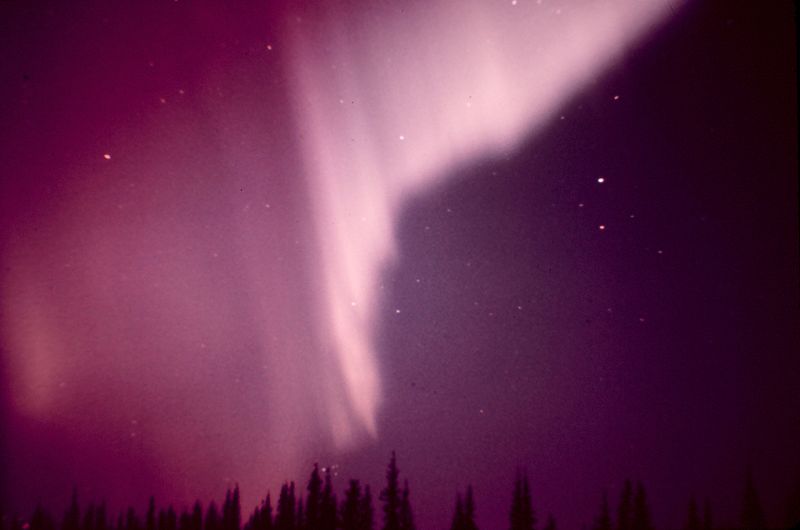
The Northern Lights have petered out during the second half of this decade, becoming rarer than at any other time in more than a century, the Finnish Meteorological Institute said Tuesday.
The Northern Lights, or aurora borealis, generally follow an 11-year “solar cycle”, in which the frequency of the phenomena rises to a maximum and then tapers off into a minimum and then repeats the cycle.
“The solar minimum was officially in 2008, but this minimum has been going on and on and on,” researcher Noora Partamies told AFP.
“Only in the past half a year have we seen more activity, but we don’t really know whether we’re coming out of this minimum,” she added.
The Northern Lights, a blaze of coloured patterns in the northern skies, are triggered by solar winds crashing into the earth and being drawn to the magnetic poles, wreaking havoc on electrons in the parts of the atmosphere known as the ionosphere and magnetosphere.
So a dimming of the Northern Lights is a signal that activity on the sun which causes solar winds, such as solar flares and sun sports, is also quieting down.
Full story at Physorg.com
Isn’t Svalbard too far north to see the aurora every night? The auroral oval is 65-70 degrees geomagnetic latitude, and Svalbard is about 75. I would not expect to see much at Svalbard without some significant magnetic activity to displace the auroral zone north and south. Around North Cape you will probably get it most clear nights however quiet the sun.
“I’m sure he knows that. My guess is that you don’t have a telescope.”
Perhaps he does know this. His post implied that he was looking for aurorae with a telescope. Does he really need you to answer for him? If he doesn’t appreciate my friendly advice, he can surely say so.
Your guess is wrong. What inspired it?
Chris Clark says September 29, 2010 at 12:38 pm
http://kho.unis.no/
… or more specifically http://kho.unis.no/Forecast.htm
Mike Haseler,
Here’s a link to an image of late July/early August auroral activity captured I believe from around the Clackmannanshire/Stirlingshire border area. I didn’t see much at the time either that looked definite – it was only later when I saw this image and others that reasonably suggest I did get a positive ID (well – I’m sticking to it!)
Not the best aurora pic ever but proof of what was there:
http://www.bbc.co.uk/news/uk-scotland-10891665 (image 11 of 16)
ES says:
September 29, 2010 at 11:39 am
Sounds like Global Tourism Disruption!
“The Exploration of the Earth’s Magnetosphere” An educational web site by David P. Stern and Mauricio Peredo, sponsored by NASA.
Electric Currents from Space
http://www-spof.gsfc.nasa.gov/Education/wcurrent.html
“When a bright aurora is seen in the auroral zone, a strong magnetic disturbance is usually also observed there…The Norwegian Kristian Birkeland, who carefully observed auroral disturbances around the turn of the century, concluded that those currents flowed parallel to the ground, along the auroral formation…Any electric current, however, must flow in a closed circuit, and since it seemed to be caused (like that of the aurora) by processes taking place in distant space, Birkeland proposed that it came down from space at one end of the arc and returned to space at the other end.”
Electro-Magnetic Induction
“Note: The original version of “Exploration of the Earth’s Magnetosphere” tried to simplify the presentation by leaving out any discussion of electric fields. Still, electric forces and electric fields play a great role in magnetospheric processes, and as details were added, it became increasingly hard to avoid them.”
“Electric and Magnetic Forces together
The electric force modifies the motion. Protons are accelerated in the +y direction, so they move a bit faster on the part of their circle closer to the top of the page (see drawing above!).”
http://www-spof.gsfc.nasa.gov/Education/wdrift.html
Science@NASA
Magnetic Portals Connect Earth to the Sun
http://science.nasa.gov/science-news/science-at-nasa/2008/30oct_ftes/
“During the time it takes you to read this article, something will happen high overhead that until recently many scientists didn’t believe in. A magnetic portal will open, linking Earth to the sun 93 million miles away. Tons of high-energy particles [electrons & ions] may flow through the opening before it closes again, around the time you reach the end of the page.”
“Indeed, today Sibeck is telling an international assembly of space physicists at the 2008 Plasma Workshop in Huntsville, Alabama, that FTEs are not just common, but possibly twice as common as anyone had ever imagined.”
Science@NASA
NASA Spacecraft Make New Discoveries about Northern Lights
http://science.nasa.gov/science-news/science-at-nasa/2007/11dec_themis/
NASA’s fleet of THEMIS spacecraft, launched less than 8 months ago, has made three important discoveries about spectacular eruptions of Northern Lights called “substorms” and the source of their power. The discoveries include giant magnetic ropes that connect Earth’s upper atmosphere to the Sun and explosions in the outskirts of Earth’s magnetic field.”
“Even more impressive was the substorm’s power. Angelopoulos estimates the total energy of the two-hour event at five hundred thousand billion (5 x 10¹⁴) Joules. That’s approximately equivalent to the energy of a magnitude 5.5 earthquake.”
Likely, the decrease in auroral storms (the northern lights) is connected to the decrease in the strength of the Sun’s magnetic field.
Electomagnetism is involved in the processes that determine the amount and intensity of auroral storms.
Dingoh – and you know what….someone WILL probably lodge a proposal to see how anthropogenic CO2 has diminished the aurora…..and they WILL get funds…..and they WILL construct a model to show how CO2 can impact on the aurora.
Question for Leif
==========
Livingston and Penn’s observations show magnetic fields associated with sunspots to be falling. Could this also apply to solar flares too? I believe that magnetic feilds are linked to flares which cause CME’s (Coronal Mass Ejections). These weaker magnetic fields would result in fewer, and less energetic charged particles being hurled by the sun at earth, and hence fewer and less energetic auroras.
The next leap of logic may be too much, but here goes. I realize that you’re skeptical of the Maunder-LittleIceAge linkage. Posing the following to you is probably the acid test for this idea. If you can’t debunk it in a few minutes, that’s a good sign…
How much energy do the charged particles from solar CME’s contribute to earth’s atmosphere? Maybe people have been looking in the wrong place when they theorize a drop in solar irradiance coinciding with a drop in sunspots. Maybe the cause of lower temperatures during low solar activity is not reduction of energy transfer via electromagnetic radiation from Sol, but rather a reduction of energy transfer via fewer, and less energetic, charged particles being hurled from Sol towards earth.
I’m suggesting that lower sunspot count and lower earth temperatures are co-dependant variables, both affected by lower magnetic fields on Sol. Comments?
James F. Evans says:
September 29, 2010 at 4:31 pm
Electomagnetism is involved in the processes that determine the amount and intensity of auroral storms.
It is generally accepted by all scientists that aurorae are the effects of electric currents generated by neutral plasma moving across a magnetic field.
Walter Dnes says:
September 29, 2010 at 9:24 pm
Livingston and Penn’s observations show magnetic fields associated with sunspots to be falling. Could this also apply to solar flares too? I believe that magnetic feilds are linked to flares which cause CME’s (Coronal Mass Ejections). These weaker magnetic fields would result in fewer, and less energetic charged particles being hurled by the sun at earth, and hence fewer and less energetic auroras.
Generally true, but not in detail. E.g. flares do not cause CMEs, rather both are consequences of disruption of magnetic field structures.
How much energy do the charged particles from solar CME’s contribute to earth’s atmosphere?
Extremely little. A typical number for the power input is 100 Gigawatt. Compare that to the 174,000,000 Gigawatt we get from ordinary sunlight, so about one millionth. Furthermore, sunlight is continuous, but auroral storms are rare, so total energy = power * time is minuscule.
Thanes says: If , as frequently asserted, the proven rising global temperature is caused by the sun [Dword sentence removed -ems], and solar activity has been freakishly low since falling from 2003 to the Minimum, not much changed since 2008, why is 2010 the hottest year recorded ever, in the hottest decade ever, with the least volume of Arctic ice ever?
OK, taking it in parts. Why has nothing happened in 7 years since 2003? Why the time lag from solar state to air temperature state. Because it has to work through a very massive system (assuming sun is causal, an assumption we’re watching for proof now as nature runs the grand experiment…) At the ICCC there was a presentation of a paper showing such a lag.
http://chiefio.wordpress.com/2010/05/17/iccc-day-two/
From my notes there (I’m sure someone has a better transcript…)
So if we take 1998 as a more or less peak, we have about 2016 as the date when we see a LOT of cold showing up. Until then, it’s going to be working off the “heat in the pipeline”…
2010 as the “hottest ever”: Don’t tell me you actually BELIEVE GIStemp? Sorry, but the reports of “hottest ever” are just wrong. We’ve not been deluged in new record highs and I’ve personally lived through much hotter. We’ve got cold and snow in surprising amounts all over the planet, north and south hemisphere, and the reality on the ground is calling the instrument record a lier. I’m going to believe the snows and not the pasteurized processed data food product.
Arctic ice is middle of the pack for the decade (see charts on the right margin) and greater than the ice was 8000 years ago. We’ve had much less arctic ice in the past and there are tree stumps to prove it.
Per predictions: Warmers like to remind us they don’t make predictions, they make projections… Me? I’m happy to predict record cold starting now and smoothly grading down to 2040, base on the work of two other folks:
http://chiefio.wordpress.com/2010/05/19/iccc-day-three/
Also from the day two link:
And yeah, I’m “predicting”.
Oh, and one of the ICCC postings had this nice chart of temperature cycles over time plotted with culture changes (wars, empires, collapses…).
Notice that the lows are regularly lower? The high points are irregularly lower too, but it’s a ‘connect the bottoms’ line that causes worry. (The good news is it’s likely to take hundred year time scales…) Though I must note that the width of the ‘warm peaks’ is getting narrower and the drop into cold faster. One can only hope the data are too sparse to support that granularity of interpretation…
http://chiefio.files.wordpress.com/2010/05/4-gtemps.gif
From Randy Mann and Cliff Harris.
Sorry I can’t let this crap science go.
Did not a study come out on the weakened outer atmosphere?
Is it the magnetic field that lights up meteors as they burn in the atmosphere?
Is it the magnetic field that makes the shuttle glow orange on re-entery?
Theory before this was how the sun reflects off the ice into the atmosphere.
So, the rotating atmospheres molecules battling any matter coming to this planet has no effect?
Just magnetics, hmmmm.
Joe Lalonde – name the study. Just bitching about it doesn’t help.
Regarding the changes in terminology, I think it is fair to point out changes were under the Bush administration with evidence below describing why. It’s on page 141 or 142 of the PDF. And also there is a letter by someone claiming to be an NOAA biologist describing what we all know was characteristic intrusion into science by the Bush admin.
Uh yes, I believe GISTemp. And if Christy had, he wouldn’t have had to correct the HADCRUT record so ignominiously after having flubbed his math for so long.
I’m glad the Heartland Institute had papers presented, but you’ll excuse me if I don’t waste portions of my life looking up proceedings of the ICCC. I’ll just make a guess and paraphrase- ” Here is the data Science won’t publish! Stupid peer review.”
http://www.ewg.org/files/LuntzResearch_environment.pdf
http://blog.oregonlive.com/myoregon/2010/02/letters_global_warming_bpa_amt.html
James F. Evans says:
September 29, 2010 at 4:31 pm
~~~~
Thanks, some of my favorites in that lot.
But this one is of great interest tooo…
“Sun Often “Tears Out A Wall” In Earth’s Solar Storm Shield”
..Based on these results, we expect more severe storms during the upcoming solar cycle,” said Vassilis Angelopoulos of the University of California, Los Angeles, Principal Investigator for NASA’s THEMIS mission (Time History of Events and Macroscale Interactions during Substorms). THEMIS was used to discover the size of the leak.
.. “Twenty times more solar particles cross the Earth’s leaky magnetic shield when the sun’s magnetic field is aligned with that of the Earth compared to when the two magnetic fields are oppositely directed,” said Marit Oieroset of the University of California, Berkeley, lead author of one of two papers on this research, published May 2008 in Geophysical Research Letters.
..While the THEMIS researchers discovered the size of the leak, they didn’t know its location(s). This was discovered by Wenhui Li of the University of New Hampshire, Durham, N.H., and his team. They used a computer simulation to discover where two holes frequently develop in Earth’s magnetic field, one at high latitude over the Northern hemisphere, and one at high latitude over the Southern hemisphere. The holes form over the daylit side of Earth, on the side of the magnetic shield facing the sun.
The simulation also showed how the leaks develop. As solar particles flow out from the sun, they carry solar magnetic fields past our planet. Li’s team realized that the solar magnetic field drapes against Earth’s field as it passes by. Even though the two fields point in the same direction at equatorial latitudes, they point in opposite directions at high latitudes, When compression forces the opposite fields together, they link up with each other in a process called magnetic reconnection. This process tears the two holes in Earth’s magnetic field and appends the section of the solar field between the two holes to Earth’s field, carrying the solar particles on this section into the magnetosphere, according to Li’s team. “We’ve found if the door is closed, the sun tears down a wall. The crack is huge – about four times wider than Earth and more then seven Earth diameters long,” said Li, whose paper will be published in an upcoming article of the Journal of Geophysical Research.
Solar particles by themselves don’t cause severe space weather, but they get energized when the solar magnetic field becomes oppositely-directed to Earth’s and reconnects in a different way
http://www.nasa.gov/mission_pages/themis/news/themis_leaky_shield.html
This dayside reconnection and double layers is getting interesting. So many energetic particle layers surrounding the planet, spinning around. jeeps
Is it 3-4 or 4-5 daily reconnection events ? Either way continuous particle injection sometimes more and sometimes less. Either way continuous particle injection..
The Heliospheric boundary eyeballs are on..
Leif..
If we have plasma bands on either side of Earth’s EEJ (equatorial electro-jet)..
Then when we look at larger structures like the perpendicular Interstellar magnetic field..
If Frisch is right we recently passed a “magnetic shell boundary” (last 50 years)..
Wouldn’t there have been a “denser plasma band” on either side of the shell boundary?
And if the shell boundary was 50 years and the plasma band that preceded it was..
Carla says:
September 30, 2010 at 6:12 am
..While the THEMIS researchers discovered the size of the leak, they didn’t know its location(s).
These press releases gets a little silly sometimes. All of this is [very old] old hat. See e.g. Figures 11 & 12 of http://www.leif.org/research/Geomagnetic-Response-to-Solar-Wind.pdf
And there are no Double Layers in or around that reconnection region.
Carla says:
September 30, 2010 at 6:27 am
If we have plasma bands on either side of Earth’s EEJ (equatorial electro-jet)..
The EEJ is formed by a very different process and the plasma band structure cannot be transferred to the Interstellar situation [not similar in any way]
Wouldn’t there have been a “denser plasma band” on either side of the shell boundary?
Whenever there is a boundary in space between different plasma regimes an electric current can be generated simply by gyration of charges around field lines. This leads often to a ‘plasma sheet’ of enhanced density at the boundary [not on either side].
Such structures in interstellar space have, of course, no effect whatsoever on the inner solar system where we live.
Ref – Leif Svalgaard says:
September 29, 2010 at 9:30 pm
James F. Evans says:
September 29, 2010 at 4:31 pm
“Electomagnetism is involved in the processes that determine the amount and intensity of auroral storms.”
‘”It is generally accepted by all scientists that aurorae are the effects of electric currents generated by neutral plasma moving across a magnetic field.'”
____________________
Leif
?”Solar Wind”?
The stronger and denser the Solar Wind, the bigger the aurorae (farther South it moves, the brighter it is)?
And so we have Thanes practicing selective listening skills…
Pascvaks says:
September 30, 2010 at 7:38 am
”It is generally accepted by all scientists that aurorae are the effects of electric currents generated by neutral plasma moving across a magnetic field.”
The stronger and denser the Solar Wind, the bigger the aurorae (farther South it moves, the brighter it is)?
Yes: The neutral plasma is the solar wind. The magnetic field is the Earth’s. So, yes, the solar wind does it. In addition to that, the solar wind has its own magnetic field, which if oriented opposite to the Earth’s field [where they meet] serves to further improve the energy input to the Earth system.
Thanks Carla, I appreciate your comment, and your mention of double layers.
Your link to Earth’s leaky magnetic field mentions “magnetic reconnection”:
“When compression forces the opposite fields together, they link up with each other in a process called magnetic reconnection.”
Of course, as the concept’s supporters are forced to admit, “magnetic reconnection” is not understood, even after decades of study. But if the electromagnetic framework is applied to this physical process, the veil of incomprehension drops away, and the physical dynamics are then revealed and becomes readily understood. And, the component physical forces, matter, and energy can be quantified both in spatial & temporal parameters — a three dimensional map of the physical process.
This electromagnetic framework requires observation & measurement of the magnetic field, electric field, charged particle location, direction, and velocity & location of charged particle acceleration (an increase in kinetic energy of the charged particles).
After this electromagnetic framework is applied and all the relevant observations & measurements are collected, it becomes apparent this physical process already has been quantified, both in the plasma laboratory and in situ (space) as an Electric Double Layer.
Per Wikipedia entry on Double Layers:
“In general, double layers (which may be curved rather than flat) separate regions of plasma with quite different characteristics. Double layers are found in a wide variety of plasmas, from discharge tubes to space plasmas to the Birkeland currents supplying the Earth’s aurora, and are especially common in current-carrying plasmas.”
http://en.wikipedia.org/wiki/Double_layer_(plasma)
So-called “magnetic reconnection”, as a concept developed in the pre-space age 1940’s (1946), only considered the one physical force then observable from Earth’s surface: Magnetic fields.
That magnetic “only” framework has been superceded by in situ observation & measurement which takes into account all the physical parameters now known to be involved as outlined above: An electromagnetic framework of observation & measurement.
James F. Evans says:
September 30, 2010 at 8:32 am
So-called “magnetic reconnection”, as a concept developed in the pre-space age 1940′s (1946), only considered the one physical force then observable from Earth’s surface: Magnetic fields.
This is incorrect. All modern descriptions of magnetic reconnection deal with the total set of forces, magnetic, electric, and kinetic.
framework has been superceded by in situ observation & measurement which takes into account all the physical parameters now known to be involved as outlined above
Hence, this is also incorrect. The latest in situ observations of all relevant parameters fully confirm our theoretical understanding of the universal process that is magnetic reconnection. Double layers have nothing to do with any of this, although they often form as by-products of the process, simply because plasma regimes with different properties result.