The sun has seen a resurgence of activity in December, with a number of cycle 24 sunspots being seen. The latest is group 1039 seen below:

2009 is ending with a flurry of sunspots. Indeed, if sunspot 1039 holds together just one more day (prediction: it will), the month of December will accumulate a total of 22 spotted days and the final tally for the year will look like this: From Spaceweather.com
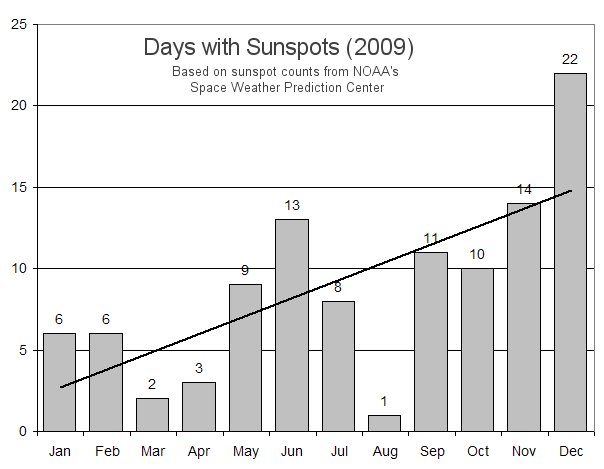
The dark line is a linear least-squares fit to the data. If the trend continues exactly as shown (prediction: it won’t), sunspots will become a non-stop daily occurance no later than February 2011. Blank suns would cease and solar minimum would be over.
If the past two years have taught us anything, however, it is that the sun can be tricky and unpredictable.
I can see a hockey stick in this chart.
As the windchill temp is -10 today, I can say the sunspot activity hasn’t had much effect yet. But I look forward to a toasty January if the trend keeps up.
Although this might be tracking the lower end of Dr. Hathaway’s
prediction
The solar flux index is 75 and has been dropping. I personally don’t expect this group of spots to last much longer. I wonder whether Livinngston and Penn have analyzed this and recent spots to determine whether they continue to fit their model.
Politics be d—ed. At this point I’m sick of the cold, and just want some heat. Hopefully these spots will do the trick.
Looks like the original prediction of “high activity” for cycle 24 might turn out to be correct after all – just a couple of years late.
According to this research there seems to be a link between Angular momentum of the planets and Solar cycles… Thus the climate.
Extract from Page 45 of this document: http://semi.gurroa.cz/Astro/Orbital_Resonance_and_Solar_Cycles.pdf
Angular momentum sum of 9 planets and the Sun
Scalar Sum
The “absolute value” chart (fig. 80) includes 0. It shows, that the sum seems very constant, and the “wave”,
seen on other charts, is only a “wave at the top of an ocean”, on the order of 8.11*10-7, close to 1 in million…
The high peaks are during times, when the Sun approaches the solar-system barycenter. At these times, the
Sun moves in the contrary (retrograde or highly inclined) direction for a short while, and has got a negative
angular momentum (with respect to the invariant plane), so it should actually subtract in a vector sum of the
system, but here it is added in the scalar sum (there is no negative scalar (absolute value or vector length)
angular momentum)…
The first derivation of angular momentum sum (fig. 78) only little matches the sun-spot cycle, but the highpeak
arround 1990 could be correlated with a drop of solar-flare activity at the middle of preceeding Sunspot
cycle 22, both peaks arround 1800 and 1990 having a damping effect on the Solar activity, possibly due to
effects of exchange between Sun orbital angular momentum and spin angular momentum.
The “wave” of approximate period of 854 years, which could also probably be anti-correlated with Sun spin
rate, seems to match the climatologic events of Medieval optimum and Global warming, and also the Little
Ice age of Maunder minimum, and similar periods in earlier ages (fig. 81)…
If this is right, now the Solar activity could drop a little, but will approach a larger maximum arround year
2050, not disturbed by the peak anomally, and then drop to a next little-ice-age arround 2400 AD.
The time-lag between the spin rate change and activity change is still uncertain…
I really enjoyed this…!
Tony Blair and Cherie are walking in the garden of No.10. Suddenly he rips off her knickers and throws them to the ground. ‘Tony,you randy devil! What about the security cameras?’ ‘No,dear’ replies Tony. ‘There’s a damp patch on the grass and I don’t want to muddy my shoes.’
Are you sure somebody is not trying to “hide a decline”? You never can tell these days!
Not that OT, UK – cold wet & miserable in the south-west, curiously, as it frequently does occur, above the line from Bristol & the River Severn, & London & the Thames Estuary, it’s colder still with snow & ice. I say curiously because it was the line I was lead to believe where the ice limit occurred in the last ice-age(s). Then again that was over forty years ago now in History classes, I expect it has all changed these days.
HNY everyone!
What? No title? I had to click on the Read More link! — John M Reynolds
>Are you sure somebody is not trying to “hide a decline”? You never can tell these days!
Well, to be fair, lately NOAA has been counting even very small spots that would have never been counted before. This month’s sunspot count especially is a bit inflated.
Anyway, the sunspot count might be subject to interpretation, but sun geomagnetic indices, which are instrumentally measured, are still very low.
Isn’t this the well predicted maxima the sun is now entering until about 2015? But this maxima I understand will be a weak one before heading back to a deeper minima.
Hopefully they will help lift the ice from my riverside walk that was perilous earlier! I’m unsure whether I want the sun to ramp up or not – if it stayed quiet we’d be seeing an end to the AGW tomfoolery within the decade but would be a bad thing for human society.
This is depressing. These sunspots are going to warm the earth giving fuel to the warmers.
Would someone be kind and explain to me what the implication of this is on earth’s climate? If someone is willing to do this, you don’t need to hold back on the physics. I’m sorry but I’ve read all the posts on sunspots for several months and still haven’t come across what this might all be about. THanks!!!!
According to Leif Svalgaards L&P-plot it seems to be on track: http://www.leif.org/research/Livingston%20and%20Penn.png
Baa Humbug, Exactly. I’d love to see the latest sunspot prediction curve for the cycle 24. A few years ago, the prognosticators were claiming that the delay in sunspots would only result in a higher intensity of spots once they began. It think, (amatuer solar astronomer here) that we are seeing an overall depressed cycle 24. Less area under the curve, slower to start, sooner to finish, less in height. Bob.
Look, the Sun has no impact on Earth’s climate, that is fact. Climate change is due to CO2, and we are really pushing a tax on that. The next tax, I mean cause, is methane. And we are pushing a tax on that, to save the planet.
I’m probably way off base here, but, isn’t there a lag time between solar sunspots and world-wide temperature? Sort of like when the shortest day is Dec. 21, but it continues to get colder until Feb. 18 when the pace of the earth cooling matches the solar warming effects. What I’m saying is that we could be in for more cooling until 2012-2014 before a warmin uptrend begins to assert itself.
Just asking.
Solar winds remain very low, cosmic rays hitting earth are unchanged.
From Dr Leif Svalgaard’s Research page:
http://www.leif.org/research/TSI-SORCE-2008-now.png
Looks like Cycle 24 is ramping up for sure.
The August count is invalid, there were no spots in August. There were also no spots on the 24th December, however an 11 was assigned to an invisible region which had no spots or official number.
“Vincent (06:55:21) :
Looks like the original prediction of “high activity” for cycle 24 might turn out to be correct after all – just a couple of years late.”
Not necessarily. Notice SC 5 (the first cycle of the Dalton Minimum), had a minimum in May 1798. Only 6 months later, in November 1798 we see November’s sunspot number at 12.
March 1799 comes up with a value of 20, and this is before satellite and large telescope technology were available to count pores!
We only see a rise to these values in SC 24 one year after minimum (Dec 2008).
http://www.robertb.darkhorizons.org/cycl3x.GIF
A Dalton type minimum is still very possible. Notice solar wind speed is currently at +-275km/sec, and geomagnetic indices are low. 1039 has failed to generate even a large B flare since at least 28th December.
Sunspot minimum may be over, but this does not mean that solar activity is no longer weak.
I’d like the increased solar activity to resolve the query in my mind that perhaps a more active sun cools the stratosphere by increasing the rate of energy to space whereas a quiet sun warms the stratosphere by decreasing the rate of energy loss to space.
Either way there would be a knock on effect involving the rate of energy transfer from the troposphere.
Imagine a reduction of energy release from the oceans to the air during a negative PDO phase being aggravated by a faster loss of energy from the stratosphere caused by a more active sun.
Now if we get a strong La Nina in a year or so plus a more active sun as we come out of the solar minimum then that should resolve the issue one way or another. Either the current trend towards cooling will accelerate or it won’t.
Interesting times.
I would like to see the Northern Hemisphere really freeze its butt off for the entire winter so the pseudo-science could be proved wrong regardless of the consequences. This isn’t being political, it is being selfish.