Note this a mirrored posting of Steve McIntyre’s Climate Audit post. The Climate Audit Server is getting heavy traffic and is slow to load – here is the article exactly as he wrote it yesterday. -Anthony
Yamal: A “Divergence” Problem
The second image below is, in my opinion, one of the most disquieting images ever presented at Climate Audit.
Two posts ago, I observed that the number of cores used in the most recent portion of the Yamal archive at CRU was implausibly low. There were only 10 cores in 1990 versus 65 cores in 1990 in the Polar Urals archive and 110 cores in the Avam-Taymir archive. These cores were picked from a larger population – measurements from the larger population remain unavailable.
One post ago, I observed that Briffa had supplemented the Taymir data set (which had a pronounced 20th century divergence problem) not just with the Sidorova et al 2007 data from Avam referenced in Briffa et al 2008, but with a Schweingruber data set from Balschaya Kamenka (russ124w), also located over 400 km from Taymir.
Given this precedent, I examined the ITRDB data set for potential measurement data from Yamal that could be used to supplement the obviously deficient recent portion of the CRU archive (along the lines of Brifffa’s supplementing the Taymir data set.) Hantemirov and Shiyatov 2002 describe the Yamal location as follows:
The systematic collection of subfossil wood samples was begun, in 1982, in the basins of the Khadytayakha, Yadayakhodyyakha and Tanlovayakha rivers in southern Yamal in the region located between 67°00 and 67°50 N and 68°30 and 71°00 E (Figure 1). These rivers flow from the north to the south; hence, no driftwood can be brought from the adjacent southern territories At the present time, the upper reaches of these rivers are devoid of trees; larch and spruce-birch-larch thin forests are located mainly in valley bottoms in the middle and lower reaches.
Sure enough, there was a Schweingruber series that fell squarely within the Yamal area – indeed on the first named Khadyta River – russ035w located at 67 12N 69 50Eurl . This data set had 34 cores, nearly 3 times more than the 12 cores selected into the CRU archive. Regardless of the principles for the selection of the 12 CRU cores, one would certainly hope to obtain a similar-looking RCS chronology using the Schweingruber population for living trees in lieu of the selection by CRU (or whoever).
As a sensitivity test, I constructed a variation on the CRU data set, removing the 12 selected cores and replacing them with the 34 cores from the Schweingruber Yamal sample. As shown below, this resulted in a substantial expansion of the data set in the 19th and 20th centuries and a modest decline in the 18th century. (Hantemirov and Shiyatov 2002 had reported a selection of long cores of 200-400 years; while the CRU archive does not appear to be the precisely the same as the unavailable Hantemirov and Shiyatov 2002 archive, it does appear to be related. This pattern of change indicates that the age of the CRU cores is systematically higher than the age of the Schweingruber cores.)

Figure 1. Comparison of core count. Black – variation with Schweingruber instead of CRU; red- archived version with 12 picked cores.
The next graphic compares the RCS chronologies from the two slightly different data sets: red – the RCS chronology calculated from the CRU archive (with the 12 picked cores); black – the RCS chronology calculated using the Schweingruber Yamal sample of living trees instead of the 12 picked trees used in the CRU archive. The difference is breathtaking.

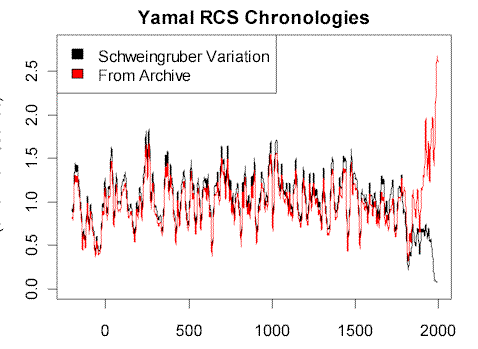
Figure 2. A comparison of Yamal RCS chronologies. red – as archived with 12 picked cores; black – including Schweingruber’s Khadyta River, Yamal (russ035w) archive and excluding 12 picked cores. Both smoothed with 21-year gaussian smooth. y-axis is in dimensionless chronology units centered on 1 (as are subsequent graphs (but represent age-adjusted ring width).
Finally, here is another graphic showing the same two RCS chronologies, but adding in an RCS chronology on the merged data set obtained by appending the Schweingruber population to the CRU archive – this time retaining the 12 cores. Unsurprisingly this is in between the other two versions, but most importantly it has no HS.

Figure 3. Also showing merged version up to 1990. (After 1990, there is only the few CRU cores and it tracks the CRU version.)
I hardly know where to begin in terms of commentary on this difference.
The Yamal chronology has always been an exception to the large-scale “Divergence Problem” that characterizes northern forests. However, using the Schweingruber population instead of the 12 picked cores, this chronology also has a “divergence problem” – not just between ring widths and temperature, but between the two versions.
Perhaps there’s some reason why Schweingruber’s Khadyta River, Yamal larch sample should not be included with the Yamal subfossil data. But given the use of a similar Schweingruber data set in combination with the Taymir data (in a case where it’s much further away), it’s very hard to think up a valid reason for excluding Khadyta River, while including the Taymir supplement.
Perhaps the difference between the two versions is related to different aging patterns in the Schweingruber population as compared to the CRU population. The CRU population consists, on average, of older trees than the Schweingruber population. It is highly possible and even probable that the CRU selection is derived from a prior selection of old trees described in Hantemirov and Shiyatov 2002 as follows:
In one approach to constructing a mean chronology, 224 individual series of subfossil larches were selected. These were the longest and most sensitive series, where sensitivity is measured by the magnitude of interannual variability. These data were supplemented by the addition of 17 ring-width series, from 200–400 year old living larches.
The subfossil collection does not have the same bias towards older trees. Perhaps the biased selection of older trees an unintentional bias, when combined with the RCS method. This bias would not have similarly affected the “corridor method” used by Hantemirov and Shiyatov themselves, since this method which did not preserve centennial-scale variability and Hantemirov and Shiyatov would not have been concerned about potential bias introduced by how their cores were selected on a RCS chronology method that they themselves were not using.
Briffa’s own caveats on RCS methodology warn against inhomogeneities, but, notwithstanding these warnings, his initial use of this subset in Briffa 2000 may well have been done without fully thinking through the very limited size and potential unrepresentativeness of the 12 cores. Briffa 2000 presented this chronology in passing and it was never properly published in any journal article. However, as CA readers know, the resulting Yamal chronology with its enormous HS blade was like crack cocaine for paleoclimatologists and got used in virtually every subsequent study, including, most recently, Kaufman et al 2009.
As CA readers also know, until recently, CRU staunchly refused to provide the measurement data used in Briffa’s Yamal reconstruction. Science(mag) acquiesced in this refusal in connection with Osborn and Briffa 2006. While the Yamal chronology was used in a Science article, it originated with Briffa 2000 and Science(mag) took the position that the previous journal (which had a different data policy) had jurisdiction. Briffa used the chronology Briffa et al (Phil Trans B, 2008) and the Phil Trans editors finally seized the nettle, requiring Briffa to archive the data. As noted before, Briffa asked for an extension and, when I checked earlier this year, the Yamal measurement data remained unarchived. A few days ago, I noticed that the Yamal data was finally placed online. With the information finally available, this analysis has only taken a few days.
If the non-robustness observed here prove out (and I’ve provided a generating script), this will have an important impact on many multiproxy studies that have relied on this study.
This is a remarkable post. McIntyre has done it again, although I’m withholding judgment until I see if there are any other ways this can be looked at. I’m very desirous of reading the commentary on ClimateAudit, but it looks like there is a very long waiting line. Looking forward to reading it tonight when it slows down a bit.
So Team cherry-picked few tree ring data from many available for 20th century in order to create a desired hockey stick. Has anything from the Team even withstood against unbiased and full information?
[snip – lets not go there yet with the F word please – A]
Is this the tipping point we all been waiting for?
The comments at CA are very illuminating. The whole saga reveals the inadequacies of peer review (as described by the Wegman Panel), particularly when the peer reviewers form a clique of colleagues and co-authors. Steve McIntyre has clearly demonstrated the importance of replication, which means the release of all data and methods, something that has been resisted by the climate community for far too long. Science as a whole may be damaged by these revelations – how can you trust government-funded scientists in the future?
If Anthony doesn’t mind, I’ll drop a link to my slightly stronger worded post on this here.
http://noconsensus.wordpress.com/2009/09/28/trash-bin/
C.S. Peirce & The Scientific Method (Excerpted from ETC, Summer 2002)
In his now famous 1887 article, “The Fixation of Belief,” Peirce examines four ways that people form beliefs. For Peirce, “fixation” means to “fix on” opinions or beliefs, and “belief” means “that which a man is prepared to act” upon.
1. Tenacity. This first method of fixing belief describes stubborn clinging to opinion. Facts and experiences not in accord with beliefs are discarded in favor of those that are. Hayakawa called tenacity “wishful thinking,” and Mark Twain satirically referred to them as “corn pone” opinions. Tenacious opinion excludes independent verification or falsification.
2. Authority. This method differs from tenacity because it commands assent through institutional means. The institutions may be theological, political, or mixtures of both as can be found in the “will of the state,” a ruling aristocracy, a guild or labor union, or other professional body. These institutions conduct systematic indoctrination and attempt to keep the intellectually sheltered population in ignorance of any source of doubt. Dissenters and questioners historically receive harsh punishment ranging from tarring and feathering through exclusion and inquisition to genocide.
3. A Priori. Peirce’s third method of fixing belief relies on reasoning from the merely plausible and reasonable to often complex and formal propositions. Because it excludes experience, the supposed proposition usually employs abstruse expression and arcane language to pose under a “scholastic tradition” intended to overwhelm common opinion and experience. Bertrand Russell observed “The more profound the philosopher, the more intricate and subtle his fallacies” in order to coerce intellectual acquiescence of the proposition.
4. Scientific Investigation. The final method is based on testing reason against the observable. It imposes objective criteria for assessing belief, and by welcoming exposure to refutation is self-correcting through experience. Science takes time, a factor belittled by those authoritarians who might wish to impose their beliefs upon others. The mark of a scientist can be seen in the proposition most readily refuted if false. The mark of a nonscientist can be seen in the proposition bolstered not by the observable but by subjective opinion, by appeal to authority, and by appeals to the merely plausible or reasonable. The nonscientist also can be seen attacking the source of an assertion rather than the assertion itself, or by placing opinion above critical scrutiny. The scientifically warranted assertion must be open to examination, to the risk of disproof, by the most rigorous possible critics. Also, the absence of criticism is not proof of valid opinion.
Peirce wrote: “… the scientific spirit requires one be at all times ready to dump his cartload of beliefs the moment experience is against him.” To do otherwise is to live with the legions of the insane, and of the humbug. For these reasons scientific method is the best means for advancing the prospect of agreement among humans.
Nice done to mirror Steve Anthony. Let’s hope the heavy traffic is based on a genuine interest of Steve’s fantastc work on this.
Thanks!
Trust but verify.
Nothing seems to be working quite right today. The DMI COI arctic temperature graph is back up and seems to be displaying the temperature fromn several days ago but has it labeled as “Sunday, October 14, 2007”. Steve’s bombshell seems to have the world of climate science rattled.
Our first lesson for the day is how to make a hockey stick climate graph, our second lesson will be how to make it look scarier.
No noticable hockey sticking in temps. here in Kansas, it got up to 90 yesterday but the rest of the month before and the forecast has been/is a bit cooler and today’s record high according to weather underground in 103 (in 1953 or around there). If we saw a true hockey stick we would be seeing 100’s into early fall or so I would guess.
Good idea to duplicate the post. CA is hammered right now.
But how can you verify when the conclusions they reach are forever out of reach of the common man. Look at how long it took Steve to get this information. The fact that he did is a miracle in itself. It seems that even Scientists are closing ranks, protecting each other instead of simply allowing information to flow freely. Now that is not to say I think a privately funded scientist should have to divulge anything, however any man who is trying to sustain research by the public OR influence public opinion then their research should become public domain. Except in cases of National Defense I do not see how this could be a major detriment.
Another good reason for this article is that the original posting on this site with a “Quote of the week” title made the topic seem to be less important than it is. This is much more than someone’s quotation.
Steve McIntyre is the man! I bet he gives the likes of Gavin and James nightmares, LOL
As Steve McIntyre sucks up almost all the oxygen in the room, I need to give a shout out to Rodger Pielke Sr. and company. They have another paper published in Geophysical Research:
“The IPCC Claim Regarding A Linear Relationship Between The Global Average Surface Temperarture Trends And Global Average Radiative Forcing Is Quantitatively Inaccurate”
If Anthony will allow, I have a short summary about Independent Verification and peer review here:
http://danhughes.auditblogs.com/2009/09/28/independent-verification-and-peer-review/
plus information about a new book by Pat Roache on Verification and Validation of scientific and engineering software, along with announcements about price cuts on two of his other books, here:
http://danhughes.auditblogs.com/2009/09/24/new-vv-book-by-pat-roache/
Robert E. Phelan (12:03:09) : Rattled — “Sunday, October 14, 2007″
Now that’s funny.
So to stay off of CA for the time being, go back one post here to Quote of the Week if you have not seen McKitrick’s summary. When possible go to CA and read all the comments. I stayed up to Midnight reading the comments at both WUWT and CA – good comments both places.
Fred Harwood (11:23:43) :
There is an excellent book about aviation medicine: ‘The Naked Pilot – The Human Factor in Aircraft Accidents’. There are strong parallels with the C.S Peirce article with the exception that aviation has made great strides in dealing with human shortcomings such as conformity, fixating, and authority and has done so simply because they are lethal.
Steve McIntyre deserves serious commendation for his persistence, integrity, courage, and scientific rigour. All done on his own time, with no payment from anybody except contributions to his tip jar.
If you feel that his work is important and should be encouraged, drop over to CA (when you can) and make a contribution to his tip jar.
[Reply: There’s a tip jar here, too. It’s not too hard to find. ~dbs, mod.]
One does need to be careful (and I think Steve has been) about calling “smoking gun” until a little time has passed and other voices are heard from. . . as Roy Spencer was reminded recently.
I am speechless at what an outstanding job Steve/et.al has done here. Anthony, at what point does this become Scientific (f-word)? I think we’re there….
REPLY: Let’s see what rebuttals are mounted. – A
Hah,
It wasn’t long before someone tried to reference this at RC, only to have the link censored by The Gavin…..
REPLY: suggestion- keep screencaps of the comment page while it is awaiting moderation. -A
Good idea to mirror CA on this one Anthony, the net is buzzing. I never thought I’d be glad to hear the CA server is having difficulties, but it seems the word is out, and people want the info from the source.
I was happy to see Steve hadn’t deleted my cheeky one liner from last night when I checked earlier.
Bye Bye sunspots. No sunspots for Copenhagen till they learn a lesson they will never forget.