From NOT A LOT OF PEOPLE KNOW THIS
By Paul Homewood
Dr Peter Ridd is back with the latest coral data:

Curiously the BBC have not got around to reporting this good news yet!
From NOT A LOT OF PEOPLE KNOW THIS
By Paul Homewood
Dr Peter Ridd is back with the latest coral data:
Curiously the BBC have not got around to reporting this good news yet!
I can’t get past the fact that that corals live in the tropics where the water is warm and the climate cult tells me that corals bleach (die) due to warm water.
Google image search on World of map of coral distribution
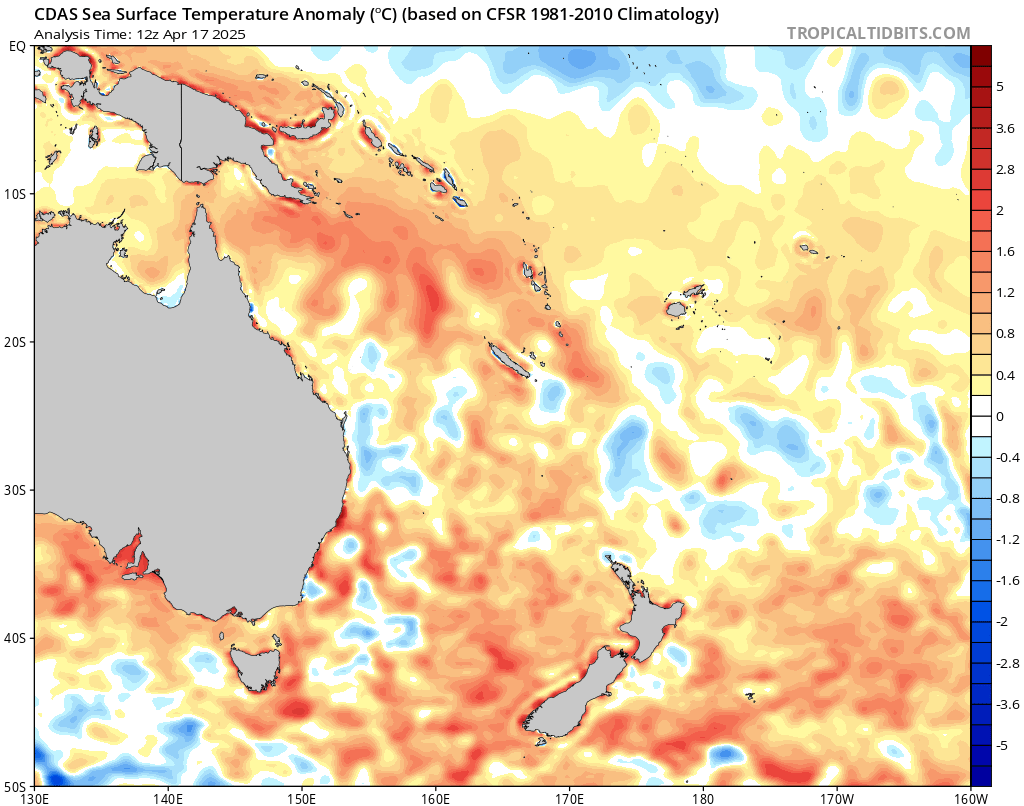
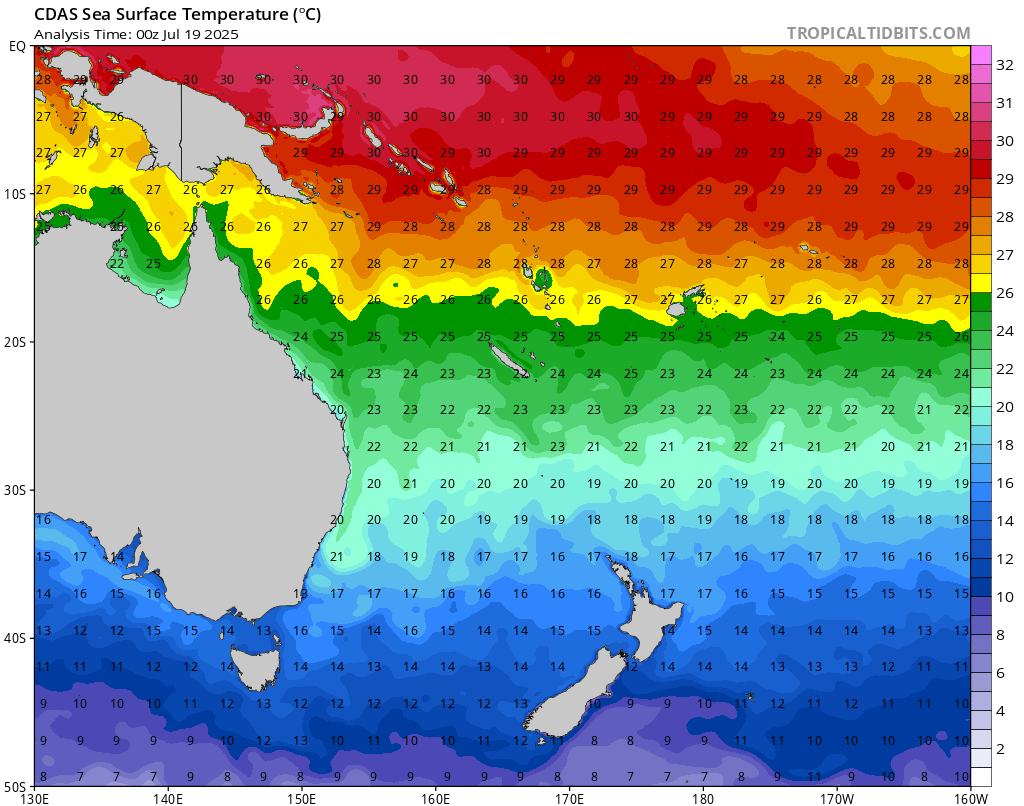
Shallow corals have a temperature survivability range of 23°C to 29°C
Much above 29C and they are prone to bleaching. Summer sea temperatures 0-10m are at the upper end of that range in the Great Barrier Reef.
With ocean temperatures increasing in the Great Barrier Reef, it’s not hard to see why its corals would be in danger.
Funny that Red Sea corals thrive at temperatures up to 34 C.
Corals seem to be as resilient as climate catastrophists ability to insist that they are not
Corals have been around for half a billion years and during 90% of that time global temperatures have been 5-10 degrees warmer.
It is highly unlikely that an apocalyptic increase of 0.5% degrees will do any harm as we would still be at least 4.5 degrees below normal.
On top of that I’d guess that Oceans warm slower therefore the warming Corals experience may be less than half of the 0.5 degrees warming we experience..
Either way – you are not around for 500 mio years if a tiny fluctuation of 0.2 – 0.5 degrees has any relevant impact on you.
The GBR has been at or near its current location, on and off, for millions of years. “On and off” because it has completely died a dozen or more times and then grown again. How do I know that? During glacial periods of the current ice age, that location is dry land. Sea level is the major factor, and while coral reefs can often keep pace with a rising sea level, they cannot handle a falling sea level An El Nino warms the water, but more importantly for the GBR it lowers sea level there.
Where I lived in Oxofordshire, most of the region must have been covered in Corals as you pick up fossilised corals and mussels from practically every drainage ditch in the area!
From the “Show All History” option of my browser, dating from just over a couple of years ago (July 2024).
Note that the “deltas” numbers use the right-hand axis, and were calculated from all “summer max to winter min” and “winter min to summer max” values, i.e. how much the monthly average for each gridcell changed every six months over the entire HadISST dataset (1870-2023).
The GBR corals can cope with monthly average SSTs that change by a minimum of 3 — and a maximum of 9 — degrees Celsius every six months, and have done so for the last few (tens / hundreds of ?) millennia. Daily data would show even larger deltas.
.
For the absolute numbers the GBR corals have evolved to thrive in temperatures that ranged from 20 to 31°C over the last 150 years or so, and yet stubbornly persist in covering a latitude range of 11 to 24.5 degrees (south of the equator).
The “Max max” numbers for all gridcells are all over 29°C, and yet the GBR failed to “die off” since 1870 as a result.
Reports of the “death” of wide swathes of the GBR have been greatly exaggerated.
The GBR is really a cooler temperature reef, the triangle from Fiji to Indonesia to Philippines is way higher and considered the greatest coral area on earth.
Bleaching main occurs when there is a temporary drop in sea level due to something like an El Nino event.
We can see that in the bleaching event that coincided with a sea level drop at the 2015/16 El Nino
You can ask Google AI:
Is there a limit to how high ocean surface water temperature can be?
Yes, there is a physical limit to how high open ocean surface temperatures can rise, which scientists generally place around 30°C to 32°C (86°F to 90°F) when averaged over large regional areas.This cap is governed by Earth’s “atmospheric thermostat,” a self-regulating feedback loop between the ocean and the atmosphere. While shallow, enclosed coastal waters can spike much higher—such as a localized, record-breaking 38.3°C (101°F) read in Manatee Bay, Florida—the open ocean cannot perpetually heat up.
What is the surface water tempreature of the GreatBarrier Reef?
The surface water temperature of the Great Barrier Reef typically ranges between 21°C to 31°C (70°F to 88°F), depending heavily on the season and location along its 2,300-kilometer length.
It’s not hard to see that we are being fed a load of misinformation by folks like you.
He’s a trans realist.
He identifies as expert gender – and gender expert.
A deep dive into that Manatee Bay, Florida temperature anomaly found that it happened at noon and low tide in a very shallow inlet where the temperature sensor was in proximity to if not embedded in the black muck bottom.
6 foot water depth versus 6 foot sensor arm.
The air temperature as reported was much cooler.
The water temperature did not remain hot.
As the sun moved and the tide flowed back in, the temperature sensor reported more reasonable readings that aligned better with the deeper water readings.
Data reviewed was published by the local offices at Manatee Bay.
Thanks for looking that tidbit up. Tells me Google AI is biased.
Wasn’t that also the one downstream from water entering the bay from a river or stream that the cooling water from a Nuclear power plant was being released into?
Sorry, no. The closest nuclear plants are Turkey Point (on the Atlantic side) and Crystal River, which is 150 miles away and has been shut down for over 13 years.
Shallow corals….. how about the deeper ones? and anyway. If the oceans are warming, then that must be helping corals to thrive. Look at that graph.
Simplistic reasoning that doesn’t understand how things work in the real world define you and left wing reasoning. Shallow corals bleach the most when abnormally low tides coincide with hot noonday summer peaks. Symbionts rapidly recolonize as the GBR data shows.
“it’s not hard to see why its corals would be in danger.”
In danger of what?
Bleaching? Dying off?
Either way, this is an entirely natural cycle that has been going on for eons, where new coral grows on dead coral, and not likely to stop any time soon.
How do you think the GBR got to the size it currently is, and keeps growing?
Uh, is the bleaching permanent?
Do note the life cycle of coral is to live and eventually die – coral reefs are dead coral.
Check sloshing of the southern oceans which varies water level – related to ENSO.
With some impact on coral from fish that eat it and a virus that pops up.
Hello facts?
Bleaching has nothing to do with coral health.
It has to do with the symbionts leaving for a while.
Please quantify your term “would be in danger”.
Is that along the same lines as:
— The Earth is always in danger of another “dinosaur killer” asteroid impact?
— The Earth is in danger of the “end times” as prophesied in the Bible?
— I am in danger of dying in a car crash?
I am in danger of killing more brain cells reading his rubbish.
ATOMIC BOMBS couldn’t wipe out coral. Go visit Bikini Atoll and see for yourself.
Coral core sample from the GBR show that bleaching has occurred for a long long time.
It is part of the life of coral reefs.
Search Zooxanthellae from your favourite browser
They are the variants, they are the environmentally sensitive organisms and there are a vast number of them.
All corals, just like all life, have survivable temperature ranges and the coral polyps have a very wide range of tolerable temperatures.
Bleaching is NOT coral death. It is removal of one sort of symbiont and replacing it with another more adapted to the changed conditions.
Corals are NOT in danger and currently they are very abundant and with the very mild warming, are getting more abundant by the year.
Dr. Ridd does such a great job explaining all this!
Good for him to do these videos.
GBR scare campaigns have been being run at us since the 1970s and the first hysterics about the Crown of Thorns starfish.
Did the Japanese nuclear disaster and Pacific ocean radiation pollution really help the Crown of Thornes Starfish, sea urchins and heat really kill off the great Kelp forests?
Google says “The Kelp Forest Collapse Between 2013 and 2017, a devastating “perfect storm” of environmental factors wiped out more than 90% to 95% of California’s historic kelp canopy. This ecological disaster was triggered by: [1, 2]
“
Funny recent story: Australian Aborigines on the coast of part of NSW have restarted eating the crown of thorns starfish in their area and the entire marine ecosystem is recovering in that area.
So maybe allowing the population to resume their traditional diet on the east coast will solve at least one coral reef problem, plagues of crown of thorn starfish.
The “system” touting its memes so that the people within the system can keep receiving salaries is a standard feature in politics, religion, CC, you-name-it…
Salesman’s motto: “Always be closing”
Climate Liar’s motto: “Always be lying”.
Salesmen are also always lying.
Some amateurs maybe.
But you don’t make it very far in professional selling if your pitch is bullshit.
“Let’s do Life Magazine.” – Richard Dreyfus, Tin Men
Completely disagree. A sales pitch/marketing is all about making people believe things that aren’t true.
Not if they need or want repeat customers.
Just like claims made about a product on TV.
If it works as advertised, I might buy it again if I need it again.
If it doesn’t work as advertised, I’ll never buy it again.
They don’t really care about repeat customers, there will always be more.
In the 1950s nuclear tests at Bikini Atoll wiped the reefs clean – ‘total destruction’ where, for instance, Castle Bravo created a 2km wide and 75m deep crater. Yet, today, the same sites are covered in thriving coral.
If reefs can recover from atomic bombs they can certainly recover from bleaching and temperature swings!
Yes, corals are true survivors. Their existence on earth exceeds that of humans by more than a half billion years.
They are so amazing, that the State of Michigan stone is a fossilized coral that lived over 350 million years ago. I saw what I think is the same coral in Australia, though fossilized in a different form, carbonate vs. silicate.
Rocks don’t lie. Climate alarmists do.
And TFN always along with the infamous Nick Stokes.
May I shamelessly steal this line?
“Rocks don’t lie.”
Well they do, but not like you meant. Rocks that lie are called Levorite. As in, leave ‘er right there.
“State of Michigan stone”
Petosky stones. I still have about 10 pounds of them for lapidary.
Yes, I maintain that corals are the weeds of the sea-bottom scapes.
Some are very colorful and pretty, most are brown / beige and unremarkable.
They grow just about anywhere, and like garden & lawn weeds, you can’t get rid of the buggers.
Even by atom-bombing them.
They just keep growing back 🙂
Technically, hydrogen bombs, I believe. An order of magnitude-or more-greater. And yes, the corals suvived.
Well, they rejuvenated all by themselves after being totally obliterated.
So yes, that is a case of survival.
Hundreds of millions of our own dollars have been spent on this lie alone by the globalist climate mafia. How much of that money was pocketed by the green industries which then wound up one after the other during these past 30 years? Can I have my money back?
Most of it, and no, you can’t have your money back.
Again this is all down to “We suddenly started scrutinizing something and became alarmed at what has always happened as if it just started happening”.
😎
We’re fortunate they discovered the Van Allen Radiation Belt before the likes of Al Gore could blame it on Freon or (only Man’s) CO2!
Hey! Don’t give them any ideas!
Opps! Danger approaches!
Over those million years, the sea levels, which determine the depth of the growing coral, and to some extent the solar radiation available to it, have risen and fallen. There has been over a 100 meters of increasing depth over the continental shelf since the last ice age,
This gives plenty of space for old coral, and new coral to stay below average sea level. But not forever. Svensmark’s enormous work suggests that future coral, for a while, is likely to be exposed by bouts of new ice formation. Who is the villain then?
The ice age hasn’t ended.
Very good point.
He meant since the last glacial period. The Younger Dryas 12,500 years ago was relatively short-lived, “only” about a thousand years, (one could call it a mini-glacial), so after it ended would be when the 100-meter SLR would have begun.
I figured that’s what he meant. But I think it’s important to be accurate.
When I went snorkeling years back on the reef off port Townsend the water was very cool and I wore a half wet suit.
In fact the Aussie beaches that I visited ie Bondi I found very cool.
Hawaii water is warmer and of course Florida. Swim suit only.
Ocean water boiling on in their imaginations!
The Great Barrier Reef does not reach Sydney. Maybe when the climate starts to boil it will make its way down there.
Such a crime against humanity that a scientist of the caliber and ethics of Dr. Peter Ridd was subjected to the ridicule and abuse dished out to him by James Cook University, with the University terminating his employment on trumped up charges, and as ultimately and shamefully sanctioned by the High Court of Australia.
And they both had the temerity to accuse Ridd of “code of conduct breaches” and to declare him guilty of acting “uncollegially and undermining research credibility”, as if they had any real understanding of such.
Fortunately, scientific FACTS overrule such pompous declarations.
And ironically, what they said Dr. Ridd was guilty of is more like what JCU and its gatekeeper pseudoscientists were guilty of.
Classic projection.
Agreed. Unfortunately this was the expected outcome. Peter Ridd was trying to contend against skilled, experienced liars. In the short run, the liars usually win. Mark Twain observed, “A lie is halfway around the world while truth is still putting on its boots.”
All young Australians are now aware that it is not a good move to waste your money going to James Cook University.
I will not employ anyone whose CV contains only James Cook in their resume.
They’re not telling fairy tales. They’re virtuously lying.
They’re lying. They know they’re lying. They feel justified to lie. For James Hansen’s children.
“The ends justify the means”.
Lying for the “greater good” is standard operating procedure for Marxists.
These are not ‘fairy-tales’ from the Warmistas; they are just straight-out old-fashioned lies. Coral likes it hot.
Fairy tale, a lie with lipstick and rouge. 😉
These are precisely the type of facts that the mainstream outlets either downplay, relegate to the back pages or suppress entirely. In fact, I maintain that these news peddlers are warned by their eco-alarmist backers like Greenpeace, the Suzuki Foundation, Environmental Defense, the Sierra Club, et al warn the BBC, CBC, PBS, The Guardian, The NY Times and their ilk to publish such findings only as a last resort or face donation cutbacks.
A quick chat with grok supports my intuition.
Coral bleaching is a shallow water phenomenon and triggered by persistent low tides.
Water temperature will cause migration but not sudden bleaching.
At 7.28, Peter Ridd shows a graph where the figure for 2025 is significantly below the level for 2021. Approaching the level in 2012. Then, at 8.02 he has a graph where the figure for 2025 is nowhere near the figure for 2012? Why is there this difference?
The ocean temperature is now ideal for coral growth.