An under-the-radar legal switcheroo should concern every business leader, investor, and taxpayer in America. Now, 23 state attorneys general have taken notice and sent a letter to the Administrative Office of U.S. Courts that bolsters the efforts of three eminent scientists who sounded the alarm.
Climate activists have found a way to get their preferred evidence standards into the hands of roughly 6,000 federal and state judges—before those judges hear more than 1,000 pending climate cases that could reshape the American economy.
They did it through a handbook.
The Federal Judicial Center (FJC) and the National Academy of Sciences (NAS) jointly publish the Reference Manual on Scientific Evidence. Likely very few Americans realize Congress established the FJC in 1967 as the research and education arm of the federal courts and made the Chief Justice of the U.S. its chair. For decades, the FJC collaborated with the NAS to give judges objective, apolitical guidance on how to evaluate scientific claims in the courtroom. The motivation is obvious, if often taken for granted by the American public: give judges the tools and standards to admit scientific evidence that is objectively true, and reject quackery and scientifically invalid hypotheses that would bias the judicial proceedings.
The manual is that guidance, and the fourth edition has just been released.
Three eminent scientists who’ve read the manual immediately started ringing alarm bells. According to Richard Lindzen of MIT, William Happer of Princeton, and Steven Koonin of Stanford’s Hoover Institution, its new chapter on “How Science Works” has a problem. In an April 1 letter to Chief Justice John Roberts, the three scientists argue that the chapter—which balloons from 18 pages in the prior edition to 65—quietly swaps out the scientific method for something inherently more political: “scientific consensus.”
In so doing, the new version flies in the face of Supreme Court precedent that has shaped the legal evaluation of scientific evidence since 1993.
That distinction matters more than it sounds. The scientific method is a familiar process: form a hypothesis, design an experiment that could prove it wrong, and let the data speak. A claim that cannot in principle be falsified isn’t science.
Consensus, by contrast, is a survey of opinion. It can reflect rigorous work, or it can reflect fashion, funding pressure, or institutional inertia. The two are not interchangeable. The Supreme Court has already said so.
In Daubert v. Merrell Dow Pharmaceuticals (1993), the Supreme Court ruled that the scientific method must govern scientific evidence. Is the theory testable? Has it been tested? Is there a known error rate? Has it been subjected to peer review? Daubert marked a deliberate move away from consensus and toward method. The scientists writing to Roberts argue that the new chapter walks that move back—instructing judges to admit evidence on precisely the grounds Daubert rejected.
The Daubert standard, as it became known, guided judges on what scientific evidence to allow based on academic method, not popularity. Lindzen, Happer, and Koonin argue that the rewritten chapter reverses that standard.
The timing could not be more consequential. The letter from the scientists points out that more than 1,000 climate-related cases are now working through state and federal courts, many pursuing damages from energy producers under theories that require attributing specific harms to specific emissions.
The EPA is simultaneously moving to reconsider its 2009 “endangerment finding”—the Obama-era rule declaring carbon dioxide a pollutant under the Clean Air Act, the regulatory linchpin that has justified sweeping federal climate policy ever since. Challenges to that finding have already begun working their way through the courts. The endangerment finding was itself the result of a 2007 Supreme Court ruling, Massachusetts v EPA. The Obama EPA then interpreted that ruling to give them wide latitude to create new rules the defining statute didn’t explicitly permit.
How judges evaluate scientific evidence in these cases carries stakes that measure, without exaggeration, in the trillions of dollars—in compliance costs, regulations, energy prices, permitting timelines, and the wider investment climate. For those making capital allocation decisions today, the question of whether courts will apply Daubert‘s methodological standard or a softer consensus test is a material variable, not an abstraction.
A second Supreme Court decision makes the manual’s influence even larger. Last year’s Loper Bright Enterprises v. Raimondo overturned Chevron deference, ending four decades of practice in which judges deferred to federal agencies’ interpretations of ambiguous statutes.
Judges must now read the law themselves. That shift places more weight on the scientific record courts independently assemble—and on the manual that shapes how they read it. A handbook that quietly rehabilitates “widespread acceptance” as a standard achieves through evidentiary back channels what Loper Bright foreclosed through statutory ones.
Reasonable scientists disagree about how much weight consensus should carry, and the climate field in particular has long blurred the line between empirical findings and policy preferences. But a manual distributed to thousands of judges is not the place to take a side in that argument. The manual should give judges the cleanest possible account of how to tell rigorous work from advocacy dressed up in consensus.
The earlier 18-page version, by the scientists’ account, did that. Lindzen, Happer, and Koonin simply ask for it back.
Chief Justice John Roberts has a straightforward option. As chair of the FJC, he can direct the center to restore the previous chapter, or commission a new one written tightly around the methodology Daubert requires. It is a simple act of housekeeping to insist that a handbook for judges reflect the Court’s own evidence standard.
Roberts has the institutional lever to correct course. By directing the FJC to revert to the earlier, concise, and methodologically sound chapter, he can reaffirm that American jurisprudence rests on evidence tested by the scientific method, not agenda-driven narratives. The result would support lower energy costs, greater consumer choice, and economic growth unburdened by regulations lacking rigorous scientific foundation.
Happer, Lindzen, and Koonin have done a public service by bringing this to the attention of the chief justice. Chief Justice Roberts should heed it. The integrity of the courts and the prosperity of the American people depend on it.
Jeff Reynolds is the Senior Editor for Restoration News. He specializes in energy and science policy, along with the political influence of dark money. He is the author of the 2019 book on dark money, Behind the Curtain.
Kevin Mooney is a Senior Investigative Researcher for Restoration News, specializing in energy policy, environmentalist groups, and dark money. He is the author of the new book, Climate Porn: How and Why Anti-Population Zealots Fabricate Science, while Targeting American Capitalism, Freedom, and Independence.
This article was originally published by RealClearEnergy and made available via RealClearWire.
Deniers are up in arms because **gasp** mainstream science is used for the handbook, instead of the Flat Earth nonsense promulgated by Happer, Lindzen, and Koonin.
At last – A truth-in-science standard that makes sense!
“Because everyone says so.”
I would be kicked out of my lab if I said a person cannot be born in the wrong body.
Yes! Because the scientists say so! (Janitors don’t count)
Mr. Beeton: Well, there’s where you go wrong. Janitors do count, but you’re too stupid to get that.
Einstein was a patent clerk.
Obviously we need to toss out all of his theories.
Scientists? Like the Deutsche Physik? So do you favor removing Einstein from the history books because of the consensus against him?
As usual, Beeton defines a scientist as being anyone who agrees with him.
Or, rather, anyone with whom he agrees.
Are ad hominem attacks all you ever have? Try addressing why you believe the letter they sent is wrong instead.
Have you ever met an alarmist who uses science and logic?
Nope, They all use the Bandwagon Fallacy, an argumentative fallacy that won’t win a middle school debate competition!
Tim Gorman and
Jim Gorman?
relatives ……
I think that you are onto something there, Mark! 🙂
“Mainstream science” huh? Deniers? Huh. Do any of the overly anxious climate wackies have any real science knowledge? Any background or training in any aspect of “climate” science? Done any outside research-even simple stuff-on any of their crisis events? Any study of the failed projections of doom? Anything? Didn’t think so. It’s not hard, people-just pick up a book. Assuming they can read, that is.
They can’t even get the math and statistics correct, let alone the actual physics. Climate science thinks sampling error is measurement uncertainty. And then they ignore the real measurement uncertainty. They also think you can average intensive properties of different things – a physical impossibility.
He is referring to the Mainstream Science that just had to pull back RCP 8.5 it used all the time to justify all the climate terror.
Science is about truth and not about political correctness.
Mainstream science is an euphemism for Lysenkoism.
Lysenko is a name I’ve not heard in a long time. Accurate tho. I would disagree-slightly-on that science is truth’ Personally I would say it’s about the search for truth and/or understanding of whatever research one is doing, be it physics, medicine, or “climate”. I believe it was Einstein that said about his very rarified math and physics that if one scientist could prove hs theory wrong, then it was wrong. Implication from that is to go back to the work involved and find out the why or the how…I used to also point out to my students that there is no “why”, only “how”. How is it the climate terrorists don’t get that?
Agreed. It’s because the climate lultists want to turn “how” into “should”. Theirs is a moral crusade in which the facts of science are irrelevant if they are inconvenient.
Correct- Science is mainly search for truth, but to me it eventually results in truth.
And Einsteins quote was in response to “100 scientists against Einstein ”
(this really existed).
His response: Why 100? 1 is enough to prove me wrong if I am.
Thanks for the followup..sometimes all one has is the zinger in a quote-and my memory is not quite as good as it was. Getting old is hard, but ya can’t weaken.
Lots more scientific training and knowledge than the Deniers on WUWT
Looks like this one Reloaded his Username again.
Back in October 2024 in a WUWT comment section, I asked that guy if he could confirm or deny if he had a direct association with the Citizens Climate Lobby, and he never could answer the question, but instead tried to pin a ‘guilt-by-association’ onto me which he couldn’t prove if his reputation depended on it. Guy was oblivious to how pathetic his attempts were …
Can you cite a study to support that claim? Or did you just make it up out of whole cloth of phlogiston? This may come as a surprise to you, but just because you make a claim, it isn’t necessarily true.
As if you people ever have any studies to support your claims.
Still, keep up the façade.
I guess you’ve never heard the name “Happer” or his contributions concerning the impact of CO2 on the climate.
And you’ve certainly never heard of Planck and his treatise on black bodies. Go review his concepts of “reflected” heat and “compensation”.
“Go review his concepts of “reflected” heat and “compensation”.”
And then immediately laugh and forget them, because physicists haven’t thought that way in over 100 years. Right, Tim?
I’ve shown you the exponential decay curves that prove otherwise. Reflected heat slows cooling resulting in a decay curve that, when integrated, gives a larger area under the curve than a curve with faster cooling. Either you didn’t bother to understand them or you simply wish to remain willfully ignorant. Only you can cure yourself of your ignorance, no one else can.
“Reflected heat”
There’s no such thing. Your idiot clone Jim told us so himself. Remember? He told us this:
“Heat flow [from a hot object to a cold one] basically is determined by Th-Tc”
This definition is physics. Anything else is hallucination. Where is the “reflected heat”? How are you proposing to measure it?
So does CO2 only radiates toward space? Or is CO2 radiation tagged with an identifier so the earth can tell that it should be ignored?
You are confusing net heat and gross heat, as usual.
Guess where this quote comes from:
“Any change in the energy distribution consists of a passage of energy
from one monochromatic radiation into another, and, if the temperature of the first radiation is higher, the energy transformation causes an increase of the total entropy and is hence possible in nature without compensation; on the other hand, if the temperature of the second radiation is higher, the total entropy decreases and therefore the change is impossible in nature, unless compensation occurs simultaneously, just as is the case with the transfer of heat between two bodies of different temperatures.”
Go away troll. You are beating a dead horse and making it stink everywhere.
“So does CO2 only radiates toward space?”
What a stupid question. Here is what you told us:
“Radiation is is [sic] EM energy in general”.
So no, CO2 does not only “radiate toward space”. It radiates energy in every direction. And “energy”, of course, as any fisherman can tell you, is defined as the “capacity to do work”. What do you think needs to happen before work will be done, Tim? Here is a clue: “the energy transformation [work] causes an increase of the total entropy”
“troll.”
Sit down, you illiterate ignorant lying juvenile twerp. Don’t come back until you are prepared to engage in a discussion that is rational, honest, and above all, polite. As Anthony asked you to.
If CO2 radiates in all directions and that radiation hits an absorbing surface like the earth then there is no heat transferred? Is heat transferred into an object by doing “work”?
YOU are the one that said: “There’s no such thing.” in reference to reflected heat. That could only mean that CO2 doesn’t radiate back toward the earth.
And now you are saying that CO2 *does* radiate back toward the earth.
Pick one and stick with it.
“unless compensation occurs simultaneously, just as is the case with the transfer of heat between two bodies of different temperatures.”
How do you suppose that transfer of heat happens between two bodies if it isn’t an EM wave transporting the energy?
“above all, polite. As Anthony asked you to.”
It’s not polite to come on here and say “Your idiot clone Jim ” either.
It’s not polite to come on here with contradictory assertions either, just so you can say someone is wrong. Heal thyself, physician!
“If CO2 radiates [energy] in all directions”
So far so good.
“radiation hits”
That’s a terrible choice of wording. Radiant energy (the “capacity to do work”) doesn’t really “hit” things, Tim. Would you like to try a different word? Or phrase? Try it this way: “exerts force on”
“an absorbing surface like the earth then there is no heat transferred?”
As I pointed out earlier, your idiot clone Jim told us that “Heat flow basically is determined by Th-Tc”. And as I’m sure you can guess, a “transfer”, or “flow”, requires two objects. What is the temperature of the other object, i.e. the CO2? Only then can we determine the work that will be done (or “heat transferred”, in your again-incorrect terminology – because of course “heat” is already defined as a “flow”, so “heat” doesn’t technically get “transferred” at all).
“It’s not polite to come on here and say “Your idiot clone Jim ” either.”
Note that I didn’t call him that until after he told us that he was illiterate by choice (“semantics are irrelevant”), and then called me a troll, while I was politely trying to teach him his physics. What would you call him? Remember, politeness is a two-way street, and I didn’t start the insults.
“It’s not polite to come on here with contradictory assertions”
That is correct. But I’m not the one who made all these assertions, am I? Can you guess who did? And do they sound contradictory to you?
“Radiation is a FLOW, it is a FLUX”
“Radiation is NOT radiant flux”
“Radiation is is [sic] EM energy in general”
“Radiation is the FLOW of energy”
“Radiation is a TRANSPORT MECHANISM for energy”
For your final questions:
“Does CO2 radiate [energy] toward the earth?”
Yes of course it does, like everything else above 0 K
“2. Does the radiation of [energy by] CO2 toward the earth result in a transfer of heat energy into the earth?”
As Jim told us, this depends on the temperature of both the CO2 and the earth. So, in general, no. (There are exceptions for atmospheric temperature inversion situations etc.)
“3. Does that generated heat in the earth represent “work”?”
There is no “generated heat in the earth” (whatever that means), since this question appears to depend on the wrong answer to question 2.
“4. Does slower cooling represent a larger transfer of heat out of an object?”
This question is borderline incoherent, like pretty much everything else you’ve said (e.g. there is no such thing as “transfer of heat” in physics, and of course you need to specify at least two objects, one of which can be “the environment”). In general, though, “slower cooling” of an object to its environment (compared to a “faster cooling”, presumably, and of course only if the object was warmer than its environment to begin with) would imply “reduced rate of thermal work”, i.e. “reduced thermal power”, and therefore “less heat”.
As usual, you can’t seem to distinguish between gross flows and net flows.
Neither can you distinguish between conductive flow and radiative flow. Conduction is linear, Th – Tc. Radiation is not linear, Th^4 – Tc^4. I’ll guarantee you that Jim was either speaking to conduction or to generalized heat flow. In the equation Q = UA(Th-Tc), U is not a physical constant, it is a hybrid constant consisting of conduction, convection, radiation, and even advection.
Only then can we determine the NET work”, fixed it for you.
“Yes of course it does, like everything else above 0 K”
If the radiation exists and is absorbed by an object then work *is* done. The radiation from CO2 intersecting the earth *will* transport heat from the CO2 to the earth. If, however, the earth radiates MORE heat away than it gets then the NET flow will be positive away from the earth.
You are *still* trying to argue that the CO2 radiation does NOTHING, just like it doesn’t exist. But then you want to insist that it does exist. Cognitive dissonance at its finest.
More cognitive dissonance. A universe with exactly one object in it WILL radiate if its temperature is greater than 0K. You do *NOT* need two objects. That radiation represents an energy flow away from the radiating object. The object cools when it loses energy. It’s temperature goes down. That represents a loss of HEAT!
Where does that heat energy that is lost go to? (hint: EM waves)
You *still* trolling. Go away.
“gross flows”
There’s no such thing. You’re hallucinating. Remember Jim’s definition: “Heat flow basically is determined by Th-Tc”. Not “net heat”. Not “gross heat”. Just “heat”.
“You are *still* trying to argue that the CO2 radiation does NOTHING”
Liar.
“Cognitive dissonance at its finest.”
Liar.
“Neither can you distinguish between conductive flow and radiative flow.”
Liar.
“NET work”
Still hallucinating.
“If the radiation [energy] exists ”
Radiant energy is everywhere.
“and is absorbed by an object”
Under what conditions?
“trolling”
Sit down, twerp.
You have nothing to offer but Argument by Dismissal. No math, no physics, no nothing.
Bottom line, if there is no such thing as a Net heat transport then CO2 can neither act as a feedback loop driving temperatures or as a factor in slowing the heat loss of the Earth.
Again, your cognitive dissonance is still showing. You agree that CO2 radiates to the earth while also claiming that radiation has no effect on the earth. They can’t both be true.
“You have […] no physics,”
Liar.
“if there is no such thing as a Net heat”
And yet Jim himself told us there wasn’t. Are you calling him a liar? If so, why not do that to his face? In public? I’ll watch from here. It will be entertaining.
“your cognitive dissonance”
Liar.
“You agree that CO2 radiates [energy] to the earth”
Of course it does. Why wouldn’t it? Everything else does.
“while also claiming that radiation has no effect on the earth”
Liar. Where did I say that?
I’ll spell it out for you in small words. Here is Jim’s lesson again, in his words:
“Heat flow basically is determined by Th-Tc” <– See that “Tc”? That’s the CO2 radiant effect. It’s the exact opposite of “no effect”.
If CO2 has an impact then it is a GROSS factor in the overall NET effect.
Yet you refuse to admit that a NET effect has GROSS factors.
If there are no GROSS factors the CO2 is not a GROSS factor.
Meaning CO2 radiation is not a factor in the NET effect.
Cognitive dissonance at its finest.
Th – Tc is primarily used with conduction, not with radiation. Radiation is based on T^4 of each object. There is no gradient in the radiation field between the objects, only the flux emitted by each object based on its temperature.
Stick a third object, ObjectC in between two radiating objects and it will react to the GROSS flux from ObjectA and the GROSS flux from ObjectB. You will get a NET flux of ObjectC -> ObjectA, ObjectA->ObjectC and so on. NO GRADIANT between any of the objects based on Th-Tc.
You keep beating the same dead horse based on your inability to see anything besides a gradient in a material that has different temperatures at different locations.
That’s not how radiation works.
“If CO2 has an impact then it is a GROSS”
That’s not what Jim said. Because it’s false.
“Cognitive dissonance”
Liar.
“Th – Tc is primarily used with conduction, not with radiation.”
That’s not what Jim said either. Because it’s also false.
“Radiation [energy] is based on T^4 of each object.”
Self-contradictory nonsense.
“dead horse”
Liar.
“That’s not how radiation [energy] works.”
Liar.
Says the guy who refuses to look at anything the party tells him not to.
Says the guy who refuses to look at the definition of the Second Law of Thermodynamics.
I am curious, Warren, about how many scientific and engineering fields are represented by “the deniers on WUWT” versus how many fields are represented by what is commonly termed “the consensus”.
Note that the original 97% claim was 75 or 77 people out of 14,000 polled with mild questions, and only those who made a living off of studying the “problem” were deemed competent to answer.
Do you have any evidence to support your biases? Or is that just what you are paid to believe?
Who is paying you to believe in an “exception” to the Second Law of Thermodynamics, Professor? Or do you actually have any evidence to support your “biases”?
Many of those so-called “climate scientists” are computer programmers who have no idea if the equations they are given are valid or not.
As usual, the alarmist rejects actual science.
Hey guys. Do yourselves all a huge favor and ignore this idiot. Anyone who thinks Lindzen, Happer, and Koonin are irrelevant in the field of climate science is himself irrelevant. Those three esteemed scientists have forgotten more about climate science than he and the rest of his bedwetting alarmist cohorts will ever know, and he can’t stand it.
Mods, any chance of installing an Ignore button? I don’t want to deny Warren his right to opine here. But it would be nice if we could ignore the opinions of morons.
True, but sometimes it’s fun to go after the idiots. That said, it’s more fun to listen to the reasonings of, well, interesting and knowledgable commentators. And who knows, maybe the idiots will learn something. Nah, not likely.
The three scientists you mention are paid shills for fossil fuel companies, and are the laughingstock of the scientific community. You guys have been conned.
I asked Bing, ChatGPT, and Copilot if they could provide sources for your claim, specifically the amounts, dates, and sources, and none of them could do so. Apparently you have sources that the LLMs don’t have. Don’t be shy, share the information with the world. Of course you are immune to being conned. Right?
Like most of his tribe, Beeton believes whatever the party tells him to believe. He doesn’t need evidence, in his mind, the party can never be wrong. Even when what it tells him to believe changes over night.
Yet another lie from the guy who’s only skill is telling them.
As usual, you just echo what you are paid to believe. You have no evidence to support your libels, but that has never mattered to you.
‘Flat Earth nonsense’
You mean like Trenberth’s energy balance diagram, or any of its successors?
Frank, we’ve been through this…340 at the top means it’s a spherical surface and a spherical TOA, adjusted for sunlight incidence angle [1360 by cosine integrated from pole to pole, sunrise to sunset, with .5 for nighttime, so 1/4 overall] PLUS with spheres SO BIG that assuming they are 2 large flat plates is a close approximation within a percent…
Or did you forget a /s in response to Beton ?
D, I do indeed get the ‘/4’ (the ratio of the areas of a circle and a sphere), and have had that ‘discussion’ with some folks here on prior occasions. In retrospect, I should not have risen to Warren’s ‘flat earth’ bait and simply addressed the ‘nonsense’ aspects of the diagram(s), specifically the so-called energy flows that are derived by applying the phenomenological physics of radiative transfer theory to what is obviously a highly convective troposphere.
Frank from NoVA wrote, “the ‘nonsense’ aspects of the diagram(s) [is that] the so-called energy flows that are derived by applying the phenomenological physics of radiative transfer theory to what is obviously a highly convective troposphere.”
That is not accurate. The various energy flow diagrams have their strengths and weaknesses, but none of them make the mistake of ignoring energy transfer by convection & evaporation.
This early EEB/ERB diagram (which shows the fluxes as percentages of incoming solar radiation at top of atmosphere) is from (Lindzen 1990), which copied it (with attribution) from (MacCracken 1985):
“Sensible heat flux” means convection.
“Latent heat flux” means evaporation (minus condensation/dew).
Here’s a comparison of five of those diagrams, including that one:
https://sealevel.info/ERB_diagrams.html
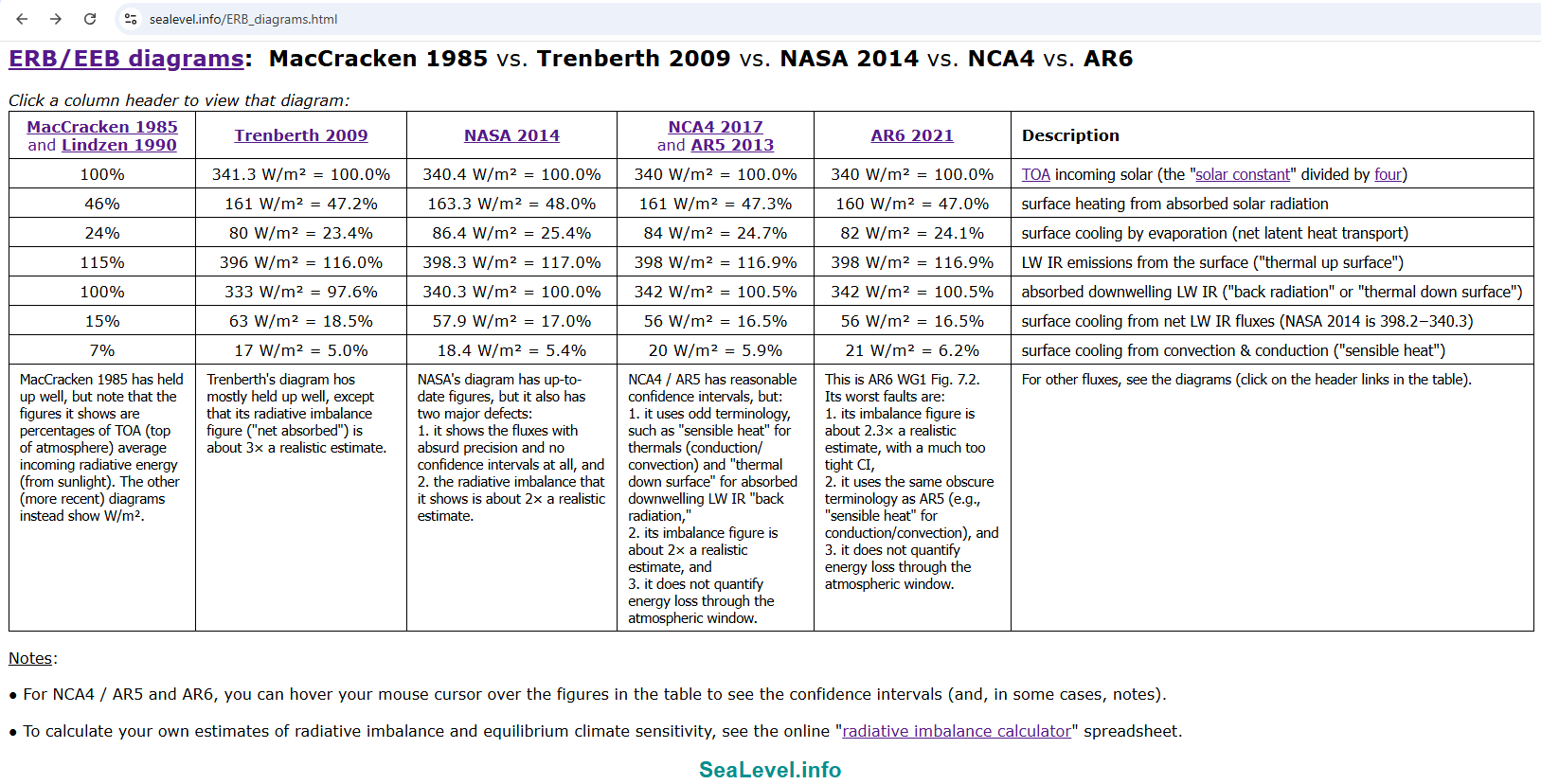
‘The various energy flow diagrams have their strengths and weaknesses, but none of them make the mistake of ignoring energy transfer by convection & evaporation.’
Since most of the thermal radiation emitted from the Earth’s surface and absorbed by GHGs is promptly converted to sensible heat within 10-20 meters of the surface, I’d say that all of these flow diagrams grossly underestimate tropospheric energy transfer by convection and evaporation.
Also, the fact that these ‘fluxes’ have been relatively consistent since 1985 is only evidence that they were all derived by applying the same phenomenological physics of radiative transfer theory that conflates atmospheric radiance to energy flow in a highly convective troposphere.
Speaking of energy flow, I’m going to ‘steal’ a question from the late Michael Mishchenko and ask you to review the publications behind the featured diagrams and advise if any of them mention the words ‘Poynting vector’:
https://youtu.be/hjKJyn_uoIE?t=1442&si=iA7O7-GIU0pNaT7-
That diagram does leave out the fact that water behaves differently than sand, soil, and vegetation. Water has a constant diffuse reflection from suspended plankton and sediment that is close enough to 6% that I won’t quibble about it. However, it leaves out the specular reflection off water that varies from 2-100%, and averages more than 12% over 12-hours of daylight. The ‘6%’ is obviously a lower-bound on surface reflectance.
It’s not that he forgot a /s in his response. It’s that he (and everyone else) forgot that here was no reason to respond at all. 🙂
Ah yes, the sacred rule: if mainstream science supports your view, it’s Truth™ – and if it doesn’t, well, clearly the dissenters think the Earth is a pancake. Flawless logic.
Of course the problem is that you guys can’t discern real science from Denier talking points. You are easily conned.
We are the ones being asked to pay the bills. We are experts in our own spheres that take issue with details we are told must be correct because the models tell us so. No. Models are (by their nature) simplified versions of the real world. They are worse than useless when used outside of their narrow view and when their outputs are contrary to measurements and observations.
A millennium of 10x higher sea level raising than current shows that the Null Hypothesis must be invoked and that we are still in the realm of natural variation rather than the catastrophist’s assumption that humanity is making material changes to the climate.
Questioning billion-dollar models with track records that make weathermen blush is peak “denier talking points”.
Bold strategy calling dissenters gullible while demanding blind faith in The Science™
Translation, anything I believe is unquestioned truth. Everything else is a despicable lie. Anyone who disagrees with me isn’t a scientist and is in the pay of evil forces.
An Idiot who is such a pervert that he thinks that co2 is a pollutant(using environment as excuse to demonize the thing that made our environment and that has been around in way higher concentrations than today for most of the time life exists)
complaining about flat earthers?
When will we start demonizing water?
And about mainstream science – it works just as well as mainstream media and mainstream politics.100% shit as soon as things get serious.
Here a little reminder:
Why most published research findings are false. – John Ioannidis’ crazy claim from 2006
was so “wrong” that
that even the lancet had to admit a decade later that up to half of all scientific studies are false.
Now imagine you try to put out this fire with gasoline by going from scientific method to consensus – it will simply open all doors for politics and lobbyism and they’ll be able to enforce and buy any outcome they want.
Lysenkoism – legalize it.
See? Interesting.
Agreed. If he thinks that CO2 is a pollutant, he should immediately stop emitting it.
“When will we start demonizing water?“
__________________________________________________________________________________________
Carbon dioxide is just as important as water as the photosynthetic equation tells us.
But climate science doesn’t point that basic truth out.
Yeah – and everybody would instantly put you in a straight- jacket(or a gay jacket in woke term?) if you’d call it a pollutant,
but when you say that co2 is a pollutant than It’s sophisticated science – just because a black Messiah ( not Isaac Hayes) said so.
That’s even crazier than flat earth stuff, as flat earth follows at least the principal of subjective observation – we will experience the earth always as flat, as the bit curvature is beyond of what we can sense, and this fooled most of the people most of the time while co2 ‘s properties have been known for most of the time since discovery
and everything was fine until the 1980ies until its properties changed to a white, racist, supremsacist Hitler.
And water is btw a way worse “pollutant ” as I’d guess a million people get killed by it for every co2 victim.
And a 33 % increase in water would drown almost all land based life while a 33 % co2 increase does – nothing.
According to a 2018 report in the New England Journal of Medicine, deadly dihydrogen monoxide is the third leading cause of unintentional death in children and adolescents (after motor vehicle crash and cancer).
The presence of dihydrogen monoxide in our oceans is a key contributor to the formation of Cat 4&5 hurricanes.
Dihydrogen monoxide is also contained in most pesticide sprays.
In the 1986 Chernobyl nuclear power plant disaster, it was an interaction of dihydrogen monoxide with the very hot nuclear fuel which caused the initial explosion.
Dihydrogen monoxide also played a key role in the sinking of the Titanic, which claimed 1,500 lives.
The only reason that you are here today is that WUWT has more influence restoring science than the Democrats can control.
And that WUWT doesn’t censor opposing opinions.
I suggest that you get back under your stone.
Stone bridge?
Does mainstream science believe in ice ages?
Warren Beeton, please see my comment here.
You were the one who called Nobel recipient Clauser a fraud.
From your the negatives on your comment, it looks like you are the fraud.
I know William Happer.
He reviewed one of my articles.
I am glad he did, because now it is so much better
He is Chairman of the Physics Department at Princeton
He was a scientist on Reagan’s Star Wars.
He is a scientist on Trump’s Dome to protect against incoming missiles.
Applying the scientific method is the prerequisite of any scientific inquiry.
Dr. Happer also gave our huge telescopes much better vision by inventing something which compensated for the movement of the air above the telescope.
That “invention” is the sodium laser guide star, a foundational breakthrough in the field of adaptive optics. It projects a laser into the mesosphere, creating an artificial star that allows telescopes to measure and correct for the atmospheric blurring that traditionally distorts astronomical images. [1, 2, 3, 4]
Developed while Dr. William Happer was participating in the 1982 JASON defense advisory group, this concept completely changed ground-based astronomy.
And he knows nothing about the climate.
Dr Oz has five words about you ….
I have yet to see anything from you that even suggests that you know anything about the climate. The only thing you have demonstrated is your ability to create ad hominem attacks, which is the refuge of fools who can’t explain how science works. And I use the word “fools” appropriately because you don’t understand that insults undercut any credibility that one may generously give you.
Beeton is probably a Prof. at a loonie lib Uni.
Telling students lies.
And you do? Do tell.
Yea, we get it. Only those people who agree with what you are paid to believe know anything about climate.
Since the whole point of being concerned about atmospheric concentration of CO2 is in how CO2 affects radiative heat transfer, I would give far more credence to Happer who understands and can explain the physics of the interaction of CO molecules and IR photons than most of the people who claim to be climate scientists.
How’s it feel to post the stupidest comment as no. 1. I’d stack Happer, Lindzen, and Koonin’s credentials up against yours any day. People have heard of them. No one has heard of you.
The main ‘Deniers’ of Catastrophic Anthropogenic Climate Change are… Nature & Physics.
The facts for “Flat Earth nonsense” are not in evidence. Is the best you can do is to make accusations that you do not support?
I deny your existence. Begone!!!!!!!
Having gone through this thread the only “denier” I see is you, denying reality.
I see Beeton is still convinced that truth is determined via popularity polls.
Lindzen, Happer, and Koonin are raising a legitimate concern—not about conspiracy, but about how science is framed for judges.
The earlier Goodstein chapter kept the focus on the scientific method—testing hypotheses against data—which aligns closely with Daubert.
Under Daubert, courts are supposed to evaluate methodology, testability, and error rates, with consensus being only one factor—not the deciding one. [law.cornell.edu] [handwiki.org]
The concern with the new chapter is that it leans more into science as a social process, including how consensus forms. That’s true in a general sense, but in a legal setting it risks blurring the line between evidence and agreement. [co2coalition.org]
If that shift leads judges to give too much weight to consensus, it edges back toward the old Frye-style reasoning, where “general acceptance” dominated.
So the issue isn’t dismissing consensus—it’s keeping it in its proper place. Courts need a clear, method-centered view of science, where conclusions are judged by how well they’re tested, not how widely they’re held.
That’s a reasonable argument for reverting to the earlier, simpler approach.
Mr. Sandberg: Excellent, this is the simple summary that Mr. Beeton tried to gaslight us away from, but it looks like readers here got it.
Here kitty kitty kitty. I have some catnip for you. Hooked to a string so you can play.
“Consensus”
In middle school debate competitions, an appeal to “consensus” is considered to be an argumentative fallacy known as the Bandwagon Fallacy.
Most of the assertions made by climate science are supported by application of a “consensus” claim. Climate science couldn’t win a middle school debate competition!
Makes one wonder why people like Pasteur, Einstein, Kepler, Galileo, Jenner, Newton, etc., etc., are considered “ground breaking” since “the consensus” already agreed with them anyway.
Albert Einstein warned against “consensus.”
“No amount of experimentation can ever prove me right; a single experiment can prove me wrong.” – Albert Einstein
Since Deniers have no consistent or coherent explanation for the behavior of the climate, you’re at no risk of any consensus,
I take it that you have not heard of the Milankovitch Cycles.
Even he has heard the term he has no knowledge of what it is.
There a any number of consistent and coherent explanations for the operation of the biosphere from a thermodynamic point of view. The most consistent and coherent explanation is that conduction, convection, and advection in the biosphere are the control knobs for all of the varying climates that exist in the non-homogeneous biosphere. CO2 is such a small component of the conduction, convection, and advection that it does not create a measurable effect. Conduction, convection, and advection do not require the non-physical process of averaging the intensive properties of different things.
It’s hard to see when the party orders you not to look.
No risk of consensus?
I take that as a plus!
‘Chief Justice John Roberts has a straightforward option. As chair of the FJC, he can direct the center to restore the previous chapter, or commission a new one written tightly around the methodology Daubert requires.’
Keep your fingers crossed. I vividly recall telling a work colleague immediately before the release of the (Roberts) Court’s affirmation of ‘Obama Care’ that there was absolutely ‘no way’ the Constitution could be interpreted so as to allow the Federal government to force anyone to buy anything, let alone an insurance policy.
At least the first part of the issue – deletion of the climate chapter from the “Reference Manual” – has been addressed.
“Under GOP Pressure, Federal Agency Pulls Climate Change Chapter From Official Manual for U.S. JudgesThe “Reference Manual on Scientific Evidence” — updated for the first time in 15 years — eliminates some 90 pages about climate science and comes just as numerous climate cases make their way through state and federal courts.”
https://www.propublica.org/article/federal-judicial-center-climate-change-republican-pressure
No word that I could find yet on what, if anything, will replace it. In this case, nothing is better than the original option. But I have to admit I’m at least a little hopeful that, unlike Biden, who prefers ‘truth’ over facts, facts will become the underlying principle of the rewrite.
Another example of the Marxists using our systems of governance against us.
Ooooh, yeah. Marxists are everywhere. Have you heard the UFOs landing in your yard?
And yet again, WB chooses insult over argument.
Avoiding reality is the only mental skill he has.
Definittely a Trans-Reality Idiot.
This is another example of small technical documents crafted and used over the years to subvert the Constitution and extend the power of of the judicial branch. The climate crusades require a lot of technical end runs to keep marching to oblivion–whether you like it or not. I think its time to map out all these tools of agenda reach.
Warren Beeton, the President of the United States has authority under his Article II constitutional powers — based on the historical precedent of World War II — to declare a climate emergency and then to impose a program of government-enforced fossil fuel rationing on America’s economy.
Here is a question for you, based on the assumption that Gavin Newsom is likely to become the Democrat’s nominee for president in 2028.
Are you and other like-minded climate activists willing to demand that Gavin Newsom commit to declaring a climate emergency if he becomes president, and then to impose by Executive Order a program of government-enforced fossil fuel rationing on America’s economy?
Are yours and other climate activist’s commitments to climate activism sufficient enough to make that demand; and furthermore, is Gavin Newsom’s own commitment to climate activism such that he would accede to that demand?
Good questions.
But Wazza will need to ask around to get a “consensus” of what the answers might be.
And don’t you dare ask for any supporting logic or real-world references in those answers that might catch them out!
“Catches? We doan need no stinkin’ catches”
“Gavin Newsom’s own commitment to climate activism such that he would accede to that demand?”
Sure he would. He strictly followed all the Covid restrictions. Didn’t he?
The 2028 Democratic National Convention will be held from August 7th through 10th, 2028, in either Atlanta, Boston, Chicago, Denver, or Philadelphia. Gavin Newsom is now the odds-on favorite to become the Democrat’s nominee for president in 2028. IMHO, he will remain so for the next two years.
If Newsom is indeed honest in expressing his concerns about climate change, then he ought to walk the talk and announce during his August 10th 2028 acceptance speech that as president he will indeed issue an Executive Order declaring a climate emergency; and based upon that declaration, will in fact impose a program of government-enforced fossil fuel rationing on America’s economy once he enters the Oval Office.
My commitment is to make sure you receive your own personal carbon tax.
A tax on breathing, no doubt, given that I expel CO2 with every breath.
Why should anyone be taxed for doing something that entirely beneficial?
Agenda noted.
Pay yours first.
a handbook
Popular handbooks and manuals in the UK and Europe include
Animal Farm
Nineteen Eighty-Four
Brave New World
And the top volume?
Praktische Idealismus by Richard von Coudenhove-Kalergi (1925)
You can probably add in the environmentalists, eg Silent Spring, from the 1960s onwards, but the EU is firmly adhering to Kalergi’s plan wherein it is written:
The European man of the future will be of mixed race. Today’s races and classes will disappear owing to the disappearing of nations, time, and prejudice. The Eurasian-Negroid race of the future, similar in its outward appearance to the Ancient Egyptians, will replace the diversity of peoples with a diversity of individuals
Your list left out Fahrenheit 451 from your list.
(Books? We don’t need no stinking books!)
Worse, all books will only be published in electronic format. That way they can all be updated as the consensus of convenience changes for the state.
Books will tell us what we need to know!
https://youtu.be/D_ZfZaRCWTI?si=PvIEvDizViHH4mwQ
Story Tip
Miliband’s New Net Zero EV Targets Are Not Credible, Warn Carmakers
The Society of Motor Manufacturers and Traders (SMMT) said the Energy Secretary’s latest so-called carbon budget implied electric vehicle (EV) sales need to triple in just three years.
This was “highly unlikely” on current trends, the industry lobby group said
…
Miliband’s latest carbon budget is based on modelling… – Daily Sceptic
That’ll be RCP8.5
Any odds on Roberts taking any action. As in a-n-y action whatsoever?
He’ll probably seek a “consensus” from the other judges 🙂
From his buddy Judge Boasberg ???
I don’t think ol’ Boozy Boasie would ever be nominated to SCOTUS.
(But then again, Ketanji did.
Was that because she got her judgment and experience in Jumanji, where fantasized events were taken as real?)
https://theconservativetreehouse.com/blog/2025/03/18/president-trump-goes-scorched-earth-on-judge-boasberg-chief-justice-john-roberts-defends-boasberg/
That “climate” chapter could have been a diversion. It was removed quickly when the AG’s of numerous states wrote a letter. But the core problem of “consensus” reasoning is stuck in the “How Science Works” section as this article reminds us.
Good for Happer, Lindzen, and Koonin to have written their letter. But the defendants in these cases should sharpen their arguments against the claimed harm by presenting direct demonstrations from outside the “consensus” body of scientific works endorsed and promoted by the IPCC.
First, it is plainly evident that the incremental IR absorbing power of rising pCO2 is massively overwhelmed by dynamic energy conversion within the general circulation. There is no plausible case for perceptible harm. The modelers know perfectly well that this is how the atmosphere operates. It is the compressible working fluid of its own weather-generating motion. A “consensus” position that harm is to be expected is a circular assertion from an ill-posed framing of the question of physical influence.
https://drive.google.com/drive/folders/1PDJP3F3rteoP99lR53YKp2fzuaza7Niz?usp=drive_link
Second, the time-step-iterated models are demonstrably incapable of producing anything of diagnostic or prognostic value concerning rising concentrations of the IR-active trace gases. A rapid buildup of uncertainty in the Earth climate state cannot be avoided and must be exposed as a fatal flaw in the use of such simulations in support of the claims of harm.
https://www.regulations.gov/comment/DOE-HQ-2025-0207-0371
There. I could be wrong. But I don’t think so.
Ruling that all Americans must insure themselves at absurd costs and calling it a “tax”… wasn’t that a bit like …issing on us and calling it rain?
Charles, why do many of the articles have a large blank gap between the introductory paragraphs and the rest of the article?
When I get logged out for whatever reason, my ad blocker jumps in and blocks the main ad that usually is in the middle of the article.
This article reminds me of an identical one posted here a couple months ago. Deja vu all over again?
We don’t need no steenking evidence when we got the feels bro-
Women’s award handed to actor who says they’re not a woman
Meetoo told women they could be equal to and just like men (a meme developed from the scribblings of an old dead bearded white guy named Karl). What they didn’t tell them is men largely don’t want to marry men and if they do they definitely don’t want to marry you girl. No matter about all those 30 plus identifiers as women on TikTok whining where have all the men gone a new generation is building the Utopian good society. Who needs the irony of the climate dooming we’ll leave to the pronouns of the last pesky demographer it seems.
Justice Roberts should be shown this quote by Robert Heinlein:
There are but two ways of forming an opinion in science. One is the scientific method; the other, the scholastic. One can judge from experiment, or one can blindly accept authority. To the scientific mind, experimental proof is all important and theory is merely a convenience in description, to be junked when it no longer fits. To the academic mind, authority is everything and facts are junked when they do not fit theory laid down by authority.
Robert A. Heinlein