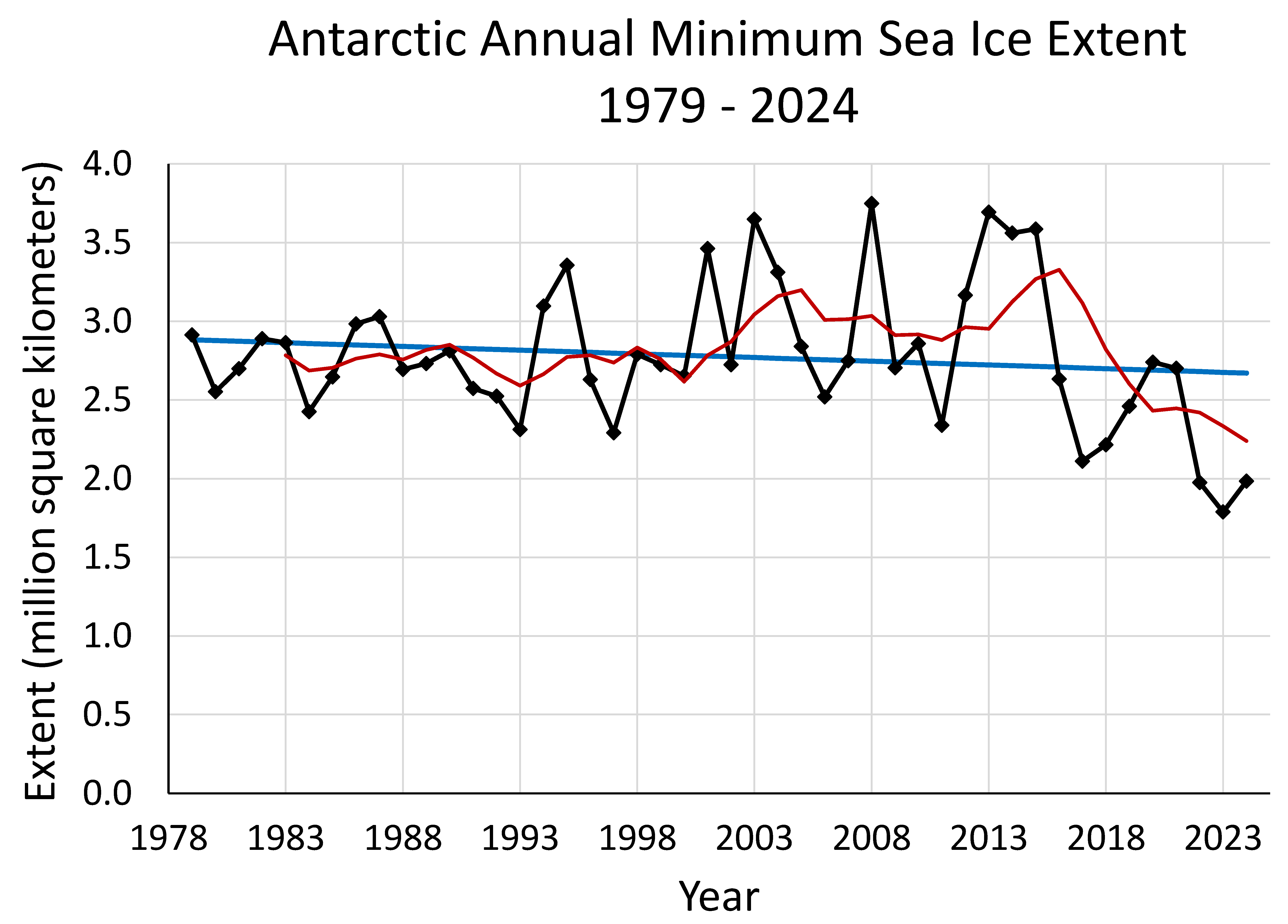
Antarctic Sea Ice Back To Normal

From NOT A LOT OF PEOPLE KNOW THAT

By Paul Homewood

First, the Arctic sea ice refused to melt away, as the “experts” predicted.

So they turned their attention to the Antarctic after a couple of years with less ice than usual.

Sadly for their credibility, this year the sea ice cover is close to normal again.

Forget about that fake slope – it is statistically meaningless, given the short timescale and the massive interannual variation.

And they can hardly blame a few years of low ice extent on global warming, when we also had record highs a decade ago.
The climate data they don't want you to find — free, to your inbox.
Join readers who get 5–8 new articles daily — no algorithms, no shadow bans.
5 15 votes
Article Rating
Subscribe
Notify of
79 Comments
Inline Feedbacks
View all comments
mleskovarsocalrrcom
March 14, 2026 6:22 am

Another alarmist prediction down the drain. I wonder how long it will take the MSM to pick this up /sarc.

Denis
Reply to  mleskovarsocalrrcom
March 14, 2026 6:28 am

Perhaps CBS, under their new leadership, will but there is no chance for the others.

Reply to  mleskovarsocalrrcom
March 14, 2026 9:18 pm

I believe that there is a story scheduled that has an embargo until the 12th of Never.

Jeff Alberts
Reply to  mleskovarsocalrrcom
March 15, 2026 4:22 pm

What is normal?

Victor
March 14, 2026 6:42 am

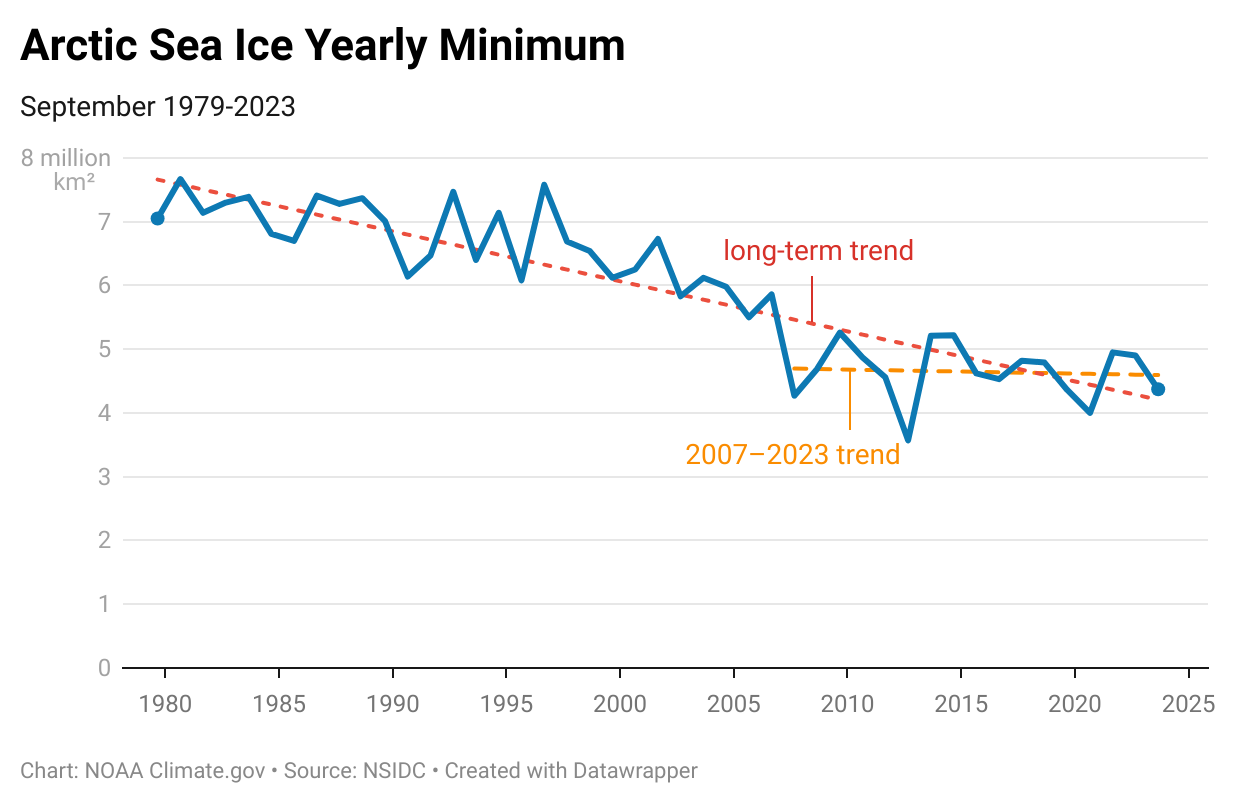
Arctic sea ice extent minimum occurs in September.
The graph for the Arctic shows that the rate of melting is significantly less after 2007.

NSIDC Arctic September
comment image

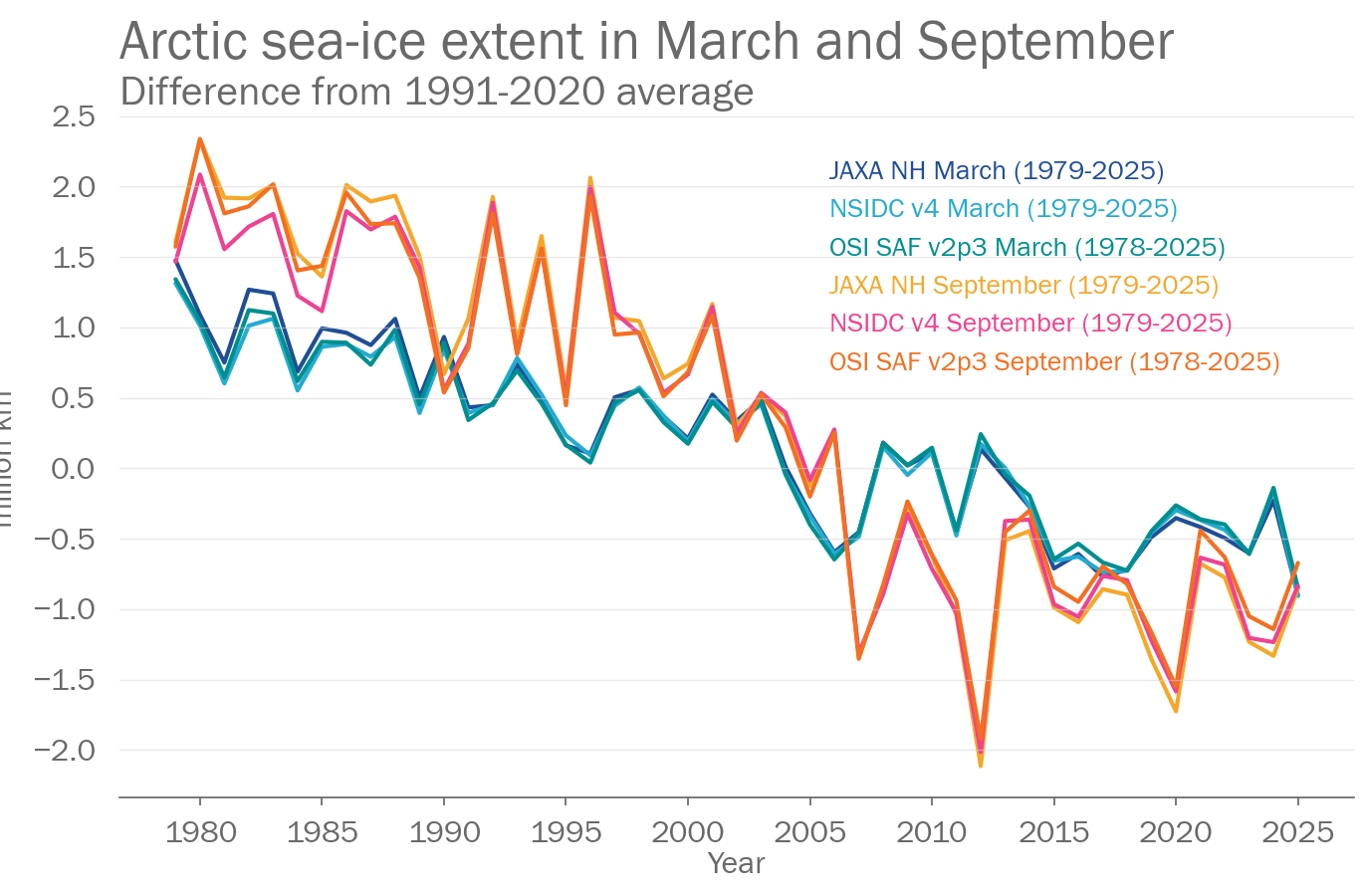
Arctic sea ice extent March and September.
comment image

MattS
Reply to  Victor
March 14, 2026 7:21 am

Note that the article is about Antarctic sea ice…

Reply to  MattS
March 14, 2026 7:51 am

Excellent, MattS . . . just excellent!

Victor
Reply to  ToldYouSo
March 14, 2026 12:14 pm

Antarctic sea ice extent minimum occurs in February and maximum occurs in September.
These two months are the important ones. The other months do not have the same statistical significance.

Reply to  Victor
March 14, 2026 2:40 pm

Gee . . . and all along I believed that the governing thermodynamics for sea ice formation/dissolution relied on the accumulation of Arctic solar energy predominately during summer months (plural) versus the net loss of Arctic energy during predominately winter months (plural).

Who knew otherwise? Best you publish a paper on your rather surprising findings.

Bryan A
Reply to  ToldYouSo
March 15, 2026 8:27 am

Who Knew Otherwise???
I’ll tell you who!!!
Whooda Thunkit! That’s who.

Anthony Banton
Reply to  MattS
March 14, 2026 10:29 am

Indeed:
And on that ….winds

“Through most of the year, Antarctic sea ice was well below the daily average,” said Ted Scambos, senior research scientist at the Cooperative Institute for Research in the Environmental Sciences (CIRES).
“Then in January and February, strong winds from the south pushed sea ice outward in the Weddell Sea. This slowed the overall decline in extent, leading to a near-average minimum,” Scambos said.
The NSIDC cautioned that the 2026 figure is preliminary, noting that “continued melt conditions or strong onshore winds could still push the ice extent lower.”
“This year’s return to less extreme conditions is not unexpected given the large year-to-year variation of Antarctic sea ice seen in the satellite record,” said Walt Meier, scientist at the NASA NSIDC Distributed Active Archive Center.

https://phys.org/news/2026-03-antarctic-sea-ice-rebounds-nearing.html

Reply to  Anthony Banton
March 14, 2026 12:33 pm

Surely you don’t think… that a temporary drop in Antarctic sea ice (incidentally just after a major underwater volcanic eruption in the west Pacific near the top of the Southern Gyre) was caused by human anything !!

Great junk speculation from the sea ice worriers, though.. “could, may, if…” etc etc etc

Anthony Banton
Reply to  Victor
March 14, 2026 10:26 am

On the other hand if the 2 years that dropped below the median were less extreme then the trend would have been seen to be continuous and there would not be an impression of a pause in decline.
Depends how you want to look at it – but usually in statistics you discard the outliers before meaning. (also the high year around 1996)

Victor
Reply to  Anthony Banton
March 14, 2026 12:37 pm

There is only sea ice extent data from 1979.
Antarctic sea ice extent change is not the same as for the Arctic.
The differences can be seen in the fact that Arctic sea ice extent has decreased faster than Antarctic and then leveled off from 2007.

Antarctic annual sea ice minimum extent February
comment image

Antarctic annual sea ice minimum extent anomaly February
comment image

Reply to  Victor
March 14, 2026 12:36 pm

Why so many downvotes…. it’s the data?
Absolutely: debate AGW theory; call out alarmism; point out the positives of a warming planet; of greater crop yields due to higher CO2 concentrations; the greening of deserts; etc……but DO NOT reject the data!

Victor
Reply to  Neutral1966
March 14, 2026 1:19 pm

Compare the Earth’s monthly global temperature anomaly with the changes in sea ice extent and find the relationships.

Make a graph with 2 lines for the Earth’s monthly global temperature anomaly.
One line shows the Earth’s monthly global temperature anomaly for the Southern Hemisphere + the months of April, May, June, July, August, September, October for the Northern Hemisphere (7 months + SH combined mean).

The second line shows the Earth’s monthly global temperature anomaly for the Northern Hemisphere months of November, December, January, February, March (5 months combined mean).

The second line will show a large temperature increase that will be consistent with the Arctic sea ice extent for the same months.

Victor
Reply to  Victor
March 14, 2026 2:13 pm

I found some graphs showing similar average temperature differences as I described.
These average temperature differences can’t be explained by the increase in CO2. There must be other planetary or human factors.

comment image

comment image

The Northern Hemisphere’s temperature increase during winter months is so high that it constitutes a large proportion of the Earth’s annual average temperature increase.

Bryan A
Reply to  Victor
March 15, 2026 8:33 am

So, what should be expected during the end of the milankovitch deglaciation cycle and the beginning of the next 100,000 year glaciation cycle?
What will the climate look like just before the switch over?

Victor
Reply to  Neutral1966
March 14, 2026 2:51 pm

Scientists who are narrow-minded will never make any discoveries.

Reply to  Victor
March 15, 2026 10:15 am

Agreed……. Personally, I think there are far too many narrow-minded contributors on this site.
Someone just has to present a graph that represents observed changes in global satellite temperature or of sea ice, for example, and it’s immediately downvotes. I can only imagine the reason for this is because the data presented conflicts with their own narro- minded perceptions. It’s one thing challenging AGW theory and alarmism, it’s quite another rejecting well recorded data. It’s in instances like these that some here remind me of “flat-earthers” – unwilling to accept any observations that clash with their own pet views on things. Pathetic, really! No wonder some skeptics are labelled deniers. Puerile, narrow-minded, partisan, completely unscientific, football fan mentality, based views.

Reply to  Victor
March 15, 2026 12:13 pm

“Scientists who are narrow-minded will never make any discoveries.”

And just who, or what tribunal, will be defining “narrow-minded”?

And I’ll just ask you to please define the difference between “narrow-minded” and “mentally focused” (on a particular subject).

And then there is this from Google’s AI bot that falsifies your assertion:

“Famous scientists who maintained an extremely narrow focus on their specialty in their published work are rare . . .Some notable examples of specialists include: 

Barbara McClintock (Genetics): Focused exclusively on maize cytogenetics, specifically transposons (“jumping genes”), throughout her long career.

Peter Higgs (Theoretical Physics): His publications were highly focused on theoretical particle physics, culminating in the prediction of the Higgs boson.

Ignaz Semmelweis (Medicine): Focused entirely on identifying and solving puerperal fever (childbed fever), pioneering antiseptic practices.” 

Making broad generalizations if fraught with peril to one’s credibility.

MrGrimNasty
March 14, 2026 7:27 am

The headline claim is based on 10 weeks of the whole year. A similar thing happened at a different point last year, before it plunged out of the ‘normal’ range again.

Sea ice is currently deficient in all but 2 areas; a large excess in the Weddell Sea is almost entirely responsible for the nearer to ‘normal’ total ice area. But the distribution could not be considered particularly ‘normal’.

Reply to  MrGrimNasty
March 14, 2026 8:03 am

“A similar thing happened at a different point last year, before it plunged out of the ‘normal’ range again.”

Of course, let’s just overlook those years from 1994 to 2015 when there were large excesses of Antarctic sea ice (several instances of such anomalies being greater than +20%). /sarc

IOW, I have no idea at all what you mean by your phrase ” ‘normal’ range“.

Reply to  MrGrimNasty
March 14, 2026 10:26 am

Define “normal”.
I think “observed range” might be a better descriptive term.

Bruce Cobb
March 14, 2026 7:47 am

True story: on this day, Marie Antoinette, upon being informed that the peasants had no cake reportedly said petulantly “Let them eat pie then!”
And to this day, we do.
We now return you to your regularly scheduled program.

strativarius
Reply to  Bruce Cobb
March 14, 2026 8:27 am

Are you sure it wasn’t when told that the peasants had no bread, Antoinette replied: “Then let them eat brioches.“? Or cake; as some would have it.

Bruce Cobb
Reply to  strativarius
March 14, 2026 9:33 am

No, that was on a different day. This story has to do with today, March 14th.

Reply to  strativarius
March 14, 2026 9:37 am

That was a different day. We’re talking about 3/14 (written in the US style of month/day).

Reply to  strativarius
March 15, 2026 1:15 am

“Qu’ils mangeant de la brioche!”

Bryan A
Reply to  Bruce Cobb
March 15, 2026 8:35 am

Happy Pi Day

Reply to  Bruce Cobb
March 15, 2026 12:35 pm

Some people—you know, those interested in truth—know your story about Marie Antoinette is just a fable.

Here’s what Google’s AI bot has to say on this subject:

“No, Marie Antoinette did not say ‘let them eat pie’ or even the famous ‘let them eat cake’ (‘Qu’ils mangent de la brioche’). This phrase was attributed to her to symbolize the aristocracy’s ignorance of the poor, likely stemming from earlier stories or propaganda. It was famously in print in 1766, when she was a child. 
Origin of the Quote: The phrase was likely written by Jean-Jacques Rousseau in his Confessions around 1766—when Marie Antoinette was only 10 years old and still living in Austria—where he attributed it to “a great princess”.
Actual Phrase: The original phrase is ‘Qu’ils mangent de la brioche’ (let them eat brioche), not cake, which is a rich bread made with butter and eggs, not just simple bread.
Propaganda: The rumor gained traction to damage her reputation, portraying her as out-of-touch, extravagant, and indifferent to the widespread hunger in France.
Historical Accuracy: There is no evidence she ever spoke these words.”

March 14, 2026 7:49 am

“Oh, well . . . nevermind.”
— SNL’s Emily Litella as played by Gilda Radner

Perhaps lesser known but more comforting to AGW/CAGW alarmists relevant to the above article:
“It’s always something . . . Life is about not knowing, having to change, taking the moment and making the best of it”
— SNL’s Roseanne Roseannadanna as played by Gilda Radner

Bryan A
Reply to  ToldYouSo
March 15, 2026 8:36 am

Way back when SNL was funny then!

2hotel9
March 14, 2026 8:01 am

Ice. In the Antarctic. Imagine that.

strativarius
March 14, 2026 8:05 am

Normal?

Whassat then?

Keir Starmer accused of being ‘too politically weak’ to remove Ed Miliband as Rachel Reeves scrambles to save UK energy crisis
Economics Editor at The Spectator Michael Simmons said that even if the Prime Minister and Chancellor “wanted to get rid of him”, Sir Keir is not “strong enough” to go through with it.GB N

Mad Ed is big with the soft left of the Labour party and its voters….

strativarius
March 14, 2026 8:29 am

My woke maxims

If their hair is blue… There’s nothing you can do

If their hair is pink… They don’t even think.

March 14, 2026 8:33 am

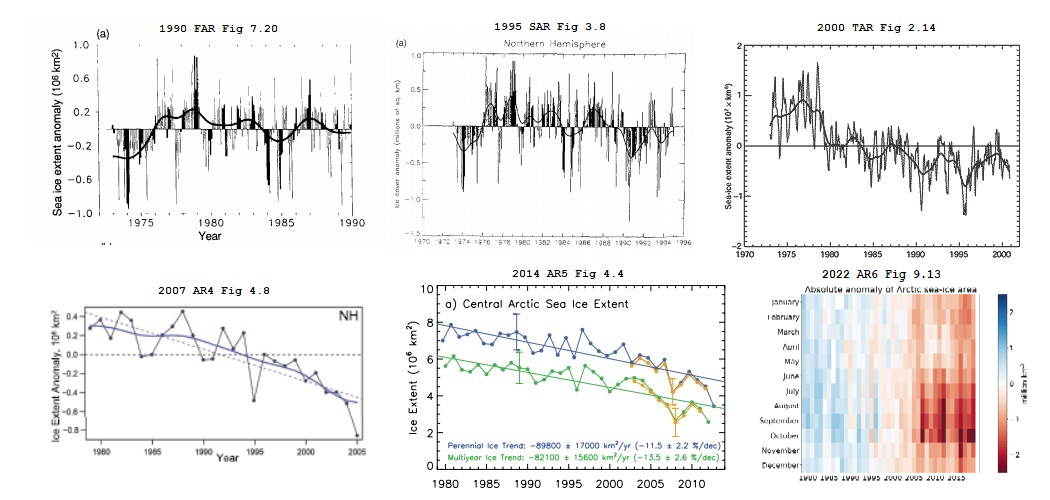
Not the Southern hemisphere, but here’s how the data for
the Northern hemisphere as been “Adjusted” over time:

comment image

Hmmm, fig 9.13 is from the AR6 & needs to be fixed duh!
Well anyway I’m rather sure fig 9.13 was made confusing
to hide the obvious biased changes made to the SAR, TAR
AR4 & AR5.

Anthony Banton
Reply to  Steve Case
March 14, 2026 9:42 am

the Northern hemisphere as been “Adjusted” over time:

Yes, because (as one would expect being 6 yrs later) newer data has been incorporated:

TAR Figure 2.14: Monthly Arctic sea-ice extent anomalies, 1973 to 2000, relative to 1973 to 1996. The data are a blend of updated Walsh (Walsh, 1978), Goddard Space Flight Center satellite passive microwave (Scanning Multichannel Microwave Radiometer (SMMR) and Special Sensor Microwave/Imager (SSM/I)) derived data (Cavalieri et al., 1997) and National Centers for Environmental Prediction satellite passive microwave derived data (Grumbine, 1996). Updated digitised ice data for the Great Lakes are also included (Assel, 1983).

SAR Figure 3.8: Sea ice extent anomalies relative to 1973-1994. Data from NOA A (USA). Smooth lines generated from a 128- point binomial filter applied to the monthly anomalies. Heavy bars represent December-February in the Northern Hemisphere or June-August in the Southern Hemisphere. 

Reply to  Anthony Banton
March 14, 2026 12:48 pm

So new data published in 1973 was found? Was a way back time machine employed to find out that the original data was wrong?

Anthony Banton
Reply to  Steve Case
March 14, 2026 11:33 pm

Try reading what I posted

Bryan A
Reply to  Anthony Banton
March 15, 2026 8:40 am

Newer data may have been incorporated but older data was adjusted…to fit the narrative!

Victor
Reply to  Steve Case
March 14, 2026 1:38 pm

Changes in how sea ice slush is calculated have occurred several times.
I found these texts about changes and the uncertainty in the calculation of sea ice slush.

Satellite-based sea ice extent calculations are experiencing, and in some cases adapting to, significant changes due to rapid Arctic and Antarctic environmental changes, which include increased slush and thinner, more transient ice. The presence of ice slush (mixed snow and water) is a major challenge for traditional passive microwave sensors, often leading to underestimations of sea ice concentration.

Impact of Ice Slush on Calculation.
Ice slush, caused by surface melting, flooding, or snow-ice formation, creates significant errors in passive microwave algorithms (e.g., NASA Team, Bootstrap).
Underestimation: Surface wetness, refreezing, and slush often cause passive microwave sensors to underestimate the true concentration of thin ice.

Anthony Banton
March 14, 2026 8:51 am

“First, the Arctic sea ice refused to melt away, as the “experts” predicted.”

A notable irresponsible personal opinion or two aside, that is patently incorrect ….

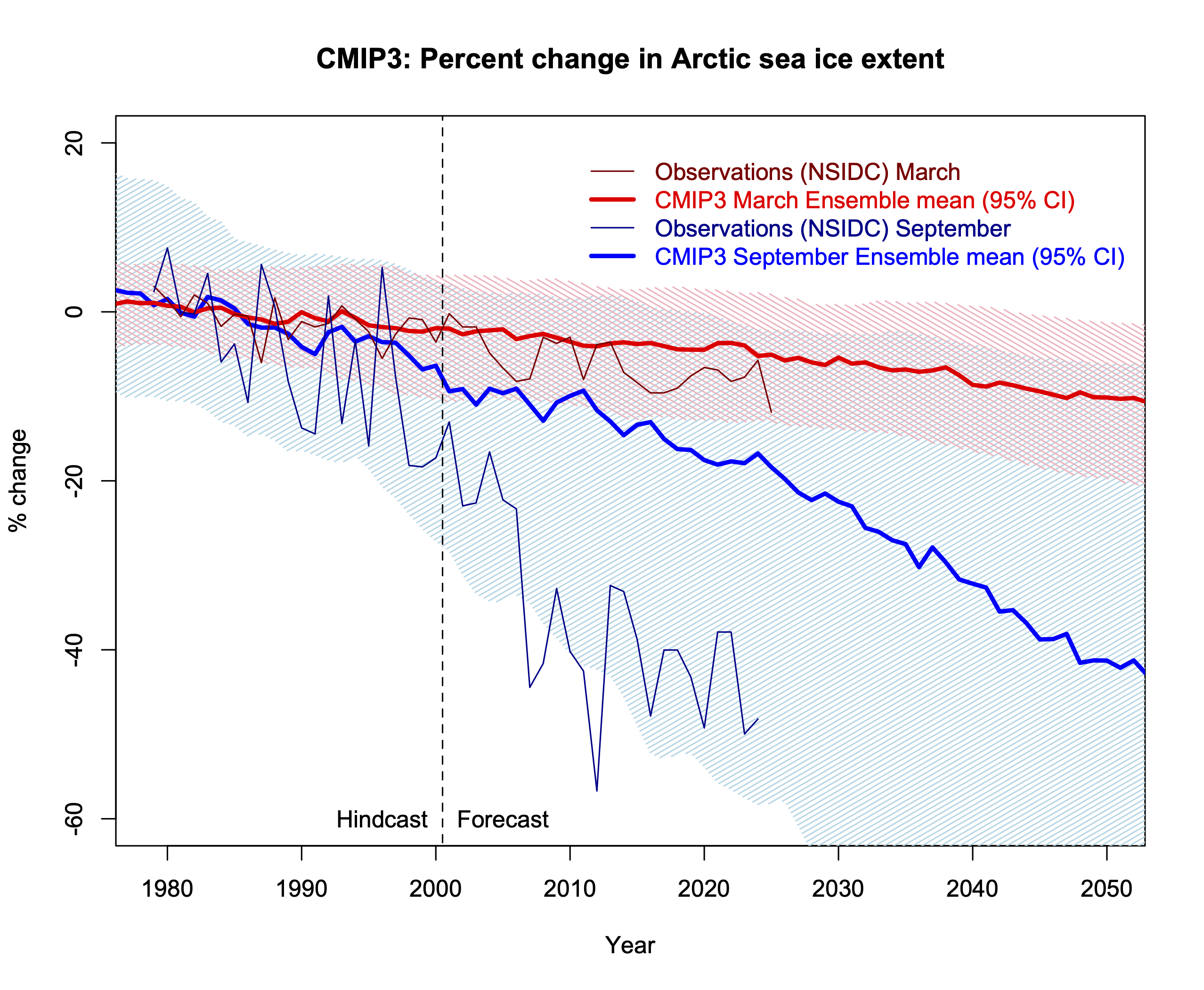
Here are te IPPC’s projections:

comment image

” Percent change in March (red) and September (blue) Arctic sea extent w.r.t. 1979-1988 in the CMIP5 ensemble and NSIDC observations. Spread is the 95% CI (with a 10 year smooth to reduce visual clutter). Solid lines are the ensemble mean. Historical forcings are used to 2005, and the RCP4.5 scenario subsequently.”

comment image

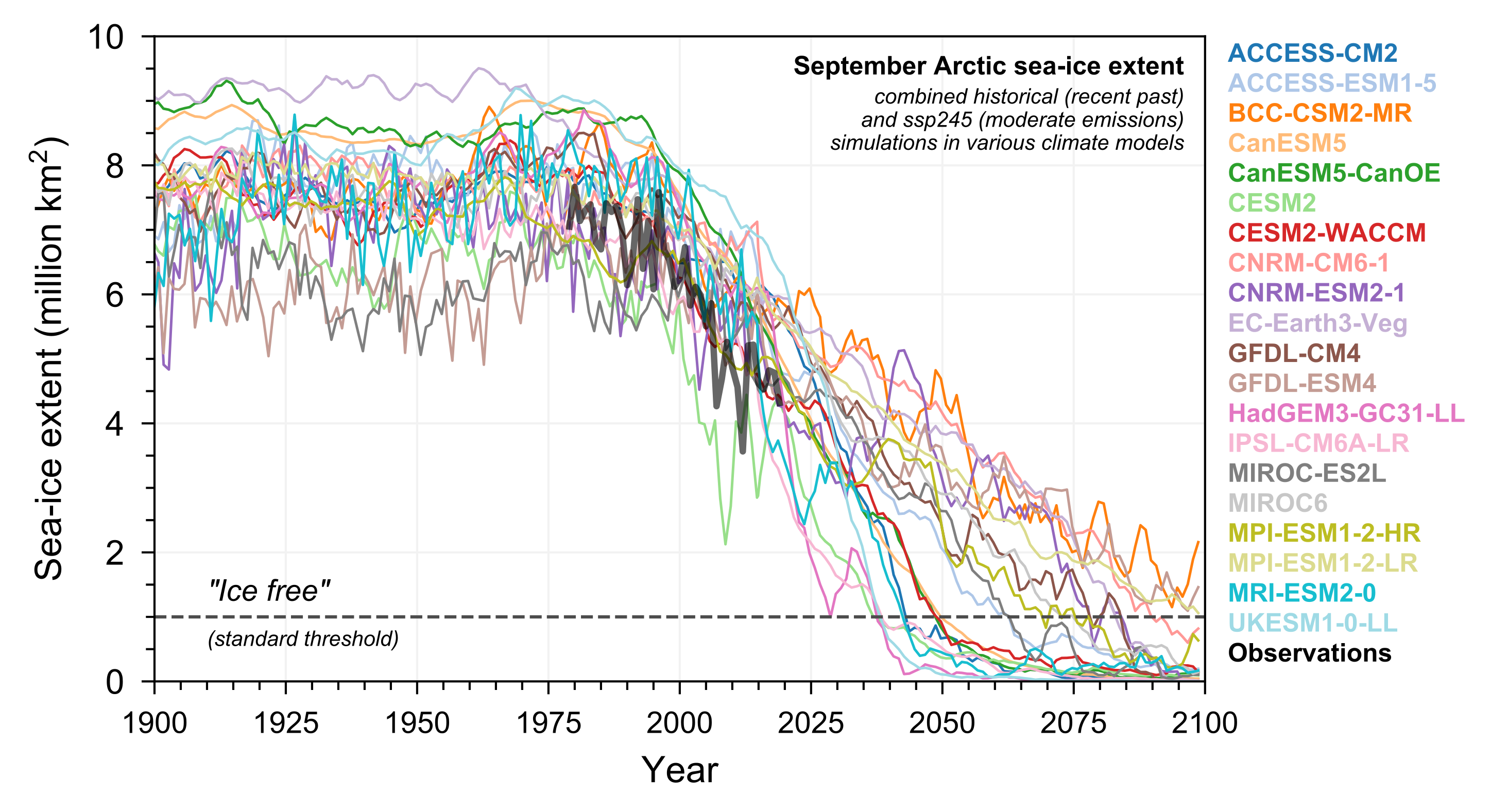
” Projections of Arctic sea-ice extent under ‘moderate’ emissions in 20 recent-generation climate models. Model data: CMIP6 multi-model ensemble; observational data: National Snow & Ice Data Center.”

In the real world the Arctic is actually running well below the most recent ensemble mean projections for the september minimum.

“Comprehensive numerical models are used to make long-term projections of the future climate state under different greenhouse gas emission scenarios. They estimate that the Arctic ocean will become seasonally ice free by the end of the 21st century, but there is a large uncertainty on the timing due to the spread of estimates across models”

https://www.realclimate.org/index.php/archives/2025/05/predicted-arctic-sea-ice-trends-over-time/
https://socialmetwork.blog/category/arctic/

Reply to  Anthony Banton
March 14, 2026 9:56 am

Seriously? Your experts start and stop with the IPPC? Which one of the following do you consider not an ‘expert’?
James Anderson (Harvard University): In 2018, this atmospheric chemist warned that the chance of any permanent ice remaining in the Arctic after 2022 was “essentially zero”.
Peter Wadhams (University of Cambridge): A longtime polar researcher who famously predicted in 2012 and 2016 that the Arctic could be sea-ice-free in summer by 2015-2018.
Ge Peng (North Carolina Institute for Climate Studies): Co-authored a 2020 study noting that at least one climate model simulation projected an ice-free summer as early as 2023.
Wieslaw Maslowski (Naval Postgraduate School): His research was the primary source for many early, aggressive timelines. In 2007, his team’s modeling—which focused on ice volume rather than just surface area—led to a prediction that the Arctic would be nearly ice-free in summer by 2013.
Mark Serreze (National Snow and Ice Data Center): In 2008, Serreze noted it was possible the North Pole itself could be ice-free that very year.
Jay Zwally (NASA): In late 2007, this leading NASA ice scientist stated the Arctic could be “nearly ice-free” by the end of summer 2012, noting that the ice was melting much faster than even the most pessimistic models at the time had predicted.
James Hansen (Columbia University) His recent work warns of an acceleration in global warming since 2015 that could lead to sudden, large-scale ice loss events in both poles by the mid-to-late 2020s.

Reply to  jtom
March 14, 2026 10:13 am

Predicting the future is hard…especially if your models have a range of +/-50%…and you use an ensemble mean in the hope that the standard deviations of the surmised “samples” are offsetting….Do these scientists realize that they were lucky to get answers as close as they did?…../s

Reply to  DMacKenzie
March 14, 2026 1:34 pm

Yogi Berra’s famous quote regarding predictions is: “It’s tough to make predictions, especially about the future”.

Anthony Banton
Reply to  jtom
March 14, 2026 12:00 pm

 Your experts start and stop with the IPPC? Which one of the following do you consider not an ‘expert’?”

Not what I said – They are experts of course, just with an outlier opinion.

Yes, because the IPCC has the consensus science and not the stffu you preffer (or the opposite). Of course there will be a difference of opinion as to the speed of travel (not the direction) and the consensus of the science here is the median of the ensemble’s members. As seen in the graphs above.

Reply to  Anthony Banton
March 14, 2026 3:03 pm

Consensus? Science? 🤭

Reply to  Krishna Gans
March 14, 2026 4:46 pm

Unthinkingly accepting “consensus” is strong sign of a person inability for rational thought.

They will “unthinkingly” accept any JUNK data or model that is put in front of them… because they have no other choice,

Reply to  Krishna Gans
March 14, 2026 6:06 pm

Do you think there is a consensus in science that the earth is not flat?

If so, does that draw science into question?

Reply to  TheFinalNail
March 15, 2026 1:11 am

You need science to see earth isn’t flat?🤣🤣🤣

Reply to  TheFinalNail
March 15, 2026 1:18 am

There is not a single piece of evidence for a flat Earth. Consensus has nothing to do with it.

Anthony Banton
Reply to  Krishna Gans
March 14, 2026 11:35 pm

Well obviously as the science involves a projection. It is not deterministic.

paul courtney
Reply to  Anthony Banton
March 14, 2026 11:53 am

Mr. Banton: In the real world, “melted away” means the ice is gone, but not in your world, eh?

Anthony Banton
Reply to  paul courtney
March 14, 2026 12:02 pm

Mr Courtney … and just where did I talk of “melting away”?

Well done – a move of goal-posts.

Anthony Banton
Reply to  Anthony Banton
March 14, 2026 12:08 pm

If you’re talking of Antarctic sea-ice … they’re not ….

Sea ice in the Antarctic showed a slight increase in overall extent from 1979 to 2014, although some areas, such as that to the west of the Antarctic Peninsula experienced a decrease. Short-term trends in the Southern Ocean, such as those observed, can readily occur from natural variability of the atmosphere, ocean and sea ice system. Changes in surface wind patterns around the continent contributed to the Antarctic pattern of sea ice change; ocean factors such as the addition of cool fresh water from melting ice shelves may also have played a role. However, after 2014, Antarctic ice extent began to decline, reaching a record low (within the 40 years of satellite data) in 2017, and remaining low in the following two years.

https://royalsociety.org/news-resources/projects/climate-change-evidence-causes/question-12/

Reply to  Anthony Banton
March 14, 2026 4:39 pm

Strong El Nino (no human causation) in 2016, followed by HT eruption and strong persistent El Nino (no human causation)

Antarctic sea ice now recovering from these two events.

There is ZERO evidence of any human CO2 causation.. Just NATURAL events.

Reply to  paul courtney
March 14, 2026 12:12 pm

And yet the current Arctic sea ice extent is FAR more than nearly all the last 10,000 years.

1979 was an EXTREME HIGH, not far below that of the LIA.

There was too much sea ice, and it drove many sea creatures out of the region

The RECOVERY from that extreme high, down slightly towards more normal Holocene levels has allowed Arctic sea life that used to live in the Arctic region to return.

The decrease in Arctic Sea ice is a blessing to this Arctic sea creatures

Eldrosion
Reply to  bnice2000
March 14, 2026 3:31 pm

Two things can simultaneously be true: the absolute extent of modern sea ice may fall within the range observed during the Holocene (or higher), while the current speed of decline is unusually rapid relative to natural variability.

Reply to  Eldrosion
March 14, 2026 4:36 pm

But is a decline from an EXTREME HIGH, and isn’t even close to Holocene normals yet

Reply to  Anthony Banton
March 14, 2026 12:10 pm

“First, the Arctic sea ice refused to melt away, as the “experts” predicted.”

A notable irresponsible personal opinion or two aside, that is patently incorrect ….

“Personal opinion” and “patently incorrect”? . . . who are you trying to fool?

You obviously don’t understand what the phrase “melt away” means . . . it refers to there being no more presence of ice in the referenced area. So please provide one credible reference— just one will suffice—that asserts there is no more sea ice to be found in the Arctic oceans, even at the height of northern hemisphere summer.

Epic fail on your comment.

Reply to  Anthony Banton
March 14, 2026 12:16 pm

No sane person pays any attention to climate models.

Current levels are way above the Holocene norm.

Arctic was regularly “ice free” for much of the early and mid Holocene…. and the world is still here.

Victor
Reply to  Anthony Banton
March 14, 2026 4:00 pm

Studies show Arctic cyclones are causing a reduction in sea ice in the Arctic.

The study showed that sea ice receded 5.7 times faster than normal during the storm and that the rapid, storm-related sea ice loss was driven primarily by two physical processes in the ocean:
The surface water is transported away from the cyclone by the strong gusting winds. This results in the upwelling of warmer water from the depths, which thus reaches the surface. Nevertheless, a small layer of cold water remains directly beneath the sea ice. At the same time, the strong winds mix the surface water like a blender.
https://polarjournal.net/icebreaker-solves-mystery-of-sea-ice-loss-after-cyclone/

Reply to  Anthony Banton
March 14, 2026 4:44 pm

Funny that not one of those unreality models matches Arctic recorded (unadjusted) surface temperatures, or historic references. 😉

The Alekseev reconstruction does match temperatures and the AMO, and is thus much more realistic.

Arctic-sea-vs-AMO-Rog-Tallbloke-768x574
Reply to  Anthony Banton
March 14, 2026 9:33 pm

So what is that graph that used all the crayons in the box supposed to be showing us? That after passing the “ice free” threshold that we can expect negative ice in the future? Or does it have something to do with ‘Ice Nine?’

Anthony Banton
Reply to  Clyde Spencer
March 14, 2026 11:38 pm

For the hard of comprehension. it is showing the spread of ensemble members.

March 14, 2026 11:28 am

“And they can hardly blame a few years of low ice extent on global warming, when we also had record highs a decade ago.”

Oh, but they can. Just look at the gleeful proclamations of the UAH data trends after we’ve had a whopping 34 months of freaky high anomalies ever since that thing happened in the Pacific that we’ll quietly ignore…

Reply to  johnesm
March 14, 2026 12:26 pm

The only 3 years that were “out of the normal group”, were 2023, 2024, 2025 (from lowest to highest)

In 2022 there was a large underwater volcanic eruption that added a lot of energy to the water in the west Pacific region,

The Southern Gyre goes straight past the region, down to the south pole where it added energy to the circumpolar stream.

Anyone who thinks this temporary drop in Antarctic sea ice extent had anything to do with human released CO2 needs a check-up from the neck-up.

Reply to  bnice2000
March 14, 2026 4:43 pm

“. . . large underwater volcanic eruption that added a lot of energy to the water . . .”

I can’t locate a conversion factor for converting “a lot” into units of energy such a terrajoules, but I do know that a single large volcano eruption would be insignificant compared to the energy present in the Earth’s total mass of oceans as represented by liquid water just being above its freezing point (that is, not including water’s latent heat of fusion).

Google’s AI bot says Earth’s oceans store about 5.8e+24 joules for every 1 deg-C rise in average ocean temperature above freezing, with the average temperature of all Earth’s oceans, from surface to sea floor, being approximately 3.5 C (38.3 deg-F).

So, call it about 3.5 x 5.8e+24 = 2e+25 joules of liquid OTC.

In comparison, the January 2022 H-T eruption is estimated to have released the energy equivalent to about 61 Mt of TNT (see https://phys.org/news/2022-08-tonga-volcano-eruption-energy-powerful.html ). Using the common conversion factor of 1 ton TNT being equivalent to 4.2e+09 joules, we can then estimated that the H-T eruption produced about 6.1e+07 x 4.2e+09 = 2.6e+17 joules of energy.

Therefore if all the H-T eruption energy theoretically went into heating just Pacific Ocean waters (that is, ignore the thermal/acoustic energy dumped into the atmosphere, ignore the energy of vaporizing some ejected water and then driving the rest into troposphere and stratosphere, and ignore the shock/pressure/thermal/acoustic energy dumped into the lithosphere, etc.) it would be . . . yeah . . .
(2.6e+17)/(2e+25) = 1.3e-8 = 0.0000013%
of the thermal energy represented by the world’s oceans being around 3.5 deg-C above the freezing point of water.

Bottom line: anyone who thinks the 2022-2023 drop in Antarctic sea ice extent had anything to do with energy coming from a volcanic eruption near the equator in the Pacific Ocean . . . (well, you know the rest) . . .

Reply to  ToldYouSo
March 14, 2026 6:29 pm

Anyone that thinks underwater volcanoes don’t significantly heat the ocean waters, and that ocean currents don’t transfer that energy is..

…. well, you know the rest !!!

Reply to  bnice2000
March 15, 2026 12:49 pm

Ignore the math at your own peril (assuming, of course, that you can follow it). And since you mentioned underwater VOLCANOES (plural) how many do you imaging are currently active—under the world’s oceans, that is—in any given year?

According to Google’s AI bot:
“While about 119 have erupted in the last 11,700 years, active undersea eruptions are rarely seen.”

Let’s see . . . yeah . . . that averages out to one undersea volcano eruption—the mechanism for releasing a large quantity of heat, not just “dribbling it out” gradually—about every 98 years.

ROTFL.

Reply to  johnesm
March 14, 2026 3:45 pm

“Just look at the gleeful proclamations of the UAH data trends after we’ve had a whopping 34 months of freaky high anomalies ever since that thing happened in the Pacific . . .”

Let’s see, assuming you are referring that “thing” in the Pacific as being the Hunga-Tonga undersea volcano eruption of January 2022, the facts are:

1) It took some 14-16 months after that eruption for the UAH-derived GLAT to deviate to the high side from its normal +/- variations around the overall trend line . . . thus, so much for your phrase “ever since”.

2) The peak positive anomaly from start-2022 until now has been about 0.95 deg-C, which can be compared to peak positive anomalies of 0.62 deg-C in 1998 and 0.70 deg-C in 2017 . . . thus, so much for your phrase “freaky high anomalies”, even if one believes GLAT can be derived to an accuracy/repeatability of even +/- 0.1 deg-C based on satellite instruments.

3) The peak positive anomaly in UAH GLAT trending occurred in early 2024 but by the beginning of 2025, more than one year ago, the monthly positive variations in the anomaly value were at or below nine other positive values obtained during the combined years of 1998, 2016, 2017, and 2020 . . . thus, so much for your phrases “ever since” and “freaky high anomalies”.

[See https://wattsupwiththat.com/2026/03/03/uah-v6-1-global-temperature-update-for-february-2026-0-39-deg-c/ for the most recent UAH graph of GLAT to confirm these facts.]

BTW, January 2022 through mid-March 2026 is a total of fifty (50) months, not 34 . . . again, so much for your phrase “ever since”, or perhaps you’ve just failed to identify where, between a +0.70 deg-C anomaly value and a +0.95 deg-C anomaly value, the level of “freaky high” begins.

Reply to  ToldYouSo
March 14, 2026 9:04 pm

I usually don’t include the /s tag in my posts, because I assume that the reader will know when I’m being sarcastic, or deliberately melodramatic to make a point.

March 14, 2026 1:43 pm

this year the sea ice cover is close to normal again.

There a few constants in climate but there is no “normal” with sea ice. It is ever changing.

Bob
March 14, 2026 1:56 pm

How long before these mongrels take credit for saving the ice at the poles?

observa
March 14, 2026 7:02 pm

A land of drought and flooding rain-
Incredible images as record rain batters Aus
We have no idea what is normal as nobody kept written records before 1788 but like those before that there are still plenty who want to rely on hearsay in this day and age.

LT3
March 15, 2026 6:23 am

I would not call anything about Antarctic Sea ice over the last ten years normal.

comment image

Sparta Nova 4
March 16, 2026 7:42 am

Pick some other arbitrary starting point and one can demonstrate the ice is increasing over time.

Sparta Nova 4
March 16, 2026 7:53 am

In what year were the Arctic and Antarctic sea ice levels optimum?

One can pick any date one choses to prove either side of the debate.