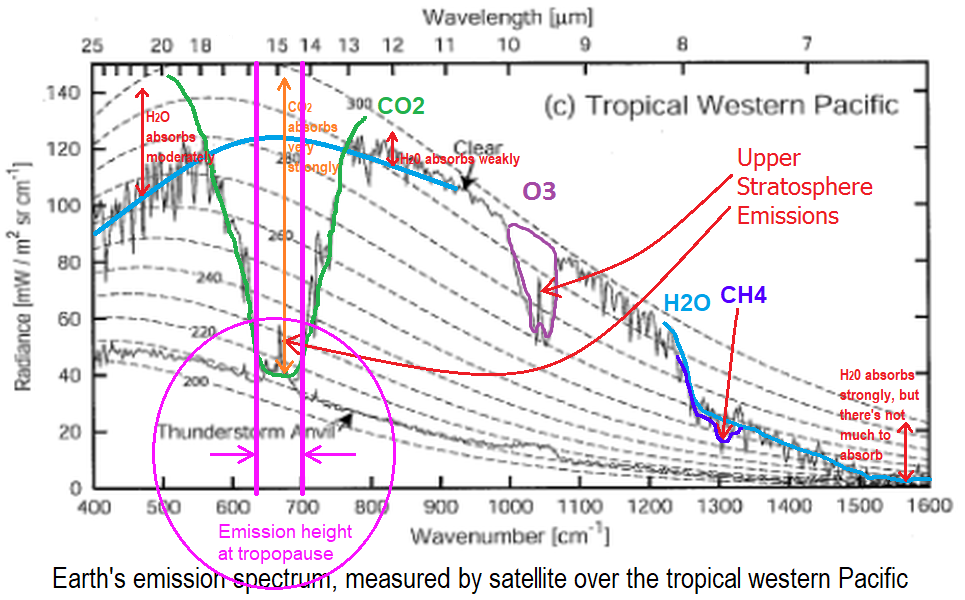
By Andy May
This is the text of a talk I gave on a Tom Nelson podcast. To listen to the talk and see Tom’s interview of me go here.
Some believe that CO2 and other greenhouse gas infrared emissions are as effective at increasing ocean heat content (or OHC) as solar radiation. Some even think greenhouse gas (abbreviated “GHG”) radiation is more effective than solar. There are many generally agreed points that dispute this conjecture:
- The average photon energy in GHG IR (greenhouse gas infrared) is less than the photon energy in solar radiation because energy goes up as frequency increases (Planck-Einstein relation).
- Greenhouse gas-induced infrared radiation is absorbed almost entirely in the ocean’s top micrometers to one millimeter. This is the upper part of the thermal skin layer or “TSL,” and called the electromagnetic skin layer. Incoming solar radiation—particularly blue-green visible wavelengths—penetrate much deeper, typically over 10 meters (and up to 100+ meters in very clear waters), before being absorbed and heating the water column (Wong & Minnett, 2018).
- The atmosphere, on average, is cooler than the bulk ocean which is the essence of the “cool skin effect” (Fairall et al., 2026). Heat flow is normally from the ocean to the atmosphere.
- The infrared energy from greenhouse gases absorbed in the thermal skin layer cannot be conducted downward into the bulk ocean since the net heat flux is upward. Instead, it adjusts the ocean’s thermal skin layer temperature profile, reducing upward conduction from the bulk ocean (Wong & Minnett, 2018).
Solar radiation warms the ocean directly; greenhouse‑gas IR warms it indirectly by reducing upward heat loss. These mechanisms are not equivalent, and the relative magnitudes are uncertain. These points are discussed in more detail in three earlier blog posts (here, here and here). The posts generated more than 500 interesting comments on my website and on Wattsupwiththat. In this talk I’d like to summarize the comments to illuminate this complex issue.
The Ocean Skin Layer
Figure 1 illustrates the classical ocean skin layer, after GHRSST and Wong and Minnett. All ocean skin components can (rarely) cover as much as the top 10 meters of the ocean in the daytime with very light winds. Thus, it grows and shrinks with conditions. In this talk we will focus on just the three critical upper components:
- The electromagnetic skin, which absorbs downwelling greenhouse gas longwave infrared radiation.
- The TSL which sustains the overall heat loss from the ocean to the atmosphere through molecular conduction, evaporation, and IR emissions into the atmosphere. The TSL is unaffected by turbulence or convection.
- The viscous skin layer, the layer where viscosity suppresses turbulence (Fairall et al., 2026).

The temperature profiles shown in figure 1 illustrate the ocean above the mixed layer, which is a layer of almost constant temperature and salinity. The constant temperature in the mixed layer is maintained by turbulence caused mostly by surface winds. The uppermost ocean skin layer is unaffected by turbulence because of its viscosity but is affected by incoming longwave GHG radiation and the small portion of solar energy that it absorbs. It loses energy through evaporation, radiation, and sensible heat loss to the atmosphere and forms a “cool skin” at the very top of the skin layer that is 0.2 to 0.5°C cooler than the water a millimeter below the surface (Fairall et al., 1996). The cool skin is important because infrared radiation (IR) radiometers and satellites measure the IR it emits (Fairall et al., 2026).
To accommodate changes in incoming radiation, the TSL changes its temperature profile and the temperature profile below it. The profile changes are dictated by the exponential Beer-Lambert law and are not linear overall but approximate a linear profile within the cool skin (Fairall et al., 2026). The cool skin remains cooler than the underlying water, and a warm TSL limits the amount of ocean mixed layer thermal energy that can make it to the surface.
What is a photon?
As noted above, due to the Planck-Einstein relation, the energy per photon of solar radiation is higher than for longwave GHG radiation because the average frequency of solar radiation is higher. To clarify this critical point, we must define a photon, which is no easy task. Nick and David, with the support of energy flow diagrams like the one shown in figure 2, will say energy per photon is not important, only energy flux. Maybe so, in a macroscopic sense, but sunlight sends its more energetic photons deeper into the ocean.
The electromagnetic field is everywhere and fundamental. It can support propagating waves (light) without matter as a medium. Quantum mechanically, this field is quantized and can only exchange energy in discrete amounts. While freely propagating (not interacting), the photon behaves purely as a wave and not as a particle. Only when it interacts with matter (absorption by a molecule, emission from one, Compton scattering, photoelectric effect, etc.) does the excitation localize, delivering its full quantum of energy at one point — that’s the “particle-like” aspect of photons. This is why Richard Feynman said photons are (paraphrasing) detected as particles but travel as waves (Feynman, 1963). The particle picture is most useful at the moments of emission and absorption. This is why I have said photons don’t really exist until energy interacts with matter in the past. But Feynman would chastise me for saying that because it is an oversimplification of reality. In quantum mechanics, photons exhibit wave-particle duality (Feynman, 1963).
Photons are not just a mathematical trick for absorption and emission, they are needed to explain aspects of propagation as well (Dodonov, 2020). Dodonov in a 2020 article reviews 50 years of research on the Dynamical Casimir effect which supports the idea that photons are genuine excitations of the electromagnetic field even in free space.
The Hanbury Brown–Twiss (HBT) effect (Bai et al., 2017) demonstrates photon bunching—a tendency for photons from a chaotic (thermal or incoherent) light source to arrive at detectors in correlated pairs more often than randomly expected, due to two-photon interference (Brown & Twiss, 1958). The HBT effect shows bunching for thermal light. The opposite—antibunching has also been observed as discussed by Kimble in 1977 (Kimble et al., 1977). This contrast (bunching for many-photon chaotic sources vs. antibunching for single-photon sources) is direct evidence of photons as discrete, indistinguishable bosons (force carriers) traveling through space. However, the “photon particle” label is really just a heuristic for energy quanta and statistics and does not imply photons are billiard ball-like objects.
GHG IR versus solar radiation
As we just said, GHG IR is absorbed in the thermal skin layer just under the ocean surface and solar energy is mostly absorbed deeper in the ocean. Importantly, the phrase “surface temperature” is ambiguous. It can mean the temperature of the true water-air interface, the temperature sensed with an infrared radiometer, the “foundation” or mixed layer temperature, or the air temperature above the water. Near-surface water temperature gradients are significant. The “cool skin” layer or the top millimeter of the ocean is normally cooler than the underlying warm layer as shown in figure 1. Within the cool skin, the flux is carried out by molecular diffusion and infrared emissions. Running a climate model with and without a cool skin can change the computed global ocean heat balance by 6 W/m2 in the tropics and 3.5 W/m2 in the midlatitudes (Fairall et al., 2026). Below is a table of key “cool skin” drivers summarized from cruise data given in Fairall et al. The GHG response column is not from the paper, but it is a logical extension based on IR flux statistics.
Table 1. Energy flux components at the ocean surface, their effect on the ocean skin, and their response to increased GHG IR. Data source: (Fairall et al., 2026)
Flux Component | Typical Effect on Cool Skin | Response to Increased GHG IR |
|---|---|---|
Net Longwave IR | Cools surface (net out ~50 W/m²) | Reduces net out, smaller ΔT, less bulk heat loss |
Sensible Heat | Cools/heats depending on air-sea ΔT, normally cools ocean. | Minimal change; TSL adjusts temperature gradient |
Latent Heat (Evaporation) | Cools surface (~100 W/m²) | Minimal change; supports surface loss, increases with more GHG IR or more insolation. |
Solar (Shortwave) | Heats below skin (~150 W/m² net) | No direct effect on IR mechanism |
As table 1 shows, solar input has a minimal effect on the skin layer. If greenhouse gases increase the IR absorbed in the skin layer, the effect will reduce the temperature difference between the mixed layer and the surface, which reduces the net heat loss from the bulk ocean. Sensible heat transfer can go either way and all that happens is the skin layer changes the gradient. Evaporation rates are fairly independent of GHG IR absorption since they mostly respond to changes in surface winds and humidity (Yu, 2007b).
Energy diagrams and flux balance
As Nick Stokes said in our extended discussion on my “Efficacy of downwelling IR” post, the energy fluxes at any 2D surface, for example the infinitely thin air/ocean interface, must balance and temperature at the surface will change to ensure the balance. This is the principle used to make the various energy flow diagrams in the literature, like the NASA diagram shown in figure 2.
Nick Stokes and Dave Burton emphasize that the energy balance diagrams show more GHG radiation flux going into the ocean than solar flux. In the slide the 340 W/m² “back radiation” is not a measure of how much energy greenhouse gases add to the ocean. It’s a one-way radiative flux in a two-way exchange, not one-way heat flow. The orange arrows show gross radiative fluxes, not net heating. Most of that flux is recycled surface emissions, whereas the net longwave surface loss is 398-340=58 W/m2, which I added to the slide in the yellow box. On net, the surface is losing longwave heat upward, not gaining it. The relevant quantity is the net longwave flux (58 W/m2), which can be compared to the solar incoming flux of 163.3, the 340.3 downward IR is not comparable.
In summary, downwelling IR is large because the atmosphere is radiatively thick, not because it is a source of heat. Only solar radiation warms the bulk ocean. Heat is the net transfer of thermal energy from a warm body (the ocean) to a cold body (the atmosphere) or from a warm atmosphere to space. The large orange arrows in figure 2 are not heat transfer, they are fluxes which are not the same thing.
Nick has said that the TSL, especially the upper portion (called the electromagnetic skin layer) where the GHG IR is absorbed, is so thin it can be viewed as a “surface.” In his view, any radiation absorbed there would be equal to any solar radiation absorbed deeper in the ocean and we can simply add the two regarding their effect on ocean heat content (OHC). The data collected by Wong and Minnett and my argument above dispute this. They show that GHG longwave IR does not directly heat the upper few meters of the ocean and is confined to the TSL. The TSL is not a massless surface.

The rate of temperature change in any body or region (here, the TSL) is the net energy imbalance (incoming minus outgoing) divided by the region’s thermal inertia or heat capacity, which depends on its mass, volume, and specific heat. The system adjusts its temperature over time toward energy balance. At Earth’s surface, changes in ocean heat content suggest a recent global mean energy imbalance or “EEI,” at the top of the atmosphere or TOA of ~0.6 W/m² according to NASA in figure 2. Loeb et al. 2021 give a range of 0.5 to 1 W/m2, a range disputed by Cohler, et al. A positive imbalance aligns with recent global warming. The imbalance varies temporally—sometimes positive, sometimes negative—on short timescales. The imbalance is influenced by periodic oscillations like ENSO, the AMO and PDO—and regionally with contributions from factors such as decreasing cloud cover. While satellite instruments alone have calibration uncertainties too large (~ ±2 W/m²) to directly measure the small absolute imbalance, it can be estimated using ocean heat content (OHC) measurements from Argo floats and deep buoys. However, significant uncertainties in OHC trends (see figure 3 and here) remain due to dataset discrepancies and pre-2005 (essentially pre-ARGO) data limitations.
Strictly speaking the Earth Energy Imbalance or EEI is normally measured at the TOA, which is separated from the ocean surface by the troposphere, where heat transfer is mostly done through convection and not by radiation as explained in my Energy and Matter post. The TOA and the surface are partially decoupled by convection, so calibrating TOA EEI with ocean heat content is not, strictly speaking, valid. We need to define a “surface EEI” to get around that. Surface EEI, as defined here, is a function of net surface radiation, or total radiation down minus total radiation up, which is a positive number if the surface absorbs more than it emits. Convection, which is composed of ~104.8 W/m2 of energy leaving in thermals and as latent heat is ignored.
If GHG IR participates in warming the bulk ocean at all, it is only by retarding heat loss from the deeper ocean through adjustments to the TSL temperature gradient. Both Dave Burton and Nick Stokes maintain that the depth radiation is absorbed does not matter. They believe, and energy diagrams such as figure 2 imply, that all radiation absorbed at the surface has the same effect and all radiation can be summed to a total with regard to changes in ocean temperature or to compute the EEI. It is likely this is true for the surface two-dimensional plane, but it is not true for the bulk ocean heat content or temperature.
Because satellite measurements of incoming and outgoing radiation from the Earth are not accurate enough to directly measure the net energy balance, satellite measurements are adjusted within their level of uncertainty to ensure that the Earth’s Energy Imbalance (EEI) matches that calculated from estimated changes in ocean heat content (OHC) (Loeb et al., 2022) & (Loeb et al., 2018). Sometimes the calculations take the cool skin into account, and sometimes they do not (Fairall et al., 2026). ARGO and deeper buoy measurements have been available in large numbers only since about 2005. The large thermal inertia in the world ocean suggests that the NASA computed EEI shown in figure 2 of 0.6 W/m2 is reasonable but has a very large uncertainty. Cohler, et al. estimate that the total 95% confidence uncertainty in annual to decadal EEI estimates exceeds ± 1 W/m2. The magnitude of EEI inferred from OHC is uncertain, and dataset differences exceed the signal over short periods.
As shown in figure 3, ocean temperature data is sparse enough in modern post-ARGO times that various sources do not agree on the average mixed layer ocean temperature or its trend (May, 2020).

The mixed layer upper ocean temperature, from the base of the skin layer to the base of the mixed layer, is fairly constant (±0.5°C) throughout at any given location and time and follows the overlying atmospheric temperature with a lag of a few days or weeks but is less volatile due to its large thermal inertia. The mixed layer has 22 times the heat capacity of the atmosphere and an average thickness of ~50 meters but varies widely around the world.
The gray line in the upper graph of figure 3 is the number of HadSST 4.2 ocean temperature observations, mostly in the mixed layer, in recent years. These observations are from ARGO float, ship, and buoy measurements (Kennedy J. et al., 2019). The other lines are global mean yearly mixed layer temperatures as estimated by various agencies. I should note that the NOAA ERSST grids (Huang et al., 2019) are fully infilled using extrapolation and assumptions about the SST under sea ice. HadSST is not (Kennedy et al., 2011) & (Kennedy et al., 2011b), and grid cells that have insufficient data are left null. This explains the difference between the HadSST and ERSST estimates in the upper graph in figure 3. The HadSST dataset has fewer populated cells in the colder polar water.
The bulk of the raw data used by the agencies in figure 3 comes from ICOADS, and ICOADS provides a simple mean shown as a green line in the upper plot (Freeman et al., 2017). Like HadSST, the differences in the ICOADS mean temperature are mostly a function of data coverage, gridding practices, corrections, and the amount of extrapolation and interpolation used in making the final global grids.
The mean temperature from NOAA MIMOC (Johnson et al., 2012) is from the ARGO era and plotted at 2012 arbitrarily. Since it is an average of many years it has no trend, but it is a complete grid like ERSST and plots close to ERSST. The point of figure 3 is that any EEI based on OHC is highly dependent upon the ocean dataset used. Figure 3 illustrates the variability in SST measurements (at about 20 cm depth) and the differences reflect uncertainties due to sampling error, measurement error, dataset construction choices, and measurement bias. The impact of long-term ocean oscillations, like the AMO, that demonstrate changes in shallow ocean thermal energy storage are also not considered. We must be careful when using OHC in any quantitative way without considering the data and methods used to compute it, especially over periods shorter than 100 years.
The lower graph in figure 3, shows the ERSST data in the upper graph converted into an anomaly from a 1961-1990 mean. It has the same slope or warming trend as the measurements in the upper graph. The final HadSST 4.2 anomaly shown in the lower graph has moved closer to ERSST, which is probably a function of making the anomaly from the 1961-1990 mean. After all the HadSST grid covers a different area than the ERSST grid. However, the HadSST slope has changed as a result of additional corrections performed after the anomaly was created. The new slope, which is closer to ERSST is solely a function of the corrections. This is not necessarily a bad thing, but it is notable that the SST warming trend can be changed so much as a function of data corrections.
Figure 4 shows ICOADS data coverage over time. Unlike ground weather stations, most of the ocean data is gathered by moving ships or drifting buoys and grid cell temperature is constructed over time using different sources and depth of measurement, although ERSST and HadSST try and correct the temperature for known biases and to a nominal 20 cm depth (Kennedy J. et al., 2019).

The ICOADS data are mostly uncorrected for bias and are not corrected for the measurements depth. The ICOADS measurement is described as the “near surface” measurement when multiple depths are available.
The notable thing about figure 4 is the lack of coverage in the Southern Ocean, the body of water connecting all oceans. Coverage in the Southern Pacific has decreased in recent years. Ocean temperature estimates below 2000 m are very sparse and while error has decreased in recent years it is still inadequate for estimating the Earth Energy Imbalance (Cohler et al., 2026). Neither the global mean mixed‑layer temperature nor its trend are known with sufficient accuracy.
The surface EEI varies at all time scales as shown in figure 5. As noted above, EEI is usually computed at the top of the atmosphere or TOA as the difference between the radiation entering the climate system and the radiation leaving it. But, because the TOA measurements are not accurate enough, the satellite measurements are adjusted to match ocean heat content changes. The OHC is affected by the radiation imbalance at the surface, which is separated from the TOA by a convection dominated troposphere where radiation energy transfer is a minor player. Thus, it makes sense to construct a “surface EEI” or more accurately a mean surface net radiation value.
The imbalance shown in figure 5 is the CERES net radiation (incoming-outgoing) hitting the surface, both longwave and short wave. Positive changes (up) mean more energy gained by the surface. It varies diurnally, with ENSO, the AMO, and all other ocean oscillations at periods of up to 60-70 years. The variations in surface EEI shown in the slide are computed from CERES EBAF (Loeb et al., 2018) data and are below the uncertainty in the satellite measurements. However, they are large compared to the AR6 calculated anthropogenic surface effect since 1750. Their estimate is 2.7 W/m2 over 275 years and this graph shows differences of over 1.5 W/m2 in less than 25 years. The Y axis values range from about 111 to 112 W/m2, this is because most heat transfer from the surface is via latent heat due to evaporation and sensible heat transfer, both of which vary mostly due to wind speed.

The surface EEI also varies from one location to another as shown in figure 6. It is a map of the grid cell by grid cell surface EEI trends from 2001-2024. White is no change, red is a trend of +1 W/m2 incoming over outgoing (that is energy gained by the surface) and blue is negative, that is more outgoing than incoming radiation. Figure 6 suggests that internal variability has a large effect on surface net radiation trends.

Flux balance
As discussed above, the energy fluxes at the 2D ocean/air interface must balance and the temperature profile inside and below the TSL changes to force them to balance. The TSL temperature profile changes throughout the day. Its heat capacity is limited (it’s only 0.1 to 0.5 mm thick), and it cannot send any net thermal energy downward because the net flux is to the surface and its viscosity prevents mixing. However, as Wong and Minnett show, it takes over the duty of sending energy into the atmosphere when it absorbs excess IR, which warms the atmosphere and has the effect of retaining more thermal energy (heat) in the mixed layer below.
Discussion
Longwave IR cannot meaningfully heat the mixed layer or deeper ocean because it is absorbed in the top 10–20 microns, which are colder than the water below and are continuously cooled by evaporation, sensible heat loss, and net longwave emission. The skin layer is too thin to store much heat, too cool to transmit heat downward, and too dominated by radiation and evaporative losses for IR to penetrate or accumulate. Only solar radiation significantly warms the bulk ocean.
The 340 W/m2 of downwelling IR radiation shown in figure 2 is not an independent energy source, it is all recycled surface radiation except for the net flux out to space. The net outward radiation is the surface emission (398 W/m2) minus the downwelling (340 W/m2) or 58 W/m2, which is much less than the incoming solar radiation (163 W/m2). The 340 W/m2 is recycled many times (see Wim Röst’s figure 1 here).
Solar radiation directly increases mixed‑layer heat content, whereas GHG IR warms the ocean indirectly by reducing upward flux. These mechanisms are not equivalent, and their relative contributions depend on skin‑layer physics. The heat flow from the TSL is upward into the atmosphere; little can move downward, upgradient into the deeper ocean.
Due to the difficulty in measuring ocean surface temperatures in a consistent manner and the complexity of the constantly changing TSL temperature gradient, ocean heat content estimates are not precise enough to estimate the world ocean energy imbalance or even its trend over recent decades. The surface and upper ocean are warming, but the partitioning of heat between solar absorption and greenhouse‑gas‑mediated flux suppression remains uncertain because OHC datasets diverge and the skin‑layer physics complicates interpretation. The short time period since decent measurements of upper ocean heat content (2005 to the present) also complicates the issue. The AMO is 60-70 years, swamping our 21-year instrumental record, plus cloud cover is decreasing which increases insolation, bottom line, we do not know much.
In addition, as detailed by Judith Lean, Joanna Haigh, Hoyt and Schatten, and others, the impact of the Sun on climate is not a simple function of the amount of solar radiation that strikes Earth’s surface, there is much more involved (Lean, 2017), (Haigh, 2011), and (Hoyt & Schatten, 1997).
Download the bibliography here.
Most importantly it does not exist in real physics. It only exists in climate fiisics. The thought that it is OK to take the T^4 potential terms outside the brackets does not have any relevant meaning to electro-magnet energy transfer in the E-M field.
It is like saying the gravity of the Sun is (G)^.5*M/r. And the Gravity on Earth is (G)^.5*m/r. Where G is the gravitational constant, M is the Sun mass, m is Earth mass and r is the distance between them. To get the force you multiply the individual terms.
RickWill wrote, “The thought that it is OK to take the T^4 potential terms outside the brackets does not have any relevant meaning to electro-magnet energy transfer in the E-M field.”
Rick, that’s gibberish.
Rick also wrote, “it [downwelling longwave infrared ‘back radiation’] does not exist in real physics.”
That’s silly. Downwelling LW IR is real and easily measurable. You’re repeating Postma foolishness, which is antithetical to real physics.
The only challenge w/r/t LW IR downwelling back radiation is determining an accurate average for that figure, over the entire Earth, over a full diurnal cycle, and over a full annual seasonal cycle. That’s difficult. It requires a lot of measurements, from a lot of locations, in many different conditions, over a long period of time.
NASA says that the numbers in their diagram (such as 340.3 W/m² for LW IR back radiation) represent “average values based on ten years of data.” That’s fine, but I have a big problem with the fact that their diagram completely omits the confidence intervals, a problem which is compounded by the fact that they show the energy fluxes with absurd precision.
That gives a very misleading impression of the precision with which those numbers are known. For that reason, I prefer this diagram, which I copied from NCA4, which got it from AR5 (except that I added the dark pink annotation about their overestimate of radiative imbalance).
BTW, to calculate your own estimates of radiative imbalance and climate sensitivity, see:
https://sealevel.info/radiative_imbalance_calc.htm
That’s an online interactive spreadsheet which I created, which lets you enter your own estimates for various “climate parameters,” and calculate what those estimates imply the radiative imbalance and TCR & ECS climate sensitivities must be.
The spreadsheet has a big, wide column on the left with descriptions of each of the input cells and formula cell to the right.
For formula cells (where the calculations are done), there’s also a big, wide column on the right entitled “references & notes,” which describes the calculations done by each cell.
Why don’t you see what you get? Just adjust the values in the yellow cells, then press the Tab key [↹] to recalculate.
When I plug in my best estimates for the inputs, I calculate a radiative energy imbalance of about 0.33 W/m², and ECS of 1.5 °C per doubling of CO2.
What do you get?
. . . I have a big problem with the fact that . . .
they show the energy fluxes with absurd precision.”
____________________________________________________________________________
Reminds me of one of my favorite quotes from the IPCC reports:
IPCC AR4 Chapter5 Page 386 pdf3
The oceans are warming. Over the period 1961 to 2003,
global ocean temperature has risen by 0.10°C from the
surface to a depth of 700 m.
When I plug in my best estimates for the inputs, I calculate
a radiative energy imbalance of about 0.33 W/m², and ECS
of 1.5 °C per doubling of CO2.
What do you get?
____________________________________________________________________
Here’s what Dr. James Hansen gets:
IPCC AR4 Chapter8 page 631 pdf43
In the idealised situation that the climate response to a
doubling of atmospheric CO2 consisted of a uniform
temperature change only, with no feedbacks operating
(but allowing for the enhanced radiative cooling resulting
from the temperature increase), the global warming from
GCMs would be around 1.2°C.
(Hansen et al., 1984; Bony et al., 2006)
That’s before feedbacks. There are a lot of feedbacks:
https://sealevel.info/feedbacks.html
Hansen also has claimed, by far, the largest net amplification of warming by feedbacks that I’ve ever seen claimed, anywhere. In this 2013 paper by Lacis & Hansen, et al, they claim (without support!) that the “feedback contribution to the greenhouse effect by water vapour and clouds” effectively quadruples (adds 3× to) the warming effect of CO2 and other GHGs.
That’s crazy talk. Frankly, I don’t understand why people take him seriously.
Terrific spreadsheet! Thanks. I think Rick only meant that the flux shown with the large orange arrows does not represent energy transfer, like the other arrows, which was also the point I made in the post. The energy transfer is the 398-340 = 58 W/m2 (my figure 2) to space from the surface or 398-342 = 56 (your figure). That simple problem is the whole reason I do not like these misleading diagrams.
The solar transfer (163 or 161) and the latent heat and thermal transfers (105 or 104) are real energy transfers, the orange arrows are not, they are just an endless loop. Radiometers are fine and very useful, but they do not measure energy transfer, only flux.
“Radiometers are fine and very useful, but they do not measure energy transfer, only flux.”
While I appreciate what you’ve done in your series of articles I still have the same problem with trying to put “balance” into terms of flux. The actual balance has to be heat-in and heat-out, not flux-in and flux-out.
“As Nick Stokes said in our extended discussion on my “Efficacy of downwelling IR” post, the energy fluxes at any 2D surface, for example the infinitely thin air/ocean interface, must balance and temperature at the surface will change to ensure the balance.”
Nick is WRONG. Since the in and out flux values are time dependent they do *not* have to balance. In fact, since they occur over two different time intervals they CAN’T balance.
What changes is the gradient between pointA and pointB. That gradient then changes as heat is lost and gained and it changes over TIME.
So much of this discussion in using flux flows ignores Planck’s specific treatment of compensation. CO2 is a heat REFELECTOR, it is *NOT* a source. It can only send back to earth what earth has already lost, the very definition of a reflector. A mirror can only reflect back what the original has already sent. While the physical processes are different for CO2 and a mirror the result is the same, the source can only get back what it has already sent.
CO2 may “slow” the rate of heat loss but that only means that the source, i.e. the earth, sees a smaller decay slope. That means that the temperature of the source, the earth, at time T1 is higher that it would be without the reflection. But that higher temperature means the HEAT being radiated at time T1 is GREATER because of the T^4 relationship. Thus the “new” radiation after time T1 compensates for the reflected heat gain. That is the compensation that Planck speaks of. A greater heat loss at time T1 means the average of the exponential decay goes up as well.
The excuse that CO2 is an “insulator” like house insulation is a non sequitur. One involves conduction and one involves radiation. They have different thermal ramifications.
I *really*, REALLY, would love to someday see a calculation in JOULES gained and lost over both the diurnal and the decadal time intervals from climate science. Both calculated using the actual flux values, appropriate time intervals, and integrals of at least an approximation of the appropriate flux profile curves. This should be done using the measurement uncertainty propagation algorithms as laid out in the GUM.
I remain convinced that the result would be that WE DON’T KNOW what is actually going on. The data we have is not fit-for-purpose and the unstated assumptions being used in calculating the thermal “balance” of the earth aren’t fit-for-purpose either.
For starters: https://www.pveducation.org/pvcdrom/properties-of-sunlight/isoflux-contour-plots
Over a 24hr period the sun delivers 20-25 MJ/m^2, barely enough to INCREASE the temperature of the upper ~7m 1K.
The whole idea of radiative balance calculations for oceanic surfaces is utter nonsense.
I found this at the web site you mentioned. God, how many times have I and others mentioned that simple averages ignore the variance of the data that create the average value.
Typical Meteorological Year Data (TMY) | PVEducation
The variability is partially what Tim is discussing. The sun is a periodic function (sine) at any given point. As the points on the same latitude rotate under the sun, they all experience the same function. If you want the average insolation for the time period the sun is visible at a given latitude/longitude you must integrate the peak value from 0 to π/2 for the leading edge and for π/2 to 0. They happen to give the same average, about 0.64 * peak value.
However, the average insolation won’t be correct for determining the temperature of the land/ocean because other factors come into play. For oceans, insolation is absorbed quite far down and doesn’t immediately cause radiation into the atmosphere. For land, conduction into the soil occurs so that the soil warms at depth and is not immediately radiated away. As Tim says, on land, the decay is exponential. The first step downward is large but the next step is smaller. This is due to the T⁴ making each step downward smaller and smaller.
In effect, one can not study the effect of radiation to the atmosphere without first studying how heat is processed IN the surface.
This plot is for joules-in. Getting joules-out is a whole different story.
Very well put and important. I really liked this and want to emphasize it:
This is a key point and often overlooked. If heat is flowing from a warmer to a cooler body (for example from the warm ocean to the cool atmosphere) and sets up a gradient through the cool skin, then you warm the cool skin a bit, the energy flow slows down, and one effect is more retained heat in the ocean than would ordinarily occur.
The cool skin is the bottleneck, if you warm it, the flow lessens.
Flux is not energy; energy is integrated flux over a given area. Gross flux is not net energy transfer. Only net flux represents actual heat flow.
Greenhouse gases do not heat the ocean. They reduce the ocean’s rate of cooling. They adjust the loss rate.
“Flux is not energy; energy is integrated flux over a given area.”
small nitpick: energy is integrated flux over a given area and a given time interval.
You are correct, thanks.
“That’s silly. Downwelling LW IR is real and easily measurable. You’re repeating Postma foolishness, which is antithetical to real physics.”
Malarky. Downwelling solar LWIR cannot be distinguished from “backward” atmospheric LWIR. If the atmosphere absorbs about 80 W/m^2 of incoming solar radiation, then why doesn’t it also absorb at least part of the downwelling GHG radiation from the atmosphere?
It seems to always be forgotten that the sun’s emission spectrum is about 43% visible light, 49% IR (700nm to 1mm wavelength), and 8% UV and shorter wavelengths. Only about 20% of the IR lies in the H2O and CO2 absorption wavelengths. That is still a LARGE amount of downward IR whose vector would be the same as downward GHG IR. You can only separate two vectors by either wavelength or direction. Since both the wavelengths and direction of incoming solar IR and GHG “backward” IR are the same, how do you differentiate between the two? Especially without the measurement uncertainty overwhelming the differences you are trying to find?
“When I plug in my best estimates for the inputs, I calculate a radiative energy imbalance of about 0.33 W/m², and ECS of 1.5 °C per doubling of CO2.”
What are the measurement uncertainties in the values used in the calculations?
Andy makes two applicable observations:
“Yearly estimates of the Earth Energy Imbalance (EEI) from CERES. Although these yearly average estimates vary over one W/m2, they are still within the uncertainty of the measurement.”
“Due to the difficulty in measuring ocean surface temperatures in a consistent manner and the complexity of the constantly changing TSL temperature gradient, ocean heat content estimates are not precise enough to estimate the world ocean energy imbalance or even its trend over recent decades.”
Tim G. wrote, “the sun’s emission spectrum is about 43% visible light, 49% IR (700nm to 1mm wavelength), and 8% UV and shorter wavelengths. Only about 20% of the IR lies in the H2O and CO2 absorption wavelengths. That is still a LARGE amount of downward IR whose vector would be the same as downward GHG IR.”
The fraction of solar energy at relevant wavelengths is very tiny, less than 0.1% of the total. Grok says, “Standard references on the extraterrestrial solar spectrum indicate that less than 1% of the total solar irradiance occurs beyond ~4 μm, and less than ~0.1% (or even smaller) beyond ~10 μm, with the tail becoming negligible.”
Tim G. asked, “What are the measurement uncertainties in the values used in the calculations?”
I didn’t incorporate CI calculations into the spreadsheet, but by experimenting with the various input parameters you can easily see the effect on the calculated radiative imbalance and ECS figures.
Tim G. wrote, “Andy makes two applicable observations: “Yearly estimates of the Earth Energy Imbalance (EEI) from CERES. Although these yearly average estimates vary over one W/m2, they are still within the uncertainty of the measurement…”
Well, they say that the EEI figures are from CERES, but that’s misleading. It would be better to say that they estimate changes in the EEI figures from CERES data.
Some people think that “radiative imbalance” is measured. But it’s not, as Andy May pointed out here on WUWT a few weeks ago:
if you look up that Leob paper, the following sentence is their sole justification for choosing that 0.71 W/m² estimate of radiative imbalance as the figure which they adjusted their data to match:
So, here’s the reference for Johnson et al. (2016):
Johnson, G. C., J. M. Lyman, and N. G. Loeb, 2016: Improving estimates of Earth’s energy imbalance. Nat. Climate Change, 6, 639–640, https://doi.org/10.1038/nclimate3043.
If you look that paper up, you’ll find that it’s just a letter to the editor of Nature Climate Change: a mere 524 words + a graph & caption!
It’s unclear whether it was even peer-reviewed. Nature says, “Correspondence may be peer-reviewed at the editors’ discretion.”
However, Nature also says, “This format may not be used for presentation of research data or analysis,” a rule which they obviously ignored in this case. So who knows?
That slender reed is the source for the “in situ value” of radiative imbalance, to which the CERES data is adjusted.
Johnson et al apparently calculated it using models, which are informed mostly by Ocean Heat Content (OHC) estimates.
Those OHC estimates are themselves generated by models, which are informed by minuscule changes in Argo float temperature measurements over the last 20 years (which Josh Willis helpfully corrected).
What’s more, the Argo float network didn’t exist before the 21st century, so there’s no 20th century data from which OHC can be reliably estimated. But that doesn’t keep NOAA’s National Oceanographic Data Center from reporting OHC data all the way back to 1955 (see Levitus 2012).
I’m not kidding. I wish I were.
It’s models, all the way down.
The more you look into what passes for “climate science,” the clearer it becomes that the emperor is starkers.
So I agree with Andy that, “ocean heat content estimates are not precise enough to estimate the world ocean energy imbalance or even its trend over recent decades.”
“The fraction of solar energy at relevant wavelengths is very tiny, less than 0.1% of the total.”
CO2 absorbs at 2nm, 2.7nm, and 4.3nm. water absorbs from 0.7nm to 4nm and around 2.9nm and 6nm. CO2 can then emit that absorbed energy at 15nm, the same wavelength as reflected LWIR from the surface. It would be impossible to separate out the sun-caused LWIR by CO2 from the earth-caused LWIR because the radiation vectors would be the at the same frequency and the same direction. By thermalization from H2O to CO2, some of the SW absorbed energy from the water can also be emitted by CO2 at 15nm. That emission would also be unable to be separated from earth-caused LWIR since it would have the same direction and frequency.
The sun-caused LWIR, be it from direct absorption by CO2 or by thermalization from water to CO2, would not be reflected energy and would not be compensated for by new radiation from the earth, thus actually causing an increase in energy rather than an increase in emission as compensation.
Since the sun-caused LWIR cannot be differentiated from earth-caused reflection LWIR by measurement protocols, I simply can’t see how the effect of “back radiation” can be physically determined – it can only be guessed at. My guess is that the uncertainty of those “guesses” by climate science is pretty large!
“It’s models, all the way down.”
And the models actually ADD more measurement uncertainty to the measurement uncertainty of the measurement data used to train the models.
There is no “earth-caused reflection LWIR.” GHGs don’t reflect LW IR radiation. They can absorb it, or they can emit it, but they cannot reflect it.
Downwelling LW IR “back radiation” is simply longwave infrared which reaches the surface.
There’s no differentiating between “earth caused” or “sun-caused.” The various factors which affect air temperature (and humidity, and clouds, etc.) all thereby affect the amount of downwelling LW IR back radiation that reaches (and is absorbed by) the surface.
“They can absorb it, or they can emit it, but they cannot reflect it.”
What do you think a mirror does? The physical process of reflection can be done using any number of methods. Absorb/emit *is* reflection. When the output toward the source represents part of the input from the source you have REFLECTION. Optical physics has tried to co-opt the term “reflection” to mean a single physical mechanism in order to differentiate between optical and thermal processes but the general meaning of the term “reflection” means returning part of the source back to the source. This is *exactly* how Planck uses the term “reflection” in his writings. He doesn’t require a specific physical process to be involved in the reflecting body, just that it sends back thermal energy to the source that originated in the source, i.e. heat that the source body emits is returned to it by some mechanism. And that the reflected thermal energy is “compensated” for by new emissions from the source body.
I agree that the term “back-radiation” doesn’t differentiate anything. That’s why I said it is impossible to measure sun-caused LWIR (due to thermalization of SW) from earth-caused reflected LWIR. If you can’t differentiate then you are left with guessing at the difference – i.e. measurement uncertainty.
Tim G. wrote, “Absorb/emit *is* reflection.”
No it isn’t (though from a quantum electrodynamic perspective you could say the converse, but that’s above my paygrade).
Reflection is immediate, and the outgoing photons represent a fraction (at most 100%) of the incoming photons.
GHGs don’t work that way. Instead, a GHG molecule like CO2 absorbs a photon, is vibrationally excited (with a bending mode vibration), and then (almost always) gives up that energy by collision with another air molecule.
Meanwhile, other CO2 molecules are doing the opposite: they are being vibrationally excited by collisional energy transfer from other air molecules.
Occasionally, one of those CO2 molecules which has been excited with a bending mode vibration gives up that energy by emitting a photon.
But it is important to recognize that the amount of LW IR radiation emitted by a GHG like CO2 is not governed by the amount of LW IR radiation absorbed by it. That is very different from reflection.
“But it is important to recognize that the amount of LW IR radiation emitted by a GHG like CO2 is not governed by the amount of LW IR radiation absorbed by it. That is very different from reflection.”
Really? So CO2 can absorb energy at one frequency with a certain energy level and then emit it at a different frequency with a different energy level?
I think what you are really trying to say is that kinetic energy received through collision can be emitted as LWIR radiative energy.
SO WHAT? What does that have to do with “reflection” of LWIR radiative energy received from the surface back to the surface via LWIR?
If you read back through the thread you’ll see that *I* am the one that brought up SW from the sun being converted to LWIR toward the surface via the absorb/kinetic energy conversion process in the rest of the atmosphere. It’s why you can’t measure downward LWIR and call it all “feedback” of radiative energy from the surface. You can’t separate out the SW absorb/kinetic energy LWIR from reflected LWIR.
Once again, the term “reflection” does not specify a specific physical or quantum process. LWIR from the earth that is sent back to the earth is “reflected” energy and the CO2 doing it is a “reflector”. Planck doesn’t lay *any* restrictions on what can be considered as a reflector. If you want to talk about “optical” reflection being different from “thermal” reflection, not a problem. But I note that both contain the word “reflection”. And CO2 doesn’t do “optical reflection”, it does “thermal reflection”. And when it comes to “thermal reflection” Planck uses the term “compensation” whereby the original source compensates for the reflected thermal energy by new emissions. It’s why the exponential decay curve is affected by reflected thermal reflection – the slope of the decay gets closer to zero meaning the reflected thermal energy results in *more* heat being emitted over a specific interval of time than without the reflected thermal energy.
David,
The ‘precision’ of the numbers shown in NASA’s diagrams is the least of their problems, their greatest problem being that the entirety of what they are trying to convey is based on the phenomenological physics of radiant transfer theory (RTT):
“Whether spelled out explicitly or not, the key premise of phenomenological photometry as well as of the phenomenological RTT is that matter interacts with the energy of the electromagnetic field rather than with the electromagnetic field itself. This profoundly false assumption explains the deceitful simplicity of the phenomenological concepts as well as their ultimate failure. Indeed, the very outset of both phenomenological disciplines is the postulation of the existence of the radiance as the primordial physical quantity describing the “instantaneous directional distribution of the radiant energy flow” at a point in space. This is followed by a“derivation” of the scalar RTE (radiant transfer equation) on the basis of “simple energy conservation considerations” and the postulation that it is the electromagnetic energy rather than the electromagnetic field that gets scattered by particles and surfaces.” [From Sec.3 of the paper cited below]
https://ntrs.nasa.gov/api/citations/20140012672/downloads/20140012672.pdf
The next problem on the list is that their instruments are incapable of measuring the Earth’s energy imbalance, the so-called EEI:
“Suppose that we have at our disposal a Poynting-meter, i.e., a device that can measure both the direction and the absolute value of the time-averaged local Poynting vector. Then measuring at a sufficiently representative number of points densely distributed over the boundary and evaluating the integral in Eq. (1) numerically would solve the above radiation-budget problem.
Unfortunately, none of the instruments that have ever been used in the disciplines of atmospheric radiation and remote sensing can, strictly speaking, be considered a Poynting-meter. Despite the wide variety of specific designs and the alleged ability to quantify the electromagnetic energy flow [2], the actual physical nature of the measurements afforded by these instruments has remained poorly understood and has rarely been formulated in the context of advanced theories of light–matter interactions. Furthermore, it is hardly recognized that the physical meaning of the signal generated by these instruments depends critically on the very nature of the electromagnetic field transporting radiative energy and hence on the object creating the electromagnetic field.”
https://www.sciencedirect.com/science/article/abs/pii/S0022407313000149
Uh-oh! The keepers of the ‘back radiation’ narrative are out in force casting down votes.
Graphic is 100% trash.
Negative reviews do not a scientific rebuttal make.
Short, succinct bottom line.
Earth is cooler w atmos/water vapor/30% albedo not warmer.
Ubiquitous GHE balance graphics don’t + violate GAAP & LoT.
Kinetic heat transfer processes of contiguous atmos molecules render an upwelling BB surface impossible.
GHE = bogus & CAGW = scam.
Nope – It is not measured because it does not exist. It is inferred based on the calibration of a powered thermopile in the pyrgeometer sensor. They measure the rate of cooling when aimed at cold objects. And give a reading in watts based on their calibration to the S-B equation.
By contrasts a pyranometer that can measure EMR power does not need battery power although the digital readout versions have batteries.
By “tweaking” an IR instrument energy can be displayed that does not exist as demonstrated by experiment.
Typical IR instruments are designed and calibrated to deliver a referenced comparative temperature and infer power flux by assuming emissivity.
Assuming BB 1.0 assumes wrong.
Upwelling IR instruments are calibrated to agree within 0.3 C w other T/C, thermistors, RTD readings.
Says so in the site manuals.
16 C/289 K BB + S-B = 396 W/m^2 * 0.16 emissivity = 63 W/m^2
396 BB/333 “back” /63 duplicate 100% imaginary & GHE loop vanishes without impact on balance.
“back” radiation is 100% nonsense.
The 396 BB/333 “back”/63 duplicate GHE loop is pure trash.
The “cool skin effect” is tiny. (Fairall 2026) reports, “The mean cool skin magnitude is… 0.178°C.”
In other words, the temperature of the “skin layer” (at the boundary between water and air) closely tracks the temperature of the water beneath. That’s because of the very efficient heat transport between the skin and the bulk ocean.
There are often huge asymmetrical energy fluxes between the skin layer and the air, with net heat transport sometimes on one direction, and sometimes in the other. At times, the difference can be more than 500 W/m², and it is often more than 300 W/m².
Other than incoming solar (which penetrates past the skin layer), all significant energy fluxes to and from “the ocean” are really to and from the skin layer.
Net radiation flux is SOMETIMES from the ocean to the atmosphere, and SOMETIMES from the atmosphere to the ocean.
Net heat flow (which also includes conduction and latent heat fluxes, a/k/a evaporation and condensation) is also SOMETIMES from the ocean to the atmosphere, and SOMETIMES from the atmosphere to the ocean.
In the latter case (i.e., when energy flow into ocean ≫ energy leaving the ocean), if the skin layer were thermally insulated from the bulk ocean it would quickly boil. It doesn’t.
In the former case (i.e., energy in ≪ energy out), if the skin layer were thermally insulated from the bulk ocean it would quickly freeze. It doesn’t.
“How quickly?” you might be wondering. Let’s calculate that!
If we define the skin layer as 1 mm thick (which is the highest number I’ve seen), then there’s 1 liter of water in the skin layer for each square meter of surface area.
A loss 300 W/m² is enough to lower the temperature of that 1 L of water by 1°C every 14 seconds.
If 1 L of water starts out at 25°C and loses energy at a steady 300 watts (300 joules/sec), it will have fallen to 0°C in less than six minutes, and it will be completely frozen in 24.4 minutes.
Yet in the ocean’s skin layer does not rapidly cool or freeze. In fact, it stays within a fraction of a degree of the temperature of the water beneath.
That fact proves the strong thermal coupling of the skin layer to the bulk ocean beneath.
There’s no such thing as a one-way thermal insulator. (A “thermal diode” would be very useful, but, alas, it is prohibited by the 2nd Law of Thermodynamics; see “Maxwell’s demon.”)
So the fact that energy LOST to the air & sky at the skin layer is quickly replace by heat from below also means that energy GAINED at the skin layer from downwelling LW IR is not confined to the skin layer. Instead, it is rapidly transported downward into the bulk ocean.
LW IR absorbed by the skin layer (and heat from moisture condensing at the skin layer) both warm the bulk upper ocean. The effect is not confined to the skin layer.
Likewise, LW IR emitted by the skin layer and evaporation from the skin layer cool the bulk upper ocean. That effect is not confined to the skin layer, either.
The takeaway lesson is that moving water is very good at moving heat. . . (and water in the ocean is nearly always moving).
That’s why moving water is often used to cool internal combustion engines.
It is also why energy balance diagrams needn’t distinguish between radiation absorbed at the very surface and radiation absorbed a couple of meters deeper. If their intensity is the same then their warming effect is the same.
That fact has been understood for a very long time. E.g., this version of the ERB diagram (which shows the fluxes as percentages of incoming solar radiation at top of atmosphere [TOA]) is from (Lindzen 1990), which copied it (with attribution) from (MacCracken 1985):
Sometimes the ocean loses 0.2-0.4 degrees Celsius.
Sometimes the ocean gains 0.2-0.4 degrees Celsius.
Where does the heat energy that the ocean periodically loses go? and where does the heat energy that is periodically added come from?
What is the reason for the ocean temperature periodically losing heat energy and periodically adding heat energy?
The Earth Energy Imbalance diagram does not show where these ocean heat energy losses and additions go?
The numbers are averages, not constants.
Global average yearly mean temperature anomalies in degree celcius:
2022 1.15
2023 1.45
2024 1.55
2025 1.44
Explain why the global yearly mean temperature anomaly began to decrease in 2025?
This data is just so much nonsense. Temperatures are never measured to +/- 0.01 degree Celsius. Since measurement error is +/- 0.1 degree Celsius, you can not conclude that there is a cooling.
I think you will find that +/- 0.1°C is only one part of an uncertainty budget. My guess is that the total uncertainty lies somewhere between +/- 0.5°C and +/- 1.0°C.
One also must recognize that what is being determined is a PROPERTY of a substance by measuring it at different locations. This then falls under the GUM (JCGM 100-2008) F.1.1.2 which specifies that the variance between the measurement points must be added to the measurement uncertainty of each single measurement. GUM H.6.3.1 is an example of when samples of the same thing are not available so reproducibility uncertainty must be calculated.
I think this might have something to do with it, but please share your theory, Victor.
I make the following conclusions:
Greenhouse gas variations do not correspond to the Earth’s
temperature variations.
Solar TSI variations do not correspond to the Earth’s temperature variations.
Something else is causing the Earth’s temperature variations.
The measurement uncertainty interval associated with the global average yearly mean temperature is at least +/- 1C and is probably MUCH wider. That means you don’t really know what the actual trend of those temperatures is. The actual trend line might have a slope that is positive, 0, or negative; you just don’t know.
There is a difference between daily, monthly and annual global temperature anomaly graphs.
How long does a temperature trend need to be?
Satellite temperature measurements began in 1979.
https://wattsupwiththat.com/wp-content/uploads/2026/04/UAH_LT_1979_thru_March_2026_v6.1_20x9-scaled-1.webp
“The numbers are averages, not constants.”
Averages of what? Outgoing LWIR is a from an exponential decay function. That function is part of the time driven by a sine wave input and sometimes has no associated driving function.
The average of an exponential decay is not an arithmetic average. How is that average outgoing radiation calculated?
What is the measurement uncertainty of that average? Since the outgoing radiation profile of both the oceans and the land vary over a wide interval geographically, a sparse sampling will have a significant standard error as well as a large measurement uncertainty from environmental variation.
I wrote, “The numbers [in EEB diagrams] are averages, not constants.”
They are averaged energy fluxes.
E.g., if peak noon TOA solar insolation is 1362 W/m², then average TOA solar insolation is 1362/4 = 340.5 W/m² (because the area of a circle is 1/4 the surface area of a sphere of the same radius).
Tim G. replied, “Outgoing LWIR is a from an exponential decay function.”
I’m not sure, but I think you’re referring to the fact that emitted radiation is ∝ T⁴. That’s true, but it is irrelevant, because net energy flux is simply the sum of all energy fluxes (positive and negative).
Tim G. asked, “How is that average outgoing radiation calculated?”
It is an average, over the entire surface of the Earth, over an entire year (or, in NASA’s case, they say, “based on ten years of data“).
I wrote to Rick, “The only challenge w/r/t LW IR downwelling back radiation is determining an accurate average for that figure, over the entire Earth, over a full diurnal cycle, and over a full annual seasonal cycle. That’s difficult. It requires a lot of measurements, from a lot of locations, in many different conditions, over a long period of time.“
The same challenges apply to outgoing LW IR radiation.
Tim G. asked, “What is the measurement uncertainty of that average?”
That’s a very good question! As I wrote to Rick:
I have a big problem with the fact that their diagram completely omits the confidence intervals, a problem which is compounded by the fact that they show the energy fluxes with absurd precision.
That gives a very misleading impression of the precision with which those numbers are known. For that reason, I prefer this diagram, which I copied from NCA4, which got it from AR5 (except that I added the dark pink annotation about their overestimate of radiative imbalance).
Since the flux-in happens over a 12 hour period (approximate) and the flux-out happens over a 24 hour period how can the AVERAGES be the same for both flux-in and flux-out?
If the flux-in is X over 12 hours and, for balance, the flux-out is X over 24 hours how come the earth hasn’t become a frozen ball?
X * 12 = 12X joules. X * 24 = 24X joules. The earth would lose twice as much heat as it takes in the flux-in and flux-out are equal.
Oh, malarky! The earth is cooling EVEN DURING THE DAY. Because it has a temperature it is emitting radiation – thus it is losing heat. As the temperature of the earth goes UP during the day due to the sun insolation IT ACTUALLY EMITS MORE HEAT DURING THE DAY because the temperature is higher!
Gross energy flux components are “in” during the day and is “out” for both the day and night.
“It is an average, over the entire surface of the Earth, over an entire year (or, in NASA’s case, they say, “based on ten years of data“).”
OMG! What kind of answer is this? The average is the average?
Do you *really* think the average value of an exponential decay is an arithmetic average?
In any case, HOW CAN THE AVERAGE OUT-FLUX OVER 24 HOURS BE THE SAME AS THE IN-FLUX OVER 12 HOURS? How in Pete’s name does the Earth manage to not cool to 0K if it loses twice as much heat over time than it takes in?
Your graph has the exact same problem as the rest. The flux-out simply cannot be equal to the flux-in since they have different time intervals.
What has to balance is the HEAT-IN vs the HEAT-OUT.
Let F be the flux function:
Heat-in is ∫ F_in dt from 0-12
Heat-out is ∫ F_out dt from 0-24
For heat-in and heat-out to balance, F-out has to be LESS than F-in.
[ ∫ F_in dt from 0-12 ]/12 is the average heat-in.
[ ∫ F_out dt ] / 24 is the average heat-out.
So exactly how do you get equal flux flows in the diagram? By normalizing the heat-in and heat-out to a common time interval? Why would you do that? The balance is actually heat gain/loss in joules and you have to know those values in order to normalize. And since you already know the values (joules) that actually tell you if balance exists or not why would you do normalization?
Tim Gorman asked, “Since the flux-in happens over a 12 hour period (approximate) and the flux-out happens over a 24 hour period how can the AVERAGES be the same for both flux-in and flux-out?”
They aren’t averages over a 12 hour period or a 24 hour period. They are averages over a full year (or, according to NASA’s annotation on their version of the diagram, over ten years).
You TOTALLY missed the point. In order to normalize the energy in and the energy out (i.e. the joules-in and joules-out) to an annual value you must first know the joules-in and the joules-out for that annual interval. If you know the joules-in and the joules-out YOU ALREADY KNOW THE BALANCE!
The normalization only confuses the issue by trying to make it look like the earth is a black body doing nothing but immediately re-emitting incoming radiation. The earth is *NOT* a BB. The radiation flux-in will *NEVER* equal the radiation flux-out no matter how much normalization you do. We don’t have an El Nino every year and that has a large impact on the annual radiation flux-out. How does that show up in the “annual normalization” compared from year to year?
As typical for climate science, they try to always hide natural variation behind “averages”. Averages don’t tell you radiation balance, balance is heat in vs heat out measured in joules. Variation exists for radiation flux-out and radiation flux-in. If the RTT “balance” diagram showed the +/- intervals for just the natural variation it would make more sense. Including the measurement uncertainties in the +/- intervals would help even more. What it should be is in terms of joules-in and joules-out with the annual standard deviation shown. There isn’t a statsitics textbook in existence that doesn’t tell you that the mean is useless without the standard deviation if you want to actually understand the data.
Whilst strictly true, this statement gives the wrong impression of what’s happening with respect to the ocean and what happens through the skin layer. From an understanding point of view, all of the SW energy from the sun penetrates the ocean to depth measured in meters and all of energy lost by the ocean is lost by LW radiation and evaporation through the skin layer.
Sometimes there is a net energy flow from the atmosphere to the ocean but the vast majority of the time, the net LW energy flow is away from the ocean. In fact you can say that SW energy is added to the ocean half the time (ie daytime) and LW energy (plus evaporation) is lost over the entire day at about half the daytime SW gain rate.
No. And that’s why the thinking is critical. There is a net LW energy flow upwards from the ocean surface.
Tim, did you grok the part about there being no such thing as a one-way thermal insulator?
The fact that the thermal skin layer doesn’t freeze, nor even cool much, even when it is losing hundreds of watts per square meter, proves that it is thermally coupled to the water beneath.
That thermal coupling is bidirectional. If thermal energy can go up (to the skin layer from the water beneath), then it can also go down (from the skin layer into the water beneath).
It doesn’t matter whether, at a given time, the skin layer is losing more energy to the air/sky than it is gaining from the air/sky (the more common case), or gaining more energy from the air/sky than it is losing to the air/sky (the less common case). In both cases, the warming effect of LW IR absorbed in the skin layer is not confined to the skin layer.
It really does matter in your thinking.
Its not a warming effect. The skin is cooling in the sense net energy is flowing upwards and that energy is convecting towards the surface and conducting through the skin.
Yours is exactly the same kind of sloppy thinking that gives people the impression the GHGs warm the atmosphere. They dont. The sun warms the surface and subsequently the atmosphere and the GHGs cause it to cool more slowly than it would have otherwise done, leaving it warmer over time.
Same deal for ocean warming. The GHGs dont warm the ocean.
“GHGs cause it to cool more slowly than it would have otherwise done”
Yep, and since the cooling is primarily a radiative exponential decay, the slower cooling actually generates a higher rate of heat loss (T^4) at any instant in time. The exponential decay sees a higher average loss rate when you integrate the exponential decay. Planck called it “compensation”.
“The GHGs dont warm the ocean.”
I see the primary problem as being climate science equating temperature with heat. Higher temperatures, especially in a radiative system, means a higher rate of heat loss (T^4). This is an issue that is endemic with “climate” science – such as equating temperature with “climate”. They aren’t the same. Temperature may be a component in climate but it is a very, VERY, poor metric for climate. Higher temps can result in a BETTER climate, not just a worse climate. See Freeman Dyson’s criticism of climate science and its models.
True, and very important.
In any particular climate, rainfall and the availability of fresh water is probably more important than temperature.
And in general feedbacks absolutely call into question the impact the additional greenhouse gasses have in our atmosphere in the short term and in the longer term. The science is very, very far from settled on that question.
Tim G. wrote, “slower cooling actually generates a higher rate of heat loss“
That’s incorrect. The rate of cooling is determined by the rate of heat loss (net energy flux), and the heat capacity of seawater. The heat capacity of seawater barely changes with changing temperature. The heat capacity 0°C seawater is nearly 99% of the heat capacity of 25°C seawater.
Tim G. wrote, “I see the primary problem as being climate science equating temperature with heat.”
I’ve never seen anyone do that, but there is a lot of confusion about the several definitions of “heat.”
1. The transitive verb “heat” means to make something warmer, or warmer than it otherwise would have been. That’s the definition intended when someone says that they’re heating their tea, or that “absorption of radiation will heat whatever absorbs it.”
The noun “heat” has two definitions:
2. One definition is a synonym for “heat content” or thermal energy content. That is the meaning when we refer, for instance, to “ocean heat content.” Here’s that dictionary definition:
“Heat is also a form of energy that a substance has because of the movement of its molecules or atoms.”
3. The other definition of the noun “heat” is thermal energy flux, i.e., the net change in thermal energy content. Here’s that dictionary definition:
“a type of energy that moves from one object or substance to another because of their difference in temperature”
Tim G. wrote, “Higher temps can result in a BETTER climate, not just a worse climate.”
That is certainly true. The reason scientists call warm periods, like the current warm period, “climate optimums” is that they are unambiguously BETTER than cold periods.
Here’s an illustration from a 1974 CIA report about the looming threat of global cooling. It shows how cooling temperatures adversely affect food supplies:
Radiative heat loss has temperature as a driving function. Higher temperatures radiate at a higher intensity (a larger joules/sec rate) – meaning a higher rate of heat loss. Flux intensity = σT^4 (specific heat is not a factor). If that wasn’t true then cold bodies would actually *raise* the temperature of warmer bodies instead of just slowing the cooling of warmer bodies. You would never be able to reach equilibrium.
Radiative heat loss doesn’t depend on the heat capacity of the seawater, it only depends on the temperature of the seawater.
If the rate of heat loss is temperature dependent then keeping an object at a higher temperature *will* result in a higher rate of heat loss meaning more heat loss per unit time.
This is why the earth actually loses heat at a greater rate during the daytime than it does at night. Since daytime temps are higher than nighttime temps the rate of heat loss is greater, meaning more heat is lost per unit time than at night.
You are kidding, right? The metric for heat is enthalpy. But climate science doesn’t use enthalpy, it uses temperature, mostly diurnal mid-range temperature. It’s why in climate science Las Vegas and Miami have the same climate since they have the same mid-range temps during much of the year.
The global average temperature tells you NOTHING about the heat in the system. Since the atmosphere is considered to be moist air, the amount of water vapor in the air has to be included in calculating the actual heat existing in the air. It’s what steam tables are for. The old canard of “it’s a dry heat” comes to mind.
enthalpy(unit volume of atmosphere) = h(dry air) + h(water vapor)
Using “heat” as a transitive verb implies *adding to total energy”, such as in “they heat the water”. That’s a different meaning than “they slowed the cooling rate of the water”.
Energy flux is *not* energy, it is a transport mechanism for energy. Heat energy is measured in joules, not joules/sec. The flux value doesn’t determine the change in thermal energy, the flux value has to be integrated over time in order to determine the change in thermal energy – i.e. the change in joules.
When I say you have to integrate the temperature curve over time (i.e. with respect to “dt”) to determine total radiative heat loss the statement is actually incorrect. You have to integrate (σT^x). I use the small x to denote that the earth is not a black body and the x may not equal 4 but something less. If earth was a black body then you would wind up evaluating σT^5 from starting temp to ending temp to get the total joules emitted.
I wrote, “In both cases, the warming effect of LW IR absorbed in the skin layer is not confined to the skin layer.”
Tim T. replied, “Its not a warming effect. The skin is cooling in the sense net energy is flowing upwards…”
Absorbing radiation always has a warming effect, regardless of whether the water temperature is rising or falling: the absorption of radiation makes the water warmer than it otherwise would have been.
If, at a particular time, outgoing radiation from the ocean surface is 400 W/m², and downwelling LW IR is only 200 W/m², and latent and conductive/convective heat fluxes are zero, and solar is zero, then the water temperature will be falling, but the absorption of that 200 W/m² of downwelling LW IR still has a warming effect, because without it the water would be cooling even faster.
If you go outside in the dead of winter in a light jacket, when a heavier winter coat is needed, you might well freeze to death. But you will freeze to death more slowly than if you didn’t have the jacket. That means the jacket had a warming effect.
Tim also wrote, “Yours is exactly the same kind of sloppy thinking that gives people the impression the GHGs warm the atmosphere. They dont. The sun warms the surface and subsequently the atmosphere and the GHGs cause it to cool more slowly than it would have otherwise done.”
When GHGs cause temperatures to fall more more slowly than they otherwise would have done, that means the GHGs are warming the atmosphere. That’s the definition.
Your use of unconventional terminology does not make the thinking of people who use conventional terminology “sloppy.”
“ the absorption of radiation makes the water warmer than it otherwise would have been.”
It means that the temperature doesn’t fall as fast. Thus the slope of the exponential decay gets less. That means *more* heat gets radiated away over time because the object will radiate more due to the higher T^4.
See the primitive image I’ve attached. The slower decay means more heat is being radiated per unit time. This is the compensation Planck spoke of for reflected heat – i.e. the received reflected heat is handled by new emissions.
This can’t be analyzed using temperature. You have to use *heat* loss in joules. The heat loss in joules is related to the integral of each temperature curve (should actually use T^4 whose integral involves a T^5 term) and the area under the slower decay is greater than it is under the faster decay.
Tim G. wrote, “the received reflected heat is handled by new emissions.”
That’s not what “reflected” means.
“That’s not what “reflected” means.”
It is EXACTLY what it means. Planck does not address the physical mechanism of how the reflected energy is reflected, only that it *is* reflected, in other words the return of already emitted energy. CO2 is *not* an energy source, it is *NOT* on fire. It can only emit what it receives – including energy received from the earth being returned to the earth.
Now if you want to say that CO2 does not reflect *all* of the energy the earth emits you’ll get no argument from me. It’s not a perfect reflector but it doesn’t have to be perfect.
In fact, climate science seems to ignore the fact that as the CO2 molecule gains elevation, less and less of its emission actually hits the earth. The higher the molecule the smaller angle the earth subtends – meaning more of the emission actually misses the earth. For climate science it seems that “half up-half down” is the common assumption – just one more non-physical assumption climate science adds to the rest of its non-physical assumptions.
Regarding your carefully worded question
When you direct AI to answer in the way you want it to, it will.
I can get the answer I want too if I ask it the right question
Regarding
In response to
Most people cant understand the difference. Most people see warming and think temperature increase.
Great, but in your case you see LW landing on the surface and believed it resulted in a temperature increase to the bulk. It doesn’t. Only the sun increases the temperature of the bulk.
As long as we’re all on the same page as far as the “GHG warming process” goes.
Most people including climate scientists!
Yep. CO2 is not on fire. Neither is water vapor. Neither is a SOURCE of energy. They represent reflective objects that can only emit what they receive. They can’t “add” anything on their own.
Tim T. wrote, “I can get the answer I want too”
Yes, you got an AI to hallucinate.
But this is not a hallucination, this is correct physics and conventional terminology:
https://grok.com/share/c2hhcmQtNQ_ce395a8d-b269-4509-8b66-af47cf1e1fba
Absorbing radiation always has a warming effect, regardless of whether or not there are other positive or negative fluxes which also have warming or cooling effects, and regardless of whether the temperature is rising or falling because of those other fluxes.
I see. So in your mind an object that is net losing energy is cooling …is hallucination.
The problem you have with that is that its just not true. If an object is net losing energy then its cooling. In the case of the ocean surface its net losing energy. Surface radiated energy (and evaporation) is greater than incident LW for the general case. That’s cooling at the surface.
The warming of the bulk comes from the sun’s SW energy penetrating past the surface.
Now if you want to argue “warming” is adding energy then great. But dont confuse the “warming” effect of downwards LW with the overall cooling effect of upward radiation and evaporation at the surface.
A cooling surface mixed down isn’t warming the ocean.
I say this because when you say this
And that’s simply wrong.
Exactly, strictly speaking “heat” is the net transfer of thermal energy from a warmer object to a cooler object. As far as warming goes, only the “net” matters.
The noun “heat” has two definitions:
● One definition is a synonym for “heat content” or thermal energy content. That is the meaning when we refer, for instance, to “ocean heat content.” Here’s that dictionary definition:
“Heat is also a form of energy that a substance has because of the movement of its molecules or atoms.”
● The other definition of the noun “heat” is thermal energy flux, i.e., the net change in thermal energy content. Here’s that dictionary definition:
“a type of energy that moves from one object or substance to another because of their difference in temperature”
Most people who use the noun “heat” seem to have heard of only one or the other of those two definitions, a fact which frequently leads to confusion, when their hearers or readers have only heard of the other definition!
There’s also the verb “heat.”
● It means to make something warmer, or warmer than it otherwise would have been. That’s the definition intended when someone says that they’re heating their tea, or that “absorption of radiation will heat whatever absorbs it.”
Sorry to belabour the point, but I think its important to have a clear understanding of the process. You say
Here is the actual definition of warming
Note that warming is not adding energy by definition. However I think is a valid use it in that sense, and cooling meaning removing energy too, as long as everyone is on the same page as to what’s happening.
When the claim is that bulk energy is actually being added when the net result is cooling then I have a problem.
“When the claim is that bulk energy is actually being added when the net result is cooling then I have a problem.”
100% Hallelujah!
The thermal skin layer is a small part of the viscous layer. The viscous layer has very little convection because it is viscous. Why it exists is poorly understood as Mr May points out. Perhaps it has something to do with orderly hydrogen bonding within the thermal skin layer which propagates downward a bit. Whatever the cause, it does exist as many tests have shown. The consequence of this layer is that heat transfer from the bulk ocean below through the viscous layer is restricted to conduction only and water is a poor heat conductor. When IR radiation strikes the very top of a water body’s surface, it heats only the surface (that’s the the thermal skin layer) because water is opaque to IR. This increases evaporation, to maintain the thermal skin layers overall temperature in equilibrium with the air/humidity above. With the loss of some of the water at the very surface, the viscous layer is maintained by whatever the agents or actions are responsible to form it. That is to say evaporation from the thermal skin layer never reduces the thickness of the viscous layer which insulates the water below from the heat added by IR. Somewhere between zero and very very little of the heat added to the thermal skin layer by IR ever reaches the bulk water below because of the teamwork among the IR radiation, the IR-opaqueness of water and the viscous layer. No, it doesn’t boil because evaporation removes the heat added by IR radiation. You can figure out why it doesn’t freeze but for when air temperature above is below the freezing point of water at the surface.
There is no significantly “viscous” skin layer. It does not exist.
Seawater has surface tension, but its viscosity is very similar to all other seawater (within a few percent).
The variations of viscosity with salinity, temperature & pressure are slight. Sometimes things float on the water, too, which can have an effect, but it is minor.
There is no impediment to heat transfer between that layer and the water beneath. If there were, then their temperatures would not stay nearly identical (within a fraction of a degree) even when there are huge unbalanced energy fluxes between the skin layer and the air/sky.
When IR radiation strikes the very top of a water body’s surface, and is absorbed there, it has exactly the same heating effect as solar radiation of the same intensity that is absorbed farther down.
The response literally said it existed
I’ve seen the viscous layer as meaning the very last couple of hundreds of microns only conduct energy, not convect it. Convection is the bulk transport but not the “last mile” transport, so to speak.
You say
This is the mistake people make when understanding the effect. Mathematically you just add the energy to get the answer, right? In principle the energy can be added as though its all one big “ocean energy” value, right?
But the fact is, in the moment you add X joules to the surface, the surface loses more than X joules and the LW energy is absorbed from the top down and its the very topmost molecules that are evaporating.
So if your thinking excludes all the detail then you miss how it works and only have a superficial understanding from which you cant reason further.
“This is the mistake people make when understanding the effect. “
Since the SW flux intensity is larger than the IR flux intensity (due to frequency difference) the IR absorbed at the surface doesn’t have the same heating effect as SW absorbed further down. They both cause heating but the amount of heating, i.e. the joules transferred, are different.
“But the fact is, in the moment you add X joules to the surface, the surface loses more than X joules “
This is quite likely. Since more energy is absorbed in the water below the surface from SW energy absorption that from LWIR at the surface there will be a bulk movement upward toward the surface from below (warm water rises). The energy lost at the surface has to include the loss of this energy as well or the ocean would never cool, its temperature would just rise and rise.
Tim T. wrote, “in the moment you add X joules to the surface, the surface loses more than X joules and the LW energy is absorbed from the top down and its the very topmost molecules that are evaporating.”
No, when the surface “skin layer” absorbs energy, it doesn’t immediately lose “more than” the amount of energy that it absorbed.
But it does lose about the same amount of energy as it absorbed, a fact that is proven by the fact that the skin layer’s temperature remains within a fraction of a degree of the temperature of the water beneath.
The question is, where does that absorbed energy go?
The answer is that it is is transported down, into the bulk seawater of the upper ocean beneath the skin layer.
It does not to a significant extent go “upward,” either in the form of increased radiative emissions, or via latent or sensible heat transport. We can tell that fact because the rates of those things are all controlled by the temperature of the water, not by the intensity of downwelling LW IR radiation, and the temperature of the water in the skin layer stays at the temperature of the water beneath (within a fraction of a degree).
It doesn’t “immediately lose more”, that’s a mischaracterisation IMO because it implies LW absorption and then radiation. The surface is already radiating (and evaporating) more energy than the LW is supplying. There is net energy loss from the ocean. The water is warmer than the atmosphere and the energy flow is upward. This is the general case.
No. The place where the LW radiation is absorbed is colder than the water immediately below it as a result of that upwards energy flow. There is no transport downward. The LW does not add energy to the bulk.
Look at the diagram, if you mix the cold surface downwards, then its cooling the water below it.
The warmest place in the diagram about a mm or more down is as a result of convection where the SW warmed bulk rises to the surface to be radiated away.
Look at the night time profile where there is no SW warming the bulk and the hook flattens out but the cold skin remains.
I would also note that the surface of the oceans is HUGE. Even a fraction of a difference in temperature would indicate a large impact on the amount of energy lost or gained by the bulk ocean. Since the surface temp doesn’t change much that would indicate that a large energy loss is occurring across the total surface.
Tim T. wrote, “The surface is already radiating (and evaporating) more energy than the LW is supplying.”
That’s true on average. But it’s not always true. Sometimes it is, and sometimes it isn’t.
Tim T. wrote, “There is net energy loss from the ocean.”
On average, yes, but not always. Sometimes there is, and sometimes there isn’t.
Tim T. wrote, “The water is warmer than the atmosphere and the energy flow is upward. This is the general case.”
I don’t know what you mean by “the general case,” but sometimes the water is warmer than the atmosphere, and sometimes it is colder than the atmosphere.
So what? It doesn’t matter. Energy fluxes to and from the skin layer affect the temperature of the entire mixed layer of the ocean, not just the skin layer.
On a warm day, especially a warm, cloudy day, when the air temperature is much warmer than the sea surface temperature, downwelling LW IR can greatly exceed upward LW IR emitted by the surface. That can easily result in a net downward LW IR flux of 50 to 100 W/m².
If the top 1 mm of water were thermally isolated from the water beneath, 75 W/m² would raise the temperature of that 1 mm layer at a rate of 1.1 °C per minute. Yet that never happens.
The reason it doesn’t happen is that the skin layer is tightly thermally coupled to the water beneath, so heat added to the skin layer by downwelling LW IR flows into the water beneath, warming the entire mixed layer, not just the skin layer.
Conversely, on a cold, clear night, with warm sea surface temperatures and cold air, LW IR emissions from the surface of the ocean can easily exceed downwelling LW IR by 300 to 500 W/m². If the top 1 mm of water were thermally isolated from the water beneath, 400 W/m² would be sufficient to lower the temperature of that 1 mm layer at a rate of nearly 6 °C per minute. Yet that never happens.
The reason it doesn’t happen is that the skin layer is tightly thermally coupled to the water beneath, so the heat lost by the skin layer to the air/sky is quickly replenished by heat flowing into the skin layer from the water beneath. So the LW IR emitted by the skin layer cools the entire mixed layer, not just the skin layer.
The general case is that the sun warms the ocean during the day and it radiates that energy away over the 24 hours. You’re banking on an edge case and its muddying your thinking.
Especially the part where you think downward LW warms the bulk. It doesn’t. It leaves the bulk warmer than it would have been if there was less LW.
I wrote, “There is no significantly ‘viscous’ skin layer. It does not exist.”
Tim T. replied, “The response literally said it existed”
The response said that the viscosity in the skin layer is at most a few percent higher than the water just below. That is not a significant difference in viscosity, and it is not enough to prevent mixing of the skin layer with the rest of the ocean mixed layer.
I gave you the diagram a couple of posts back. Here it is again. Talk us through how the cool surface, mixed down, warms the bulk. Pay particular attention to what it does to 1mm depth on the way past.
What does “idealized” mean in the caption?
I’d say that the graph is indicative of the temperature profile without claiming that profile applies to all ocean surface all the time.
Its a bit like the Trenberth energy balance diagram. Nowhere on earth does the Trenberth diagram actually apply but its indicative of the global processes.
What are you going to claim it means?
Tim T., I don’t know what they mean by “idealized,” which is why I asked you (since you posted it).
I suspect that it’s for still water, because it shows a considerably larger temperature deviation that is normally reported. But maybe it means “theoretical,” or “modeled.”
Here is an example of real (measured) temperature and salinity profiles of the mixed layer and below. It was measured in the tropical Indian Ocean, by one of the earliest early Argo floats:
Note the uniformity of the temperature and salinity in the mixed layer. One of the definitions of the mixed layer is that it is the layer from the surface down to the depth at which the water temperature has decreased by 0.2°C.
The reason temperatures (and salinity) are so strikingly uniform throughout the mixed layer is because of the mixing. This is what would be called “calm seas” in the ocean:
Thanks to that mixing, a joule of energy from LW IR “back radiation” absorbed at a depth of 2 µm has exactly the same warming effect as a joule of energy from sunlight absorbed at a depth of 2 meters.
Dave,
We are not discussing the mixed layer here, but the skin.
For a discussion of the mixed layer see here:
https://andymaypetrophysicist.com/2020/12/12/the-ocean-mixed-layer-sst-and-climate-change/
It is a very different issue.
Dave,
The cool skin is a one-way thermal insulator in the sense that the flow is only from the ocean to the atmosphere on a net global scale.
Andy, there’s no such thing as a one-way thermal insulator, in any sense, and we’re not talking about “a net global scale.” We’re talking about what happens when LW IR radiation is absorbed and emitted in a particular place at a particular time.
There’s always LW IR being emitted by the ocean, and there’s always LW IR being absorbed by the ocean. Rarely are those opposite fluxes identical in magnitude, and they often differ hundreds of W/m².
Yet regardless of how large the difference is between those fluxes, the temperature of the skin layer still never departs more than a fraction of a degree from the temperature of the water beneath. That proves that the skin layer is very well thermally coupled to the bulk ocean beneath.
So, there is no thermal insulator between the skin layer and the rest of the water. LW IR radiation emitted by the skin layer cools the upper ocean (not just the skin layer), and LW IR radiation absorbed by the skin layer warms the upper ocean (not just the skin layer).
Likewise, evaporation from the skin layer cools the upper ocean (not just the skin layer), and condensation at the skin layer warms the upper ocean (not just the skin layer).
(People often forget about condensation at the ocean surface, but it happens whenever the water temperature is below the dew point of the humid air, just as it does on land.)
That is precisely what we are talking about here, that is how energy diagrams work and that is the basis for EEI, the subject of the post.
I do not care about whether the process can be described as a “one-way thermal insulator” or not. The viscous skin layer does suppress convection and the only way thermal energy can go down in the viscous skin is via conduction, which is not a good mechanism in water.
Regardless of the mechanisms involved, the net global heat flow is from the ocean to the atmosphere and there is no net heat flow into the ocean due to GHGs, just more heat retained and the heat retained is all solar.
“there is no net heat flow into the ocean due to GHGs, just more heat retained and the heat retained is all solar.”
100%. Other than miniscule amounts of heat from the earth’s interior and radiation from the other planets, *all* heat energy in the biosphere is from the sun.
Andy wrote, “The viscous skin layer does suppress convection…”
That’s wrong. There is no “viscous skin layer” which suppresses convection enough to significantly impede the flow of heat between the skin layer and the rest of the upper ocean. It does not exist. The skin layer has surface tension, but its viscosity is within a few percent of the rest of the water in the upper ocean.
Andy wrote, “the only way thermal energy can go down in the viscous skin is via conduction, which is not a good mechanism in water.”
That’s wrong. The water molecules in the skin layer are constantly mixing with the rest of the mixed layer. That’s why they call it the “mixed layer.”
You’ve seen that the temperature of the skin layer stays within a fraction of a degree of the temperature of the rest of the mixed layer, even when there are net energy flows between the skin layer and the air/sky of hundreds of W/m².
Why don’t you do an experiment with food coloring and water? See how long it takes food coloring introduced to the top 1 mm of water to disperse throughout a sloshing container of water.
I say to use sloshing water because the ocean is almost always sloshing. But you could also do the same experiment with still water. You’ll find that it takes longer to get a uniform color in your container, but thanks to Brownian Motion the food color still won’t stay in the skin layer.
Not really. Does warm water rise or fall in a liquid? If the sun is warming the ocean, then that water should rise as it expands. It will impact the skin layer and the skin layer will tend toward with that warmer water. Otherwise, the skin layer would never change temperature at all.
For the same reason, there is little heat diffusion downward from the skin layer, since warmer water rises. What changes is the evaporation rate.
I wrote, “thermal coupling is bidirectional.”
Jim replied, “Not really. Does warm water rise or fall in a liquid?”
On average, the skin layer is said to be a small fraction of a degree cooler than the water beneath. But that very slight temperature difference doesn’t translate to a significant density difference, so it doesn’t cause the skin layer molecules to sink.
But the upper ocean is rarely still. The water is constantly mixing and churning, which moves the heat around with the water, so you cannot get sharp temperature gradients.
Jim wrote, “there is little heat diffusion downward from the skin layer, since warmer water rises. What changes is the evaporation rate.”
That is incorrect. The only way that absorbing LW IR affects the evaporation rate is by affecting the water temperature.
Some people speculate that absorbing an LW IR photon might cause the water molecule which absorbs it to promptly evaporate, but that doesn’t happen. There’s nowhere near enough energy in a 15 µm photon to evaporate a water molecule.
The energy carried by a photon is inversely proportional to its wavelength, λ:
E = hc/λ
where:
h = Planck’s constant, 6.62607015e-34
c = velocity of light in a vacuum, 2.99792458e8
h·c = 6.62607015e-34 × 2.99792458e8 = 1.9864459e-25
For LW IR from CO2, the wavelength is 15 µm = 1.5e-5 meters, so:
E = hc/λ = 1.9864459e-25 / 1.5e-5 = 1.3242973e-20 J
That’s not enough to evaporate even one molecule of water.
Water has molecular weight 1 + 1 + 16 = 18 (well, actually 18.015 g/mol). So one mole of water weighs 18.015 grams, and contains Avogadro’s number of molecules, 6.0221408e+23.
So, one gram of water is (6.0221409e+23 molecules/mol) / (18.025 g/mol) = 3.3409936e+22 molecules/gram.
540 “small calories” (gram calories) are required to evaporate one gram of 100°C water, plus one cal per degree to raise it to 100°C from its starting temperature.
So if the water starts at 100°C, to evaporate it requires (540 calories / g) / (3.3409936e+22 molecules / g) = 1.6162856e-20 calories per molecule. 1 J = 0.239006 cal, so that’s 6.76253e-20 J
That’s (6.76253e-20 / 1.3242973e-20) = 5.1 times the energy available from a single 15 µm electron.
More realistically, if the water starts at 25°C, 540+75 = 615 cal / g is needed to evaporate it, which is a little over 5.8 photons per molecule.
So when a water molecule absorbs a LW IR photon, it does not evaporate.
The colder molecules at the surface dont “sink” because they’re not statically sitting there. The warmer water immediately below, conducts energy upwards toward that colder surface and is increasing its energy. But simultaneously that surface is emitting radiation upwards, and even after adding the LW from the atmosphere, its still net losing energy and cooling. That balance maintains the temperature profile.
Water molecules at the surface have a range of energies. Its a distribution. The “25C molecules” is a measure of their average. Some of them will very nearly have enough energy to evaporate. The LW energy gives those ones enough energy to evaporate.
No, Tim T., the only way that LW IR affects the evaporation rate from the ocean is by its effect on the temperature of the upper ocean. There’s no laser/maser-like process by which absorbed LW IR causes stimulated emission of radiation.
The water evaporates molecule by molecule when those molecules have enough energy and only a small number have that energy. Temperature is a measure of how many have sufficient energy.
LW radiation adds energy to individual molecules as its absorbed. Mostly that energy is passed to surrounding molecules through collision but if the molecule gained enough energy to evaporate then it’ll do so.
Tim T. wrote, “LW radiation adds energy to individual molecules as its absorbed. Mostly that energy is passed to surrounding molecules through collision but if the molecule gained enough energy to evaporate then it’ll do so.”
That’s wrong. The collision frequency between water molecules is so rapid that when a water molecule absorbs is less than a picosecond! Not even a nanosecond, a picosecond!
So when a water molecule absorbs an infrared photon, that energy (82.7 meV in the case of a 15 µm photon) is immediately thermalized and shared with the bulk ocean.
Absorbing LW IR radiation does not increase the rate of evaporation of water beyond what you would expect from its effect on bulk water temperature. It also does not increase the rate of radiative emissions beyond what you would expect from its effect on bulk water temperature.
It just warms the water. (That means it makes the water warmer than it would have been in the absence of that absorbed radiation; that doesn’t necessarily mean that the water temperature is rising.)
No. A picosecond is 10^-12 seconds but in a mole of water (ie every 18g), there are the order of 10^23 molecules. Its just a matter of statistics as to how many molecules evaporate given their individual energies at any time (ie represented by temperature).
Explain for us your version of the evaporation of a molecule. Explain how it happens because it looks like you dont think evaporation ever happens as thermalisation-before-evaporation is inevitable.
And lets be very accurate, it doesn’t warm the water. It adds energy. The LWin added X W/m2 but LWout was greater than X W/m2 and the surface cooled.
Also, at exactly the same time, that difference in energy was replaced from below, conducted through the skin from the bulk towards the surface.
Tim T. wrote, “Its just a matter of statistics as to how many molecules evaporate given their individual energies at any time (ie represented by temperature).”
Right. And we call that statistic “temperature.”
The only way that absorption and emission of LW IR by the ocean surface affects the evaporation rate is by being factors which affect the water temperature in the mixed layer.
Tim T. wrote, “it looks like you dont think evaporation ever happens”
Don’t be silly.
Tim T. wrote, “it doesn’t warm the water. It adds energy.”
That’s a contradiction.
“It adds energy to the water” ≡ “It warms the water”
Those two statements are exactly synonymous.
How is that confusing??
Tim T. wrote, “The LWin added X W/m2 but LWout was greater than X W/m2 and the surface cooled.”
Irrelevant. Sometimes the surface is cooling, and sometimes it is warming, but that does not change the facts that…
● Absorbed radiation and condensation warm the water, always.
● Emitted radiation and evaporation cool the water, always.
● When the energy fluxes cooling the water exceed the energy fluxes warming the water, the water temperature falls.
● When the energy fluxes warming the water exceed the energy fluxes cooling the water, the water temperature rises.
How is that confusing???
People have two legs – accurate and informative but not always true.
The average number of legs people have is two – strictly speaking, inaccurate and less informative about legs across the population.
Sometimes people have two legs and sometimes they have fewer – the use of “sometimes” referring to people with two legs is arguably wrong and at the very least highly misleading in terms of understanding legs across the population.
Your option framing your understanding of downward long wave radiation and its interaction with the cool skin is analogous to last one and consequently your reasoning leading to describing the process of ocean warming is wrong.
This is a silly argument. GHG IR does warm the skin layer, as you admit. The odds of an evaporation event are increased as temperature increases. However, wind speed and humidity are the main factors in evaporation. At low wind speed, the overall skin layer (the TSL and the temperature profile below it, thickens as shown in figure 1. When the wind is stronger, the skin layer thins.
The cool skin directs the heat flow upward and it makes a large difference in estimates of OHC.
Andy wrote, “GHG IR does warm the skin layer, as you admit.”
Downwelling LW IR warms upper ocean (the “mixed layer”), just like absorbing sunlight does. Absorbing any radiation makes the water warmer than it otherwise would have been.
The only difference between absorbing 0.5 µm radiation and absorbing 15 µm radiation is the average penetration depth. Longer wavelengths are absorbed at shallower depths. But that hardly matters, because the upper ocean is almost never calm. Its constant sloshing and churning mixes the water and equalizes the water temperature throughout the mixed layer, and all LW IR radiation and most solar radiation is absorbed within the mixed layer.
The fact that the skin layer stays within a fraction of a degree of the temperature of the rest of the mixed layer, even when there are enormous net energy fluxes between the skin layer and the air/sky, proves that heat moves readily and rapidly between the skin layer and the rest of the mixed layer.
Andy wrote, “The cool skin directs the heat flow upward…”
“Directs?” No.
The “cool” skin is always within a fraction of a degree of the temperature of the rest of the water, because of the constant churning of the water. There’s no “directing” going on, just mixing.
The cool skin is cool because of the churning of the water? You’re going to need to talk us through how that works in your mind.
It should be clear that the cool skin exists due to the high temperature gradient between the upper ocean and the lower atmosphere. This gradient exists either because of or as a result of the direction of net heat flux. There is no net heat flux downward, which is the main point.
As for the churning of the water, both Wong and Fairall agree, this does not affect the TSL due to its high viscosity except when waves break and breaking waves heal themselves very quickly.
Two comments.
It is a fact that warm water rises. I could find nothing on the Internet that refutes it. That means the gradient is from ocean to the TSL most of the time.
Since warm water does rise, it means ocean water will be in contact with the TSL. That contact should allow conduction into the TSL. Otherwise, the ocean and TSL would be two isolated systems and the base temperature of the TSL could never change to match warming/cooling of the ocean.
Jim, “warm water rises” only when less dense than the surrounding water. The temperature of the skin layer stays so close to the temperature of the water beneath it that their density difference is very, very slight.
It’s mixing action that mainly distributes heat in the “mixed layer” of the ocean, and keeps the temperature of the skin layer very close to identical to the temperature of the rest of the mixed layer, even when the energy fluxes between the skin layer an the air/sky are very unequal.
Mixing in the mixed layer has nothing to do with the skin other than generally setting its temperature. The specific temperature is still set by the rate of energy loss of the ocean.
You’re banking on your edge case again. Every notice how humid it becomes when its warm and cloudy? Why do you think that is?
Tim T. wrote, “Mixing in the mixed layer has nothing to do with the skin other than generally setting its temperature.”
That’s incorrect.
The mixed layer extends from the very surface down to a depth of at least several meters, usually more. In other words, the skin is part of the mixed layer.
It is mixing which creates the uniformity of temperature over that range of depths.
https://copilot.microsoft.com/shares/A9TzsVR5Jbr8vBeZ2yx4D
https://grok.com/share/c2hhcmQtNQ_b3052526-1eb9-47ed-8a09-0248e224e9bf
https://www.perplexity.ai/search/f7d3342d-a12e-4722-86e2-64b910f7c3d2#2
You are right that the mixed layer sets the temperature of the skin (within a small fraction of a degree). The way that the mixed layer sets the temperature of the skin is by mixing.
The water in the skin layer is continually and rapidly being exchanged for other water. It’s the very same water as the rest of the mixed layer. The skin layer is just the part of the water which happens to be at the top at any given instant.
You’re just making it up as you go along.
Just no. The general temperature of the mixed layer is approximately the temperature of the skin. But the actual temperature depends on the convected and absorbed SW energy that creates the hook in the diagram.
The “mixed layer” does not define the skin temperature gradient.
Andy wrote, “As for the churning of the water, both Wong and Fairall agree, this does not affect the TSL due to its high viscosity except when waves break”
You’ve misunderstood them. They do not say that.
Most obviously, there is no “high viscosity.” The viscosity of the skin layer is within a few percent of the viscosity of the rest of the ocean, and they’re constantly mixing.
Here’s what Wong and Minnett reported:
Note that they say that there is not “a significant dependence between LWout and LWin@zenith.”
In other words, absorbing more LW IR does not increase the amount of LW IR emitted (other than by gradually increasing the bulk water temperature).
They also say that, “the heat from the absorbed additional IR radiation is not immediately returned to the atmosphere through the upward fluxes of LH, SH, and LWout.”
“LH” is Latent Heat, and “SH” is Sensible Heat, so they’re saying that absorbing LW IR also does not accelerate evaporation (other than by gradually increasing the bulk water temperature).
So, we know that:
When LW IR is absorbed in the skin layer it does not affect the rate at which LW IR is emitted by the skin layer; andWhen LW IR is absorbed in the skin layer it does not affect the rate of evaporation from the skin layer; andEven when the energy fluxes between the skin layer and the air/sky are hugely asymmetrical, the temperature of the skin layer stays within a fraction of a degree of the temperature of the water beneath.
Those facts can only be true if the skin layer is tightly thermally coupled to the water beneath.
Why do you think its some sort of “supporting argument”? LWout is set by the surface temperature. And since LWout > Lwin then LWin doesn’t show up as warming because the net effect was always cooling. Instead LWin impacts TSL by impacting the rate of energy loss.
Look maybe you should just read the abstract because they’re clear about their hypothesis and its not that the LWin heats the bulk. They explicitly say it doesn’t.
Straightforward. The LWin modulates the TSL and reduces LWout. The TSL is impacted by the size of that “hook” which comes from the rate of energy loss from the ocean.
And then in the conclusion they put the nail in the coffin for your beliefs
And this is as per the question I asked you to answer regarding mixing down from the skin temperature profile diagram. You can answer it with regards the one from the paper you’re quoting if you like.
But it seems unnecessary as Minnet et all have already answered it.
“the incident IR radiation does not directly heat the upper few meters of the ocean” — because most of the downwelling LW IR radiation “is absorbed within the top micrometers of the ocean’s surface.”
Why do you think they wrote “directly?” It’s because they know it does heat the upper few meters of the ocean indirectly. That’s because the thin skin layer where the LW IR radiation is absorbed mixes with the rest of the mixed layer.
That’s why the temperature of the top micrometers of the ocean’s surface stays at very nearly the same temperature of the rest of the mixed layer, even when energy fluxes between the top micrometers of water and the air/sky are hugely imbalanced.
Indirectly by, and I quote,
It slows the cooling of the bulk through the skin. SW warms the ocean. LWin slows the cooling by modulating the flow of heat.
No. They dont say that in the paper and its obvious that the surface is cooler than the water immediately beneath it so mixing down must be a cooling effect. They’re explicit about the LWin not warming the bulk.
At this point, I think the discussion is going nowhere.
Tim T. wrote, “It slows the cooling of the bulk through the skin. SW warms the ocean. LWin slows the cooling by modulating the flow of heat.”
That’s a distinction without a difference. You’re quibbling about HOW the warming occurs.
1 joule of sunlight absorbed in the mixed layer makes ocean heat content 1 J greater than it otherwise would’ve been. I.e., it heats the ocean.
1 joule of LW IR absorbed in the skin layer makes ocean heat content 1 J greater than it otherwise would’ve been. I.e., it heats the ocean.
If you want to say that it does so “by slow[ing] the cooling by modulating the flow of heat,” then fine, call it what you will.
The end result is the same: regardless of where the radiation is absorbed, it has exactly the same warming effect. One joule of absorbed radiation increases the heat content of the oceans by one joule, regardless of the wavelength of the radiation.
Tim T. wrote, “They’re explicit about the LWin not warming the bulk.”
Wrong. You’ve misunderstood their meaning. They were talking about how incoming LW IR warms the bulk ocean, and they argue that it’s not by conduction.
The immediately previous sentence in the paper is:
That’s their rather clumsy way of saying that the absorbed LW IR effectively replaces some of the energy which the skin layer would otherwise have gotten from the water beneath, and thereby makes the water beneath warmer than it otherwise would have been.
They explicitly say that radiation absorbed in the skin layer DOES warm the bulk ocean, right in the Abstract. They wrote:
The primary mechanism by which heat flows between the skin layer and the rest of the mixed layer is by mixing. That’s why it is called the “mixed layer.”
No. That’s not what the mixed layer is.
The mixed layer isn’t mixed from the skin into the bulk. That isn’t a warming effect because the skin is colder than the water below it. You’ve refused to address that. The paper (unsurprisingly) doesn’t claim it.
The sun’s SW energy is absorbed at different depths according to its wavelength. The mixing in the mixed layer by currents, wind and waves is mixing the SW energy throughout to create a relatively homogenous temperature.
But the warmed water still does convect towards the surface so that the energy can be radiated away.
And they explicitly tell us how
And they explicitly tells us its not direct
Tim,
Exactly so. The net energy loss from the surface, on a global average, is ~58 W/m2. On net, on a global average, there is no energy gained in the bulk ocean from GHG IR. At times it can help retard bulk ocean heat loss by changing the TSL temperature profile, but that is it.
“ there is no energy gained in the bulk ocean from GHG IR”
I can’t argue with this. I just wish we could all start speaking in joules instead of joules/sec. Ignoring the impact of time in the actual physical world of thermodynamics is like having a splinter I can’t get out of my finger.
Dave,
Regarding “SOMETIMES” and “net heat flow” and “net radiation flux”
You are obfuscating with unnecessary tangents. Let me try and clarify all this. “Sometimes” has no meaning in this discussion, we are speaking here of global averages. The average radiation flux from the surface is about 398 W/m2 and the average flux downward is about 340, I think we can all agree on that. The average solar flux downward at the surface and absorbed by the surface is about 163 W/m2, we should all be able to agree on that. Some of the absorbed solar energy is lost through evaporation and as sensible heat transfer (about 105 W/m2), again we should agree on that.
OK, now understand that radiation (measured as W/m2) is not energy, it is power density. It is the rate of energy transfer per unit area, energy is only obtained after integrating flux over time and area. This is a very important point, do not confuse flux with energy or net energy transfer!
Gross radiation flux (GHG IR down or up from the surface) is not net energy transfer and not comparable to the incoming solar flux absorbed at the surface.
All three are energy fluxes.
Only the last one is the net energy transfer. On a global average (the basis of these silly energy diagrams), the net radiative cooling of the surface is 58 W/m2. That is the key point and only the net radiative cooling can be compared to the net incoming solar energy of 163 W/m2.
How is that average radiation flux from the surface calculated? Is it an arithmetic average? Or is the flux, an exponential decay, integrated to determine the average? The average of an exponential decay is *NOT* an arithmetic average.
YOU GOT IT RIGHT!
How much of this is LW from the sun and how much from GHG? Is this a calculated value or a measured value? If it is measured how did the measurement protocol separate out sun insolation at the frequency of H2O and CO2 from the reflected flux from the earth caused by H2O and CO2?
Tim,
If I read the papers correctly, the ~398 and ~340 are measured values, although as Dave points out, there is significant uncertainty in the measurements, perhaps +-4 to 5 W/m2. You are correct that the outgoing is a power function of Earth’s surface temperature, but regardless the incoming and outgoing fluxes are in the same units and can be subtracted. Thus, the net energy flow is outward and ~398-340.
The outgoing flux can’t be a “measured” value. You can’t measure an average for one thing. And if the earth was emitting a flux of 340 W/m^2 over a 24 hour period then it would radiate away far more heat than it takes in at 398 W/m^2 over 12 hours. Thus the outgoing flux has to equate to approximately half the flux coming in, and since it is an exponential function that’s only going to be a broad brush estimate that assumes the earth radiates away a constant value at all times instead of it being an exponential decay. The only other possibility would be that the earth radiates away nothing at night – it becomes a frozen ball at 0K at night.
This is why the incoming and outgoing flux can NEVER balance, only the heat gain and loss in joules can approach balance.
The only other option is to normalize the heat gain/loss to a common time interval but that requires calculating the total joules in and out. If you’ve already calculated the joules in and out then why normalize them further? You will already know the balance between them!
This whole radiative transport balance is a joke. Because the temperatures of the objects involved, the sun and the earth, are so different their emitted spectrums are totally different and because the time intervals for both are different trying to equate the flux to and from each is a lost cause. All you can do is equate the heat gain/loss over time.
I sympathize a lot with what you are saying. The post was specifically about energy flow diagrams like figure 2. I don’t like them because they are so misleading and you state why they are misleading quite well. They ignore energy storage and the fact that the energy stored in the climate system varies a lot, as shown by climate oscillations like the AMO and PDO.
You are correct that the fluxes cannot ever balance, what is really needed is a measure of energy storage, watch it as it goes up and down, the AMO is a good indicator of that.
But that was not the point of this post. This post was about EEI and GHG IR and the cool skin.
“You are correct that the fluxes cannot ever balance, what is really needed is a measure of energy storage”
100%. Which climate science just seems to be unable to address in a legitimate manner.
“But that was not the point of this post. This post was about EEI and GHG IR and the cool skin.”
I understand. I only sidetracked things by trying to quantify what the GHG IR *is*. It doesn’t matter what it is, it only matters how it is handled — including the cool skin. I just get an itch on the back of my neck when people start implying that reflected energy (and partial reflection at that) can add energy to an emitting object and then I have to scratch at it!
“And if the earth was emitting a flux of 340 W/m^2 over a 24 hour period then it would radiate away far more heat than it takes in at 398 W/m^2 over 12 hours. Thus the outgoing flux has to equate to approximately half the flux coming in,”
More of the usual nonsense! The Earth is receiving ~340W/m^2 for 24 hrs and it’s losing at approximately the same rate over the same time (if it wasn’t about the same there would be a substantial change in the Earth’s temperature).
Phil, it’s just so simple a 2nd grader can figure it out.
If you take a point on the equator and add up all the joules received during daylight hours (total 12) and divide it by 24 hours you get a value that you will NEVER measure.
X/12 ≠ X/24
What *HAS* to balance is joules-in and joules-out. In order to normalize the quantity of joules received during the day to a 24 hour period you HAVE TO FIRST KNOW THE NUMBER OF JOULES INVOLVED.
In order to know the joules-in you have to integrate the MEASURED incoming rate during daylight over the interval of the daylight, i.e. 12 hours.
In order to know the joules-out you have to integrate the MEASURED outgoing rate over the entire diurnal period, i.e. 24 hours.
You can then normalize the two amounts of joules to any time interval you want – BUT YOU’LL NEVER BE ABLE TO ACTUALLY MEASURE THAT NORMALIZED RATE.
And if you know the joules-in from integrating the daylight rate over 12 hours and the joules-out from integrating the outgoing rate over the entire 24 hours — THEN WHY NORMALIZE ANYTHING?
YOU ALREADY KNOW IF THE HEAT-OUT EQUALS THE HEAT-IN FROM THE JOULES-OUT AND THE JOULES-IN.
The entire normalized flux diagram is crap!
ONE MORE TIME: the MEASURED incoming flux happens over 12 hours, the MEASURED outgoing flux happens over 24 hours – THEY BETTER NOT BE THE SAME NUMBER! X/12 ≠ X/24
“Phil, it’s just so simple a 2nd grader can figure it out.”
I think that my grandson probably could and he’s a third grader.
Unfortunately it appears that you can not!
At any instant the Earth is receiving ~1360 W/m^2 solar radiance.
That is distributed over an area of 𝝅r^2
During the course of 24 hrs the Earth will have received a total of
~1360x𝝅r^2x24x60x60 J over its surface area.
The average over that time per unit area is
~1360x𝝅r^2x24x60x60/4𝝅r^2
therefore ~340x24x60x60 J/m^2
or a rate of ~340 W/m^2
qed
That is distributed over an area of 𝝅r^2
~1360x𝝅r^2x24x60x60 J over its surface area.
The area it is distributed over is half of the globe at any one point in time. That is 2πr² in area.
As I told you earlier there is an experiment you can do. Take a basketball and a piece of saran wrap of πr². Try to cover the entire surface area of 1/2 the basketball. They DO NOT match.
ADDED Later
I really don’t know where this cross-section idea originated. It is wrong. Your equation needs to include 2πr² since everywhere on earth receives insolation.
“At any instant the Earth is receiving ~1360 W/m^2 solar radiance.
That is distributed over an area of 𝝅r^2″
That is the physics!
Your ‘saran wrap’ example is nonsense
The cross-section is an established fact and is illustrated by diagrams you have shown here yourself.
For example:
Draw the perpendicular to the incoming rays, what is the cross sectional area? That defines how much solar radiation arrives at the Earth.
The term cos(θ)dθ results in a *decrease* of effective illuminated area, not an increase in illuminated area or a decrease in effective flux value.
This “settled science” is incorrect and was postulated by someone who didn’t know what a plane EM wave is.
Each point inside each beam has an intensity of 1360. In fact, every point in the single “beam” that striks the earth has the same value. There are NO separate beams to “expand”.
With your assumptions inherent in the graphic, the beams as drawn would have a varying internal value because 1360 is spread over a larger area. In other words, there is a single ray whose impact has the radius of several hundred miles with a reduced value at each point. That violates the fact that every point on a plane EM wave has a similar intensity.
This drawing only makes sense if the sun is considered as a point source where the radiation sphere is still expanding.
Here is a modified drawing by me, pardon the clumsy drawing with my finger. Every yellow line has the same intensity, 1360. Each yellow line is made up of smaller and smaller lines, all with an intensity of 1360.
There is NO beam spreading.
If there was beam spreading what would stop intensity from beam1 spreading into the area of beam2? What would then be the sum of the intensity? What would b1a + b2a be? Would it be “beam1 = beam2 = beam”?
There is no “beam spreading”, the beams are parallel to each other and impinge on different parts of the Earth’s surface. The point is that as the angle of incidence changes so does the area that is illuminated.
Can you explain what a plane EM wave is in your own words? Tell us.
Can you explain how every point on that plane EM wave spreads? Tell us how each nail on a nail bed overlaid on a spherical surface touches larger and larger area. Does the point size increase?
Is this textbook incorrect?

Yes as I’ve said before that text is correct and agrees with me, it explicitly states that the radiative flux striking the surface depends on the elevation angle because the area illuminated increases as the angle changes!
No, it doesn’t show that. It shows F_rad = the radiant flux absorbed into a perfectly black asphalt parking lot.
The radiative flux striking the surface is 1361. The amount absorbed is 1361 * cos(1 – θ).
Read that equation carefully. The intensity of the Poynting vector does not change depending on the place it intersects the earth. It remains constant. What changes is the tangent line and the normal part of the Poynting vector perpendicular to that tangent line at every point on earth. No spreading. Every square millimeter receives the same intensity. If you like I can go through the math equations.
That’s not what it says, it calculates the incident energy on the surface and states that if the surface is perfectly black then all that energy will be absorbed.
Again, the cos(θ)dθ term in the surface integral DECREASES the effective area determining the amount of impinging radiation that is absorbed. It’s why the total absorbed over the hemisphere exposed is πR^2 instead of 2πR^2.
The effective area of illumination becomes less, not greater.
The radiation absorbed by an incremental area on a sphere is given by the surface integral
∫∫_S F · N dS
where dS becomes dθdⱷ and F · N becomes Fcos(θ)
Again, cos(θ)dθ results in a smaller effective area absorbing the radiation. It represents the component of the radiation vector normal (90°) to the surface. The flux intensity is not reduced, it remains the same, its value is F. F has two components, Fcos(θ) and Fsin(θ). The Fsin(θ) component “skids” along the surface and is never absorbed.
Your interpretation looks to me like a boundary problem. Just at the boundary of the hemisphere (where the illuminated area should approach zero), nothing should be illuminated.
If θ is the angle between the normal vector and the flux vector then your illuminated area becomes 1/cos(θ). The issue is what happens when the angle between F and the surface approaches 90deg. The illuminated area approaches infinity instead of 0. If θ is the angle between the surface and the flux vector then the illuminated area becomes 1/sin(θ) and, again, as the flux vector becomes more and more horizontal compared to the surface, i.e. θ = 0, the illuminated area approaches infinity instead of 0. You wind up with a discontinuity at the boundary in either case. Almost infinite illuminated area on one side of the boundary and 0 illuminated area on the other side of the boundary.
If you use the interpretation that the effective area is cos(θ)dθ (where θ is the angle between the flux vector and the normal vector) then you don’t have that discontinuity at the boundary. At 90deg the effective area becomes 0 [i.e. cos(90deg) = 0], instead of infinity.
I much prefer the usage that doesn’t result in a discontinuity at the boundary.
It’s your brother’s source, talk to him about it!
His source doesn’t say what you are saying.
From the example: “Because the solar radiation is striking the parking lot at an angle, the radiative flux into the parking lot is half of the solar irradiance.”
The operative words are *INTO THE PARKING LOT”. It doesn’t say “ONTO the parking lot”, it says *INTO”. The word “into” means “absorbed”. Only half the solar irradiance is ABSORBED INTO the parking lot. That means Icos(θ)dθ, exactly what you get from the divergence theory.
Yes it does agree with me, it explicitly refers to absorption by a “perfectly black asphalt parking lot”.
Phil,
According to the divergece theorem, the flux going through a surface (i.e. the portion of the flux that is vertical to the surface) is
∫∫_s F · N dS
where ∫_s denotes a surface integral, F is the flux vector, N is the vector normal to the surface, and dS is an area of infinitesimal size. F · N = Fcos(θ) where θ is the angle of incidence. Fcos(θ) is the vertical component of the flux.
Please note that the average value of Fcos(θ) is not Fmax/2. The cosine function makes the average about .64Fmax.
It is only *this* vertical component that causes the transfer of heat energy into a parcel of the surface and, thus, determines the temperature of that parcel. And since the part of the earth associated with that parcel has a specific heat that temperature will be different whenever the composition of the earth is different. If the temperature is different then the emitted radiation will be different.
Since that vertical component of the flux only exists for 12 hours, you can only integrate over 12 hours to find the total number of joules transferred by the flux through that parcel on the surface. If you try to average it over 24 hours you come up with a value that will never show up on a measurement device anywhere, not at the surface, not in the atmosphere, and not in space.
This calculation only accounts for the movement of the sun. It does not take into account latitude which also impacts the angle of incidence.
You don’t seem to realize that you are making the assumption that the earth is a perfect black body. The same assumption that climate science assumes but never explicitly states. The earth is *NOT* an object that is in total equilibrium throughout, it does not immediately emit what it absorbs, it does not absorb *all* of the flux that impinges on it, and it has a specific heat which a BB does not.
It’s this type of non-physical, never stated assumptions that permeate climate science. It’s why nothing it ever “measures” matches up with reality.
(X joules)/12 hours ≠ (X joules)/24
Which side of the equation do you think will be closer to what a measuring device will see at the surface of a desert on a cloudless day?
“Not every point on the surface of the earth ABSORBS 1360 W/m^2.”
I never said that it did!
“The issue isn’t what the entire globe gets, it’s what each individual piece of the globe gets,”
The subject is the Earth’s Energy Imbalance so it is what the entire globe gets!
“The subject is the Earth’s Energy Imbalance so it is what the entire globe gets!”
Not when the interpretation is a difference in temperature due to the Earth not being a black body. And the difference is *NOT* due to reflectivity (i.e. albedo), it is a difference in specific heat variation in the composition of the earth over the entire globe.
The energy imbalance has to be measured in terms of ENERGY in joules, not in radiative flux in terms of joules/sec.
Energy flux WILL NEVER BALANCE, especially in the short term, e.g. a decade or even a century. The time intervals associated with the flux-in and the flux-out are too different. The earth represents a huge heat sink (think specific heat and non-radiative energy transport). Energy into the oceans may not appear in the flux-out for literally a century or longer.
The flux-in and flux-out don’t have to balance over a day, a month, a year, a decade, or even a century in order for the energy-in and energy-out to balance for the entire biosphere over its existence. The time interval between glacial and non-glacial intervals is a *perfect* example. Trying to balance flux-in and flux-out over a day, a month, a decade, or even a century would make it impossible for these intervals to happen.
And again, in order to normalize the flux-in and the flux-out you have to know the total joules transferred per the appropriate time interval in order to have a value to use in the normalization.
IF YOU KNOW THE TOTAL JOULES IN AND THE TOTAL JOULES OUT THEN YOU KNOW THE BALANCE! What does climate science think normalizing the flux-in and flux-out to measure the balance offers as additional information? If you don’t know the joules-in and the joules-out then the flux-in and flux-out values become nothing more than highly uncertain GUESSES!
“It is only *this* vertical component that causes the transfer of heat energy into a parcel of the surface and, thus, determines the temperature of that parcel.”
There is no vertical component, just light at the incident angle!
“This calculation only accounts for the movement of the sun. It does not take into account latitude which also impacts the angle of incidence.”
The calculation I made takes into account both latitude and longitude.
“You don’t seem to realize that you are making the assumption that the earth is a perfect black body.”
I make no such assumption, I refer to incident light not absorption.
“There is no vertical component, just light at the incident angle!”
So light is not a vector? It doesn’t have magnitude and direction? You just keep getting further and further out into left field trying to justify your assertions!
“The calculation I made takes into account both latitude and longitude.”
And it winds up with a discontinuity at the boundary. The usual way of specifying radiative flux absorption as dependent on cos(θ)dθ doesn’t.
This violates every textbook I have and Planck’s Theory of Heat Radiation where he explicitly says.
That quote has no bearing on the issue. Light has both scalar and vector properties, one thing you can’t do is split a ray of light into two orthogonal beams which the two of you claim!
This morning when the sun shone through the window into my house it produced an illuminated patch on the carpet that was the same width as the window and about twice as long as the window is high, that’s what happens when the sun impacts the Earth’s surface at an incident angle.
“Light has both scalar and vector properties, one thing you can’t do is split a ray of light into two orthogonal beams which the two of you claim!”
Gravity has both scalar and vector properties. How do you split it into vertical and horizontal vector components to analyze the effect of gravity on a rolling block on an inclined plane?
“This morning when the sun shone through the window into my house it produced an illuminated patch on the carpet that was the same width as the window and about twice as long as the window is high, that’s what happens when the sun impacts the Earth’s surface at an incident angle.”
And the heating impact on the component is solely based on the normal component of the light incident on the carpet, not on the tangent component of the light.
Consider these questions:
“Gravity has both scalar and vector properties. How do you split it into vertical and horizontal vector components to analyze the effect of gravity on a rolling block on an inclined plane?”
Gravity is a force, light is an electromagnetic wave, they are not the same!
“How do you see the light hitting the carpet?”
I see the reflected light which depends on the color of the carpet, a black carpet will reflect far less than a white one.
“Does that light beam warm the illuminated portion of the carpet? Does it have a higher temperature than the surrounding carpet? If so, where did the “joules” that raised the temperature come from?”
Yes it is warmer than the surrounding carpet, how much depends on the absorption properties of the carpet, a dark carpet will absorb more and be warmer than a white one.
“If you had a measuring device that had an aperture of dA (i.e. infinitesimal) would it measure the same intensity in the light beam on the house side of the glass as at a height just above the carpet?”
If pointed directly at the light source, yes.
Gravity is a tensor field. It interacts with the space-time field of masses. That interaction certainly causes the geodesic lines of space-time to stretch and compress. Stretching in one direction and compressing in the direction perpendicular to the stretching. It causes a *curvature* deviation. While the gravity WAVE may not have a vector representation, it certainly causes directional changes in the geodesics.
If you look at the carpet you see reflected light. What happens to the light that isn’t reflected?
If the intensities are the same then the angle of of the beam doesn’t change the intensity of the beam. What changes is the result of the interaction of the beam with the mass it is hitting. Only the part that is perpendicular to the carpet gets absorbed. The intensity of the beam doesn’t change because of the angle it is travelling.
The patch you saw was made up of one of the two components contained in the beam through the window and in your example it was the reflected portion of the incoming insolation that entered your eyes. The perpendicular component was absorbed and warmed the carpet.
If the beam had been totally absorbed by the carpet you would have seen nothing.
Vector analysis is done in all science and engineering. You can not analyze complicated forces like gravity, light, or diffusion without it.
Pilots use it constantly by breaking their velocity into orthogonal vectors along with orthogonal vectors of the wind. That allows them to find actual velocity and the actual direction they are flying.
I spent an hour in CoPilot trying to figure this out.
It first started out that the beam spreads because the projection of a beam onto a curved surface shows spreading. I then pointed out that means the intensity at each point in the expanded area is reduced by the factor of the spread. This violates the fact that a plane wave has the same intensity everywhere. It also means that the angle of incidence doesn’t change. And, that means you must multiply by the cosθ to obtain the “normal” component, that is, the absorbed value.
CoPilot finally admitted that “beam spreading” is a layman’s shortcut explanation for finding a reduced amount of absorbed energy in one step.
I asked CoPilot to then work through the math starting with a Poynting vector value that was constant at all points on the plane wave. Guess what? It gave exactly what you describe. It also made the point that this agrees with optical physics.
dS must be evaluated as a small area and not an increased area.
“It first started out that the beam spreads because the projection of a beam onto a curved surface shows spreading. I then pointed out that means the intensity at each point in the expanded area is reduced by the factor of the spread. This violates the fact that a plane wave has the same intensity everywhere.”
No it does not, the intensity of the beam of light is constant normal to the direction of travel, when it strikes a surface at an acute angle to the direction of travel the intensity striking the surface is reduced.
The intensity striking the surface is reduced.
So instead of 1360, the intensity arriving at a point on the surface is less by cosθ.
At this point in time what value is absorbed into the surface and what value is reflected?
The intensity arriving doesn’t change. The intensity arriving is “I”. “I” doesn’t change.
The amount absorbed is Icos(θ). “I” stays “I”.
“So instead of 1360, the intensity arriving at a point on the surface is less by cosθ.”
Correct.
“At this point in time what value is absorbed into the surface and what value is reflected?”
That depends of the absorption property of the surface material,
for example fresh snow absorbs 5-20% of solar whereas dry dark soil absorbs 70-90%.
From the textbook I have referenced numerous times.
What you don’t understand is that you are accomplishing the same thing but for the wrong reason. What does that cause? Since you have reduced the intensity of the radiation impacting the earth, the earth must absorb it completely. No reflection is allowed.
The textbook assumes a perfectly black parking lot so that one does not need to include an absorptivity factor into the equation.
As I said, you can’t see where the beam hits because there is no reflection sending light to your eyes.
“when it strikes a surface at an acute angle to the direction of travel the intensity striking the surface is reduced.”
No, the intensity of the radiated vector is not reduced. The amount absorbed by the surface is reduced. The intensity of the amount absorbed is Icos(θ) but “I” stays at “I”. “I” doesn’t change.
That’s not how it works! Incident intensity I=Io cos(θ) where Io is 1360 the intensity normal to the direction of the beam.
“That’s not how it works! Incident intensity I=Io cos(θ) where Io is 1360 the intensity normal to the direction of the beam.”
It is *exactly* how it works. The intensity is the joules/sec delivered by the transport mechanism – the beam. That rate is in the direction of the beam, not perpendicular to the direction of the beam. If the joules/sec rate was perpendicular (i.e. normal) to the direction of the beam then no energy would be transferred to the object being illuminated.
“According to the divergece theorem, the flux going through a surface (i.e. the portion of the flux that is vertical to the surface) is
∫∫_s F · N dS
where ∫_s denotes a surface integral, F is the flux vector, N is the vector normal to the surface, and dS is an area of infinitesimal size. F · N = Fcos(θ) where θ is the angle of incidence. Fcos(θ) is the vertical component of the flux.
Please note that the average value of Fcos(θ) is not Fmax/2. The cosine function makes the average about .64Fmax.”
You show a double integral but only show the result of integrating over one axis. When you do that you’ll get Fmax/2.
“You show a double integral but only show the result of integrating over one axis.”
dS is not one axis. You are integrating over the surface. dθdⱷ.
dθ is basically latitude. dⱷ is basically longitude.
Even at the equinox when the sun is directly over the equator, the heat absorbed by a point on the equator is a sine function because of the angle of incidence as the sun travels along the equator. The average heat absorbance is about 0.67(Imax). Imax occurs when the sun is directly overhead of the point on the equator [sin(ⱷ) = 1 ].
You only integrated over θ the value you got is only true for the equator, integrated over both θ and ⱷ will give Imax*0.5, and that’s the incident light not the absorbed light. As explained before the absorbed light will depend on the incident light and the absorbing property of the surface.
Unbelievable.
I said: “dθ is basically latitude. dⱷ is basically longitude.”
The average of a sine wave from 0 to pi is .64! It is *not* 0.5.
The integral of sin(ⱷ) from 0 to pi = 2.
The average of a sine wave from 0 to pi is 2 divided by the integration interval of pi.
2/pi = .64. (I stated .67 – my memory was faulty).
So the average solar insolation at a point on a line of latitude, e.g. the equator, is 0.64(Imax).
If you move away from the equinox Imax changes to (I_0)cos(θ). So the equation becomes I0 * cos(θ) * 0.64 for the total insolation during the day at a point on the line of latitude defined by θ.
398 is a calculated – 16C, 289 K plus S-B assumed BB that fills the denominator of the emissivity ratio, 63/396=0.16.
It is 100% imaginary.
Heat is not emitted by IR. Two different forms of energy each with a specific transfer method.
398 W/m^2 is any BB at 16 C or 289 K.
Imaginary.
398 BB/340 “back”/58 duplicate all of which is 100% imaginary.
Andy wrote, “we are speaking here of global averages.”
No, we’re not. Global averages are not what prove that there’s no impediment to the flow of thermal energy between the water of the skin layer and the water beneath it.
It’s the fact that the temperature of the skin layer always closely tracks the temperature of the water beneath which proves that fact.
There are often huge asymmetrical energy fluxes between the skin layer and the air/sky, with net heat transport sometimes in one direction, and sometimes in the other. At times, the difference can be more than 500 W/m², and it is often more than 300 W/m².
Yet the temperature of the skin layer never differs from that of the water beneath by more than a fraction of a degree. That can only be because of the very efficient heat transport between the skin and the bulk ocean.
Andy wrote, “OK, now understand that radiation (measured as W/m2) is not energy, it is power density. It is the rate of energy transfer per unit area, energy is only obtained after integrating flux over time and area. This is a very important point, do not confuse flux with energy or net energy transfer!”
The surface area of the Earth is a constant, so it does not matter whether you show totals or divide by that constant surface are to get the W/m² figures which are shown in most of the EEB diagrams.
Likewise, I think everyone understands that for energy (in joules), you would need to multiply the power figures by a time period (in seconds).
Andy wrote, “The average radiation flux from the surface is about 398 W/m2 and the average flux downward is about 340, I think we can all agree on that.”
340 is just LW IR. 1 W/m² of absorbed solar has exactly the same warming effect as 1 W/m² of absorbed LW IR back radiation, so to get “average flux downward” you need to sum them.
Using NASA’s (too precise) figures, the surface absorbs an estimated average 163.3 W/m² solar plus 340.2 W/m² LW IR back radiation = 503.5 W/m² average flux downward.
Of course those numbers are all just averages. The fluxes at the equator are much greater, and at the poles they are much less. Likewise, solar is much greater at noon, but zero at night. Etc.
NASA shows LW IR radiation from the surface averaging 398.2 W/m², but to that we need to add latent heat transport (86.4 W/m²) plus conduction/convection (18.4 W/m²), yielding a total average of 503.0 W/m².
Of course those numbers are also just averages. For instance, latent heat transport is greater over the oceans, and much less over deserts.
Andy wrote, “net radiative cooling of the surface is 58 W/m2… and only the net radiative cooling can be compared to the net incoming solar energy of 163 W/m2.”
You can compare to whatever you want, but for net heating effect you need to also add latent heat transport + plus conduction/convection (which some EEB diagrams call “sensible heat”).
Yes, we are, averages are the whole point of the EEI diagrams like figure 2 and that was what the post was about.
That said, underlying all of this is the amount of energy storage in Earth’s climate system, including the upper ocean. The energy stored in the system varies on long cycles as shown by the AMO, PDO, etc. The energy flow diagrams, like figure 2, are very flawed, and one of their flaws is they ignore the variable heat storage in the system.
115%???? of ISR at surface???
What trash!!!!
Nicholas Schroeder wrote, “…100% imaginary.”
Please stop, Nicholas. The fact that your eyes are insensitive to the longwave infrared (LW IR) radiation emitted by warm things does not make that radiation “imaginary.”
Stuff on the surface, like seawater, dirt, grass, trees, etc. all emits LW IR radiation (and a little bit of microwave radiation), which goes upward, cooling the surface.
Some of that outbound radiation escapes to space. The rest is absorbed by stuff in the air (mostly GHGs).
A very tiny fraction of that outbound LW IR, which Google AI estimates at 0.1%, is reflected back to the surface. The fraction is so tiny that almost everyone ignores it.
Some of the stuff in the air, including components of the air itself which we call “radiatively active gases” or “GHGs,” but also clouds, and dust (“particulates”), also emits LW IR radiation (and a little bit of microwave radiation). That radiation goes in all directions.
Just like LW IR radiation emitted by stuff on the ground, some of the radiation emitted by stuff in the air escapes to space, and some of it is absorbed by more stuff in the air. But some of it goes downward, and makes it down to the surface. When LW IR radiation emitted by stuff in the air reaches the surface, we call it “downwelling” or “back radiation.”
That radiation is not “imaginary.” Your eyes cannot see it, but it is measurable, and often quite intense, and it can have a major effect on the temperature of whatever absorbs it.
In fact, that’s how this gizmo works: by measuring LW IR radiation emitted by stuff.
I used one of those a few minutes ago, to check the temperature of my coffee, after I removed it from my microwave oven. (My microwave oven also works by using radiation which is invisible to your eyes, and that radiation also has a major effect on the temperature of whatever absorbs it.)
This larger gizmo measures the much smaller microwave emissions of stuff in the air to deduce lower tropospheric air temperatures:
“That radiation is not “imaginary.” Your eyes cannot see it, but it is measurable, and often quite intense, and it can have a major effect on the temperature of whatever absorbs it.”
That doesn’t mean that it *adds* energy to the earth. Earth generated LWIR that gets reflected back to the earth only replaces energy that has already been lost by the earth. Earth_energy_loss = Earth_energy_emitted – Earth_energy_reflected. At most the Earth_energy_reflected can only equal Earth_energy_emitted meaning an energy loss of zero. But CO2 isn’t a perfect reflector so Earth_energy_loss is always more than zero. Energy loss > zero means cooling.
Since water in the atmosphere can absorb SW energy from the sun and then thermalize that to CO2 (you didn’t think thermalization was only “from” CO2 to other gases did you?) the “downward” radiation includes a component of LWIR that is sourced from the sun and doesn’t represent reflected energy from either water or CO2. Since that downward component has the same direction and frequency as the reflected LWIR how do you separate the two components when you measure the downward LWIR? If you can’t separate the two components then how do you determine the impact of the downward LWIR on the Earth’s temperature?
Tim G. wrote, “Earth generated LWIR that gets reflected back to the earth only replaces energy that has already been lost by the earth.”
A very small fraction of the LW IR absorbed at the surface got “reflected back to the earth” by low clouds and dust. GHGs do not reflect anything.
But even if they did it wouldn’t matter. Reflecting energy back to the surface which otherwise would have escaped to space obviously would make the surface warmer that it would’ve otherwise been.
Tim G. wrote, “But CO2 isn’t a perfect reflector so…”
Gaseous CO2 is not a reflector at all.
Tim G. wrote, “Since water in the atmosphere can absorb SW energy from the sun and then thermalize that to CO2… the ‘downward’ radiation includes a component of LWIR that is sourced from the sun and doesn’t represent reflected energy from either water or CO2.”
There is no such thing as “reflected energy from either water [vapor] or CO2.”
The rate at which LW IR is emitted by CO2 and water vapor is determined by the air temperature where the CO2 and water vapor are. It doesn’t matter how it got to that temperature, and it is not in any sense “sourced” from the earth or the sun.
And according to Planck, that “warmer than otherwise” generates the compensating “new emissions”. The higher the temperature the more heat that gets radiated. Keep the temperature higher “than it could have been” represents *more* heat being radiated, not less. “COMPENSATION”.
The actual heat loss by the earth is the integral of the T^4 curve, an exponential decay. Slow that decay, making the slope of the curve closer to 0, and when compared to the “could have been” curve with a greater negative slope and you will see *more* total heat emitted by the first curve. It has to be that way because the curve with the slope closer to zero will have more area under it.
Planck doesn’t require the thermal reflecting body to be an “optical” reflecting body like a mirror. It just has to take in heat from the source and send some of it back to the source. That *is* what CO2 does. In general terms, reflection means “returning some source energy back to the source”. Go read Planck!
“It doesn’t matter how it got to that temperature, and it is not in any sense “sourced” from the earth or the sun.”
Malarky! This is like saying that it doesn’t matter where your music radio station emits its radiation from. It’s like saying that the momentum applied to the cue ball by the cue and transferred to the 8-ball by the cue ball isn’t sourced from the cue! Of course it matters! The processes that the radiation from the source go through in getting to the receiver doesn’t mean that the source isn’t the source! The energy transferred to the 8-ball isn’t sourced from the cue ball, it’s sourced from the cue (and ultimately from your arm muscles).
Planck feedback is the very first one listed on my “Feedbacks” page, here:
https://sealevel.info/feedbacks.html
‘In fact, that’s how this gizmo works: by measuring LW IR radiation emitted by stuff.’
That’s right, the key word being ‘stuff’, i.e., condensed matter, and only then within the range of the narrow band of wavelengths comprising the atmospheric window. It most definitely does NOT, however, measure so-called ‘back radiation’, i.e., energy flow from GHGs, because these gases emit outside the atmospheric window, and, as previously pointed out, no such instrument exists.
https://wattsupwiththat.com/2026/04/24/earth-energy-imbalance-the-sun-versus-co2/#comment-4188541
‘Some of the stuff in the air, including components of the air itself which we call “radiatively active gases” or “GHGs,” but also clouds, and dust (“particulates”), also emits LW IR radiation (and a little bit of microwave radiation). That radiation goes in all directions.’
Again, no problem with radiation emitted by ‘stuff’, but ‘back radiation’ from GHGs has never been measured. What is detected is simply the radiance of air parcels that have been warmed by the thermalization of excited GHGs via collisions with non-GHG species in the immediate vicinity of the detector.
Unfortunately, this poly-directional radiance has been conflated with the directional flow of energy through the erroneous application of the phenomenological physics that is radiant transfer theory (RTT).
Well, that was quick! To whom it may concern, how about presenting a counter argument, rather than hiding behind a downvote?
Something never discussed is the reduction in intensity due to spreading. Assuming a volume radiates equally in all directions, that is, a sphere, intensity reduces by r². Makes you wonder how much reaches the surface from 10m high.
Actually the relevant quantity is a steradian.
https://en.wikipedia.org/wiki/Steradian
The steradian is related to surface area of a sphere in the same manner as the radian is related arc length of a circle.
If the steradian is denoted by the value Ω, then Ω = A/r^2
if the arc angle is denoted by θ and the arc length by s then θ = s/r
The total flux into a spherical hemisphere from a plane wave is (πR^2)I, where R is the radius of the sphere.
If the sphere is in the x,y,z coordinate system then Θ is the angle from the z-axis to the dA element and is from 0-π/2. ⱷ(phi) is the angle in the x,y plane as you travel around the subtended circumference.
The integral winds up being done against dΘ and dⱷ in order to cover the entire area of the hemisphere being illuminated.
With R, dΘ, and dⱷ you’ve covered the steradian.
‘Makes you wonder how much reaches the surface from 10m high.’
Yes, particularly since CO2 doesn’t freely radiate to space below 80+ km.
Frank wrote, “‘back radiation’ from GHGs has never been measured. What is detected is simply the radiance of air parcels that have been warmed by the thermalization of excited GHGs via collisions with non-GHG species in the immediate vicinity of the detector.“
That is quite an odd comment, because you just described “back radiation” while denying that it is “back radiation.”
Downwelling “back radiation” is simply LW IR radiation which reaches the surface of the Earth. The vast majority of it was emitted by GHGs in the air, such as water vapor and CO2.
You appear to have missed the point that I differentiate between atmospheric radiation from condensed matter, e.g., dust, ice, water droplets, clouds, etc., and the radiance of atmospheric GHGs.
The former can be measured at surface within the span of the wavelengths comprising the atmospheric window. I have no idea how much energy is conveyed to Earth by this radiation, but looking at a typical EEI diagram, neither do its authors.
The latter, i.e., the radiance of an atmospheric air parcel containing GHGs, is a function of the parcel’s composition and temperature, which itself is overwhelmingly determined / maintained by collisional processes within the parcel. Knowing the radiance at some level in the atmosphere is not the same as knowing the net direction of radiant energy flow at that level. This is why I, and many others, maintain that what is referred to as ‘back radiation’ in EEI diagrams has never been measured, but rather, simply modeled into existence via the phenomenological physics of radiant transfer theory. (See various citations, above).
Assuming you disagree with the above, you first need to explain how it is possible for a surface instrument to detect a ‘photon’ emitted by CO2 from an air parcel located, say, 1 km above the surface, when Wijngaarden & Happer (I know you’ve cited them in other comments) have calculated that CO2 can only spontaneously emit to space above 80 km. Second, you need to explain on what grounds you consider yourself to be skeptical of the alarmist climate narrative, when you appear to agree with every aspect of the ‘science’ that produced the EEI diagram in your first comment, above.
The linked paper:
RADIATIVE FORCING BY CO2 OBSERVED AT TOP OF ATMOSPHERE FROM 2002-2019
Goes through a whole heap of AIRS line-by-line radiation data to actually determine the reduction in OLR due to rising CO2 from 2002 to 2019. The culmination of all the effort is the attached chart.
The chart label states that it is nighttime. The body of the text states that 89% of the radiation data available had to be discarded because it was polluted by cloud.
So after waving away 94.5% of the data, the influence of CO2 can be measured by a small reduction in the absorption band of CO2. Then the adjacent increase in OLR is also waved away as the result of surface warming.
ALL the observed warming and cooling is readily explained by the change in solar flux across latitudes. Did you know that the peak daily solar intensity at 10N has increased 1W/m^2 from 1939 to present time?
Interesting paper, thanks! But, as you say, it is only nighttime clear sky forcing, ignoring the large impact of daytime variations in solar and clouds, not to mention TPW.
Ice dominates the radiative transfer. I calculate that the energy rejected by convective thermo-regulation from 30S to 30N amounts to 108ZJ each year. All this comes off ice. In fact, Earth’s albedo is dominated by ice whether it is in the atmosphere, on land or on water.
There is no atmosphere above the oceans that has an average radiating temperature above 273K. The vast majority of the emissivity of the atmosphere is due to H2O. So H2O, with an average radiating temperature below 273K, will be ice.
Look at satellite soundings for ocean surface temperature and there are massive gaps because there was too much cloud to see the surface.
Ever wonder why UAH and RSS give lower troposphere temperatures rather than surface temperature? And look at the actual temperature values rather than the anomolies.
Remove the Earth’s atmosphere or even just the GHGs and the Earth becomes much like the Moon, no water vapor or clouds, no ice or snow, no oceans, no vegetation, no 30% albedo becoming a barren rock ball, hot^3 (400 K) on the lit side, cold^3 (100 K) on the dark. At Earth’s distance from the Sun space is hot (394 K) not cold (5 K).
That’s NOT what the RGHE theory says.
EVIDENCE:
RGHE theory says “288 K (15 C) w – 255 K (-18 C) w/o = a 33 C colder ice ball Earth.” 255 K assumes w/o case keeps 30% albedo, an assumption akin to criminal fraud. Nobody agrees 288 K is GMST plus it was 15 C in 1896. 288 K is a physical surface measurement. 255 K is a S-B equilibrium calculation at ToA. Apples and potatoes.
Nikolov “Airless Celestial Bodies”
Kramm “Moon as test bed for Earth”
UCLA Diviner lunar mission data
JWST solar shield (391.7 K)
Sky Lab golden awning
ISS HVAC design for lit side of 250 F. (ISS web site)
Astronaut backpack life support w/ AC and cool water tubing underwear. (Space Discovery Center)
Why doesn’t the temperature get hotter than 35°C (95°F) in the rainforest while the temperature gets 50°C (122°F) in the desert?
What are the factors that control the temperature in the rainforest and are absent in the desert?
Forest canopy shields the ground, so the heat sinking (heat capacity) of the ground absorbs less energy keeping it at a cooler temperature.
Measured above the canopy, the air temperature is much hotter.
Why is the rainforest warmer than the desert at night?
Very strange?
What is the heat source that warms the rainforest at night?
Doesn’t need to be a heat “source” in the rain forest, just a lower heat loss to space. The desert sees less water vapor so more radiation get to space quicker. The rainforest sees a lot more water vapor so the radiation doesn’t get to space nearly as quickly.
Can air with a lot of water vapor hold more heat energy than air without water vapor?
Victor asked, “Why is the rainforest warmer than the desert at night? … What is the heat source that warms the rainforest at night?”
The heat source is humidity, and especially the latent heat fluxes that result from humidity.
Humid environments experience much smaller temperature swings than dry environments. Not only does water vapor emit LW IR “back radiation,” which offsets some of the radiative heat loss from the ground, it also damps (get it?) temperature swings by absorbing and releasing latent heat.
In daytime temperatures cannot rise as far or as fast in a moist environment, due to evaporative cooling.
At night the opposite happens: when the surface temperature falls below the dew point, moisture begins condensing, which releases heat, which slows the temperature decline.
And what impact does this have on “climate”? Does the measured surface temp under the canopy at 6′ from the ground have a larger impact or smaller impact than the temp above the canopy at 30′ or more from the ground? Which one does “climate” science use in their “climate” models?
The Sahara was a rainforest 6000 years ago. The trees in the rainforest were cut down and used to build houses, boats, and heat the houses and cook food.
When all the trees in the Sahara rainforest were cut down, the Sahara became a desert.
The rainforest holds large amounts of water and creates more rain over large areas of land.
https://climatewaterproject.substack.com/p/the-solution-to-stop-the-expansion
The Sahara was not a rainforest during the mid-Holocene Climate Optimum 6000 years ago, but it was apparently mostly savannahs and grasslands, rather than desert. Thankfully, the desert is once again retreating.
1.
https://www.newscientist.com/article/mg17523610-300-africans-go-back-to-the-land-as-plants-reclaim-the-desert/
Or here:
https://web.archive.org/web/20160413120341/https://www.newscientist.com/article/mg17523610-300-africans-go-back-to-the-land-as-plants-reclaim-the-desert/
2.

https://web.archive.org/web/20090802012648/http://news.nationalgeographic.com/news/2009/07/090731-green-sahara.html
Or here:
https://sealevel.info/Owen2009_Sahara_Desert_Greening-NatGeo30639457.html
EXCERPT: “Vast swaths of North Africa are getting noticeably lusher due to warming temperatures, new satellite images show, suggesting a possible boon for people living in the driest part of the continent.”
3.
https://www.huffpost.com/entry/greener-deserts-higher-co2-climate-change_n_3391267
4.
https://www.spacedaily.com/reports/Elevated_carbon_dioxide_making_arid_regions_greener_999.html
5.
Donohue et al (2013). Impact of CO2 fertilization on maximum foliage cover across the globe’s warm, arid environments. Geophysical Research Letters 40(12), pp. 3031-3035. https://doi.org/10.1002/grl.50563
6.
Zhu et al (2016) Greening of the Earth and its drivers. Nature Climate Change 6, pp. 791-795. https://doi.org/10.1038/nclimate3004
Total nonsense. The Sahara became a desert when the ITCZ (Intertropical Convergence Zone) shifted radically southward due to changing orbital obliquity about 5,900 years ago.
See figures 3&4 in this post and the discussion:
https://andymaypetrophysicist.com/2023/02/23/holocene-co2-and-the-earlier-ipcc-reports/
Cutting down trees had nothing to do with it. The enviro-wackos are so self-centered they think everything has to do with human activities.
What heat source did the population of the Sahara use in 2000 BC to melt metals?
https://www.africanhistoryextra.com/p/a-general-history-of-iron-technology
Radiative forcing is as bogus as caloric and phlogiston.
Chris didn’t manage to get his paper published, but I nevertheless cite it here:
https://sealevel.info/Radiative_Forcing_synopsis.html
His result is not very different from the result found by (Feldman, 2015) and (Kramer, 2021) by different means.
Here is a description of the enthalpy of vaporisation for water under existing Earthly atmospheric pressure: http://en.wikipedia.org/wiki/Enthalpy_of_vaporization “the molecules in liquid water are held together by relatively strong hydrogen bonds, and its enthalpy of vaporization, 40.65 kJ/mol, is more than five times the energy required to heat the same quantity of water from 0 °C to 100 °C (cp = 75.3 J K−1 mol−1). ” Water boils away at 100 degrees C so in other words the process of evaporation removes from the local environment (in the form of latent heat) over five times the amount of energy required to induce that evaporation. In the face of that energy imbalance the extra longwave IR radiation in the air from more greenhouse gases has no opportunity to heat up anything other than the specific water molecules that then evaporate earlier than they otherwise would have done. Nothing is left to add energy to the oceans, it all disappears as latent heat and the background energy flow from oceans to air continues undisturbed. The process is even self- limiting because, if the flow of downward IR were to stop, the rate of evaporation would simply fall back to the normal background rate set by atmospheric pressure, solar input and the energy value of the enthalpy of vaporisation.
from
https://www.newclimatemodel.com/the-setting-and-maintaining-of-earths-equilibrium-temperature/
Very good points.
Strange that some seem to disagree.
I know, there must a pack of alarmists running through this thread downgrading comments arbitrarily. Your comment is fine and accurate and well stated. If you wrote anything incorrect, I missed it. It is plain vanilla physics as far as I can tell.
Andy, Stephen’s comment is wrong. I’ve shown you that Wong and Minnett reported that absorbing LW IR radiation has no immediate effect on the rate of latent heat loss (evaporation), and I’ve also shown you why: because there’s nowhere near enough energy in a LW IR photon from CO2 or water vapor to evaporate a water molecule.
Absorbing radiation just warms the water. Regardless of whether it is UV, visible, infrared, or microwave radiation, it just warms the water. That’s plain vanilla physics.
Dave,
Both you and Stephen are mostly correct in what you write, but you don’t understand the full picture. Wong and Minnett deliberately use the word “immediate”, and they also say there is no net heat flow from the TSL to the bulk ocean, you quoted that last bit yourself. These two statements by Wong and Minnett appear to contradict one another, but in reality, they do not. They only mean that additional IR has no instantaneous effect on evaporation, it is clumsy writing for sure, but OK.
They also say that when GHG IR warms the TSL, the TSL takes over more of the burden of transmitting heat to the cooler atmosphere. This has the effect of causing the bulk ocean to retain more of its heat (or technically thermal energy).
The rate of evaporation is mostly controlled by wind speed and humidity (Yu, 2007), but it does increase nonlinearly with temperature. Two nonlinearities stack:
It rises exponentially with surface temperature.It rises nonlinearly with the increase in high-energy molecules.Evaporation is a complex process with many drivers, temperature is only one, and not the most important one. Your comment:
Is meaningless and doesn’t pertain to this discussion.
The skin layer is typically 0.1–0.5°C cooler than the bulk.It loses energy through:Evaporation (latent heat flux)Sensible heat fluxNet longwave emissionAs SST rises:
Evaporation increases sharply.Latent heat loss increases.The skin layer cools more efficiently.This helps maintain the skin–bulk temperature gradient.This is why the ocean surface is a net energy loser through evaporation, even in a warming climate.
If this wasn’t true, the oceans would end up boiling away.
Andy wrote, “[Wong and Minnett] also say there is no net heat flow from the TSL to the bulk ocean, you quoted that last bit yourself.”
Nonsense. Neither they nor I said that.
In fact, they said the opposite. Right in the Abstract they wrote, “additional energy absorbed within the TSL … [leads to] the observed increase in upper ocean heat content.”
That IS, by definition, net heat flow from the TSL to the bulk ocean.
Even you just said the opposite, in a roundabout way! You wrote:
“when GHG IR warms the TSL, the TSL takes over more of the burden of transmitting heat to the cooler atmosphere. This has the effect of causing the bulk ocean to retain more of its heat (or technically thermal energy).“
That’s an admission that when downwelling LW IR is absorbed by the skin layer, it makes the bulk ocean warmer than it otherwise would have been. That IS net heat flow from the TSL to the bulk ocean.
It means the skin layer is thermally coupled to the bulk ocean. (A nit: you didn’t need the word “technically,” because in this context “heat” and “thermal energy” are exact synonyms.)
But it’s NOT because the skin layer “takes over more of the burden of transmitting heat to the cooler atmosphere.” The rate at which the skin layer transmits heat to the atmosphere is not affected significantly by changes in downwelling LW IR.
What’s ACTUALLY happening is that the water is mixing. That keeps the temperature of the skin layer very, very close to the temperature of the rest of the mixed layer, regardless of the LW IR and latent heat fluxes.
What factors affect the amount of evaporation?
The strength of solar radiation?Does evaporation decrease if the air above the sea is saturated with water vapor?Does evaporation increase if the air above the sea lacks water vapor?Is the amount of evaporation affected by weather conditions, such as high pressure or low pressure?Will a bowl of water evaporate in a room without sunlight?
The rate of evaporation is related to the amount of kinetic energy available to break the bonds between molecules at a given atmospheric pressure. It will be highly variable from place to place but overall those are the only two determining factors.
Two variables: heat energy and air pressure.
These two variables control the humidity in the atmosphere.
Increasing heat energy increases evaporation.
Decreasing air pressure increases evaporation.
The water in lakes and the ocean balances the Earth’s temperature and climate.
Increasing heat energy and temperature increases evaporation.
Decreasing heat energy and temperature decreases evaporation.
The varying heat radiation during the year created by the Earth’s oval orbit around the Sun (perihelion and aphelion) is balanced by the process that water, evaporation and water vapor create.
The evaporation rate is primarily determined by wind speed and humidity, but temperature plays a role.
True, but those factors can either increase or reduce evaporation rate depending on the circumstances.
The underlying rate of evaporation globally is set by the available kinetic energy and atmospheric pressure only.
Victor refers to heat energy and air pressure which sounds like he agrees.
A wet sweater dries faster if a fan blows air on the sweater.
What is the reason why the sweater dries faster when a fan blows air on the sweater?
Is more heat energy added to the sweater from the fan’s air blowing?
A wet object dries when the rate at which water molecules depart exceeds the rate at which they arrive from water vapor in the air. The rate at which it dries is the difference between those two fluxes: water molecules departing minus water molecules arriving.
When the air is still, the air immediately adjacent to the wet sweater has a locally elevated humidity, which increases the rate at which water molecules arrive from the air.
Wind speed is the primary driver of evaporation rate Yu, 2007. Humidity is next, followed by temperature.
Anyone who has witnessed downslope “snow eaters” knows this to be true.
Not so much the wind speed, but the rapidly rising temperature of the descending air due to the föhn effect (Chinook winds)
Andy wrote, “The evaporation rate is primarily determined by wind speed and humidity, but temperature plays a role.”
True, though humidity doesn’t affect the rate at which water molecules leave the ocean, it just affects the rate at which other water molecules enter the ocean from the air. “Evaporation rate” is a net flux: the difference between the rate at which water molecules leave the ocean and enter the air, and the rate at which water molecules in the air enter the ocean.
One thing that does not affect the rate of evaporation is the rate of LW IR absorption (except, indirectly, by slowly affecting the water temperature of the ocean mixed layer).
This is gibberish, nowhere do we discuss individual molecules. The rate of evaporation is just that, the net evaporation into the air. As for the rest that is nonsense as well, it’s obvious that the rate of LW IR absorption by the TSL affects its temperature and temperature has some effect on the rate of evaporation, although delayed as Wong and Minnett write (admittedly their writing is unclear).
Andy wrote, “This is gibberish, nowhere do we discuss individual molecules.“
It’s not gibberish, Andy, I just explained the mechanism by which the humidity level in the air affects the evaporation rate from the water. Was I unclear?
Or do you doubt that my explanation is correct? If so, then how do you explain the fact that the humidity level in the air above the water affects the evaporation rate from the water?
Andy wrote, “it’s obvious that the rate of LW IR absorption by the TSL affects its temperature…“
Hardly. The temperature of the skin layer (TSL) is determined to within a fraction of a degree by the temperature of the rest of the mixed layer (which is usually at least a few meters deep). If the downwelling LW IR intensity doubles or halves (perhaps as low clouds pass over), the temperature of the TSL scarcely budges.
Stephen Wilde wrote, “extra longwave IR radiation in the air from more greenhouse gases has no opportunity to heat up anything other than the specific water molecules that then evaporate earlier than they otherwise would have done. Nothing is left to add energy to the oceans, it all disappears as latent heat…”
Where did you hear that? It is completely wrong.
Wong and Minnett (which Andy cited) tried to detect such an effect, and reported that “the heat from the absorbed additional IR radiation is not immediately returned to the atmosphere through the upward fluxes of [latent heat, sensible heat, and LW IR emissions].”
There’s nowhere near enough energy in a LW IR photon to evaporate a water molecule. A 15 µm photon (from CO2) imparts only 82.7 meV = 1.3243e-20 J of energy. If water starts at 100°C, to evaporate it requires 6.76253e-20 J per molecule. That’s 5.1 times the energy available from a single 15 µm photon.
Shorter wavelength photons from water vapor have more energy, but still not nearly enough to evaporate a water molecule.
So when a water molecule absorbs a LW IR photon, it does not evaporate. Instead, it loses the absorbed energy by collision with another water molecule, on average within less than a picosecond.
In other words, absorbing LW IR just warms the water.
Your arguments along this line do not improve through repetition. You are still skipping the key word “immediate.”
Stephen Wilde wrote, “extra longwave IR radiation in the air from more greenhouse gases has no opportunity to heat up anything other than the specific water molecules that then evaporate earlier than they otherwise would have done”
Since water molecules collisionally exchange energy at sub-picosecond intervals, his claim is that when water molecules absorb LW IR photons they then evaporate in less than a picosecond.
I consider that “immediate.” Do you disagree?
So Stephen Wilde says that the energy from extra LW IR is immediately lost through increased evaporation, of the very water molecules which absorbed the LW IR photons.
But Wong and Minnett reported that that energy is “not immediately returned to the atmosphere through the upward fluxes of [latent heat, sensible heat, and LW IR emissions].”
Obviously you can see that those statements are contradictory. Right?
In case it isn’t obvious to someone reading this, the Wong and Minnett statement is right, and the Stephen Wilde statement is wrong. The only way that absorbing LW IR radiation affects the rate of heat loss by the ocean, by any means, including evaporation and LW IR emission, is by slowly raising the temperature of the ocean mixed layer.
So, basically, it is still variations in the The Sun what does it. And carbon dioxide is innocent.
Professor Stephen Hawking said:
“Any physical theory is always provisional, in the sense that it is only a hypothesis: you can never prove it. No matter how many times the results of experiments agree with some theory, you can never be sure that the next time the result will not contradict the theory. On the other hand you can disprove a theory by finding even a single observation that disagrees with the predictions of the theory.”
There have been many failed predictions of climate doom and all of them have failed to occur.
“There have been many failed predictions of climate doom and all of them have failed to occur”
OK:
Could you please list them?
(They have to have been published in the IPCC ARs) as that is where the consensus science is published.
Off the cuff statements from any expert in the field is personal opinion only.
BTW: They need to have “failed” now…. as in your “have failed to occur” (past tense).
I am not aware of any “climate doom” scenarios within the current time-frame.
They lie decades ahead if at all.
Did you leave off the /s tag?
Google “failed climate predictions” for just a few clear examples of predictions/climate doom stories, that have not turned out to be accurate. And yes… Not all are decades ahead, if at all.
I hope you left the /s tag off…… I hope.
1) “a geologist). Not the IPCC.
2) “a Stanford Uni biologist”. Not the IPCC.
3) “Ehrich a Stanford senior researcher”. Not the IPCC.
4) Ehrich again.
5) Memo by Daniel Moynihan. Not the IPCC
7) J P Lodge Jn. Not the IPCC
8) Peter Gunter N Texas Uni. Not the IPCC
9) Ecologist Kenneth Watt. Not the IPCC
10) Barry Commoner Biologist. Not the IPCC.
11) Dr Dillon Ripley. Smithsonion Inst. Not the IPCC
Blah, blah, blah ….etc
Got fed-up and stopped at 1988.
Not one is authored by the IPCC.
Try reading my post.
Specifically where I said.
“They have to have been published in the IPCC ARs, as that is where the consensus science is published”
And therefore, as I said, just personal opinion.
That’s why the IPCC exists … to report credible science that has widespread support.
And why they have not made any “climate doom” predictions that have failed.
Most of those reports are from media, who as I say, jump upon any sensationalist, out-there statement by some idiot scientist or other that shoots off his/her mouth.
It sells.
I’m not going to get into how you define “doom,” but the IPCC has made many, many failed predictions, starting with the very first IPCC report:
1990 IPCC FAR: “Under the IPCC ‘Business as Usual’ emissions of greenhouse gases the average rate of increase of global mean temperature during the next century is estimated to be 0.3°C per decade (with an uncertainty range of 0.2°C – 0.5°C).” See here, page xi.
Reality check: Since 1990 the warming rate has been from 0.12 to 0.19°C per decade depending on the database used, outside the uncertainty range of 1990. CO2 emissions have tracked the “Business as Usual” scenario. An interesting discussion of the 1990 FAR report warming predictions and an analysis of them through April of 2015 can be seen here. A list of official warming rates from various datasets and for various time spans can be seen here.
This is documented, along with many other failed predictions from the IPCC here:
https://andymaypetrophysicist.com/2017/10/30/some-failed-climate-predictions/
The late Prof. John Brignell used to maintain a “complete list of things [said to be] caused by global warming,” but it was so much work to try to keep it up to date that several years before his death he stopped trying. This was the last version of his list:
https://web.archive.org/web/20180626062347/http://www.numberwatch.co.uk/warmlist.htm
More recently, the IPCC’s 2018 Special Report on Global Warming of 1.5°C predicted a variety of worrisome consequences of exceeding a warming of 1.5°C above “preindustrial” (late Little Ice Age) temperatures. In 2024, according to most global temperature indexes, we did, indeed, exceed 1.5°C, and yet nothing bad happened as a result.
Here’s an example of what’s actually happened as CO2 levels have risen:
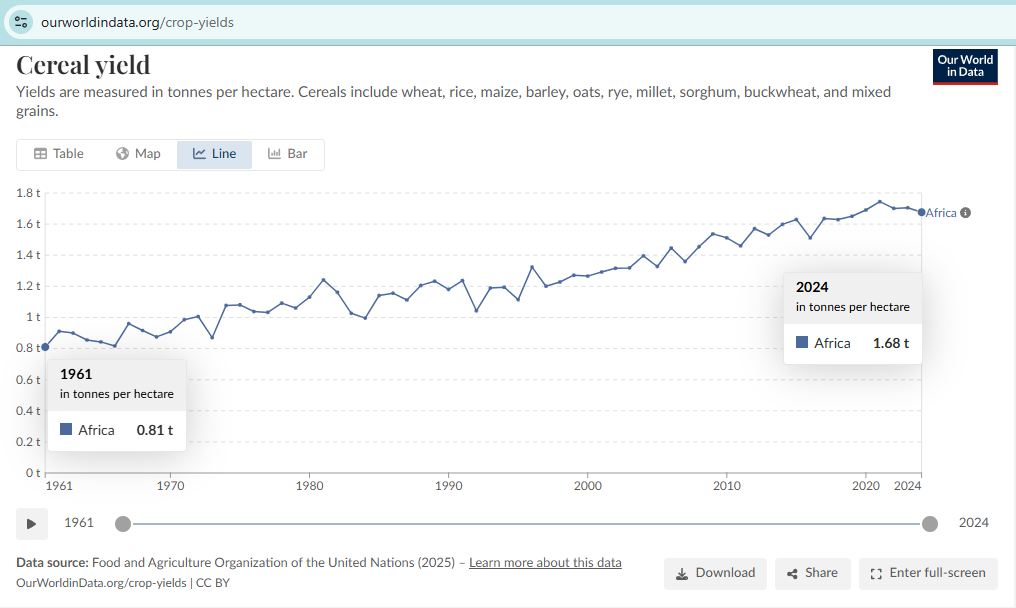
(Average per-acre cereal crop yields doubled in Africa, since 1961.)
Your point is well taken, but with one important caveat. Much, if not most of the “climate doom” scenarios are found in the popular press and are attributed without specific names to “scientists”, “the science”, “experts”, etc. The uninformed populace generally accepts such attributes as truth, and naming the source is unnecessary, perpetutating the hoax.
That the world we live in …. sensionalism sells for the media.
Just like misinformation (read lies) sells for certain politicians.
It’s tribal and you gets what yer pay for.
As it stands thanks for confirming my assertion (implied) that there are NO climate doom scenarios that have “failed” that are in any of the IPCCs writings.
Oh, could you please tell Eng_ian & Altipeuri it is they that need the sarc tag.
“sensionalism sells for the media.” [I assume you meant “sensationalism”]
The Met Office lives by tribal sensationalism.. Why is that ?
There is no climate “doom” whatsoever. !!!
You could start with Failed Predictions – from this very website:
https://wattsupwiththat.com/failed-climate-prediction-timeline/
And then move on to the Extinction clock: extinctionclock.org
Only one failed prediction is needed to disprove the whole carbon dioxide is the cause of global warming theory.
Have you actually read Thomas Kuhn’s – The Structure of Scientific Revolutions?
It’s too late, we all disappeared into a cloud of blue steam decades ago.
“Only one failed prediction is needed to disprove the whole carbon dioxide is the cause of global warming theory.”
That’s alright then, as there isn’t one.
Anthony,
Here is a list, as of 2017, by Javier Vinós, of failed climate predictions. It is a list composed only of predictions made by academics or high-ranking officials, as reported in the press or scientific journals.
https://andymaypetrophysicist.com/2017/10/30/some-failed-climate-predictions/
Read my response above …..
Essentially …..
“…… as I said, just personal opinion.
That’s why the IPCC exists … to report credible science that has widespread support.
And why they have not made any “climate doom” predictions that have failed.”
The original post did not qualify the statement as only from the IPCC. Your insistence of claiming that only the IPCC counts IS YOUR OPINION. It is not worth much. Lot’s of .gov sites, educational web pages, textbooks all have had predictions that have not come true. Like it or not the IPCC is the guy saying everybody but me is crazy.
“That’s why the IPCC exists … to report credible science”
Yet they have FAILED magnificently !!
Especially once they get rabid activists to write their “Summaries for tpolitical control”
WUWT provides decades of failed prediction records.
https://wattsupwiththat.com/failed-climate-prediction-timeline/
And no, you do not get to define who, where, or when the failed predictions were made public.
Note the stupid phrase “consensus science.”
IPCC summary report is political and intended for policy makers. It is not science.
Carbon dioxide is more than merely “innocent.” It is greening the Earth:
https://www.nasa.gov/centers-and-facilities/goddard/carbon-dioxide-fertilization-greening-earth-study-finds/
https://www.youtube.com/watch?v=zOwHT8yS1XI
(That’s a NASA video)
It is also drastically improving global food security.
That is a very, Very Big Deal. In the 1870s (with CO2 around 289 ppmv) a three-continent drought and famine killed an estimated 3.7% of the world’s population, even though they had only 1/6 as many mouths to feed as we have today. (For comparison, Covid-19 killed about 0.1%.)
When CO2 levels were below about 340 ppmv, catastrophic famines were a regular occurrence.
Thankfully, catastrophic drought-triggered famines don’t happen anymore, and elevated CO2 is one of the main reasons for that blessing.
Andy is getting closer but still missing one key ingredient. Where is the GHG IR coming from? Once this question is answered it eliminates any need for this hand waving.
It is not “upward conduction” within the TSL that changes. It is conduction from the TSL to the atmosphere. The key to understanding this lies in the answer to the question I posed.
The vast majority of the increases in IR absorbed by the oceans comes from CO2 only a few meters above the surface (99.94% within 10 meters). This is essentially a side effect of saturation. It was pointed out decades ago by Dr. Heinz Hug. So, why is this important?
Keep in mind the energy that is radiated towards the surface is highly likely initiated by a kinetic energy transfer to the GHG (99.999%). This means those 10 meters of the atmosphere cool as part of the overall process which leads to the IR transfer.
As a result, when that energy is absorbed by the TSL you have created an energy difference which is double the energy of the photon. Since conduction is an ongoing feature of the TSL and the lower atmosphere, this energy change will lead to an increase in the energy being conducted by the TSL into the atmosphere.
Conduction is just another kinetic energy transfer. You will note the energy content of the lower atmosphere and TSL are returned to the pre-IR radiation equilibrium. This is why IR radiation at current CO2 saturation levels cannot warm the surface.
Keep in mind the lower atmosphere itself is considered to be kept in thermal equilibrium by the ongoing turbulence of the atmosphere. Even though conduction occurs right at the surface, the molecules are constantly moving around. This allows us to look at the energy change from a statistical standpoint over the entire atmospheric turbulent boundary layer.
The bottom line: The energy change from increasing CO2 IR radiation to the surface is negated by conduction from the surface back into the atmosphere. The TSL itself is unchanged.
PS. I ignored evaporation changes to keep the focus on IR.
Very interesting points. The surface (meaning the lowermost atmosphere and the TSL) has a very steep temperature gradient. The gradient changes rapidly throughout the day in response to surface energy fluxes, both in and out. The net is always out, but the amount changes with conditions. As GHG concentrations increase, does the out change with it? This very much lessens any temperature impact on the surface. I’ve always thought that changing CO2 might not change the surface temperature in a measurable or consistent way. This may be why.
Conduction between the TSL and lower atmosphere is always based on the 2nd Law. Net energy flow goes both ways at various times, it is not always out. For example, a warm front could bring warmer air over colder water. However, in general (and on average) you are correct, the net flow will be from the TSL to the atmosphere.
As GHG concentrations increase you will get more and more downwelling IR. As I described, as long as the IR comes from the turbulent boundary layer, the TSL will respond with an increase in energy conducted back into the atmosphere. With CO2 this is almost always the case.
Although this discussion is about oceans, the same process works on land.
It does seem strange that downwelling IR cannot cause the surface to warm. However, once one understands all the details it makes perfect sense. In fact, once you also consider evaporation, it turns out increases in downwelling IR from CO2 will cool the ocean surface.
“In this talk I’d like to summarize the comments to illuminate this complex issue.”
Complex because it’s esoteric handwavium & imaginary like caloric and phlogiston.
ISR heats the surface unencumbered by atmospheric absorption as seen in USCRN data. Heated surface then warms the atmos. Easy to explain, easy to demonstrate.
In his 1920’s lecture notes on heat radiation Planck observed that for heat radiation to interact w stuff comparable dimensions are required.
For instance, high energy, short wave cosmic and X-rays are comparable to molecular dimensions and interact violently.
Lower energy UV rays are longer and merely produce fluorescence dislodging molecular orbits per photo-electric equation (Einstein’s Nobel).
Visible rays are long & low energy and obvious.
Infrared wave lengths are too long to interact at the molecular level as observed while standing under IR heaters at the garden center checkout counter.
BTW still standing after all these years.
Earth is cooler with the atmosphere/water vapor/30% albedo not warmer. Near Earth outer space is 394 K, 121 C, 250 F. 288 K w – 255 K w/o = 33 C cooler -18 C Earth is just flat wrong. Dividing 1,368 by 4 to average 342 over Spherical ToA is wrong.
Ubiquitous GHE heat balance graphics don’t balance and violate LoT. Refer to TFK_bams09.
Solar balance 1: 160 in = 17 + 80 + 63 out. Balance complete.
Calculated balance 2: 396 S-B BB at 16 C / 333 “back” radiation cold to warm w/o work violates Lot 2. 63 LWIR net duplicates balance 1 violating GAAP.
Kinetic heat transfer processes of contiguous atmospheric molecules render surface BB impossible. By definition all energy entering and leaving a BB must do so by radiation. Entering: 30% albedo = not BB. OLR: 17sensible & 80 latent = not BB. TFK_bams09: 97 out of 160 leave by kinetic processes, 63 by LWIR = not BB. As demonstrated by experiment, the gold standard of classical science.
For the experimental write up see:
https://principia-scientific.org/debunking-the-greenhouse-gas-theory-with-a-boiling-water-pot/
Search: Bruges group “boiling water pot” Schroeder
RGHE theory is as much a failure as caloric, phlogiston, luminiferous ether, spontaneous generation and several others.
When GHE fails the entire CAGW house of cards implodes like the Titan submersible.
“By definition all energy entering and leaving a BB must do so by radiation”
Not a true definition.
“Not a true definition.”
It’s pretty close. The *IDEAL* black body has no internal temperature gradients. The *ideal* black body is isothermal, the surface is at the same temperature everywhere.
This doesn’t leave much room for any other method of heat loss/gain, i.e. conduction or convection.
Any material involved in conduction or convection with a BB would have to have identical composition throughout and must have the exact same interface to the BB surface everywhere. Anything else would cause one of the restrictions above to be violated.
CO2 has three main IR radiation emission bands, which are the same, of course, as its absorption bands. These are equivalent to black body radiation of an object at -80, 400, and 800 deg C. The atmosphere, including the upper tropical troposphere, is NEVER 400 or 800 deg C (solar emissions are much hotter). But, everything on the surface is hotter than -80 deg C. Thus, the energy levels of -80 deg C are already full and the -80 deg C IR is reflected (rejected) and sent upward. Thermodynamics at work.
As the upper troposphere is about -17 deg C and the surface is about 15 deg C, no IR emissions of any gas there can emit IR that warms anything on the surface. Why is the discussion so detailed when the impossibility of CO2 doing what they say so obvious? In fact, physicists have been unable to get CO2 to warm anything and concluded that it is the world’s best refrigerant, being abundant, cheap, nontoxic, and stable. New skating rinks and Mercedes Benz (in A/C) have been using CO2 for cooling as the primary refrigerant. In the atmosphere, CO2 is constantly trying to cool the planet to -80 deg C by emitting IR that nothing in the atmosphere can absorb, the latter being always warmer.
Furthermore, as sea water is mostly a saturated calcium carbonate solution at warmer temperatures, the warmer water are constantly trying to remove CO2 (which is 50 times more soluble in water than the air) and kill all aerobic life on Earth. Indeed, shells in colder water dissolve rather rapidly after na organism dies.
We need more CO2, not less. Volcanoes have been our saviors as they emit CO2. We are currently in a CO2 drought and could easily handle being 4 to 10 times higher to good effect. NO global warming to be detected.
In sea water the proportions of CO2, HCO3^1-, and CO3^2- are
0.5, 89.5, 10.5.
“Thus, the energy levels of -80 deg C are already full and the -80 deg C IR is reflected (rejected) and sent upward. Thermodynamics at work.”
A common misconception of the Wien relation …
(if I read your meaning correctly)
-80C or 193K is the temperature of an emitting (BB) surface that will give a maximum within the spectrum of LW frequencies at 15 micron.
However the Earth emits at an average 288K, and although the peak emission is at an avearge of ~ 12micron it still emits way more energy at the 15 micron level that a body at -80C.
In fact ~ 5x more.
“As the upper troposphere is about -17 deg C and the surface is about 15 deg C, no IR emissions of any gas there can emit IR that warms anything on the surface. ”
No, actually the temp of the tropopause varies from ~ -80C in the tropics to ~ -50C at the poles.
CO2 does not warm the surface.
It is an “insulating” effect and slows heat loss.
At the level of the Trop GHGs emit to space.
This is a good response to Chas. Higley, however, I do not see the point in this statement
…
The only means that CO2 has to “slow heat loss” is to send some of the energy in various forms in the atmosphere back toward the surface by way of radiation. Energy transferred from one place to another is what we call “heating” or “warming” that other place.
Why the reluctance to admit that energy emitted from a cool body can land on, be absorbed by, and therefore contribute to the temperature of a warmer body? Any insistence otherwise will violate the First Law.
If the hot body is radiating at 400, then it is cooling. If you add a cool body that is radiating 200 toward the hot body, the hot body will still be radiating at 400 but also absorbs the 200. The net result at the hot body is a reduction in the cooling rate. It is still cooling, just doing so at a slower rate.
You are correct that it contributes to the temperature at any point in time, but too many people interpret this as the temperature is rising because of the added radiation. It doesn’t. If it did, it would be a perpetual machine with a constantly rising temperature.
People tend to use the term “cooling” in two ways: 1) temperature is declining, and 2) heat is leaving. The two are not necessarily the same, but they could be. If a body is radiating at 400 then I agree that it is cooling (transferring heat out), but this doesn’t mean its temperature is declining because it could be gaining energy “being heated” by some other means. The boiler in a thermal plant is cooling by virtue of sending heat to the turbine, but it is heating by accepting heat from combustion. The two balance during steady operation and the boiler’s temperature doesn’t change.
Please don’t put words in my mouth. I haven’t mentioned the Second Law at all. To decide on what the Second Law demands requires a more complete specification of any situation than what we have here. For instance, with only the barest Clausius description of a perpetual motion machine (of the Second Kind) one could argue that a recuperator in a power plant shouldn’t work because it is recovering low temperature heat expelled from the turbine and adding it to high temperature heat in the boiler. A T-S diagram, though, shows the situation fully and why the recuperator does work.
What I am objecting to here is the very contrived distinction between these two statements.
1) “Radiation from CO2 doesn’t heat the Earth’s surface.”
and
2) “What CO2 does is to slow the cooling of the Earth’s surface.”
Because the statements are one and the same. CO2 has no means to affect the surface except through radiation exchange of energy because there is far too little of it in air to have any effect on direct contact, that is through conduction, at the surface itself. There is plenty of it, though, to impact radiant exchange.
I see that someone has come along and downvoted me throughout this thread to erase any upvotes I had acquired. Sorry, downvoters, science isn’t determined by voting.
I wasn’t criticizing what you said. I wanted to make a statement so that people who read your comment didn’t interpret incorrectly.
Too many treat the surface as a black body and it isn’t. It is not homogenous and it has conduction.
All this dealing with fluxes w/o including surface effects is meaningless unless the proper system components are identified and treated.
Exactly! Obviously we have attracted the attention of a pack of alarmists that want to cause trouble. Doesn’t matter, we have facts and observations on our side.
I usually don’t downvote people, but I do take the time to explain when something doesn’t make sense. This…
doesn’t make sense. You are misusing Wein’s radiation law, which simply states where the peak wavelength of the blackbody spectrum is located at a particular body temperature. It makes no statement of equivalence, and to say that 4.3um wavelength radiation is what comes from a blackbody at 400 Celsius is going to lead to nothing but misunderstanding.
In point of fact, at 300K, which is a temperature representative of surface materials like water and soil, the blackbody radiant intensity at 4.3 um wavelength is about one-fifth that at 15 um wavelength, and the peak is found at 10 um wavelength at only slightly higher intensity than at 15 um. Temperature does not map uniquely to a wavelength. It maps to a distribution.
Meanwhile, comparing the radiant properties of CO2 as a gas to its use as a refrigerant makes no sense at all. Water is used as a refrigerant in your internal combustion engine, but this has no bearing on how effective it’s vapor is at keeping the Earth’s surface warm.
Typically, the earth is assumed to have been in an energy balance, the warming from additional CO2 should be in the order of 3.7W/m2.
There are other factors, natural and antropogenic which affect the ocean surface heat exchange, I can imagine oil films and changing wind patterns from deforestation or natural changes having an effect.
All of this makes the detection and attribution more difficult.
Albedo uncertainty is 23 W/m^2.
Elliptical orbit perihelion to aphelion is 91 W/m^2.
3.7 is noise in the data.
Any given point ToA is delta 700 W/m^2 summer to winter.
This is a post I was able to read from Go! to Whoa! but necessitating repeated returns to decode the alphabet soup abbreviations and check the shifts in focus.
Qualitative issues – what mechanism is being considered at what level of the ocean and the atmosphere was made clear and the end result was to much more fully understand the complexity and the confusion surrounding the gathering of definitive data to advance the understanding of climate mechanisms.
I remain of the conviction that ONLY by radiating energy out into space does the earth shed energy which enters into the system from the sun.
I also keep in mind that every photon which leaves the earth lowers the accumulated energy within the entire Dutch doll of spheres in the atmosphere and the ocean as well as the land.
“Greenhouse gas-induced infrared radiation is absorbed almost entirely in the ocean’s top micrometers to one millimeter. This is the upper part of the thermal skin layer.” Is that theoretical, no wind, perfectly calm and smooth surface? I was on a destroyer for a week once and I don’t know where that infrared radiation was going, but the ship was going 30 degrees to starboard and then 30 degrees to port non-stop.
Shorter wavelengths penetrate deeper, longer wavelengths penetrate less. Longwave infrared penetrates hardly at all; it is absorbed right at the very surface.
Likewise, longwave infrared radiation emitted from the ocean is all emitted right at the very surface.
Likewise, energy released by condensing humidity (latent heat) is added right at the very surface.
Likewise, energy absorbed evaporating water (latent heat) is removed right at the very surface.
In fact, all save one of the important energy fluxes to and from the ocean occur right at the very surface. (The one exception is sunlight, which penetrates an average of a few meters, though blue light penetrates farther.)
But the fact that most important energy fluxes to and from the ocean occur right at the very surface doesn’t matter w/r/t its warming effect, because the “mixed layer” of the ocean is constantly being… mixed. So water at the very surface (the “skin layer”) is constantly being exchanged for water beneath.
The claim that LW IR absorbed by the ocean does not heat it is wrong. Absorbing radiation warms whatever absorbs it. 1 W/m² of infrared radiation absorbed by the ocean warms it exactly as much as 1 W/m² of visible light.
Energy released from condensing water is released in and just above clouds, it is only released at the surface in dew or fog. If this were not true the planet would be very different.
Andy wrote, “it [latent heat] is only released at the surface in dew or fog.”
Why do you say “only?” That is a common circumstance. Anytime the sea surface temperature is below the dew point, condensation occurs.
Andy,
You make a number of valid points, thank you.
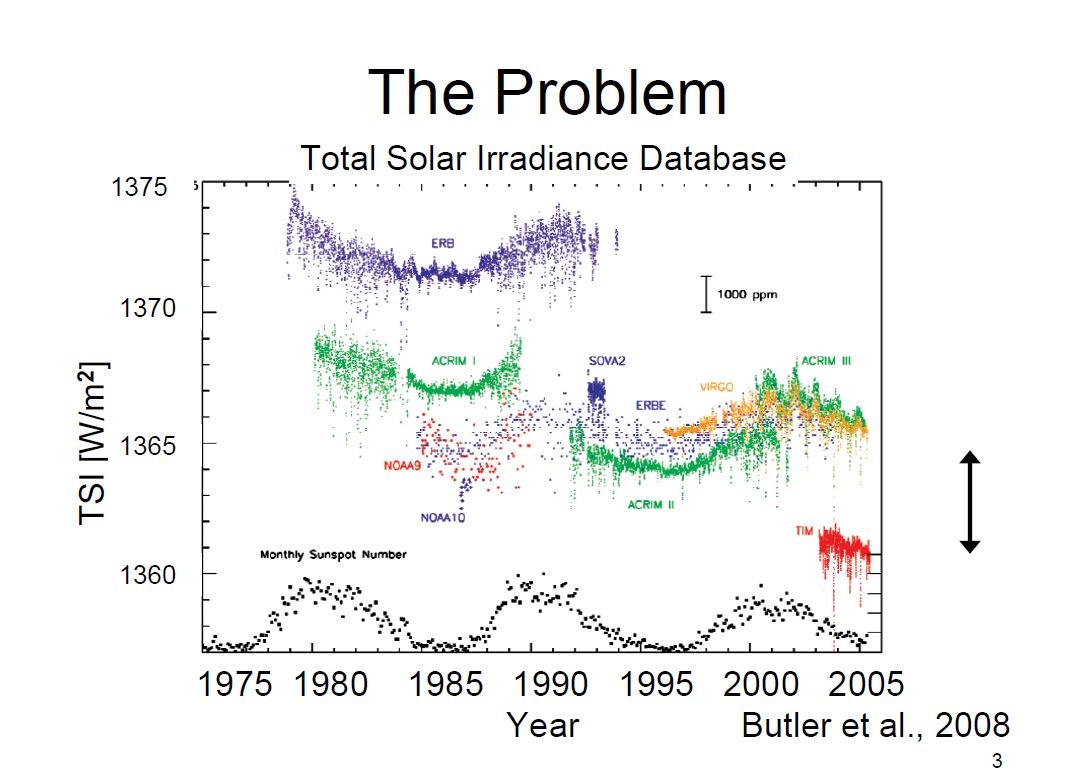
Many of them take me back to about year 2010, when I assembled the graph that opens with this link:
The problem, now some 15 years old, is that no amount of numerical or statistical delicacy can overcome the relatively huge differences between the watt/m2 calculations from the various satellite platforms. No matter which logic is used to support one outcome over another, there is no way to remove an element of guesswork because the observations cannot be repeated to verify which guesswork was best.
This type of scenario is an open invitation for favored current wisdom to graduate to accepted current wisdom. People are prone to quote that Science advances through improvements to accepted wisdom, but I have not seen much advance in the estimation of TOA balance from these early years. My “hard” view is that they should be scrapped.
Geoff S
“My “hard” view is that they should be scrapped.”
They aren’t even “measurable”. You can’t measure calculated values. If you total the sun’s energy input over 24 hours in order to create an average instead of 12 hours you get a flux value that can’t be measured. X/12 ≠ X/24
Nor do I understand why, if you know the actual total joule input over 24 hours, would you want to convert that to a hokey joules/sec value that can’t be measured? Just add up the joule output to get a total and see if the two balance!
I can’t see any correlation between the sun’s varying TSI (sunspot maximum/minimum) and the earth’s temperature.
If the sun’s UV radiation intensity varies on different sides of the sun, the UV intensity will vary with the sun’s rotation speed.
The sun’s daily UV radiation (daily MgII index) appears to vary in 30 day cycles.
The sun’s rotation speed is 25-30 days.
The earth’s daily temperature anomaly varies by 0.2-0.4 degrees Celsius in several different short cycles, one of which appears to be in a monthly cycle.
Is there a correlation between the sun’s varying UV radiation (daily MgII index) and the earth’s daily temperature anomaly?
https://www.iup.uni-bremen.de/UVSAT/data/
The earth’s daily temperature variation is “weather” just as much as anything. If the “anomaly” you are talking about is Tmax – Tmin, the measurement uncertainty is on the order of +/- 0.5C to +/- 1.5C for any specific measurement location. The diurnal temperature variation would have to be larger than this in order to really know you’ve identified a difference.
This graph is essentially a round-robin measurement intercomparison test of different laboratories using cavity radiometers, which are the most accurate instruments for irradiance measurements.
The irradiance range in the graph is 1360-1375 W/m2, which is a little more than 1%, measured by multiple cavity radiometers installed in different satellites. This range is a strong indication of the between-laboratory measurement uncertainty inherent in the technique.
That the various instruments show structure over time that lines up with sunspot numbers indicates the within-laboratory uncertainty is at least ±0.3%.
For thermopile radiometers, the total uncertainty of radiometric measurements is typically much higher, on the order of 5%.
So yes, making energy balance calculations that are inside of these limits cannot be3 justified.
I used to part-own an analytical chemistry lab to service sectors like agriculture, mining and quality control of their shipped products.
My personal income depended on performing accuracy tests from clients within our advertised boundaries. If I failed, the client went to a competition lab.
If I can had made up values, a client would soon discover the “adjustment” and go elsewhere.
Here, these TOA values are adjusted as described. There is no competitor, so disgruntled clients like me have no recourse.
The TOA sector should not go where prudent scientists do not.
Geoff S
The irradiation interval 1360-1375 TSI is at 1 Astronomical Unit.
At Earth distance, the irradiation interval is between 1320-1410 TSI.
Should 1AU or Earth distance be used in the graph?
https://lasp.colorado.edu/data/tsis/tsi_data/tsis_tsi_L3_c24h_latest.txt
The important piece is this:
INSTRUMENT UNCERTAINTY reflects the instrument’s relative standard uncertainty (absolute accuracy) and includes all known uncertainties from ground- and space-based calibrations plus a time-dependent estimate of uncertainty due to degradation.
Note carefully the phrase “time-dependent estimate”. That means a guess. Guesses add their own uncertainy. Without a specified measurement uncertainty budget it’s truly impossible to judge the reasonableness of the standard uncertainty assigned.
If you look at the data they are reporting uncertainty and resolution clear out to the ten thousandths digit. That tells me immediately that they are *averaging* something, and the averaging is actually hiding the true standard deviation that indicates actual uncertainty.
Column 6 shows the “guess” at degradation going from .16 to .32.
The link also shows:
“INSTRUMENT PRECISION reflects the TIM’s sensitivity to a change in signal, and is useful for determining relative changes in the TIM TSI due purely to the Sun over timescales of two months or less”
It shows the precision as about .007. Since the measurement uncertainty is two orders of magnitude greater than the precision how can it be useful in determining relative changes? You simply don’t know if the change is actual or not, it’s masked by the measurement uncertainty.
Bottom line? what difference does it make which you use. I don’t trust either one.
Climate trendologists would analyze the TSI versus time graph by first averaging all the data points for each year, then plot a regression line through the averages. With a negative slope of say -0.5 W/m2/yr, they could then claim imminent doom and declare the sun is going dark.
Of course if they didn’t like the result, they instead could go back and adjust the raw irradiance values to get the desired numbers.
Really? You mentioned Haigh’s paper in 2011 as the supporter of solar heating? Interesting choice of references..
Actually the later paper by Zhong and Haigh from 2013 https://rmets.onlinelibrary.wiley.com/doi/10.1002/wea.2072 is used by the AGW people to calculate the alleged heating produced by carbon dioxide molecules in the atmosphere.
If I ignored the papers where the author’s opinions differed from mine, I’d hardly have anything to read in the climate science literature. I ignore silly opinions without basis, especially in the Abstract and Conclusions which are typically just to get the paper through peer-review. It is the same with Zhong and Haigh. There isn’t much new in Zhong & Haigh, it’s all been covered in extreme detail in many articles and in the body of the paper they admit the impact of increasing CO2 on warming is very small, but in the conclusions, they try and make it sound potentially alarming.
In 2011, Haigh wrote: “the topic of solar influences on climate was often disregarded by meteorologists.” Of course, this is still true, no one understands how solar changes affect the climate with any degree of accuracy. We know it does and have some hints as to the mechanisms, but that is it. We know that CO2 concentration has some small effect on global temperature in theory, but it is so small, and Earth’s climate processes (clouds, ocean cycles, stratospheric ozone, etc.) are so powerful (as Haigh makes clear), the net effect of rising CO2 is likely lost in the noise. This is what I take from Haigh’s articles by reading the whole thing, but if one reads only the Abstract, Introduction, and conclusions, as most do, they will have a different take. This is a problem brought about by peer-review, an elaborate form of censorship that I have no respect for anymore. Haigh does good work, but ignore her opinions, the body of her papers reveal that they are pure politics.
Andy, good for you.
Regardless of what pier reviewed papers say, a lot of people here rely on their own observations. I observe my local temperatures and I have been alive long enough to recognize little if any change in range of temperatures year over year. Some are hot and some are cold. No pattern, just constantly changing weather.
Myself and others here have examined stations around the globe and find little evidence of CAGW other than UHI affected stations.
As an engineer, measurements are king. One could solve Maxwell’s equations while sleeping, but if the measurements put into them are faulty, the results are faulty. I grew up using VOM’s, progressed to VTVM and FETVM’s, oscilloscopes, and various and sundry digital instruments. I would never try to average measurements from each of those even today. They all have their own characteristics and the readings are not direct comparable. Thermometers over the years are no different. CO2 effects are hidden in the measurement uncertainty of the different stations.
Dear Mr. May,
You should read the full paper by Zhang and Haigh, 2013 which provides the formulae to calculate the heating by carbon dioxide which all AGW models used clam the heating by sun is negligible. It does not look at all as supporting the sun as the main source of heating on earth..
While you missed some pretty important references to the papers by other authors which really support the solar heating as the main source based either on the solar orbital motion or on the measurements by the CERES satellite payload.
I have read Zhong and Haigh (was Zhang a typo?) it is a short paper and not very technical and it does not say much about the impact of the sun and solar variability, for that we need to see Haigh (2011) which is quite good (except for the unsupported opinions on the dangers of more CO2). I have no problem with most of Zhong and Haigh, but disagree with their interpretation and opinions, their figure 5 makes clear that they do not see a danger or problem with the impact of CO2, although they do try and hide this by including a lot of irrelevant stuff, especially their 32xCO2 curve which is meaningless, there aren’t enough fossil fuels to get there.
The relevant curves are the 2XCO2 and the 1XCO2 curves which lie right on top of one another. Their analysis is OK, but I prefer van Wijngaarden and Happer (2020) who do a better job on this topic. The real problem with the article is not the data they show or their analysis of it, but the unsubstantiated opinion: “there can be no complacency with regards to its potential to further warm the climate.” This is not supported with anything in the article and totally unnecessary.
Likewise in Haigh (2011) she carefully says that GHGs have “a smaller effect than the total net human forcing.” But provides no evidence for this opinion. This sort of throw-away line is common in papers and just put in to satisfy the peer-reviewers and colleagues. It is important to disregard the opinions and focus on the solid data and analysis of it.
Whenever I see that NASA energy imbalance graphic (or any of its bastard cousins), I throw my hands up in disgust.
As to some of the points made, I agree. As to others, I disagree.
Given the basis of discussion is the graphic, I shall stop commenting.
Good points. I agree these various EEI diagrams are nonsense.
One other point is the obsession with IR.
The ideal black body emits a full spectrum of EM radiation.
We have satellites that measure microwaves, for example.
It is true as the surface temperature shifts in the black body, the magnitude of emitted wavelengths decrease or increase according to Plank’s Law, the Wein distribution and the Stephan-Boltzmann equation. But none of the wavelengths go to zero.
The focus on IR is primarily driven by the “atmospheric window” but focusing on 14.9 um ignores the totality of the energy transfer.
As an aside CO2 absorbs UV wavelengths that can lead to ionization or molecular dissociation.
The atmospheric window is not at 14.9 µm. It spans roughly 8-13 µm (though O3 carves out a little notch in it at round 9.5 µm).
Those are the LW IR wavelengths where the atmosphere is sufficiently transparent that a large fraction of LW IR radiation from the ground at those wavelengths can escape to space, without being absorbed in the atmosphere.