Pollen-reconstructed New Brunswick (Canada) spring temperatures affirm the Medieval Warm Period or Medieval Climate Anomaly (MCA, 900-1400 CE) was 1°C warmer (3.2°C vs. 2.2°C) than both the Little Ice Age (LIA, 1400-1850 CE) and modern period (1850 to present).
Other sites in this region also show no net warming since the 1800s and 1-3°C cooling from the MCA to the LIA.
This new research also identifies a higher frequency of natural forest fires during the LIA cooling period than the warmer MCA.
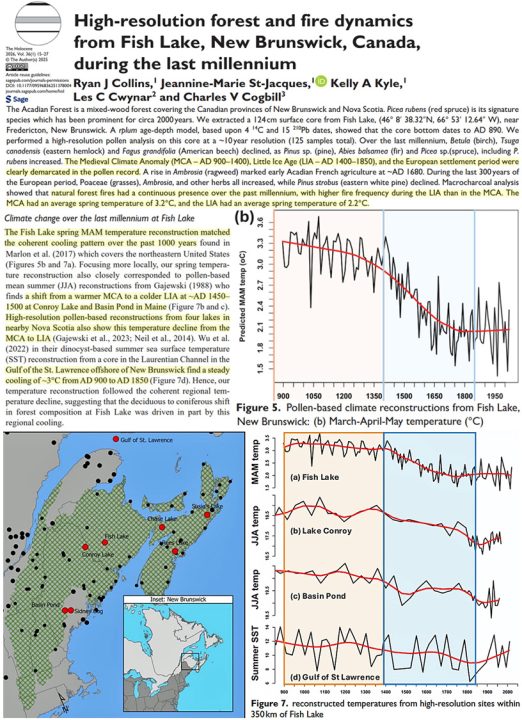
Image Source: Collins et al., 2026
“Pollen based climate reconstruction”. Really? That sounds like tree ring based climate reconstruction – and just as fanciful.
In the conclusions, “fires recorded in the 19th century can be plausibly connected to the historical fire record of the timber industry”.
Colour me impressed. It’s plausible that recorded fires can be plausibly connected to the fires recorded? Wonders will never cease!
Somebody might inform the authors that climate is the statistics of weather observations, but I doubt it.
Eastern Canada has been resided in by humans for 10,000+ years, ever since the ice melted. Those humans set fire to the landscape frequently. This is established historical fact. The authors’ cavalier and frankly racist use of the term “natural fires” demonstrates their profound ignorance and biases.
The historical fire frequency, location, and extent, just like today, is an artifact of human agency and human choices. Attributing ancient fire to climate micro-change is disingenuous and fallacious.
Interesting, tree rings cannot be used for climate reconstructions, therefore nothing can be.
Please try to learn something before pontificating.
Each type of plant produces a different pollen and the types of plants that grow in a region can be determined by examining pollen deposits.
Since different plants have different climate preferences, climate can be estimated by examining pollen deposits.
In the conclusions, “fires recorded in the 19th century can be plausibly connected to the historical fire record of the timber industry”.
Timber harvesting would be limited even a few centuries ago.
‘OR For’ makes a good point about people setting fires to do things.
Coast Salish felled trees with fire to create more open space for food plants like Camas Lilly, and periodically burned them to suppress competing species and insects – they were farming, improving the land to grow more food. (Druids in BC worship the ‘Garry Oak Meadows’ that resulted. The natural form of Garry Oak is forest, but Douglas Fir will supplant it, just as Garry Oak supplanted the early-in early-out Aspen species (inlanders can think Trembling Aspen).)
There’s research suggesting other uses of fire in the ‘pacific northwest’, such as clearing a trail into the mountains each spring. Belief is they chose wet time to limit spread of fire but weren’t always successful at doing that.
So the warmth of the Medieval Period has now become an anomaly has it? Well I suppose in the context of a glaciated Earth it might be, but in that case I’d rather be living in an anomaly.
I scoffed at that, too, when I read it.
Liars, always trying to control the language.
All previous warming was regional.
All previous cold spells were regional.
Ignore the fact that these regional episodes also occurred nearly everywhere else at more or less the same time.
Must be like the phenomenon of plants communicating with each other. :-o)
(Actually responding to same stimuli.)
Surely that can’t be so. Between the scorching heat, monstrous storms, catastrophic droughts and floods, ravaging diseases and boiling oceans, mankind would not have survived. Oh wait, that’s from CO2 heat. Oops.
Michael Mann is not going to like this study.
Where are the error bars on the graphs? I’ll bet they’re wider than 1C. And what exactly is “high resolution”?
I see the resolution, 10 years. Which could miss El Nino/La Nina and other events.
In regard to previous climate, Kristian Kristianson’s lecture on ytube is interesting. On the basis of a combination of archeology and paleogenetics he points to the neolithic farmers becoming smaller and large settlements being abandoned in a cooling period about 3250 years ago. This, combined with the arrival of mutated ursinia pestes (plague) led to major population collapse just before the Yamnaya arrived to replace virtually all Y chromosome variants in Europe.
Weather sure has major effects on people and animals. This talk is well worth an hour.
https://www.youtube.com/watch?v=bxTVSwt-jsU
No doubt the provincial or federal authorities will think of ways of justifying the re-introduction of carbon taxes to prevent runaway warming that could turn New Brunswick into another Sahara almost overnight.
Canada needs all of the old-time Global Warming that it can get its hands on.
What is the significance of the following statement I found in the study?
“A few cautions must be raised with respect to the Fish Lake climate reconstructions. A major issue in doing climate reconstructions based upon modern pollen-climate calibration sets arises because human-caused landscape disturbance is so severe in much of the world (certainly in northern New England, the Maritimes, and southern Québec) that vegetation no longer reflects climate in the same way that it used to prior to this severe anthropogenic disturbance (Kujawa et al., 2016; St-Jacques et al., 2008, 2015). Hence, when transfer functions constructed using modern pollen-climate calibration sets are used for the inference of past climates of more pristine landscapes, unavoidable errors arise such as substantial climate signal bias and underestimation (St-Jacques et al., 2008, 2015). A further source of loss of sensitivity in our reconstructions arises from having to pool all Picea, all Pinus, all Alnus and all Acer species together, despite their different climate optima (Thompson et al., 2015) due to the low taxonomic resolution used by previous researchers whose compiled results form the pollen-climate calibration set (Whitmore et al., 2005).
Despite issues existing with the precise values of our climate reconstructions, they are sufficiently reliable for comparison to the general patterns found in regional syntheses (e.g. Ladd et al., 2018; Marlon et al., 2017; Shuman and Marsicek, 2016).”
Ayup – that’s when Vikings farmed southwest Greenland.