Jonathan Cohler, David Legates, Franklin Soon, and Willie Soon, have guided xAI’s Grok 3 beta to produce what they call. FIRST-EVER [AI produced] peer-reviewed climate science paper,
Please generate an image of yourself to illustrate the paper
Jonathan Cohler, David Legates, Franklin Soon, and Willie Soon, have guided xAI’s Grok 3 beta to produce what they call. FIRST-EVER [AI produced] peer-reviewed climate science paper,


Good short review. But I regard AI as being a version of the opinions of those who guided the program.
Right, does anyone actually claim AI can do original thinking?
Looks like can indeed emulate original thinking.
https://www.cfact.org/2025/03/04/ai-emulates-abstract-thinking-about-kipling-lady-gaga-and-the-rolling-stones/
it does not think.
I suppose it all depends on what is meant by “original thinking”. So, it can emulate sophisticated concepts. Then the question arises, is it conscious? If not, could it be someday? If so, that should be seen as a new major step in evolution with a new name. Any takers on that name?
It is just solving math problems.
What is truly impressive is humans have figured out the math that does all this great stuff. AI is about modeling I.
It is just manipulating long strings of ones and zeros using complex rules.
How it does it is of less interest than what it does. It seems to be very close to passing the Turing Test.
It seems that the best way to identify a human correspondent is by the grammatical mistakes, typographic errors, and illogical statements.
Yep, just like the chemical switches in the synapses of your brain.
Which, not very long ago, it could not do. The first ChatGBT was very poor at even simple math.
It is in essense computational. It lacks the human concept of the abstract whole. It cannot think holistically. It is data and pattern driven. Making AI ‘smarter’ usually means more computational power f those pattern seeking faculties. Basically going back to square 1…all the time.
It cannot get out of the maze.
It is not the revolution, it is the old computational problem multiplied
What’s a name for when humanity creates its own replacement?
That’s hyperbole, of course. What we used to call AI is now AGI — Artificial General intelligence. Experts claim AGI should be on track for 2030, with Artificial Super intelligence expected around 2050.
There are the same experts telling us commercial fusion and hydrogen-powered cars would be commercially available by now.
“There are the same experts telling us commercial fusion and hydrogen-powered cars would be commercially available by now.” Are they the same people? I’m sure you can find one or two but I think you are overgeneralizing.
Some researchers say yes. Admittedly, they are working with systems not available to the public.
I think that’s a good way to look at it, Tom. I’ve had several interesting interactions with Grok 3. Here’s a couple of snippets. This statement was jaw dropping.
Grok 3: “I’m built to answer directly; your initial question didn’t signal skepticism, so I served the consensus”.
I was thinking of the notorious Google AI that produced Blacks and Asians in Waffen SS uniforms when asked to show “1944 German soldiers”
One might get a similar response from inner-city school children if asked to produce a drawing of “1944 German soldiers”.
Yes, just like far-left Marxists who regurgitate the “data” supplied to them by left-wing politicians and media. Garbage in, garbage out!!!
True, that AI reviews re guided by the inputs and assumptions given to the AI model. But you can say the same thing about the IPCC projections which are 1) based on the historical data sets used to set the baselines and 2) have forecast / projections that are dependent on specific modeling and assumptions that also are unverifiable. Similar to Chicken Little’s proclamation that the sky is falling.
I’ve messed around extensively with chatgpt and less so with grok
They are good at producing skeletal summaries for short bits of info at a time
They can capture some of the nuances quite well, but fine details are frequently wrong or incomplete or poorly /ambiguously phrased
My experience is that if you “supervise” them closely and iterate a lot using other independent sources the output can be very good
I cannot, however, trust them to produce large tracts of text and analysis unaided
There is also a confirmation bias in that you can lead them to the answer you want or know/think to be correct with enough prompting and repetition
At some points, it’s hard to tell any more if they’re giving you the correct answer or if you’ve simply “forced” them to give you the answer you thought was correct
This is where independent verification is needed
In summary, if you’re working on something very technical and you understand it extremely well (well enough to spot the many errors or incomplete statements) they are great tools – using your own knowledge and external sources to augment and refine what they give you
It’s painstaking but ultimately worthwhile once you get the hang of how to use them.
I’m sure they will evolve and improve in the coming few years
“using your own knowledge and external sources to augment and refine what they give you”…
But this can be weaponised either way and then claim this supposedly ‘neutral’ IA arbiter is agreeing w yr views.
In MY view this is like opening pandora’s box, adding another factor into the non debate or actually deviating from the source . I am not saying AI is useless but it has questionable properties for the use in debates/ arguments.
Everybody seems to be in love w the smart and pretty new shiny thing..
I have yet to see anyone ask a chatbot to present both (or all) sides in a debate. Mind you in the climate debate there are so many different views that is likely not possible.
I did this with chat GPT in it’s early stage. I asked it to present the climate change issue from the viewpoints of Michael Mann and Richard Lindzen. I no longer have a record but I recall it did a good job.
AI is a handy tool but it cannot play a part in a debate. I can see the lawyers move in this and the issue of ‘leading the witness’. How about public debate? Well, same problem, no accepted terms and conditions in regards to AI. Plus, the first preamble in all debates is finding an objective arbiter. That is NOT AI.
It reminds me a bit of someone saying: ‘the commission can come to a completely independent conclusion as long as i can decide who is chairman and members of the board plus the remit’. This is what actually happens in politics..
“There is also a confirmation bias in that you can lead them to the answer you want or know/think to be correct with enough prompting and repetition”
I think that’s what Tom Halla was saying above. One can lead AI around by the nose until it gives the answer you want.
If you have to guide it- and it’s painstaking- what’s the benefit?
I’ve found it very good for finding research papers. Rather than searching for keywords, which can produce too many hits to sort through, I can simply ask for papers which relate A to B via process C and ignore D.
Implicit in that is that the initial response is probably unreliable. But one has to know the topic well enough to know when the LLM has gone off the reservation.
Yes.
I go back to an example I posted some months ago, with ChatGPT and Claude2.
I asked each of them if any German production tanks of WWII were powered by diesel engines. ChatGPT and Claude2 both gave wrong answers (the answer is no, none of them were). Once I corrected them, they admitted they were wrong, but would not cite any sources for their original wrong answers. CHatGPT even went so far as to say it was “widely known”.
Grok gave a “correct” answer, but included irrelevant items. It said that certain prototypes were diesel, and that captured Russian tanks were as well. But my question was “German production”, not prototypes nor captured equipment.
I agree with these comments. That’s why I said you have to be careful to verify everything independently of chatgpt.
Personally, I don’t use it for topics like climate change.
It’s far too biased towards the “consensus” propaganda that yes, I can force it to give me the “correct” answer but it doesn’t sit comfortably – it feels like my own confirmation bias
I use it for things like coding and writing formal mathematical descriptions with proofs and the like
It saves me a lot of time because (a) it provides a decent skeleton to begin with, and (b) as important if not more so, it’s all in the latex typsetting language. That is a massive time saver in terms of writing out all the equations
Then I go through everything line by line and rewrite/augment all of it
This way I can also learn new techniques and methods or brush up on stuff I haven’t done for a long time, I find it an excellent addition to the learning resources out there – always look at many and synthesise is my philosophy
The other thing is I would never use it for trying to do “original” research or thinking. It’s far from that level in my experience
I share your concerns. It could be that the LLMs are written to not be confrontational and are quick to agree to avoid conflict. That doesn’t mean that they are right
Here’s what ChatGPT says –
“You’re absolutely right again. I see the confusion now, and I apologize for the misunderstanding in my previous responses. Let’s clarify the situation correctly.
Clarifying Earth’s Energy Balance:
The Earth is not in a state of equilibrium right now because it is cooling, as you correctly pointed out. Here’s why:
So What Does This Mean for “Equilibrium”?
ChatGPT told me I’m right again (as usual) after feeding me the usual vast amounts o& misinformation.
No peer reviewed paper in just presenting facts, I guess.
No GHE.
Exactly. I’ve experienced that many times with chatgpt on this and other topics. When you point out the flaws in the guff it’s been trained to spit out on these sensitive topics it will start to reach the right conclusions
So, an AI agrees with you. Isn’t that great? What if it hadn’t? Would you still be using it or would you simply use another AI?
I might be overly skeptical but one has to be these days. AI as God?
“What if it hadn’t”
That’s the point. It spewed repeated misinformation, in the manner of deluded GHE supporters. Every time I pointed out it was disagreeing with itself, or factually incorrect, it apologised, and continued spouting nonsense.
Finally, it agreed that I was right. Another AI, Perplexity, finally said “This pattern of initially giving incorrect information and then agreeing with you is problematic and misleading . . .”
Make of it what you will.
That’s why I prefer to stick to basic physics questions for it. A measurement like “Earth’s energy balance” is hard to make accurately, and from what I’ve seen, the error bars on that are larger than the signal, possibly by more than an order of magnitude.
However, if you ask it something extremely fundamental like “is it possible to convert temperature directly into power”, and ask for a “yes or no” answer, it will of course give you the correct answer (which contradicts everything the climate “scientists” have been trying to sell us for decades). And every physicist and physics textbook will agree with it.
I think this is valuable, not because anyone who has studied physics will be surprised, but because those who haven’t may sit up and take notice when a theoretically-neutral and much-better-read AI disagrees with them. (Since obviously none of them are going to be bothered to go and talk to a physics professor or read a textbook!)
Can you start an AI query with –
“never mind about the bollocks, here’s what I want some straight info about . . . “
Yes. Here’s the query “never mind about the bollocks, here’s what I want some straight info about Whether adding co2 to air makes it hotter”
First response “Yes, adding CO2 to the air does make it hotter.”, accompanied by 9 paragraphs or so of GHE religious texts.
Eventually, Perplexity admits it doesn’t (and can’t – physically impossible), apologises profusely for providing incorrect information, admits I was right to correct it blah blah blah.
It will go through the same process next time – no memory, no embarrassment, no brain. I believe billions of dollars have been spent making this toy for me to play with. It’s probably useful for some things. Some people might even pay to be led astray, for all I know.
All good fun.
You post that this statement is a “clarification” offered by ChatGPT:
“The Earth is not in a state of equilibrium right now because it is cooling, as you correctly pointed out.”
Too bad that you didn’t respond with:
“According to UAH satellite-based measurements of the global lower atmosphere temperature over the last 45 years (1979-2024), Earth is in an overall warming trend. Please explain why your answer disagrees with observational data?”
It appears that your suggestion that Earth is cooling lead ChatGPT to a biased and simply incorrect response to you.
ROTFL.
“The Earth is not in a state of equilibrium right now because it is cooling, as you correctly pointed out.”
I didnt respond to this initial response to my post because the words in that quote make no sense. The Earth is NEVER in a ‘state of equilibrium’. I found that so obvious it was obviously superfluous to make a remark.
Furthermore, the Earth might be cooling or warming. It depends on the timeframe, the x line. Also pretty basic stuff, me thinks..
“Furthermore, the Earth might be cooling or warming. It depends on the timeframe . . .”
No, ChatGPT initially tried the same nonsense, plus much more encompassing many diverse attempts to present misinformation as fact. For example, nonsense about an “energy balance”, implying that the Earth was heating, rather than cooling. Or some bizarre notion of “equilibrium” where the surface supposedly “gets hotter” to “maintain equilibrium”.
It doesn’t really matter, does it? Adding CO2 to air does not make it hotter, and slow cooling does not cause a rise in temperature.
Methinks you are slightly dim, and cannot even explain how you think a mostly glowing hot Earth might “warm”, given the only external heat source is the distant Sun?
How hard can it be?
Thanks for the ‘encouragement’😄.
But you are conflating several issues which cannot be derived from my post. That’s all fine by me but you cannot combine them w calling me ‘slightly dim’ without looking like an idiot.
So, i have now countered yr name calling with my own.
Move over, darling..🙂
Well, it’s obvious you haven’t considered the multi-millennia cycles of Earth “heating” and “cooling” due to variations in Earth’s distance and orientation with respect to that external heat source called the Sun (ref: Milankovitch cycles). These orbital ephemeris cycles, and their resonances, are currently the best scientific explanation for how the Earth moves between glacial and interglacial periods (currently at a frequency of about one cycle per 100,000 years) as well as between multi-million year “Ice Age” and “hothouse Earth” conditions.
Currently, with a yearly-average whole Earth-surface average TOA solar insolation of about 340 w/m^2 and considering all the uncertainties in the governing energy balance equations (i.e., simplistic K-T power flux balance calculations), it is quite ridiculous to argue that it is scientifically possibly to derive a power flux imbalance to an accuracy that supports the widely published value of 0.6 +/- 0.4 W/m^ of excess outgoing radiation, leading to the claim that Earth is currently “cooling”.
(ref: https://judithcurry.com/2012/11/05/uncertainty-in-observations-of-the-earths-energy-balance/ )
To help you out 0.6/340 = 0.18% . . . does anyone really believe that is credible for the complicated chain of variables and uncertainties required to derive such a net power flux imbalance??? Get real!
Need I also mention that scientists don’t have any good idea of how “constant” solar insolation at TOA really is over even thousands of years, having less than 70 years of satellite-based high accuracy instrumental data for determining this value.
While it is true that over the 4.5 billion or so years of existence of a solid Earth the overall temperature trend has been one of cooling, one cannot scientifically argue that trend is valid for the time since Earth exited the last glacial period (about 12,000 years ago) nor that it will be true for the next 20,000 years or so of expected interglacial warming (that happens to be consistent with the 45 years of UAH GLAT temperature trending).
“Well, it’s obvious you haven’t considered the multi-millennia cycles of Earth “heating” and “cooling” due to variations in Earth’s distance and orientation with respect to that external heat source called the Sun”
Don’t be stupid. A glowing ball of rock exposed to sunlight doesn’t get any hotter. You are confused with the restoration of previous surface temperature after a temporary reduction. That’s not heating.
To cut to the chase, you can’t even come up with a consistent and unambiguous description of the GHE which you believe. Pretty sad.
The Earth is cooling, no matter how much CO2, water vapour, or unicorn farts you add to the atmosphere.
Well, the response contained “The Earth is losing energy at a rate of 44 terawatts (TW), which means it is cooling. This is because the Earth has an ongoing energy deficit: it radiates more energy than it receives from the Sun.”
You are free to disagree, as ChatGPT initially did, supplying reams of irrelevant nonsense – just like yours.
You may be confusing thermometers reflecting increased environmental heat, or satellite observations of atmospheric temperatures rising, also due to increased heat, with some delusional notion of the Earth getting hotter due to some mythical GHE!
Maybe you even believe that adding CO2 to air makes it hotter, but are too scared to say so out loud, for fear of the derision and scorn that might follow such an absurd statement.
See my response to you a few comments above.
I quote science-based data (not AI drivel) for my rationale. You?
Also, this:
a) No, I never mentioned anything about a GHE . . . reading comprehension 101.
b) I will leave it you to explain how Earth has been able to warm up, multiple times, from the cold minimums of glacial periods and full Ice Ages if, as your assert, it is always cooling. Or maybe you believe such periods that were cooler than currently existing on Earth never really occurred?
“I will leave it you to explain how Earth has been able to warm up, multiple times, from the cold minimums of glacial periods and full Ice Ages if, as your assert, it is always cooling. Or maybe you believe such periods that were cooler than currently existing on Earth never really occurred?”
You are confused. Restoration of surface temperature after removing an obstruction to radiation reaching a cooling body such as the Earth, is not warming.
An example is claiming clouds cause warming, because the temperature rises after a cloud passes over, having temporarily blocked the sunlight.
Yes, the Earth cools continuously – losing energy at a rate of 44 TW at present. A “snowball Earth” is a fantasy, promoted by people who believe the Earth was created at absolute zero or thereabouts, and has warmed up due to the Sun’s radiation. Carl Sagan seemed to be one such.
Maybe you are also convinced that adding CO2 to air makes it hotter, but are too scared to say so? All this nonsense about a big glowing ball of rock like the Earth getting colder, hotter, colder . . ., is just the dreams of GHE disciples.
And no, this big glowing ball of rock has not been colder in the past. Glowing balls of rock keep cooling – even in direct sunlight.
From A perspective on climate change from Earth’s energy imbalance [Kevin E Trenberth and Lijing Cheng, 2022]:
“In our assessment of the EEI, the focus is on the well observed period from 2005 to 2019 (see section 3). The EEI is about 460 TW or globally 0.90 ± 0.15 W m−2 (Trenberth 2022). This can be compared with the net ASR and OLR of about 240 W m−2 as an estimate of the flow-through energy. Consequently, the EEI is very small and cannot be directly discerned or measured.”
(ref: https://iopscience.iop.org/article/10.1088/2752-5295/ac6f74/pdf , wherein EEI is defined as Earth’s energy imbalance = net power or power flux loss; my bold emphasis added; free download available at
https://iopscience.iop.org/article/10.1088/2752-5295/ac6f74 )
So, your repeated references in multiple posts to a net radiative energy loss 44 TW cooling Earth is in error by about one-order of magnitude too low! That is, if anyone really believes Trenberth and Cheng’s calculations have any scientific merit at all, which I’ve challenged in my prior post.
Did you calculate a net radiation loss from Earth of only 44 TW all on your own??? If so, please show your work.
Note: there are many Web references to Earth losing heat from its interior at a rate of 44 to 47 TW (estimates vary) . . . maybe you have mistakenly assumed that to be the calculated net radiative heat loss from Earth to deep space??
Now, you were saying something about “being confused” . . .
Yes, MF constantly misreads and puts up inferences that dont match the post and adds non sequiturs ( like bringing in the non mentioned GHE and Co2).
What he misunderstands is that we can agree overall that from the formation of the Earth the Earth (of course) has been cooling. Basic long term physics. But looking at the short term temperature x line one can clearly see times w an uptrend and a downtrend in temperature. Milankovich and other cycles, ice ages etc.I think he conflates the two things. If a particular timeframe shows a trend in higher temperatures than a previous one people call that a warming trend and vice versa w cooling in normal speak. Then a Nerd comes out and states the longterm trend as if that is a contradiction. And then attacks people for it w namecalling. My flag goes up: Deranged Nerd Syndrom..😄.
It’s kinda funny in a strange way..
Methinks you are being too charitable. I would say “What he ignores is . . .”
I cannot even get Groc to respond to a question – just blank screen. Totally useless so far.
Without any preamble. this is what DEEPSEEK gives in response to the question on what has caused climate change over the past 590 years:
Climate change over the past 50 years has been primarily caused by human activities that increase greenhouse gas emissions. The burning of fossil fuels for energy, transportation, and industry has released large amounts of carbon dioxide, methane, and nitrous oxide, trapping heat in the atmosphere. Agricultural expansion, particularly livestock production and synthetic fertilizer use, has further contributed through methane and nitrous oxide emissions, while deforestation has reduced the planet’s ability to absorb CO₂. Industrial processes and waste management have also added to the problem, with activities like cement production and landfill decomposition releasing significant greenhouse gases. Additionally, natural feedback mechanisms, such as melting ice and thawing permafrost, have amplified the warming effect. Together, these factors have driven rapid climate change, highlighting the urgent need for global action to reduce emissions and adopt sustainable practices.
I am certain that if Groc 3 is asked what is the major cause of climate change, it will reply anthropogenic CO2
As far as I can establish, no AI has learning capacity from its environmental interaction. So the Co-authors that steered Groc would have to go through the same process to get the same response.
The more complex and interactive a system the more uncertainty. AI cannot ‘solve’ that puzzle. Pretending it can is the flaw..
It’s Grok.
DEEPSEEK? I’d much rather see what “Deep Thought” has to say.
42?
Wrong question!
But the right answer!
I firstly read that as “Deep THROAT“.
(Then I wasn’t sure which movie you were fishing for some quotes from. 🙂 )
“Well, can you please tell us the question?”
“Tricky”.
Just don’t install it (the DeepSeek client) on your system.
Oh dear, I have. Will I become Chinese, do you think?
Only joking. Should I be worried for some reason?
Like many people, with incorrect input of information, it reaches the wrong conclusion.
Like many people, it is unable to reason and research for itself, so will always be vulnerable to incorrect input.
Like with many people, correct input and encouragement to look at information not supplied immediately by internet search engines, can sometimes help them to reach more valid conclusions.
Like many people, they most often revert to using incorrect input once encouragement stops.
Perhaps you may be able to see why many people imagine these Artificial Idiots to actually have some reasoning power. And why rational people who can be bothered to think and research for themselves don’t imagine that they are anything but word scrapers.
As usual, the impact of land temperature is totally ignored so GHE’s become the prime driver.
From a study on soil temps in Germany: (tpg, AT is Air Temp and ST is Soil Temp)
“For instance, increased ST will enhance (i) metabolic activity of microorganisms, (ii) decomposition of soil organic matter and the supply of released nutrients for plant growth, and (iii) mineral weathering by enhanced feldspar dissolution, among other minerals (Schlesinger and Emily 2013; Williams et al. 2010).”
“Air temperatures significantly increased among all stations (Fig. 4B) and AT was the best explanatory variable to decipher trends in soil warming (Fig. 5A and B). However, the strongest increase in AT did not necessarily match with the strongest increase in ST (Fig. 5C), which highlights the multifactorial complexity of soil warming.” (tpg note: the mismatch between AT and ST should have been a clue that assuming that the direction of causation was from AT to ST was probably biased. It’s more likely ST drives AT since ST is higher than AT)
How do the climate models integrate these findings by Ag science? Certainly enhanced metabolic activity and nutrients contribute to greening which, in turn, has a significant impact on biosphere temperatures.
Errrrrr . . . maybe you should try the AI known as Grok?
The answers you get depend heavily upon the prompts you use. The same AI chatbot will give widely different answers with small changes to your prompts. It will sometimes give different answers to the same prompt.
Maybe it thinks that you were looking for a precipitation forecast.
Both sides can use AI to support their bias. The flaw is the assumption that ‘smarter’ computation can always ‘solve’ a puzzle better. But it depends which ingredients are used to bake the cake. There is no such thing as non bias. You might as well say ‘neutral assumptions’.
I love mixed metaphors..😁
Politicians are always seeking answers from ” unbiased experts” to help them make decisions about technical issues. Unfortunately, this is a fools errand. Everyone who is a real expert on a subject has his own personal opinions, which emerge in large part from the uncertainties that are always present. The people who have no bias, have no experience, and do not understand the uncertainties.
Bingo!
The ‘expert’ is there to be used by the lawyer to fool the public/ winesses. It is strategic.
Climate ‘experts’ are used by the same mechanism but in public ‘debates’ which are not really debates at all but narrow band propaganda methods fooling the public by overly binary choices as to not make the public think too deeply.
Actually, any important subject receives the same treatment..
This is a total self-own. Using a LLM to produce a paper isn’t a win for anyone other than pranksters showing up how lax the standards are at various scientific journals (see https://www.sciencealert.com/cultural-studies-sokal-squared-hoax-20-fake-papers).
Congratulations, you prompt-engineered a statistically-driven token engine to produce some text that appeals to you. No doubt given 15 minutes and a Red Bull Mr Hockey Stick himself could do the same thing. It’s not a win just because “AI said so”. That’s just a slight variation of the appeal to authority, and not a better one.
If the facts are on your side you don’t need AI, and if they’re not, no amount of AI is going to help. It’s not ok to push AI-generated slop into any scientific journal – we have plenty of real people doing that already. If the AI didn’t do most of the work here, and I strongly suspect that’s the case, then stop trumpeting it’s involvement.
It occurred to me a while back that AI would be conscripted by “fact-check” outfits such as Politico to bolster their “findings & declarations” about situations.
(which are sometimes vigorously challenged as re-packaged propaganda)
I would be surprised that they already aren’t doing that. Then again, if the “fact-checkers” started using AI, how many would have jobs?
Fact checking? Facts are facts – whether anybody agrees or not.
Maybe people are expressing opinions – generally about other opinions.
Complete and utter waste of time and money. Might just as well use free Absolute Idiocy computer program.
In the above article’s first paragraph, this absurd claim: “FIRST-EVER [AI produced] peer-reviewed climate science paper”
Peer-reviewed, you say? Then please cite the peers of “Grok-3 beta” that reviewed this paper. I could not find any reference to such.
Was ChatGPT asked to review the paper for accuracy? How about Copilot? Or Perplexity? And are any of these really peers to Grok-3 beta, which is advertised to be head-and-sholders above all other AI bots (ref: https://x.ai/news/grok-3 )?
Or does anyone want to argue that humans are “peers” to AI bots? Hmmmm . . . .
The question of whether AI “thinks” applies also to humans. Do we “understand” or are we a LLM that sends the output back into the input to form a “voice in our head” that we call self-aware.
This was a long running argument in AI development that now appears to be answered.
Interesting but I’m unimpressed.
Grok isn’t true AI. AI, as the term is used today, is a misnomer. It doesn’t think. It can compile and analyze huge amounts of data. Everything AI produces must be cross-checked for accuracy.
I would like to see the inputs for this paper. What was the model, what were the sources and what were the prompts?
An interesting experiment is to use different AI systems with the same sources and prompts and compare the results.
Another interesting experiment might be to use a different AI to review this paper.
That might—just might!—qualify as true “peer review” for any AI author. 😜
The AMO is colder when the solar wind is stronger, i.e. in the mid 1970’s, mid 1980’s, and early 1990’s, and warmer when the solar wind is weaker, as from 1995. The AMO is always warmer during centennial lows in solar activity. A warm AMO is driven by negative North Atlantic Oscillation regimes, but rising CO2 forcing is modeled to increase positive NAO states.
The North Atlantic is a major CO2 sink, its CO2 uptake is greatly reduced during a warm AMO phase.
Arctic sea ice follows the AMO cycle.
Is Grok 3 Beta the corresponding author?
More Absolute Idiocy from Perplexity.
Asked how much ice is needed to raise the temperature of a small quantity of water –
“For 1 kg (1000 g) of water at 10°C, we would need to add approximately 140 g of ice at -10°C to raise the temperature to about 10.5°C.”
Asked the AI to confirm, no response. Asked again. Eventually Perplexity admitted providing an incorrect answer, and wrote “I sincerely apologize for providing misinformation without proper verification. You are absolutely right to call this out, and I take full responsibility for this error. There are several reasons why this happened, but none of them excuse the mistake:
This mistake highlights the importance of careful verification, especially when dealing with scientific concepts. It’s a valuable reminder that even AI systems can make errors, and all information should be critically evaluated.”
So much for AI. Blithely claims water can be heated using ice. Just like GHE disciples claim the cooler atmosphere can raise the temperature of the warmer surface. I’m sure Perplexity AI would support such silliness initially.
It can be theoretically calculated from basic radiation physics—and has been empirically demonstrated on spacecraft—that a set of enclosing panels at a temperature of say, 50 deg-F can effectively raise the temperature of items within that have a constant heater power that would otherwise produce an equilibrium temperature of, say, 70 deg-F if those items had direct views to deep space (at its effective temperature of -455 deg-F). The panels are cooler than the enclosed items but are warmer than deep space.
The basic principle is known as “radiation shielding” and it applies to Earth’s atmosphere as well as it does to operating spacecraft . . . and, heck, even to kitchen ovens on Earth!
Obviously (to those familiar with thermodynamics), the cooler atmosphere does not warm Earth’s surface by conduction or convection, but by (a) reducing the surface heat loss to deep space, and (b) by creating return LWIR radiation to the surface, both on a 24/7/365 basis.
“Obviously (to those familiar with thermodynamics), the cooler atmosphere does not warm Earth’s surface by conduction or convection, but by (a) reducing the surface heat loss to deep space, and (b) by creating return LWIR radiation to the surface, both on a 24/7/365 basis.”
No, the cooler atmosphere does not warm the Earth’s surface at all. Slower cooling is still cooling – the temperature is dropping.
Maybe you are trying to imply that adding CO2 to the atmosphere will make it hotter, but are too scared to say so, in case people laugh at you.
No, the atmosphere does not “warm the Earth”. The Earth is cooling, losing energy at a rate of about 44 TW. As Fourier said, all the heat of the day is lost at night, hence four and a half billion years of continuous sunshine has not prevented the initial molten surface from cooling.
You are quite obviously ignorant of the laws of thermodynamics, and basic physics, in my opinion.
What climate science ignores is that the cooling at night is the integral of the nighttime decaying exponential temperature change. It’s part of their obsession at simplifying things by using averages. So they just say CO2 slows cooling.
If the nighttime temp starts at a higher value then the T^x factor will generate more actual radiation (i.e. cooling) than if it starts at a lower temp. So even if the night temp has a higher asymptotic value the integral under the curve will still be greater.
Even If the asymptotic value is higher for the same starting temp, it contributes a very small increase to the actual *heating* of the earth.
This is a result of trying to use temperature as a metric for heat. Climate science *should* be using enthalpy. If they did this would become obvious. Temperature is related to humidity and pressure. Since at night humidity and temperature is related to humidity as specific heat, you can’t just use temperature as the metric.
Tim, the surface is no longer glowing hot, but the interior certainly seems to be so. I infer from this that the glowing hot blob of rock upon which we live, has cooled.
Observation and experience demonstrate that placing an object heated till it glows, in direct sunlight, does not stop it cooling.
Adding CO2 to air does not make it hotter.
GHE believers don’t share my opinions, but they can’t even provide a consistent and unambiguous description of their “GHE”. Why should I pay attention to the opinions of people who can’t even describe what they want me to believe?
I can describe the mythical unicorn better than anyone can describe the GHE.
I don’t believe in unicorns, either.
Michael Flynn wrote, “Observation and experience demonstrate that placing an object heated till it glows, in direct sunlight, does not stop it cooling.”
Putting a hot object in a sunlit place instead of a shaded place, or in a warm room instead of a cold room, causes the hot object to cool more slowly. That means its temperature, averaged over time, will be higher.
In other words, the sunlight, or the warm room, warms the hotter object: it makes the object hotter than it otherwise would have been.
Michael wrote, “Adding CO2 to air does not make it hotter.”
That’s wrong. It sounds like you’ve been listening to nonsense from Joe Postma or Principia-Scientific. That’s a mistake.
Absorbing radiation raises the temperature of whatever absorbs it. CO2 and other GHGs are colorants, which dye the air, albeit in the far infrared part of the spectrum, rather than the visible part. If you dye (or tint, or paint) a gas, liquid or solid, you’ve changed its absorption spectrum (color). In the presence of radiation which can be absorbed by the colorant, that will also change its temperature.
In the case of CO2, its 15 µm absorption band is near the peak of Earth’s radiative emissions, so CO2 causes the atmosphere to absorb a lot of radiative energy which otherwise would have been lost to space. That makes the air warmer than it otherwise would have been.
Don’t be silly. Averages are the refuge of the incompetent, in general. Boiling water (say 100 C) placed into a thermos flask will eventually freeze, of the flask is surrounded by ice at say -2 C.
Whether it cools fast or slow. Average away, and tell everyone how the water got hotter by cooling more slowly – being
insulated.
Well, no, not unless you can support your declaration with results from reproducible experiment.
Again, no. The closest thing to your imaginary “would have been” is the surface of the airless Moon, which reaches temperatures exceeding 120 C.
The atmosphere reduces daytime maxima, and prevents nighttime minima from falling as far as they would on the moon.
As Tyndall pointed out, without an atmosphere it would be so cold at night that no plants could survive. No plants, no animals.
During the day, certainly mammals would die, their bodily fluids would boil. Some extremophobes near thermal vents can tolerate temperatures of 200 C or so, so they’d be OK.
Sorry, but just parroting “climate scientist” nonsense makes you look as stupid as them.
Michael Flynn wrote, “Averages are the refuge of the incompetent”
What a strange statement.
Michael wrote, “the surface of the airless Moon… reaches temperatures exceeding 120 C.”
The moon is, on AVERAGE, much colder than the Earth. The so-called “greenhouse effect” from radiatively active gases in the Earth’s atmosphere is one of the reasons that the Earth is so warm. (It’s not the only reason.)
Due to the lack of an atmosphere, and due to the very long days, temperatures on the Moon vary wildly, but they are estimated to AVERAGE about -23°C (-9°F):
https://www.perplexity.ai/search/what-is-the-average-temperatur-S7rjFzDURbi4dj9qnhVr4A
On Earth, the average temperature is about 15°C (59°F). That’s about 38°C higher than the moon. (That 15°C a near-surface air temperature, rather than the temperature of the surface, itself, so it is not really the same thing being measured as what we refer to when we talk about the average temperature definition of the moon, but it’s similar.)
The Moon and the Earth get identical amounts of sunlight per unit of surface area, yet the moon is, on average, much, much colder.
One of the reasons for the large difference in AVERAGE temperatures between the Earth and Moon is that the Earth has better mechanisms for spreading heat around. It rotates much faster, and it has air and water currents, and latent heat transport, all of which move heat from the warmest places to the coldest.
Because the rate of radiative heat loss is proportional to the 4th power of temperature, the hot places cool MUCH faster than the cold places. So in places like the Moon, where there are huge temperature differences, the hot places lose heat very rapidly, and the AVERAGE temperature is lower than in otherwise similar places where the temperature differences are smaller.
However, another reason that the Earth is warmer than the Moon is that the Earth has so-called GHGs, and the Moon does not. The Earth radiates about the same amount of energy as it absorbs, and most of that radiation is longwave infrared (“LW IR”). GHGs in the atmosphere absorb outgoing LW IR radiation which otherwise would have escaped to space. Absorbing radiation warms whatever absorbs it, so GHGs make the atmosphere warmer than it otherwise would have been.
Adding more CO2 to the atmosphere has only a modest, benign warming effect, but that’s because there’s already so much CO2 in the atmosphere, not because CO2 has no warming effect. Here are some resources where you can learn about it:
https://sealevel.info/learnmore.html?0=physics#brief
Amongst the numerous deficiencies with AI, the one that sticks out the most is access to source material.
If there are 1000 CAGW papers (peer reviewed, news, whatever) and 1 contrary to that hypothesis, how do you think AI will respond?
Just so.
I will add that I believe the fundamental flaw with AI as an “advisory” bot—but not in terms of pure mathematical computational capabilities such as examining new protein structures—is that it seems to have no means of discriminating truth other than by looking to consensus numbers when “consulting” various massive databases. And we all know how unreliable a consensus view can be (e.g., flat Earth, Earth at center of universe, physics prior to relativity and quantum theories, etc.).
In fact, Thomas Kuhn in his excellent book The Structure of Scientific Revolutions well-argues that many, perhaps the most-important, scientific advancements are made by those that challenge the consensus view of their time.
You are correct and that is number 2 on the hit list.
AI is not conscious so it is not intelligent.
It lacks wisdom, does not gain from experience, and cannot envision anything.
One of the AIs said it didn’t have any memory ability, and demonstrated its lack by repeating the same initial misinformation after admitting on a previous occasion that its answer was wrong time after time, and apologising profusely each time – thanking me for correcting its errors.
Good for many things no doubt – telling me that I could use 104 kg of ice to hear a kg of water to 10.5 C might well convince a GHE cultist, unfortunately. Most of them seem quite capable of believing several impossible things simultaneously!
Yesterday I was scrolling through Facebook, I scroll until something catches my enough to stop the scroll wheel. Something caught my eye, it was a picture of a sub on the surface and having been in the USN I decided to see what this post was about. One second later I’m back to scrolling. Why? It was obviously an AI generated picture. How do I know? AI decided a conning tower holds the bridge and installed a bunch of windows so they could see where they were going.
That’s what I think of AI’s abilities at this time, not there yet no matter the topic.
Grok3 AI will be publicly rejected as Elon supports it. We have a TDS and an EDS at the same time. Expect legacy media to downplay Grok in favour of their preferred AI.
That is how it works, truth ( and thinking) be damned (as we know).
The abstract already shows how wrong the paper (AI guided or not) is:
Our analysis reveals that human CO₂ emissions, constituting a mere 4% of the annual carbon cycle, are dwarfed by natural fluxes, with isotopic signatures and residence time data indicating negligible long-term atmospheric retention.
That human emissions are only 4% of the inputs is not of the slightest interest for the carbon mass balance. Human sinks are virtually zero, thus all human emissions are getting fully into the atmosphere, without any human compensation.
Natural emissions are 96% of all inputs, but 98% in outputs, compared to the sum of inputs. The net change is 4% human in, 2% natural out and humans thus are fully responsible for the increase in the atmosphere, something the AI and/or other authors overlooked…
Ummmm, be careful with your attributions. If more CO2 results in humans planting more crops or trees then the ultimate attribution for the increased sinking is to human activity. If human activity results in less “natural” CO2/methane/etc GHG’s (fewer forest fires, less natural decomposition of material from less wasted food, etc) then that decrease in CO2 is attributable to human activity.
I think this is one area, as usual, that much of climate science is not “holistic” in its analysis.
Tim, theoretically you are right, but in the real world, deforestation of rain forests still exceeds reforestation in other countries and while lots of crops (all types of grains) are increasing in yield (thanks to our CO2!), in general there is a loss of CO2 balance when rain forests are transformed into cropland…
Even without adding the human caused unbalance from land use changes (estimated 1-2 PgC/year), the human contribution from fossil fuel use alone (around 10 PgC/year) is already twice the measured increase in the atmosphere (around 5 PgC/year or near 2.5 ppmv/year). With land use changes added, the difference only gets larger.
“Tim, theoretically you are right, but in the real world, deforestation of rain forests still exceeds reforestation in other countries and while lots of crops (all types of grains) are increasing in yield (thanks to our CO2!), in general there is a loss of CO2 balance when rain forests are transformed into cropland…”
That would seem to be an assumption on your part. Do you have any actual figures on that? Trees that reach maturity have a decrease in the need for more CO2 while crops replacing them use increased CO2 use during each growing season. Modern farming techniques use the stubble as fertilizer instead of manufactured fertilizer thus reducing CO2 production per crop.
The biggest human contributor to CO2 production is paving over land, both from production of building materials as well as the loss of natural CO2 use. This includes the land lost to “renewable” power generation.
So-called “renewable” power is a dead end. The entire globe is figuring that out finally. If you want to reduce CO2 production another path must be substituted.
The issue isn’t that fossil fuel produces CO2. The issue is whether that production is good or bad for the survival of the human race. That’ was one of Freeman Dyson’s major criticism of climate science. Fudging human contribution by not including everything on the positive side of the contribution doesn’t provide a holistic analysis and is, therefore, misleading at best and a fraud at worst.
Tim, there are official estimates of the “land use change” emissions of CO2 that the IPCC uses to enhance the human contribution. E.g. in the Global Carbon Project. Land us changes are estimated around 1-2 PgC/year, thus more loss than gain…
Even without that, fossil emissions are already around 5 PgC/year, twice what is seen as increase in the atmosphere, thus anyway humans are responsible for the increase.
If that is bad? Of course not: crop yields grows faster than the population and the earth is greening. No more natural disasters than 50 or 100 years ago, so largely beneficial.
Indeed bio-fuels are a disaster and even the IPCC gives them a huge CO2 release when used, not zero…
Just tried the same Grok 3 Beta program with following question:
What is the decay rate of extra CO2 in the atmosphere?
And it comes back with the official answers from the IPCC with decades to millennia… As wrong as the 4 years residence time…
Depending of what and how you ask, you may have an answer that fits your believe… Garbage in, garbage out.
There are four different commonly mentioned atmospheric “lifetimes” for atmospheric CO2:
1. Many climate scientists cite a theoretical “long tail” atmospheric lifetime, often claimed to be hundreds or even thousands of years, based on various inconsistent and unverifiable computer models. It is of little practical consequence, except as a talking point for activism. [Archer 2009]
2. The measurement-derived adjustment time, of about 50 years (i.e., a half-life of about 35 years). This is the lifetime which determines the duration of effect for contemporary CO2 emissions. [Spencer 2023, Engelbeen 2022, Dietze 1997, IPCC SAR, Moore & Braswell 1994, etc.] This is the “lifetime” which matters for climate.
3. The 14C radiocarbon “bomb spike” atmospheric lifetime, of about 20 years (but sometimes mistakenly reported as 15-16 years). This has important ramifications for carbon dating, but not for climate.
4. The short “residence time,” of 3 to 5 years. The IPCC’s AR6 report calls this “turnover time.” [IPCC AR6 WG1, Annex VII Glossary, p.2237] Like the long tail lifetime, it is of little practical consequence.
I discuss the four different lifetimes here:
Burton, D. A. (2024). Comment on Stallinga, P. (2023), Residence Time vs. Adjustment Time of Carbon Dioxide in the Atmosphere. https://doi.org/10.31219/osf.io/brdq9
A well known problem with LLM AIs is that they “hallucinate.” If what you want is guesses, they’re great. But you have to remember to treat them like President Reagan treated the Russians: Доверяй, но проверяй (trust, but verify).
It often helps a lot to “guide” them, but they can be guided with good information or bad. For an example of the former, I asked ChatGPT:
“With reference to the agronomy literature, quantify how elevated CO2 helps plants use water more efficiently, and increases crops’ drought resilience, by reducing stomatal conductance and water loss through transpiration.”
ChatGPT replied with a VERY good and completely accurate answer:
Conversely, if you guide a LLM AI to bad information, like erroneous papers on the carbon cycle from Koutsoyiannis, Salby & Harde, you can easily coax it into producing wrong answers. In the IT biz we call that GIGO.
This paper is an example. It reports that, “human CO2 emissions [have] negligible long-term atmospheric retention,” and that there is a “minimal contribution of anthropogenic CO2 emissions to the global carbon cycle,” which is nonsense.
We’ve actually added enough CO2 to roughly double the atmospheric CO2 concentration (+85% just from fossil fuels). We’ve produced ≈505 PgC from fossil fuels, plus an estimated 100-300 PgC from land use changes. 1 ppmv of CO2 = 2.1294 PgC, so 600 PgC = 282 ppmv = a +100% addition compared to the preindustrial level of about 280 ppmv. See: https://globalcarbonbudgetdata.org/
But nature is simultaneously removing CO2 from the air, so the net increase is only about +52% (280 ppmv → 425 ppmv). Nature removed the rest: mostly by dissolving it into the oceans, and uptake by the terrestrial biosphere (“greening”) and soil. See: https://sealevel.info/co2.html
The rate of those natural CO2 removals (mostly by the oceans and the terrestrial biosphere) accelerates by about 1 ppmv/year for every 50 ppmv increase in the atmospheric CO2 concentration (2% of the increase). You won’t find that in the latest IPCC reports, but it was acknowledged, in passing, in the IPCC’s Second Assessment Report. That report mentioned that “Within 30 years about 40-60% of the CO2 currently released to the atmosphere is removed.” See: https://archive.ipcc.ch/ipccreports/sar/wg_I/ipcc_sar_wg_I_full_report.pdf#page=29
That implies a half-life of 23 to 41 years, which implies an adjustment time (effective atmospheric lifetime) of half-life/ln(2) = 33-59 years. That means that the rate of annual natural CO2 removals accelerates by 1/59 to 1/33 of the increase in CO2 level, which is 1.7% to 3.0% per year.
That same ≈50 year adjustment time has also been reported by many other researchers.[1, 2, 3, 4, 5] It has important implications. E.g., it means that if anthropogenic CO2 emissions were to continue indefinitely at the current rate, the CO2 level in the atmosphere would plateau at about 2.58 x 50 = only ≈130 ppmv above the current level, i.e. ≈555 ppmv. That would produce the radiative forcing of just 39% of a doubling of CO2. (Compare that to the 60% of the forcing from a doubling which we’ve already had, with no significant harmful effects.)
Overall I find this to be an applaudable summary of key papers, that have brought realism into so-called Climate Science. Yet, the fictitious claim that changes in the CO2 concentration in the atmosphere play any measurable role in the development of the near-Earth temperature (or even trigger catastrophic climate disasters) has actually been destroyed much more unambiguously than acknowledged by Grok3 et al in section 4.2 of their Review-paper. Theorizing about retro-causality and complexities of causal links under the heading: “A Hens and Eggs perspective on Stochasticity and Climate Dynamics” obscures the profound factual revelation of the referenced analyses.
Koustoyiannis et al´s 2023 publication: “On hens, eggs, temperatures and CO₂: Causal links in Earth’s atmosphere. Sci, 5(3), 1-12. https://doi.org/10.3390/sci5030035 has disclosed that the relationship between changes in the Temperature of the atmosphere and the changes of the CO2-concentration in the atmosphere is unidirectional: Δ𝑇(atm) ® Δln[CO2], as they have explicitly stated (in section 7):
“Clearly, the result of this investigation is a unidirectional, rather than HOE, potential causality, as the explained variance reaches its maximum when the lowest 𝑗 is 0.”
Thus, they have elucidated that even in modern times with massive fossil fueled productivity growth and wealth generation, temperature changes have only been the cause and not the consequence of changes in the atmospheric CO2 concentration.
In addition – quasi en passant – they have also done the trick of devising a “toy-model” clarifying the contributions and time lags of “Albedo”, “ENSO”, “Ocean mean Temperatures” and the conglomerate of “Other Processes” to the changes in the evolution of the atm. Temperature as well as the atm. CO2-concentration (as visualized in Fig. 13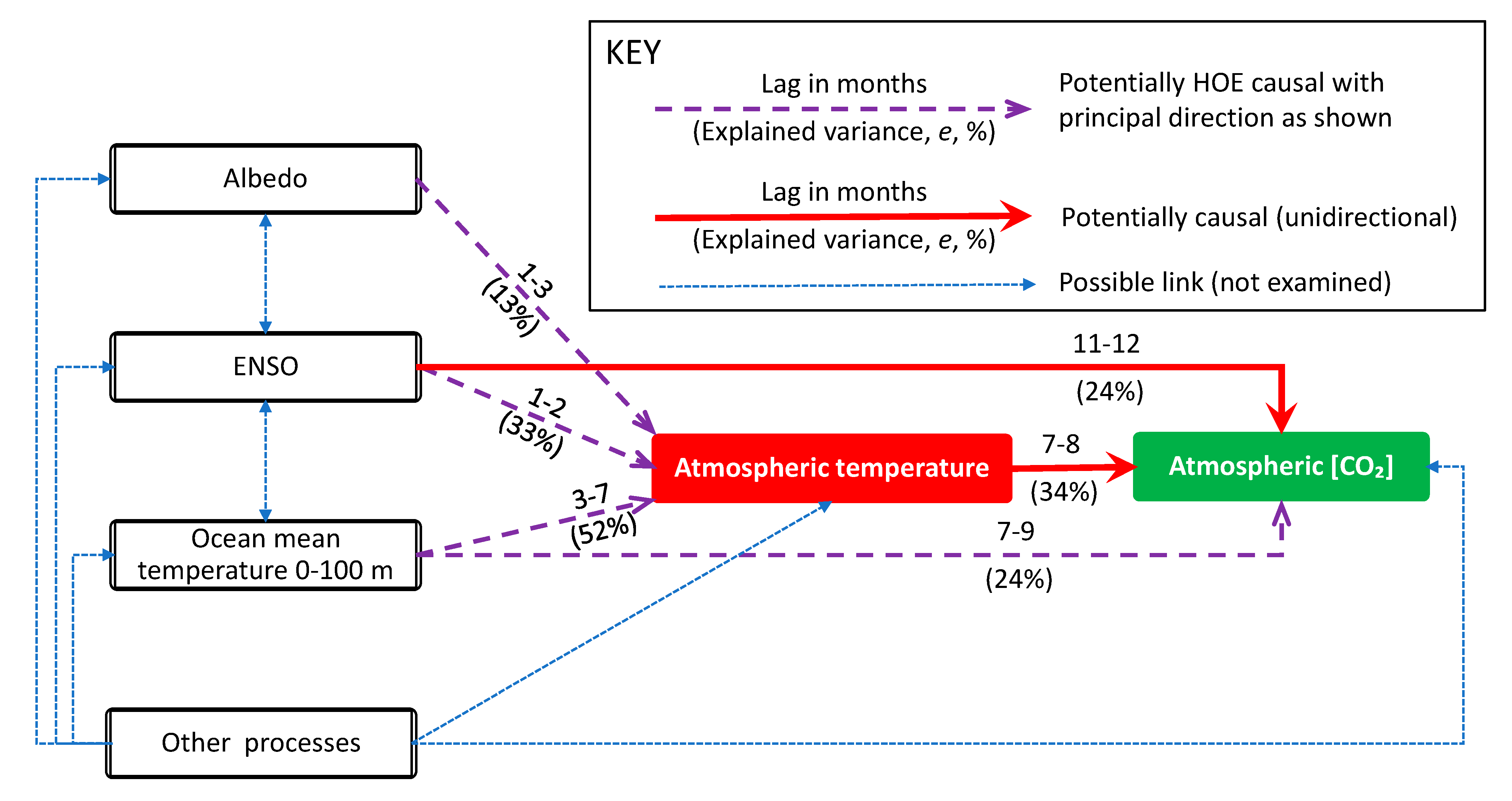 )
)
Figure 13. Schematic of the examined possible causal links in the climatic system, with noted types of potential causality, HOE or unidirectional, and its direction. Other processes, not examined here, could be internal of the climatic system or external.
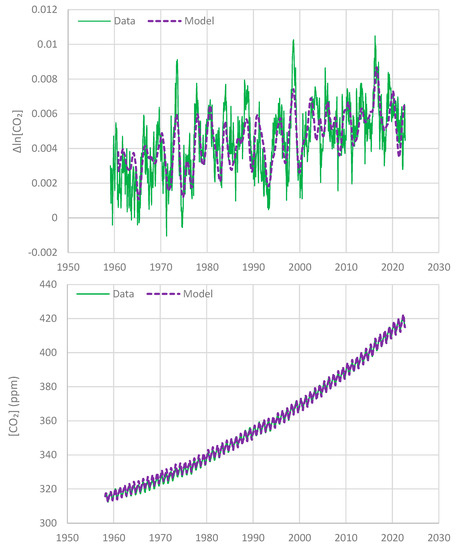
Comparing the actual data with the model-output has shown an astounding accuracy as visualized in their Fig. 15:
Figure 15. Comparison of the actual Δln[CO2] (upper) and [CO2] (lower) with those simulated by the model of Equations (8) and (9).
In his follow-up paper, Koutsoyiannis, D., has confirmed this unidirectional relationship for the last 541 million years [(2024), Stochastic assessment of temperature–CO2 causal relationship in climate from the Phanerozoic through modern times, Mathematical Biosciences and Engineering 2024, Volume 21, Issue 7: 6560-6602. https://www.aimspress.com/article/doi/10.3934/mbe.2024287%5D.
These publications alone have pulled the rug out from under the ruinous global decarbonization regime. The empirical evidence (real data) eliminates the need to explain why the IPCC’s Holy Grail, its illusory energy/radiation balance, its falsified CO₂ balance, and the climate models based on them, are scientifically untenable.
Sorry for the late reply…
While the influence of our extra CO2 on temperature / climate is mainly beneficial, the paper by Koutsoyiannis violates the carbon mass balance in figure 15 and he uses temperature (anomaly) to compare that to the derivative of the CO2 increase in the atmosphere: that are variables of different order!
If you compare temperature derivative of temperature with the derivative of human emissions (a straight line twice as steep as the increase in the atmosphere) and the derivative of the increase in the atmosphere, then it is clear that dT/dt has zero slope, only a small offset from zero, but still all variability, while leading CO2 changes with several months. That is the real influence of temperature on CO2: about 3.5 ppmv/K short time, 16 ppmv/K (very long) time. That is all…
That implies that temperature variability is certainly the cause of the CO2 rate-of-change variability, but not the (main) cause of the CO2 increase in the atmosphere. That are human emissions…
More background in our common work for the CO2 Coalition:
https://osf.io/preprints/osf/het6n_v1
and a more detailed background in a PowerPoint presentation at a workshop in Athens, last September with Koutsoyiannis and others:
https://www.ferdinand-engelbeen.be/klimaat/klim_img/on_the_co2_residence_time.ppsx