Essay by Eric Worrall
Another nail in the coffin of climate models? A study published in Nature suggests there is no evidence for a decline in AMOC over the last 60 years.
AMOC study: Critical ocean current has not declined in the last 60 years
…
In the Atlantic Ocean, a system of connected currents – the AMOC – moves water throughout the world’s oceans powered by a combination of winds and ocean density. It not only distributes the ocean’s heat, moisture, and nutrients, but regulates the Earth’s climate and weather too.
As the climate is continuously changing and the atmosphere is warming, many scientists fear that fresh water from melting polar ice sheets could significantly disrupt – or even collapse – the AMOC. While a decline of the AMOC would have grave consequences, a collapse would be truly catastrophic, as Oceanographic reported back in October 2024.
As studies about the AMOC’s long term future are still uncertain, a team of scientists from Woods Hole Oceanographic Institution (WHOI) took a closer look at the past to help inform the AMOC’s likely future.
In a new paper published in Nature Communications, scientists made a surprising announcement: The AMOC has not declined in the last 60 years, indicating that it is currently more stable than expected.
“Our paper says that the Atlantic overturning has not declined yet,” Nicholas P. Foukal, study author, adjunct scientist in Physical Oceanography at WHOI and assistant professor at the University of Georgia, said. “That doesn’t say anything about its future, but it doesn’t appear the anticipated changes have occurred yet.”
…
Read more: https://oceanographicmagazine.com/news/new-study-argues-amoc-has-not-declined-in-the-last-60-years/
The abstract of the study;
Atlantic overturning inferred from air-seaheatfluxes indicates no decline sincethe 1960s
Jens Terhaar1,4,5, Linus Vogt 1,2 & Nicholas P. Foukal 1,3
Received: 2 July 2024
Accepted: 6 December 2024
Published online: 15 January 2025The Atlantic Meridional Overturning Circulation (AMOC) is crucial for globalocean carbon and heat uptake, and controls the climate around the NorthAtlantic. Despite its importance, quantifying the AMOC’s past changes andassessing its vulnerability to climate change remains highly uncertain.Understanding past AMOC changes has relied on proxies, most notably seasurface temperature anomalies over the subpolar North Atlantic. Here, we use24 Earth System Models from the Coupled Model Intercomparison ProjectPhase 6 (CMIP6) to demonstrate that these temperature anomalies cannotrobustly reconstruct the AMOC. Instead, wefind that air-sea heatfluxanomalies north of any given latitude in the North Atlantic between 26.5°N and50°N are tightly linked to the AMOC anomaly at that latitude on decadal andcentennial timescales. On these timescales, air-sea heatflux anomalies arestrongly linked to AMOC-driven northward heatflux anomalies through theconservation of energy. On annual timescales, however, air-sea heatfluxanomalies are mostly altered by atmospheric variability and less by AMOCanomalies. Based on the here identified relationship and observation-based estimates of the past air-sea heatflux in the North Atlantic from reanalysis products, the decadal averaged AMOC at 26.5°N has not weakened from 1963 to 2017 although substantial variability exists at all latitudes.
Read more: https://www.nature.com/articles/s41467-024-55297-5.epdf
Michael Mann appears to be a fan of imminent AMOC collapse theories;
I know it will be a surprise to all of you that a climate analysis promoted by Michael Mann has bitten the dust, though to be fair the study authors emphasise past performance is not a reliable guide for the future. Perhaps Mann can give us a revised set of dates for this particular climate apocalypse.
Anything endorsed by Michael Mann is equivalent to any study using RCP8.5, a clear notice they are pulling their conclusions from their nether regions.
I find it interesting that Dr. Mann’s ability to coax out climate signals from tree rings also translates to expertise in ocean currents.
It is amazing that he is able to remain so humble in light of such staggering abilities.
What a maroon.
Well there are lots of people who claim to be able to read multiple things in tea leaves so perhaps tree rings are similar 🙂
The ‘cold spot’ in the illustration is the convection zone south of Iceland and Greenland, and it has more or less disappeared in recent years:
see animation here
Sea surface temperatures in the N. Atlantic display a multi-decadal oscillation so that the cold blob comes and goes in cycles.
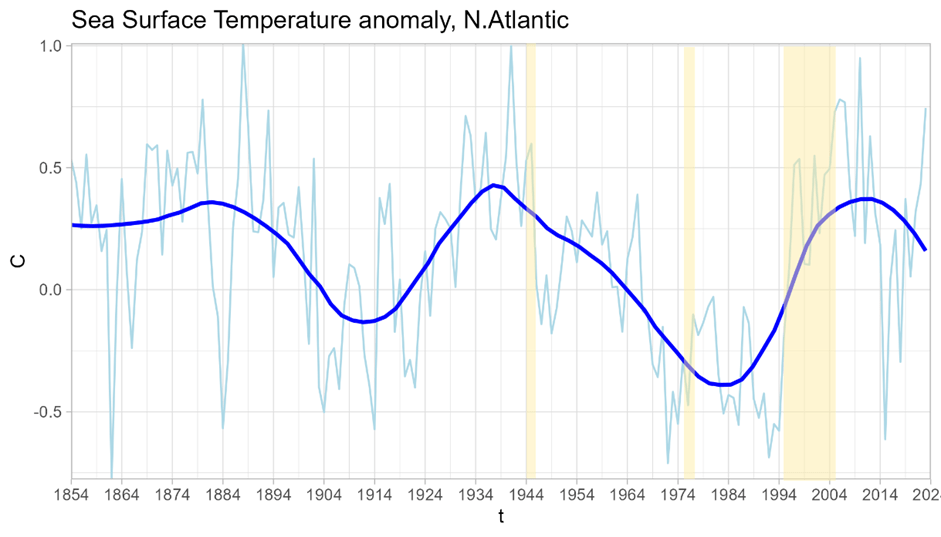
More on this development here:
https://wattsupwiththat.com/2024/07/18/amocs-cold-blob-has-gone-missing/
This study takes account of a fingerprint area of ocean that….
“For that, careful fingerprinting techniques have been applied to longer records of sea surface temperature (SST), which, backed by a survey of a large ensemble of climate model simulations, have found the SST in the Subpolar gyre (SG) region of the North Atlantic (area marked with a black contour in Fig. 1a) to contain an optimal fingerprint of the strength of the AMOC
https://www.nature.com/articles/s41467-023-39810-w
“Warning of a forthcoming collapse of the Atlantic meridional overturning circulation”(2023)
“….. it has more or less disappeared in recent years:”
Says otherwise:
“Sea surface temperatures in the N. Atlantic display a multi-decadal oscillation so that the cold blob comes and goes in cycles.”
Is not visible in that more focused area of ocean (bar maybe 1 cycle).
1… there is NOT a long record of SSTs.. they only exist as bucket dipping along trade routes…
and 2…“backed by a survey of a large ensemble of climate model simulations”
[taunting~ctm]
“Another nail in the coffin of climate models?”
From the abstract of the paper
“Here, we use24 Earth System Models from the Coupled Model Intercomparison ProjectPhase 6 (CMIP6) to demonstrate that these temperature anomalies cannotrobustly reconstruct the AMOC.”
Sometimes we like models, sometimes not.
So proving that the models don’t work is akin to liking models in your mind?
How can you prove the models don’t work with a model based analysis?
Analyse the models, and compare with observations. If the models cannot reproduce the historical observations, the models are bunkum.
For example:
That’s not what they said. They said the models “cannot robustly reconstruct the AMOC” and that they used air-sea heat flux anomalies instead. Looks pretty robust to me.
OK, so here is their figure of reconstructions. Notice something?
Models of models
Nick, never mind the models, are you concerned about the AMOC?
Concerned the trough won’t get refilled ?
😉
For Nick et al, the models ARE the established planetary phenomena.
They don’t have to match real-world historical or current observations.
‘Matches? We doan need no stinkin’ matches”
It is something to watch.
Or you could watch paint dry !.
I hope it gives you many happy hours.
[taunting~ctm]
You didn’t answer the question.
“Sometimes we like models, sometimes not.”
Roger that. Which models do robustly reconstruct the AMOC?
Your posts are getting more and more bizarre
He just has a strong compulsion to point out at least one error in any article he disagrees with. Occasionally he just gets the wrong end of the stick (as I believe he has here). Occasionally he picks something that isn’t particularly important. Occasionally it’s just something way out of left field.
Regardless, he has to pick on something. I guess that makes him feel that everything posted here is wrong, as long as he can find something wrong, however small or irrelevant.
Having said that, occasionally he has a good point. The silly ones just detract from that and make him look desperate, unfortunately for him.
Projecting, Nick?
Story tip – ‘I Know Who Caused the Fire’: Were the L.A. Wildfires Caused by Homeless Arsonists? – PJ Media
Excerpt: The mainstream media desperately wants the Los Angeles wildfire story to have a very specific villain: Climate Change.
The theory they’re pushing goes like this: Climate Change is real — only a stupid “science denier” would argue otherwise. And because it’s real, weather patterns are far more extreme. From famines, fires, and droughts to hurricanes, snowstorms, and floodings, Climate Change is the answer to all your questions. So, YES, Climate Change is responsible for the L.A. wildfires!
If Dems are so sure these fires are all the result of climate change then why not prepare/mitigate more?
They should have a fire station on every street and if some asks why, then they can say climate change.
If someone asks why do you have 50 firefighters working at that station, then they can say climate change.
If someone asks why you have a 30 million gallon water tank next to the fire station, then they can say climate change.
If someone asks why does every home have to have a sprinkler system, then they can say climate change.
CA is corrupt.
Yep, it’s so obvious that even the climate crusaders don’t believe their own bullshit themselves.
As ever –
“Don’t place any credibility on what people SAY.
Observe what they DO. And don’t do.”
Did you hear about the “meditating hikers” who just happened to be near the ignition point when the Palisades fire began?
https://www.dailymail.co.uk/news/article-14288267/hikers-blamed-starting-LA-fires-break-silence.html
Were they meditating Rastafarian style ?
Homeless people often have substance abuse issues, particularly drugs like methamphetamine. The abuse of these drugs is also associated (co-occurrent) with pyromania, so the likelihood of homeless people lighting fires is actually quite high.
The stability of the AMOC is far more dependant on the zonal stability or otherwise of the jet stream crossing the Atlantic.
As its highly dependent on the persistence of the Westerly winds that play such a important part in driving it across the Atlantic ocean.
Placing ‘stability’ and AOC in the same sentence… oh, sorry…
‘a system of connected currents – the AMOC – moves water throughout the world’s oceans’
As I understand it, these ocean currents have a velocity of the order of 5 cm/s, which means that they would take several decades to circulate the globe.
Has anybody ever tried to calculate the momentum associated with these currents, and the forces and time-frame that would be required to modify them.
Just trying to imagine the force balance and the time frames involved, no I am not surprised that the AMOC is stable.
The currents that make up the system we call AMOC are vastly faster than you stated. The Gulf Stream that constitutes the western and northern portions has an average velocity of 4 mph or 6.4 kph. It would take only 30 days to cross the north Atlantic.
But the Magic Molecule can do anything, doncha know?
There is also the Atlantic Multi-decadal Oscillation index (AMO), defined as:
a coherent mode of natural variability occurring in the North Atlantic Ocean with an estimated period of 60-80 years. It is based upon the average anomalies of sea surface temperatures (SST) in the North Atlantic basin, typically over 0-80N.
The last +/- flip was in 1960, accompanied by a 1-2degC drop in annual mean CET temps. It is due for another flip.
Ireland temperatures also match the AMO quite well, as does basically all raw temperature data in the Arctic region, USA etc
The US has predominantly westerly winds except at the southern tip of Florida where the northeast trade winds begin. So no, the AMOC doesn’t significantly influence weather or climate in the US. Ireland and western Great Britain are heavily influenced by the relatively warn westerlies that flow over the NE portion of the Gulf Stream, resulting in a warmer or milder climate than that to the east in northern continental Europe.
The US climate in the west is influenced by cold westerlies blowing across the Kuroshio or Japanese current, as well as by states of the ENSO cycles. The ENSO even affects the weather in the SE US, particularly the Gulf coast because its westerlies flow over a relatively narrow land mass in Mexico.
Measured USA
As you should know from being a reader of WUWT, correlation is not causation.
Anyone even remotely familiar with meteorology knows that air masses and wind directions are are what create regional climates, being driven by the Coriolus effect as well as heat transfer in oceanic currents. Given that westerly winds predominate in the temperate northern hemisphere, it is always a given that the oceanic mass over which the air masses pass that determines the weather (warm or cold, and moist) in the western coastal regions. And that in the centers of the continents, it is continental air masses (generally cold and dry) that begin to take over from maritime air masses .. again, all moving from west to east in the northern hemisphere temperate zone.
That is why the climate in the northeastern US states, though being well south of the latitudes of major populated north European areas in the UK and France, is much colder and harsher than in northwestern Europe. The Atlantic Ocean maritime air masses moderate the climate in northern Europe. The continental air masses that predominate in the northern seaboard of the US are cold and dry.
It was a major shock to English and French early American colonists in the 16th and 17th centuries how cold, harsh, and long the winters were, even as far south as Virginia and North Carolina, who struggled to farm and feed themselves. The Europeans anticipated that the climate in the mid-30s to low 40s degree latitudes of the east coast of North America would be similar to that in Spain, Portugal, the Mediterranean coasts, and north Africa.
In the tropics, it is the trade winds that predominate, north easterly on the north side of the equator, and southeasterly on the south side of the equator, with intertropical convergence zones on either side of the equator.
Mt Baker glaciers v AMO (inverted)
AMO vs US temps
…as well as by states of the ENSO cycles.
There is the Pacific Decadal Oscillation as well –
Overall, the PDO’s spatial pattern resembles that of ENSO. The largest distinction between the PDO and ENSO is their timescales: While ENSO is primarily an interannual phenomenon, the PDO is decadal in scale.
Arctic ice sheets have been much lower in volume and area than now for most of the last 10,000 years.
Any conjecture that the AMOC would collapse if ice melted a bit is pure nonsense.
The amounts of ice melting are miniscule compared to the normal annual fluctuations.
The amount of change to the concentration of greenhouse gases in the atmosphere is miniscule compared to daily, or indeed hourly, fluctuations.
It’s all ridiculous.
The ‘science’ actuals don’t matter. The simple fact that this paper got published at all in the Nature stable is a sign of slow skeptical progress toward ‘science’ reality.
More exposed water in the arctic means the water is better able to radiate heat to space, as well as lose heat from evaporation. Plus more evaporation makes the surface water saltier.
All in all, if there is any change at all, it will be to accelerate the North Atlantic current.
A serious question:
with the extreme cold front moving through there are still folks living in tents in the Carolinas.
Any suggestions on where to donate and how to help? So many of these NGOs are scams.
Fraizer, thanks for the offer.
This may help:
https://www.charitynavigator.org/discover-charities/where-to-give/hurricane-helene-2024/#charity_list
AMOC will stop if Earth quits spinning….or the cold depths get as warm and the same density as the surface….or Newfoundland and Ireland move within close proximity….or there is glacier from Baffin Island to Norway….anything else will be just minor randomness.
That doesn’t say anything about its future, but it doesn’t appear the anticipated changes have occurred yet.
That applies to every claim about “extreme weather” in the Observations section of the IPCC reports. They haven’t actually measured any trend of increasing drought, heatwaves, flooding, cyclones, extreme storms, etc. But they’re certain they will happen because the models say so.
It is interesting that the PBS graphic has the current dissecting the island of Cuba.
‘hasn’t declined yet’.
The learned professor couldn’t control himself to nevertheless include a sop to the teachings of the climate church. Or perhaps it was the editor who insisted on it as a condition for publication.
Have any of these so-called scientists ever studied thermodynamics? This is high school stuff. Heat follows temperature gradients, high to low. The tropical ocean is warm. The polar ocean is cold. Heat will transfer from south to north unless the sun burns out or the ocean evaporates. The AMOC might evolve based on stuff like hydrothermal vents, but it cannot disappear.