The Nature Reviews Earth & Environment paper on hydroclimate volatility represents yet another example of speculative science dressed up as crisis-level evidence. Its central claim is that so-called “hydroclimate whiplash”—sharp transitions between wet and dry conditions—will become far more frequent and intense as the planet warms. The authors predict that subseasonal whiplash events (three-month shifts) will increase by 113% under 3°C warming, while interannual whiplash events (year-long shifts) will rise by 52%. These figures, dramatic as they may sound, are derived from models riddled with uncertainties and based on poorly defined baselines, making their real-world implications highly suspect.
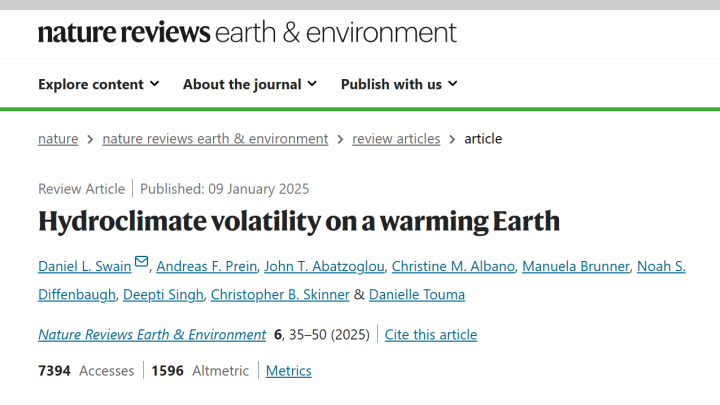
Abstract
Hydroclimate volatility refers to sudden, large and/or frequent transitions between very dry and very wet conditions. In this Review, we examine how hydroclimate volatility is anticipated to evolve with anthropogenic warming. Using a metric of ‘hydroclimate whiplash’ based on the Standardized Precipitation Evapotranspiration Index, global-averaged subseasonal (3-month) and interannual (12-month) whiplash have increased by 31–66% and 8–31%, respectively, since the mid-twentieth century. Further increases are anticipated with ongoing warming, including subseasonal increases of 113% and interannual increases of 52% over land areas with 3 °C of warming; these changes are largest at high latitudes and from northern Africa eastward into South Asia. Extensive evidence links these increases primarily to thermodynamics, namely the rising water-vapour-holding capacity and potential evaporative demand of the atmosphere. Increases in hydroclimate volatility will amplify hazards associated with rapid swings between wet and dry states (including flash floods, wildfires, landslides and disease outbreaks), and could accelerate a water management shift towards co-management of drought and flood risks. A clearer understanding of plausible future trajectories of hydroclimate volatility requires expanded focus on the response of atmospheric circulation to regional and global forcings, as well as land–ocean–atmosphere feedbacks, using large ensemble climate model simulations, storm-resolving high-resolution models and emerging machine learning methods.
https://www.nature.com/articles/s43017-024-00624-z
But the bigger story here isn’t the paper’s shaky science—it’s the timing of its publication.
Released on January 9, 2025, just two days after the Palisades and Eaton Fires broke out in Los Angeles and while they were still raging, the paper appears to have been rushed out to provide the media with a ready-made link between the fires and climate change. The fires, which have already caused 24 fatalities, destroyed thousands of homes, and inflicted $50 billion in economic losses, dominated global headlines.
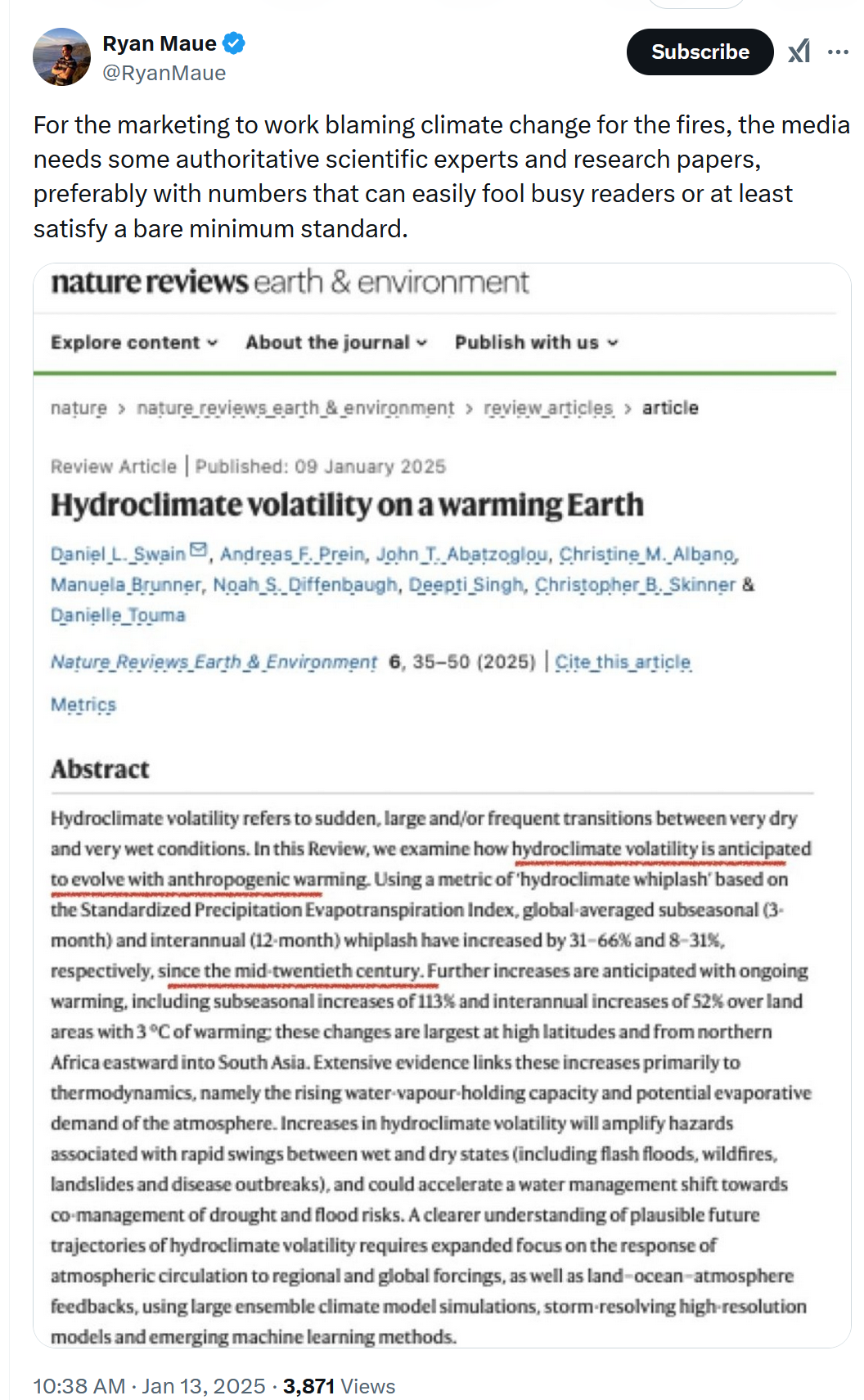
As if on cue, the media pounced on the paper to frame the LA fires as evidence of escalating climate volatility. It’s hard to imagine the journal’s editors weren’t aware of how perfectly their publication would align with the news cycle. Whether intentional or opportunistic, this timing seems far too convenient to be coincidental.
Newsweek: Why a Rain ‘Whiplash’ Is to Blame for Los Angeles Fires
Earth.com: Hydroclimate whiplash’ is wreaking havoc across the U.S.
Grist: Weather whiplash’ is fueling the Los Angeles fires
KQED: Climate Scientists Warn of Growing Whiplash Effect on Weather Patterns
Let’s examine why this paper’s conclusions are deeply flawed and how its suspicious timing highlights the growing interplay between speculative climate science and media-driven alarmism.
The Los Angeles Fires: A Manufactured Narrative
The Palisades and Eaton Fires, which began on January 7, 2025, have caused destruction on an unprecedented scale. The Palisades Fire has destroyed over 420 homes, while the Eaton Fire has devastated more than 7,000 structures. The fires have claimed at least 24 lives combined, making them some of the deadliest in California’s history. Predictably, the media seized the moment to blame climate change, framing these disasters as yet another example of a warming world spiraling out of control.
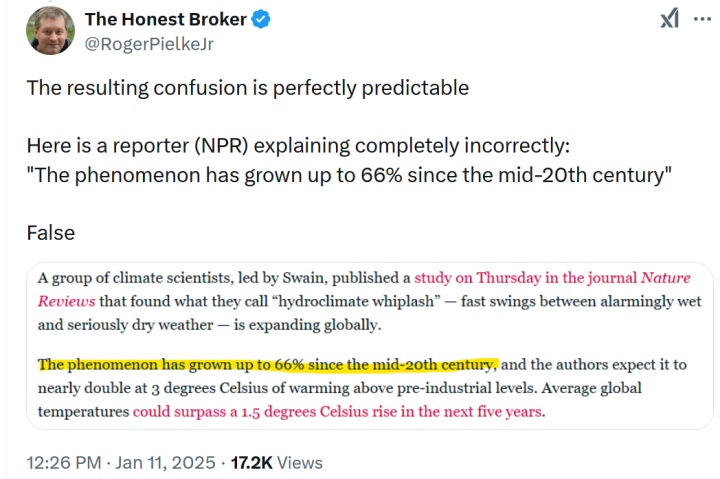
The Nature paper on hydroclimate whiplash provided the perfect scientific veneer to reinforce this narrative. Though the paper itself does not explicitly link whiplash events to wildfires, its release during the fires gave journalists just enough material to connect the dots. Headlines proclaimed that increasing “whiplash” was driving extreme weather patterns and fueling events like the LA fires.
However, the reality is far less dramatic. Wildfires in California, including the Palisades and Eaton Fires, are driven by far more immediate and well-understood factors, including:
- Fuel Accumulation: Decades of poor forest management have allowed dangerous amounts of dry vegetation to build up. This is a far bigger driver of wildfire risk than climate change.
- Ignition Sources: Investigators believe the Eaton Fire may have been started by electrical infrastructure failures—an all-too-common ignition source in California. Human activity (including arson and accidental ignitions) remains the leading cause of wildfires globally.
- Weather Variability: California’s Santa Ana winds, with gusts reaching 70 mph during these fires, are a long-standing feature of its climate and have fueled fires for centuries, long before industrial emissions.
While climate change might influence background conditions, such as slightly lengthening fire seasons, it is far from the primary culprit in these disasters. Yet, thanks to the convenient timing of the Nature paper, the media has doubled down on the narrative that climate change is the driving force behind California’s fires.
Hydroclimate Whiplash: A Crisis Built on Speculation
The term “hydroclimate whiplash,” coined by the paper’s authors, refers to abrupt shifts between wet and dry periods. The authors claim that these events will increase dramatically under global warming scenarios, using projections from the CESM2-LE climate model. The numbers they cite are eye-catching:
- A 113% increase in subseasonal whiplash events by 2100 under 3°C warming.
- A 52% increase in interannual whiplash events over the same period.
But these projections crumble under scrutiny. As Roger Pielke Jr. would say, this is a classic example of the “percent of a percentage problem.” By expressing changes as percentages without providing clear baseline context, the authors obscure the real-world significance of their findings.
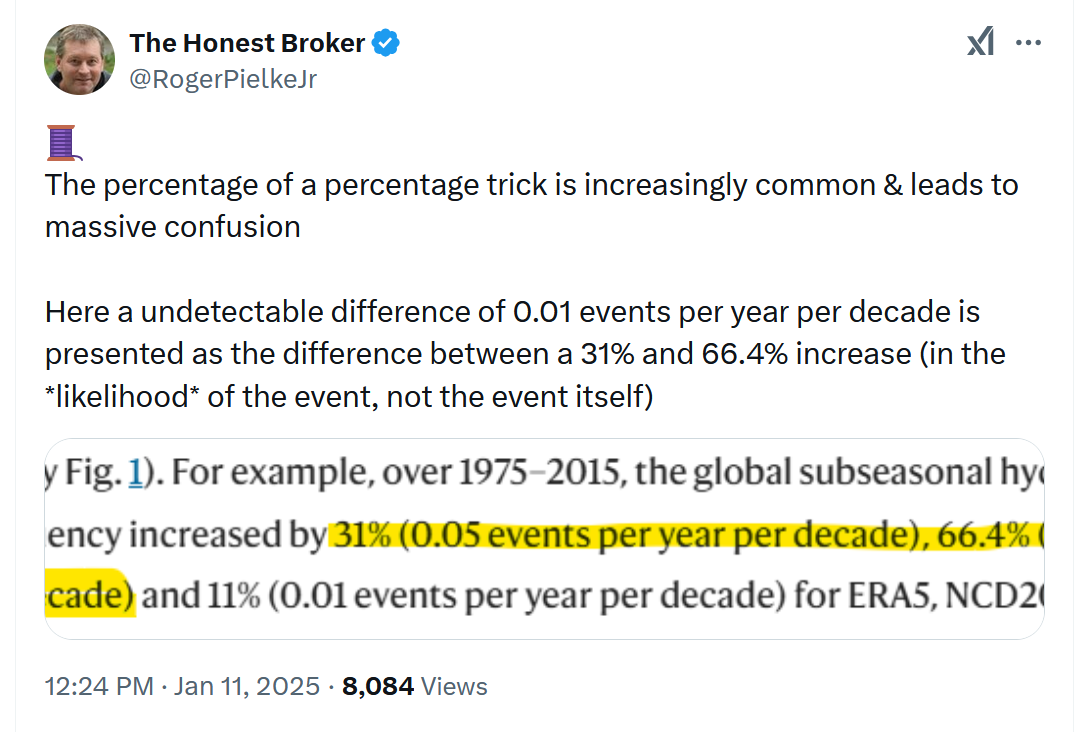
If subseasonal whiplash events currently occur, say, once every five years, then doubling their frequency means they would still happen only every 2.5 years. Such increases, while statistically interesting, hardly warrant the apocalyptic tone of the paper.
More importantly, “hydroclimate whiplash” itself is poorly defined and highly dependent on arbitrary thresholds. California’s climate, for instance, has always experienced sharp shifts between wet and dry conditions. Atmospheric rivers bring heavy rains during wet seasons, followed by dry summers. This variability is a natural feature of California’s Mediterranean climate, not a harbinger of climate catastrophe.
Shaky Science: Flaws in the Paper’s Approach
Even if we accept the concept of hydroclimate whiplash, the Nature paper’s conclusions are undermined by significant flaws in its methodology:
- Unreliable Models: The CESM2-LE climate model, which the study relies on, struggles to accurately simulate extreme events in today’s climate. If the model can’t capture current conditions, its projections of future trends are little more than guesswork. The authors even admit that the model underestimates extreme events, yet they proceed to base their conclusions on it.
- Baseline Ambiguity: The paper provides no clear explanation of how frequently whiplash events occur today. Are they once-in-a-decade events? Once-a-year events? Without a baseline, the dramatic percentage increases cited in the paper are meaningless.
- Natural Variability Ignored: The study attributes most of the projected increases in whiplash events to anthropogenic warming while downplaying the role of natural drivers like the El Niño–Southern Oscillation (ENSO). ENSO alone has a massive influence on precipitation variability in regions like California.
- Rare Events Amplify Uncertainty: Modeling changes in rare phenomena is inherently difficult. Small errors in the model’s input parameters can lead to massive variability in the results, making the projections highly unreliable.
Taken together, these flaws render the paper’s findings speculative at best. Yet its timing and dramatic conclusions have elevated it to a level of media prominence that far outweighs its actual scientific rigor.
Suspicious Timing: A Case Study in Opportunism
The timing of the Nature paper’s release—just two days after the Palisades and Eaton Fires erupted—raises serious questions about the journal’s motives. Peer-reviewed studies typically spend months, if not years, in review and revision. The decision to publish this paper while the fires were still raging appears calculated to maximize its media impact.
Journals like Nature are well aware of how their publications influence public discourse. By releasing this paper during an ongoing disaster, the editors ensured that it would dominate headlines and reinforce the narrative that climate change is the primary driver of extreme weather and disasters. This isn’t merely a coincidence—it’s opportunism.
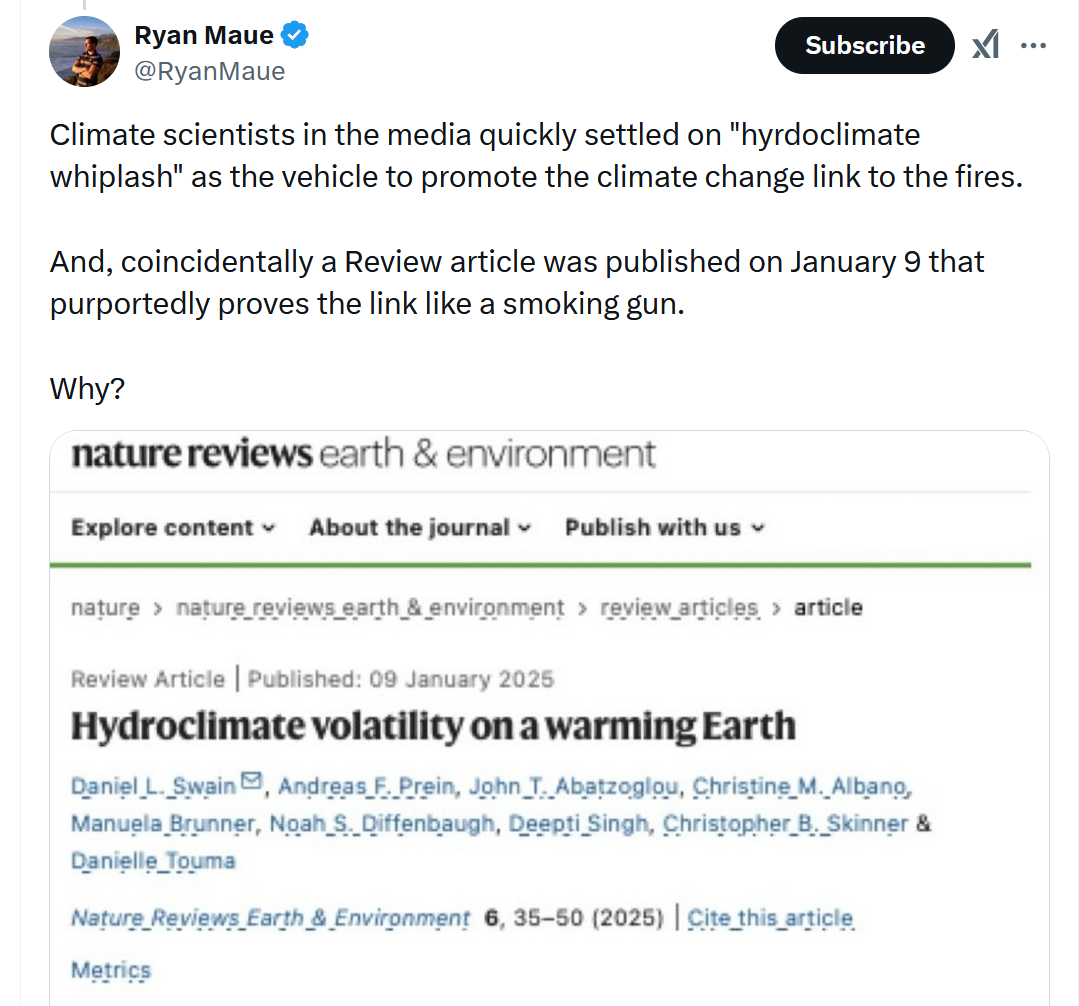
The media, predictably, ran with the story. Headlines conflated the fires with hydroclimate whiplash, portraying the LA disaster as an inevitable consequence of climate change. The result is a media-science feedback loop where speculative studies are treated as definitive evidence, fueling public fear and bolstering calls for sweeping, costly policies.
The Danger of Alarmism
The consequences of this kind of alarmism are profound. By framing hydroclimate whiplash as an urgent climate crisis, the Nature paper distracts from more immediate and solvable problems. California’s wildfire risk could be significantly reduced through better forest management, infrastructure upgrades, and targeted fire prevention strategies.
Instead, resources are often diverted to climate mitigation policies that do little to address the root causes of wildfires. The public, meanwhile, is left fearful and misinformed, believing that climate change is solely responsible for disasters like the Palisades and Eaton Fires.
Conclusion: Alarmism Dressed as Science
The Nature Reviews Earth & Environment paper on hydroclimate whiplash is a textbook case of speculative science weaponized for alarmism. Its dramatic projections, built on flawed models and vague baselines, lack the rigor needed to justify its conclusions.
But the timing of its release—just two days after the LA fires began and while they were still raging—casts an even darker shadow. Whether by design or opportunism, the paper was strategically published to align with the media narrative surrounding the fires. This is not science informing policy; it is science feeding fear.
The public deserves better. Policymakers need transparent, robust science—not alarmist studies timed to exploit tragedy. Hydroclimate whiplash may make for a compelling headline, but it’s a poor foundation for sound policy or meaningful action. Let’s focus on solving real problems, not amplifying manufactured crises.
Roger Pielke Jr. and Ryan Maue’s X thread are well worth reading for more information.
https://x.com/RogerPielkeJr/status/1878130793211404701
https://x.com/RyanMaue/status/1878817340823069145
If we are suffering from “hydroclimate whiplash,” can we not get seatbelts installed?
Whiplash is headrests not seatbelts.
So will I be safe as long as I keep to my recliner? That’ll make the cat very happy!
Yours too, eh?
Coincidentally, hydroclimate whiplash was first described in Journals of Salem Witch Trials 333 years ago.
That’s interesting. Can you provide a reference?
I would love to provide a detailed descriptive connection between (Dr) William Griggs and his theory regarding the tangential relationship between witchcraft and ‘hydroclimate whiplash’ (he didn’t exactly call it that though).
It seems that it would be a fun one, but at this point I don’t have the time (or creative energy).
The Journals are supposed to be held in secret for another 333 years.
It seems to me these climate “scientists” are suffering more from self-flagellation than whiplash
Thank goodness for hydroclimate whiplash. Los Angelas can expect drenching rains any day now.
An atmospheric river directed there would quickly solve the LA fire problem.
No Santa Ana winds. Lots of water.
Unlikely. God has provided this lesson to godless CA.
“God has provided this lesson to godless CA.”
That’s a very silly thing to say.
Why? Be specific.
Well there are about 12 million Catholics in California representing about 30% of the population. So California hardly qualifies as “godless”.
🤔 Catholics in CA, and the White House, I think.
You probably have to define which god … all gods are not equal 🙂
Whether they are equal or not is a matter of personal perspective…
Because it’s not something that anyone could possibly know. It’s apparently just wishful thinking.
UPFs Ultra Processed “Facts”
😉
Nice post, Charles.
I did some quick research since somewhat familiar with the Nature stable of peer reviewed journals. Took some digging into paper publication details in the Nature stable manure piles. (Hint, they are always at the very end after citations, author contribution credits, and conflict declarations.)
The average time between acceptance and publication (for the stable) is 12-14 months. (They have a footnote saying an accepted paper may appear in their online versions 6 months before print publication. Obviously print publication time will vary with whichever in the stable journal prestige and backlog of already accepted papers. This ‘convenient’ ’climate whiplash’ paper was finally accepted by Nature on 11/21/2024 and print published 1/9/2025. So about 5-6 weeks. Your post hypothesis is confirmed by Nature’s own smoking gun data.
Now some good news. The main journal, Nature, has a self touted ‘impact index’ of 50.5 (makes sense, as it and Science are the two premier science journals), and an ‘immediacy index’ of 13.2. Nature Communications: Earth and Environment has an ‘impact score’ of 8.1 (translation, almost nobody cares) and an ‘immediacy index’ of 1.3—which they are obviously now trying to enhance as you point out by rushing ‘whiplash’ into print AFTER the abnormally dry LA winter was well known AND the Santa Ana winds were already predicted.
Dunno whether to laugh or cry. I’ll laugh at their transparent propaganda failure, and cry for what the once prestigious Nature journal stable has become.
You are looking at the wrong data. Nature has a broad suite of publications that has very different publication times. “Nature Reviews Earth & Environment” is an online only journal that publishes articles as soon as they are ready. In the January Issue there were two reviews both of which took 49 days between acceptance and publication. In the December issue there were 4 reviews that took
36, 48, 48 and 36 days to get published. So there is no sign of a smoking gun and it is just a coincidence that the paper got published when it did.
70% of the California coast received “above average” or “well above average” rainfall in November and December.
CO2 is a curious molecule indeed that it only hovered over the LA area for the last several months!
So, clearly a whiplash since before Christmas.
Does Santa use a whip on his reindeer?
Changing the rules for permitting controlled burns and brush clearing would do much more than speculating on climate change. It is pure “look, a squirrel!”
Fig 1 in the paper showing areas of the globe where the authors claim ‘whiplash events’ have occurred includes South East Australia.
Annual rainfall in Australia generally including SE Australia is notoriously variable, there is no apparent increase in ‘volatility’ 1900 – 2024.
But by their definition proves there always was whiplash. And their models say it will get worse.
One cannot look solely at average rainfall. If rainfall is intermittent, 2-3 weeks with none, the next rain will run off the hydrophobic soil, adding little additional moisture. The dry conditions could enhance flooding with more runoff from precipitation.
Don’t give the California Democrats any more ideas.
If they hear that the soils have become hydrophobic, they will mandate forced “diversity” seminars for every hillside in the state!
Or even worse, they will start requiring safe spaces for hydrophobic dogs!
“Whiplash” doesn’t sound safe or woke.
That’s how propaganda works.
Increases in hydroclimate volatility will amplify hazards associated with rapid swings between wet and dry states (including flash floods, wildfires, landslides and disease outbreaks), and
couldshould accelerate a water management shift towards co-management of drought and flood risks.Atmospheric CO2 levels are not going to lower for centuries if at all, so stop procrastinating and get on with adaptation!
Sound like more effective water management and storage is needed.
Adaptation is what we’ve been doing for millennia. Some of us stopped when we started blaming everything on the CC boogeyman.
Well it’s like this-
LA fires could push up Australian insurance costs
because-
John Williamson, Home Among The Gum Trees
Well if you play the climate shell game you clear enormous areas of vegetation to reduce fire risk. Then you apply to sell carbon credits to rehabilitate the land. You can even use foreign species such as saltbush.
https://www.greeningaustralia.org.au/carbon-farming-meet-the-farmers-and-their-new-crop/
“This will be something that obviously the planning minister, the minister for building … all the authorities will look at what’s happened here [and] consult with the local council. But it hasn’t been an issue that’s been raised previously.”
‘Almighty sound’: House falls down cliff on Mornington Peninsula
Predictions are difficult particularly about the future.
Why is it that climate is predictable but the winners of the trifecta on June 25th 2025 are not?
When I see the word “predict” used in anything to do with “climate”..
… I think of tarot cards and ouija boards…. maybe even tea leaves !!
Cliff Mass points out that ten hours of a steady hot and dry Santa Anna wind can quickly remove the moisture from the fuel sources of a potential southern California wildfire, regardless of any wet conditions which might have preceded the fire. Climate change has nothing to do with it.
What strikes me as someone who works in nuclear is how similar the LA fire disaster of 2025 is to the Fukushima Daiichi meltdown disaster of 2011. Similar in this respect:
In both cases, a loaded cannon was pointed directly at people and at property. Ample warnings from competent observers were voiced prior to each disaster that a loaded cannon was present and was a very serious threat to both people and property.
In both cases, the LA fires of 2025 and the Fukushima Daiichi meltdowns of 2011, civil authorities and corporate managers who were directly responsible for public safety took no action whatsoever to deal proactively with these highly visible threats. With disastrous consequences.
It shouldn’t be this way, but there is more money in failure and crisis, never let it go to waste they say. Newsom is smiling and moving about with glee at the opportunity to build back better.
Like his pet toy train.
Inasmuch as the civil authorities were elected by the people, the people got what they deserved.
“without providing clear baseline context“
Somewhat like another common problem: Base rate fallacy – Wikipedia
Snidely Whiplash, anyone?
Snidely.JPG (761×508)
having spent my working life in risk management I’ve always been critical of any headline about a percentage increase in risk without stating the actual figures. 30% more than not much is still not much.
Say you could attribute a 1 degree rise in temperature in the last human lifespan….and that increase water vapor by 7%, and just say that increased rainfall by 7%….and the average rainfall per rainy day in your area was .5 “ or 13 mm….would you really notice if the rainfall was .535”or 14 mm instead…since your rain gauge and your neighbor’s would likely show a larger variation ?
If you normally have a dozen of those .5” rains per year with a range of 8 to 16, how long to notice that you’ve been averaging 13 instead of 12 ? Answer: about 30 years….hmmm…
1.3 x 0 = 0
“The term “hydroclimate whiplash,” coined by the paper’s authors, “
Maybe they’ll invent a new term to describe when a warm front meets a cold front?
How about “thermoclimate whiplash”? 😎
There is no physical connection between the incremental rise in CO2 forcing (or the global mean temperature) and seasonal to inter-annual scale hydroclimate variability, hydroclimate whiplash is a sham.
In theory, rising CO2 forcing should lead to increased positive NAO/AO conditions and hence a La Nina bias, and drier conditions there *on average*. But it takes a year or two of wetter weather to boost the undergrowth fuel load for bigger fires, and that is more likely to happen when lower indirect solar forcing has led to negative NAO/AO conditions, and an El Nino episode.