By David Wojick
Massachusetts just passed a law requiring the big utilities to buy a whopping 1,500 MW of batteries by this July. It should cost several billion dollars requiring immediate rate increases so it will be getting lots of attention. Net zero storage finally hitting the fan.
The total battery buy is an incredible 5,000 MW with most of that bought in the next few years so the rate increases will keep coming. The law is a study in vagueness so there will be a lot of confusion along the way.
The complex issues involved have been nicely outlined in two articles by Laurie Belsito at the Massachusetts Fiscal Alliance. The first, written before the Bill passed, is titled “Proposed Battery Law Costs Billions and Does Nothing”. See it here:
https://www.massfiscal.org/op-ed-the-actual-costs-legislature-climate-bill
This article focuses on the cost of the entire 5,000 MW, saying this:
“The amount of batteries is somewhat unclear. The Bill specifies that 5,000 Megawatts (MW) of batteries be bought but this is the discharge capacity, that is how fast the batteries can be emptied. The storage capacity is what counts and that is measured in Megawatt-hours (MWh). Specifying MW is like buying juice based on how fast it pours not how much the bottle holds.
The Bill does include a range of storage capacities which bounds the cost somewhat. Most of the batteries are what is called mid-duration which means they can provide full discharge for from four to 10 hours. Almost all grid scale battery systems these days are four hour duration so for simplicity we will start by assuming the whole 5,000 MW buy is four hour batteries.
This gives 20,000 MWh of storage. Battery systems today run around $500,000 per MWh. That gives a total cost of $10,000,000,000 or ten billion dollars which equals roughly 17% of the current state budget. If 10 hour batteries are purchased the cost jumps to $25,000,000,000 or twenty-five billion dollars. The Bill actually calls for a good bit of longer duration batteries as well which makes the cost even higher.”
Ten billion, twenty-five billion, maybe more who knows? That is seriously vague and I doubt the Legislators who voted for this madness had any idea of these numbers.
There is a lot more in the article that is well worth reading.
The second Belsito article analyzes the looming complexities of the utilities buying 1,500 MW in a rush. It is titled “Amidst Glaring Unknowns in New Energy Law, Rate Increases Definite” and is here:
https://www.massfiscal.org/amidst_glaring_unknowns_in_new_energy_law_rate_increases_definite
Here are three excerpts to give the flavor of the analysis. There is a lot more in the article.
1. “This is sure to be a very complex process with little guidance from the new law. The big question we have is who will wind up paying for something we previously found won’t give us much bang for our buck, where many billions of dollars will buy you a few more hours of energy at best. Big rate increases are certain but it’s unclear which ratepayers will be taking the hit and how these price increases will be distributed among them.”
2. “One point to be considered is that the law says this huge battery storage buy shall be made jointly by “every distribution company” in the State. The law is unclear on whether this includes municipal power authorities, which are not technically companies. If it does exclude them, then municipal power customers might be off the hook when it comes to paying the billions.
Assuming it is just the investor-owned utilities that most of us use, the big question is then how will the cost be divided among them? The new law is silent here. They might do it on the basis of customer equity, such as total retail sales. Or they might do it on the basis of their relative need for batteries in which case customers of one utility could see much bigger rate increases than another utility’s customers.
Another complexity is that these rate increases all have to be applied for and approved by the state Department of Public Utilities. This can be a long-drawn-out process but the bill itself puts the state under a significant deadline. Rushing to spend billions is never good policy, but it is now the law that our elected state representatives and governor approved just a week after most of them secured reelection, while the senate gave its approval days before. Presumably while the purchase process is done jointly the rate increases will be done on individual utility cases, especially if the rate increases differ a lot.
There is also a chicken and egg dilemma. The rate increases should be based on the battery costs, but the utilities cannot finalize the purchases to establish costs without the rate increases. Perhaps they will make the purchase contracts contingent upon getting the necessary rate increases. Among the uncertainty, the one thing that can be assured is that your bills will go up.”
3. “These staggering costs and who will pay them will start to come into focus with the rate increase applications that the power companies will have to file. The affected ratepayers should demand an explanation as there is no apparent use for all these thousands of extremely large, expensive and dangerous batteries that will be dotting the landscape in our communities.”
I can hardly wait for these rate increase requests to hit. People will finally see the costly absurdity of battery backup for renewables. I and others at the Net Zero Reality Coalition have been writing about this for several years. See https://www.cfact.org/netzerorealitycoalition/. Until now the issue has been academic but this is a looming reality.
The astronomical cost of backup batteries is an issue that extends far beyond Massachusetts. We should all watch this issue storm closely.
Ultimately, the cost of Grid Scale Battery units will be borne by the ratepayers and reflected as a portion of their monthly bill with residential ratepayers carrying a slightly higher portion relative to Industrial or commercial customers. Just like current electric rates and the cost of adding or maintaining current reliable generation sources connected to the grid.
As discussed in her second article they shoukd need a rate increase approval to make the big July buy. It will spell out who pays how much. This should focus public attention on the ridiculous cost.
And, as usual, no mention of the small matter of how the said batteries will be recharged.
Ironically Mass imports around 70% of its electricity, likely a lot from coal burning PA and Ohio as these are the nearest net exporters. So recharging may not be a problem.
Canada sells power from their Niagara Falls hydroelectric generation to several bordering USA states.
Massachusetts PopulationAs of 2024, the estimated population of Massachusetts is 7,136,171, according to the U.S. Census Bureau.
that is a huge cost per person …
Well the State could dish out loans to minors to be paid back like education debt if they can’t pay. Just trying to be helpful here.
Government is supposed to open these types of contracts to public bidding, with lowest price qualified bidder getting the award.
A process that tends to leave a bad taste in the mouths of everyone affected.
There is another alternative payer, the taxpayer. What might/will happen is their legislature will appropriate tax money to pay for this in order to keep rates low. Texas recently did something similar when they (and the Texas voters) created the Texas Energy Fund. It is funded with $10B in general revenue (taxes) funds and must be used to fund energy projects to ensure reliability. In other words dispatchable sources (gas primarily). It is a reliability subsidy to the unreliable wind and solar. With 30 million Texans, that works out to about $333 per person which which are not reflected in rates payed on monthly bills, but still a cost.
Could well be but there is no mention of funding in the new law mandating the purchases. Yet another major complexity which hopefully will engender even more adverse publicity.
Grid scale batteries pay for themselves . this is their dirty little secret. They play the arbitrage market morning and night releasing stored energy when prices are high and recharging when its low/ultra low. They are day traders . Its noble nonsense that all that storage will be available to run for hours
Only 10% ‘might’ be reserved for blackouts where they are paid to be standby reserve for say 10min or 4 hours depending their MWhr release
Plus some % of the grid batteries also need specialty inverters so they can lead the grid frequency when its out of balance and restore to the 60hz otherwise they will just do their normal ‘follow the frequency’ and collapse the system.
Just as a hydro system carries the cost of storage in its build and supply price. so should the ‘cheap wind’ turbines be expected to carry their storage requirements as grid batterys
Ridiculous.
For the same amount of money they could build multiple nuclear facilities that provide power 24/7/365 for decades to come.
Making grid scale batteries an absurdly wasteful purchase.
Besides, nuclear facilities can run for a number of decades where the battery farm will have to start replacing cells or units within a few years.
Where will the mining be done for all the minerals needed for these batteries ?
How much fossil fuel will be used in the mining and manufacture and installation ?
Stop it. We are not allowed to ask relevant questions!
/sarc
Has the Massachusetts Fiscal Alliance documented their source for the figure of $500,000 capital cost for a megawatt-hour of battery storage? And are the details of the estimate delivering that $500,000 figure online somewhere?
Tesla claims $226,000 per MWh
https://www.teslarati.com/tesla-energy-375-million-megapack-contract/
But there’s more than the “Cost of Batteries” in the cost of battery.
Site Prep
Infrastructure
Fire suppression
Transportation
Construction
Transmission grid connection
But does the Act require all of these subsystems? Perhaps the utilities could buy the batteries and leave them muddied and unconnected on a field somewhere and still be in compliance. If legislators want to do engineering, make them do it all.
Unfortunately I don’t see utilities spending (Investing) Hundred$ of Billion$ in the boondoggle just to let the main purchase sit in a field and moulder.
Those batteries can’t get too hot or too cold, so add the cost of environmental control for those batteries. Also add the cost of heating and cooling to the operational costs.
In a proper Australian summer, most of the stored energy would be used for cooling purposes 😉
“The capital cost of a 1 MWh BESS includes the cost of the batteries, PCS, BMS, and other ancillary equipment. The cost of batteries is typically the largest component of the capital cost, accounting for about 50-70% of the total cost. The cost of PCS and BMS accounts for about 20-30% of the total cost, while the cost of ancillary equipment accounts for about 10-20% of the total cost.
The capital cost of a 1 MWh BESS can vary depending on several factors, including the type of batteries used, the performance specifications of the system, and the installation location. Generally, lithium-ion batteries are more expensive than lead-acid batteries, but they offer better performance and a longer lifespan. The cost of a 1 MWh BESS can range from $500,000 to $1.5 million or more, depending on these factors.”
https://www.ritarpower.com/industry_information/1-MWh-Battery-Energy-Storage-System-amp40BESSamp41-A-Comprehensive-Overview_290.html
The US Energy Information Agency in 2021 estimated costs of between $500K and $1M per MWh of storage. They have come down a little. You can find the reports on storage at the link below.
https://www.eia.gov/analysis/studies/electricity/batterystorage/
Sonoma County has “Sonoma Clean Power” providing 100% Fossil Free energy (yeah right) but PG&E customers have the right to “Opt Out” and remain supplied by PG&E grid generation mix.
I wonder if customers will have the option to “Opt Out” of Grid Sourced Battery Back-up?
The insane costs would be recurrent every 10 – 15 years 😳.
OT – Serious fires currently in Los Angeles burning dozens of homes and displacing more than 30,000 people in Palisades, Santa Monica, Brentwood area. 70 mph+ Santa Ana winds driving the fires and predicted to continue over night. Only Fox News has been covering.
More climate refugees.
It will be interesting to see the root cause. Homes appear to be contributing significantly to the combustible materials; at least as significant as the scrub.
Our news here in Australia showed a bulldozer being used to clear cars from the roadway to allow emergency vehicle access. It looks chaotic and deadly.
Homes appear to be contributing significantly to the combustible materials
Modern home construction is far more vulnerable to fire than older construction. Engineered lumber (LVL I-beams) burns much more easily than dimensional lumber. Modern furniture materials have the same problem. Result: houses burn faster.
It looks like a horror show. Lots of people losing everything they own.
Yes, and I read that in some affected areas, fire insurance for property was impossible to get because these areas were recognized brush fire events corridors.
Fortunately no Li-ion battery farms are in the inferno.
How long until the usual suspects start blaming global warming? Despite the fact that this is coldest time of the year for that area.
It’s a guarantee that the news will never talk about the total lack of fire control measures for the last decade or two.
Is there such thing as negative time, Mark?
Already happening: https://x.com/BernieSanders/status/1877022130665083186
Also, AP is blaming the cold weather on climate change (story tip) https://apnews.com/article/polar-vortex-chilly-cold-climate-change-frigid-5dd0dcb49a7ead488e221e8c5d9edc8f
Imagine pulling into a gas station and trying to buy 100 horsepower of gasoline.
What ought to happen is some court void the law and tell the legislature to pull their thumb out of their ass. But no doubt the courts will hum and hah and find some clever legal beagle quibble to figure out what it should have meant.
There is nothing that lawyers cannot screw up.
Kinda like twisting Constitutional law into a pretzel to designate Obama Care a tax?
Nice article and very relevant to the future of Massachusetts.
A couple of juicy tidbits will add a certain tang.
Bath County, VA (photo) is the location of the world’s largest pumped storage, costing about $5 billion in today’s dollars. It generates 3 GW of power; contains sufficient water to run for 11 hours, and produces 33.6 GWh of energy. Bath County pumped storage is quite comparable to the proposed Massachusetts’ battery – with notable differences..
As an aside, Massachusetts was known formerly as Taxachusetts. Now, it may become known as Battichusetts. Chew on that moniker for a second – battery – batty?.
Back to the Bath County facility- it yields ~80% round trip efficiency; not bad. A battery will be hard put to match the efficiency, and optimally, batteries operate between 80% and 20% fill, if you want the battery facility to last very long. That is what Tesla does.
Moreover, one can sail on and fish in the Bath County impoundment, although you might need an elevator to get in and out of a boat since the water level can change by as much as 130 feet in its 11 hour operation cycle. Having a river handy and dispatchable power, the facility is quickly refilled in a timely manner. Bath County’s purpose is NOT backup, but load following. That is exactly the function a battery does best, but with only for a 10 year life span before replacement, if lucky.
For comparison, Massachusetts consumes over 50 TWh of electricity annually, or the equivalent of 1000 times the proposed battery facility. Some facility.
Bath County is a single lake, built in 1985, and is functioning perfectly today; 40 years later. It has every likelihood of functioning another 100 years. The Hoover Dam is 105 years old and going strong. On the other hand, Batterychusetts consists of a COMPLEX, sensitive series of millions of small batteries, any of which may fail, and will fail. In the best possible case, at least TWO Batterychusetts must be built and rebuilt to match Bath County’s present 40 life cycle, and likely – four – which according to the numbers in Dr. Wokjick’s article brings the cost to at least 100 $Billion, at least.
One other, somewhat interesting, feature of Li-ion batteries, compared to water, is the ease with which Li-ion batteries burn!
Definitely, Battichusetts. Or, maybe the legislature is just captive of lobbyists?
“Constructed between 1931 and 1936” — Wikipedia article on Hoover Dam. Only 89 years old.
Right, I could not get the edit to allow me to change it .
“As an aside, Massachusetts was known formerly as Taxachusetts. Now, it may become known as Battichusetts.”
Wokeachusetts!
Well California already has Commifornia so Wokeachusetts can’t have that one (Commiechusetts)
The Peoples Republic of …
It’s Democrats so…
The Democratic Peoples Republic of …
How about Calichusetts. Or Massifornia.
Just a nit but recreational use of both impoundments is not permitted due to the drawdown issues you cited. There are 2 ponds provided for recreation below the lower reservoir. And it is actually 2 lakes at the site, one at high elevation and once at a lower elevation. That elevation difference is used to generate power from the motor/generators in the lower powerhouse.
Right, that is why I noted that you would need an elevator. But, you could enjoy LOOKING at the lake, a lot better than a battery filld building.
“was known formerly as“?
sarcasm…
This is actually a good thing. Once it gets rolling the costs are going to get real as well as the ratepayer pain. That is the only thing that can put the brakes on the insanity. I’d feel sorry for the residents but most of them voted for it so…..
Yes, we are getting a volunteer crash-test dummy.
I also feel sorry for the residents, but they did vote for these fools.
One party state for decades. Choice is an illusion.
Absolute insanity! MA is only one part of a grid system, NEISO, that generally gets about 10% of its energy from ‘renewables’ and has ties to external sources. I’m also willing to bet that the utilities don’t own generators, so why should they be on the hook to buy batteries?
Yes the utilities were required to sell off all their generation capacity. They just do transmission and retail distribution. Interestingly they have a bunch of retail competitors who may not be involved so if the utilities raise their retail prices these competitors might take their customers. Chaos is coming.
Social media legal defense by analogy – they don’t make energy, they just allow energy suppliers to connect to energy users. If the energy could come from anywhere, who can be regulated?
‘Chaos is coming.’
Any chaos is well deserved. I just don’t get it.
First, as you confirmed, the utilities don’t own generation so their only reliability concern is equipment failure or downed wires, which no amount of storage, battery or other, can ameliorate.
Second, I’m sure MA and the other states comprising NEISO have an excess of gas and oil capacity that can be maintained and dispatched a lot cheaper than new batteries, not to mention access to energy from beyond the ISO.
And finally, since MA is part of a grid, there’s no way they can isolate any ‘benefit’ their batteries provide from accreting to any non-MA load on that grid. So much for the idea that governments are necessary to ‘fix’ market failures like ‘free riders’, etc.
I can’t believe the legislature passed this idiotic law without vigorous opposition. Besides Joseph Z., is there anyone in MA who isn’t a moron?
Laurie Belsito is definitely not a moron so that makes two. Or do you mean in the Legislature?
Fair enough to call me out for tarring the entire electorate for the stupidity of the Legislature and the Governor. It just astounds me that a law to coerce a boatload of money from ratepayers to serve no useful end could possibly get passed by that electorate’s so-called ‘public servants’.
‘Rent-seeking’ is a wide spread financial practice.
So much of the problem is the regulators.
Regulators are appointed, hence they reflect the will of the elected, who in turn reflect the will of the electorate. Like our Federal government, this works well only when specific criteria have been met…
“Our Constitution was made only for a moral and religious people. It is wholly inadequate to the government of any other.”
~ John Adams
Many towns here in Wokeachusetts are resisting these battery systems- at least trying to but the state will force them to accept them. The towns doing this resistance are not anti green- in fact, they are some of the most fanatic green energy folks in the state. They want net zero but they don’t want windmills in their town- and they don’t want forests and prime farm land converted to solar farms and they don’t want industrial scale battery systems. They ignorantly think that by putting solar on every building and parking lot in the state and putting windmills at sea, they’ll arrive at net zero nirvana.
Yes the new law also includes a new Energy Office that can override local opposition.
I expect to see some rebellious attitude here over this. There is a strong tradition of local government in New England. Several local governments in western MA have tried to zone the batteries in such a way as to limit them in size and location. The state forcing it on the towns will not go without resistance. Though these towns might be deluded regarding green energy- they’re still stubborn, independent Yankees! 🙂
Hasn’t Biden stopped all offshore drilling…
That must surely stop all offshore windmills as well ?!
You can bet Trump will try to get a total ban on offshore windmills.
According to the US census there are 2.7 million households in Massachusetts. Home Depot sells small generators from $365 upwards. The cost of supplying each and every household with their own gererator would be as low as $1 billion.
Enough power for lights, TV, PC and the pump for gas central heating. Yes, expensive to run full time but we are talking about 4 to 10 hours backup, 5 gallons of gasoline.
Let me try again (Chrome issues) If the greenie idiots finally manage to shut out the fossil fuel folks, where are the people going to get the fuel for their generators? At what cost? Is there mercury in their drinking water or has the whole state lost its collective mind?
I’m getting gas at a local airport without any additives. It’s twice as expensive but mechanics have told me it’s better for the generator. I doubt that gas will not be available.
Fossil fuel production and consumption is at an ALL TIME high.
Why? Because it works.
I just got a heavy duty generator installed in my modest ranch house here in Wokeachusetts. Since the electrician was going to be expensive whether I got a small or large generator, I got a large one, rated at 9,000W/7,250W with all the bells and whistles. Electric start, CO detector, etc. Now that this state is on the way to net zero bad acid trip, which will result in frequent power outages, I thought I should go ahead with it. I’ve got enough things to worry about without freezing in the dark.
Will there be a noise issue with it Joseph?
Some are very noisy and some are much less so. The less noisy type are called inverters. The ones that aren’t inverters run at full speed constantly. The inverter type run only at the speed they need to run to meet the need. The following is what I purchased: https://www.championpowerequipment.com/product/201067-9000w-electric-start-open-frame-inverter-with-co-shield/
Thanks Joseph.
I see that yours is rated at 72 decibels.
As you would already know, most worksite safety rules usually require noise protection (ear-muffs) in working proximity at 80 db.
So I gather you’re not intending to run your generator on your back porch 🙂
Years ago, I had a 6 kva Chinese made gasoline generator that was branded “Silent”. It was anything but.
If I had close neighbors in an urban setting, rather than a 25-acres bushIand setting, I would have been deluged by complaints.
It did have a reliable Briggs & Stratton engine though.
Thanks for that .
The inverter ones being noisy doesnt add up.
Your one runs at full speed , while the inverter- meaning variable speed DC motor is going to be running most of the time much less dB at say 10%-20% speed .
Sure at full speed it might be noiser than the one you have but that might be rare.
I got the inverter. It can run at full speed or you put it in economy mode by flipping a switch, then it will adjust the speed depending on demand. That’s all I know based on the manual. I’m an idiot when it comes to machines. I don’t have the entire electrical box connected to the newly installed switch box which is connected to the generator. The manual says when you first run it be sure to not run it at more than about 50% capacity. Once I start using it- I’ll be able to tell the demand on it because it has a digital screen that will give that information. I’ll then test everything it is connected to while reminding myself what it’s not connected to. Then I may decide to add more if the normal usage during an outage is small compared to the capacity. My electrician lives just up the road and drives by here all the time so he can stop by again to add those extra items on the electrical box. There are 3-4 switches still available. Like I said, though, I’m an idiot when it comes to this stuff. Good thing the electrician is a good teacher!
First of, that Massachusetts bill is total bull manure, because no more windmills will be built on the East Coast, and American Gulf, and West Coast, so these batteries are not needed
I am totally astounded at the lack of knowledge of educated people who write about battery systems.
Legislators, who are babes in the woods looking for the Abominable Snowman, should have no voice regarding energy systems
The INSTALLED CAPACITY is defined as “MW/MWh, delivered as AC at battery system outlet voltage”, which is what you see in a field, plus you see a whole lot of other equipment to support a large battery installation.
The actual visual capacity is greater, because Tesla uses derating factors to account for internal losses related to connecting many modules
Tesla recommends you do not discharge to less than 20% full and not charge to more than 80% full, to achieve 15 year life, that means 0.6 of installed capacity is the maximum you can use on a day-to-day basis, and 24/7/365 service; that is one-hell-of-a-lot-more severe than an EV used a few hours per day.
All is explained here
BATTERY SYSTEM CAPITAL COSTS, OPERATING COSTS, ENERGY LOSSES, AND AGING
https://www.windtaskforce.org/profiles/blogs/battery-system-capital-costs-losses-and-aging
Battery System Loss, A-to-Z basis
About 100 x 0.17125/0.14555 = 17.7% more needs to be drawn from the HV grid as AC to charge the battery systems up to about 80% full (preferably many days before any wind/solar lull starts), than is fed to the HV grid as AC by discharge from the battery system to about 20% full; the loss percentage increases with aging.
Other losses: 1) thermal management (HVAC) of batteries and enclosures, 2) control and monitoring, 3) site lighting, O&M, surveillance. Those losses, usually not mentioned, add about 2 – 4% to the system losses; more in cold and hot climates
Here are the major loss factors
1) AC electricity from distribution, or high-voltage grid, via step-down transformer to battery voltage, loss about 1%
2) Through front-end power electronics to DC
3) Charge added to battery
4) Discharge from battery
5) Through back-end power electronics to DC, which is digitized to a sine wave, with same phase and 60-cycle frequency as the grid
6) AC electricity to distribution, or HV grid, via step-up transformer, loss about a 1%
Round-trip loss about 22%, greater with battery system aging. See URL
https://www.explainthatstuff.com/how-inverters-work.html
That means you need to draw at least 125 MWh as AC from the HV grid to have about 100 MWh delivered to the HV grid as AC, for a 20% loss; when new the loss is less, when older the loss is more, so 20% is an average.
Almost all battery systems have 10% throughput or less, per EIA.
Four-hour battery systems used for midday solar peak shaving, with the electricity used during late- afternoon/early-evening peak hours, have at most a 40% throughput.
The above is a primer
More to follow
Utility-scale, battery system pricing usually is not made public, but for this system it was.
Neoen, in western Australia, has just turned on its 219 MW/ 877 MWh Tesla Megapack battery, the largest in western Australia.
Ultimately, it will be a 560 MW/2,240 MWh battery system, $1,100,000,000/2,240,000 kWh = $491/kWh, delivered as AC, late 2024 pricing.
Smaller capacity systems will cost much more than $500/kWh
Example of Turnkey Cost of Large-Scale, Megapack Battery System, 2023 pricing
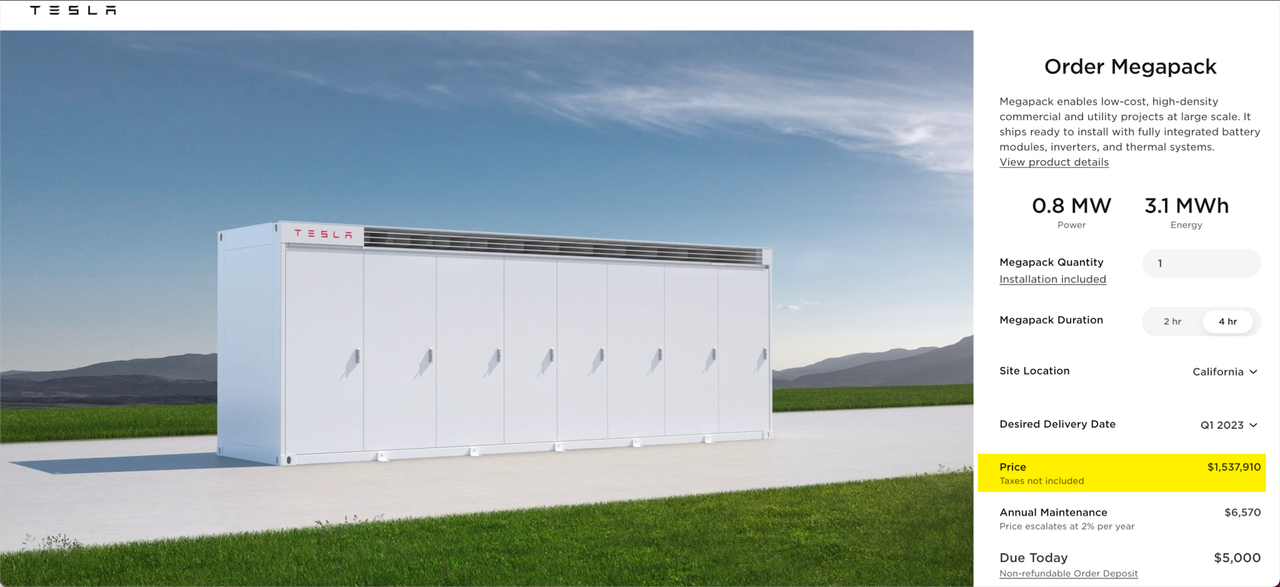 ?itok=lxTa2SlF
The system consists of 50 Megapack 2, rated 45.3 MW/181.9 MWh, 4-h energy delivery
Power = 50 Megapacks x 0.979 MW x 0.926, Tesla design factor = 45.3 MW
Energy = 50 Megapacks x 3.916 MWh x 0.929, Tesla design factor = 181.9 MWh
Estimate of supply by Tesla, $90 million, or $495/kWh. See URL
Estimate of supply by Others, $14.5 million, or $80/kWh
All-in, turnkey cost about $575/kWh; 2023 pricing
https://www.tesla.com/megapack/design
https://www.zerohedge.com/commodities/tesla-hikes-megapack-prices-commodity-inflation-soars
Annual Cost of Megapack Battery Systems; 2023 pricing
Assume a system rated 45.3 MW/181.9 MWh, and an all-in turnkey cost of $104.5 million, per Example 2
Amortize bank loan for 50% of $104.5 million at 6.5%/y for 15 years, $5.484 million/y
Pay Owner return of 50% of $104.5 million at 10%/y for 15 years, $6.765 million/y (10% due to high inflation)
Lifetime (Bank + Owner) payments 15 x (5.484 + 6.765) = $183.7 million
Assume battery daily usage for 15 years at 10%, and loss factor = 1/(0.9 *0.9)
Battery lifetime output = 15 y x 365 d/y x 181.9 MWh x 0.1, usage x 1000 kWh/MWh = 99,590,250 kWh to HV grid; 122,950,926 kWh from HV grid; 233,606,676 kWh loss
(Bank + Owner) payments, $183.7 million / 99,590,250 kWh = 184.5 c/kWh
Less 50% subsidies (ITC, depreciation in 5 years, deduction of interest on borrowed funds) is 92.3c/kWh
At 10% usage, (Bank + Owner) cost, 92.3 c/kWh
At 40% usage, (Bank + Owner) cost, 23.1 c/kWh
Excluded costs/kWh: 1) O&M; 2) system aging, 1.5%/y, 3) 19% HV grid-to-HV grid loss, 3) grid extension/reinforcement to connect battery systems, 5) downtime of parts of the system, 6) decommissioning in year 15, i.e., disassembly, reprocessing and storing at hazardous waste sites. The excluded costs add at least 15 c/kWh
COMMENTS ON CALCULATION
Almost all existing battery systems operate at less than 10%, per EIA annual reports i.e., new systems would operate at about 92.4 + 15 = 107.4 c/kWh. They are used to stabilize the grid, i.e., frequency control and counteracting up/down w/s outputs. If 40% throughput, 23.1 + 15 = 38.1 c/kWh.
A 4-h battery system costs 38.1 c/kWh of throughput, if operated at a duty factor of 40%.That is on top of the cost/kWh of the electricity taken from the HV grid to feed the batteries
Up to 40% could occur by absorbing midday solar peaks and discharging during late-afternoon/early-evening, which occur every day in California and other sunny states. The more solar systems, the greater the peaks.
See URL for Megapacks required for a one-day wind lull in New England
40% throughput is close to Tesla’s recommendation of 60% maximum throughput, i.e., not charging above 80% full and not discharging below 20% full, to achieve a 15-y life, with normal aging.
Tesla’s recommendation was not heeded by the Owners of the Hornsdale Power Reserve in Australia. They excessively charged/discharged the system. After a few years, they added Megapacks to offset rapid aging of the original system, and added more Megapacks to increase the rating of the expanded system.
http://www.windtaskforce.org/profiles/blogs/the-hornsdale-power-reserve-largest-battery-system-in-australia
Regarding any project, the bank and Owner have to be paid, no matter what. I amortized the bank loan and Owner’s investment
Divide total payments over 15 years by the throughput during 15 years, you get c/kWh, as shown.
There is about a 20% round-trip loss, from HV grid to 1) step-down transformer, 2) front-end power electronics, 3) into battery, 4) out of battery, 5) back-end power electronics, 6) step-up transformer, to HV grid, i.e., you draw about 50 units from the HV grid to deliver about 40 units to the HV grid, because of A-to-Z system losses. That gets worse with aging.
A lot of people do not like these c/kWh numbers, because they have been repeatedly told by self-serving folks, battery Nirvana is just around the corner.
NOTE: Aerial photos of large-scale battery systems with many Megapacks, show many items of equipment, other than the Tesla supply, such as step-down/step-up transformers, switchgear, connections to the grid, land, access roads, fencing, security, site lighting, i.e., the cost of the Tesla supply is only one part of the battery system cost at a site.
NOTE: Battery system turnkey capital costs and electricity storage costs likely will be much higher in 2023 and future years, than in 2021 and earlier years, due to: 1) increased inflation rates, 2) increased interest rates, 3) supply chain disruptions, which delay projects and increase costs, 4) increased energy prices, such as of oil, gas, coal, electricity, etc., 5) increased materials prices, such as of tungsten, cobalt, lithium, copper, manganese, etc., 6) increased labor rates.
BATTERIES IN NEW ENGLAND TO COUNTERACT A ONE-DAY WIND/SOLAR LULL FOR A MERE $456 BILLION
https://www.windtaskforce.org/profiles/blogs/batteries-in-new-england
Currently, the variable output of wind and solar is counteracted by fossil-fired, CO2-emitting, quick-reacting power plants. Some people want to replace such power plants with large-scale battery systems to reduce CO2 emissions. This article presents an analysis that shows, using such batteries systems for counteracting, and storing electricity, even for one day, has a very high owning and operating cost, even with 50% subsidies.
NE has variable weather conditions, with frequent periods of very little wind, even offshore, and very little sun, which means wind and solar power, already highly variable 24/7/365, is frequently minimal, throughout the year.
This analysis shows the cost of battery systems, if they are used to store electricity for a W/S-lull lasting one day.
In this analysis, we ignore hydro, for simplicity.
As part of our analysis, we assume, at some future date:
.
– CO2-emitting power plants will be shut down, such as fossil fuel, wood burning, refuse burning, etc.
– Nuclear plants, once shut down, will not be replaced
– Existing hydro plants, about 7% of NE annual generation, will remain.
– Wind and solar installed capacity, MW, will be sufficient to provide 100% of average daily demand each day of the year.
https://www.iso-ne.com/about/key-stats/resource-mix
NOTE: This analysis uses average values, for simplicity. A more exact analysis would use hourly or 15-minute values. Whereas it would be more difficult to understand by non-technical people, the outcome would be nearly the same.
Open top URL to read much more
Wilpost, thanks for your commentaries. I sent a link for this WUWT topic to many people (natural resource, environmental and state officials) here in Wokeachusetts. I hope they read the post and the comments. They might actually learn something. 🙂
I tried to send Mass folks my stuff as well, but my stuff is blocked (also in Maine and Vermont, two more nut cases) to keep all those people stupid.
I wrote that article at least 5 years ago, BASED ON EIA ANNUAL REPORTS OF ACTUAL INSTALLATIONS, which subsequently had their format changed so those annual reports have become obscure/less useful.
I called the EIA about it but never got an answer.
With Trump in, I hope the stone wallers are fired
Who did you try to send to in MA? The media, like the Globe? State officials?
If the dollar cost were zero would it be a good idea?
Nothing is for free
Nuclear plants do not need battery systems, so any battery system cost should be added to wind and solar costs
“First of, that Massachusetts bill is total bull manure, because no more windmills will be built on the East Coast, and American Gulf, and West Coast, so these batteries are not needed”
I hope you’re right, but believe it or not, this state seems totally unaware of who our next president will be and what his policies are. This state is still aiming for net zero nirvana. It’s now a full court press by every state agency, per order of the governor. I’m wondering how long it will take before the state government and the state’s MSM wake up to the new reality. The woke delusion here is extremely strong.
Massachusetts Woke Folks Hell-Bent on Buying 5,000 MW of Batteries Will Further Impoverish the State for Decades
https://www.windtaskforce.org/profiles/blogs/massachusetts-woke-folks-hell-bent-on-buying-5-000-mw-of
by Willem Post
A very comprehensive presentation.
You left out one important factor. Keeping the cells warm in winter and cool in summer and associated variations in capacity due to temperature.
I mentioned it in my write up
Just re-read
“Legislators, who are babes in the woods looking for the Abominable Snowman, should have no voice regarding energy systems”
Here in Wokeachusetts, those same legislators know nothing about forestry- yet they write laws regulating it- which mostly serves the interest, of course, of the regulators. All forestry regulators here could be put out of work- it wouldn’t make any difference.
Now, this is not the end.
It is not even the beginning of the end.
But it is, perhaps, the end of the beginning.
It represents an issue that extends to us all, in fact, as the storage problem cannot be solved in any other way that will satisfy the green blob. Hydro resources to do the job do not exist within the U.S. and would be countered with endless lawsuits. Transmission from boreal Canada would involve enormous expense and poor use of capital involved. Using thermal storage, well, that guarantees fighting the second law of thermodynamics at every step, doesn’t it?
And 20,000 MWhr? Not even close to what is needed for the current standard of reliability which is one day of unscheduled outage per ten years operation.
‘Using thermal storage, well, that guarantees fighting the second law of thermodynamics at every step, doesn’t it?’
As usual, you’re being logical. Remember, we’re dealing with people who have no grasp of basic science, let alone thermodynamics.
Photo of European wall plug headlining article about USA Massachusetts electricity.
AI strikes again?
I did the calculations a while ago to figure out how much battery backup I need to run my house without compromise as part of a solar power package. I live in New England very close to Massachusetts, so my numbers may easily reflect actual numbers for an average Mass resident.
I have a unique energy profile in my home, as I can heat my basement and first floor with an oil fired boiler, but I also can heat the first floor with combination heat pump and wood stove. My second floor can only be heated with heat pumps or resistance heating. I prioritize electric heating because most people sleep on the second floor, hence my inquiry into solar and batteries. It’s a large 1970s built home, with moderate insulation, typical for that time.
Long story short, the obstacle was no matter how big my solar project was, the sky is cloudy when I need electricity the most in the winter, and especially at night, and the sun angles are horrible for any roof mounted system. I’ve been collecting data since 2016, and the scale of the battery I need quickly became shocking. I realized I needed close to a MWh to get me through the winter. If I wanted 99.9% availability electricity without compromise, I needed a battery that cost as much as my house that would fit inside a large trailer. That’s probably over $3,000 in principle, ignoring the interest charges, every month
Massachusetts wants every resident to heat, and cook, and do everything with electricity as my home can do, and they want to do it with green energy and storage. Perhaps my house is a bit larger than the average Massachusetts resident, but even if that were the case by double (it’s not), that’s 3,500,000 MWh required for 99.9% availability. And that’s just the residents, never mind industry and commercial interests, and I don’t drive an EV.
It’s insane
Two questions:
Is there enough manufacturing capacity to build batteries in the volume the law requires.
The article states a current price for batteries. How much will this big boost in demand increase that cost?
And what is the impact to EVs?
Rumor has it they use batteries.
BOOM!
Where do you get the massive amount of energy to charge them? How big will the fire be? The big Tesla batteries have already had fires, and they do not perform as expected either. Running flat very quickly. Recharging is a problem of supply too. Big diesel generators are used.
Very nice David.
“Ten billion, twenty-five billion, maybe more who knows? That is seriously vague and I doubt the Legislators who voted for this madness had any idea of these numbers.”
The solution is simple take that 25 billion dollars and build nuclear plants. Nuclear plants will cancel the need for wind, solar and batteries. They will produce power when we need it, will last longer than wind, solar or batteries and can make money.
You’d think MA would look a couple miles south at the ongoing arguments here in CT regarding the monstrosity “Public Benefits Charge”. That is a per-kWh charge on our electric bills for all the State-mandated “stuff”: renewables, Millstone subsidies, EV subsidies, coverage of electrical bills for those that do not (or cannot) pay, etc.Each of those was approved, and mandated, by the State legislature. That PUC is approaching and starting to exceed the generation and delivery charges.
Eversource explicitly splits it out in the bills so everyone can see it, all laid bare. And politicians are now dancing heel-to-heel trying to back peddle…
So who’s going to pay for these batteries? Well, the utilities certainly won’t so the money will come from ratepayers and/or taxpayers (unless MA has a magic money tree hanging about somewhere).
“There’s no such thing as a free lunch.”