By P Gosselin
The Little Ice Age

The period between 1250 and 1860 is also known as the Little Ice Age. We have already reported on it several times here. The Little Ice Age was the undoing of the Franklin expedition, among others. In search of the Northwest Passage, the crew failed because of the ice, even though they had set off in summer. Franklin was in the wrong place at the wrong time. He paid with his death.
AI-generated Image. Source: Klimanachrichten
But what was the climate like at the time and what were the climate drivers? Volcanoes played a major role, but so did a minimum of solar activity. However, summers were by no means consistently wet and cool.
A study from 2022 looks at this topic. Here’s the abstract:
The Little Ice Age (LIA), which lasted from about 1250 to 1860 AD, was likely the coldest period of the last 8000 years. Using new documentary data and analyses of alpine glacier fluctuations, the complex transition from the Medieval Climate Anomaly to the LIA and the ensuing high variability of seasonal temperatures, are described and interpreted for Europe. The beginning of the LIA was likely different in both hemispheres. The low temperature average of the LIA is primarily due to the high number of cold winters. Conversely many summers were warm and dry.
Important triggers of the lower temperatures were, primarily, the numerous clusters of volcanic eruptions and the weak solar irradiance during the four prominent Grand Solar Minima: Wolf, Spörer, Maunder, and Dalton. The drop in temperature triggered the sea-ice–albedo feedback and led to a weakening of the Atlantic overturning circulation, possibly associated with a trend towards negative North Atlantic Oscillation indices.
The statistics of extreme events show a mixed picture. Correlations with forcing factors are weak, and can only be found in connection with the “Years without a Summer”, which very often occurred after large volcanic eruptions.
We must always bear in mind that several factors came together in the middle of the 19th century. One of the coldest periods in the last 8,000 years was followed by a climatic counter-movement. In addition, the industrialization of the world and the massive use of coal began. Land masses were reshaped on a large scale, such as during the colonization of North America.
This period also marked the birth of modern meteorology. During the Crimean War, France lost large parts of its fleet due to a storm for which it was unprepared. As a lesson from this, weather forecasts were made on the basis of data, of course in no comparison to today. However, warnings of storms were also possible back then thanks to the use of telegraphy. So a lot of things came together.
A recent study on the subject found that volcanism was predominantly “responsible” (51% involved), but that the North Atlantic Oscillation (NAO), which particularly influences winters in Europe, was also involved and that the Interdecadal Pacific Oscillation (IPO) at the other end of the world was even involved (28%). In any case, we would do well to remember that nothing in nature is constant and romanticized images from the period before the mid-19th century should be viewed critically. So the next time we hear the phrase “before industrialization”, please remember this article.
“before industrialization”
My ancestors on the paternal side were shepherds in Norfolk in the early 18th century. By all accounts it was a very hard life.
Thankfully, we have that nice Mr Miliband who is going to lead us backwards into the future.
“”The truth is that like all big industrial transitions, the shift to green was never going to be without pain””
https://www.theguardian.com/commentisfree/2024/nov/29/keir-starmer-labour-net-zero-electric-vehicles-green
All previous industrial transitions have benefited the human, this transition cannot be made – it will only cause pain.
The LIA was miserable year-round
Dry, warm summers means poor crops, means little food to save for winter (there was no refrigeration), means starving during cold winters.
Finally, the unfortunate NATURAL cycles realigned and Europe awoke from its 600-year depression.
After that, fossil fuels were a factor to finally increase CO2 from near the lowest level in the past 600 million years.
As a result a lot more world greening occurred.
https://www.windtaskforce.org/profiles/blogs/hunga-tonga-volcanic-eruption
Plants require at least 1000 to 1200 ppm of CO2, as proven in greenhouses
Many plants have become extinct, along with the fauna they supported, due to a lack of CO2.
As a result, many areas of the world became arid and deserts.
Current CO2 needs to at least double or triple.
Unfortunately, not enough fossil fuel is left over to make that CO2 increase happen
Earth temperature increased about 1.2 C since 1900, due to many causes, such as long-term cycles, fossil CO2, and permafrost methane which converts to CO2.
.
CO2 ppm increased from 1979 to 2023 was 421 – 336 = 85, greening increase about 15%, per NASA.
CO2 ppm increased from 1900 to 2023 was 421 – 296 = 125, greening increase about 22%
.
Increased greening: 1) Produces oxygen by photosynthesis; 2) Increases world flora and fauna; 3) Increases crop yields per acre; 4) Reduces world desert areas
Question (and I do NOT know the answer): Of the CO2 generated on Earth each year, what proportion comes from NATURAL phenomena (e-g, volcanoes, wetlands, insects, etc?). Thanks, Frank Moore, Columbus, Georgia
Frank, vastly more CO2 emissions come from natural sources than from fossil fuel burning, perhaps 96%. However, don’t be confused as so many are by this fact. Unlike man-caused emissions, which are not balanced by any sort of man-caused sinks, there are natural sinks of an even greater magnitude than the natural sources.
Natural sinks absorb the equivalent of all the natural sources plus half of our fossil fuel and concrete-making emissions. A small amount of the increase in atmospheric CO2 has been due to general warming which leads to increased ocean out-gassing. (About 15ppm out of 145ppm rise). About 90% of the increase has been due to fossil fuel burning.
Rising CO2 is mostly due to human influences, but rising CO2 is net beneficial. It is in no way a problem. Even if CO2 has been the only factor influencing temperature, which is highly unlikely, empirical evidence shows that each doubling of CO2 concentration would only warm the climate by less than 2°C. There isn’t enough economically-extractible fossil fuel left to double CO2 concentration from current levels.
If we did achieve a doubling to 850ppm, CO2 levels would still not be returned to the concentration optimal for plant growth.
That’s an excellent summary. I have snarfed it.
Also, From memory, so check: Humans create about 35Gt pa of CO2 by combustion of hydrocarbon fuels. (In case oil is not a fossil fuel).
Termites produce 50Gt pa naturally as part of the 96%/770Gt of the CO2 that is naturally produced every year as part of the carbon cycle.
Total atmospheric CO2 is 3,000 Gt.
This 3,000Gt is 2% of the total surface CO2 on Earth, the other 98% is dissolved in the oceans, and liberated by warming…
1ppm is c. 7.5Gt.
Most important, the claimed effects are bot positive for humanity and also tiny compared to natural variability that is simply denied as a contributor to change , which are all well balanced by the natural control system that returns energy to space by radiation and evaporation at the same rate it arrives. Both the solar input and Earth’s rate of enrgy loss to space per degree of temperature change changes with time, so the temperature must rise and fall to keep the energy balance, but remains a strong natural control.
Because of added manmade CO2 emissions, oceans have been net CO2 absorbers for over a century.
The warming of the oceans only means they absorbed slightly less CO2 than they would have absorbed without the warming.
Nature has been a gradual, intermittent net CO2 absorber for billions of years.
There was no year over year ocean CO2 outgassing in the past 100 years.
According to current scientific understanding, the last time the oceans significantly outgassed CO2 on a large scale was likely during the last major glacial period, around 20,000 years ago, when warming temperatures caused the oceans to release previously absorbed carbon dioxide into the atmosphere as the ice sheets melted and the planet warmed out of the Ice Ag
Richard,
It is a matter of semantics I think. My point is that the equilibrium partial pressure of CO2 would be about 295ppm for the current sea surface (average) temperature. This is 15ppm higher than it was in 1850. If the warming had occurred without the concurrent increase in fossil fuel burning, then there would have been a 15ppm rise in CO2 concentration due to outgassing.
My point is not to argue in favor of CO2 concentration rise being caused by natural sources, but rather to disprove that theory while acknowledging that outgassing is a real phenomenon. Don’t forget that CO2 flux goes in both directions in different regions and times of the year.
Also more importantly, just because CO2 rise is predominantly caused by fossil fuel burning, doesn’t prove that higher CO2 concentration is in any way harmful. Nor for that matter does it even definitively prove that the net effect is warming. There may be emergent phenomena that compensate for the enhancement of the greenhouse effect.
What we can say is that if the only significant factor in warming has been the enhancement of the greenhouse effect, then the equilibrium climate sensitivity is less than 2°C per doubling of CO2 concentration, and that is not a cause for alarm.
What a load of balderdash. Human released CO2 barely makes a dent in the total CO2 flux.
Explain the big spike in the rate of change of atmospheric CO2 at every El Nino event, if its not coming from the ocean.
—–
“when warming temperatures caused the oceans to release previously absorbed carbon dioxide into the atmosphere”
You mean like the last 100 or so years !
Billions? AAAAAAha ha ha ha. Where do think co2 comes from? Space?
P.S. The earth is <> 4.5 billion years old.
I think what he means is that upon formation the Earths atmosphere settled down to be about 80% CO2 and is less than that today. So it has overall been falling ever since, mostly by its uses as plant food and animal life which has led to large amounts of oxygen in the atmosphere, a steady increase in nitrogen and the fixing of carbonate in limestone and chalk rocks and in organic deposits of coal oil and gas.
What is your problem with CO2 coming from space? Everything came from space at some point.
Primordial Earth atmosphere contained hundreds of times more CO2 than today, similar to Venus and Mars. Life is about 3.5 bln yo, and during all of this time life forms sequestered CO2 out of the air and water, depositing CaCO3 at the bottom of oceans as limestone and chalk. Volcanoes put some of it back.
I need some of this manure to feed my tomatoes.
CO2 outgassing following ocean temps is all recorded in the ice cores from Vostok and Greenland. Not much controversy about it. The lag is several 100 years, so short scale fluctuations like recent few tens of years warming have no chance to effect today’s CO2 air content.
But the Medieval Warm Period does -right on schedule.
Rich. Nice flow, excellent case building, thank you, I’ll be passing it along at Quora.
Don’t be confused by claims of “balance,” since none of that is based on any MEASUREMENTS. It is all ESTIMATES and ASSUMPTIONS.
CO2 IS CO2. If we contribute 3-4%, then that is precisely how much we add to the “mix,” irrespective of claims of “balance.”
First of all, the fact that fossil fuel burning is responsible for the observed rise in CO2 concentration is a completely different topic from the question of whether CO2 emissions enhance the natural greenhouse effect or cause any warming. To say that human activity has caused the rise in CO2 concentration is not to say the human activity causes dangerous warming.
The proof that manmade emissions are responsible for the observed rise in CO2 concentration is the fact that the directly and accurately measured increase in CO2 content of the atmosphere is only half the CO2 expected from directly measured production of fossil fuels and concrete production.
The mass balance argument says
In – Out = Accumulation (1)
In(man) + In(nature) – Out(nature) = Accumulation (2)
Rearranging:
In(man) – Accumulation = Out(nature) – In(nature) (3)
In(man) – Accumulation = Net sink (4)
The amount of CO2 produced when burning fossil fuels is accurately known from the chemistry lab for each fuel, as is the amount of CO2 released by converting calcium carbonate to lime (calcium oxide) when making cement. We have accurate measurements of fossil fuel and cement production from tax records. This number is conservative because any overestimation results in higher tax and royalty payments.
We have accurate direct measurements of CO2 concentration change which can be converted to an accurate measurement of the mass of CO2 in the atmosphere based on the total mass of the atmosphere derived from the accurate measurement of atmospheric pressure and the surface area of the earth.
Even before considering the likelihood that manmade emissions are probably greater than what is reported to the tax man, they are roughly double the observed increase of CO2 in the atmosphere. This means that it is absolutely certain that the net natural sink is a positive number. Nature cannot be the cause of rising CO2 concentration in the atmosphere if it is a net sink.
We do not need to measure or estimate or assume ANYTHING about the natural sources or the natural sinks. If we had to do that, we would indeed never be able to do so with any accuracy. But the argument rests on very accurate measurements of fossil fuel and cement production over a period of several decades and the change in CO2 concentration over the same period. As with any measurement, there is some uncertainty due to measurement error. However, fossil fuels production would need to have been overestimated by a factor of two, for decades, resulting in massive double payment of taxes in order for there to be enough error to flip the sign of the net sink to negative. (To a net source).
Those who cling to the belief that nature could be the source of increasing CO2 concentration appear to be doing so out of a hope that it would render moot the question of whether rising CO2 causes warming because if nature is responsible then there’s nothing we could do about it.
Yet even that is not correct. If rising CO2 were a problem, then we would need to limit our contribution to it even if we were not the sole cause.
The good news is that rising CO2 is net beneficial and at most is only causing a minor milding of the weather. So there is no point in denying basic algebra.
Your argument supposes that human emissions is the sole result of increasing CO2. That ignores any attribution to nature sources that are also increasing.
Oceans are not warmed by CO2 yet they are warming somewhat thereby releasing additional CO2. Increases in animal and insect populations also release additional CO2. Respiration from increasing flora and longer growing seasons add to CO2.
Simple algebra using unproven attribution quantities is VERY suspect.
The argument is that Nature cannot be both net sink and net emitter at the same time. No matter what the uncertainties are, humans contribute about twice the annual CO2 growth. This makes Nature a net absorber.
Agree with everything except this:
“rising CO2 … is only causing a minor milding of the weather”
This is a conjecture based on rigged computer models assuming either a completely dry atmosphere, or a strong positive water feedback with fundamentally unstable climate. In real life climate is stable, the water feedback is negative, and CO2 does not cause any discernable effect that could be measured.
It is premature to concede that CO2 makes any effect on climate other than through globally affecting plant growth.
I made no such concession. “at most” is a very critical qualifier that you edited out of my comment.
To be explicit, temperature seems to be rising slightly and that may have nothing to do with rising CO2 but if CO2 is having an effect at all, it is AT MOST a minor milding of the weather.
The percentage of CO2 emissions that are natural is about 96% BUT nature absorbs MORE CO2 than it emits, and has been doing so for billions of years.
Manmade CO2 emissions are about 5 ppm a year and nature (oceans, plants, soil) manages to absorb about 2.5 ppm of the added CO2 emissions. The other 2.5 ppm causes a rise of atmospheric CO2 for the year.
Some conservatives can not understand this simple process. I call them The WUWT Peanut Gallery.
The increase of atmospheric CO2 since 1850 is 100% manmade.
CO2 levels have naturally decreased for billions of years before there were manmade CO2 emissions. Vents, volcanoes, wildfires, etc. did not create enough CO2 to prevent the very long term declining trend of CO2.
Natural sources of carbon dioxide (CO2) include: volcanic eruptions, animal respiration (breathing), decomposition of organic matter (like decaying plants), forest fires, ocean outgassing, and weathering of carbonate rocks, all of which contribute to the natural carbon cycle by releasing CO2 into the atmosphere.
Conservative Nutters
Total CO2 is 96% manmade
and does not cause global warming
Leftist Nutters
Total CO2 is 33% manmade and causes every problem in the world.
Honest Climate Science
Total CO2 is 33% manmade
CO2 causes beneficial warmer winters and better plant growth
Honest Climate Science and Energy
I have no idea how you arrive at the idea that only 33% of the rise in CO2 is ‘manmade’.
Depending on how you look at it, it is between 90% and 100%. It’s either 90% if there is no enhanced greenhouse effect or up to 100% if all of the observed warming has been due to enhancement of the GHE.
ALL CO2 emissions are natural.
Your argument that humans are unnatural is a bogus argument.
You have been told this before, but continue to insist that human behavior is somehow supernatural. A position that you or anyone else never can confirm.
Doonman, you are of course correct that mankind is part of nature. The distinction is not an arbitrary question of natural vs. unnatural. The distinction is on what we humans control and what would happen even if we were not part of the natural world.
When there are consequences from actions, we are ethically accountable for the consequences of our actions. Most of us would acknowledge that dumping raw sewage into a river upstream of another city that depends on that river for its water supply would be unethical.
We are not responsible, on the other hand, for weather damage to another country. That is something outside our control. We refer to that as a ‘natural’ phenomenon as distinct from something caused by human activity.
It doesn’t make sense for you to quibble about terminology if you acknowledge this distinction.
I doesn’t make sense to conjecture about human co2 at all.
What conjecture? There is zero conjecture in the mass balance.
Well lets say that we can potential control about 33%. By committing suicide.
There is allegedly a way to spot fossil based CO2 by isotope analysis.
C14 is generated in the atmosphere by cosmic rays IIRC and so after a million years or so is no longer present in fossil fuel.
So a net reduction on atmospheric C14 equates to large amounts of fossil fuel generated CO2. Or volcanic injected CO2.
You can check this up. I cant remember the exact details
It’s true that you can cast around in the dark with conjectures about radioisotopes and then make arguments and counter-arguments about how the observations could be caused by volcanos or whatever.
But there is no reason to make it so complicated. We burn x tons of fossil fuel that produces y tons of CO2. We measure the CO2 concentration and observe that it increased by only y/2, half as much as we emitted.
It is not rocket science. Nature absorbed half of what we emitted.
That doesn’t depend on natural sources balancing natural sinks. It doesn’t depend on anything staying the same from year to year. Maybe there’s major natural variation in both the sources and the sinks. That’s all irrelevant.
All we’re asking is whether the rise in CO2 concentration is more or less than the amount it would rise from the quantity of CO2 we emit. If it rises less as is the case by a factor of 2, then we know that the net effect of the myriad massive natiural fluxes is to remove CO2 from the atmosphere.
About 4% of the CO2 flux is human released. It does not accumulate any more than the natural increase in CO2 released by natural warming.
Temperature drives the CO2 increase, not human release.
Mid 2024 More Proof Temp Changes Drive CO2 Changes | Science Matters
This is too small to show any measurable isotopic signature of human CO2 because it gets cycled so quickly.
As you have shown many times, there is no measurable warming by atmospheric CO2..
Perhaps you would like to try again..??
1… Please provide empirical scientific evidence of warming by atmospheric CO2.
2… Please show the evidence of CO2 warming in the UAH atmospheric data.
3… Please state the exact amount of CO2 warming in the last 45 year, giving measured scientific evidence for your answer.
“If there are no measurements to support a conjecture, it is just speculation.” (RG)
“Plants require at least 1000 to 1200 ppm of CO2, as proven in greenhouses” W
420 ppm CO2 supports 8 billion people, so plants obviously do not “require” 1000 to 1200 ppm
Greenhouses often CO2 enrich from 600 to 1200 ppm, but only during the initial growing season when greenhouse vents are closed, and usually not 24 hours a day.
Optimal CO2 levels vary across different plant growth stages: 600-1200 PPM for seedlings, 800-1500 PPM for vegetative and flowering/blooming plants
The best time to supplement CO2 is during the day, from one to two hours after sunrise to two to three hours before sunset. There is no photosynthesis at night unless there is artificial light.
C4 plants such as corn, sugarcane and many grasses can survive with 10 ppm CO2 and don’t benefit as much from CO2 enrichment.
More CO2 in the atmosphere = more life on our planet. We should hope for CO2 x 2, not fear it.
Quit your nitpicking. Wilpost obviously meant that plants benefit from higher CO2 up to at least 1000 to 1200ppm, rather than require
Rich,
I require nutrition to survive, but I need much more nutrition to thrive.
The same is true for plants.
Plants WANT to thrive, but are limited by survival diet, i.e., low CO2 and lots of fertilizer, pesticide, herbicide, etc., in case of crop plants.
From the plant’s point of view, they are only just above the “slice of bread and a sip of water” stage.
Just that the bread is no longer mouldy.
I understand what you are saying but that is not quite true.
I don’t think you could say that a bamboo growing 1 metre/day is not thriving.
That’s interesting. So were mine. The ancestors were called Punt. Makes me distantly related to Louisa May Alcott.
The shift to green is an anti-industrial transition, deindustrialization, or just pure self-destruction.
It should also be remembered, before industrialisation the average age of death was below 40 years of age. Thanks to innovation and industrialisation along with the use of fossil fuel powered machines ,we have doubled life expectancy. That is something we should celebrate and ensure continues so future generations can enjoy the longevity we have.
I’m convinced that the reason my parents both lived to around 90 was gas-fired central-heating. In earlier ages, when houses were less well heated, people were left vulnerable to infections by the lower domestic temperatures in which they lived.
The average age is misleading. The reason for a low life expectancy is that childhood was deadly. If someone dies at age 68 and a child dies at age 2, then the average is 35 but no one died at 35. The improvement in life expectancy is due primarily to curing childhood diseases. Another factor was war–lots of people died during the many wars fought.
Another case where “The average of measurements is not a measurement!”
You might also note that primarily young men suffered from wars and work accidents, while childbirth was tough on young women. If you made it past those challenges, then not too much has changed. (Apologies to “modern medicine!”)
In 1900, in both New York City and England, one woman in 11 could expect to die from causes directly related to child bearing. A nasty piece of old-fashioned obstetric kit was forceps to crush the head of a baby in obstructed labour to save the mother – still necessary for a doctor practicing where no surgical facilities are available.
“Another case where “The average of measurements is not a measurement!””
Absolutely! That’s been my thought throughout this whole climate change nonsense. And life expectancy is just another misleading statistic.
Wait till you are my age to see if ‘not much has changed’
I should have died twenty years ago.
Then again at ten years ago.
I expect to struggle through another ten.
In short modern medicine has put about 30 years on my life compared with mediaeval times.
i am going to take exception to this, and to what hiskorr and idle Eric say below. Yes, the change in life expectancy is greatly influenced by changes in mortality in the infant to young adult populations. However, that adults lived long lives occasionally is also an over-rated statistic. Take a look at photographs of your grandparents, and depending on your age your parents too, and what is striking is how old people in past ages appeared to be even in their early 50s. Life is measurably easier now and we age less quickly; all due to comforts and easier work enabled by fossil fuels.
In fact, I’d go so far as to say that the advancements in medicine and conquest of childhood mortality is indirectly due to fossil fuels because of the materials they provide and because the greater labor productivity they foster have enabled greater investments in research with a longer payout duration.
And pharmaceutical products, including vaccines, are yet another thing we have produced largely thanks to our use of fossil fuels, absent which, for one example, the metal and glass for microscopes wouldn’t exist.
The average age of death is somewhat misleading due to high levels of child mortality at the time, if you got past the first few years of life, you had a good chance of living to something close to what you might expect today.
Quite what effect industrialization had on the advance of medical science, I can’t say.
The average lifespan for men born in 1800 in the United States was 66.21 years, and 64.66 years for women. This includes infant deaths.
1700 was about 40 years old.
In 1800, the child mortality rate in the United States was 462.9 deaths per 1,000 births, meaning that more than 46% of babies did not survive to their fifth birthday. In the 1800s, up to 30% of children died before their first birthday.
Whenever I see the phrase “pre-industrial” and the date 1850 associated, I note clearly that what is actually being talked about is the end of the Little Ice Age.
Still, how ODD it has warmed since then, sure…
CO2 as measured in 1820 was as high a concentration as today.
CO2 as measured in 1880 was the lowest concentration in the 19th century.
Apparently 1880 also was the lowest “average” temperature in the 19th century.
Curious that 1880 is always used.
Some date the industrial revolution to 1760. Maybe all that warming from industrialization is what caused the end of the LIA..
What Gosselin doesn’t quote is from the conclusion:
“Both the MCA (about 950-1250 AD) and LIA (about 1250-1860 AD) showed a high climate variability. On average the MCA was only a few tenths of a degree warmer than the LIA “
[MCA-MWP]
We still have a high climate variability; that hasn’t changed much at all.
A few tenths? How many tenths?
This is WUWT’s chosen paper. I quote what they said.
Nick, please show us the instruments available in AD 950-1250 that could measure a few tenths of a degree & show us the 1,000s of locations they would have to be in, to give an accurate picture.
Beat me to it. Nick Picker is curiously obtuse in so many cases.
And then he runs away.
Lies, Damn Lies and Statistics!
Brave, brave Sir Nick
https://m.youtube.com/watch?v=BZwuTo7zKM8
This is how it goes so often here. WUWT puts up a paper that they think makes a point they like. I quote what they say that puts it in perspective. So then the chorus says – it’s just science, they don’t know nothing.
DENIAL of the MWP is the refuge of the ignorant !
A few of things we do know by observation… Vikings colonized Greenland and grew crops to feed animals during the MCA but not during the Little Ice Age. Ötzi the ice man, the 5,300 year-old frozen mummy did not crawl under a glacier in the Tyrolean Alps to escape his attackers. The Frost Fairs on the Thames River occurred during the little ice age but not before and not after. Hippos used to live in the Thames River as evidenced by bones dug from the Thames.
All occurred before Humans released quantities of CO2 into the atmosphere which scares people into spending their money.
Is someone still trying to use Saint Michael’s Hockey Stick as a valid temperature reconstruction?
Or any of them. None of the proxy recons are any kind of accurate. Abd most have such poor temporal resolution, they would completely miss any century scale changes.
Apparently. It seems quite reasonable to tack proxy resolutions of a hundred years to measured resolution of 24 hours and make a hokey stick with the results, does it not?
Yeah Nick, you know they’ve gotta give a tip of the hat to the machine, they were lucky to get this much published!
They weren’t quoting their own reseach, they simply gave a nod to the ‘climate change’ gatekeepers:
When you see the name Mann, you know the research is junk.
Which shows how worthless the reliance on “average temperature” measurements is!
The average global temperature is approximately 59°F (15°C).
That doesn’t stop it from getting over 100°F in many places in the NH Summer nor the.SH Summer
There is no meaningful global average.
It all depends on definition, method of measurement, and purpose of use. There could be, say, if one moves away from Earth far enough in space, looking at it at very low resolution.
The world has only warmed up by a few tenths of a degree since the end of the LIA.
Actually, from the Nadir of the LIA, the world has warmed almost 1.7°C and nothing has “Tipped” just lovely balmy temperatures, longer growing seasons and a markedly greener biosphere. And multiple annual fledgings of songbirds in my front bushes.
Here in Colorado, you would have to really ignore the impact of El Niño on the Rocky Mountains. Our snowfall and temperature varies based on it, among other things like the NAO, Arctic Oscillation especially.
Over the past few months the ENSO meter has moved firmly into La Nina, but has moved back to firmly neutral in the last few weeks.
I don’t know what this means? Ae we heading back to El Nino?
Now downward again
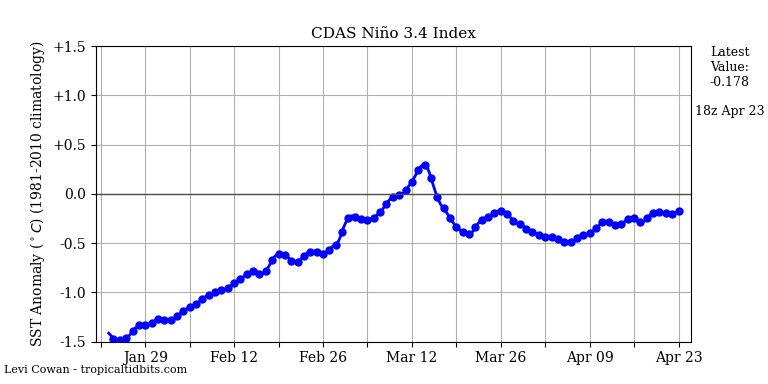
My monkey Clarence, who predicts all things weather by using the dartboard method, can’t predict where we will be with El Niño or La Niño this upcoming 12 months since he got into the liquor cabinet again and actually missed the dartboard on 3 successive tries.
I might add Clarence does better than the weather models, especially the American ones.
Sounds like we should all be heading for the liquor cabinet.
“ actually missed the dartboard on 3 successive tries.”
Sounds like a full-fledged member of the Hockey Team!
How many waitresses were injured by the misses?
This Southern Californian hopes so.
Everybody is getting the jitters
Blairites are in despair over Keir Starmer’s flailing leadership
A person close to the former PM said the current government is like a bunch of unimaginative ‘librarians and academics
https://www.independent.co.uk/voices/starmer-leadership-blairites-despair-b2656483.html
It’s the anti-Midas touch; everything is turning to…
But this was always going to be the case, entirely predictable results from known ideological thinking on climate, sociology and economics! The real problem has been that the Tories were just as bad ideologically over climate, energy and engineering. Obviously, the quality of recent politicians has been a major factor in the decline of the West, but the quality and ethics of scientists and peak authoritative bodies has also been sadly lacking.
It is a parliamentary dictatorship.
All signed up
Excellent points.
They’ve got “turnsta.”
Everything they touch turnsta 💩
No need to insult librarians.
In the 1980s there were estimates that the global average temperature naturally fluctuated in a +/ 0.5 degree C. range over the past 5000 years.
The IPCC adopted the related charts but deleted the +/- 0.5 degree C. numbers from the charts.
There is no doubt that average temperatures always varied, and that Central England was very cold in the 1690s.
The best explanation for warming from CO2 emissions is that CO2 would amplify any natural warming trend or decrease natural cooling trends. And that CO2 warming amplification most likely happened after 1975, with more warming (+0.75 degrees C. since 1975) than any previously estimated +0.5 degree warming period in the past 5000 years. The characteristics of the post-1975 warming trend best match what was expected from CO2 emissions, reduced SO2 emissions, and UHI increases, with some evidence of a reduction in cloudiness and no evidence of changes in top of the atmosphere solar energy.
The IPCC, since 1995, “forgot” about natural climate change variables and decided to blame all global warming on humans. They later replaced the +/- 0.5 degree C. chart with the Hockey Stink Chart that almost eliminated natural fluctuations of the average temperature
Note to WUWT Peanut Gallery:
It’s time to comment that CO2 Does Nothing and 99.9% of scientists since 1896 have been wrong about CO2.
.
No necessity for further answer as your ignorance and missing capability to learn s.th. is well known 😀
Not many say it does NOTHING. Most will say it’s unknown how much it does- ergo, no need to panic.
Especially since none of the predictions have come true.
Every change does something. What many of those scientists get wrong is just how much something. Matching expectation is not evidence of causality. The only certain thing is that no one understands the complexity of the system well enough to validate any claim. There does not seem to be any extant crisis nor any reason to expect one due to human emissions of CO2.
And what the “something” is.
Greene has the bold type out, he must really mean business now.
His ADHD Tourette’s meds must be really out of wack ! 😉
Note to WUWT Peanut Gallery:
No need, you already did yourself😉👍
Poor fella… doesn’t realise that he is the only one in the peanut gallery…
… so he is talking to himself.
Proxy records are very very bad. Low temporal resolution, don’t really match temperatures, etc. I take very little stock in them.
My take is that the Holocene Climate Optimum was likely 2-4C warmer than today (though, again, all we have are useless global averages to go by). Do we know this for a fact? No. It’s a guess. But we also know there is no crisis occurring (except in ideology).
As for the “99.9% of scientists since 1986 have been wrong about CO2..” I’m perfectly fine with that. Of all the science humans have undertaken since the concept was invented, I’d say more than 99.9% has been wrong. Why would today be different?
The 99% is a load of guff for a start.. many scientists have said any effect from CO2 is immeasurable, because it is far smaller than daily, and seasonal and decadal natural temperature variability.
Arrhenius, M&W etc all used radiative principles only, ignoring all the other ways that energy moves in the atmosphere. Their modelled conjectures are meaningless.
The initial conjecture by Arrhenius was purely an artefact of his bizarrely simplistic model, which bore zero resemblance to the atmosphere of any actual planet we know of. !
I base my “was likely 2-4C warmer than today” on existing treelines, tree trunks emerging from permafrost, settlements emerging from permafrost, etc.
Those driven by ideology must be in a serious quandary since November 5th.
Richard Greene,
If the WUWT site had a it’s own soft porn site link it would be really weird and anyone that questioned the credibility of the site would have a viable point
You have very little credibility and you are wierd.
ROFLMAO.. What a load of anti-science speculative BS!!
Let’s see if you can continue to COWARDLY AVOID producing any actual evidence of CO2 warming..
1… Please provide empirical scientific evidence of warming by atmospheric CO2.
2… Please show the evidence of CO2 warming in the UAH atmospheric data.
3… Please state the exact amount of CO2 warming in the last 45 year, giving measured scientific evidence for your answer.
“If there are no measurements to support a conjecture, it is just speculation.” (RG)
“The IPCC, since 1995, “forgot” about natural climate change variables and decided to blame all global warming on humans.”
They didn’t forget. It was their mandate from the start.
PS.. As to CO2 warming since 1975… must have happened between 1975 and 1979, because…
… there is no indication of any CO2 warming in the UAH data.
All the warming in the UAH data comes at El Nino events, which have nothing to do with CO2.
But RG already knows that, and is just making anti-science blustering noises in the hope that people won’t laugh at him.
Yeah but how much Mr Twonk, HOW MUCH??? You always leave out that bit.
800 year periods (give or take) of REVERSE CORRELATION between atmospheric CO2 and temperature occur repeatedly in the ice core reconstructions.
Until you can explain that, your meaningless “consensus” arguments will remain meaningless.
Look this is climate scince 101.
CO2 is GHG.
Before mankind started burning fossils it only circulated through the Earth’s biosphere via the carbon cycle.
You know, sources and sinks (but not, at that point man as a source).
So Earth’s climate was affected by natural processes, chief among them (on centennial/millennial time scales is the eccentricity of the Earth’s orbit, and crucially how much solar energy falls on the NH in summer).
So the millennia went by and ice sheets came and went. The oceans warmed and cooled and CO2 content was fed back into the cycle by either being more or less sunk into the oceans ( and over even longer time-scales by being scrubbed out by rock).
Aside from the likely injection of massive amounts during the PET it is/was a v slow process.
So, guess what?
Co2 was modulated between sources and sinks via a lag in terrestrial temperature fluctuations.
Then along comes mankind, who for in excess of 150 years has burned fossil carbon, such that it now injects twice the amount that the biosphere can absorb.
So, surprise, surprise, the atmospheric content of it has/is increasing – to the tune of a 50% increase to date.
CO2 is a GHG.
It therefore thermalises LWIR as it exits to space and then re-emits it at a colder level.
Messrs Stefan and Boltzmann discovered a relation – the T^4 one – that means that the cold emission layer radiated away Earth’s heat less efficiently.
In short CO2 both is a feed-back and a driver, it simply depends on which comes first.
Proof of climate change:
Arctic blast grips the northern Plains, Midwest and Great Lakes
You know what weather is ?
He is just in his usual “ruffle feathers” mode.
Richard Greene and the Ad-Homs
Actually it’s referred to as a Seasonal Pattern.
According to Google AI
Will Trump impose a 25% tariff on that cold air being exported to the US?
Trying to avoid science, by using bluster. ! 🙂
Richard, sounds like you (or Mrs. Greene) are going to be doing some serious shoveling over the next few days.
Last winter only 10 minutes of snow shoveling ONE TIME here in SE Michigan. I made the wife shovel — she actually likes the exercise. I pretended to have heart trouble Fred Sanford style, and stayed inside.
Well if that ain’t climate change I don’t know what is!
But this time it will be snow that is being shoveled.
Proof of stupid comments.
Proof of RG’s clueless mess. ! 🙂
Odious troll.
Am certainly convinced that a increase in northern blocking was a large factor in the cause of the cold winters in Europe during the LIA.
While the recent Arctic blast the UK had in November with wide spread snow cover (my local area recorded its first snow on the 18th). Shows we are only a weather patterning shift away from returning to such conditions, dispite any increase in atmospheric CO levels and the following of the crass cause that is net-zero.
“But children won’t know what snow is.” Must have been something else.
“Industrialization” began long before 1850. Steam engines powered by coal to run large scale factories were developed by the late 17th century and entered full utilization in the second half of the18th century when large scale factories were developed in western nations. The cotton gin was invented by Eli Whitney in 1794 which resulted in large scale production of both cotton (primarily in the US southern states) and textiles (concentrated in both the northern US states and in the UK). Large scale production of iron and steel was well underway in the 17th century, used for all manner of tools and manufactures, and of course production of bronze, tin, and iron goes back thousands of years in human history. Kilns have been in use for thousands of years heated by wood, peat, and coal for the production of everything from pottery to bricks and cement used in large scale production and construction. Ancient civilizations used kiln-dried bricks for most of their construction, including Romans, and the use of fired bricks goes back to around 3,500 BC..
The warmunists focus on 1850 because it is the convenient point of beginning of a recovery from the Little Ice Age. With no more validity than concluding that because today’s temperature has risen by 25 deg F since the morning low, we’ll be experiencing 2,000 deg daytime highs within 3 months.
“The warmunists focus on 1850 because it is the convenient point of beginning of a recovery from the Little Ice Age.”
No, it’s because decent temperature observations aren’t available before that date.
“This IPCC Special Report on Global Warming of 1.5°C uses the reference period 1850–1900 to represent pre-industrial temperature. This is the earliest period with near-global observations and is the reference period used as an approximation of preindustrial temperatures in the IPCC Fifth Assessment Report.”
https://www.ipcc.ch/site/assets/uploads/sites/2/2018/12/SR15_FAQ_Low_Res.pdf
“No, it’s because decent temperature observations aren’t available before that date.”
In other words they have no idea what happened before that and any claims that the last 150 years are somehow unique are unsupported.
“In other words they have no idea what happened before that and any claims that the last 150 years are somehow unique are unsupported.”
So ice cores and other proxies are of no consequence?
Atmospheric CO2 concenration has not risen by 50%?
All scientists since Arrhenius and Tyndall in the mid19th ct have been wrong?
OK, there was no LIA.
Claims of cold are unsupported
It’s the chief exhibit of the “it’s all natural” camp
You want to take that away from them?
“So ice cores and other proxies are of no consequence?”
They are all seriously flawed. In many cases, it’s not known what they are responding to (especially in the case of tree rings). At best they are guesses, and some aren’t even wrong.
Arhennius used a very simplistic and erroneous model and made erroneous naïve assumptions.
He couldn’t even get his dimensions balanced in his equations.
You are still stuck in the naïve, gullible and ignorant stage.
Historic claim of the LIA are very well supported, as are historic claims of a much warmer MWP.
Proxies that provide “anomalies” do not provide absolute temperatures to go along with them. You can not directly divine if the absolute temperatures were warmer or colder than than those at the current time, only that temperature change (anomaly) might have been similar.
A better barometer as to actual temperatures are things like tree lines, artifacts being uncovered from retreating glaciers, and written histories.
The Vikings, also known as Norsemen, lived in Greenland for over 400 years, from around 982 AD to the 14th century.
Between 1607 and 1814, there were a total of seven major frost fairs held on the frozen River Thames in the heart of London.
If claims of cold are unsupported why did the Vikings leave Greenland or why was there ice skating on the Thames?
1850? Global?
It’s
Pretty
Conclusive
Crap
Innit?
A brief history of Coal
4,000 years ago: Archeologists believe that someone in northern China discovered that a strange black rock could burn, which was likely the first time a human used a fossil fuel
200 BC: The Chinese began using coal for heat and as a trading commodity
100-200 AD: Archeologists have found evidence that the Romans in England used coal
1300s: Native Americans used coal for cooking, heating, and baking pottery
1673: Explorers rediscovered coal in the US
1720: The first commercial coal mine in North America began production in Port Morien, Canada
1748: The first documented mining of coal in the US
“Near global”! Is there a map showing the temperature reporting stations from 1850 to 1900?
I highly doubt that volcanoes were that much of a factor, since their effects are short-lived.
My thoughts exactly Bruce. I suspect that the LIA is entirely explained by variations in solar activity.
The paper does at least acknowledge variable solar output, but it appears to suggest that solar output is only low during sunspot minimums. In the paper the minimums are listed as: Oort 1010-1080, Wolf 1280-1350, 493 Spörer 1420-1550, Maunder 1645-1715, and Dalton 1790-1830. The minimums are about 200 years apart. Solar output was likely low the entire time and just fluctuating above and below the threshold level required to generate sunspots. We know from proxy data that the sun’s convection layer didn’t stop.
Usoskin reconstructed sunspot data using 14C as a proxy. It’s not perfect, but it is quite useful. I’ve used his reconstruction to show variations in solar activity over the last 1000 years. Real sunspot data is used from 1780. The warming trend we’re currently in is at the top.
https://www.researchgate.net/figure/Comparison-of-30-90N-version-of-ice-core-reconstruction-with-Jones-et-al-1998_fig1_256476383
Pretty squished graph. But you can see that (even though we’re looking at a bogus global temperature), temps often went up after an eruption, or were already on their way down, or the eruption occurred after the purported cooling it was to have caused. It’s a mish mash, and proof of nothing.
And they also “often” didn’t.
A blur of irrelevant nothing mess. Proof of anything is tenuous, to zero.
No one said it was “proof” Oxy.
Besides there would never be any that would satisfy you.
Indeed the hallmark of a sceptic (sarc)
Thanks for the attribution to the AI generated art work. It’s a beautiful scene. I’m curious about your prompts: Did you ask for the “weak sun”? Northerly setting?
I think Neils Bohr Institute Prof Peder Stefenssen has the goods on this one.
https://vimeo.com/manage/videos/607494244
Also this bibliography:
http://pages.science-skeptical.de/MWP/MedievalWarmPeriod.htmx
And this one of over 1,000 papers/references:
https://www.google.com/maps/d/u/0/viewer?mid=1akI_yGSUlO_qEvrmrIYv9kHknq4&ll=-3.81666561775622e-14%2C0&z=1
Check out the Archeology from Greenland and Lendbreen Pass in Norway. Artefacts emerging from the ice dated to the MWP. Also the work of Joerin on glacial advances and retreats in the Alps is equally persuasive. Physical date and artefacts from around the World from Eqautor to polar reguons. Not so much in the SH because it is full of oceans so there are fewe record. And it has twice the oceanic volume so temperatures vary less for the same varaibility in energy input. What does that all tell you?
The IPCC simply makes it up. Most change is natural. 1.6W/m^2 of AGW, if real as modelled, cannot cause 1.5K change in Earth’s average temperature. Nowhere near enough of an energy perturbation, it would require a radiative anomaly of over 10W/m^2 to warm Earth’s surface by an average 1.5K.
Very nice.
I object to the revisionist history of calling The Medieval Warm Period or Medieval Climate OPTIMUM the “Medieval Climate ANOMALY.”
There was nothing “anomalous” about the Medieval Warm Period. It was the second coldest warm period (vs. today) in a series of such periods, NONE of them being “anomalous”
The Little Ice Age, by contrast, WAS the “anomaly,” as the COLDEST period during the Holocene WITHOUT a series of previous such occurrences. Contrast this with The Roman Warm Period, The Minoan Warm Period, and of course The Holocene Climate OPTIMUM, all previous warm periods which were each WARMER THAN The Medieval Warm Period.
I’m tired of the manipulation of language that supports the ridiculous “climate crisis” propaganda.
It’s comical that they call with certainty it was 51% by volcanoes. It’s ridiculous. Sure volcanism is a minor perturbation, but it’s the transferring every from the tropics to the poles that changed. The Sahara grew and expanded, meaning energy in the tropics is being spent evaporating water and not being transferred to the poles. This whole interglacial is because of the warm waters moving to the poles. The locked in nature of our world dictates this and CO2 has nothing to do with it.
“Before industrialization” refers to the worst period in human history since the last glaciation period, anyone suggesting “solutions” to take us back that time needs to be removed from public and locked up.
electroshock called for.
“Medieval Climate Anomaly” is the Medieval Warm Period?
Yes, cynically renamed to make it seem like an “outlier.”
“Land masses were reshaped on a large scale …”??? Aside from the digging of the Panama and Suez canals, and filling of marshes and such (reclaiming land), land masses weren’t reshaped in the 19th Century. Unless I am misinterpreting “reshaped” (think tectonic plate movement).
I forget some stuff, but I’m sure the climate fanatics were describing the pre-industrial era, a few years ago, as being before 1850. Now the pre-industrial era seems to be before 1880. Am I right? Does anyone know why they made the change? Like watchers of the old Soviet Union knew, small changes in language could reveal big changes in thought. 1880 is a strange choice. There was a whole lot of industrialising going on before then.
I hate to rain on the parade, but we’ve been through the claims that the LIA was caused by volcanoes plus solar minima.
Regarding the claim that the Little Ice Age was caused by volcanoes, see my post “Dronning Maud Meets The Little Ice Age“.
And regarding the claim that solar minima cause cooling, see my post “Maunder And Dalton Sunspot Minima“.
Comments welcome.
w.
“The drop in temperature triggered the sea-ice–albedo feedback and led to a weakening of the Atlantic overturning circulation, possibly associated with a trend towards negative North Atlantic Oscillation indices.”
Negative NAO reduces the sea ice, partly by driving a warmer AMO. The NAO varies week by week and month by month according to the solar wind strength. Two years after the coldest winter on record in 1684, was the second mildest winter in record in 1686. Entirely due to how the four gas giant planets order solar activity levels.
https://docs.google.com/document/d/e/2PACX-1vQemMt_PNwwBKNOS7GSP7gbWDmcDBJ80UJzkqDIQ75_Sctjn89VoM5MIYHQWHkpn88cMQXkKjXznM-u/pub