Guest Post by Willis Eschenbach
Well, every time I go to look at the climate models, I come away more confused. And today is no exception. I decided to take a look at the relationship between the change in forcing (downwelling radiation) and the change in temperature.
Forcing datasets are somewhat hard to come by, but the Computer Model Intercomparison Project 5 (CMIP5) forcings for the GISS-E2 model are here. The sum of all the forcings is shown in Figure 1, along with the CEEMD smooth of the data.

Figure 1. Forcings used in the CMIP5 runs by the GISS E2 model.
The big dips in the forcings are the theoretical changes in forcing due to volcanic eruptions.
Next, here is the average surface temperature output of six runs of the GISS E2 model using those forcings, available from the marvelous KNMI website here.

Figure 2. Average of surface temperature (“tas”) output from six CMIP5 GISS model runs.
Already, although the model does a decent job hindcasting the past global surface temperature, we have problems. The difficulty is, back here in the real world, the volcanoes have not had that large an effect on the surface temperature.

Figure 3. Average surface temperature of six CMIP5 GISS model runs compared to Berkeley Earth surface temperature.
Why the exaggeration of the volcano effects? Me, I say it is because as the eruptions cool the surface, the climate responds by the daily tropical cumulus field forming later in the day, and the tropical thunderstorms also forming later or not at all. This warms the surface, counteracting the effects of the eruptions. However, YMMV …
But none of that is what I started out to look at. I wanted to see if the CMIP5 modeled temperatures slavishly follow the forcings. Thirteen years ago, I showed that the temperature output of the CCSM3 climate model could be very closely emulated by a simple one-line formula, viz:
T(n+1) = T(n) + λ ∆F(n+1) * (1- exp( -1 / τ )) + ΔT(n) * exp( -1 / τ )
See the linked post for the description of what the formula means.
So I used that formula, to see how well I could emulate the temperature output using nothing but the forcing applied to the model. Here’s the result:

Figure 3. “Black box” emulation of the GISS-E2 model temperatures, calculated from the forcing alone.
So the situation is unchanged. An R^2 of 0.97 says the emulation is doing a most excellent job. In passing, it’s interesting that the volcanic action in the model averages is a bit larger than in the calculations from the forcing, just as happened with the model average compared to the real world.
In any case, to recap the bidding: The GISS-E2 climate model has 440,000+ lines of code. It has over two million gridcells representing the world, and it takes a whole day to do just one model run on a parallel-processing computer with 88 processors.
And after all that, it merely spits out a lagged and resized version of the input forcing.
Hmmm …
Now, in the formula used to emulate the model output, the variable “lambda” (λ) is the change in temperature resulting (in modelworld) from a 1 watt per square meter (W/m2) increase in forcing. This is a measure of the “transient climate response” (TCR), how the temperature responds in the short term to a change in forcing. It’s usually expressed as the amount of change from a doubling of CO2 (2xCO2).
And the doubling of CO2 is said by the IPCC to increase forcing by 3.7 W/m2. This would make the TCR have a value of 0.41 °C/Wm2 * 3.7 W/m2 per 2xCO2 = 1.5°C / 2xCO2.
Now, I wanted to calculate the equilibrium climate sensitivity (ECS) from that TCR value. However, when I went to research that … let me say I was shocked. There’s a good discussion of the issues in an article with the long title “Emergent constraints on transient climate response (TCR) and equilibrium climate sensitivity (ECS) from historical warming in CMIP5 and CMIP6 models“.
What was shocking? Well, several things. First, according to the article, every different model uses a different value for the increase in forcing from a doubling of CO2. Remember above where I noted that the IPCC says forcing increases by 3.7 W/m2 from a doubling of CO2 (2xCO2)? Here’s what the models say:

Figure 4. Change in forcing from a doubling of CO2 as used by 31 different climate models.
Zowie! The models are all over the place, with values for 2xCO2 forcing ranging from 2.6 to almost 4 W/m2. And the range of the uncertainty on the median value (width of the notch in the sides of the box) doesn’t even include the canonical IPCC value of 3.7 W/m2 … how these jokers have the nerve to call climate science “settled” is a mystery. Not only do we not have agreement on the values of the ECS and the TCR, but we don’t even agree on how much the forcing changes when CO2 doubles! Who knew? I remember Steve McIntyre asking for an engineering-level derivation of the 3.7 W/m2 figure for 2xCO2, but I had no idea that the models disagreed so much on this central figure.
Then there was another surprise. It turns out that the ECS is not some fixed multiple of the TCR. Instead, the ECS of small values of TCR is a smaller multiple of the TCR than for large values of the TCR. Figure 5 shows that relationship.

Figure 5. Scatterplot, ECS values versus TCR values for 31 different climate models.
This relationship would mean that the GISS E2 model would have an ECS on the order of 2°C / 2xCO2 … but of course, that’s only if the 2xCO2 forcing is 3.7 W/m2, when in fact we have values from 2.6 to almost 4 W/m2.
To compound the problem, as you can see, the different models give widely different values for equilibrium climate sensitivity (ECS). They range from 1.8°C to 5.7°C for a doubling of CO2, more than a three-to-one variation.
Here’s the final impossibility. Despite the different models having wildly different equilibrium climate sensitivities and different transient climate responses and different forcing changes from doubling CO2 … somehow they all do a pretty good job of hindcasting the actual temperature record.
And if the models were actually “physics-based” as every modeler claims, this would not be possible. I call this “Dr. Kiehl’s Paradox”, since he noted it first, and I discuss this impossible result here.
Gotta love that settled science …
Look, the ECS is a central, vitally important number in mainstream climate science. The forcing change from doubling CO2 is another central, vitally important number in mainstream climate science. They’ve been studying the subject for a half-century, and both numbers still have an enormous uncertainty range.
And worse than that, the uncertainty of the ECS has gotten wider with more study, not narrower …

Figure 6. ECS estimates over time, from 172 different sources.
In any other science, a half-century spent studying such a central number would result in reduced uncertainty … but in climate science, it’s going the other way.
To me, this is evidence that the basic paradigm of climate science is wrong. This basic paradigm is the claim that the temperature change is a linear function of the forcing change. I don’t think that’s true. I think that’s simplistic nonsense. I think that the climate actively responds to changing conditions and that there are a host of emergent climate phenomena that oppose any warming from any source, including changes in forcing.
Anyhow, that’s the story of my latest wandering through the models … I ended up knowing less than when I started.
Here in the US, it’s Mother’s Day, so my gorgeous ex-fiancee and I are going for a bike ride and then out for dinner … what’s not to like?
Best to all, and remember, when you comment please quote the exact words you’re discussing. It makes everything much clearer.
w.
I think the real issue is the climate science crowd have been cooking the books on the temperature data so long you really don’t know what to expect. If the current global temps are being measured to go down, they either tamper with the measured temperatures or go back and change the historical records (or both). And with UHI, just how do you compare even one site’s records with data from 30 years ago to now?
When Manhattan Island is being overrun with water and palm trees start growing in Iceland, then I’ll be worried.
What’s to worry? Finally, New York would get a good washing, and the Icelanders certainly won’t complain about the warmer weather – save them a fortune in heating costs, and airfares to warmer climes.
Willis is providing us with a Galileo moment.
Galileo told the upper crust in the Roman Catholic Church they were full of bull manure
Willis does the same with the pseudo “climate-science/global-warming/CO2” hoax, which is used by western moneyed elites to perpetrate a multi-$TRILLION/YEAR scam on brainwashed populations
The twilight of the climate gods is coming soon; Die Gotterdammerung
A lot of high level scientific analysis can be avoided, if we look at global warming as being equal to retained energy in the atmosphere, which mainly depends on three items, the specific heat content of dry air, water vapor and CO2, aka specific enthalpy
Extract from:
https://www.windtaskforce.org/profiles/blogs/hunga-tonga-volcanic-eruption
https://www.windtaskforce.org/profiles/blogs/natural-forces-cause-periodic-global-warming
Retained Energy (Enthalpy) in Atmosphere Equals Global Warming
RE in atmosphere is a net effect of the interplay of the sun, atmosphere, earth surface (land and water), and what grows on the surface and in water.
.
Calculations are based on three well-known items. I assumed 16 C in 2023 and 14.8 C in 1900, as the temp of the entire atmosphere, which is overstated, but helps simplicity.
.
The RE ratio would not be much different, if complex analyses were used, such as how the three items vary with altitude and temp. The complex approach would subtract from both REs, leaving the ratio intact.
.
This method is suitable to objectively approximate the RE role of CO2. How CO2 performs that role, the A-to-Z process, will keep many academia folks busy for many years.
.
NOTE: This short video shows, CO2 plays no RE role in the world’s driest places, with 423 ppm CO2 and minimal WV ppm, i.e., blaming CO2 for global warming is an unscientific hoax.
https://youtu.be/QCO7x6W61wc
.
Dry Air and Water Vapor
ha = Cpa x T = 1006 kJ/kg.C x T, where Cpa is specific heat of dry air
hg = (2501 kJ/kg, specific enthalpy of WV at 0 C) + (Cpwv x T = 1.84 kJ/kg x T), where Cpwv is specific heat of WV at constant pressure
.
1) Worldwide, enthalpy of moist air, at T = 16 C and H = 0.0025 kg WV/kg dry air (4028 ppm)
h = ha + H.hg = 1.006T + H(2501 + 1.84T) = 1.006 (16) + 0.0025 {2501 + 1.84 (16)} = 22.4 kJ/kg dry air
RE of dry air is 16.1 kJ/kg; RE of WV is 6.3 kJ/kg
2) Tropics, enthalpy of moist air, at T = 27 C and H = 0.017 kg WV/kg dry air (27389 ppm)
h = 1.006 (27) + 0.017 {2501 + 1.84 (16)} = 70.5 kJ/kg dry air
RE of dry air is 27.2 kJ/kg; RE of WV is 43.3 kJ/kg
https://www.wikihow.com/Calculate-the-Enthalpy-of-Moist-Air#:~:text=The%20equation%20for%20enthalpy%20is,specific%20enthalpy%20of%20water%20vapor.
.
CO2
h CO2 = Cp CO2 x K = 0.834 x (16 + 273) = 241 kJ/kg CO2, where Cp CO2 is specific heat
Worldwide, enthalpy of CO2 = {(423 x 44)/(1000000 x 29) = 0.000642 kg CO2/kg dry air} x 241 kJ/kg CO2 @ur momisugly 289 K = 0.155 kJ/kg dry air.
.
RE In 2023; 16 C; 423 ppm CO2; 4028 ppm WV
World: (16.1 + 6.3 + 0.155) kJ/kg dry air x 1000 J/kJ x 5.148 x 10^18 kg x 10^-18 = 116,113 EJ
Dry air, WV and CO2 played 71.4%, 27.9% and 0.69% RE roles. WV RE/CO2 RE = 40.6
Tropics: (27.2 + 43.3 + 0.155) kJ/kg dry air x 1000 J/kJ x 2.049 x 10^18 kg x 10^-18 = 144,765 EJ.
Dry air, WV and CO2 played 38.5%, 61.2% and 0.22% RE roles. WV RE/CO2 RE = 279.4
The Tropics is a major RE area, almost all of it by WV. At least 35% of the RE is transferred, 24/7/365, to areas north and south of the 37 parallels with energy deficits
.
RE in 1900; 14.8 C; 296 ppm CO2; 3689 ppm VW
World: (14.8 + 5.8 + 0.106) kJ/kg dry air x 1000 J/kJ x 5.148 x 10^18 kg x 10^-18 = 106,594 EJ
Dry air, WV and CO2 played 71.5%, 28% and 0.51% RE roles. WV RE/CO2 RE = 54.7
The 2023/1900 RE ratio was 1.089, a 9519 EJ increase
Interesting and well researched but what about the oceans? That is the world’s calorimeter.
Going to have to read this again, and re-read the earlier pieces referred to, but initial reaction is that its excellent.
Now, what we need is for Nick Stokes, MyUserName and the other true believers to explain what exactly is wrong with it.
Its putting a finger very simply right on the key issues, and I can’t see what is wrong with it. It confirms my own basic puzzlement on another issue, why anyone thinks that the mean of all these different models can be a sensible guide to anything. It cannot be.
Under the name of rgb@duke, Robert Brown of Duke University commented some time ago on this subject noting that it is mathematically incorrect to average the outputs of such computer runs. HIs arguments appeared sensible to me but were to far above my head for me to truly understand.
The obvious thing is that averaging wrong outputs together cannot produce a correct output, or at least the odds are vanishing small.
If all the computer runs were accurate based on physics then you wouldn’t need more than one model and one run.
The other big problem is that temperatures are not truly random, While the temperature tomorrow is not determined by the temperature today, both are determined by a myriad of factors that are *not* random. The air pressure today isn’t independent and random from the pressure tomorrow, neither is the humidity, and on and on through all the other factors. An “average” is a descriptive statistic that assumes, for the most part anyway, that the next “throw” of the dice is independent and has no dependency on prior throws. Temperature just isn’t that way. If the humidity, pressure, cloudiness, etc doesn’t change then tomorrow’s temperature will be much like today’s. Tomorrow’s temperature is dependent on today’s conditions (not today’s temperature but the factors that determine the temperature), e.g. the tilt of the earth (i.e. the season).
Unless you can forecast what the humidity, pressure, cloudiness, etc will be on June 1, 2025 how can you predict the temperature? How can you do it for 100 years down the road? And that’s for every location on the earth!
An average is an expectation for what the next throw of the dice will be, what the height of the next horse will be, how many goals Player 1 will score in the next game. What is the expectation for the daily Tmax 25 ears from now? I don’t know and I don’t trust an average of past temperatures to tell me, any more than I trust the carnival hucksters claiming to see my future in their cloudy crystal ball.
You mean two wrongs (or more) don’t make a right.
but 2 (w)rights do make an aircraft
Apologies. I couldn’r resist an old joke
After years of study of the problems that you mention, I have to agree with you that there are unknown factors affecting these routine temperature measurements. There is no more that I can do, because the next step would be to place arrays of various screen/thermometers, 100 or so to each array, operated routinely for 20 years minimum.
People talk about “pristine” weather stations for UHI study. Yet, nobody knows how far from a station human activity has to be avoid influence. Or how far from an airstrip to avoid jet wash heat.
In much work on measurement uncertainty, there will be replication experiments where as many variables as possible are held constant, to derive the sensitivity of each factor. This basic approach, such as running a number of thermometers near to each other for a long time, has very few formal publications after a century or more of weather thermometry. In essence, the customary, formal approach to measurement uncertainty has never been done properly, so we blunder on in ever increasing spirals of group ignorance as if errors were trivial or even self cancelling. Our institutions have failed us. Geoff S
Not even what you describe would fix the measurement uncertainty factors of microclimate and calibration drift, at least not in the magnitude required to identify differences of temperature in the milli-kelvin range.
You might be able to put stations in locations where Urban heat would have no impact but that doesn’t mean environmental conditions such as a nearby soybean field wouldn’t still have an impact.
Trying to find differences in the milli-kelvin values through averaging over wide areas is just a lost cause. It’s one of those things that humans will never be able to do that accurately. The resolution and accuracy of our measuring devices just doesn’t support that.
Add in the fact that most month’s temperatures have significant skewness and kurtosis then trying to combine those into an annual average with no weighting being done just makes it worse. Even doing annual averages based on the calendar year is questionable as far as trying to classify “climate” effects. Why don’t we average from March to March or June to June? It would make more sense to me at least!
The Earth is still in a 2.5 million-year ice age named the Quaternary (Glaciation) with about 4.6 million people dying each year from cold-related heart attacks and strokes compared to about 500,000 dying each year from heat-related causes.
‘Global, regional and national burden of mortality associated with nonoptimal ambient temperatures from 2000 to 2019: a three-stage modelling study’
https://www.thelancet.com/journals/lanplh/article/PIIS2542-5196(21)00081-4/fulltext
A very well written commentary, Mr Gorman, on what could be called scale and resolution problems which afflict all attempts to model climate for anything other than huge regional rectangles or grids or, indeed, the entire planet.
As computers cannot handle randomness (either properly or simulated) then small or even tiny square/rectangle effects run into the same problem as large square/rectangle effects very, very quickly because actual size really doesn’t matter once you try to look at a problem close up. The numbers you expect your computer to resolve in doing this become of massively huge size in next to no time and will run out of the will to live before giving you an answer – unless, of course, you cheat big time.
As an example take analogue sound reproduction and consider that the original wax cylinder recorded a very good copy of everything it captured in the capture mechanism (inverted horn) in the vibration of a sharp needle passing through the wax. A simple but precise copy of nature’s processing which progressed really well until digital came along.
Digital processes attempt to take sampling slices rapidly but gets nowhere near the authenticity of analogue sound unless the data files are huge (several GB’s in size) making a mockery of the whole attempt to pack sound into small convenient parcels. There is a similar issue with scale and resolution in imagery and no amount of tinkering can do any better than get as near to true likeness as it can with what it has to work with. We see our efforts in such plethora as ultra high definition (and/or AI in computer languages) which Nature just scoffs at as well She might. We see the same in climate models where the huge hazards for not cutting your cloth according to your needs become quickly apparent.
The other completely farcical criticism of a digital world as compared to analogue is that the latter is energy efficiency thoughtful (that’s Nature for you) whereas the clumsy human digital processes consume vast quantities of unnecessary energy not doing anything useful but simply converting digital data back and forth from storage format in order to show how imperfect it is. Analogue had no such conceits. It is no wonder some of our powerful batteries have explosive tempers since even our computers run hotter the smaller and more powerful you try to make them and when they go wrong ….
When nature makes noises we need to listen instead of trying to appear clever by finding stuff that really isn’t there and really wasn’t ever there.
It’s almost as if Nature is telling us something as in “Yes, yes, you are all very clever, BUT, is this really the best you can do to emulate me? I am NOT pleased.”
As far as local weather goes seaweed and a good barometer in the hands of an expert are as good as it gets.
And one of the bugbears, for me, is the crude modelling. Dividing the atmosphere and oceans into cubes, then working the energy transfers between them, has limitations. The corners and edges of the cube, have zero transfer between neighbours, whereas in the real world, those corners, and edges don’t exist. Additionally, does it matter where you start the model running from? And what about feedbacks?
Logically, there can only be one best forecast. Averaging it with all the other forecasts with less skill results in a forecast that is inferior to the best one.
I did not see rgb’s comment but as Willis shows all models are doing is putting pseudo random squiggles on top of their basic assumption and using massively complex, opaque and expensive GCMs to bully us all into silence.
As IPCC originally said climate is a multivariate, non-linear, chaotic system which cannot be modelled numerically.
Instead we wasted 40y trying to do the impossible and hide a rigged outcome under a haystack of data.
Warren would just declare that since Willis disagrees with the 99.9% consensus of climate scientists, Willis is just another Denier, therefore there is no need to actually deal with any of Willis’s arguments.
Correct. The (political) science has L-O-N-G been settled…we must immediately and urgently eliminate cheap and abundant energy in all its forms—fossil fuels, nuclear, hydropower—in western economies only of course, to collapse those economies and eliminate ‘capitalism’.
Whether the scaremongering is air pollution, the coming ice age, or broiling the planet, the solution is ALWAYS for free western countries to stop burning fossil fuels. They mustn’t try to substitute ‘dangerous’ (-ly affordable) nuclear fission, or (heaven forfend) annoy any snail darters with hydroelectric dams.
The models should be converging, if a real science, but they are diverging using various bogus, subjective assumptions
Willis: Thanks for another fascinating and revealed look under the hood. It appears that the squirrels have escaped their wheels and are running amuck creating total chaos.
Are the squirrels eating the computer’s wiring harnesses?
Only if they are soy based.
And only if the squirrels identify as foxes.
Transfoxes
Speaking of exaggerations, the image above the headline, perhaps added by an editor, is a rather gross miss-depiction of the actual depth of the earth’s atmosphere relative to its sphere. The image suggests the atmosphere extends to about 1/4 of the solid/liquid earth’s diameter (about 2,000 miles high) whereas the actual extent is to about 62 miles – to the Karman line.
Naw, I put the image there. It’s a visualization of the gridcells of a climate model. And yes, in the real world the atmosphere wouldn’t even be visible at that scale … which is why they exaggerated the depth so you can see the gridcells.
w.
“change in forcing (downwelling radiation)”
Again, downwelling- or “back radiation” is not a forcing. If it was you’d instantly run into an explosive feedback loop. “Back radiation” changes just a little if you double CO2, but you have substantial variation over the day/night cycle (in the magnitude of 50W/m2, depending on cloudiness). That is because the given temperature is the main factor for how much “back radiation” there will be.
So if an increase in CO2 causes an increase in “back radiation” (say ~2W/m2 for 2xCO2), you will also get about 4W/m2 additional “back radiation” for every 1K in temperature increase. The question then will be how to treat these 4W/m2? Will that kind of “back radiation” increment not matter? Would the climate distinuish between the cause of that increment? Or will you logically treat it as a feedback? In the latter case, the feedback is stronger than the forcing and then climate goes boom..
Here is something you should read very carefully..
https://greenhousedefect.com/basic-greenhouse-defects/a-little-thing-about-back-radiation-that-people-forget
E. Schaffer May 13, 2024 10:42 am
Sorry, E., but that’s not true in the slightest.
Positive feedback only creates an endless loop if the feedback factor is greater than 1 … which is far from the case for the downwelling radiation.
w.
As I have pointed out, the feedback factor is not just greater than 1, it is about 2, assuming “back radiation” would have any significance, which of course it does not. On top of that it might serve as a little hint, that in the whole world of “climate science” no one knows about “back radiation feedback”. lol
But following your “logic”, I am just very curious how you deal with changes in “back radiation” due to changes in temperature? Do you deny the fact? Do you say “back radiation” in this instance was irrelevant? Do you just argue it would be small? But if so, why does the IPCC not account for it? I mean there has got to be some minimal reflection on the issue.
You can not seriuosly ignore it just because it falsifies you.
E., the upwelling longwave radiation from the surface is ~400 W/m2.
The downwelling longwave radiation from the atmosphere is ~ 345 W/m2.
This is a feedback factor far less than 1.
Next, you say:
If I understood what any of that means, or what it has to do with me, I’d try to answer. Unfortunately, you have not done what I asked, which was to quote the exact words you are discussing.
In addition, your aggro nasty insulting tone sucks. I’m not the guy you think you’re talking to.
Come back when you’ve learned to keep a civil tongue in your mouth.
w.
Sorry for using such offensive terms as “lol”, “logic”, “reflection” or “falsifies”. As a non-native speaker I was not aware they are so insulting!
Anyway, behaving defensive will not dudge the argument. Do you now insinuate the relation of “back radiation” to surface radiation would determine the feedback factor of otherwise unknown “back radiation feedback”? If that was so, taking your figures, we would end up with a fb-factor of 345/400 = 0.8625
And although that is just below the fb-factor = 1 treshold, it would still be by far the biggest feedback of all. That alone would suffice to propel a say 1K CO2 forcing to an ECS = 1 / (1-0.8625) = 7.3K. Adding other, conventional feedbacks to it, we end up in the twilight zone, again.
To recapitulate the bidding:
So far you’ve put scare quotes around what you call my “logic”, laughed (“lol”) at me, falsely speculated about what I might “argue”, accused me of “insinuating” things, of “denying” facts, of not “minimally reflecting” on the issue, and you’ve told me I should not “ignore” things.
OK. As of now, I’m ignoring you.
Don’t like it?
Don’t care. I won’t debate science with someone who continually insults me. Go whine to someone else. You’ve burned your bridges with me.
Sadly,
w.
Tragic..
Nope. Not a tragedy of any kind. Just someone who seems to be able to curb their tongue and discuss scientific ideas without endless veiled insults and snide remarks.
w.
“I won’t debate science with someone who continually insults me”
But you’re perfectly happy to call us pigs, horses, rats, and pond scum, aren’t you, Willis?
If a man accuses me of lying, I’ll assuredly call him pond scum, because that’s what he is. I’m an honest man.
Don’t like my style, Steve?
Congratulations. Go post somewhere else.
w.
No, Willis, you’re not an honest man. Maybe you used to be, in your fishing and cowboy days, I’ll give you the benefit of the doubt, but pretending to be a “climate scientist” requires a long series of lies, and you are all on board with that.
You regularly lie that you choose your words carefully, and can defend them. Then you refuse to do so. That makes you a liar. Furthermore, your claims about DWLWIR power are also lies, and these have been pointed out to you many times. You have no defense (logical fallacies don’t count), and continue to repeat them. Therefore you are, again, ipso facto, a liar. Your claim that I “changed my mind” down below was also a lie, as I pointed out. And thus your claim that you are an “honest man” is simply yet another lie. Once you start lying, it’s hard to stop, isn’t it?
Remember, what I did to get called “pond scum” was to guess what you meant by putting words into your mouth, after a series of comical logical fallacies from you. Sure, that was unscientific of me, absolutely. (My only defense is that I’m not accustomed to being peppered with such rapid-fire fallacies, you’re really good at that.) And you constantly request that we not do that to you, which is fair. Now would you like me to tell you how many times you’ve done the same thing to me, or other people? You did it in this thread down below, for just one example, when you made up a strawman that I never claimed, and tried to argue against that. In your favour, you won your argument against the strawman. Congratulations! Not only are you a liar, but you are a hypocrite, too. Is that what they call “honest” where you come from?
But CO2 is not involved, because the photons have wavelengths beyond the CO2 14.9 micron window
Please explain how ‘back radiation’ is supposed to work. Back to where and by what means?
Longwave (thermal) radiation is emitted in all directions by the greenhouse gases in the atmosphere. Some of it goes downwards back to the surface. This is called “downwelling” or “back” radiation.
That’s it.
w.
I think it is more complicated than this.
The amount of longwave radiation is based on temperature. That means that the earth sends more longwave radiation skyward during the day than at night. If the back radiation from this is truly a cause of rising temperatures then we should be seeing Tmax go up over time instead of Tmin. Yet it seems to be an increasing Tmin that is driving the “global average” higher, not Tmax.
If the back radiation only slows down heat loss then the integral of the temperature curve during the day, i.e. the cooling degree-day values, should be going up as well. Since the cooling degree-day values and the agricultural Growing Degree Days (GDD) are related we can get a picture of what is happening by looking at the that.
For the US at least, this was looked at here: https://www.nature.com/articles/s41598-018-25212-2
They found that the GDD trend in the US peaked in 1939 and went down till 2014, the end of the study period.
When I saw this study it only confirmed for me that “back radiation” is not nearly the controlling factor for climate that climate science claims it is. If it was we should be seeing higher heat accumulation during the 20th century but we didn’t.
If back radiation was the controlling factor climate science claims it is then we should also be seeing an impact on ground temperatures at various depths. There is lots of data available on ground temps since agriculture is so dependent on ground temperatures. Why doesn’t climate science make use of this data to see what is actually happening at the surface or near surface. I can’t seem to find any studies on this in the literature.
But that is not what “climate science” claims. I have explained in depth what the consensus CO2 forcing is based on, how it works, and what the troubles with that are..
https://greenhousedefect.com/unboxing-the-black-box
If CO2 weren’t considered to be the controlling factor the correlation between CO2 growth and model output wouldn’t be so high.
See this in the AR6 excerpt in your post:
“Radiative forcing The change in the net, downward minus upward, radiative flux (expressed in W m–2) due to a change in an external driver of climate change, such as a change in the concentration of carbon dioxide (CO2),”
They may no longer use the term “back radiation” but their definition of “radiative forcing” is exactly the same thing! The operative words are “downward minus upward”.
1 The correlation between CO2 and temperature is NOT good. Within consensus metrics NH temperature can not be reconstructed. The IPCC forcings rather look like this for the NH..
2 The parts you left out would make it clear they talk about “back radiation”, though at the tropopause level. So “BR” from the stratosphere.
3 The biggest part of CO2 forcing would still be from diminishing outgoing emissions
4 Even then this definition of forcing is a contradiction on its own right. The forcing of given, natural CO2 levels would only be their reduction of emissions TOA. The enhanced GHE, basically the anth. forcing, would work by adding up “radiative fluxes” at the tropopause. The same physical phenomenon can not be dealt with differently. It is huge contradiction and blunder within “climate science”
5 Eventually even the term “radiative flux” is nonsense. Radiation does not flow and heat only flows as there is a delta. On most instances radiation involves no flux at all, while “climate science” assumes there always was a flux.
You are ignorant of basic physics. The idea of radiation flux, in no way implies a fluid flow, it is just radiation power density per unit area. It is used in all sorts of physics and microwave antenna design etc. Nothing to do climate silliness.
You still fail to understand electro-magnetic fields. Radiation energy is unidirectional .in time and space. Energy only goes from hot to cold.
The T^4 term used in the RTE is field potential. You can remove the brackets to do the arithmetic but there is no physical manifestation of forward and backward radiation.
There is only one E-M field in the entire universe. All interacting at the characteristic velocity of EMR, which is a function of the permeability and permittivity of the medium.
The E-M field can be like a confused sea but the energy transport is unidirectional at any point in time and space. And in the presence of matter at different temperatures, always from hottest to coldest.
Heat conduction in a metal bar will go from hot to cold. There is no common notion of forward and backward conduction. But we could remove the brackets from the temperature term and have a concept of forward and back conduction but there would be no physical manifestation. Likewise with convection there is a delta T term the brackets could be removed to do the arithmetic but the forward and backward convection has no physical manifestation.
The problem with using the notion of downwelling long wave radiation is that it confuses the real physics. You are lumping the entire atmosphere into a single blob of matter at a temperature that gives a value that can be used as the T(cold) term in the RTE. The atmosphere is far more complex than that. It gives no insight into the physical processes.
Look at any radiosonde over a warm surface and try to explain the temperature and humidity profiles using the notion of back radiation. I have attached yesterdays for Darwin
You will only be able to understand what is going on by considering the transmission of energy from the surface; energy absorption through the atmosphere then reradiated to nigher in the atmosphere or eventually to space. Trying to lump all that complexity into a single blob at a particular temperature is so far removed from the actual physics of the radiation energy transport it is pointless. Looking at radiation absorption and re-transmission through the atmosphere gives insight why convection dominates the temperature regulation of the surface.
Do you ever wonder why there is never a gradient based on distance and time used in these calculations. Only 24 hour averages in order to simplify the arithmetic from requiring calculus? T⁴ is not linear. Using simple linear arithmetic seems to simplistic.
Wrong. You are confounding radiation with thermal energy. Photons are emitted from a molecule in a random direction. They do not need to get permission from a customs officer who checks the temperature of their destination.
How much physics have you studied, Greg?
You are confusing quantum effects with classical thermodynamics. A rookie mistake.
betting we’ll find convection dominates in nearly all rocky planets with significant atmospheres as we explore more exoplanets
just imagine the awesome convective power of the permanent CO2-driven polar hurricanes on Venus
probably lowers the near-surface temperatures by hundreds of degrees
ironic given that popular science blames the CO2 on Venus and Earth for warming that actually originates in the clouds in both cases
Willis, all molecules transfer heat by collision and convection not just greenhouses gases, in all directions
Greenhouse gases absorb photons with specific wavelengths, and re-radiate photons at longer wavelengths
From:
https://www.windtaskforce.org/profiles/blogs/hunga-tonga-volcanic-eruption
https://www.windtaskforce.org/profiles/blogs/natural-forces-cause-periodic-global-warming
CO2 and WV Vertical Profiles
Air contains variable amounts of WV, on average around 1.5% (15000 ppm) at sea level, and 0.4% (4000 ppm) over the entire atmosphere. The image shows data of two tests:
WV is 11 g WV/kg dry air = 17722 ppm at sea level; 9 g WV/kg dry air = 14500 ppm at 1.6 km.
The WV ppm rapidly decreases, due to condensing/freezing on aerosol particles, water droplets, ice crystals, and cloud formation.
WV/CO2 molecule ratio is about 17722/423 = 41.9 near the surface; 14500/423 = 34.3 at 1.6 km.
https://d-nb.info/1142268306/34
.
NOTE: CO2 was 423 ppm at end 2023, but in densely populated, industrial areas, such as eastern China and eastern US, it was about 10% greater, whereas in rural and ocean areas, it was about 10% less.
Inside buildings, CO2 is about 1000 ppm, greenhouses about 1200 ppm, submarines about 5000 ppm
https://svs.gsfc.nasa.gov/4990
.
IR Radiation Near the Surface: IR photons, at all wavelengths, thermalize (transfer their energy) by collisions with molecules, aerosol particles, ice crystals and water droplets near the surface.
Photons of the green color have 15/0.55 = 27.27, more energy than 15 micron photons
IR photons, at appropriate wavelengths, thermalize by absorption by WV and CO2 molecules within 150 m from the surface. The upward radiation flux from the surface, at long wavelengths, is 398.19 W/m^2, per NASA
.
Downward IR Radiation by “Warmed” TS: The “warmed” TS emits IR radiation in all directions.
Downward radiation sees about the same CO2 ppm, about 423 ppm in 2023, but increasing WV ppm, up to 17772 ppm near the surface
Downward radiation at longer wavelengths, is mostly outside of CO2 absorption bands, but within WV absorption bands.
The other photons thermalize by collision with numerous air molecules, aerosol particles, ice crystals and water droplets.
The remaining downward radiation flux impacting the surface, at longer wavelengths, is 340.3 W/m^2, per NASA.
.
Upward IR Radiation by “Warmed” TS: The atmosphere above the TS is transparent to IR radiation (aka atmospheric window).
WV is about 3.3 ppm at 20 km; irrelevant regarding absorbing photons
CO2 is about 390 ppm at 20 km; at low temperatures of about -50 C (223 K), photon wavelengths are beyond CO2 absorption bands, i.e., any increase of CO2 ppm, such as from burning more fossil fuels, does not reduce upward IR radiation
Air pressure at sea level is 101.325 kPa, about 10000 kg, at 288.1 K (15 C)
Air pressure at 20 km is 5.529 kPa, at 216.6 K (-56.5 C)
https://www.pdas.com/atmosTable2SI.html
Collision rates are less, due to 1) low temperature, 2) molecules moving slower and much further apart.
Collision rates are 4 billion/s at sea level; 1 billion/s at 10 km; 7 million/s at 50 km
With sufficient transparency, the upward radiation flux becomes the dominant heat transfer/cooling mode.
Total upward radiation flux (TS + clouds + window) is 239.9 W/m^2, per NASA; this value has been increasing since 1985, even though CO2 ppm has been increasing, i.e., the window is not closing. See URLs and Image 11A and below 5 images
https://www.engineeringtoolbox.com/air-altitude-pressure-d_462.html
https://www.windtaskforce.org/profiles/blogs/the-greenhouse-model-and-co2-contribution
https://wattsupwiththat.com/2024/04/18/when-satellites-refute-the-climate-crisis-narratives-trust-the-science/
What prevents them from emitting at the same wavelength ?
Willis wrote: “Longwave (thermal) radiation”
energy
“is emitted in all directions”.
Fixed that for you.
“called “downwelling” or “back” radiation.” which you dishonestly label in Watts…
If the open loop gain is G(s) and the feedback gain is H(s) then with positive feedback the transfer function is G(s)/ (1- G(s)H(s) )
It’s when G(s)H(s) equals 1 that the system becomes undefined.
When G(s)H(s) is greater than 1 the system output can grow until physical constraints prevent further growth.
wikipedia has a good description
“Mathematically, positive feedback is defined as a positive loop gain around a closed loop of cause and effect.[1][3] That is, positive feedback is in phase with the input, in the sense that it adds to make the input larger.[4][5] Positive feedback tends to cause system instability. When the loop gain is positive and above 1, there will typically be exponential growth, increasing oscillations, chaotic behavior or other divergences from equilibrium.[3] System parameters will typically accelerate towards extreme values, which may damage or destroy the system, or may end with the system latched into a new stable state. Positive feedback may be controlled by signals in the system being filtered, damped, or limited, or it can be cancelled or reduced by adding negative feedback.”
Your term “feedback factor” is ill-defined. It isn’t the feedback loop itself that is the problem, it is the product of the open-loop gain G(s) and the feedback amount (H(s).
If ΔCO2 causes more CO2, i.e. a G(s) greater than 1, then the positive feedback factor G(s)H(s) is likely greater than 1. Otherwise the (1- G(s)H(s) ) factor actually turns into a negative feedback system since the product of G(s)H(s) would be negative which turns the transfer function into G(s)/ (1+G(s)H(s) ), i..e the denominator gets bigger instead of smaller.
I would say that the whole problem here is the “greenhouse” assumption from CO2. That is just analyzing a part of the system and, as your many recent posts show, there is far more going on the the entire system that just a CO2 piece of the puzzle. The gain of the ENTIRE system as well as *ALL* of the feedback loops must be analyzed together to determine the stability of the system. The last sentence in the wikepedia quote is *very* appropo.
Yes. The phase difference is important between the various feedbacks. Some additive to some degree others subtractive.
Down radiation of low-energy photons, from the-colder-than-earth-surface atmosphere, is at a longer wavelength, beyond the 14.9 micron window of CO2 molecules, but not beyond the wide window of the much more numerous WV molecules
The photons are mainly destroyed/transfer their energy by collisions with the hundred-thousand-times more numerous other molecules, which causes a minuscule atmosphere temperature increase.
Please do not call it “down welling”, which is a bull manure term
BTW, the photons of the color green have 27 times more energy than 15 micron photons
And it’s incorrect to sum individual spectrum lines, as if adding up a rainbow to get total heat.
Anyone who is adding wavelengths does not understand what a spectrum is of which axis they should be adding or integrating. Totally silly argument.
I sense an opportunity for some redirection of
govttaxpayer funds into more productive uses come next November. Typically excellent beatdown of the dead horse the alarmists are trying to ride, W.If a climate model sends a message months ahead of time that there will be a dangerous freeze in your area, that would be useful. Other than something of that nature, what good are they?
A prediction, decades out is beyond the scope of any practical usefulness.
IPCC TAR Chapter 14 Page 771 (pdf pg. 3)
The climate system is a coupled non-linear chaotic system, and therefore the long-term prediction of future climate states is not possible.
This depends mm the model and definition of “long-term”. Milankovitch cycles theory makes predictions.
The predictions are somewhat on the order of “June in the Northern Hemisphere is going to be warmer than the preceding December.”
In any case, I don’t worry at all about the predictions of the first – but check my wardrobe every Spring for the latter.
I predict that in about a billion years, it will be a lot warmer.
It is not quite accurate though and observation as well as history proves me correct. There are limit states that are far from chaotic.
There are many examples of hard limits and linear responses.
Sea ice forms at -1.2C and insulates the surface to slow heat loss from oceans beneath.
a given surface has a highly linear temperature response to top of atmosphere solar EMR.
Open ocean surface temperature cannot sustain more than 30C. It is a hard physical limit.
23,000 years ago, the oceans were 138m lower than now. But the land has limited carrying capacity for ice and a good portion of the land ice was gone by 12,000 years ago. The same cycle occurred around 140kyr earlier, and similar cycles 11 times in the past 800kyr.
The current interglacial is coming to its natural end. We can already observe that the oceans in the NH are warming quite fast. The atmospheric water in the northern hemisphere is rapidly increasing. Snowfall extent is trending up. Greenland is gaining permanent ice cover. Early signs that the present interglacial is coming to an end.
The Sun has started a Grand Solar Minimum that will drop temperature by 1C overall although its effect will probably be more outside of the Tropics and less in the Tropics.
‘Modern Grand Solar Minimum will lead to terrestrial cooling’
https://www.tandfonline.com/doi/pdf/10.1080/23328940.2020.1796243?needAccess=true
https://www.swpc.noaa.gov/products/predicted-sunspot-number-and-radio-flux
What does the actual Solarcycle 25 data say about the “Modern Grand Solar Minimum”?
https://www.swpc.noaa.gov/products/solar-cycle-progression
And all because the Earth is a water planet and the pressure at sea level is constant. The Earth’s rotation speed is also constant, which protects the planet from extreme temperatures.
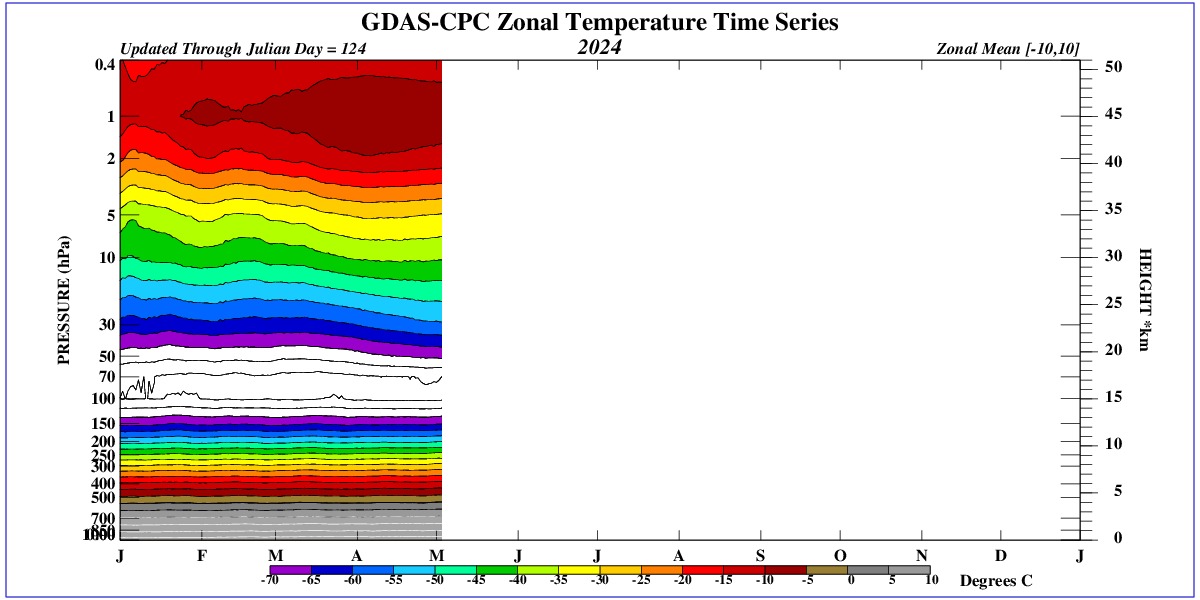
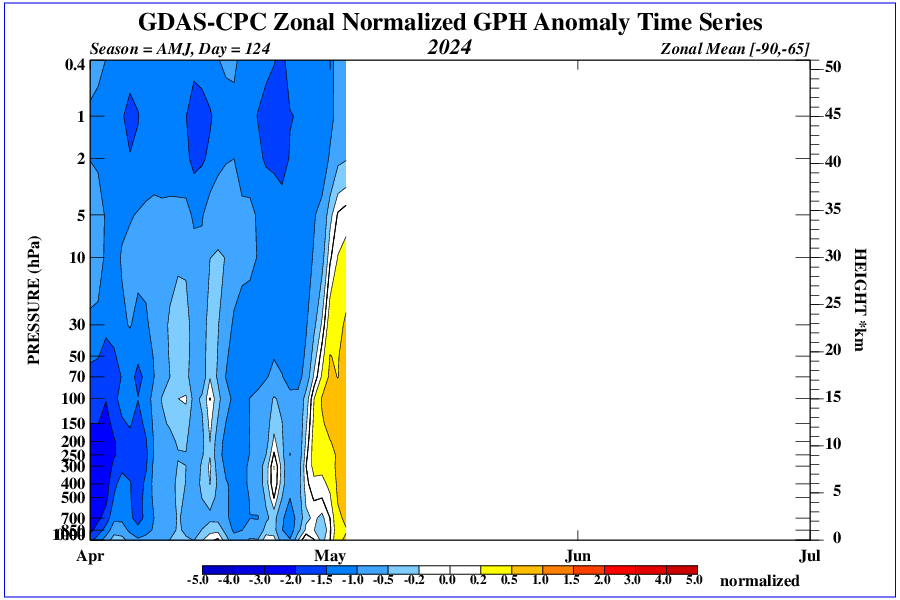
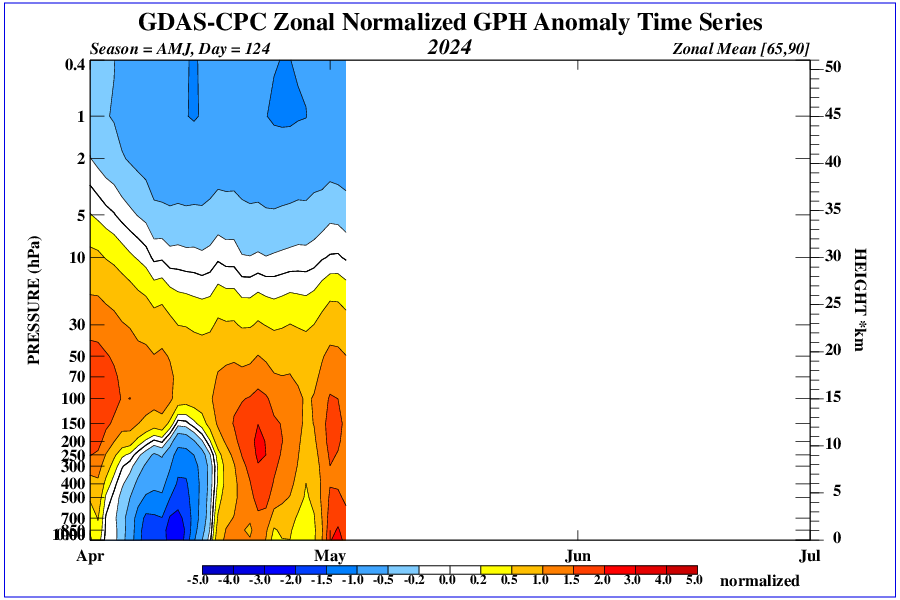
The greatest pressure changes occur over the arctic circle and depend on the strength of the solar wind.
The last graphic shows the immediate effect of a strong geomagnetic storm.
The effect of the geomagnetic storm is also visible over the northern polar circle.
“Open ocean surface temperature cannot sustain more than 30C. It is a hard physical limit.”
it’s amazing how many people just seemed to forget that for 40 years
I need to cogitate on this a bit more. If the oceans cover ~75% of the earth, and if their temperature has a limit, where does the hockey stick come from? Land temperatures?
from minimum temps going up!
That is an example of a highly non-linear response, not a “hard limit”.
Thanks for the precise reference. I quoted this from memory earlier but did not have a ref.
Speaking of models, I recall reading a while back that something like just a 4% change in the estimated presence of cloud cover in models resulted in significant changes in the resultant temperatures increases or decreases.
But in reality, cloudiness varies by much more than 4%.
Am I recalling this situation correctly?
climate4you.com has cloud cover data going back about 40 years or so. While the numbers jump up and down, the data says that over that time, cloud cover has declined about 2%. I don’t recall any study of the resultant temp increase (or is it decrease) that would cause.
I believe it was Roy Spencer who stated that equivalence.
Correct.
If any of the climate models was even 70% accurate, the others would stop being used overnight.
Which of the models, if any, is ‘accurate’ and how would its accuracy be validated? Short answer is there is absolutely no incentive for the modeling ‘community’ to answer either question. They’re not competing to discover the ‘truth’ but to obtain funding.
The purpose of the models is to get papers published and so continue to make a career for the researchers.
This is how all science works.
And all the climate models are very successful.
Willis:
You are making the assumption that CO2 actually has some climatic effect. It does not.
See “Scientific proof that CO2 does NOT cause global warming”
https://doi.org/10.30574/wjarr.2024.21.3.0884
Thanks, Burl. I’m aware of your theory that SO2 is the secret control knob of the climate. Every time I’ve looked, I’ve found no evidence to back it up.
I appreciate the invite, but I’m gonna pass,
w.
Willis:
A pity.
I have taken a different approach, which should convince even you.
What convinces me are facts.
SO2 emissions increased from ~0 MT/year in 1850 up to ~70 MT/year around 1975, and decreased since then.
According to your theory, this should have caused the global temperature to drop from 1850 to 1975 and increase since then.
In fact, temperatures have been increasing, in fits and starts, for about 300 years since the start of the Little Ice Age … which totally disagrees with the SO2 data.
Onwards,
w.
Willis:
Since CO2 was not considered to be a factor in our climate until Hansen’s presentation to Congress in 1988, my article was focused on what has happened circa 1980. and later.
.
In the mid-1970’s it was recognized that industrial SO2 aerosols needed to be decreased due to Acid Rain and Health concerns, and “Clean Air” legislation was introduced to reduce their amounts in the atmosphere.
According to the gridded data of the Community Emissions Data System of the University of Maryland, industrial SO2 aerosol emissions peaked at 139 million tons in 1980, and by 2019 they had fallen to 83 million tons.
Now, we know from VEI4 or larger volcanic eruptions, our climate warms up when their SO2 emissions eventually settle out of the atmosphere, because of the cleaner, less polluted air.
Increased warming also HAD to occur because of the 56 million ton.decrease in SO2 aerosol pollution between 1980 and 2019, but it is totally ignored by those pushing the greenhouse gas hypothesis, and instead the warming is attributed to rising levels of CO2.
Since 1979, the amount of SO2 from volcanic eruptions has been measured by satellites. For VEI4 eruptions the median amount is 0.2 million tons, and it causes 0.2 deg C of cooling (and the same amount of warming when they settle out).
Thus, the warming from a 53 million ton decrease in SO2 aerosol pollution easily accounts for ALL of the warming that has occurred in our modern era. Therefore, CO2 can have NO climatic effect.
Here is some assistance for you, Burl.
https://wattsupwiththat.com/2024/05/13/weekly-climate-and-energy-news-roundup-598/
“”The really important fact found in the Conclusions is:
The EEI trend is primarily associated with an increase in absorbed solar radiation (ASR) partially offset by an increase in OLR [Outgoing longwave radiation). … Large ASR trend primarily driven by reductions in low and middle clouds.
Let us emphasize this point. The increase in Earth’s Energy Imbalance (EEI; Trenberth’s “heating”) is due primarily to the increase in absorbed solar radiation—the difference between the sunlight incident upon the earth and the amount of reflected sunlight. Further, the solar irradiance (incident sunlight averaged over the spherical shape of the earth) increased only very slightly—from 340.14 W/m2 for 2000 to 2010 to 340.17 W/m2 for 2013-2023. The Loeb report clarifies that the change is due to the decrease in low and middle clouds. [Boldface added]
In other words, the increase in EEI is due to a decrease in albedo (less reflected sunlight), contrary to IPCC’s calculations that always show an increase in albedo.
In yet other words, the heating of our planet that we’re seeing is not due to an increase in atmospheric CO2. This conclusion of the CERES project, which was designed expressly to determine the heat imbalance of the earth and its causes, has been ignored by “climate scientists,” investigative journalists, and politicians, and will continue to be ignored.
Still, this one fact rings the death knell of the “climate crisis.” Unequivocally, it says that the worries about CO2, “carbon pollution,” “carbon emissions,” and so forth are entirely misplaced. The one fact that the warming we are experiencing is due to changing albedo—NOT CO2—means that the UN’s COPs (Conferences of Parties), the IPCC’s Assessment Reports, the restrictions on coal, oil, and natural gas, and the belief that we help “save the climate” by killing our cattle are all based on sham science.”
end excerpt
So, clouds are the control knob of the Earth’s temperatures?
Now, what controls the clouds?
Are volcanic eruptions just blips on an underlying warming or cooling trend, caused by something else, like Mother Nature?
Tom Abbott.
Thanks for the comments!
You ask what controls the clouds:
They need moisture nucleation sites to form, which are primarily SO2 aerosols (small droplets of Sulfuric Acid).
As our atmosphere is cleansed of SO2 aerosols due to Net-Zero activities,etc. there are fewer nucleation sites available, and thus fewer clouds, resulting in higher temperatures.
Higher temperatures mean increased evaporation, so the atmosphere becomes more highly saturated with moisture, which it releases in largely random torrents of rain, known as Atmospheric Rivers.
It is unfortunate, but we MUST stop decreasing SO2 aerosol pollution!
Volcanic eruptions are just temporary blips that provide some relief.
The troposphere has become a sea of small manmade particles, due to fuel droplets injected into engines, forming small particles, after combustion, may be 50 to 100 molecules each, which become nucleation sites.
Airliner contrails at 40,000 ft is water vapor freezing on combustion particles; pollen likely does not float that high.
Each gallon burned up produces billions of such particles.
That will not cease until fossil fuels are used up, about 100 years from now.
Indeed the new IMO banning the use of bunker oil in commercial shipping will do nothing to “save the planet” but will lead to a self-fulfilling prophesy of yet more global warming.
They probably realised they need all the help they can get since CO2 is not going to be dramatic enough.
I have been hypothesising this cleaning effect for about ten years based on TLS data after major eruptions. I was not aware this was “known” or recognised. Where are you refering to?
The last two major eruptions caused step change cooling in TLS of about 0.5 deg C. If this implies a more transparent stratosphere ( less ozone and/or less residual aircraft pollution ) then it also implies surface warming.
https://climategrog.wordpress.com/tls-2022/
Greg Goodman:
I use as my reference the NASA publication “Atmospheric Aerosols: What Are They and Why Are They So Important?”
They state that “Volcanic SO2 aerosols “reflect sunlight, reducing the amount of energy reaching the lower atmosphere and the Earth’s surface, cooling them”, and “human made sulfate aerosols absorb no sunlight, but they reflect it, thereby reducing the amount of sunlight reaching the Earth’s surface”.
This article can be found by googling its title.
They don’t state that warming re-occurs after they eventually settle out, but that is an obvious conclusion.
Further,only VEI4 and larger volcanic eruptions show up in the climate record, along with reduced SO2 aerosol emissions from idled factories, etc., during American business recessions.
I’m surprised by your claim because coal emits a lot of sulfur and coal was a major energy source in 1850, albeit smaller than today.
Pollution and small particles were localized patches, such as the Ruhr Valley.
In the 1960s, these patches merged into worldwide fog, according to old timer pilots, who used the patches for navigation purposes, when flying from Europe to the US East coast.
Biomass was THE major energy source in 1850
World coal production was about 100 million metric ton in 1850, will be about 4.5 BILLION metric ton in 2024
“this should have caused the global temperature to drop from 1850 to 1975 and increase since then.”
This may fit to the more extreme edge of my findings regarding corrected global land surface temperatures:
https://osf.io/huxge
Willis wrote: “What convinces me are facts.”
No, Willis, they obviously don’t. Because whenever we present physics facts to you, your response is invariably “I refuse to engage in pig wrestling”, and similar ad hominems. Or just crickets, as evidenced by your failure to respond to my questions below in this thread. That doesn’t sound like “being convinced by facts”. It sounds a lot more like Lord Monckton’s “invincible ignorance”.
Steve, here’s a science question for you.
What’s the difference between a college student running a maze, and a rat running a maze?
…
…
The rat stops running if there’s no cheese at the end of the maze.
And sadly, that’s been my invariable experience with you. There’s no cheese at the end of your endless word mazes.
What convinces me are the facts, and sadly, what you claim are “physics facts” are generally either irrelevant to the question at hand, or nothing more than your fantasies.
I’ve been down this path with you far too many times to start down it again. Don’t like it?
Don’t care. Rave on.
Look, how about this time YOU write a post showing just how wrong I am, or a post laying out your brilliant ideas and insights, and put it up on WUWT so we can all see just what a genius you are and just how solid your “physics facts” are?
Then I can stand on the sidelines and demand that you define what “sunshine” means …
I’ll wait …
Regards,
w.
I am not the one who has failed to define what “sunshine” means, Willis. That would be you, as usual. Can you define “radiation” for us, please? Without calling me a rat, or a pig, or a horse, or pond scum?
Note that I have written a post showing just how wrong you were, when you asked me to describe the correct analysis for your “Steel Greenhouse”. You completely ignored it, presumably because it was incomprehensible to you. Others have corrected you too, and you ignored them as well. Still sounds like “invincible ignorance” to me.
Steve, I’m sorry to have missed your post. Please give us a link to it so I can comment on it.
w.
Sure, Willis, no problem, glad you asked, here you go:
https://wattsupwiththat.com/2023/11/20/dlr-curiosities/#comment-3819228
I apologize for insinuating that you deliberately ignored my posting if you simply missed seeing it. (I couldn’t tell the difference from here.) There are a lot of posts and comments on this site, that’s for sure.
Steve, comments are closed on that site, so I’ve copied your comment over here.
This is why I so dislike interacting with you. Seems you are incapable of just discussing a subject without endless insults.
So you’re saying that the power source is providing 100W/m2 … which curiously is exactly what I said.
As I specified in my Steel Greenhouse post, the shell is so close to the sphere that the difference between them is small enough to ignore in a first-cut analysis like this one.
For example, the radius of the earth is 6378 km. Let’s assume that the sphere is that size, and the shell is say 2 meters from the sphere. That’s a size difference of 0.06%, which as I said is small enough to ignore in a first-cut analysis.
But you’ve ignored that. Now, you can do the calculations for a shell with twice the exterior surface area of the sphere … but that’s not what I’m doing. In any case, let’s follow what you are doing. But first let me note that in my thought experiment there is no 3K background.
Works for me.
OK, we’ve finally gotten to the problem. You seem to think that either the inner surface of the sphere is not radiating, or that the radiation somehow mysteriously disappears.
(continued below)
But it doesn’t. The radiation is absorbed by the inner sphere, and no, this is NOT a violation of the second law.
The second law says that the NET flow has to be from hot to cold. And indeed, this condition is fulfilled. It says nothing about the individual radiation flows.
And since you agree with me that the inner sphere ends up warmer once you add the shell, just where is the power coming from to further heat the inner sphere?
There’s only one possible source, and that’s the shell. Yes, the shell is cooler than the warmer sphere, but that doesn’t stop the two-way radiation flow.
Don’t believe me? Here’s Dr. Roy Spencer on the subject.
https://www..com/2016/08/simple-experimental-demonstration-that-cool-objects-can-make-warm-objects-warmer-still/
And here’s his follow-up post on the subject.
https://www.drroyspencer.com/2016/08/experiment-results-show-a-cool-object-can-make-a-warm-object-warmer-still/
Yes, I know it may be counterintuitive. But if you light a candle outside on a clear day, the sun gets warmer … the candle just radiates, and the radiation is absorbed by whatever it strikes regardless of the temperature of the target object.
Of course, the NET flow of heat is from the sun to the candle. But radiation from the candle is absorbed by the sun, and so both the sun and the candle end up warmer.
Here’s a thought experiment. Imagine a star alone in space. It has a certain temperature. Now imagine a cooler star with a lower temperature is placed next to the warmer star.
What happens to the temperature of both stars? Following your exact calculations, both stars will warm … but if radiation from the cooler star is NOT being absorbed by the warmer star, just where is the power coming from to warm up the warmer star?
Now, it’s quite clear to me that no matter what I say, you’ll want to nitpick it to death. So I’m just going to leave this here and get back to doing worthwhile things … please don’t expect me to answer your objections. I don’t have any more time for your trivia.
w.
Since it looks like we’ve reached the end of your thinking capacity, and that you would literally rather die than define “radiation” for us (and by “literally” I mean “figuratively”, of course), I remembered that you have defined radiation for us in the past, at least once, if slightly indirectly. I can’t find your original direct quote that I vaguely remember, but I found this one, which I think is close enough:
“The energy associated with radiation is proportional to frequency and inversely proportional to wavelength”
That is a bit more detail than I needed for this purpose, but let’s focus on this part:
“The energy associated with radiation”
See, that wasn’t so hard. Why was it such a godawful struggle to get you to say it (again)?
Anyway, now that we know, in your own words, that radiation is a form of energy (defined as “the capacity to do work”, as you said), we can see how ill-informed it was for you to write this:
“either the inner surface of the sphere [shell? -skj] is not radiating”
But of course it is. It is radiating energy (or, in the literal phrase you used, it is radiating the “energy associated with radiation”, which sounds a bit clunky, but is accurate) In other words, as you said, it is radiating the capacity to do work. Just like every other object with a temperature above absolute 0. Right? And we certainly wouldn’t measure radiated energy in Watts, would we? Because Watts are a unit of power, which you told us is the rate of work being done per unit time. So you see, you do know what all these concepts mean, you just haven’t linked them together properly in your head yet. That’s your next bit of homework.
Note that, contrary to everything you wrote in part 2 of your reply to my post, literally no one has said that the presence of a colder (but warmer than the 3K background of outer space) object in the vicinity of a warmer one does not affect the rate of heat loss from the warmer one. I certainly never said that. I explicitly said the opposite in my description of your steel greenhouse. That’s not the issue.
If you simply stop labelling all your radiation arrows in Watts, as I explained above, then we should be fine.
And I’m going to have to ask you to stop using the word “absorbed”, unless you can define that in terms of energy, work, and power, as well. Please and thank you.
No, this is not “trivia”. It is a fundamental misunderstanding on your part about how radiation, energy, work, and power are related to each other. Your claims about “back radiation power” do not have experimental evidence to back them up, therefore you are obviously wrong. I am trying to teach you how to think about physics correctly.
“either the inner surface of the sphere is not radiating”
No, Willis, you don’t get to use the word “radiating” to “disprove” my post until you can define it. So far, you have failed (indeed, flat-out refused) to do so. Please correct that omission before continuing. “It’s just like sunshine” isn’t going to cut it. And no, this is not “nit-picking”.
(Once you define that word correctly, you will see immediately that all surfaces are indeed radiating, but my description takes that into account properly already.)
As a separate point, yes, if you want to specify that the sphere and the shell are so close together that there is effectively 0 distance between them, then the calculations will result in the temperatures of the shell and the sphere approaching the same value (which would be the no-shell value that I described) as the vacuum gap approaches 0 and the radiating surfaces approach the same size. There is no problem with that, it’s just less useful in showing how the S-B equation works in a multi-body equilibrium system. That’s why I started with a noticeably larger shell, which was your original pre-edited description.
And the calculations don’t change very much if you change the background temperature from 3 K to 0 K, either, so feel free to substitute that if you prefer. It’s just a bit less intuitive to visualize a 0 K background since there’s no such thing in our universe, nor any obvious way to fabricate one. But if you keep in mind that it’s not a realistic scenario, then as a thought experiment it’s probably fine.
Burl, your paper is very short of evidence or any data that SO2 instead of CO2 is the temperature driver of the planet. Of course SO2 has some effect. So does CO2. You can use Modtran and get answers that make sense for CO2, about a degree per doubling depending mostly on cloud cover. I’ll go with CO2 having most of the effect on climate rather than SO2…with cloud cover variability from one trip around the Sun to the next, being variable enough that attribution to CO2, CH4, NOx’s, Ozone, is not a very fruitful undertaking.
DMackenzie:
Read my reply to Willis, above. It proves that decreased SO2, and not increased CO2, is the temperature driver of our planet.
Quantification of the amount of “greenhouse gas warming” BEFORE and clouds, aerosols etc. is here:
https://www.swpc.noaa.gov/products/solar-cycle-progression
“Too Hot” models were admitted to by Gavin Schmidt in the Nature magazine article he co-wrote a couple of years ago:
https://irp.cdn-website.com/0bdd390b/files/uploaded/NatureGavinSchmidtClimateModels.pdf
It strikes me that if you look at the blue lines on the graph in the article it seems removing a few of the hot models and the climate crisis pretty much disappears.
Excellent article, Willis.
“Simplistic nonsense” sums it up nicely.
Fun factoid. The 1.8C ECS in CMIP6 is INM CM5. That is the only CMIP6 model that does NOT produce a spurious tropical troposphere hotspot. The Russians wrote a whole paper about this important result, with beautiful and compelling graphics. Turns out they just tuned their model’s ocean rainfall to what ARGO was showing! Imagine that—tuned to real observations.
Of course, a model ECS of 1.8C, close to EBM observational estimates, means the climate alarm would be over. Won’t do, because then we could can all the other models and save billions per year. (Most recent estimate was US spent $2.4 billion per year on climate models, but only $80 million/yr on weather models. H/T Cliff Mass.)
Seems to me that if the US spent just one years worth of climate model funding on Climate Reference Network stations spread about the earth, we might actually begin to understand surface temperature better
Thanks, Rud, interesting. It’s also worthy of note that per the link in the head post, the INM CM5 shows an increased forcing from 2xCO2 of only 2.88 W/m2 … which is only about three-quarters of the canonical 3.7 W/m2 IPCC figure for 2xCO2.
I still haven’t worked out the practical results from the differing 2xCO2 numbers. For example, INM 5.0 shows an ECS (per the link above) of 1.93 °C / doubling of CO2. However, since they only find 2.88 W/m2 per doubling, that would seem to equate to 0.67°C / W/m2, which for a standard 3.7 W/m2 per 2xCO2 would equate to 2.5°C per 2xCO2 …
… or not … like I said, still wrapping my head around it.
Best regards,
w.
ECS = Effective Radiative Forcing / Net Radiative Feedback
For an ECS stated at 1.93 and a Radiative Forcing 2.88 W/m2, the Net Radiative Feedback (λ) = ~-1.5 W/m2 per K.
Forcing and feedbacks tend to be correlated across models.
160 Papers Find Extremely Low CO2 Climate Sensitivity
(a) Quantified Low Climate Sensitivity to Doubled CO2
LINK
The narrative is settled – like it or lump it.
Willis, you wrote: “Well, every time I go to look at the climate models, I come away more confused.”
That’s no surprise. Climate models are based on fake physics, designed to confuse and obfuscate, not to enlighten.
Then you wrote: “the relationship between the change in forcing (downwelling radiation) and the change in temperature”
I guess the modelers are referring to radiation from the atmosphere, not from the Sun.
If “forcing” means “downwelling radiation”, why don’t they just say “downwelling radiation” instead of “forcing”?
Finally, what do you think “downwelling radiation” means, Willis? Please phrase your answer in standard physics terms of energy, work, and power, if possible. While we are at it, you had probably better give us your definitions of “energy”, “work”, and “power”, too, so we all know what you are talking about. This should help to reduce everyone’s confusion. Please and thank you!
“Downwelling radiation” means radiation headed downward towards the surface. Not sure why you are confused about that.
Work is what happens when a force moves an object. Energy is the capacity to do work. Power is work per unit time.
w.
Yes, but how exactly does the ‘downwelling’ work?
Simple. You shine a lamp down well ! Climatology is tricky at first because most of the people doing are not scientists they are activists, so they don’t make sense.
It’s not me who is confused, Willis.
Radiation is energy, so why are you showing “downwelling radiation” in Watts? Are you going to answer my question and define your terms? What is “radiation”? What is “energy”? What is “power”? A real scientist would have no trouble answering these questions.
Oops pardon me, you did answer some of my questions and I tripped up and failed to read your answers.
But you haven’t defined “radiation” yet, so please define that next, so that we can figure out how it relates to energy, work, and power.
Are you going to answer my request to define “radiation”, Willis? And also “forcing”, which you are apparently considering to be a synonym? I ask because you used these words 27 times in your head post, and of course you regularly claim that you “choose your words carefully, and can defend them”. Were you lying when you said that? What do you think these particular words mean?
Define “radiation”? Seriously?
No, Steve, I’m not going to define “radiation” for you. Why?
Because I’ve been in this maze of yours before, and there’s no cheese at the end. No matter what definition I give you, you’ll tell me I’m wrong.
Pass. If you don’t know what electromagnetic radiation is at this point in the discussion, nothing I can say will make any difference.
Best regards,
w.
Yes, Willis, “seriously”. Why? Well, you don’t have to, of course, but refusing isn’t making you look any smarter, that’s for sure. An actual physicist would have no trouble answering this question. You don’t even have to answer from memory – you are welcome to look up the answer in a physics textbook or Wikipedia and paste it here. The answer is no more than a dozen words long, at the level of detail I’m looking for.
No, it’s not a “maze”, and there is no “cheese”. There is only real physics, and fake physics. I am trying to teach you the real kind, because the climate “scientists” certainly won’t, and they’re the only ones you’ve been listening to so far, for some reason.
My guess is that you refuse to answer because you know that whatever you say is going to constitute shooting yourself in either one foot, or the other. Starting from false premises means that you are going to get stuck in a contradiction pretty quickly, and you are avoiding that unpleasant circumstance by simply running away from the impending contradiction, like some sort of coward.
Steve, you asked for a definition of work, energy, and power, and said I wasn’t a “real scientist” if I couldn’t define them. So I gave you this:
“Work is what happens when a force moves an object. Energy is the capacity to do work. Power is work per unit time.”
But of course, rather than having the balls to admit that yes, I do know the difference and thus I must be a “real scientist”, you immediately changed the subject to wanting me to define “radiation”.
Seriously? Whatever definition I give you’ll say I’m wrong. If I say it’s a wave, you’ll say no, it’s a particle … and if I say it’s a particle you’ll say no, it’s a wave.
And of course, if I say it’s both a wave and a particle you’ll immediately change the subject again and ask me to define something else.
You have absolutely no interest in an actual discussion. You just want to endlessly nitpick.
Pass. I don’t go on a snipe hunt for anyone.
w.
No, Willis, I didn’t “change the subject”. My original request included this question: “Finally, what do you think “downwelling radiation” means, Willis?” I am merely reminding you that you haven’t answered it yet.
Claiming that “everyone knows what sunshine is” isn’t going to get you a passing grade on a physics test. Your kindergarten teacher might accept that, but your high school or university physics professor won’t.
No, I’m not trying to trick you with the wave-particle duality here. That’s too detailed for what we’re studying at this stage, which is thermodynamics.
I’m looking for a one-sentence definition of “radiation”, which you can Google in about three seconds, and as a hint, it will include at least one of the three words you correctly defined earlier: “energy”, “work”, or “power”. It’s not a trick question, and every textbook and source on the Web will give you the same answer, which I’m not planning to mendaciously dispute or anything. I just want you to say it, out loud, on WUWT, for all posterity to record. What’s hard about that? It sure is harder than pulling teeth to get you to say it, though, for some reason.
And no, I’m not the one who has “no interest in an actual discussion”. That would be the fellow who said “No, Steve, I’m not going to define “radiation” for you,” followed by “Pass”. Wouldn’t it?
Downwelling and upwelling are stupid terms to apply to radiation which does not “well up” or down, it radiates. But Willis did not invent the term and there’s lots of stupid unscientific terms in climatology like “forcings” and perfectly normal “anomalies”.
Apart from trying to troll Willis , I don’t see the point in all your comments.
I’m not “trolling” him, Greg, I’m pointing out where he is wrong, which is whenever he says anything about thermodynamics. All of it. He is also completely impossible to teach. Try it, and you’ll see.
The radiative greenhouse effect has to also consider heat which then gets into thermal energy, resonant scattering, 2nd Law, etc.
Can the radiometric measurements behind figure 1 really resolve what looks to be 0.01 or 0.02 W/m^2?
With respect to Fig 3 and the “exaggerated volcano effects”, it suggests the aerosol forcing is too strong in GISS model.
By introducing aerosol, and increasing the atmospheric SW up, the surface SW absorbed is diminished. That is, less solar reaches the surface.
Indeed, this causes a cooling effect for GMST.
However, the delta T depends on energy budget.
Recognizing the latent heat flux (net evaporative heat transport away from surface) is strictly bound to 1/2 the surface solar absorbed, this latent heat flux is diminished proportionally to the change in surface absorbed solar.
In Trenberth style schemes, 160 W/m2 surface solar absorbed is accompanied by 80 W/m2 latent flux. LE = 1/2 Surface Solar Absorbed.
LE has no dependence on the LW down, only the shortwaves absorbed (surface available energy).
For 1 unit reduced surface solar absorbed, 0.5 unit evaporative cooling is missing. Thus, the change in temperature is only half as much as one might expect by the change in solar alone.
Effectively, accounting for energy budget constrains, this latent flux budget adjustment cuts the aerosol forcing effect in half.
In a general way, the aerosol forcing effect is directly relevant to a CO2 sensitivity estimate. For a high sensitivity of Earth System to CO2, the “cancellation” by aerosol to date must also be strong. For a relatively low sensitivity System, the cancellation by aerosol to date must be weak.
For an ECS about 3C, the fraction cancelled by aerosol must be about 50% to date. For an ECS about 1.5C, the aerosol cancellation must be about 1/2 of that, or 25%.
By recognizing the energy budget constraints, such that non radiative transport up and away from surface is not independent from surface available energy (i.e. low entropy solar photons), these adjustments could be quantified. To date, no such effect appears to be in the accounting.
“They’ve been studying the subject for a half-century, and both numbers still have an enormous uncertainty range.”
Recall the statements about the Age_of_Earth. It took over 100 years of modern science to get to 4.54 ± 0.05 billion years, about which in fact an age could be anticipated. In another half-century, “climate science” may admit it doesn’t have numbers and never will.
First, I have to wonder where the models get their ECS estimate, and second, why is it a static number rather than a decreasing effects as the concentration goes up? Then, of course, we know that the historic temperatures have been “adjusted”. And another wonderment. We also know that water acts not only as a heat trapping gas, but also a buffer, working in concert with vegetation.
How is this handled (or mishandled) by the models?
TCR and ECS are emergent properties of climate models. For example, for TCR they just add 1% more CO2 per year than the previous year. 2x in about 70 years. What does the model say delta T is that year?
ECS is a bit more complicated, because after the doubling they let the model run out at that 2x value for some ‘extra time’ from decades to centuries.
As a simple rule of thumb just multiply TCR by 1.25 to get approximate ECS without all the time dependent complications.Those values come from the observational EBM TCR and ECS best estimates. Your model mileage will vary.
‘And after all that, it merely spits out a lagged and resized version of the input forcing.’
I’m sure it also spits out some nice color-coded graphics that ‘prove’ we need to mend our evil fossil fuel ways. What’s always ignored is whether or not the modelers can produce a post-2xCO2 energy diagram that is remotely consistent with what they maintain is the Earth’s ECS.
I’ve said this many times in the past.
Hind casting is simply curve fitting.
The very first time a brand new model hindcasts, they might be able to argue it isn’t. But then they tweak the parameters and do it again and from then on it pretty much is by definition.
In Larcis et al 1992 they did actually try to model the effects of volcano emissions and match it to AOD measurements around and after El Chichon in 1982.
By the time of Hansen et al 2002 they totally dropped the modelling and were purely to doing parameter twerking to get Von Neuman’s elephant to wiggle its ass.
As a result they reduced AOD “forcing” scaling from 30W/m2 to 20W/m2 .
I discuss all this with citations and links to papers at the end of this article:
https://climategrog.wordpress.com/2015/01/17/on-determination-of-tropical-feedbacks/
I think this exercise just goes to prove the point that there is such a thing as negative knowledge.
Willis,
“And after all that, it merely spits out a lagged and resized version of the input forcing.”
We’ve been through this before. The forcings are not an input to the GCMs. They are derived from the GCM output. You can’t just say, use my formula and forget the GCMs. Without the GCMs you wouldn’t have forcings to input to your formula.
Thanks, Nick. Please provide evidence that the forcings shown in Figure 1 are the output of the GISS-E2 climate model.
To assist you, there’s a description of how each of the forcings are calculated here. That document contains the following links:
You’ll have to explain to us how the solar irradiance forcing is a GCM output … and here’s a sample, what it says about the forcing from the WMGHGs:
In other words, the forcings are calculated from ice core data, Mauna Loa, and the like.
w.
Willis,
OK. From your first GISS link:
“Quantifiying the actual forcing within a global climate model is quite complicated and can depend on the baseline climate state. This is therefore an additional source of uncertainty. Within a modern complex climate model, forcings other than solar are not imposed as energy flux perturbations. Rather, the flux perturbations are diagnosed after the specific physical change is made. Estimates of forcings for solar, volcanic and well-mixed GHGs derived from simpler models may be different from the effect in a GCM. Forcings from more heterogeneous forcings (aerosols, ozone, land use, etc.) are most often diagnosed from the GCMs directly.”
From the sample you list, they are entirely describing the actual GHG inputs, which are gas concentrations etc. There is no mention of a forcing in W/m2.
The Miller et al paper linked from the GISS site, which is the overview of GISS E2 in CMIP, is even more explicit:
“We characterize perturbations to the pre-industrial climate using the effective radiative forcing (ERF), defined as the difference in TOA net radiation between two AMIP-style simulations with pre-industrial SST and sea ice, where one simulation contains the forcing agent: for example, an increase in greenhouse gas (GHG) concentration (Hansen et al., 2005).“
They have to run two simulations to get the forcing.
Also in the conclusion:
”Warming of the GISS-E2.1 ensembles is reduced compared to the GISS CMIP5 simulations, despite the higher TCR of the former. This reduction is due to smaller total forcing in the GISS-E2.1 configurations that follows the reduction of GHG forcing by one-quarter. We attribute this reduction to greater longwave opacity of the GISS-E2.1 pre-industrial climate, which has higher water vapor concentration and greater cloud longwave forcing than the GISS CMIP5 model (Figure 7). This demonstrates the importance of the unperturbed climate to forcing and forced climate trends. The LW opacity increase and forcing decrease is also related to a lower sensitivity of precipitation to warming in GISS-E2.1 compared to the CMIP5 GISS-E2.’’
Note the presence of the extra word “effective”.
This is just red scarf trick to justify their own logic. They do arbitrary parameter twerking of dozens of poorly constrained quantities to get the best hind-cast fit [Hansen 2002]. Then they remove on variable and keep it constant, re-run the model and say : there we have shown what the climate “should” be if weren’t here.
That does NOT prove that Von Neuman’s elephant really wags its tail like that, nor does it prove how much it wags because of anthropogenic CO2. It is an illusionists trick, not science of any kind.
It is all based on the implicit and undeclared assumption that their arbitrary parameter twerking produces a reasonable hindcast for the right reason and not that it is just “a solution” with no further validation which is right for the wrong reason.
Thanks, Nick. I think I see the issue. You’re concerned about the forcing expressed in W/m2.
But what I’m concerned with is not the units of the input forcing. It is the shape of the input forcing. Perhaps an example will make it clear. The model is fed historical concentrations of GHGs. Here’s the log of the CO2 input in ppmv, and the forcing values of that much CO2 in W/m2. Data from the IIASA CMIP5 historical forcings dataset.
As you note, the input is NOT in the form of W/m2 … but the shape of the forcing in W/m2 is the same as the input. And that is true no matter what value the model assigns to the forcing from a doubling of CO2. The shape doesn’t change.
And in turn, the shape of the temperature output will be the same as the shape of the input. Yes, it doesn’t have the units of the input. But it has the shape of the input.
The problem is, the output being nothing more than a lagged, resized version of the input forcings (regardless of units) means that nothing is important but the shape of the input forcing. Not changing ocean currents. Not changing rainfall. Not changing polar vortices. Not thermoregulatory mechanisms involving clouds and thunderstorms. Just the input forcings.
The output is a linear transform of the input, and nothing matters but the input.
Finally, you are correct that this does not mean that we can just use the input forcings to say what the model output will be. We can’t use this one-line equation to replace the models.
However, what it does mean is that the output will be a lagged linear transform of the input forcings, and that’s a problem.
Best to you,
w.
Willis, so the GCM’s don’t start with a solid body surrounded by a gaseous layer that is then subjected to a radiative flux (solar radiation) which calculates relative thermal changes throughout it’s grid layers based on balancing conductive, radiative, and mass convective action with CO2 concentrations just being an Initial condition? In this version ECS would be a rough output based on the final steady state of the model solution.
What you described and showed above is simply a gross assumption that a node will radiate a fixed amount of energy based on the assumed ECS of its CO2 concentration, or am I missing something?
+100! You pegged it.
[…after the GCM been tuned to match the TOA radiative imbalance by altering parameters]
Hi Willis, Your last comment that you ended up knowing less than when you started resonated with me as it’s a large cog in my brain. Knowledge is a bottomless well. As one question is answered ten more emerge. So it is that the more one knows the less one knows.
Mass must be accounted for. The back radiation can do no work. CO2 has an emissivity of near zero so would be near impossible for CO2 to produce 345 W/m2.
The power of back radiation.
Indeed. At high altitudes there is very little vibrational energy emitted by Co2 that only has 1 vibrational mode and there are almost no water vapour molecules to transfer it to ( and thereby ‘force’ anything. AND it is cold AND it has to somehow travel back to a hotter place breaking a few laws of thermodynamics. At least that is how i perceive it works. Entropy results in energy loss to space. Back radiation cant logically be a factor, let alone a big energy number. It is often stated but ive never come across a proper explanation using standard physics. Energy (im)balance doesnt count in my book because that can be explained by other means using standard physics. What i am proposing is that the supposed GHE is based on unproven hypotheses that cannot be properly theorised.
The supposed “radiant greenhouse effect” is entirely based on false physics, as you said. A few people have coined terms like “climate fizix” to describe the new branch of “science” that they have invented in order to push this scam.
Who is claiming that ? No one. The contention is that CO2 changes the figure by a few W/m2 and mildly reduces the net upward flux.