News Brief by Kip Hansen — 26 January 2024

Have you ever seen a manatee up close? I mean, close enough to kiss on the nose? If so, you would not have been tempted, not even on a dare.
Besides, getting that close to a manatee might get you arrested for manatee harassment. There is quite a list of things you must not do to or with or around manatees in Florida. Here is the gist of the Florida State laws on manatees:
“Manatees are protected by the Marine Mammal Protection Act of 1972, the Endangered Species Act of 1973, and the Florida Manatee Sanctuary Act of 1978. It is illegal to feed, harass, harm, pursue, hunt, shoot, wound, kill, annoy, or molest manatees.” [ source ]
“The manatee is also protected by the Florida Manatee Sanctuary Act of 1978, which states: “It is unlawful for any person, at any time, intentionally or negligently, to annoy, molest, harass, or disturb any manatee.” [ source ]
This list of forbidden activities includes feeding or giving fresh water to manatees or blocking the path of a manatee moving in your direction. Florida is really serious about its manatees.
Aside: It takes an imaginative legal mind to use the word “annoy” in regards to a wild animal – exactly what annoys a manatee? (I know what annoys me….)
Back in 1996/1997, the estimate of the number of manatees living in Florida was estimated at a low of 1,700. As a result, they were formally listed as Endangered under the U.S. Endangered Species Act. By 2016, as a result of actions meant to protect the manatees, their numbers increased to over 6,000, and today is thought to be well over 7,500. Manatees are currently classified as Threatened.
Let’s admit, counting manatees is exceptionally difficult. They spend their time under murky sluggish waters, often have green moss on their backs the same color as the water itself and if congregating, tend to swim above and below one another. Even in the clear waters of Blue Spring State Park, where they estimate almost 1000 manatees are spending the winter, all of this makes it hard to determine their exact numbers, despite their size. [see the image at the top of the essay]
So, what is the big deal? First and foremost, manatees are exceptional neat. In the same sense that platypuses are neat. The always look sad to me, mournful even. Anatomically, they are interestingly weird. Itty bitty eyes, holes in their heads for ears, and, wow, those big blubbery hairy lips! [No jokes now, guys….]
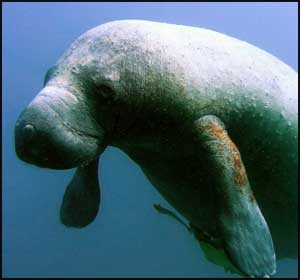
“Manatee adults have no incisor or canine teeth, just a set of cheek teeth, which are not clearly differentiated into molars and premolars. These teeth are repeatedly replaced throughout life, with new teeth growing at the rear as older teeth fall out from farther forward in the mouth, somewhat as elephants’ teeth do. At any time, a manatee typically has no more than six teeth in each jaw of its mouth.”
Now, remember, U.S. Federal law requires that states make every effort possible to protect and “save” endangered and threatened species. Thus, when Florida’s east coast manatees were found in poor condition in 2022, 160,000 pounds of fresh lettuce were fed to manatees, as sea grass beds (the normal source of manatee nutrition) had been depleted, but by March of 2023, Florida’s Fish and Wildlife Conservation Commission still had feed almost 400,000 pounds of fresh lettuce to manatees at several locations along the Indian River and Mosquito Lagoon.
Why? Manatees have already been on the Endangered Species list and then as their numbers increased they were moved to Threatened status, but concerns remain.

It seems that too many manatees die. They are big and live in shallow water, and regulations require reporting any dead, dying or struggling manatee to State Fish and Wildlife. Florida has its own, well-financed, manatee research and rescue fleet and has biologists and veterinarians that do necropsies on manatee corpses.
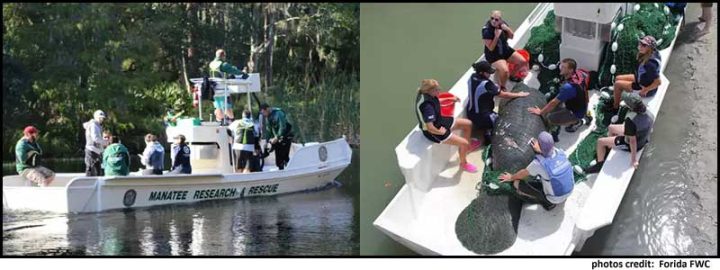
There are three main things that kill manatees:
1. Boat propellers and boat hull strikes.
2. Starvation – when sea grass beds are disturbed or damaged by storms or human developments.
3. Cold.
Manatees are slow and have trouble getting out of the way of oncoming boats. The props of those boats deeply cut the backs of manatees causing infections and eventually death. A manatee struck by a fast-moving boat’s hull can suffer broken bones or even a broken back.
Manatees eat sea grass(es) and other aquatic plants. Motorboats bombing through shallow sea grass beds leave scars of bare sand that take years to fill back in. Florida Department of Environmental Protection makes special efforts to protect and restore sea grass beds, which benefits manatees and a lot of other species as well, with the Florida legislature having created a new preserve ”to protect about 400,000 acres of seagrass, mangrove islands, salt marsh, oyster reefs, sponge meadows, corals, and other habitats.”
And, despite all the hype and hysteria about sea surface temperatures in Florida, the waters surrounding Florida are just barely warm enough for manatees.

“Manatees are regarded as tropical marine mammals, migrating to warmer waters during the colder months of the year. In the summer months, manatees are widely dispersed in Florida’s waterways and can even be found on rare occasions as far north as Massachusetts. When the water temperatures dip below about 68°F (20°C), however, manatees seek out Florida’s warm water areas. Prolonged exposure to lower water temperatures causes manatees to lose body heat and inadequately digest their food, which can lead to a condition classified as ‘cold stress’ and eventually can be fatal.” [ source ]

The map [above] shows that as of today, 30 January 2024, most of coastal Florida is too cold for manatees. To remain in truly coastal waters, manatees would have had to migrate south of Naples. However, Florida’s manatees are saved by the warm springs for which Florida is famous. These world famous hot springs, famously crystal clear, are the winter habitats of Florida’s manatees. The highlighted spring is Blue Spring State Park, at which nearly 1,000 of Florida’s manatees are currently basking in the park’s waters, which run at a constant 72 degrees all year round. Blue Spring State Park is a long ways from the sea, even as the crow flies, not to mention travel by endless miles of the winding St. John’s River temperature was a relatively chilly 58.8 degrees – which is dangerously cold for manatees.
Personal note: I have travelled the U.S. Intracoastal Waterway many times and encountered quite a few manatees, mostly down south – Georgia and Florida. They are fascinating creatures and their sad faces encourage one to give them fresh water which some have learned to beg from anchored sailboats which is why it is forbidden. The manatees will stay in the anchorage depending on passing sailboats for fresh water – and suffer from lack of it when all the boats have moved on. Better for the manatees that they learn to find local seasonal sources of natural fresh water.
Bottom Lines:
1. You have got to love these wacky sad-faced animals. Too big and slow and trusting for their own good.
2. Manatees don’t seem to be able to adapt to modern propeller driven boats and stay out of their way. Florida’s solution for their protection has been to restrict where, and how fast, boats can go. This is not popular with many boat owners.
3. Beer and cocktail fueled motor boaters (including sports fishermen) want to get where they are going and get there now. That means speed and shortcuts, even through shallow, barely deep enough, waters. The boats wreck the sea grass beds. Which is a shame. Declaring NO GO ZONES and preserves is the answer, with draconian enforcement.
4. Florida is barely warm enough now for manatees. If normal coastal sea temperature gets any cooler there, if sea water temperatures keep getting any colder in the winter months, Florida may not be able to maintain its manatee populations. Humans can keep trying….but nature rules, as Darwin has shown.
# # # # #
Author’s Comment:
I really do like manatees. And, really, it is simply because they are interesting – and odd.
I’m not sure that Florida’s free-roaming manatees can be “saved” in the long run. They are running up against the unending expansion of human habitation and our use of both land and sea. Florida’s “boat mania” is the real danger, along with climate – the periodic cooling of Florida’s coastal waters especially on Florida’s West coast, above 27° North, where sea water temps are below 68°F (20°C) three months out of each year. This is normal for the region. Episodic cold spells, the freezes that threaten Florida’s citrus crops, often kill manatees. Maybe a warmer climate would help them.
Thanks for reading.
# # # # #
Nice run down on manatees. Reminds me of:
Penalties for Possession of Bald Eagle Feathers & Violating Migratory Bird Treaty Act in Wisconsin. A first offense violation of the Bald and Gold Eagle Act can result in a fine of $100,000, one year imprisonment or both. A second violation is considered a felony and penalties significantly increase.
Source: Google search on “Eagle feather regulations”
And Mexico’s bird or birds are ravens and crows. To stop Mexicans from killing bald eagles, we (the US) had to stop killing crows. Not only do crows destroy crops, they are really major nuisances.
Do you know what you call two crows? It’s an attempted murder.
Jim ==> Very good, sir!
Unless you are running a wind farm. In that case, you are permitted to kill eagles en masse with no penalty.
I wonder if boat owners could be encouraged to use propulsion methods less dangerous to sea animals?
Caging propellers or using water jets might make it safer for boating and manatees to co-exist…
Really it’s the A-holes that don’t observe the idle speed limit in Manatee habitats that are responsible for the vast majority of boat strikes according to what I was told by locals. Since in a lot of places along the west coast where the Manatees congregate the depth only increases at about 1 foot a mile those restrictive speed zones can be quite extensive.
rah ==> And yes, as I said, boaters don’t like the speed limits — which means it takes “forever” to get from one’s inland canal dock to the open water of Charlotte Harbor, Mosquito Lagoon or the Banana River — I know, we sailboat and are forced to go that slow naturally in close waters.
Dodgy ==> Well, of course using water jet engines would help with prop dangers. There are some larger boat waterjet systems out there: https://www.hamiltonjet.com/
or here.
Love to learn new information. Thanks.
My 3rd career was as VP & GM of a very small company that provided specialized product and services to generally large investor owned corporation.
certain types of ceramics are much more abrasion resistant than metals in certain applications. High Alumina, silicon carbide, Alumina zirconium silica, etc.
Each type has applications/operating conditions it is best suited for.
A major industry we did a lot of work for were coal fired electric generating plants.
coal and the bottom and fly ash produced from burning it are highly abrasive.
We did a lot of work at the Crystal River generating complex. That facility condenses salt water for its operations. Once the salt water is cooled was released back into the gulf via a channel.
Though cooled, the water was still well above Ambient. We did our work during winter shutdowns and of course it was a major gathering place for the Manatees that time of year.
rah ==> Reuters has this story.
Years ago, when the Scientific American was scientific, they had an article on one of the problems with the slowing down of boats. The problem was that slowing down put the propeller noise frequency outside the manatee’s hearing frequency range.
I imagine that would seriously annoy them.
DavsS ==> At last, an annoyance!
Hmm, as if all engine types and sizes, be they inboards or outboards or inboard-outboards and all the different props they have, produce sound in the same frequency range at low speed.
rah ==> My wife and I did a LOT of snorkling….and hearing the buzz of a prop in the water ALWAYS drove us to the surface for a safety check — to make sure we knew where the boat was and where it was headed — and to waves arms in the air to make sure the captain knew we where there. If it was obvious the captain was oblivious, we dove deep and stay down for a bit. Manatees would do the same, if they had the understanding necessary.
The maximum propeller RPM of small boats does not vary that much. Most outboard engines operate with similar RPMs. Fast boats with inboard engines is mostly lower, but not by that much. I have done a lot of diving and the scream of a small craft at full speed is really powerful.
skarven ==> Underwater sounds can be tricky as well… Whales have a similar problem (and the boats are much bigger and comparatively slow).
Aside from congregating in the freshwater springs that are connected by surface water to the Gulf or Ocean, springs that tend to stay a constant 70-72 deg F as opposed to the low 60s that is common in coastal waters during the coldest months of the year, manatees also tend to congregate in electric power plant cooling water discharge areas that also flow into coastal waters. Pretty much every coastal power plant has a “manatee viewing area” which can get pretty crowded by people during the colder weather (which coincides with our peak seasonal visitation months).
The boating advocacy groups generally don’t oppose manatee-based restricted speed (low wake or no wake) zones in coastal areas, as manatees are extremely popular with the people here in Florida. What does typically cause conflict with boaters is other restricted speed zones that are imposed by local government for the purpose of reducing shoreline erosion, noise, and general safety concerns in coastal areas. Florida has over 1 million registered boats, no. 1 in the nation, and that does not include the many thousands of boats that come down here in the winter months, whether cruised or on trailers, from up north. Popular waterways get crowded. And because far too many boaters drink far too much alcohol when they’re out on the water, their behavior is often atrocious.
Duane ==> A Florida resident, I assume. Boaters associations generally do support “sensible” boating and really really don’t want further restrictions to be imposed — some boaters using inland canal-based docks and marinas are hampered by the impossibility of getting anywhere to fish or go fast by the speed limits and this affects very-local economies.
One instance is Cape Canaveral. Marinas on the inland side of the Canaveral Lock can’t cater to deep sea fishing enthusiasts — it takes too long to get out onto the ocean. But the marinas on the ocean side of the lock are booming and never have open spaces. (In this case, it is the lock itself, opening times, that cause slow-down). But a close look at Google Earth shows how many docks there are miles inland from the Banana River, for example.
Everyone loves manatees (or say they do) but most of Florida’s hotshots don’t LIKE the speed limits — not even the sensible ones.
More on that Crystal River Generating complex. Units 1 & 2 were big coal fired Combustion Engineering plants with wet wall boilers that went into service in the 60’s. The wet wall boilers were suspended from huge I beams on springs from above. The boiler housing of Unit 2, the larger of the two expanded over 8’ vertically when operating at full capacity. Miles of stainless steel tubing panels lined the walls of the boiler housing.there were 5 different SS alloys used depending on their location in the boiler.
Unit 3 was nuclear. Units 1,2, and 3 are all shut down now. Unit 4 was a coal fired unit built to the design of Babcock & Wilcox. It is still in operation I believe.
All of those units used water from the Gulf that was inducted through pipes 5 or 6’ in diameter. A cage prevented the larger forms of sea life from being sucked in. Periodically the cages were changed out and a marine biologist counted an logged the species and numbers killed. The complex maintained a fishery where they raised replacements to be released into the wild to replace what was killed.
Of course plankton made it into the condensers and those condensers would be opened and serviced and cleaned during the shutdowns. The smell was not pleasant.
It amazed me that some barnacles and mollusks survived the heat and vacuum and grow and adhere to the wall of the condenser housing.
rah ==> and these units supplied heated water for the manatees to bask in at the outlets….
Yep, the manatees loved to hang out around the mouth of the channel
where the water was discharged after going through the cooling tower.
BTW, the black grit on roofing shingles is processed and ground bottom ash. That ash is also used as sandblasting grit, in paints/floor coatings, and as aggregate in some forms of precast concrete,
I have tried this line on women as regards myself. It has never worked.
Perhaps at closing time when they all look good?
Mumbles ==> Maybe not quite sad-faced enough? Or, maybe, too wacky?
Did you try buying the lasses more drinks?
I recall reading somewhere that it was speculated that the stories of seeing mermaids was sailors misidentifying manatees.
They must have been at sea a long time!
Gunga ==> To put this mildly….wildly horny sailors….at sea for a very long time…but they were not far off…see images here.
😎
If I had more skill and time I’d photoshop a manatee over one of those mermaids!
I read that a long period of sensory deprivation can result in hallucinations.
I didn’t know that another type of deprivation could do the same.
(Or maybe they very well stocked up with beer? I’ve heard that beer and bars can have a similar effect.)
One aspect you didn’t mention is the refuges created by the cooling water from fossil fuelled power stations, which may well be lost soon.
https://www.npr.org/transcripts/1091736131
Nasty ==> rah has been talking about this in his comments.
What would be a reason why those things should not go extinct? They really are as ugly as sin. And, not at all amusing.
Walter ==> I think a better question is: How many resources should be spent trying to maintain them in an environment no longer suitable for them?