Guest Post by Willis Eschenbach
Those who read my work may recall my post called “Munging the Sea Level Data“. In it, I showed that the apparent acceleration in the satellite sea level was merely an artifact of the combining of the four satellite records, viz:

Original Caption: NOAA sea level data, showing the trend of each of the full individual satellite records and the overall trend. SOURCE: NOAA Excel Spreadsheet
Despite the obvious differences between the first and last halves of the record, scientists merely spliced them together and obscured the splice. My conclusion in that post was:
There’s no evidence of any acceleration in the rate of sea-level rise in either the tide gauge or the shabbily-spliced satellite records.
So today I stumbled across a paper published in Nature magazine entitled A revised acceleration rate from the altimetry-derived global mean sea level record. Care to guess what the paper says?
Yep. You’re right. They conclude that once they took a hard look at the satellite records, the problem was disagreement between the satellites … and once they applied their correction methods to the TOPEX satellite records, they found:
Based on four different weighting methods used in a tide-gauge comparison it is determined that TOPEX is drifting and not ERS. Therefore, we suggest to calibrate the TOPEX GMSL record with the crossover of ERS1&2 after the removal of cal-1. The calibration reduces the observed acceleration in GMSL, so that it becomes statistically equivalent to zero at the 95%-confidence level.
The observed acceleration in satellite-observed GMSL (global mean sea level) is “statistically equivalent to zero” … go figure.
[UPDATE] An alert commenter pointed out what I had missed, which was that the article is not new. It was only last week’s media article describing their work that was new—their study was published before mine. Mea maxima culpa. However, my work uses a totally different method, but comes to the same conclusion, so it appears I was confirming their work, rather than them confirming my work—science as it should work.]
Here where I live on the northern California coast, we’re getting the blessing of an “atmospheric river”, which is a phenomenon where lots of moisture comes from the tropics up to the west coast in a narrow band. It used to be called the “Pineapple Express”, but I suppose that was determined to be racist against pineapples or something …

Given the several years of the recent drought, this is more than welcome. We got 3-1/2 inches (9 cm) of rain yesterday, with more expected tonight.
So, wet blessings to all.
w.
Discover more from Watts Up With That?
Subscribe to get the latest posts sent to your email.
Happy Holidays Willis – thanks for all your good work!
Best to you as well, Allan, and thanks for all your contributions.
w.
The most important thing is to learn honestly. A fact confirmed by two independent studies (satellite orbits can change) is honest science.
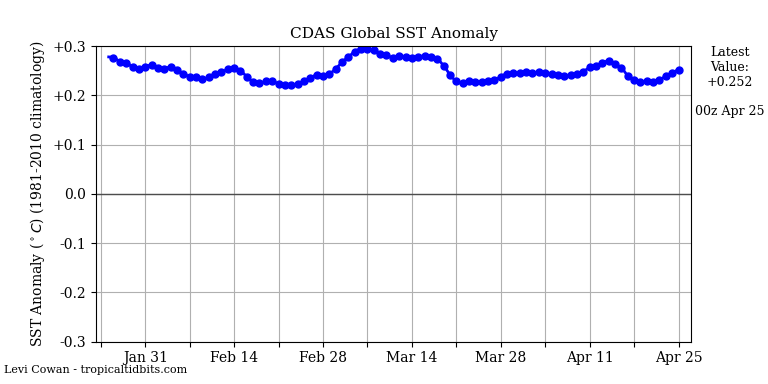
Nino34 is a good predictor of global average temperature ~4 months in the future.
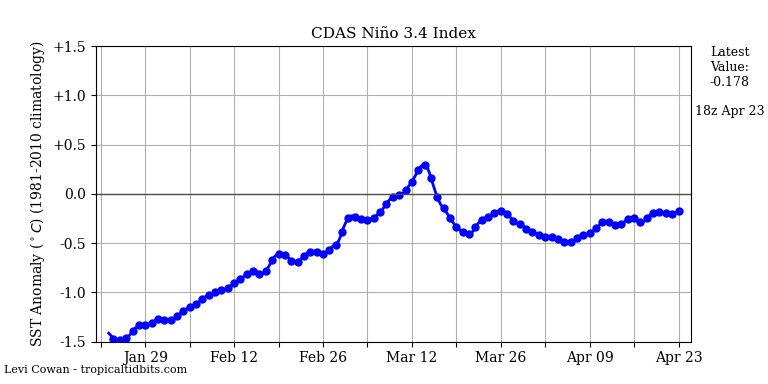
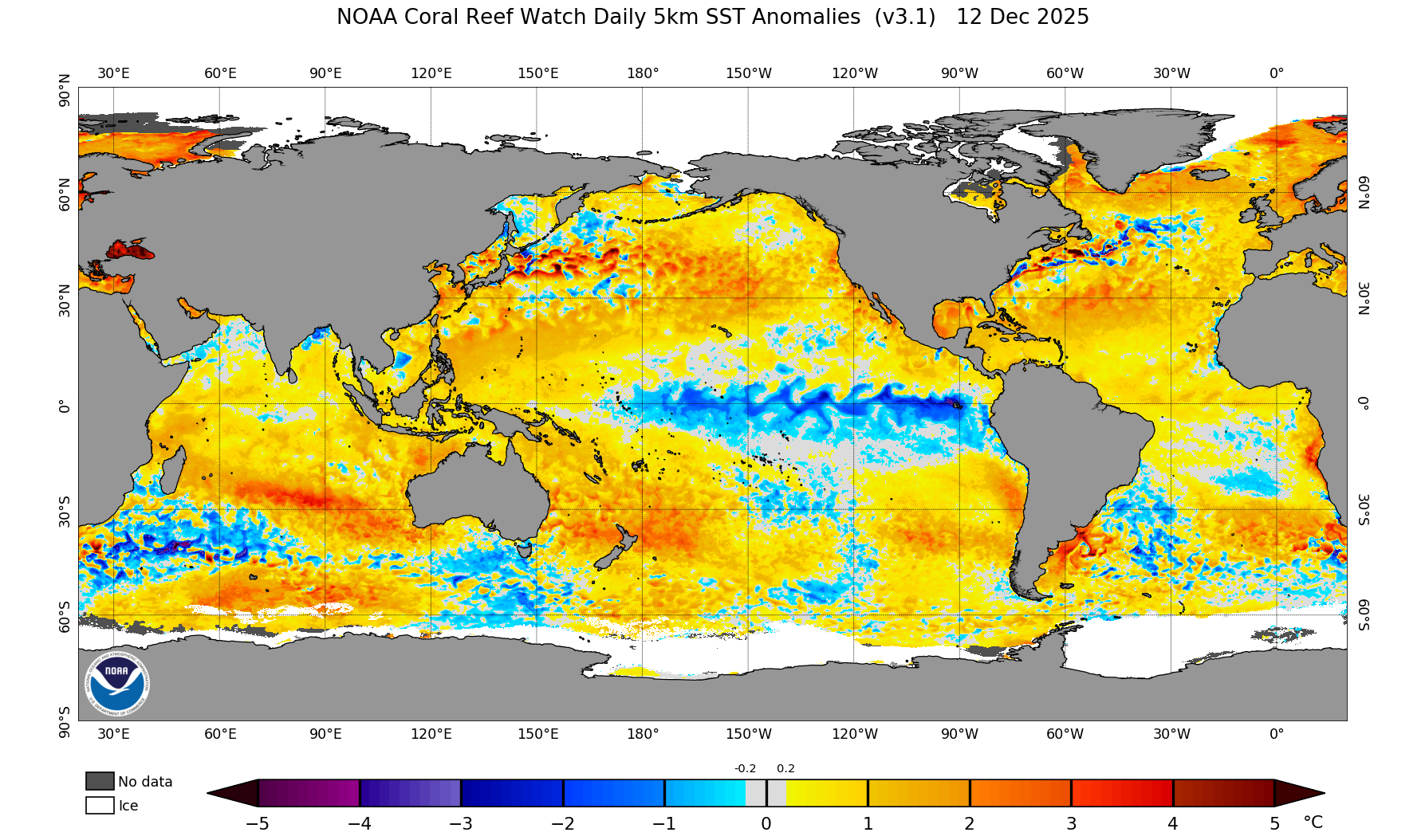
Nino34 Index below -0.5 indicates a “la Nina” condition. It is now about -1.0.
There is a lack of any warming throughout the southern hemisphere and the tropics.


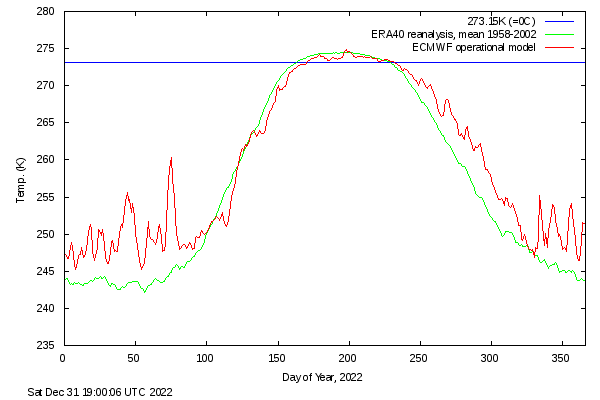
Temperature jumps at the pole indicate the ripples of the polar vortex.
Re the figure legend:
Is that a sea level anomaly or a satelite anomaly?
I did some investigation some time ago about the Jason satellites and was surprised to find that satellites drift a lot. If I remember correctly, to the tune of 10 – 12 feet. This compromises the actual readings and requires correction. Some of the drift is caused by gravity variations in the orbit.
The problem I found is that their measurements error was reduced by averaging over a months time. Each averaging period “reduced” the error in each actual reading. Does that remind anyone of another set of data being averaged?
With claiming millimeter accuracy, I had to wonder how, with that much drift they could separate satellite drift from sea level variation.
IIRC, the Jason manual only claims 25 mm accuracy, about 1/2 a wavelength. Anything more than the designers claim is going to be the result of statistical analysis.
Take a 1000 readings randomly accurate within 25 mm with say a tape measure, and suddenly you believe you are accurate to 1/sqrt(1000) times your previous accuracy.
Of course it is complete bullscheidt with radar since your equipment is already taking millions of wavelength samples per second.
Statistics can’t add resolution that isn’t there in each measurement. Mathematicians believe that, no discipline in the physical sciences believes that.
Statistics with the correct conditions can remove errors and get you a true value but it can’t add significant digits to that true value.
There is the matter of what Willis E. said in https://wattsupwiththat.com/2018/12/17/inside-the-acceleration-factory/
He demonstrated that tide gauge data without satellite data indicated that the sea level rise rate in 1993-2013 was .76 mm/year more than in 1972-1992, for countering the statement of 2.1 mm/year faster sea level rise if satellite data is included. However, he found some need to state in bold “manufacturing sea level acceleration where none exists”, as if .76 being a correct replacement for 2.1 (mm/year per 21 years) = zero.
Thanks, Don. I fear my wording wasn’t clear.
The scientists have increased an actual short-term trend difference of 0.76 mm/year by artificially manufacturing an imaginary increase of 1.34 mm/year. They did this by improperly splicing the satellite record onto the tide gauges, thus manufacturing 1.34 mm/year of sea level rise where no such rise actually exists. My apologies for my lack of clarity.
Finally, although there indeed is recent short-term (30 year) acceleration in tide gauge records, I fear that is meaningless. Here’s trailing 30-year acceleration and deceleration of sea level for the full period of three different sea level records.
Is it accelerating or decelerating? Well … both.
My best to you,
w.
From the paper we have
Fitting a curve is not science.
Sea level rise is not accelerating because the TOA radiative imbalance isn’t accelerating. If the energy available to melt ice and warm the oceans isn’t accelerating, then the ocean sea level cant be accelerating. Nor is it expected to.