Guest “You can’t fix stupid” by David Middleton
JANUARY 11, 2022
Coal will account for 85% of U.S. electric generating capacity retirements in 2022Operators have scheduled 14.9 gigawatts (GW) of electric generating capacity to retire in the United States during 2022, according to our latest inventory of electric generators. The majority of the scheduled retirements are coal-fired power plants (85%), followed by natural gas (8%) and nuclear (5%).
Coal. After substantial retirements of U.S. coal-fired electric generating capacity from 2015 to 2020 that averaged 11.0 GW a year, coal capacity retirements slowed to 4.6 GW in 2021. However, we expect retirement of coal-fired generators to increase again this year; 12.6 GW of coal capacity is scheduled to retire in 2022, or 6% of the coal-fired generating capacity that was operating at the end of 2021.
Most of the plants making up the operating U.S. coal fleet were built in the 1970s and 1980s. U.S. coal plants are retiring as the coal fleet ages and as coal-fired generators face increasing competition from natural gas and renewables.
The largest coal power plant planning to retire in 2022 is the 1,305-megawatt (MW) William H. Zimmer plant in Ohio. Morgantown Generating Station in Maryland plans to retire its two coal-fired units (1,205 MW combined) in June, followed by two of the plant’s six smaller petroleum-fired units in September.
[…]
EIA
JANUARY 10, 2022
Solar power will account for nearly half of new U.S. electric generating capacity in 2022In 2022, we expect 46.1 gigawatts (GW) of new utility-scale electric generating capacity to be added to the U.S. power grid, according to our Preliminary Monthly Electric Generator Inventory. Almost half of the planned 2022 capacity additions are solar, followed by natural gas at 21% and wind at 17%.
Developers and power plant owners report planned additions to us in our annual and monthly electric generator surveys. In the annual survey, we ask respondents to provide planned online dates for generators coming online in the next five years. The monthly survey tracks the status of generators coming online based on reported in-service dates.
Solar. We expect U.S. utility-scale solar generating capacity to grow by 21.5 GW in 2022. This planned new capacity would surpass last year’s 15.5 GW of solar capacity additions, an estimate based on reported additions through October (8.7 GW) and additions scheduled for the last two months of 2021 (6.9 GW). Most planned solar additions in 2022 will be in Texas (6.1 GW, or 28% of the national total), followed by California (4.0 GW).
[…]
EIA
Not all generating capacities are created equal. No power plant can constantly operate at 100% of it’s nameplate capacity. All power plants require maintenance. The theoretical capacity factor is the percentage of the generating capacity a power plant can deliver at a 100% utilization rate. The realized capacity factor is driven by the utilization rate. Nuclear power plants generally have a 95% theoretical capacity factor and nearly 100% utilization rates. Therefore, their realized capacity factors are usually >90%. Solar and wind power plants also have nearly 100% utilization rates; however they have very low theoretical capacity factors because they are time of day and weather-dependent.
The theoretical capacity factor of coal-fired power plants is about 85%. The realized capacity factor is variable and tied to the price of natural gas. The higher natural gas prices go, the greater the utilization rate of coal-fired power plants.

The EIA forecasts that natural prices will average around $4/mmBTU in 2022.

The average capacity factor of coal-fired power plants will probably be in the range of 55-60% in 2022.
Utility scale solar PV power plants achieve an average capacity factor of 25%.
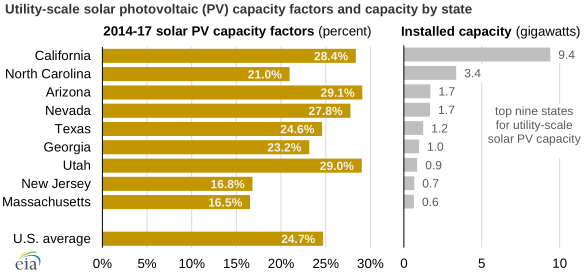
The theoretical output of 14.9 GW of coal-fired capacity is greater than the average achieved capacity factor of solar PV. And the actual output of solar PV is generally the maximum achievable output.
| Capacity Factor | GW | GWh/yr | |
| Coal | 85% | 14.9 | 110,945 |
| Solar PV | 25% | 46.1 | 99,747 |
Bear in mind that the coal-fired power plants can run 24/7/365… including nights and cloudy days. Even using the anticipated capacity factors with a $4/mmBTU natural gas price, the soon to be retired 14.9 GW of coal-fired capacity would have generated 71-78% of the electricity as the 46.1 GW of solar PV will.
| Capacity Factor | GW | GWh/yr | ||
| Coal | 60% | 14.9 | 78,314 | 78% |
| Solar PV | 25% | 46.1 | 100,959 | |
| Capacity Factor | GW | GWh/yr | ||
| Coal | 55% | 14.9 | 71,788 | 71% |
| Solar PV | 25% | 46.1 | 100,959 |
To make matters worse, solar power tends to deliver its maximum output when demand is at its lowest. The Southwest region includes Arizona, southern Nevada and most of New Mexico. Nuclear and coal-fired power plants provide about 2/3 of very steady baseload. Natural gas provides most of the rest of the baseload and ramps up during peak demand hours (8-9 AM and 7-9 PM). Solar power ramps up as demand falls off from mid-morning to mid-afternoon.

When you replace dependable, 24/7/365 base load with this:

You get a “duck curve“…

The moral to the story…

Spread the Green Blight: intermittent energy, and renewable profits. I’m surprised the environmentalists are not up in arms, protesting for a green solution.
Solar is literally eating coal and nuclear’s lunch.
With solar peaking in the middle of the day, it eats into the economics of base load generators that most efficiently run 24×7. The optimum generator mix then uses gas and hydro to ramp up and down to meet periods of peak demand.
I don’t know who you have been robbing, but it doesn’t work that way. You still need nuclear and coal for nighttime baseloads.
He did say that coal and nuclear need to run 24/7, gas and hydro being used to load follow.
Coal is pretty OK at load following. Steam trains do not run at full throttle all the time.
Even nuclear can load follow. Submarines can run slow as well.
Its the economics of so doing that dictate the usage, not the technology. Gas is expensive, and hydro is rain limited, that’s why they are the plants that shut down when demand and price is low.
Its only eating coal and nuclear’s lunch when the considerable external costs of renewables can be shuftied off onto coal and nuclear generators due to political meddling with the market.
“Solar power will account for nearly half of new U.S. electric generating capacity in 2022” except at night when there will be no generation and demand will peak.
Forget “the grid”.
I live where “winter” means it gets cold at night.
The heat in my home is gas.
If I lived in a home with electric heat, the Green threat of depending on a wind and solar powered electric grid to provide heat for my home would send chills up my spine.
In Britain they are considering laws that will require everyone to replace their gas furnaces with heat pumps.
Solar power will account for nearly half of new U.S. electric generating capacity in 2022
Capacity sounds nice. How will actuality measure up?
Let me guess. A computer model says everything will be fine.
And this….
WSJ
The Interior Department said Monday that it plans to block oil and gas leasing on about 11 million acres on Alaska’s North Slope, or roughly half of a 23-million acre reserve set aside for energy development decades ago.
The action, announced in connection with a federal lawsuit brought by environmentalists, would reverse a Trump administration effort to expand oil production in the National Petroleum Reserve in Alaska.
The reserve had been set aside for oil and gas development in the 1920s. Under former President Barack Obama, the federal government restricted oil and gas development to 11.8 million acres of the reserve.
Don’t forget, considering capacity factors, that 46GW (capacity) solar/wind is about 12GW of energy supplied through the year replacing 14GW of coal energy. Seems to me that this is going well,
Math is hard.
You do realise that for solar it is maybe 46GW of capacity for a 6 hours a day, then 0GW for maybe 18 hours a day? If the sun can shine fully on the panels for that day.
But, but, but, but averages you know they don’t lie!
Bring it on I say.
These dolts will only realise the futility of their renewables fantasy when presented with clear evidence from the country unlucky enough to have drunk the most cool-aid.
The closure of the Zimmer plant is interesting. Originally planned as a nuclear plant, the reactors were abandoned and the plant was a kluged monstrosity. Keeping turbines designed for a reactor ensured a low efficiency coal plant.
Not only planned but built.
After getting out of the navy, I went to work for GE. After getting my SRO certification for supervising power assention testing on BWR, Zimmer was one of three choices of
GE nuke plants where construction was complete except for testing.lack of documentation
I choose a different plant but was latter joined by engineers who had gone to Zimmer. According to them, the utility blamed union corruption for cost over runs. They got the the Ohio state police to go under cover as union workers. While they found no corruption, the union guys were complaining about the lack of QC that that they had seen at other plants.
Fuel was never loaded into a perfectly good reactor because of the lack of documentation.