Researchers found that salinity changes as a result of water cycle changes lead to less surface warming
UNIVERSITY OF MIAMI ROSENSTIEL SCHOOL OF MARINE & ATMOSPHERIC SCIENCE

CREDIT: NASA, SCIENTIFIC VISUALIZATION STUDIO
MIAMI—A new study led by scientists at the University of Miami (UM) Rosenstiel School of Marine and Atmospheric Science, in collaboration with scientists at Princeton University, shows that the intensification of global hydrological cycle drives more ocean heat uptake into the deep ocean and moderates the pace of global warming.
As a result of a warming climate, the global water cycle becomes more intensified and as a result wet regions are getting wetter and dry regions are getting drier. The researchers found that this intensification is also reflected in ocean salinity. The increase in ocean surface salinity in salty regions, such as the subtropical oceans, leads to denser seawater and more heat uptake in to the deep ocean. The increase in the rate of ocean heat uptake would reduce the rate of surface warming.
“We discovered a new mechanism that influences the rate of global warming through a suite of climate model experiments,” said Maofeng Liu, a postdoctoral researcher at the UM Rosenstiel School, Department of Atmospheric Sciences. “The good match between climate model simulations and observations in the past few decades suggest that the salinity changes due to human-induced warming are likely working to enhance the ocean heat uptake.”
To conduct the study, the researchers used a global climate model to conduct two sets of experiments. In the first set of experiments conducted as a baseline, they increased the atmospheric carbon dioxide concentration one percent per year until it doubled. In the second set of experiments, they repeated the first experiment but do not allow the surface salinity to respond to the CO2-induced global hydrological cycle changes. The different outcome from the two sets of experiments highlights the impact of the water cycle changes in the ocean heat uptake and transient climate change.
Global warming from emission of greenhouse gas into the atmosphere is increasing sea levels and resulting in more frequent and intense storms, drought, and wildfires.
“Predicting the rate of global warming is still a challenge,” said Liu. “This study found a new impact to the rate of global warming.”
The study, titled “Enhanced hydrological cycle increases ocean heat uptake and moderates transient climate change,” was published on Sep 23, 2021 in the journal Nature Climate Change. The study’s authors include: Maofeng Liu, Brian Soden and Bosong Zhang from the UM Rosenstiel School; and Gabriel Vecchi and Wenchang Yang from Princeton University.
Funding for the study was provided by National Aeronautics and Space Administration (NASA) and the U.S. Department of Energy (DOE)
About the University of Miami’s Rosenstiel School
The University of Miami is one of the largest private research institutions in the southeastern United States. The University’s mission is to provide quality education, attract and retain outstanding students, support the faculty and their research, and build an endowment for University initiatives. Founded in the 1940’s, the Rosenstiel School of Marine & Atmospheric Science has grown into one of the world’s premier marine and atmospheric research institutions. Offering dynamic interdisciplinary academics, the Rosenstiel School is dedicated to helping communities to better understand the planet, participating in the establishment of environmental policies, and aiding in the improvement of society and quality of life. For more information, visit: www.rsmas.miami.edu and Twitter @UMiamiRSMAS
JOURNAL
Nature Climate Change
DOI
METHOD OF RESEARCH
Computational simulation/modeling
SUBJECT OF RESEARCH
Not applicable
ARTICLE TITLE
Enhanced hydrological cycle increases ocean heat uptake and moderates transient climate change
ARTICLE PUBLICATION DATE
23-Sep-2021
Disclaimer: AAAS and EurekAlert! are not responsible for the accuracy of news r
Common knowledge is that the poleward heat transport works similar to a heat pipe with water as the working fluid. In a heat pipe the working fluid velocity is nearly directly related to the the temperature difference between the input and the output. The next thing that will be discovered is that wheels have to be round to work properly.
Did they happen to check the results of their model with reality?
This is solid emissions from bulls’ backsides to the highest order.
The variation in salinity across the surface in the image simply shows the high evaporation zones where salinity is higher and the convergence zones where salinity is lower – most evaporation occurs at SST of 28C. Warmer locations are convergence zones and get more rainfall so are lower salinity. The high latitudes are net precipitation so also less saline.
In locations with high evaporation, there is an upward flow of water from depth working against the conduction of surface heat downward; the surface is the warmest place. That sets the ocean thermocline.
Higher heat retained in the oceans is an indicator of lower evaporation not more. Lower evaporation slows the rate of transport of cool water in the deep channel from the poles to the ITCZ. The consequence is slight increase in temperature at depth as conduction has more time to transport heat deeper. Thermoclines are set by the rate of downward heat conduction and upward flow of cooler water.
This image shows the process reasonably well:
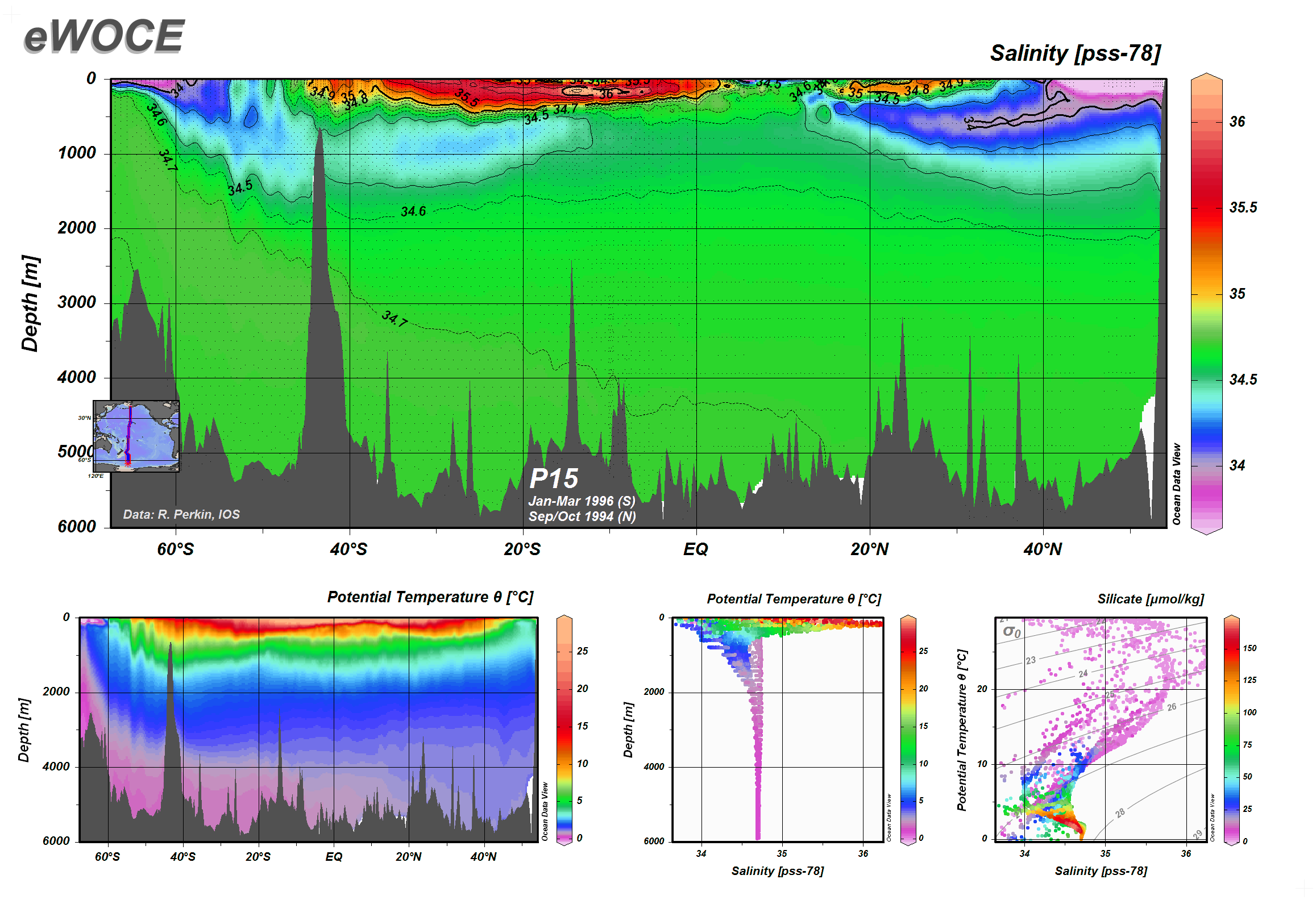
The high salinity regions either side of the ITCZ show the high evaporation zones. The lower salinity fingers between 500m and 1500m depth below the evaporation zones show the transport channels for high latitude water being transported to the evaporation zones.
It is invalid to claim that weather causes changes in the frequency of wildfires when an unknown but large number of them are caused by arson.
We do not have reliable measurements of “arson change” over the last few decades. Geoff S
A woman was just arrested in California and charged with starting one of the recent fires near Redding. She is suspected of actually being a serial arsonist.
She is denizen of Palo Alto with degrees in biology and chemistry.
Actually, Environmental Science. (She tutored Biology and Chemistry students though, so maybe?) I have to say, I thought your comment was sarcastic, but no.
Doesn’t even make a very good Faerie Storie – it contradicts itself too much and even a child could see through it
Get A Life boyz & girlz of Miami, dump the computer and venture outside into the real world.
Observe what water does > everywhere you see it doing anything, it is taking heat away from the surface or stopping it arriving in the 1st place
Or, get this, maybe CO2 does not cause much warming if any at all…
Or, you could create some kind of extravagant explanation why your ideas about warming are all wrong but not wrong…
When I was young I was a male model. Until the predictions proved grievously wrong.
In my little corner of the world the last 5 years have been wetter.
“ Intensified water cycle slows down global warming”
That’s what emergent thermal homeostasis looks like.
https://ptolemy2.wordpress.com/2021/07/08/emergent-thermal-homeostasis-a-new-paradigm-for-ex-pluribus-unum-climate-stability/
In their landmark 2016 paper, which climate alarmists are trying to airbrush to oblivion, Zaichun Zhu and colleagues found 25-50 percent of vegetated areas having a longer growing season. This is defined as “greening”. This is specifically due to CO2. By contrast, only 4% of vegetated area was “browning” with reduced growing season.
https://www.nature.com/articles/nclimate3004
So this statement “CO2 makes wet areas wetter and dry areas dryer” is a typical fabrication-flail that just comes off the top of their heads and has no basis in evidence – indeed is flat out contradicted by the evidence.
CO2 is greening the planet, and shrinking deserts such as the Sahara. And it is specifically CO2, not warming, that is having this effect, by significantly increasing the light capture efficiency of photosynthesis (don’t you just love that word!) at the leaf level.
Last year – 2020 – Vanessa Haverd and colleagues clearly demonstrated that increased CO2 in air, not warming, is the “dominant driver” of the plant growth enhancement that is happening worldwide, to the tune of 30% since 1900, and 47% per doubling of CO2. Now that’s a carbon sensitivity that can be believed:
https://onlinelibrary.wiley.com/doi/full/10.1111/gcb.14950
https://ptolemy2.wordpress.com/2020/10/04/co2-fertilisation-and-the-greening-of-the-sahara/
A) They use NOAA’s dubious “Ocean Heat Content, 0-2000 Meters” calculation where the Buoy numbers are so small, well within measurement error bounds, NOAA converted the temperatures measured in Celsius to Joules.
B) They use 1.9K° TCR in their CO₂ Forcing model, out to 200 years in the future. With CO₂ doubling at 170 years forward.
i) Their CO₂ does not show any logarithmic decline in warming.
ii) Their atmospheric CO₂ annual increase is percentage based. The First year’s CO₂ ppm increase is 4.15 ppm and increasing every year afterwards. Yet, one of their alleged findings is that humans are responsible for the CO₂ increase. Confirmation Bias!
C) The primary finding is “transient climate response would increase by approximately 0.4 K without this process”.
i) That is, temperatures would be 0.4K° higher without the ocean subducting those infinitesimal Joules temperature increases. Presumably, the 0.4K° surface temperature increase is the total aggregated 170-200 years in the future.
Summation: It appears this alleged research is to provide excuses why official temperature models run hot.
Models of one sort or another are stacked, using gross assumptions for inputs and annual growth.
Since when was a climate model an experiment?
(That’s a rhetorical question)
“a suite of climate model experiments”
Talk about an oxymoron ! These people need to be taught that a climate model is a theory, not an experiment !
How many people use a composite of browsers to surf the web? Is Microsoft Windows composed of an average of operating systems? Do they have teams of programmers creating operating systems which they then average to create the ideal operating system?
Averaging computer program models is like averaging temperatures, both are affronts to both man and nature.
Climate model “experiments”.
From the article: “Global warming from emission of greenhouse gas into the atmosphere is increasing sea levels and resulting in more frequent and intense storms, drought, and wildfires.”
None of that is true.
This is great news. All we need to do now is to desalinate water to end droughts and then dump the salty brine back into the sea to end global warming.
Should be simple to do with solar and wind powered desalination plants. I wonder why politicians haven’t promoted it.