Guest post By David Archibald
Our planet’s temperature peaked in 2016 and has been in a disciplined decline since. It is in a channel 0.5°C wide with a slope of -0.03°C per annum. The atmosphere had been warming at 0.013°C per annum according to Dr Roy Spencer’s work. If the established cooling trend continues it will only take another decade to get back to the temperatures of the early 1980s. With the cooling trend firmly established, the question is: Can the proximate cause be found in the solar record?

Figure 1: NCDC global temperature anomaly 1979 – 2021
From the mid-1980s the atmospheric temperature was in an uptrend channel 0.75°C wide with its boundaries shown by the purple lines. It was a disciplined uptrend with the lower bounding line being touched four times over 30 years. Similarly the current downtrend has its lower bound defined by four data points.

Figure 2: Jurisdictions that have declared a climate emergency
The darker shade of blue is at the national level. Most of Europe has declared a climate state of emergency which is fitting as a cold winter is forecast which will be accompanied by extortionate power prices and possible blackouts due to a lack of natural gas. The degenerate Europeans may find conditions challenging. The good thing about a climate emergency is that the language encompasses cooling as well as the much-feared warming so the climate emergencies don’t have to be lifted no matter how cold it gets.

Figure 3: Sea level at Fort Denison, Sydney 1914 – 2021
Sydney, Australia declared a climate emergency in June, 2019 and is bravely awaiting its fate from rising sea levels. In fact sea level in Sydney has established an uptrend of 4 mm per annum in a channel 220 mm wide which has taken sea level back to that of over a hundred years ago.

Figure 4: F10.7 Flux and Oulu Neutron Count 1964 – 2021
This is the first clue that the Sun is causing the cooling trend. The importance of the neutron count is that neutrons provide nucleation sites for cloud droplets. A proportion of the atmosphere has enough water saturation for clouds to form but lacks nucleation sites for cloud droplets. Increased cloud cover increases the Earth’s albedo and more sunlight is reflected into space. There has been a widening of the gap that formed between the F10.7 flux and the neutron count at the end of the Modern Warm Period. If the widening continues, that trend will become significant.

Figure 5: Heliospheric current sheet tilt angle
This figure is included to show the relative length of the solar cycles.

Figure 6: F10.7 flux for solar cycles 19 to 25 aligned on the month of minimum
So far Solar Cycle 25 is tracking exactly as per Solar Cycle 24 to this point.

Figure 7: F10.7 flux and Ap Index 1964 – 2021
The Ap index, a geomagnetic index, doesn’t correlate well with the solar cycle. The abrupt decline in 2006 though does mark the end of the Modern Warm Period, confirmed in other data series.

Figure 8: aa Index 1868 -2020
Before the Ap index there was the aa index which has data back to 1868. The Modern Warm Period stands out as a period of higher activity of the aa index. Since the end of the Modern Warm Period the aa index has averaged 14.6, very similar to the average of the last decades of the Little Ice Age. This is also likely to be the long term state of the Sun.

Figure 9: Cumulative aa index
This graph uses a technique useful for finding long term turning points. It shows that the Modern Warm Period started in 1993 and ended in 2006.

Figure 10: Interplanetary magnetic field
This is similar to the Ap index in that it shows a flat period during the 1970s cooling period of Solar Cycle 20, not the rise typical during a solar cycle, and an apparent floor of activity during the Modern Warm Period which was breached in 2006. There is an interesting development in that the interplanetary magnetic field has been flat at best since the solar minimum.

Figure 11: Sunspot area by solar hemisphere 1874- 2021
This figure also shows that solar activity has returned to the level of the late Little Ice Age.

Figure 12: Sunspot area by solar hemisphere 1985 – 2021
Breaking down solar activity by hemisphere shows that solar activity is more disciplined than is apparent from the sum of the hemispheres. The peaks of the last three cycle by hemisphere are aligned, likely to be caused by the major gas planets going above or below the plane of the solar system. The southern hemisphere peaked two and a half years after the northern hemisphere.

Figure 13: Sunspot area by hemisphere 1874 – 1924
The disciplined decline of solar activity by hemisphere over the last three cycles isn’t a one-off event. There was a similar trend in activity for the southern hemisphere in the late 19th century.

Figure 14: Hemispheric sunspot area and F10.7 flux
Sunspot area corresponds to the F10.7 flux. So if you have F10.7 flux, sunspot number is superfluous.

Figure 15: Dye 3 10Be record
This is the 10Be record from the Dye 3 borehole on the Greenland ice sheet drilled in 1979 – 1981. It is similar to the neutron count in that the lower the number, the stronger solar activity pushing galactic cosmic rays from the inner planets of the solar system. This data shows how anomalous the Modern War Period was and what we will return to.

Figure 16: Solar wind flow pressure 1967 – 2021
This seems to be driven by some deeper process in the Sun and is overprinting the solar cycle.

Figure 17: Oulu neutron count 1964 – 2021
This is the inverse of the solar cycle – the peaks correspond to solar minima. There appeared to be a ceiling of activity during the Modern Warm Period. That was broken with the shift to a new phase of activity. What is promising is that the 24/25 minimum could be developing a broad top. If so, sustained cooling will follow that.

Figure 18: Oulu neutron count aligned on the month of solar minimum
This figure shows that the current cooling trend started or coincided with the Oulu neutron count being above 6,500 in 2016. The last few months of data (thicker orange line) show the count continuing to go sideways.

Figure 19: Alpha/Proton Density Ratio
This figure also shows a flat trend through the 1970s cooling period followed by a 40 year long downtrend in activity. Whatever solar processes caused the Modern Warm Period and the mild warming we all enjoyed in the second half of the 20th century, they are declining and the Sun is returning to its normal, colder state.
David Archibald is the author of American Gripen: The Solution to the F-35 Nightmare
Comparison of UV solar activity in the three most recent solar cycles (SC) 22-24. The thick curves show the Mg II index timeseries twice smoothed with a 55-day boxcar. Dates of minima of solar cycles (YYYYMMDD) were determined from the smoothed Mg II index.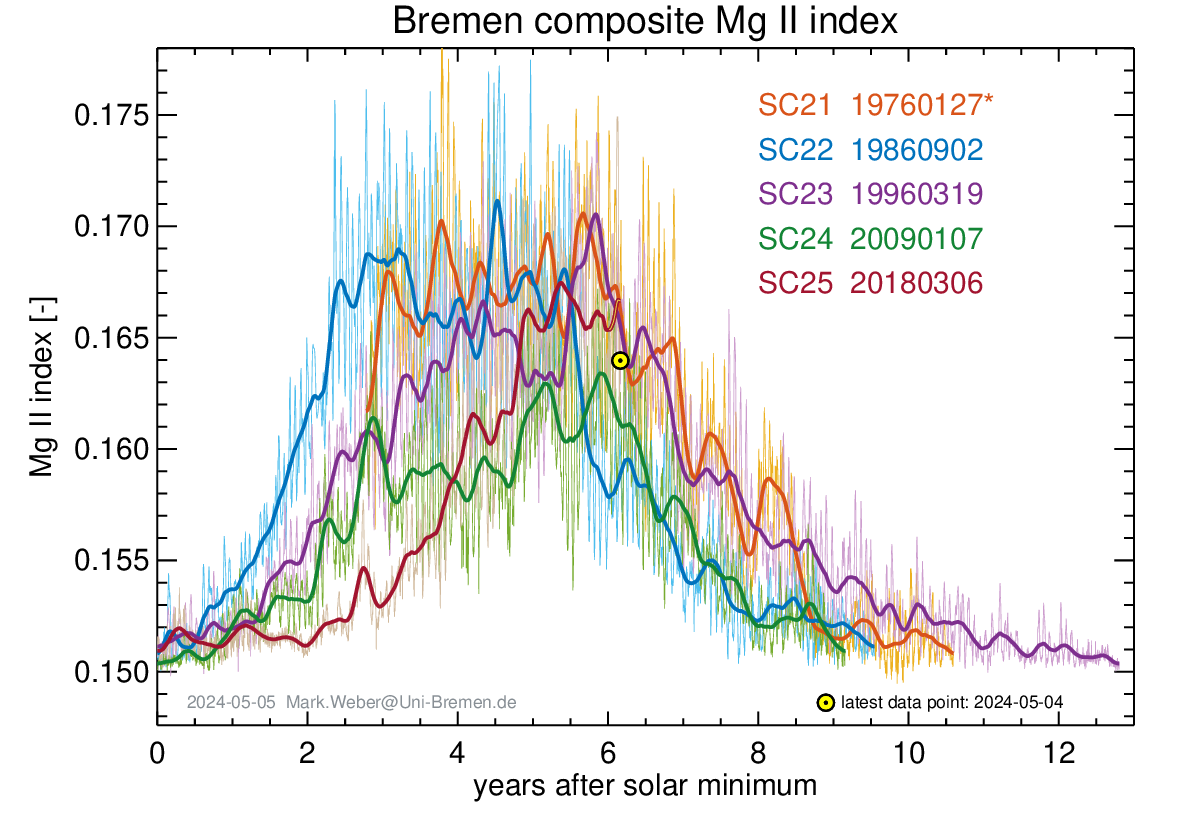
Very interesting Ren. Do you have an opinion on the severity of the coming European winter and the role of the negative phase of the QBO Index?
David Archibald
During solar minima the so-called “Holton-Tan Relationship”is valid for bothphases of the QBO: In the QBO-eastphase the Arctic is relatively warm, with frequentMMWs, while during the westphase cold polar vortices dominate. However, during solar maxima the situation is reversed, especially during the westphase of the QBO. New results based on an extended, 66-year long data set fully confirm our earlier 276 K. Labitzke and M. KunzeFig. findings and suggest a significant effect of the SSC on the occurrence of the MajorMidwinter Warmings (MMWs) as well as on the strenght of the stratospheric polarvortex and on the mean meridional circulation.
https://www.researchgate.net/publication/237105625_Variability_in_the_stratosphere_The_sun_and_the_QBO
Large effects of solar variability related to the 11-year sunspot cycle (SSC) are seen in the stratosphere, but only if the data are grouped according to the phase of the QBO (Quasi-Biennial Oscillation). New results based on an extended, 66-year long data set fully confirm earlier findings and suggest a significant effect of the SSC on the occurrence of the Major Midwinter Warmings (MMWs) over the Arctic as well as on the strength of the stratospheric polar vortex and on the mean meridional circulation. By means of teleconnections the dynamical interaction between the Arctic and the Tropics in the stratosphere and in the troposphere is shown for the whole data set and compared with the anomalies of single events. The results suggest strongly that dur- ing the northern winter the teleconnections between the Arctic and the Tropics were determined by the MMWs and the undisturbed, cold winters, respectively. These events in the stratosphere depend, however, on the 11-year SSC and on the QBO. The stratosphere is least disturbed during the northern summer when the interannual vari- ability is small. And if the different phases of the QBO are introduced, a large solar signal is found in the eastphase of the QBO (more than two standard deviations). It is shown that the QBO not only modulates the solar signal on the decadal scale, but that the QBO is itself modulated by the solar variability.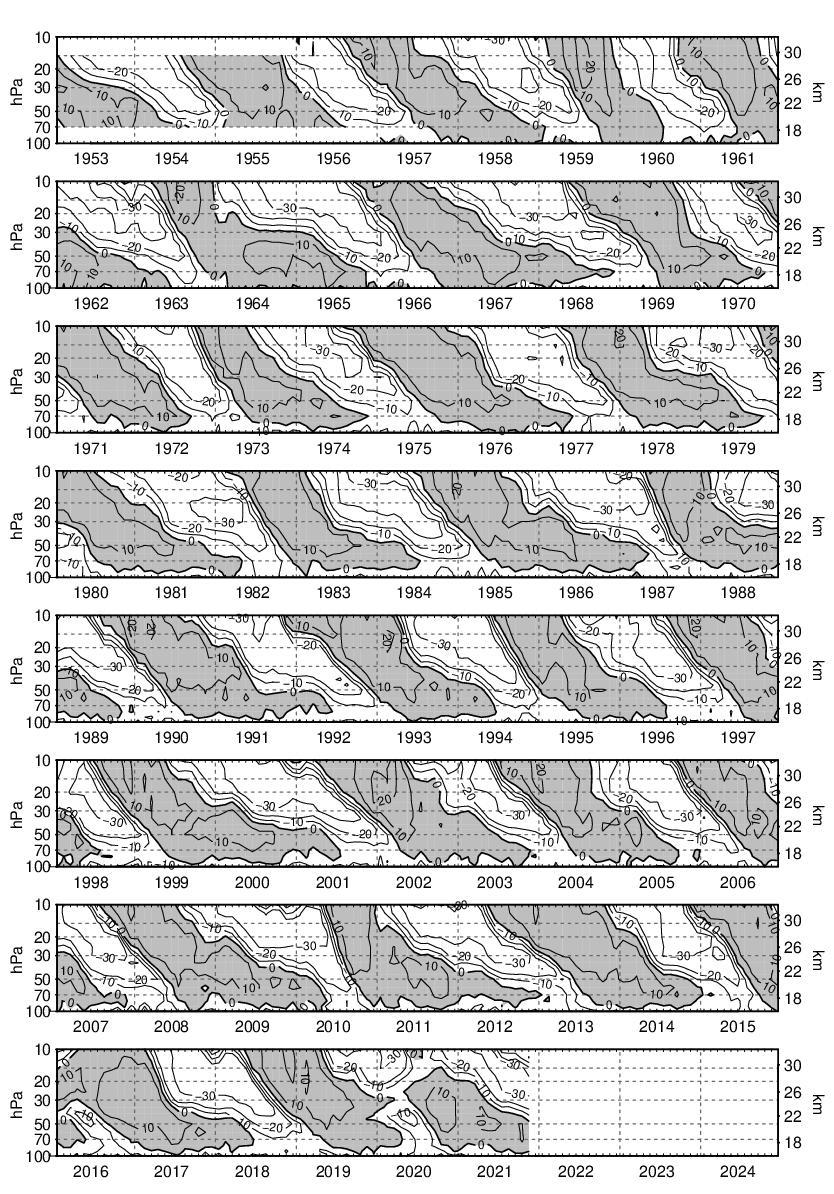
“European electricity prices have climbed to their highest levels in over a decade in recent weeks, rising above 100 euros per megawatt-hour in many markets. In Germany and Spain, for example, prices in September have been around three or four times the averages seen in 2019 and 2020. This increase has been driven by the surge in gas, coal and carbon prices in Europe. The strong rise in gas prices led electricity providers in a number of European markets to switch from gas to coal for power generation – a trend that would have been more pronounced if it had not been for the increase in the price of carbon emission allowances on the European market.”
https://www.iea.org/news/statement-on-recent-developments-in-natural-gas-and-electricity-markets
Thankyou.
You say the cooling trend is “firmly established” but your very first chart shows that it is not. The two purple lines show a long-term upward trend, and then the two red lines show a brief cooling trend…..that remains within the area that would be encompassed by the purple lines if you extended them farther. The cooling trend has not broken out of the warming trend’s area, and thus it is not “firmly established” at all.
I don’t know why I always say that next year will be less hot than this mine And I discover, my God, that it is the opposite of that