Guest Post by Willis Eschenbach
Let me start with the standard explanation of why the earth warms when greenhouse gases (“GHGs”, e.g. water vapor, CO2, methane, etc.) increase. This is from NASA:
When averaged over the course of a year, the amount of incoming solar radiation received from the sun has balanced the amount of outgoing energy emitted from Earth. This equilibrium is called Earth’s energy or radiation balance. Relatively small changes in the amounts of greenhouse gases in Earth’s atmosphere can greatly alter that balance between incoming and outgoing radiation. Earth then warms or cools in order to restore the radiative balance at the top of the atmosphere.
SOURCE
That explanation is clean and clear. When greenhouse gases reduce the amount of outgoing radiation, the earth’s surface has to warm up and radiate more, until the balance is restored.
According to NASA it’s quite clear and obvious—when CO2 increases, simple physics requires that the surface temperature increases to keep the radiation balance at the top of the atmosphere.
So, what’s not to like?
To explain what’s not to like, let me provide the simplest possible energy balance model of the earth. The values are all approximate.

Figure 1. Approximate energy budget of the planet. All values are in watts per meter squared (W/m2).
There are three layers in the model—the lowest part of the stratosphere; the troposphere; and the surface. Note that all three layers are balanced, in that the amount that is lost by each layer is equal to the amount that is absorbed. In addition, the system as a whole is balanced—237 W/m2 is absorbed by the system, and 237 W/m2 is radiated back out to space.
Now, recall the NASA claim that if GHGs increase and absorb more upwelling radiation, that the “Earth then warms or cools in order to restore the radiative balance at the top of the atmosphere.”
How large a change in the radiation balance are we talking about? Well, if we use the figures of the Intergovernmental Panel on Climate Change (IPCC), since the year 1958 when we started measuring CO2, the reduction in outgoing longwave radiation due to increased CO2 is about 1.5 W/m2. This is a change of a bit more than half of one percent of total outgoing radiation. Or to look at it another way, it’s an imbalance that is increasing at the rate of about two-hundredths of one watt per square meter per year … very, very small, in other words.
So let me ask you. Looking at Figure 1 above, is the warming of the surface the only way that the outgoing radiation at the top of the atmosphere (TOA) can be increased by about half a percent per half century to restore the overall balance?
Obviously, and totally contrary to NASA’s claim, surface warming is NOT the only way to restore the top-of-atmosphere radiation balance. Some of the other ways are:
• Decrease the incoming radiation. This happens by means of changes in the amount, composition, albedo, thickness, time of emergence, and/or nature of the clouds. It also happens over the ocean, from the ocean albedo changing due to winds causing breaking waves, spume, and foam. These are all white and reflect much more sunlight than does a calm ocean surface.
• Increase the amount of solar radiation absorbed by the atmosphere. This happens by means of changes in the amount of atmospheric water vapor, or by changes in the clouds.
• Increase the amount of latent heat removed from the surface via evaporation of water. This happens by changes in the wind, since evaporation is inter alia a linear function of the wind speed. It also happens by changes in the number of thunderstorms, which increase local evaporation due to storm-generated winds. It also happens due to increasing ocean water surface area due to spray, as well as due to the increased surface area of waves compared to smooth water.
• Increase the amount of sensible heat removed from the surface. This is also a function of the wind, since the sensible heat transfer increases as a linear function of wind speed.
• Increase the amount of surface energy moved high into the troposphere inside thunderstorm towers. These towers circumvent greenhouse gases in two ways. First, heat from the surface is moved into the bases of the thunderstorms as latent heat of water vapor, which doesn’t interact with the greenhouse gases. Then when the water vapor condenses, the heat is released. But it travels vertically inside the cloud tower, where it is not free to interact with the surrounding greenhouse gases. At the end of the vertical movement, the energy is released far above the surface, where there are far fewer greenhouse gases to absorb it.
• Increase the amount of surface upwelling radiation that makes it directly to space. This happens in the areas around and between the thunderstorms. These areas are composed of dry descending air which has been emitted at the top of the thunderstorms after having most of the water condensed out. Because water vapor is the major greenhouse gas, this lets much more surface energy go straight to space.
• Increase the amount of energy moved from the tropics to the poles. This is a huge amount of energy, about 10% of the total solar energy entering the system. Because the poles are much drier and colder than the tropics, much more of the outgoing radiation from the surface goes straight to space. When more energy is moved polewards, more radiation escapes to space.
Any one of these phenomena is certainly capable of changing outgoing TOA radiation by half a percent in half a century.
Let me summarize:
- There really is a very poorly-named “greenhouse effect”, which has nothing to do with greenhouses. It’s the main reason why the earth is not as cold as the moon.
- When greenhouse gases increase, the amount of outgoing top-of-atmosphere radiation does decrease.
- The theoretical imbalance over the last sixty years due to increasing CO2 is about 1.5 W/m2, or about half a percent of the outgoing radiation. Per year, it’s an annual imbalance increase of 0.02 W/m2, an amount far too small to measure.
- Unlike what NASA and other mainstream scientists endlessly claim, there are many more ways other than surface warming for this imbalance to be restored.
- In general, we do NOT have measurements of the various other ways of restoring the balance that are anywhere near accurate enough to tell us how much of each of these phenomena contribute to the 0.02 W/m2 change which is annually necessary to restore the balance.
The important takeaway from all of this is that there is no physics-based requirement that surface temperatures perforce must change when the level of CO2 and other greenhouse gases increases or decreases. The surface temperature may indeed change to restore the TOA radiation balance, but contrary to the endless claims of the alarmists, there is no physics that requires that it does so.
There is a further problem, which is that the amount we don’t know about the climate far exceeds the amount we do know. For example, here are 2,000 years of Northern Hemisphere temperatures.

Figure 2. The temperature history of the extra-tropical northern hemisphere from 30°N to 90°N. These have about an 80% correlation with global temperatures.
Here are questions that we don’t know the answers to about the thermal history shown in Figure 2:
- Why did the “Roman Warm Period” end around 150 AD and the world start cooling? Why did it not just stay warm?
- Why did the warmth end in 150 AD and not 50 AD or 300 AD?
- Why did the world keep cooling, in fits and starts, until about 550 AD?
- Why did the cooling stop in 550 AD, and not 350 AD or 750 AD?
- Why did the world warm from there, in fits and starts, until the peak of the Medieval Warm Period in the year 1000 AD?
- Why was the peak not in 800 AD or 1200 AD?
- What started the cooling from there to the depth of the Little Ice Age in 1700 AD?
- Why did the cooling end in 1700 AD, not in 1500 AD or 1900 AD?
- Why didn’t the cooling continue until we went into a true Ice Age, as the Milankovich cycles would suggest?
- What made it start warming again in 1700 AD, instead of just staying at the same cooler temperature?
- Why has the warming continued, again in fits and starts, for three centuries since 1700 AD to the present? (Protip—we know that the first two centuries of warming were NOT caused by CO2 increases.)
Given all of that, the idea that we understand the climate well enough to claim that we can predict the future climate a century from now based solely on projected CO2 levels is … well … let me call it insanely optimistic and let it go at that. As shown above, the system is far from as simple as it is claimed. The computer models are far too crude to capture all the complexities. And most of all, we simply do not understand enough about what natural processes made the past temperatures go up and down to stand a chance of predicting the future temperatures.
Sadly, despite all of that, a horde of obsessed folks, both scientists and laypeople, are insisting that based on nothing more than their inchoate fears of some imaginary future Thermageddon, we totally throw out a very successful energy source that has freed humans for the first time in history from lives of endless want and hunger, and replace that proven energy source with untested, unreliable, intermittent energy sources …
And they are still doing this despite the fact that we’ve been warned every year for half a century that the horrible Thermageddon is only a decade or two away. How many failed, cratered predictions will it take for people to notice that the underlying theory isn’t working?
This is madness. What we need to do is to continue to do what we’ve done so successfully in the past—use our proven, reliable energy sources to work to insulate and protect people from the endless, inevitable vagaries of the weather.
That is the no-regrets option. That way, whether or not CO2 turns out to be the secret knob controlling the temperature, we’ll be far less at risk from storms, floods, droughts, and all of the weather phenomena that have been killing people for millennia.
My very best to everyone,
w.
Keeping Things On Track: I am asking that you stick to the topic of the thread, which is the question of what can change the TOA radiation balance. In particular, if you think that there is no downwards radiation from the atmosphere to the earth, or if you claim that radiation from the atmosphere cannot leave the earth warmer than it would be if there were no radiation from the atmosphere, TAKE THAT ARGUMENT SOMEWHERE ELSE. I am NOT interested in getting side-tractored into debating that question on this thread, and I will assuredly snip it if you try. So save yourself the heartache of watching your genius argument disappear into the ether. There are lots of places on the web where you can debate that question to your heart’s content. This is not one of them. And don’t whine if you try it and get snipped. You’ve been warned, it’s on your head, not mine.
My Usual Request: I can defend my own words and I’m happy to do so. I cannot defend your interpretation of my words. So please, to avoid misunderstandings, quote the exact words that you are discussing.
Willis how much of the warming is due to the warm phase of the AMO since about 1995?
According to the UAH V 6 data most of the warming since 1979 is from the NH 0.16 c decade and N pole 0.25 c decade.
While SH is 0.11c a decade and S pole 0.02 c decade. SP over last 42 years is effectively zero and perhaps for decades more in the past?
So what’s likely to happen when the AMO changes to cool phase and perhaps in the 2020s?
Shouldn’t your diagram also show water in clouds absorbing and reflecting IR that is being emitted from the surface?
Fred, almost no IR is reflected by the clouds. And the absorption by the atmosphere includes that absorbed by clouds, GHGs, dust, and aerosols.
w.
Shouldn’t the absorption by clouds be partitioned from clear sky with it’s GHGs, dust, and aerosols ,and water vapor?. In clouds all those do not contribute very much to absorption compared to water droplets/ If clouds do not reflect downward then IR radiates downward based on the temperature at the bottom of clouds.
FWIW…I’m not offended by your use of the word “reflected” in this case. I knew what you meant. That is with clouds present less IR proceeds upward and more IR is returned downward. Maybe “reflected” isn’t the best word choice from a purist perspective, but it gets the point across all the same. Anyway, this is included in the UWIR and DWIR figures both with magnitude 321 W/m2 from the first gray layer in the atmosphere.
Might point is you should not be averaging UWIR and DWIR in clouds with UWIR and DWIR in clear sky when you are trying to partition absorption of IR by CO2.
Point taken there. But keep in mind these energy budget models are not meant for fine grained analysis like that.
Hardly any substance can reflect IR, except polished gold (hence the gold coating on the James Webb telescope mirror)..
That is a very odd list of possible effects. With the exception of the first “decrease the incoming radiation” every single effect in the list will result in the warming of the surface. Take the second for example:
“ Increase the amount of solar radiation absorbed by the atmosphere”
now if you increase the amount of absorbed radiation you are going to heat up the atmosphere which will in turn heat up the surface.
Most of the other items listed discuss energy transport within the atmosphere. None of those are 100% efficient and there will necessarily result in added heat and thus warming of the surface.
Izaak, I fear that you are not following the story to the end.
Take your example, “increase the amount of solar radiation absorbed by the atmosphere”, which you say will “heat up the surface”.
If sunlight makes it to the surface, it will warm it by an amount “X”.
If, on the other hand, it is absorbed by the atmosphere, something around half will be radiated up and half will go down … so the surface will be warmed by an amount of X/2.
In which case will the surface be cooler?
The same is true for say sensible or latent heat leaving the surface. An amount X of energy is moved from the surface to the atmosphere. Of that amount, ~ X/2 is returned to the surface.
Does the surface end up warmer or cooler?
My best regards to you.
w.
Very few people doubt that CO2 is capable of warming the earth.
The entire argument is about the amount.
The actual science shows that the amount of warming isn’t enough to matter, so unless you are one of those religious types who believe that any change that is caused by man is evil, there is nothing to worry about.
Masterpiece! All of the climate puzzle pieces laid out on one page, clear as a bell, ready for a climate science text book. Thanks W.!
Note that all three layers are balanced, in that the amount that is lost by each layer is equal to the amount that is absorbed
And note that if the system is balanced, there won’t be any warming which is most certainly why Dr. Trenberth over a decade ago changed his iconic heat budget to show an imbalance of 0.9 w/m² LINK
I think Kiehl & Trenberth 1997 are probably what you mean by “iconic heat budget”. I wouldn’t really call it iconic though since it was among many energy budgets at the time and not even remotely close to the first which was done by Dines in 1917. Note that KT1997 specifically says they are presenting their version of the energy “in the context of previous assessments” which assumed radiative balance. This is not say that they thought the planet was in perfect energy imbalance; only that the goal was to refine important energy fluxes and planetary albedo ignoring the imbalance for now. Hunt et al. 1986 summarizes many of the early attempts at energy budgets. One important contextual change and enhancement for the TFK2009 version made possible by satellite and reanalysis data previously unavailable to KT1997 version was the inclusion of the imbalance which comes from the Fasullo & Trenberth 2008 (FT2008) publication which itself is an examination of the energy budget with a particular focus on the imbalance. The error published at the time on that 0.9 W/m2 figure is a rather large +/- 0.5 W/m2. But what is really cool about FT2008 is that they document the annual cycle of the imbalance which is positive in the NH winter and negative in the NH summer..
Yes, this one: IPCC TAR Chapter one Page 90 It’s been referred to as iconic more than once. It’s the one that Trenberth changed in that LINK above. That Trenberth updated the chart is a fact, why he updated it is a matter of opinion. Here’s a link to my WUWT post from this past January as to maybe why the change was made.
I could be seriously misunderstanding your linked comment, but it looks like you made up a story and conversation of how you think it played out that isn’t actually true. I think you’re overthinking things here. I think it is as simple scientists (it isn’t just Trenberth) felt that including the imbalance is useful thing to do so they did.
The 3 layer energy budget model tells you exactly what can change to restore radiative balance at the top of the atmosphere. It is incoming solar radiation, reflected solar radiation, and outgoing longwave radiation. That’s it. Anything that directly or indirectly leads to a change in any of those 3 could turn a balance into an imbalance and vice-versa.
Nothing that happens at the surface or middle layers can change incoming solar radiation. So that makes it easy to eliminate incoming solar radiation changes as a viable mechanism to restore an energy imbalance on its own. That leaves only changes in reflected solar radiation and outgoing longwave radiation as the only way energy imbalances can be restored via internal processes. But there are plenty of processes that can change both of these. You listed several processes already.
One interesting observation that we can use to eliminate some of these processes as possibilities is the increase in OLR simultaneous with a neutral or even increase in EEI. What that tells us is that not only is ASR increasing, but that dASR >= dOLR. That means if albedo is responding as a feedback then it is a positive feedback at least over the last couple of decades which means it could not be acting as an energy balance restoration mechanism; at least right now. Feedbacks are tough nuts to crack though so there is no guarantee that the albedo feedback won’t switch directions in the future and provide that mechanism to restore the balance later on. One big problem right now is that since EEI is not declining it is difficult to figure out what restoration mechanism is currently in play.
Willis, it is obvious to me that you are a very sharp guy and a qualified skeptic. Judging by all the usual suspects that take shots at you, you are also on target.
I consider myself pretty smart, but I have to look up to with with admiration for your sharp intelligence.
“That is the no-regrets option. That way, whether or not CO2 turns out to be the secret knob controlling the temperature, we’ll be far less at risk from storms, floods, droughts, and all of the weather phenomena that have been killing people for millennia.“
Paul Joseph Watson more or less said, This isn’t about controlling the temperature, sea level, frequency of tornadoes & tropical cyclones, precipitation, droughts, floods, polar bear habitat, ocean pH or any other presumed controllable aspect of the Earth climate system, it’s about controlling YOU.
We’ll be far less at risk from a rampaging left wing power grab if we understand that CO2 really isn’t the issue.
It’s fine to argue the science, but the goal of that argument is expose the false science, not in some way kiss up to it and the people behind it.
There’s a geometry problem involved in the assumption that the stratosphere emits equal amounts of energy toward the Earth and toward outer space.
A packet of air at an altitude of 30 miles radiates equally in all directions. The question is how much of that radiation hits the Earth and how much misses and goes to outer space. So, where does our packet of air see the horizon? If I haven’t messed up my back of the napkin calculation, our packet of air sees outer space for about 190 degrees and sees the Earth for about 170 degrees.
So, the top of the stratosphere (30 mi.) radiates significantly more toward outer space than it does toward the Earth. The bottom of the stratosphere (12 mi.) should be the same but not as much.
The diagram above shows the bottom of the stratosphere radiating 147 watts per square meter toward outer space and toward the Earth. I don’t see how that can be correct.
It never ceases to blow my mind that climate scientists claim 0.1% accuracy on data that is no better than +/- 20%. The above is a case in point.
Thanks, Bob. While you are correct, it’s what I call “A difference that makes little difference”
There’s very little radiation from the top of the stratosphere. The bottom layer is just above the tropopause, which averages about 18 km up. The dip of the horizon at that altitude is about 4°. This gives a difference of about 2% (52% up vs 48% down), so it is generally ignored in first-cut analyses such as this one.
For more accurate analyses, you’d of course include it, but for my purposes, it makes absolutely no practical difference.
Bear in mind also that a photon that is emitted at say 1° above the actual horizon at altitude is likely to be reabsorbed because it’s going through a lot of the atmosphere … and that would reduce the amount lost to space. The actual calculations for that are insanely complicated, and so as I said, in first-cut analyses such as mine, it’s universally ignored.
w.
I agree that it makes little difference to your analysis. My grump is that when ‘they’ do their radiation budget, as reflected in the illustration above, they show 147 W/m2 upwelling and 147 W/m2 downwelling from the lower layer of the stratosphere. In doing that they say that upwelling and downwelling are the same within 0.7%. I would say, just based on geometry, that is extremely unlikely.
As you point out, convection moves sensible and latent heat upwards in the atmosphere such that it circumvents the greenhouse effect in the lower atmosphere. Also as I have pointed out elsewhere, the atmosphere and oceans circulate heat such that the planet’s average surface temperature would be quite a bit higher than the average temperature of the Moon even without the greenhouse effect. So, the greenhouse effect, which does indeed exist, is probably overestimated by more than just a percent or two.
We are presented with radiation budgets and CO2 budgets in which the numbers are given with better than 1% accuracy. As far as I can tell, their ‘proof’ of their theories relies on that accuracy and, as far as I can tell, those claims of accuracy are demonstrably bogus.
Anyway, honest science gives its results with error bars.
The stratosphere is much higher in the Tropics where much of the energy is found. This means that CO2, which primarily radiates from the stratosphere, is spreading energy poleward as well as towards space.
This is a factor left out but very important. More CO2 moves energy towards the poles. It moderates the latitudinal temperature differences.
Since CO2 operates in the stratosphere, most of the energy it absorbs comes from water vapor and clouds. Very little comes from the surface. The surface radiation is almost all absorbed by water vapor and clouds. The claim that CO2 absorbs solar energy absorbed by the surface is actually false. Adding more CO2 just helps spread the already captured solar energy better.
Any energy reradiated downward by CO2 is of such a weak nature that when it does reach the surface it is likely to be reradiated upward almost immediately or enhance evaporation based on the temperature of the surface. That is, if the surface is already warm such as in the Tropics the energy is quickly removed from the surface. If the surface is colder the energy is more likely to be absorbed.
Hence, CO2 will warm the cold areas of the planet and may very well cool the warm areas due to the enhanced evaporation. This is shown in the latest analysis from Dr. Spencer.
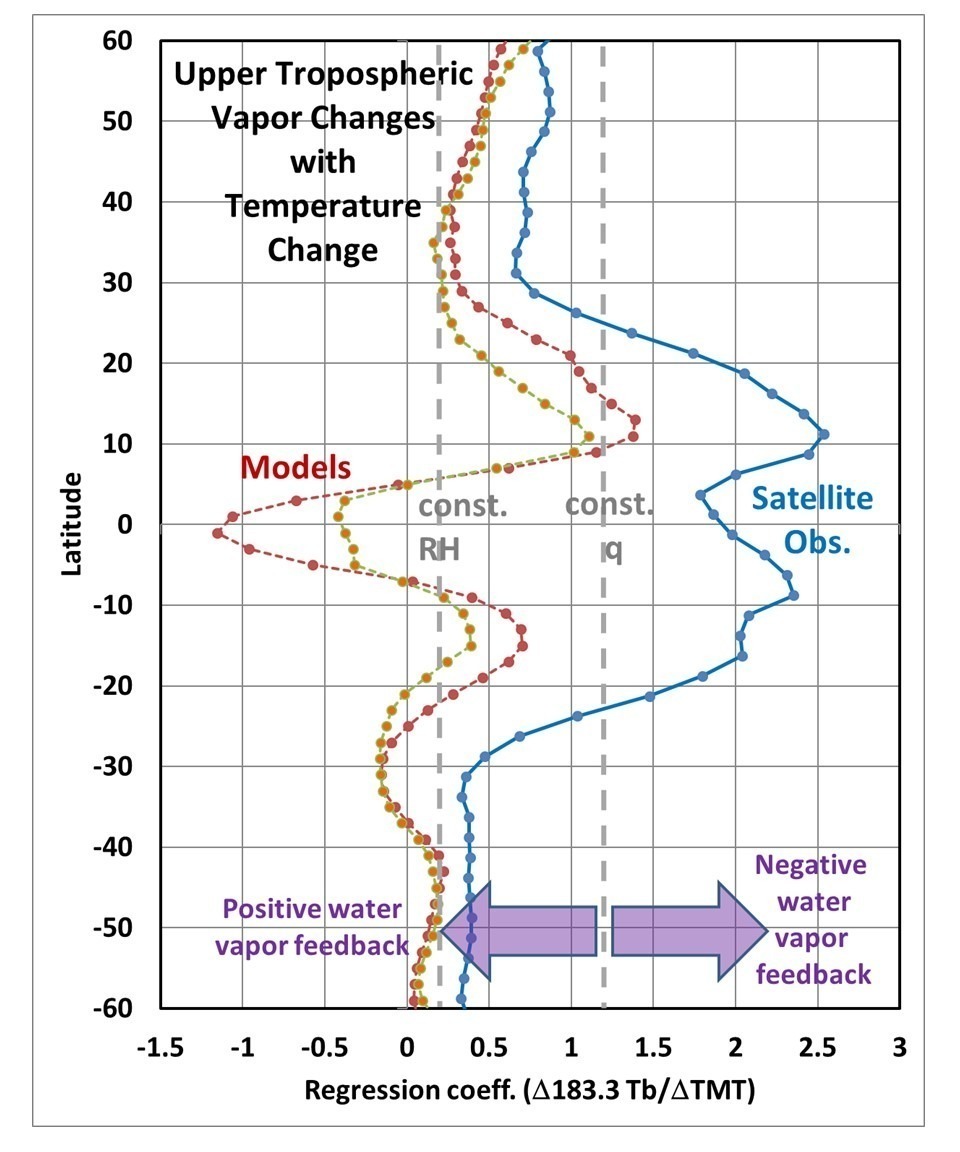
None of this detail (and much, much more) is captured in any energy balance diagram.
For example, how much total kinetic energy is absorbed by the surface? The diagram shows ZERO. Trillions and trillions of molecules smashing into the surface every millisecond without any energy transfer?
I’ve always found these figures quite interesting, but not for the reason most do. While these figures present a detailed view of what some believe to be happening in a simple way, the truth is all the numbers in these types of figures vary due to: atmospheric disturbances, the ever changing surface type/features, and of course even changes in solar radiance.
Yeah, absolutely. The figures in these energy budgets are global averages only. The spatial and temporal distribution of these fluxes are definitely not homogenous. In fact, in the TFK2009 energy budget they refer the spatial and temporal inhomogeneities as causing “rectification effects” which have to be considered if you want to get a better estimate of the surface UWIR by working backwards from temperature.
Willis,
thanks for the great analysis.
one question- all of the various factors that can increase increase out going radiation – do they need an increase in temperature for them to increase? Not necessarily surface temperature. If in fact they all depend on an increase in temperature to increase outgoing radiation, it would seem that the increase would be less than if one assumed only an increase in surface temperature would bring the system back into balance.
Jim Berry July 26, 2021 6:23 pm
Some do, some don’t. For example, an increase in wind cools the surface, but doesn’t require a temperature increase.
w.
Jim asks a question, and gets five down votes for his trouble. What’s the logic in doing that, downvoters? Are you trying to discourage the asking of questions?
I was taught in thermodynamics that the hotter an object is the more energy it is radiating. Temperature is a measure of how hot or cold an object is; it is a measure of the average kinetic energy of the particles of a substance. As the object gets hotter it actually changes color, e.g. the Stars. Where is this Increased radiation going?
Then there is the fact that warmer water evaporates faster when it is warmer. This means that, during the process of evaporating the water transfers energy to the vapor which is carried away and the water, because of the loss of energy the water gets colder. Thousands of times more energy is transferred in evaporation than in changing the temperature one degree. This same principle is how they make ice cream, which takes a temperature close to zero to become the consistency of ice cream by cooling the container with salted Ice and agitation to accelerate the melting of the Ice. SO, where does all of the energy transfere from the evaporation of the warmer ocean fit into this heat balance equation? Seventy Five percent of the Earth is WATER. That is approaching trillions of trillions of calories transferred.
In the energy budget domain the evaporation of water is included in the latent heat figure. For this particular version it averages 76 W/m2. That is enough energy to evaporate 5.4e17 kg of water every year. That would be enough to lower sea level by an astonishing ~1.5 meters every year if it all didn’t just precipitate and find its way back in.
The weak nature of CO2 photons means more evaporation as CO2 increases. Hence, some of the energy that is claimed to cause warming must instead be lost to latent heat.
It’s my opinion that solar output variability needs more weight in the discussion. Something else not understood or discussed is the earths own core and how it could be affecting this. Nobody can actually drill down there to actually observe and measure what is going on, we think we know what is going on based on other things. Geologic events certainly can affect short term climatology and when paired with some other variation that could have very significant long lasting effects. Fact is, there is still a lot we don’t know yet.
Willis: The skeptic that I am tried to find a flaw in your words. I could not… not even did I find a typo.
You made perfectly falsifiable claims that are backed by what we know or what we could know by some research of our own. You did the work for us. This is a nice piece that just about covers the subject matter.
Thank you!
ahhh incoming and out going will ALWAYS be equal … no matter the GHG concentrations …
The fact that you got 8 down votes from this statement shows me that the moronosity factor is alive and well here.
The fact that everybody but bdgwx and you got multiple downvotes suggests a coordinated pants-wetting by somebody. Care to explain Mike?
Really? What happens if you put more heat into something than can escape?
Not true.
On average, they will always be equal, but perturbations can temporarily cause outgoing to be either above or below incoming, until equilibrium is re-established.
You didn’t mention the fact of solar radiation absorption by the ocean and its role in warming and generating greenhouse gases, so your ‘balance’ discussion at the TOA is at best incomplete, lacking the major atmospheric influence, the ocean.
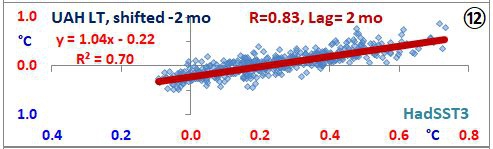
This relationship means the ocean has consistently warmed the atmosphere over time.
‘This relationship means the ocean has consistently warmed the atmosphere over time.’
Precisely! The sun heats the oceans and the oceans transfer the heat to the atmosphere. Your graph shows that 70% of the variance in UAH temp is explained by SST. This clearly demonstrates that the oceans are the intermediary between the sun and the atmosphere.
However, there is a lag, of the order of decades to centuries, between variations in solar energy, which is primarily absorbed by the oceans, and the transfer of these variations to the atmospheric temperature.
Willis, in a reply to a comment above, noted that the Maunder Minimum did not adequately correlate in time with the Little Ice Age in order for it to be considered a causal effect. I think that the lag between solar activity and the transfer of its effect to the atmosphere, through the intermediation of the oceans, which as I said above is at a minimum of the order of decades, needs to be considered before coming to such a conclusion.
Or shown another way.
https://woodfortrees.org/plot/uah6/from:1979/to/plot/uah6/from:1979/to/trend/plot/hadsst3gl/from:1979/to/offset:-0.35/plot/hadsst3gl/from:1979/to/offset:-0.35/trend
Both the lag and the exact match in warming trend demonstrate the oceans have been driving the warming of the past 40 years. What is driving the ocean warming is still debatable. We know the energy comes from the sun but what causes the oceans to retain different amounts of energy?
My own view is the cause is two-fold.
1) Increasing salinity of the mixed layer over the past 400 years driven by the THC.
2) Human pollution of the oceans.
Both of these will lead to reduced evaporation which is a cooling process.
Ok.
Let me respond by explaining that the temperature reading on the thermometer is only temperature and doesn’t actually reflect the amount of heat energy in a cubic meter of air at sea level… the heat energy that effectively doesn’t change without gross variations of the mass of the Earth’s atmosphere. This is reflected and supported by the evaporation tank data and is how physics works.
This claim makes no sense.
There is no evidence to support your belief that there have been large changes in the mass of the atmosphere.
Because – in my opinion, staying the same temperature is impossible. The climate is like a permanent pendulum always trying to settle in the middle but never getting there because it is spinning, circling the sun – which is spinning, pulsating and circling the galaxy, which is….
Willis
I think this is right up your alley:
Observational evidence that cloud feedback amplifies global warmingPaulo Ceppi and Peer Nowack
PNAS July 27, 2021 118 (30) e2026290118
Edited by Isaac M. Held, Princeton University, Princeton, NJ
Approved June 10, 2021 (received for review December 21, 2020)
https://doi.org/10.1073/pnas.2026290118
AbstractGlobal warming drives changes in Earth’s cloud cover, which, in turn, may amplify or dampen climate change. This “cloud feedback” is the single most important cause of uncertainty in Equilibrium Climate Sensitivity (ECS)
can someone point me to a calculation of earths surface temp assuming 100% o2 n2 atmosphere. (no water)
thats complicated David. No water means no clouds which contribute half of the 0.3 albedo of the planet. Then a lot of the albedo is the contribution of ocean albedo of less than 0.1. Then with no water, there is no grass, albedo 0.25…..then N2 and O2 are transparent to IR….so you are really looking for something like the surface temperature of the moon, but with shorter rotation time. So maybe try….
https://www.drroyspencer.com/2016/09/the-faster-a-planet-rotates-the-warmer-its-average-temperature/
thanks for the link but not what I am looking for. Even though O2/N2 are mostly IR transparent they are going to pick up energy from conduction. I would have thought that this calculation would be the first one done in trying to get to GHG sensitively, at least to understand the basics.
I think what you may be asking is what is the average temperature when all other things remain equal including but not limited to albedo, absorbed solar radiation (ASR), and outgoing longwave radiation (OLR) and when the GHE and only the GHE were turned off. That comes out to the canonical 255K based on the Stefan Boltzmann law with OLR of 240 W/m2 to balance ASR of 240 W/m2 such that the planet is in steady state.
but surely the surface temp would be a function of the thickness of the atmosphere.
how. about simplifying further. a steel ball with a constant internal heat source (so no day night problems nor dust nor albedo). what happens to the surface temp of the steel ball if you add an o2/n2 atmosphere.
This has been discussed over the years. It all depends on what assumptions you use. As already mentioned the lack of water means the albedo decreases. This eliminates the 254 K answer. The lack of any gases radiating energy from the atmosphere would lead many to assume 274 K as that takes into account the albedo change.
The problem with both of these answers is they assume an average temperature over the entire planet which is also wrong. The tropics would be much warmer than the poles while day night differences would also increase. Since there’s no water you’d end up with a lot of dust on the surface while the planet’s rotation in combination with unequal heating would create strong winds. That means a lot of dust goes into the atmosphere.
Since dust absorbs and emits both solar and IR radiation the ability of the atmosphere to radiate energy would return. This would raise the height of the effective radiation level allowing the surface to warm even more. I suspect you’d end up with something warmer than the current temperature of the planet due to the lower albedo in combination with the dry adiabatic lapse rate.
how. about simplifying further. a steel ball with a constant internal heat source (so no day night problems nor dust nor albedo). what happens to the surface temp of the steel ball if you add an o2/n2 atmosphere. the next question is what happens when you add a bit of ghg.
Or, simplest solution, change the speed of convective overturning so that in response to any potential warming effect from GHGs one increases the rate at which potential energy energy is returned to the surface as kinetic energy for radiation from surface to space.
Only minuscule change required for the change in CO2 observed being far less than natural variability.
Simple is good.
From the 1958 “Introduction to Meteorology” by Sverre Petterssen:
“…if there where no moving parts in the system (winds of the atmosphere and the currents of the oceans), the temperature would decrease in the polar regions and increase near the equator. As a result of the exchange across latitude circles the outgoing long-wave radiation varies with latitude much more slowly than does the incoming short-wave radiation.
…The amounts of heat thus transported across the latitude circles 20, 40, and 60 are shown (below).
The amounts are enormous and show a maximum in the mid latitudes.
The Annual Heat Balance, by Latitude Zones:
Poleward transport of heat across latitude parallels in cal/min :
Where …(10 to the power of 15) is a million million kilocalories
Lat 20º …..57 X (10 to the power of 15 )
Lat 40º …..77 X (10 to the power of 15)
Lat 60º …..50 X (10 to the power of 15)
Zones of latitude 0º-20º ….Fraction of total area 0.34 …Short-wave absorbed 0.39 cal/cm2/min
Long-wave emitted 0.3 cal/cm2/min
Zones of latitude 20º-40º …Fraction of total area 0.30 …Short-wave absorbed 0.34 cal/cm2/min
Long-wave emitted 0.3 cal/cm2/min
Zones of latitude 40º-60º …Fraction of total area 0.22 …Short-wave absorbed 0.23 cal/cm2/min
Long-wave emitted 0.3 cal/cm2/min
Zones of latitude 60º-90º …Fraction of total area 0.14 …Short-wave absorbed 0.13
cal/cm2/min
long-wave emitted 0.3 cal/cm2/min
Weighted mean: Short-wave radiation absorbed 0.30 cal/cm2/min
Long-wave radiation emitted 0.30 cal/cm2/min
Thanks Willis for nicely homing like a Sidewinder heat seeking missile on the central and most pertinent core of the climate “heating” issue!
The surface temperature may indeed change to restore the TOA radiation balance, but contrary to the endless claims of the alarmists, there is no physics that requires that it does so.
IMO the emission height mechanism – it rises when more GHG e.g. CO2 makes the atmosphere more IR-opaque – is inescapable. But it does NOT lead to the inescapable conclusion of heating up the whole atmosphere and ocean, an overly simplistic and complexity-denying conclusion, for exactly the reasons Willis outlines.
In the complex-chaotic climate system there are LOTS of other ways in which the trivial fact of TOA radiative balance can be restored. These include emergent mechanisms of thermal homeostasis, which I doubt will get a mention in the forthcoming new IPCC report.
https://ptolemy2.wordpress.com/2021/07/08/emergent-thermal-homeostasis-a-new-paradigm-for-ex-pluribus-unum-climate-stability/
Say you’re a planet with an atmosphere and ocean. Thus a climate. Which way do you choose for balancing your radiation budget, out of the long menu of options Willis listed?
Well the one that you DONT choose is simply heating up the whole atmosphere and ocean. Why not? Because it’s the option involving the greatest expenditure of energy. And the universe doesn’t really approve of that. There’s this thing called the ”Principle of Least Action” that dictates that if a system is induced to change from state A to state B, it will do so with the least – not the most – expenditure of energy. Or action.
This law is all pervasive – one of physics’ most fundamental laws, it underlies other named laws such as Fermat’s theorem and Noether’s law.
https://ptolemy2.wordpress.com/2020/02/09/the-principle-of-least-action-calls-into-question-atmosphere-warming-by-co2/
A system forced to change will do so with the least action or expenditure of energy. And providing the least pretext for misanthropic political agendas.
There’s clearly a coordinated action going on by a crowd of servile weaklings to downvote all comments by Willis and those in support. Some “mechanical Turk” of lefties for hire such as are employed to enforce political bias on social networks by the likes of Jackboot Dorsey of TwitR. How pathetic! Nothing to say? Just a fraudulent click campaign?
“You know you’re over the target when you start getting flak incoming.”
”There’s clearly a coordinated action going on by a crowd of servile weaklings to downvote all comments by Willis and those in support. ”
There’s clearly a failure of eyesight on your part.
I counted back about 80 comments and over 70 had negative ticks regardless of who wrote them or what they said. Even simple non partisan questions are apparently frowned upon.
Saying that there is a coordinated effort to downvote Willis and those in support does not prove that nobody else gets downvotes.
That’s right. But I’m not saying that am I.
Thanks,
I had noticed this trend on the way through. I just ignored all the minus ratings.
Small things amuse small ( and malevolent ) minds.
“Just a fraudulent click campaign?”
That’s what it looks like to me, considering what they are downvoting.
Jim’s *question* just above, got downvoted, and his question wasn’t even controversial, it was just a question that did not imply Jim was taking any particular position or selling a particular position. I wouldn’t even call the downvoting vindictive, I would call it pure stupid, at least in this particular case.
“they are far too crude… and we don’t understand enough”
Uncertainty is high, high in either direction. That means changes is CO2 concentration might have an even greater effect than we realize doesn’t it? Or do the errors and your doubts only go in one direction?
Be that as it may, I agree with Izaak who says above:
“With the exception of the first “decrease the incoming radiation” every single effect in the list will result in the warming of the surface.
So a pretty flimsy basis on which to indulge yourself an anti-CO2 rant and then tell readers to stay on topic.
”Uncertainty is high, high in either direction. That means changes is CO2 concentration might have an even greater effect than we realize doesn’t it?”
No
Are you in Willis’ camp; suggesting it can only have a weaker effect than we realize? But I thought the error bars were both +/-.
Lloydo – see figure 2 in Willis’ article. What we are expected to accept in the CAGW hypothesis is that up until around 1950 the temperature changes were natural, and yet after 1950 those natural processes somehow stopped and all the subsequent temperature changes were driven by CO2 increase. Before 1950 the CO2 level hadn’t changed much from the previous few thousand years, and after that we burnt a lot more fossil fuels.
That figure 2 clearly shows that the global temperature does not depend much on the CO2 concentration, even though there must be some effect. However, given that the Vikings grew Barley in Greenland during the MWP, I’d suggest that the MWP peaked at a degree or two higher than today, and that the previous warm periods are likely underestimated on that graph.
It remains that the CO2 warming effect is smaller than the uncertainties in the values of other effects. That also means that if by some miracle we do reduce anthropogenic CO2 emissions to zero, we won’t be able to measure any temperature difference as a result because the other variables are not known to a high-enough precision. IIRC if everyone complied with the Paris accord then in 2100AD the temperatures would be lower by 0.02°C. That difference is actually very hard to measure, and given the daily temperature range of 10-20°C and a seasonal change of around the same, 0.02°C is actually irrelevant.
What caused the previous temperature rises and falls? It’s obviously not correlated to the CO2 concentration.
Agree in principle except CO2 has not been demonstrated to have ANY “warming effect;” that is purely hypothetical, and assumes “all other things held equal.”
AGW is Not Science – yep, that’s why I said there ought to be some difference but you can’t see it in the graphs. The climate models assume there’s a positive feedback, but the salient point from the history is the stability of the global average temperatures despite the changes in the solar energy from solar variability and our distance from the Sun, so there must be a lot of negative feedback in the system. This is in any case what we’d expect to see in a complex system that is in equilibrium and being disturbed – things shift to resist the changes. Basically Le Châtelier’s principle on a global scale.
Put another way, all other things cannot be held equal.
Willis followed that figure 2 with a list of historic temperature/climate shifts which cannot be explained by changes in the CO2 level, and AFAIK we don’t know why they happened either. Since we don’t know why they happened, and can’t hindcast them, that also means we can’t predict the future climate. This failure to correctly predict is easily seen by looking at the IPCC’s past predictions for current temperatures. If the predictions are wrong, then the theory is wrong.
There’s also the problem that we don’t have a long history of accurate measurements. The proxies used to estimate previous conditions (temperatures, rainfall, insolation, etc.) also assume “all other things being equal”, and we have no way of knowing that. For example, we might go on what crops grew, but they would almost certainly be different varieties than today. Net result is that uncertainty is unavoidable, and yet it seems that the data is presented with more certainty than can really be justified. That also applies, IMHO, to Willis’ figure 2.
I was somewhat amused by the UK Met Office’s “heat warning” over the last few days, for temperatures in excess of 30°C, coupled with people complaining of not being able to fly to Spain (Covid problems) at 32°C or so. Amazing how people would want to travel to somewhere where there’s such a risk of death from heat-stroke….
Good comments, Simon.
We have a long way to go to understand how our climate works, and it doesn’t appear to work the way the alarmists say it works since every prediction they make is wrong.
Uncertainty =/= error
Loydo
You say every possible change in climate dynamics of the three phases of water, can only ever warm, never cool?
Is self-parody what you were aiming for or is this accidental?
I said no such thing, but at least I try to make sense.
That would be a first.
That means changes is CO2 concentration might have an even greater effect than we realize doesn’t it?
Since CO2 has not been empirically demonstrated to have any effect on the Earth’s temperature, and has been empirically demonstrated to have no such effect, the answer is “no.”
Loydo July 27, 2021 12:02 am
Loydo, I fear Izaak’s claim is wrong. See my comment above.
w.
And this: “Uncertainty is high, high in either direction. That means changes is CO2 concentration might have an even greater effect than we realize doesn’t it?”
A lie, repeated many times, does not become the truth.
The real world has thoroughly debunked the possibility that the climates sensitivity to CO2 changes can be high.
A few million years the CO2 levels were 5000 to 7000ppm, and none of the bad things that you pray for happened.
That pretty much puts the lie to your claim that it is possible for CO2 to have even more impact than the models over predict.
CO2 levels have gone from 280ppm to over 400ppm in the last 70 years or so, and nothing bad has happened.
That pretty much puts the lie to your claim that it is possible for CO2 to have even more impact than the models over predict.
Science is now an “anti-CO2” rant. Why don’t you learn a little bit about science, it will make you look a little less like a pathetic, unthinking troll.
Willis,
You wrote –
“The theoretical imbalance over the last sixty years due to increasing CO2 is about 1.5 W/m2, or about half a percent of the outgoing radiation. Per year, it’s an annual imbalance increase of 0.02 W/m2, an amount far too small to measure.”
The only imbalance is the observable fact that the Earth’s surface has cooled to its present temperature, from the molten state, as far as is known.
The Earth has continuously emitted more energy than it has received, obviously.
Making an unsubstantiated assertion about a “theoretical imbalance” is just silly. Wishful thinking by climate cranks is not a “theory”.
Unless someone can come up with some physical reason why the Earth has not cooled to its present temperature from the molten state, GHE believers are just spouting nonsense. Crap, if you prefer. Certainly not science.