Guest post by Jim Steele

Most people are unaware that the greenhouse gases CO2 and H2O, both warm & cool our planet. When I mention that CO2 has a cooling effect, I’m amazed by the hateful tirades from paranoid people who dismiss scientific truth as “dangerous misinformation”.
However, discussions about temperature inversions have occasionally induced more respectful debate with critical thinkers. Most people have observed “frost fans” erected in orchards and vineyards, so are interested in why they work. Frost fans disrupt freezing layers of surface air that can develop at night during the spring, damaging flowers and fruits. Frost fans simply pull warmer layers of air from above down to the surface raising minimum temperatures. But why does that warmer layer of air exist?
During the day, earth’s surface absorbs both solar radiation and the downward infrared heat emitted from greenhouse gases. Absorbing that energy faster than it can emit infrared back towards space, the surface warms. However sunlight doesn’t heat the lower atmosphere (aka troposphere) directly. Nitrogen, oxygen and argon comprise ~ 99% percent of our atmosphere and is transparent to incoming solar energy. Furthermore, unlike greenhouse gases, those gases neither absorb nor emit infrared energy. The troposphere warms primarily by gaining energy via collisions with a heated earth surface. During the day, the warmest air layer lies closest to the heated surface. Rising warm air causes turbulent mixing and collisions with cooler air above that raises air temperatures there. However because air cools as it rises due to decreasing air pressure, warming is limited.
Without solar heating, earth’s surface cools by emitting more infrared heat than it absorbs from recycled heat emitted by greenhouse gases because greenhouse gases don’t intercept all emitted heat. “Atmospheric windows” allow about 23% of the surface heat to escape directly to space without being recycled. The air layer closest to the surface then cools by transferring heat to the colder surface. However, higher air layers can’t sink and collide with the surface again unless they lose their heat. But nitrogen, oxygen and argon can only shed that energy by colliding with cooler greenhouse gases which will absorb their energy and emit half back toward space.
Because the bulk of our atmosphere only cools by transferring heat to greenhouse gases, a small percentage of greenhouse gasses creates a “cooling chokepoint”. Consequently, the atmosphere sheds energy more slowly than the solid earth that more quickly loses energy via atmospheric windows. This difference in cooling rates creates a warmer layer of air above the cooler surface air and is called a temperature inversion. Now imagine a world without greenhouse gases. Without greenhouse gases nitrogen, oxygen and argon can’t lose enough heat back to space and the atmosphere would keep warming.
Outside the tropics, inversion layers more readily form in winter and spring. The earth’s surface holds less heat during winter’s reduced solar heating. Where people use fireplaces to stay warm, inversions layer are revealed by rising smoke that suddenly flattens when it encounters the warmer air above. Frost fans work by drawing down warmer air layers to mix with cooler surface layers, and thus protect crops from freezing. Similarly, months of “polar nighttime” cools Antarctica’s interior surfaces to as low as −89.2 °C (−128.6 °F), creating a continent‑wide inversion layer. When above average surface temperatures are periodically reported, it’s often the result of high winds that, like a frost fan, disrupted Antarctica’s inversion layer.

In the 1990s, climate scientists determined urban heat effects raised minimum temperatures several degrees but not maximum temperatures. Such areas weren’t warming but getting less cold. That suggests urbanization disrupted local inversion layers. Increasingly covering the land with heat retaining asphalt and concrete, reduces surface cooling. Removal of vegetation or wetness results in hotter surfaces that store more heat. Traffic, tall buildings or frost fans disrupt surface winds bringing warmer air to the surface. All those dynamics raise minimum temperatures, and thus average temperature. Various local disruptions of inversion layers may better explain why some US weather stations show warming trends while 36% show long term cooling.

Our atmosphere also has a global inversion layer. Above the troposphere, is the warmer stratosphere where temperatures increase with altitude due to absorbing solar UV. Because CO2 in a warmer stratosphere emits infrared faster than it absorbs it from the troposphere, more CO2 cools the stratosphere. (For similar reasons CO2 has a cooling effect in Antarctica.) Furthermore storm clouds bring the tremendous amounts of heat stored in water vapor to the stratosphere. Again we can see where the warm inversion begins as clouds stop rising and develop an anvil shape at the stratosphere. Because the stratosphere is nearly devoid of water, the wavelengths of infrared heat released as water vapor condenses to liquid and ice, mostly pass freely to outer space, without recycling it back to earth.
If these dynamics were better understood, people would more likely laugh at climate catastrophe narratives rather than succumb to paranoia.
Very interesting arrival. Love your articles Jim. Something that has always bothered me is the interpretation that sunlight (photons) pass thought the atmosphere transparently. I get radiative gases have absorbtion bands, but don’t photons collide with all gas molecules. Is it right to think that incoming solar radiation, which is just photons of a short wave length, strike no N2 or O2 molecules. Doesn’t outgoing longer wave length radiation also strike all molecules as well. Of course only the radiative gases absorb photons setting off vibrations. It bothers my intuition to say without radiative gases that long wave radiation would flow uninterrupted to space.
I hate posting from phones! Word check has a mind of its own.
FYI…There is a window to edit any comments on this site now.
Thanks for this article. Some good points to consider. The atmosphere is the working fluid of its own heat engine operation. This is powerfully exhibited in storms, weather systems, and the general circulation. Should I be worried about additional CO2? Not if I see it as an incremental improvement both to the radiative coupling to the surface – the hot end of the heat engine – and to the performance of the cold-end emitter at high altitude.
No matter how you try, cold air doesn´t heat the warm surface. The atmosphere is -18C, the surface is 14C. There are no experiments that show that cold air can warm a hot solid, under any circumstances, in any way. It doesn´t matter if it´s 100% co2, cold gas cannot warm a hot solid.
This is a strawman argument. Scientists do not say that the reradiation of 345 W/m2 from the atmosphere is able to maintain the surface temperature of 15 C and to emit radiation of 396 W/m2. What happens actually.
Just one evidence. The Earth emits LW radiation by the surface about 396 W/m^2. It is according to the Planck’s law (about 16 C degrees) and it has been confirmed by direct measurements. In addition to this, the Earth’s surface is able to release sensible heating 24 W/m^2 and latent heating 91 W/m^2 by evaporating about 1 meter of water each year. Totally the surface is able to produce energy flux of 396+91+24 = 511 W/m^2. Because there is a clear observation that only 165 W/m^2 of solar energy is absorbed by the surface, where is the rest energy of 346 W/m^2 coming from? These people stop commenting just right here. No answers.
Think of it in terms of resistance. The surface is not “heated” by the atmosphere. It just cools more slowly.
”The surface is not “heated” by the atmosphere. It just cools more slowly”.
Ok so answer me this. Two radiating heaters facing each other. Turn one on. It heats the other one which is off. Turn on the other heater to half of the first one. Does the first heater stop heating the second one? No? Then a cooler object is heating a hotter one.
This is a good idea for an actual experiment that anyone can with an IR thermometer.
But I think you may need to explain it more clearly.
Which one is on halfway, and is therefore cooler?
*Heater on the left (HL) is off.
*Heater on the right (HR) is turned on to ”1”
*HR warms HL. (to the value of ”X”)
*HL is turned on to ”2” and heats up to the value of ”Y”
Forgetting the back and forth radiations for the moment, is HR still warming HL to ”X” (now +”Y”)? If yes, then a cooler object is warming a hotter object. If no, what is happening?
Right there with you.
The people who are making a fuss about this as if something impossible is being asserted, are not being analytical, and are claiming laws of physics that do not exist.
Obviously radiation from cooler objects impinges on warmer objects all the time, everywhere, everyday.
They are not all making the same mental errors, but nor are they taking into account everything.
Laws of thermodynamics and conservative of mass and energy only apply in close systems, not where there are outside inputs.
So in the case of radiation from the upper atmosphere, that place and the surface are all one thing.
The ground will not get warmer while the sky gets colder, because a warm object is radiating more strongly than a cold object.
If a situation arises where the sky is somehow warmer than the ground, the ground will warm up.
In fact this is observed to occur on cold nights when a cirrus deck moves in during a radiational cooling event.
I have observed this occurring many times at my nursery in Florida on cold nights with dry air, clear sky, low dewpoints, and light winds at the surface.
A streak of jet stream cirrus will raise the surface temp several degrees in minutes.
It has recently occurred to me that one way this occurs is by reflection off the ice crystals in the clouds.
The clouds are colder than the ground, but they are reflective, and within the ground surface “seen” by these clouds, is the warm Gulf of Mexico, and other bodies of water, and locations that are warmer than my farm was.
So photons can reflect off the clouds, and I am now becoming more certain that is at least one of the things occurring.
So in the case of CO2 molecules in the sky, they are radiating IR in every direction, and of course some of this is towards the ground.
These do not magically disappear because they are impinging on a warmer surface.
But what is happening is, the ground is simultaneously sending a far higher number of IR photons up to the sky in every direction.
So the incoming ones simply slow the rate of ground cooling by some amount.
The thing is, there are examples from astronomy long known to astrophysicists of stars being warmed by cooler stars.
I documented such below, going back over 100 years.
There is no debate about it, only the details of what happens next and the quantification of the entire process.
And if it happens in one instance, that disproves the notion it is physically impossible.
What I have posted here should give everyone making these claims to re-evaluate their position.
Smart people change their minds when they get new information.
Several years ago, I came upon this debate not having any idea who was right.
But I have educated myself, thought of examples which might prove it one way or the other, then did research to find documentation.
And find it I did…plenty of it.
People Like Michael moon had at best one quick look at some literature and did not read what they were looking at very closely, or something, and then went right along making claims that are unsupported and in fact contradicted by the example he himself gave.
In the case of the cold night in Florida, one has to consider the ground at my cold farm, the sky with the cirrus clouds, and the surrounding area with warmer places, as one closed system.
The energy that warmed my farm near the ground came from somewhere…someplace warmer than the air at my farm.
Another mistake people seem to make is conflating the ground itself with the air just above the ground, and also seem to think of the sky as if it is one precise place, rather than a continuum with a vast vertical extent.
Another place where people seem to not be very analytical is when considering, or failing to do so, that many events are occurring simultaneously.
Photons redirected towards the ground does not mean those photons were “trapped” by CO2.
Plus, air temp is a measure of the average energy of the molecules in the air, but in any volume of air, there are some molecules with far more energy than average, and some with far lower energy than average.
None of this means warmistas are correct that CO2 is the thermostat control knob of the atmosphere and hence the planet, but for some people, they seem to have notions of such details being an all or nothing make or break situation, vis a vis the concept of CAGW.
It is not.
Another thing to consider is, when a CO2 molecule emits an IR photon towards the ground, it does not mean it makes it to the ground.
We know that the effect of CO2 in the air falls off tremendously as the concentration goes up…each new CO2 molecule has less and less of an effect, because there are already a whole bunch of them floating around, doing what they do.
So at the concentrations that exist near the ground, the free path is very short for an IR photon at one of the wavelengths that can be absorbed or emitted by CO2. For one thing, as everyone should know by now, these wavelengths overlap to a large degree with those of water vapor.
So a redirected photon may in fact have very low chance of ever getting anyplace close to the ground, before it is reabsorbed, and then reemitted, and in about half of these instances, it will be going up.
That is why serious people have reached a point in the discussion where what matters is what is occurring in the rarified upper reaches of the atmospheric column.
And because of this limitation on what some more CO2 can do, it opens the door wide open for other factors to completely overwhelm the effect of increasing CO2.
When it is warmer, more radiation flows to space.
More convection carries more air aloft.
More evaporation of water causes more water vapor, and more water vapor causes convention to carry a huge amount of additional latent heat to the upper reaches in convective updrafts.
And more clouds from more water in the air, changes the amount of solar energy reaching the surface.
And on top of all of that, the warmista case hinges on a critical factor rarely brought up…that the heat budget of the Earth is tightly constrained by the rate at which IR can make it up to space.
It is not.
Every night, on nearly every location in the planet, the air cools to near or at the dew point.
At which point cooling stops, to a very substantial degree.
But, and this is the critical point, every night this dew point is reached and cooling stops with several hours to spare!
So if it becomes warmer for any reason, which it does in many places at many times for many meteorological and climatological reasons, there are always plenty of opportunities for this retained heat energy to find it’s way to space.
It is not some situation where any retained heat is forever trapped upon the Earth, or trapped anywhere on or in it, either.
Which is why we see wide swings in temperature on every time scale, in every place, for the entirety of the record we have to examine.
And it is this very record of the past that provides the best evidence that this reasoning I have just laid out is true: We can see that at no time in the past has CO2 every been seen to control the temperature of the Earth or any part of it.
If and when the Earth grows warmer for any reason, the air will over time become increasingly humid.
In fact geologists and students of Earth history, refer to warm periods in the past as more humid periods.
And more humid conditions are more moderate.
This can be seen anyplace one cares to look.
Water is the great moderator.
It does not get as hot by day, or in the Summer, and it does not get as cold at night, or in the Winter, when and where it is more humid.
Which is why in the past during times when the Earth was far warmer than it is now, whether the ancient past such as the Mesozoic hothouse ages, or the more recent past, such as 8,000 years ago during the Holocene Climate Optimum, when the Sahara desert was a lush and verdant savannah crisscrossed with rivers, dotted with lakes, and spotted with forests…at these times in the past when Earth was warmer, which is nearly the entire past with the exception of the recent catastrophic Ice Age we are currently living through…the Earth was a far more temperate, more benign, and more clement place, with teeming habitat from pole to pole in many specific and well documented instances. Likely when ever it was warmer, the Earth was a better place for life, and when colder, it was and is worse, far worse.
There are no examples from the history of our planet when the opposite has been shown to be true.
Which makes the situation we find ourselves in at the present time all the more inane and incredible, and the people worried about global warming about the most idiotic jackasses I can think of to ever assume any of the levers of power.
So idiotic, it is difficult to believe the smart ones believe a word of it.
“The clouds are colder than the ground, but they are reflective, and within the ground surface “seen” by these clouds, is the warm Gulf of Mexico, and other bodies of water, and locations that are warmer than my farm was.
So photons can reflect off the clouds, and I am now becoming more certain that is at least one of the things occurring.”
Another thing which may well be occurring is, that warmth from layers of air at some distance from the surface are warming the surface, either directly, or indirectly by reflection, when these clouds move in.
Obviously warm air is radiating in all directions, so air in the layers above the surface are always radiating downwards, but when the sky is clear the net flow is out to space and the surface cools, rapidly after sunset and more slowly as the temperature approaches the dew point. Once the sky is no longer a transparent window to space, because a layer of clouds has moved in, the net flow is from the warmer layers to the colder layers, which on such nights is the ground the layer just above the ground.
The top of the ground is generally frost covered on such nights, so I tend to think it is not the source of any near ground warming over such a short span of time.
I can think of no way that warmth from under the ground can warm the air above the ground, without melting the frost on top of the ground.
But there are always places with no frost and warmer air just within the confines of the farm…such as under the trees, adjacent to structures, the structures themselves, and any paved surfaces.
Structures and paved surfaces are few, and the spaces under trees small and isolated, so the source for general warming of the air six feet off the ground within a few minutes of clouds moving in would seemingly have to be a larger reservoir.
Thank you Nicholas
I think what you say makes a lot of sense. That basically, as I have said in a simple way many times, the fact that increasing co2 concentrations are known to increase radiation towards the surface (although there still seems to be conjecture as to whether it has actually been measured or not) is absolutely not the simple mechanism leading to the outcome the alarmists would have us believe.
To me the evidence for this is completely overwhelming so find it surprising the amount of push-back I see when I say the radiation from increasing co2 may very well be mathematically understood and even measured, but it’s effect on average global temperatures cannot and probably never will be.
Quote: “For similar reasons CO2 has a cooling effect in Antarctica”. During the Antarctica wintertime, the temperature may be even -50 C degrees. The emission of this temperature is about 140 W/m2. The CERES data shows that during the coldest period of Antarctica, the longwave (LW) radiation at the top of the atmosphere (TOA) is about 110-120 W/m2. It means that the GH gases and clouds have absorbed about 20-30 W/m2. This causes a small GH effect and the atmosphere and CO2 behave in the same way as it does everywhere else. In the average global conditions, the surface emits 395 W/m2, GH gases and cloud absorb 155, and the rest of 240 W/m2 is radiated into space.
Great explanations on inversion layers & thunderstorm anvil etc. PS Re “Nitrogen, oxygen and argon…neither absorb nor emit infrared energy.” While not strong N2 & O2 have some greenhouse effect: “The effect of collision-induced absorption by molecular oxygen (O2) and nitrogen (N2) on the outgoing longwave radiation (OLR) of the Earth’s atmosphere has been quantified. We have found that on global average under clear-sky conditions the OLR is reduced due to O2 by 0.11 Wm^2 and due to N2 by 0.17 Wm^2 . Together this amounts to 15% of the OLR-reduction caused by CH4 at present atmospheric concentrations. Over Antarctica the combined effect of O2 and N2 increases on average to about 38% of CH4 with single values reaching up to 80%. This is explained by less interference of H2O spectral bands on the absorption features of O2 and N2 for dry atmospheric conditions” Höpfner, M., M. Milz, S. Buehler, J. Orphal, and G. Stiller (2012), The natural greenhouse effect of atmospheric oxygen (O2) and nitrogen (N2), Geophys. Res. Lett., 39, L10706, doi:10.1029/2012GL051409. https://agupubs.onlinelibrary.wiley.com/doi/pdf/10.1029/2012GL051409
CO2 is irrelevant when it comes to the temperature of the lower troposphere.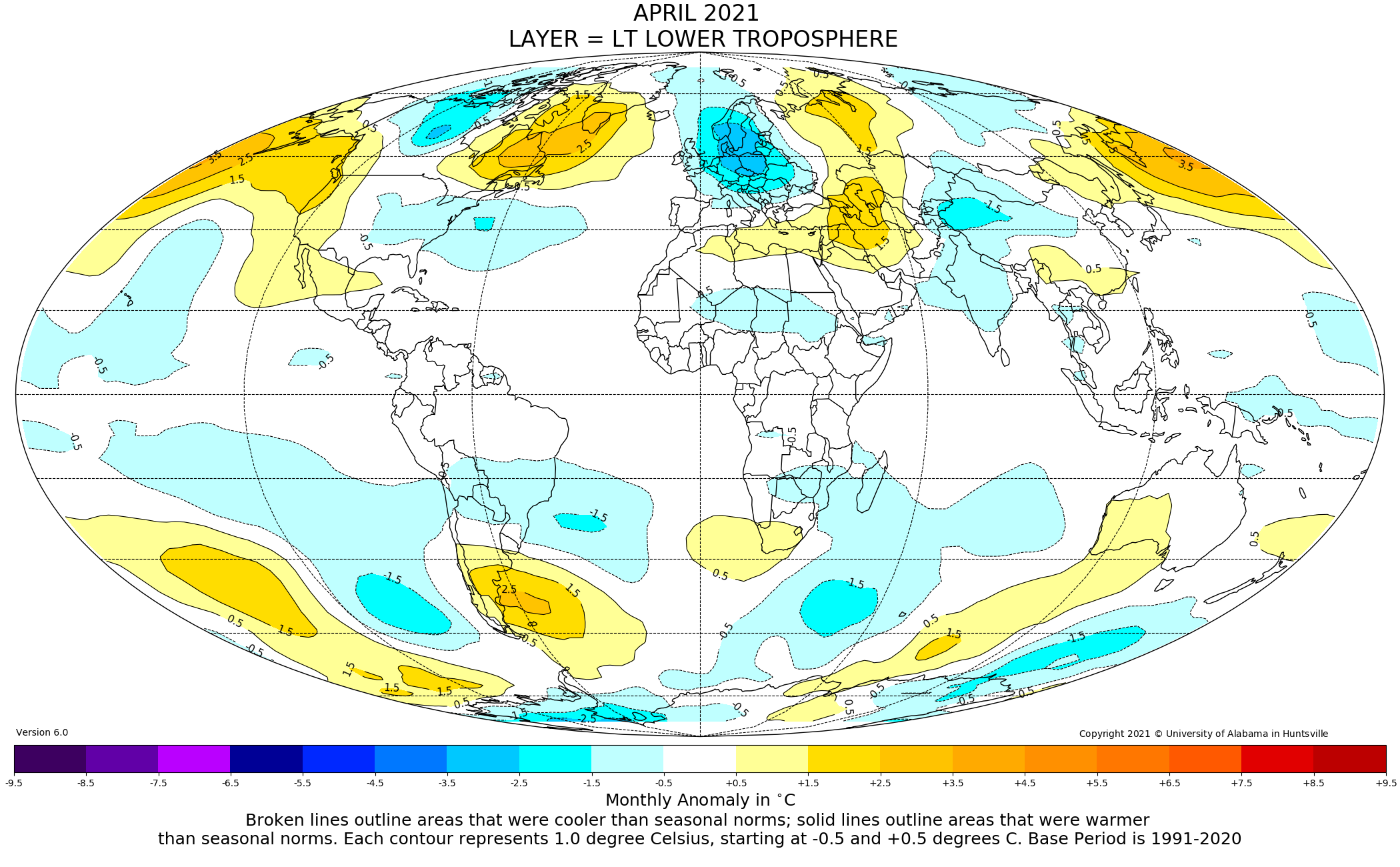
Water vapor raises the height of the tropopause, which slows the escape of infrared radiation into the stratosphere; CO2 cannot do this. The molecular weight of the water vapor molecule H2O is 2+16=18, the CO2 molecule is 12+32=44.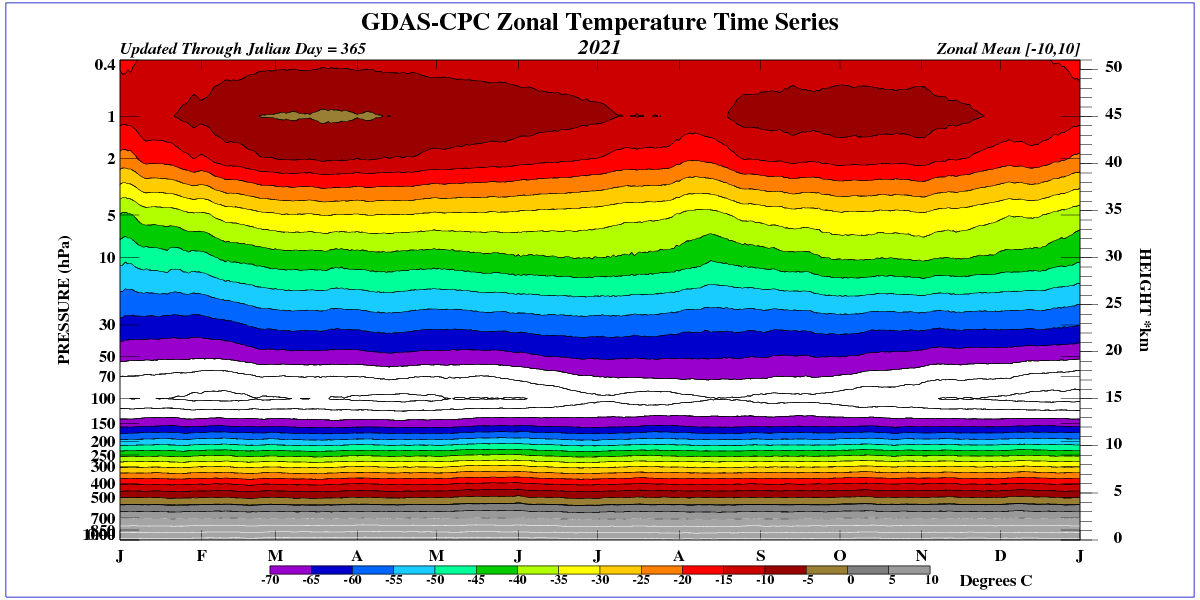
In the graphic above, you can see a slight decrease in the tropopause, which is the result of a decrease in TSI.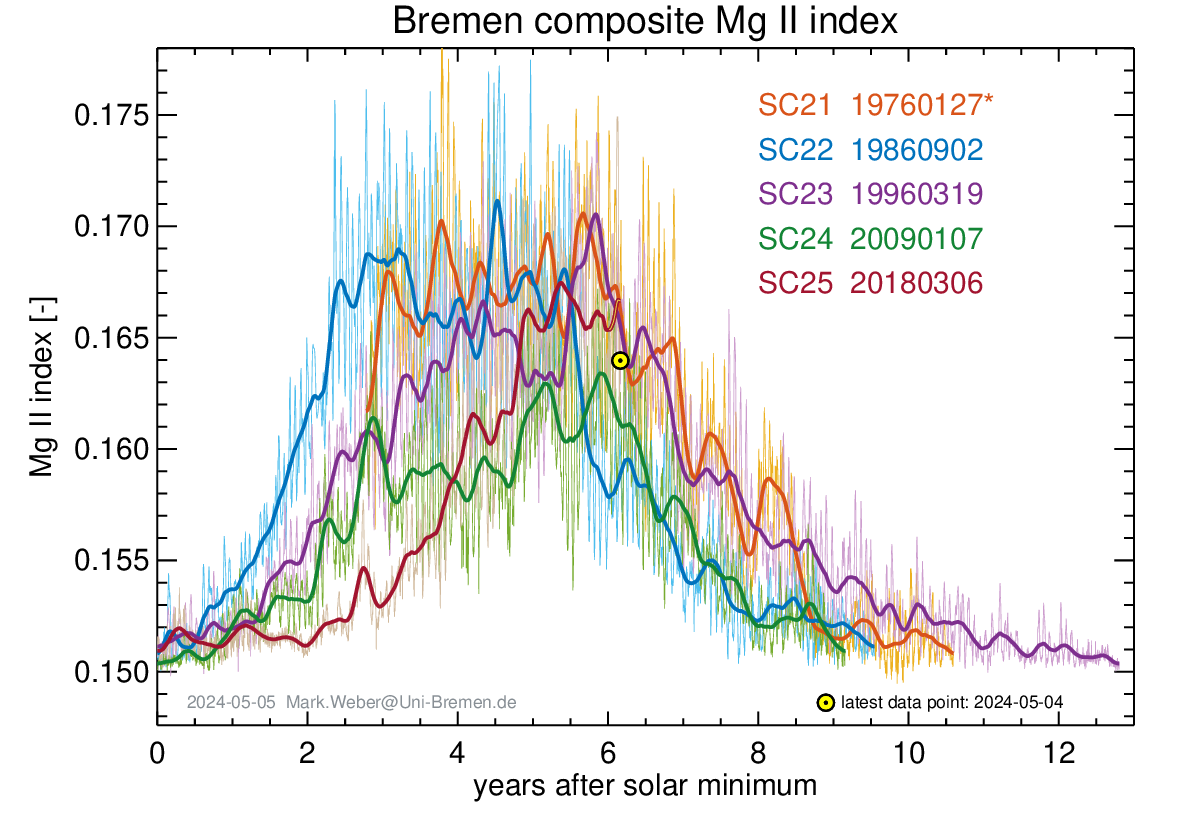
During the winter, the stratosphere sinks low in high latitudes. You can see the tremendous importance of changes in solar radiation.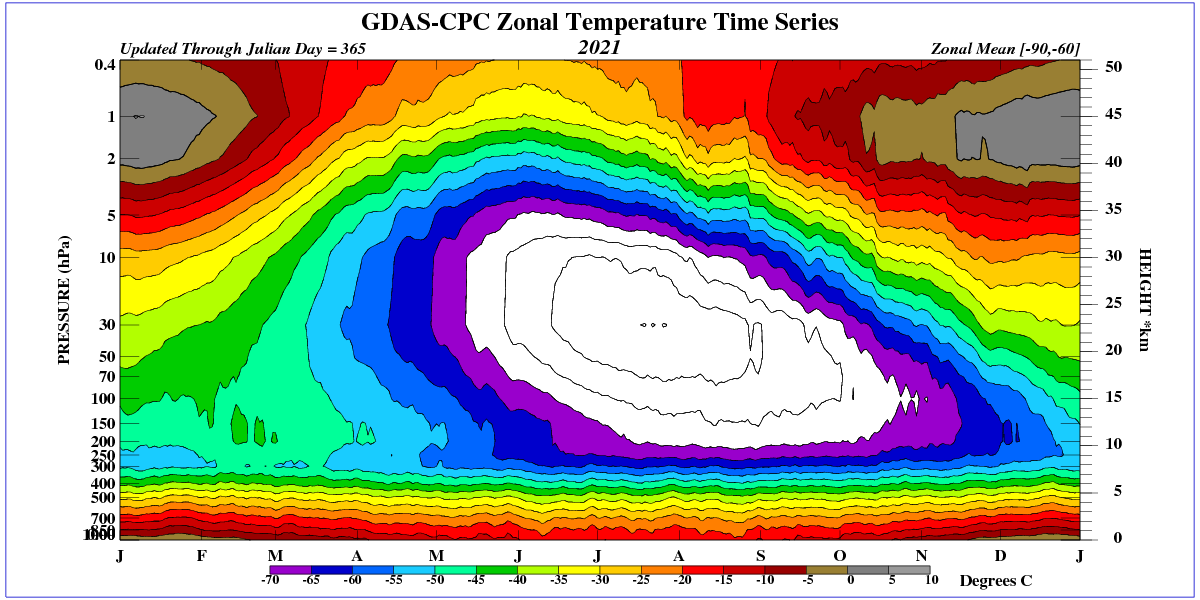
What does the molecular weight of water and CO2 have to do with the height of the tropopause?
The popular atmospheric heat balances assume the surface radiates as a BB which creates “extra” energy out of a “what if” S-B calculation that violates both the LoT and basic bookkeeping rules.
You are saying that measured and scientifically determined radiative transfer values are not valid. Prove it.
Yep.
Here in Toronto its an established fact that our nighttime low average are regularly higher, which of course drives up the daily average.
Yet people will continue to “remember” how hot the days are…
Regularly higher than what?
“Without greenhouse gases nitrogen, oxygen and argon can’t lose enough heat back to space and the atmosphere would keep warming.”
This would be equal to saying without hydrology, as water does almost all of the work, if you had all gases but no water as vapor then its a half frozen half baked rock with a very cold atmosphere because that surface IR goes straight to space (no water, no clouds, and CO2 0.04%)
Heat needs something to retain it, an atmosphere with nothing to absorb IR and emit heat, will be very cold even if the surface in direct sunlight is extremely baked.
Venus is only that hot because the atmosphere has a density that can retain that amount of energy (pressure is an effect of this, some think the pressure is the driver, it’s not of course, you cant store energy in nothing (kinetic energy without particles to bang together)
Anything that absorbs and emits IR without itself heating up, may well add a relatively miniscule amount of warming back down on the surface, but with nothing in between to actually heat up between CO2 and rock, means it’s gonna be bloody cold, until you actually heat up by catching IR on your own body (if you magically floated there in the troposphere of this magical planet.
catch enough of that IR and go up like a pagan effigy 😀
Without clouds and water vapor, direct solar energy would heat any oxygen to 100s of degrees, but if theres no water, theres no O2
I am not a fan if using earth without an atmosphere to make a point, because the example is never what earth would actually be like without an atmosphere
“During the day, earth’s surface absorbs both solar radiation and the downward infrared heat emitted from greenhouse gases.”
We engineers study heat and radiation, particularly how to warm things up, as there is money involved. This concept that the atmosphere can heat the surface is absurd. The SUN heats the surface!!! The atmosphere is generally cooler than the surface, and cool things just cannot heat warmer things.
I had to go look up what happens when radiation from a cooler body impinges upon a warmer body, as it was never mentioned in my engineering education as it is trivial. What happens is, the radiation from a cooler body is simply reflected.
Something that absorbs energy becomes warmer, every time. The atmosphere radiates all the time, the entire atmosphere, not just “greenhouse gases.” So your statement has two giant errors. All matter above Absolute Zero radiates all the time.
You and your friend Willis are ignorant of the laws of thermodynamics and heat transport. Back to school for both of you….
Moon says, “when radiation from a cooler body impinges upon a warmer body, …the radiation from a cooler body is simply reflected.”
LOL. You give skeptics a bad name, or perhaps that’s your intent. Please link to the science that says a body absorbs wavelengths from warmer object, but reflects the same wavelength from a cooler body??? So bizarre
Michael if you had to look it up and that;s what you came away with you are not only “ignorant of the laws of thermodynamics and heat transport.” but ignorant about what basic science is reliable on the internet. “Back to school for you
Michael Moon
May 7, 2021 10:28 am
“I had to go look up what happens when radiation from a cooler body impinges upon a warmer body, as it was never mentioned in my engineering education as it is trivial. What happens is, the radiation from a cooler body is simply reflected.”
You’re the one who needs to go back to school, preferably not the one that taught you that rubbish. A photon emitted by a gas molecule has has no knowledge of the temperature of the molecule it is emitted from. A 15µm photon is just the same if it is emitted from a molecule at 20ºC or -20ºC, if it subsequently strikes a black body at 15ºC it will be absorbed no matter the temperature of its source.
Jim and Phil,
Let me give you a simple example, easy to research: binary stars in elliptical orbits. When the warmer star approaches close to the cooler star, the cooler star warms up, but the warmer star does not. Go look it up. And then tell me how a cool thing can make a warm thing warmer, despite the Second Law of Thermodynamics. Magical thinking….
Michael, You are the one who keeps pushing magical thinking and irrelevant examples.
What applies to the physics of all heat transfer is simple. Given equal heat capacity and quantities, the temperature of all things is a matter of balance between incoming vs outgoing energy. When incoming energy outweighs outgoing things warm. And vice versa.
The problem with climate alarmists’ claims of a warming earth, is that they are really measuring changes in the rate of warming and rates of cooling. Higher urban heat islands form because heat retaining materials cool at a slower rate, thus the minimum temperature will be higher. It most probable that there was no added energy from CO2 or the sun, just a slower cooling rate that causes the warmer temperature.Longer nights allow more cooling before the sun adds heat, so minimum temperatures fall through the winter.
Regards conduction, heat via collisions ALWAYS transfers heat back and forth between BOTH warm and cold bodies. The same principle applies to diffusion of molecules and heat. Molecules move back and forth between high and low concentrations, but there will always be a net change from high to low concentrations. Because warmer bodies have more energy, the preponderance of heat transfer will be from warm to cold objects. So on AVERAGE heat always travels from warm to cold bodies.
Regards radiative heating, instead of collisions transferring energy we have energy waves. First think in terms of blackbodies that absorb and emit all wavelengths of heat energy, The physics is certain that a warmer body will emit more radiative energy than a cooler body. But the magical thinking you and others insist upon that “warm bodies cant absorb more radiation from a cooler body” is nonsense. That has never been what the laws of thermodynamics have ever stated. Your nonsense arguments only give good scientific skeptics a bad name as anti-science or ignorant.
A colder body always emits radiation in all directions without concern for the relative temperature of its surroundings. A warmer black-body will always absorb whatever radiation comes its way, and thus gain energy. Conversely a warm object will still cool, even though its absorbing more radiation as long as the balance between absorption and emission favors a preponderance of cooling emissions. By absorbing energy from its surroundings, the object just cools at a sower rate.
Similarly, a warm body in thermal equilibrium, needs only absorb slightly more energy to warm. That energy can come from any radiating body whether or not that body is cooler or warmer. That is irrefutable thermodynamics!
Here is a diagram of “Net Diffusion” . It shows molecules moving on BOTH directions. But more going from high to low concentrations. Same for heat waves
For metals, it is well known that as the temp of the metal increases, it’s reflectivity decreases and absorption increases.
This is exactly the opposite of what one might expect if what Michael Moon asserted was true.
In fact, no where in texts on reflectivity does one find mention of the temperature of the source for the EM radiation.
Wavelength matters, but objects at any particular temperature emit and absorb across a wide range of wavelenghts.
Reflectivity is wavelength dependant, but it is most definitely not temperature of the emitting object dependant.
Funny how a simple example can disprove such a notion too: Astronomers analyze light/photons
of all wavelengths using telescopes and sensors and spectroscopes, and many of these sources are colder than the device gathering the photons.
If what Michael said was true, this would be impossible.
And we would not even be able to see anything colder than our eyeballs.
Nicholas, if you think anything Michael said would prevent you from seeing anything colder than your eyeballs, you need to read more carefully. The reason you can see objects colder than your eyeballs is that the photons you are seeing were emitted by objects much hotter than your eyeballs (like the sun, or a lamp) and were then reflected off colder objects. However, if all of the objects in your environment were colder than your eyeballs, you would indeed not be able to see anything at all. You can try this by going into a closed room at night and turning off the lights. Does that help?
Since you have looked it up Michael, perhaps it would not be too much trouble to give a reference for your assertion?
I think you just made that up!
I have actually studied this issue quite closely yeas ago when I was checking my thought experiment involving two stars, against actual astronomical data and understanding.
There are many references in the literature to what happens when two stars are close binaries.
The effects they have on each other have a name…Proximity Effects.
Discussions of the bolometric or geometric albedo of these stars make it clear that what is being discussed is incident radiation heating the outer layer of each star, and the incident energy being re-radiated.
It is also clear that stars do reflect some light incident upon them, and hot stars tend to reflect more.
But the reflectivity is a consequence of the particulars of the star, not of the temperature of the star than emitted the radiation incident upon it.
Here is a discussion of how, in stars with a convective envelope, each star heats the other on the side facing it’s companion.
“The bolometric albedo of a Main Sequence star of about one solar mass and a typical Algol secondary (with mass 1.45, luminosity 8.4, and radius 3.8, in solar units) is estimated to be 0.4 to 0.5 instead of unity for the strict radiative equilibrium”
(link is below, 1969AcA…)
Note that they are speaking specifically about two different temperatures of stars, and do so in the context of radiative equilibrium.
There is simply no support for the notion that warmer objects modify their reflectivity depending on the temperature of the body that is emitting the radiation incident upon them.
Consider two objects that are shining on each other, and one of them is slightly warmer than the other. In the reflectance scenario, the warmer one would have to act as a perfect mirror to the radiation from the other one, but the slightly cooler one would not act as a mirror, since it is slightly cooler.
This makes no sense to start with, since they have widely overlapping emission spectra.
But lets just play out this scenario, and consider what happens as the cooler one warms up to be slightly warmer than the other one.
Now the one that was a mirror suddenly would have to become an absorber, and the one that was an absorber, would have to suddenly become a mirror.
This is plainly ridiculous, and contradicts everything know about reflectivity, experience, and common sense.
Cooler objects shine photons on warmer objects everyday, all the time, everywhere, and they do not just bounce off.
In the case of stars, it is known how to discern reflected light: It is polarized by being reflected.
The amount of light reflected by the stars in a binary system is a few percent, if they are very hot.
Lower if they are not.
Some links:
“The Proximity Effects in Close Binary Systems. II. The Bolometric Reflection Effect for Stars with Deep Convective Envelopes”
1969AcA….19..245R (harvard.edu)
“In a close-orbiting binary pair, a small but significant fraction of the light from each star falls upon the other, and the result has to be carefully modeled to simulate the observed spectrum of the system as it rotates.
One effect is that each star’s radiation will non-uniformly heat the surface of the other star and alter its thermal radiation, but here I’m asking about light from one star being scattered or diffusely reflected by the other.
How is this scattered/reflected light calculated, and roughly what is the spectral reflectance?
Of course each star will be different, so one example or maybe two would be sufficient.”
My bold italics. And one reply, in part:
“You are right that the albedo depends on the type of star (hotter stars having high scattering albedo due to all those free electrons), and many stars do show a lot of scattering from their surfaces. Scattering/reflection elevates the effective temperature above the actual temperature of the layers being looked at, but again, if you stick to effective temperature, it makes no difference if there is scattering or heating of a blackbody, because effective temperature explicitly refers to the outgoing flux with no claims on the actual temperature. It is quite common for this distinction to be swept under the rug, and most stellar temperatures are effective temperatures, not actual temperatures”
star – What is the spectral reflectance of starlight in a close binary? – Astronomy Stack Exchange
“Besides having circular orbits, the stars in the most tightly-bound systems…heat each–other.”
The Astrophysics Spectator: Binary Star Systems
A relevant discussion and many ideas for further reading (and again, my bold)
” On the other hand, a fact of capital importance was pointed out by Hosokawa (1959) who established empirically that the bolometric albedo for late-type stars was different from 1.0, that is, when these stars are irradiated they do not re-emit simultaneously all the incident flux.”
2001MNRAS.327..989C (harvard.edu)
“”Our modelling showed that stars are actually quite poor reflectors of light. The Sun, for example, reflects less that 0.1 percent of the light falling on it.
“However, for hotter stars, such as the components of Spica, with temperatures of 20,000 to 25,000 degrees Kelvin, the amount of reflection increases to a few per cent. The total amount of reflected light coming from the Spica system is, however, still very small.””
Scientists prove that binary stars reflect light from one another (phys.org)
This next paper may be the best one, and in the very first sentence, we have confirmation of my thought experiment, that two different temperatures of stars heat each other up.
“The Reflection Effect in Eclipsing Binary Systems.” “The mutual heating of the components in the binary systems gives rise to one of the most intricate parts of the theory of EBS…”
Mutual heating.
Right there.
Later on, and I have to take a screen shot of this and post it as a photo due to the format of the linked text, are many discussions on this exact topic and detail. Like one from Eddington, in which it is stated that all of the incident radiation must be either re-emitted or scattered, but that the spectrum of this re-emitted radiation would be altered.
One thing never mentioned, or even hinted at, inferred, implied, or in any other way broached, is any concept relating to the hotter star by necessity not being able to absorb radiation from the cooler one.
In fact, no two stars are the exact same temperature, strictly speaking.
Mostly they are not even close.
And yet all of these discussion refer to mutual heating, absorption and reemission, and scattering and reflectivity.
The reflectivity is a small percentage, as shown by modern studies of the polarization of the reflected radiation.
And it is a consequence of the hot electrons in the star doing the reflecting, and nothing to do with the relative temperatures of the stars in the binary system.
Stars radiate across a wide spectrum, as do many objects, even relatively cool ones.
Photons do not come tagged with the temperature of the emitting substance.
1985Ap&SS.113..349V (harvard.edu)
And then we have this:
“The process by which the radiation from one component of a binary system affects the photosphere of its companion is often called the “reflection effect. ” However, for early-type systems with radiative envelopes, this is a misnomer, since most of the incident radiation is absorbed. The resulting temperature rise due to this irradiation is the primary physical diagnostic of this effect, and it is what this brief note attempts to predict analytically. Consider a binary system, with spherical stars (radii R1 and R2, luminosities L1 and L2), their centers separated by a distance D. Let us deal first with the radiation from star 2 incident upon a specified point on star 1, and further only examine the “line-of-centers ” point on star 1 which is closest to star 2. The effect of mutual irradiation will be strongest there. Note, of course, that the stars themselves actually iterate this effect between one another, since, e.g., when star 2 heats up star 1, that in turn affects the illumination back onto star 2, and so on.”
Note the stars are always different temps.
They heat each other.
Note also that “reflection effect” is a misnomer, and all astronomers understand this.
It does not matter if energy is scattered, reflected, or absorbed and re-emitted, except when it does, such as when the incident energy is entrained into convective cells in the receiving star.
CiteSeerX — A Simple Approach to Mutual Irradiation Heating in Close Binary Systems (psu.edu)
Paywalls prevent me from being able to explore many other papers on this topic.
Garbage, in any case the relevant law is the Law of Radiational heat transfer
I think there are about four that are relevant.
But yes, second law of thermodynamics is not where to look.
The four:
Planck’s law
Kirchhoff’s law of thermal radiation
Wien’s displacement law
Stefan–Boltzmann law
Some others that may apply are:
Sakuma–Hattori equation
Rayleigh–Jeans law
It is not hard to find reference material, that is for sure.
Here is a summary as it applies to weather in one handy page:
The Four Laws of Radiation | Learning Weather at Penn State Meteorology (psu.edu)
Oops, Penn State!
Forget that last one!
Of course, if one considers The Art of War, it becomes a relevant document, perhaps?
The absorbing/emitting components in the atmosphere act as a shield hindering the surface (land and oceans) from radiating with the full black body spectrum to the space. The hindered part of the spectra is radiated from the surface to the shield although being cold at higher altitude, a lot warmer than the space at -270 °C. Compensating for the temperature difference, shield vs space, the surface temperature has to be higher when shielded than when not shielded, all due to net power radiated from hot to cold as in :
Q = k(Th^4 – Tc^4)
See page 31 – 34 for radiating effects with shields.
heat_4e_chap13-radiation_ht_lecture-pdf.pdf
From page 35 for absorbing and emitting gases (CO2 and H2O) in furnaces and combustion chambers as by Hottel et al based on experimental data.
Kind regards
Anders Rasmusson
Anybody reading (and understanding) the paper cannot deny that increases in atmospheric GHGs cause surface warming. How much warming is determined by all of the other dynamic atmospheric processes, especially the effects of H2O phase changes.
”How much warming is determined by all of the other dynamic atmospheric processes, especially the effects of H2O phase changes.”
So it could very well be zero. Perhaps all that actually happens is that the RATE of processes of heat dissipation you mention just increase with a net zero warming. The separation of the so called down-welling effect from all other factors can only theoretically calculated but never actually measured. The back radiation may be measured but it’s effect cannot. There is ALWAYS something overlooked or misunderstood or unknown. And that’s why climate models don’t work. And that’s why talk of a 1C rise or a 0.3 degree rise due to increased co2 is basically bullshit.
You seem great at “looking stuff up”.
Better than me for example, because I cannot find any source for any such assertion.
If you could be so kind as to point us to your reference material, we would sure appreciate it.
I say we but I mean me, and figure others would like to see it as well.
Because then, if any of us want to use this factoid ourselves in the future, we can avoid the uncomfortable situation of appearing to have simply made it up in our own head, and claimed it was true.
After all, we all want other people to learn from and use what we have gone to the trouble to research and reason out and then taken the time to share in blog comments, right?
Plus, we all hate it when we are having a discussion with someone who just makes stuff up, don’t we?
I am sure we all hate it enough to do whatever we must, in order to keep anyone from accusing US of just making stuff up.
So unless you just made this up, like that other crap about binary stars in the “what happens to the temperature of each star in a binary system when they approach one another ” reference guide, I am sure you will be anxious to prove it.
Jim, great post!
With regards to the photo of the anvil shaped cloud, I just can’t take my eyes off of it! I could only guess that it may top out at 10-15,000 ft. (WAG), well above the condensation level. Of interest is the heavy/extreme haze that appears to being pulled into it under the anvil. Question in my mind is: Is upwelling LWIR (as well as downwelling SWR having an effect keeping the H2O in a sort of suspended state between vapor and condensate?
I would work for no wages to be a part of releasing a neutral buoyancy balloon into that haze to see if it is being cast from that cloud or being drawn in. Of course that will never happen as I would be on someone’s ass to make it happen and would expect to be paid if they were just sitting on their ass.
Weather on Earth is driven primarily by the Hadley cell convection loop. Air near the surface is warmed by contact with the surface. It rises to the tropopause where it spreads out laterally (at least as far as the rotating spherical Earth will allow) and cools by radiating energy to space. When it has lost enough energy it descends again around latitudes +-30 degrees completing the convective loop. The atmosphere of the troposphere is a classic is heat engine converting thermal energy from the sun into mechanical energy – wind rain etc – and it obeys the laws discovered by Carnot in the 19th century. One of which is that 100% efficiency is impossible. There must be a cold junction where energy is lost to space.
However any gas that can radiate significant energy at these temperatures is by definition a green house gas. Thus without green house gases the tropopause could not cool and that means the heat engine could not function. There would be no convection, no lapse rate, the entire atmospheric column would be isothermal and because of the extremely slow thermal transfer by conduction in a situation of temperature inversion it would equilibrate to very close to the maximum surface temperature. Condensation of water releases energy and in the GHG free scenario there is no way to lose that energy, thus the atmosphere could not cool enough to allow condensation and that means clouds could not form. Instead the entire atmosphere would become saturated with water vapour and evaporation would also cease. In short there would be no rain no wind no clouds no weather on Earth at all. GHG’s may reduce the radiative loss to space from the surface but they also create the surface energy loss mechanisms of convection and evaporation of water which according to NASA’s much publicised diagram of Earth’s energy balance contribute more than 100 watts/sqM or more than 60% of the total surface energy loss.
So what would surface temperatures be without GHG’s. We all know how fast the surface can warm from walking on a beach in summer or on a pavement (time constant well under 1 hour). I clearly remember once walking down a Las Vegas street in summer with the soles of my shoes melting from contact with the pavement. Peak insolation near the equator in summer without clouds would be close to 1300 watts/sqM. From the Stefan Boltzman law that translates to a surface temperature of 116C! At night, unrestricted surface emission would take the temperature to far below freezing. (Basically a similar situation to what exists on the moon). GHG’s act to dramatically reduce maximum temperatures and increase minimum temperatures creating a climate where life can survive. Yet the claim is a tiny increase the GHG’s will reverse that trend? That implies a point of inflection in the temperature versus GHG concentration relationship. Where is it and why would it occur? What possible justification is there for such an unsupported claim?
The thing is, we do not even have to go through all of that.
We can look back at what we know occurred in the past.
What was the CO2 level as temp varied?
What was the temp as CO2 varied?
What is clear from studying Earth history and human records is that CO2 is not the thermostat control knob of the atmosphere.
Other factors dominate, not matter what can be said or not said about the radiative properties of CO2 or anything else.
Another thing is clear from Earth history…we are too cold now.
It has never been too hot, even when CO2 was many times higher.
And CO2 is the basic building block of the entire biosphere, and it is in dangerously short supply, even with the recent increase.
No one has ever explained how anyone will die or the Earth will become dangerous from some warming.
In fact the opposite is true.
They never explain it, they simply assert it, and somehow people believe it, even though every experience we have shows the opposite is true.
Why no mention of the “saturation” level of CO2 and the fact that CO2 mostly affects the same IR wavelengths as H2O?
CO2 blocks X amount of IR from the sun during the day and at night CO2 blocks Y amount of IR from the surface…what are the X and Y quantities …watts/sq m?
Amazing. The idea of downwelling IR is brought up again. AND AGAIN, and again. ad nauseum.
downwelling IR **FROM CO2** is a joke. Downwelling IR from H2O is real. It has been measured. Downwelling IR from CO2 has not been measured without models being used to make it magically appear. Yet NO ONE differentiates between the two.
IR in the lower troposphere is emitted by the Earth. IT is not emitted by the CO2 in the atmosphere because the CO2 cannot emit while in the quenching atmosphere that is caused by a billion collisions with the CO2 molecule before the molecule can emit.
Einstein calculated the emission times for IR active molecules and there is no doubt about this fact.Since the Early 1800s we have known the time to collision of the atmospheric particles.
There is a factor of approximately a billion to one Time to emission vs. time to collision.
Second reason: If a CO2 molecule were to emit IR in the mesosphere, that photon would represent no net addition to the Earth’s heat budget.
Why? because to excite a CO2 molecule that high the molecule would have to be excited by collisions. Any emission that high would represent a net reduction of kinetic energy from the atmosphere. a cooling effect if it were to be emitted outward….. AND NO EFFECT if it would be emitted downward. WHY? because the emission would represent the same kinetic energy that was removed from the atmosphere by collision. NO CHANGE!!!!!!!!!!!!!!
.
Energy captured by a CO2 molecule in the troposhere is NOT the same as energy captured by a CO2 molecule in the Mesosphere. They come from different energy sources. One from and the other from collisions. This makes a HUGE difference in the way the energy is passed on.
Butch, I dont understand your argument or see you offer the evidence to support it. So perhaps you could explain why satellites observe a reduced intensity of wavelengths, that are shown to absorb CO2 in controlled laboratory experiments, that are missing from what is expected from the Planck curve as illustrated here
When CO2 intercepts photons of a given wavenumber, that energy does not show up at the sensor that is expecting it and so there is a trough in the chart.
If the CO2 were to consistently re-emit the photons it had arrested, that energy would, indeed, arrive at the sensor and there would be no trough.
Granum, I think your argument is grossly simplistic. Laboratory experiments show that within milliseconds of absorbing infrared wavelengths, they are emitted even though those CO2 wavelengths no longer are detected by satellite sensors. So here is a more robust explanation for the CO2 trough.
Collisions with CO2 handoff absorbed energy to O2 and N2, or radiate it in all directions with about half of which aimed at the earth’s surface. If CO2 back radiation reaches the earth’s surface, the added warmth then induces infrared radiation that is emitted across the surface’s whole black body spectrum. Of which about 23% now escapes back to space unimpeded as wavelengths that escape through the atmospheric windows.
Likewise if the CO2 collision was with O2 and N2, and then transferred to H2O, then that energy is emitted by H2O and its specific frequency. So again the energy that was undetected because CO2 absorbed and emits those frequencies, energy can still escape to space via other wavelengths.
Thus the trough only shows that CO2 has directed certain wavelengths of energy via absorption and emission which then detoured through other pathways
Jim, I don’t find that explanation satisfying.
You seem to imply that radiated energy absorbed by CO2 is diffused more or less equally per collisions with the bulk of the atmosphere and per emission of photons.
This is at odds with the notion that collisions vastly overwhelm emission other than in dense, hot gases, or conversely rarified gases.
After all, it’s not the temperature of CO2 that we measure; it’s the temperature of the air, which is mostly not CO2 (nor water). Did that N2 get all its warmth from contact with the surface?
Next, I would take issue with your “added warmth” from back-radiation.
Everyone is at great pains to emphasize that no actual increase in temperature occurs when the surface absorbs photons from a cooler atmosphere, but your putative blue shift in emission is predicated on precisely that.
If the surface temperature is not increased, the Planck curve will not be displaced to the left and the same amount of 667 wavenumber energy will go out as before. That should show up at the CCD of the sensor.
Huh????
Inspired response!
Lost for words?
But you do see yourself as a teacher, right?
He heard you. He simply could not believe his ears. &ehk=ZyFjUnKNKUzM9SoD9jXq2dTyyq2iErvCaRc21xm3OIA%3d&risl=&pid=ImgRaw
The IR emitted from the surface is traveling up, if it is absorbed by the atmosphere and the energy is transferred to the atmosphere by collisions a sensor above the atmosphere will register a trough in the spectrum. If instead the light is emitted it will be emitted in all directions so only about one half of it will be emitted to space so a trough will still be registered.
”. Downwelling IR from H2O is real. It has been measured. Downwelling IR from CO2 has not been measured without models being used to make it magically appear. Yet NO ONE differentiates between the two.”
As I said above, even if it is measured, it’s effect can’t. Only a lot of mind masturbation exercises.
Yes a good post here – Thanks.
Water is major coolant in the climate scene. One has only to look at the the Hydro Cycle to see this as it drives the Latent Heat of evaporation UP through the atmosphere and beyond to space for dissipation, before returning to earth as ice, rain, snow etc. depleted of its energy.
For every kilogram of water evaporated some 694 Watthrs of energy is dissipated this way. Never mind pesky CO2 and all that obsession.
Even those wispy cirrus clouds up there nudging the tropopause are dissipating energy to space (what is left of it) as the ice crystals at -50C grow dendritically before being dragged back to earth by gravity.
“Frost fans disrupt freezing layers of surface air that can develop at night during the spring, damaging flowers and fruits. Frost fans simply pull warmer layers of air from above down to the surface raising minimum temperatures. But why does that warmer layer of air exist?”
And in connection to the factors you discuss, cold air sinks and stratifies.
Those fans disrupt and mix the pooled cold air with the warmer air.
Mixing in that warmer air pulled from higher levels works very well.
I live on a hill. First and last frosts miss the majority of my property as the cold air seeks lower areas. Where I must worry about frosts are lower areas of my fields which capture the coldest air sinking to the ground.
Even then, the people living further down the hill experience more extensive frost damage. Which means when discussing frost damage with downhill neighbors, I listen and console.
Smudge pots work in reverse to the fans.
Smudge pots disrupt the pools of cold air by causing air circulation with higher levels of warmer air. Individually, smudge pots minimally warm air. It is the air circulation the fires cause that helps prevent crop losses.
I was looking at the heat balance chart in the comments. I will leave off the Watts per square meter to make it easier for me. The chart shows 104.4 absorbed by the atmosphere, yet gives 49.6 up to space and 97.7 down to earth. What did the difference of 42.9 come from? Further, there is 8.8 emitted by the clouds, but no where does it show where that came from. What am I missing?
Energy balance illustrations are often confusing and one here seemed more so. I prefer energy budgets like Stephen’s although it too requires careful perusal
On the rare chance you have not seen this before.
398 W/m^2 upwelling from the surface is a theoretical, “What if?”, S-B BB calculation for any surface at 16 C. (395.5 – close enough)
It creates “extra” energy out of thin air violating both standard bookkeeping standards and LoT 1.
A = 165 – 24 – 88 = 53 = B 398 – 345
You can have A OR you can have B.
YOU CANNOT HAVE BOTH!!!!!!!!!!!!!!!!!!
This results in a 345 W/m^2 of “extra” energy in a 100 % efficient, perpetual loop, from cold to hot w/o the addition of work violating BOTH LoT 1 & 2.
This power flux non-balance graphic and all its kith, kin and clones are 100% rubbish.
But why does it even exist?
To provide an explanation for the GHG molecules to absorb and reradiate photon level energy ala Al’s photo-electric effect.
LWIR does not possess the high energy, short wave, work function energy level requisite to make that happen.
Once upon a not so long ago time published, peer reviewed, main stream, scientific consensus included:
phlogiston,
caloric,
luminiferous ether,
spontaneous generation,
water filled Martian canals,
planet Vulcan,
medical humors,
four elements of matter,
cold fusion……..
And they all turned up wrong.
RGHE theory is going to join them.
What are you talking about???? Where did you get your equations
After looking at the graph you posted earlier, I assume all the yellow boxes are your additions, and I give you props for translating % to W/m2.
But your comparison of the 2 equations simply shows you dont understand the graph .
Incoming solar seems balanced by outgoing LR +/- less than 1 W/m2. Other energy budgets are similar but with enough differences that all are within the uncertainty estimates.
What publication was your heat balance illustration taken from
Perhaps you missed my response to Michael who seems to be of the same school of thought as you, and who perpetuates the same misunderstanding of thermodynqmics
Michael, You are the one who keeps pushing magical thinking and irrelevant examples.
What applies to the physics of all heat transfer is simple. Given equal heat capacity and quantities, the temperature of all things is a matter of balance between incoming vs outgoing energy. When incoming energy outweighs outgoing things warm. And vice versa.
The problem with climate alarmists’ claims of a warming earth, is that they are really measuring changes in the rate of warming and rates of cooling. Higher urban heat islands form because heat retaining materials cool at a slower rate, thus the minimum temperature will be higher. It most probable that there was no added energy from CO2 or the sun, just a slower cooling rate that causes the warmer temperature.Longer nights allow more cooling before the sun adds heat, so minimum temperatures fall through the winter.
Regards conduction, heat via collisions ALWAYS transfers heat back and forth between BOTH warm and cold bodies. The same principle applies to diffusion of molecules and heat. Molecules move back and forth between high and low concentrations, but there will always be a net change from high to low concentrations. Because warmer bodies have more energy, the preponderance of heat transfer will be from warm to cold objects. So on AVERAGE heat always travels from warm to cold bodies.
Regards radiative heating, instead of collisions transferring energy we have energy waves. First think in terms of blackbodies that absorb and emit all wavelengths of heat energy, The physics is certain that a warmer body will emit more radiative energy than a cooler body. But the magical thinking you and others insist upon that “warm bodies cant absorb more radiation from a cooler body” is nonsense. That has never been what the laws of thermodynamics have ever stated. Your nonsense arguments only give good scientific skeptics a bad name as anti-science or ignorant.
A colder body always emits radiation in all directions without concern for the relative temperature of its surroundings. A warmer black-body will always absorb whatever radiation comes its way, and thus gain energy. Conversely a warm object will still cool, even though its absorbing more radiation as long as the balance between absorption and emission favors a preponderance of cooling emissions. By absorbing energy from its surroundings, the object just cools at a sower rate.
Similarly, a warm body in thermal equilibrium, needs only absorb slightly more energy to warm. That energy can come from any radiating body whether or not that body is cooler or warmer. That is irrefutable thermodynamics!
Here is a diagram of “Net Diffusion” . It shows molecules moving in BOTH directions. But more going from high to low concentrations. Like waves heat waves can flow back and forth between warmer and cooler objects
“A = 165 – 24 – 88 = 53 = B 398 – 345
These are straight off the graphic you posted.
165 net makes it to the surface.
That is the ABSOLUTE max that can leave per LoT 1.
The 53 LWIR can not be used TWICE!
Once with the surface balance and again with the GHG loop.
The 345 is “excess” violating LoT 1.
1 the earth is cooler with atmosphere not warmer.
2 the GHG loop demands “extra” energy
3 it can’t come from the earth radiating as a BB.
So, address these specific points and don’t wander off into the esoteric weeds with a bunch of irrelevant handwavium.
LOL Nick,
You completely dodge and dismiss the specific points I presented by flipping it into a snarky self‑righteous attack demanding “address these specific points and don’t wander off into the esoteric weeds with a bunch of irrelevant handwavium.”
I’ll address your 3 points in good faith, hoping the your objections are sincere and that you will scientifically address my points in the post above, without your snarky dismissal.
To first clarify, because you failed to indicate what graph you alluded to, I mistakenly thought your last post was referring to the graph you presented earlier. You often make such ambiguous comments and snarkily suggested I missed something. So the numbers seemed odd compared to Stephen’s eneregy budget illustration that I presented. Still overall TOA incoming vs outgoing numbers are similar for both illustrations.
Nonetheless, it becomes very clear that you really don’t understand the illustrations or the thermodynamics of heat transfer, despite your incessant “irrelevant handwavium” that anything you fail to understand must be “violating LoT”
The illustration I presented is from Stephens (2012) “An update on Earth’s energy balance in light of the latest global observations”. I suggest you read the paper carefully. I somewhat trust the overall data they present because they share their uncertainties and discuss the reasons for that uncertainty. However their overall conclusion that heat is being trapped is suspect precisely due to those great uncertainties. The uncertainty of the surface heat imbalance is about 30‑fold relative to their concluded 0.6 W/m2 imbalance.
Your point “The 53 LWIR can not be used TWICE!” and “That [53] is the ABSOLUTE max that can leave per LoT .” seems odd because neither illustration suggests the “ABSOLUTE max” was ever violated. Of the 165 w/m2 absorbed by the surface – sensible and latent heat can account for 24 + 88 w/m2, but with huge uncertainties. Latent heat is particularly uncertain because it cant be measured directly. Latent heat is estimated via estimates of precipitation, which also suffers from several biases. That leaves 53 W/m2 to leave the surface via net longwave radiation. Of the 398 W/m2 measured that’s leaving the surface, 345 had been recycled while 53 W/m2 escaped to space. Thus after subtracting reflected solar energy, the incoming energy was ~240.2 and outgoing ~239.7. No Laws of Thermodynamics were violated and 53 LWIR was not used twice. Your misinterpretation just applied bad math.
Your point 1: 1 the earth is cooler with atmosphere not warmer:
Apparently, you missed the whole point of my article. The atmosphere vis a vis GHG BOTH warms and cools the earth. The analysis of incoming and outgoing energy has such great uncertainties that it is possible cooling effects outweigh warming effects. I cant quantitatively prove it one way or the other. I can only argue there is enough of a cooling effect that any alarmist rants about an existential climate crisis and the world burning up is utter nonsense.
Your point 2: the GHG loop demands “extra” energy.
You can only arrive at that conclusion via your bad math. Since you seem not to believe in a greenhouse effect that recycles infrared, consider how precipitation also gets recycled. Although most water vapor evaporated from the ocean falls back as precip to the ocean, about 40 units are transported to the land. Yet precip measurements show that nearly 3 times that amount falls to the surface. Usng your logic and math, you might argue that those numbers are wrong cause it requires “extra water” and it violates the law of conservation of matter. But just like LWIR, water gets recycled and helps carry latent heat to the TOA.
Your point 3: it [“extra” energy] can’t come from the earth radiating as a BB.
See point 2. The estimates of 398 W/m2 LWIR leaving the surface vs absorption of 345 LWIR is a function of greenhouse gas recycling ( redirecting) energy back to the surface. There is no extra energy ever being claimed or implied.
Please understand this science. You and your ilk who haunt this site and vehemently argue there is no greenhouse warming, only provide fodder to the crazed alarmists who try to make legitimate skeptics look anti-science. But then again, I sometimes worry that maybe that is the intent of your bad science.
.
see global water cycle
From the values used my reference was clearly Stephen’s graphic!!
The curriculum of the BSME degree I was awarded from CU in ’78 was loaded with LoT, heat transfer, physics, chemistry. If I did not understand the LoT my engineering career in power generation would have been 35 weeks not 35 years.
Your understanding of the radiative interplay between hot and cold systems and non-radiative heat transfer processes is just flat wrong.
And I have demonstrated my LoT understanding by experiment, the gold standard of classical science.
https://principia-scientific.org/debunking-the-greenhouse-gas-theory-with-a-boiling-water-pot/
165 enters and no more than 165 may leave. LoT 1
398 is 15% MORE than arrived from gross ISR violating LoT 1
165 – 54 – 88 = 53 used once. All of it net to the surface from the sun.
398 – 345 = 53 used twice and a calculation.
The albedo cools the lit side.
The thermal resistance warms the dark.
Comparing to water is a false analogy.
The 398 origin is a BB calculation for LWIR upwelling from the surface. Trenberth even says so in TFK_bams09.
If this recycling which involves energy moving from cold to hot w/o work existed there would be refrigerators w/o power cords.
I have not seen any.
You?
Once upon a not so long ago time published, peer reviewed, main stream, scientific consensus included:
phlogiston,
caloric,
luminiferous ether,
spontaneous generation,
water filled Martian canals,
planet Vulcan,
medical humors,
four elements of matter,
cold fusion……..
And they all turned up wrong.
RGHE theory is going to join them.
Sigh! You just repeated your same misinformation, and did not address nor refute what I presented. You just rant diffusion and precipitation analogies were “false”, without offering reasons, clearly revealing again you are blind to the physics. And speaking of false analogies “refrigerators w/o power cords” Really? LOL
“energy recycling”
Leaves none behind to warm the atmosphere.
Leaves none behind to warm the surface.
100% efficient
Aka perpetual motion.
I can explain it to you.
I can’t understand it for you.
Nick,
Here are 2 basic points you ALWAYS fail to address or refute and are the lynch pin of your misguided beliefs.
You and you ilk continue to argue for magic as if a warm body can discriminate between an identical heat wave coming from a warm body vs a cooler body.
You incessantly repeat past failed scientific concepts like “phlogiston, caloric, luminiferous ether, spontaneous generation” as if you believe everyone else but you can be wrong. Your narcissism is showing.
I’ll trust your claim that you are an intelligent engineer, which leads me to believe you must then be a malicious troll who cuts and paste the same misinformation across the internet for the purpose of making the public see climate skeptics as utterly stupid and that ignore the science. You are a cancer and I will no longer bother engaging in your dishonest rants!
The highlighted closing comment in the following brought a “Wow!” response elsewhere. Thought I’d see how it plays here.
RGHE theory’s assumption that GHG molecules absorb/emit LWIR energy seems to be rooted in Einstein’s photo-electric effect & equation except the Work Function has been dis-platformed.
A minimum level of energy is required, i.e. the WF, to initiate the photo-electric effect heat conversion process: Incident Photon = WF + Emergent Photon.
The efficiency of the conversion is Emergent/Incident and must be less than 100%.
High energy cosmic and X-ray heat radiation particles deliver that minimum.
Low energy IR particles do not.
In his lecture notes of 1913 Planck observed that the linear dimensions of the space considered must be large compared to the wave lengths of the heat radiation. (or wavelengths shorter than target substance)
High energy cosmic and X-ray SHORT wave lengths meet this criterium.
Low energy IR LONG wave lengths do not.
Atmospheric energy moves around on the kinetic level not the molecular level.
There is no incident/emergent heat radiation from GHG molecules.
LWIR does not have the requisite minimum energy.
RGHE theory has this wrong, too.
Reference
“The Theory of Heat Radiation”, Max Planck, translation by Morton Masius, 1914, Dover Publications.
It’s true that greenhouse gases (GHG) play a role in cooling the atmosphere.
But, it’s muddled logic to think that that means they have a net cooling effect on the planet.
GHG inhibit cooling of the surface, and increase cooling of the atmosphere (particularly the upper atmosphere). One really needs to analyze the overall net effect, instead of just looking at a piece of the puzzle and thinking that shows the whole picture.
It’s a bit analogous to looking at a refrigerator and concluding that having a refrigerator in your kitchen must cool the kitchen. A refrigerator produces cooling in one place and heating in another place. What’s the net effect? Ultimately, the net effect is that a refrigerator on average warms the kitchen.
(No, I’m not saying that the atmosphere is necessarily a heat pump. Whether it is or isn’t is beside the point, with respect to what I’m saying. I’m saying one needs to look at net effect, not just one aspect of a situation.)
Totally agree Bob,
The whole purpose of this article is to make people aware that GHGs both warm and cool the earth,.Without understanding the cooling dynamics alarmists get lost in the silly idea the earth is burning up. Energy budget models are trying to look at the overall picture, but the uncertainties of their estimates are nearly 30 fold greater than r the 0.6 W/m2 of estimated “trapped” heat.
I very much like and agree with the point you make about why winter minimums are much warmer in urban areas (and one of the reasons why the graphs of changing temperature anomalies are nonsense dressed up as science).
I am still trying to work through the physics in my head about why putting more CO2 or H2O into the upper atmosphere cools it. I suppose it depends on the effective altitude of the mean radiation emitting surface and the energy of the molecules (ie temperature) up there for any given spectral band. Increasing CO2 or H2O at a given altitude will absorb more radiation emitted from a lower altitude, but if the mean temperature of molecules is higher at the higher altitude then it would have a higher propensity to emit more radiation on the given emitting wave-bands than it absorbs. What about the overall impact on total emissions seen from above. Well if at higher altitude the molecular density is lower there must be more gaps allowing radiation through from below. Yes the absolute partial pressure at a given altitude may have increased but what is the total impact on emissions into space. I would think that a lower air density at the higher altitudes must mean that there is a diminishing effect to increasing the specific partial pressure of a GHG at that altitude. I am not however ruling out that there could be a cooling effect from what you are saying. A very valid argument! I am not one to sit down and do the maths very readily (and it is a long time since I was compelled to do so at university) perhaps someone could sit down and do the blackboard math on this. It would be interesting to see it here if they could post it.
An excellent post about inversion layers.
People who live near mountains are very familiar with temperature inversions, which tend to be strongest during anticyclones (high-pressure areas) with very light winds in late autumn or early winter when days are short and the sun is low in the sky.
I lived for about 6 years in Lyon, France, near the confluence of the Saone and Rhone rivers, but there are hills to the north and west that rise to about 600 meters above the valley floors. If calm weather with little or no wind was over Lyon during November through February, a fog layer would form over the rivers, and spread over the plains to the south and east, but often the hilltops would be above the fog. If this situation persisted for more than about two days, the valley floor would not receive any sunlight all day, and cold air was trapped under the fog, while the hilltops would be in sunshine all day long, and frequently 5 C or more warmer than the valley floor during daylight hours. Strangely enough, all the CO2 emitted by industries in the city and trapped under the inversion didn’t trap enough heat to break the inversion!
This situation sometimes persisted for a week or more, and was only disrupted if a storm approached from the west, with southerly winds bringing warm air from the Mediterranean to mix with the cold air over the valley, with a brief period of mild, sunny weather ahead of the storm.
Inversions did not last long during spring and summer, because the stronger insolation could penetrate the cool air over the rivers within a few hours after sunrise and warm the air in the valley, which would then induce vertical convection and mixing.
[[Because the bulk of our atmosphere only cools by transferring heat to greenhouse gases, a small percentage of greenhouse gasses creates a “cooling chokepoint”. Consequently, the atmosphere sheds energy more slowly than the solid earth that more quickly loses energy via atmospheric windows. This difference in cooling rates creates a warmer layer of air above the cooler surface air and is called a temperature inversion. Now imagine a world without greenhouse gases. Without greenhouse gases nitrogen, oxygen and argon can’t lose enough heat back to space and the atmosphere would keep warming.]]
Zonk! NONE of the atmosphere cools by transferring heat to so-called greenhouse gases, because there’s no such thing as greenhouse gases. The reality is that the atmosphere does just fine removing its daily deposit of solar heat by radiation, convection, and evaporation sans fictional back radiation.
This writer suffers from years of miseducation by the IPCC octopus that is hell-bent on pushing their CO2-driven global warming hoax for political purposes, and is daily closing its grip on trillions, not to change the climate, but to redistribute wealth for their idea of Marxist social-racial justice Robin Hood-style after picking the pockets of millions of useful idiots.
https://www.quora.com/What-does-science-mean-in-the-following-question-Why-do-people-deny-the-science-of-climate-change/answer/TL-Winslow
BTW, Chinook winds have nothing to do with CO2:
https://en.wikipedia.org/wiki/Chinook_wind
https://en.wikipedia.org/wiki/F%C3%B6hn_cloud
Readers of this blog of all places need to wake up to my great free online Climate Science 101 course that straightens the whole field out on solid physical principles starting at square one, and kills the CO2 greenhouse gas warming hoax forever. If you don’t dedicate time to studying it your mind will remain stuck at stupid, allowing the IPCC to run all over you.
Click this to open your mind forever: http://www.historyscoper.com/climatescience101.html
Another malicious troll spamming “there’s no such thing as greenhouse gases” despite the fact the absorption and emission of infrared waves by water and CO2 are measured. TL gives life to the label “denier”
“During the day, earth’s surface absorbs both solar radiation and the downward infrared heat emitted from greenhouse gases”
Call me crazy, but in a freely convective environment like our atmosphere, longwave radiation isn’t just emitted downward, but would be emitted in all directions. An actual greenhouse traps heat because the barrier stops free convection. What is the physical means by which CO2 disrupts convection, or is it simply mimicking disruption? I’m asking for a friend.