Guest Post by Willis Eschenbach [See update at the end]
Thanks to the excellent comments by folks here on my post “A Request for Peer Preview“, I thought I’d go down the rabbit hole of the surface response to increased downwelling surface radiation, AKA “radiative forcing” or just “forcing”.
Surface radiation includes the net solar or “shortwave” forcing plus the downwelling “longwave” infrared thermal radiation from the atmosphere. On a global 24/7 basis, the sum of these two averages about half a kilowatt per square metre.
(Please don’t bother me with claims that downwelling longwave radiation from the atmosphere doesn’t exist. It has been measured, not estimated or modeled but measured, thousands of times by scientists all around the planet for over a century. If you don’t think it’s real, you need to do your homework … and in any case, this is not the place to debate it. I never delete comments on other peoples’ threads, and I almost never delete comments on my own threads, but in this case, I’ll make the exception. Please just take up the debate elsewhere, thanks.)
Now, the most direct way to see how variations in total forcing affect the temperature is to use actual data. So on a gridcell-by-gridcell basis, I took a direct look at how the surface temperature is affected by the variations in forcing. For the surface temperature, I used the Berkeley Earth gridded temperature; and for the radiative forcing, I used the CERES data. I first removed the seasonal variations from both datasets, then used standard linear regression to calculate how much the temperature changed when the forcing changed by one watt per square metre (W/m2) in each gridcell. Then I multiplied that by 3.7, since in theory the forcing increases by 3.7 W/m2 when the level of atmospheric CO2 doubles.
Here’s the result of that analysis:


Figure 1. Change over a 20-year period in the temperature due to the change in downwelling longwave (LW) plus shortwave (SW) at the surface.
Note that this gives us 0.15°C per each additional 3.7 W/m2. As expected, the ocean changes less than the land, because of its greater thermal mass, and again as expected, the poles change more than the tropics. Note that there are large areas of the tropical ocean where the surface temperatures are negatively correlated with forcing. This means that in those areas, when the temperature rises, the clouds rearrange to cut down incoming radiation.
However, there’s a huge problem with this method—it doesn’t give the surface time to equilibrate and adjust to the changes in forcing, because the changes are occurring on a monthly basis. So this is just a short-term response to changing forcing. But what we want to know is, what is the long-term response to such a change?
In my last post, I pointed to a novel way to calculate this. I took the average of each of the Berkeley Earth and the CERES 20-year 1° latitude by 1° longitude datasets I’d used to calculate Figure 1 above. Then I made a scatterplot where each dot is one gridcell. I calculated a LOWESS smooth of the data to show the average trend. Here’s that graph from my last post.

Figure 2. Scatterplot of surface temperature versus downwelling surface radiation. The slope of the LOWESS curve is the change in temperature resulting from a 1 W/m2 change in downwelling radiation.
Upon further consideration, I realized that I could get a more accurate answer by dividing the two datasets up into land and ocean. Here are those results.

Figure 3. As in Figure 2, but for the land only.

Figure 4. As in Figs. 2 and 3, but for the ocean only.
Now, these are interesting in their own right. As we saw in Figure 1, the response of the surface to increased forcing goes negative at high ocean temperatures, but not for high land temperatures. In addition, the data is more tightly clustered around the LOWESS smooth when divided in this manner.
These two graphs lead to the following relationships:

Figure 5. Change in land temperature in °C corresponding to a 3.7 W/m2 change in surface forcing at various temperatures/forcing levels.

Figure 6. Change in ocean temperature in °C corresponding to a 3.7 W/m2 change in surface forcing at various temperatures/forcing levels.
Note that as expected, the change in ocean temperature is smaller than the change in land temperature at a given level of surface forcing.
Finally, I took the LOWESS smooths for the ocean and the land, and I used them as lookup tables to let me know the average temperature response for any given level of downwelling surface radiation. I used those temperature responses to calculate the expected temperature change for a global 3.7 W/m2 increase in downwelling surface forcing for each gridcell on the globe. Figure 5 shows the end result of that calculation.


Figure 7. Expected change in surface temperature in the long term for a change of 3.7 W/m2
Some things of note. First, despite this being the result of an entirely different calculation method from that used in Figure 1, the main features are the same. The ocean still warms less than the land. But since this is long term, the ocean has had plenty of time to equilibrate, so the ratio of the two is not as large (Figure 1, ocean 0.08°C, land 0.31°C per 3.7 Wm2. Figure 7 above, ocean 0.39°C, land 0.71°C per 3.7 W/m2 of TOA forcing). We also see that as in Figure 1, the poles warm more than the tropics.
Finally, we see much the same general areas of the ocean cooling while radiation is increasing as we saw in Figure 1.
How well does this represent the long-term response of the surface to changes in radiation? I’d say quite well. Suppose we have two adjacent 1°x1° gridcells of the surface. One is a bit warmer than the other because it has greater downwelling radiation, and the difference between the two temperatures divided by the difference in the two radiation levels is a valid measure of how much the additional radiation heats the planet.
Two key points about this situation. First, the average temperature in those two locations is the result of centuries of them having approximately the same average radiation. We’re talking about variations of a few W/m2 over time, and total downwelling radiation averages about half a kilowatt per square metre.
Second, if over that time the global downwelling radiation has slowly increased due to changes in greenhouse gases, the temperature of both locations will have increased, and that will just shift the points a bit up and to the right in the scatterplots above. But it won’t change the underlying relationship of the temperature differences divided by the radiation differences.
So I’d say that this is a very valid way to accurately measure the long-term real-world surface temperature changes from changes in downwelling surface radiation.
And the bottom line of the analysis? An increase of 3.7 W/m2 in downwelling surface radiation, which is the theoretical increase from a doubling of CO2, will only increase the surface temperature by something on the order of a half of a degree C.
Hmmm …
[UPDATE] An alert commenter has noted that the nominal 3.7 W/m2 per doubling of CO2 is measured at the top of the atmosphere (TOA) and not at the surface. It turns out that for each additional W/m2 of forcing at the TOA, the surface forcing increases by about 1.3 W/m2. This increases my estimate of the temperature change from the 3.7 W/m2 from 0.36 °C to 0.47°C, or from about a third of a degree per doubling to about half a degree per doubling. I’ve swapped out the graphics in Figure 7 for the correct values, and fixed the references in the text.
Here on our dry California forested hillside, the State has officially declared our county a drought area. I went out yesterday to take a look at the two water tanks that together supply both our house and the rental house on our property. Instead of containing 5,000 gallons or so between the two tanks as usual, they had about 1,500 gallons … as you might imagine, I said bad words. Possibilities regarding our two-well water system:
- Float switches in the tanks are bad.
- One or both of the submersible pumps are bad.
- One or both wells silting in.
- One or both wells w/plugged screens on the submersibles.
- The wells need plunging or acid-washing or ??.
- Leakage in the distribution system.
- It’s just the !@#$%^ drought.
Gotta love owning land, you’ll never get bored. For those aware of my checkered past, it’ll be no surprise that I used to drill water wells and install and service pumps for money, but I’m retired, so the guy from the company who drilled our well is coming out on Friday to take a look.
Best to all, stay well, hug your family, glory in the day, because as the song says, “You don’t miss your water ’til your well runs dry” …
w.
I’d like to understand your process, and I regret that your explanation not clear to me. In particular, I’m having trouble making sense out of what you were applying linear regression to.
Presumably you’re doing a linear fit to data that has temperature on one axis and downwelling radiation flux (SW&LW) on the other axis.
But if the data all come from the same gridcell, why is there any variation in forcing or temperature to regress against?
Are the data coming from different months? Or are you using data from different gridcells?
I could use some clarification.
As I understand, it is spatial variation – ie different grid-cells.
“So on a gridcell-by-gridcell basis, I took a direct look at how the surface temperature is affected by the variations in forcing.”
Which is why I think it is wrong to then interpret the temperature variation as a response to downwelling IR. That is an influence, but latitude variation of insolation is the primary one.
Based on other comments, I think what you’re saying is true for Willis’s Method 2, but not his Method 1. Method 1 relies on variations between months, within a particular grid-cell.
Though, I can’t imagine Method 1 working very well in the tropics where there is little seasonal temperature variation. I wonder how that was dealt with?
I think Willis is lumping together SW insolation and downwelling IR in making his plots.
So, I’m not sure I agree with that particular objection, though I have other concerns.
As noted in a comment by Steve Z, if you’re trying to model radiative forcing associated with a doubling of CO₂, that should not be modeled as a globally uniform forcing. That’s not the effect that increasing CO₂ concentration produces.
The effects of increased CO₂ levels are to (a) cause the atmosphere to absorb a slightly increased fraction of upwelling longwave radiation, thereby incrementally warming the atmosphere; and (b) incrementally increase the intensity of downwelling radiation for a given atmospheric temperature (whether that temperature reflects radiatively absorbed heat or convectively delivered heat).
Neither of these approaches will be rigorously correct, but either would likely be significantly better than your current assumption of uniformly increased downwelling LW radiation.
* * *
As you noted in your update, the downwelling radiation flux associated with increased CO₂ levels will be larger than the forcing at TOA value you were using.
* * *
Regarding your technique of using your scatter-plots of temperature vs. downwelling SW+LW radiation, and using this to estimate the effect of increased radiative forcing, I find myself having divergent reactions:
Why don’t I entirely trust it? A whole bunch of reasons, only some of which I can currently articulate:
Some experimentation might offer a sense of how robust the model output is with respect to varying assumptions concerning #2 and #3. Ideally, I’d want to do some analysis to make sense of how I might expect downwelling radiation to vary by location.
I’m less clear on how you could in any way address #1 and #4.
* * *
I hope this is helpful.
Bob, your comments to date have been uniformly helpful.
Regarding your point 1, you think that it is a problem that a host of other factors (advection, ice mass change, etc) affect the surface temperature response to changes in radiation.
Me, I see that as the biggest plus for my method. If increasing radiation increases advection, and that reduces or increases the response to the increased radiation, that’s a real-world fact.
And if you don’t include that, then you’re not measuring a real-world response to the change in radiation—you’re measuring some kind of theoretical change.
For example, the percentage of sensible and latent heat loss (what in heat engine terms is called “parasitic loss”) both increase in response to increased temperature. And as a result, the effect of increased radiation on temperature is smaller than theory would otherwise predict. My method measures that … and if it’s not included, again you’re just measuring theoretical changes, not real-world changes.
Regarding points 2 and 3, you say “The technique falsely assumes that increased CO₂ levels can be mapped, in some simple way, to how much downwelling LW radiation will increase in each location.”
Not true. The technique measures, not assumes but measures, how much a change in CO2 levels changes downwelling surface LW radiation in each location. And since all of the different locations group in a tight line, we can see that it is a function of CO2 changes and NOT of location.
Regarding point 4, my method includes areas with sea ice, without sea ice, with high and low salinity, etc … and they all map out very tightly in a very clean line with respect to downwelling radiation. So if radiation increases and sea ice melts, all that does is move that gridcell both up and to the right along the line, to a point where sea ice has already melted due to increased radiation. And overall, this will make almost no difference to the overall shape of the line as indicated by the LOWESS smooth.
My best regards to you and thanks for all of your contributions to the discussion,
w.
I agree that there are many effects that your technique is likely to account for. However, as I mentioned in another comment, what your technique does not account for is the possibility that, in the present of global changes in forcing, circulation patterns could change in a way that could, hypothetically, cause the scatter plots and associated curves you are relying on to shift–which would invalidate your results.
Conceptually, I don’t think this possibility can be ruled out. You may have an intuition that no shift would occur, but if so, that’s just intuition, not proof. You’re doing something conceptually analogous to assuming that the system is “ergotic.” That sort of assumption is sometimes valid for dynamic systems, but not always.
For that to be the case, you would need to be doing something completely different than what you seemingly described.
Could I check and see if I understand what you did?
I think what you did was:
Have I understood your process correctly?
If so, I see no sign that your process “measures… how much a change in CO2 levels changes downwelling surface LW radiation in each location.”
To the contrary, if appears that you assume an increase in downwelling radiation of 3.7 or 4.8 W/m² in each and every grid cell. This is the assumption that I am asserting is not remotely valid. The change in downwelling radiation associated with a doubling of CO₂ would be different in different grid cells; it wouldn’t be 4.8 W/m² in every cell. The way this forcing would vary from cell to cell is not easy to rigorously predict, and is not (as far as I can tell) predicted by your method.
Have I misunderstood your process?
Where in your process do you believe your process “”measures… how much a change in CO2 levels changes downwelling surface LW radiation in each location.”
This brings us back to the point I made above: from a perspective of the mathematical physics involved, I believe it is possible that changes such as melting of significant quantities of ice could in principle shift the scatter plot, invalidating your predictions.
The idea that the scatter plot wouldn’t shift is a hypothesis, not something that is proven.
Thanks for your willingness to engage.
I searched the literature with Google Scholar for analysis ofdownwelling IR from the atmosphere at night.
The most recent paper was Stebbings et al 1944. Not quite as recent as I might have hoped. Oddly someone found time to do this in the thick of WW2. (I love the language of these old papers!)
nph-iarticle_query (harvard.edu)
With the best IR spectroscopy of the time, they identified the molecular species associated with this IR downwelling. The main culprits were nitrogen (a three-atom collision emission) and various oxygen species. In other papers around the same time a lot of hydroxyl (OH) species were also identified by IR emissions.
CO2 was notable by its total absence from these studies. They found no IR wavelengths associated with CO2. The strongest one was associated with the 3-atom nitrogen emission.
Anyone have anything more recent?
Hatter, all of the TAO buoys record downwelling radiation on a 24/7 basis.
Also, the US SURFRAD stations measure downwelling radiation, AKA “back radiation”.
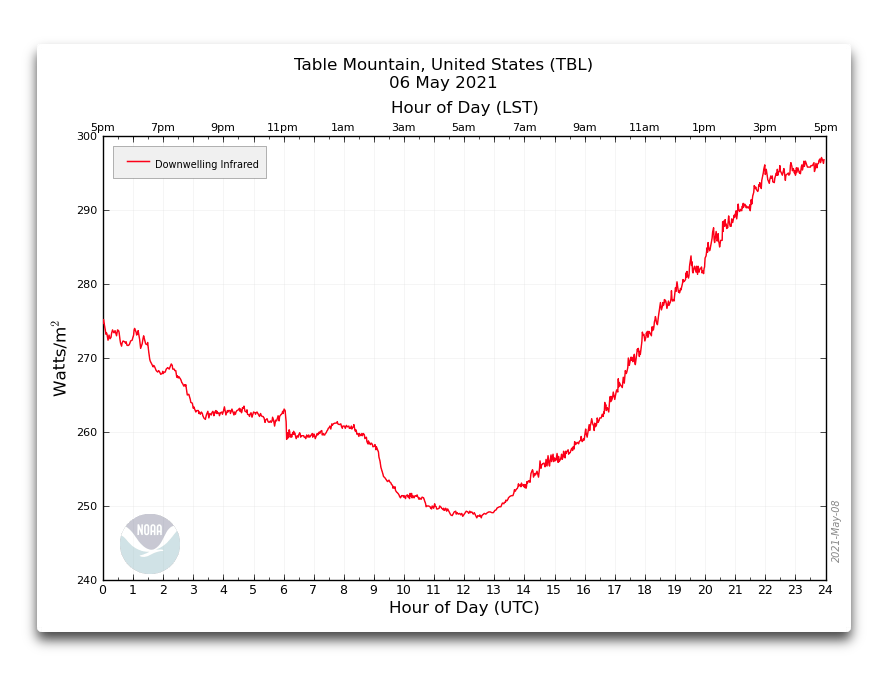
A search on Google Scholar for “downwelling longwave SURFRAD” finds 400+ studies, and a search for “downwelling longwave TAO buoys” finds 500+.
See also e.g. Spectral and Broadband Longwave Downwelling Radiative Fluxes, Cloud Radiative Forcing, and Fractional Cloud Cover over the South Pole, and Observations of downwelling far-infrared emission at Table Mountain California made by the FIRST instrument
Finally, you say:
If you take a look at the article, they deliberately filtered out the CO2 radiation because they were looking at the nitrogen section of the spectrum.
Best regards.
w.
Thanks Willis.
I know there are many papers about downwelled IR in general, I was thinking more of those that that identified molecular species from specific emission peaks. Rather than absorption troughs.
Regarding Fig. 3 and Fig. 4, the land and ocean scatterplots, I wonder what areas of the globe are near the LOWESS smooth and thus show a typical response to changes in forcing and which areas warm or cool slower or faster.
It would be interesting to know how stable this relationship is over time. Maybe one could identify areas of concern, that show a stronger response to increases in forcing than other regions.
Especially if these areas lay in the oceans, some yet unknown warming mechanisms might be detected
Willis,
By “forcing” you mean whatever causes warming, not specifically CO2, right? IOW, the 3.7 W/m2 for a doubling of CO2 is just a what-if prediction using the hypothetical 5.35 * ln(2).
Finally, does it make sense to apply 3.7 W/m2 universally to the whole planet?
In an earlier response to Ferdberple you said, “But the increase [in CO2] has been…far larger than can be explained by oceanic outgassing.” Have you considered that population growth has contributed the majority of the rise as vegetation decomposition?”
On the whole, I like your approach and the data is awesome. Especially the inflections of the curves and the surface versus TOA plot. Each section of the plots has a story to tell.
We have heard so much about the perversion of the peer review process that it would be instructive for you to post once a month on the progress of your paper. To see a complete exchange between you and your peer reviewers, as opposed to just the characterizations of them we have seen so far in this forum, might demo to us the problems involved. Your over comments to us, clearly delineated as such, would be fine. But the name of the game would be to include the unedited exchanges.
If this is a request already made in the nearly 500 comments to this and your earlier post, then, me too…