Guest essay by Eric Worrall
Ariel Ortiz-Bobea, an economist at Cornell University, claims all the CO2 and global warming we have added to the atmosphere is harming plant growth and agricultural yields, and we are only keeping up because of better farm practices. But how does Ariel explain the global greening of wilderness regions observed by NASA?
Rapid global heating is hurting farm productivity, study finds
Research shows rising temperatures since 1960s have acted as handbrake to agricultural yield of crops and livestock
Oliver Milman@olliemilman
Fri 2 Apr 2021 02.00 AEDTThe climate crisis is already eating into the output of the world’s agricultural systems, with productivity much lower than it would have been if humans hadn’t rapidly heated the planet, new research has found.
Advances in technology, fertilizer use and global trade have allowed food production to keep pace with a booming global population since the 1960s, albeit with gross inequities that still leave millions of people suffering from malnutrition.
But rising temperatures in this time have acted as a handbrake to farming productivity of crops and livestock, according to the new research, published in Nature Climate Change. Productivity has actually slumped by 21% since 1961, compared to if the world hadn’t been subjected to human-induced heating.
…
“The impact already is larger than I thought it would be,” said Ariel Ortiz-Bobea, an economist at Cornell University who led the research.
“It was a big surprise to me. The worry I have is that research and development in agriculture takes decades to translate into higher productivity. The projected temperature increase is so fast I don’t know if we are going to keep pace with that.”
…
The abstract of the study;
Anthropogenic climate change has slowed global agricultural productivity growth
Ariel Ortiz-Bobea, Toby R. Ault, Carlos M. Carrillo, Robert G. Chambers & David B. Lobell
Abstract
Agricultural research has fostered productivity growth, but the historical influence of anthropogenic climate change (ACC) on that growth has not been quantified. We develop a robust econometric model of weather effects on global agricultural total factor productivity (TFP) and combine this model with counterfactual climate scenarios to evaluate impacts of past climate trends on TFP. Our baseline model indicates that ACC has reduced global agricultural TFP by about 21% since 1961, a slowdown that is equivalent to losing the last 7 years of productivity growth. The effect is substantially more severe (a reduction of ~26–34%) in warmer regions such as Africa and Latin America and the Caribbean. We also find that global agriculture has grown more vulnerable to ongoing climate change.
Read more: https://www.nature.com/articles/s41558-021-01000-1
Back in the real world, NASA reports that not only is the world greening thanks to anthropogenic CO2, the extra vegetation is exerting a strong cooling effect on the surface of the planet.
A new study reports that increased vegetation growth during the recent decades, known as the “Greening Earth”, has a strong cooling effect on the land due to increased efficiency of heat and water vapor transfer to the atmosphere.
A new study published in the journal Science Advances titled “Biophysical impacts of Earth greening largely controlled by aerodynamic resistance” reports that the entire land surface would have been much warmer without the cooling effect of increased green cover during the recent decades. The study used high-quality satellite data from NASA’s MODIS sensors and NCAR’s state-of-the-art numerical earth system model.
Satellite observations show widespread increasing trends of leaf area index (LAI), known as the Earth greening. However, the biophysical impacts of this greening on land surface temperature (LST) remain unclear. Here, we quantify the biophysical impacts of Earth greening on LST from 2000 to 2014 and disentangle the contributions of different factors using a physically based attribution model. We find that 93% of the global vegetated area shows negative sensitivity of LST to LAI increase at the annual scale, especially for semi-arid woody vegetation. Further considering the LAI trends (P≤0.1), 30% of the global vegetated area is cooled by these trends and 5% is warmed. Aerodynamic resistance is the dominant factor in controlling Earth greening’s biophysical impacts: The increase in LAI produces a decrease in aerodynamic resistance, thereby favoring increased turbulent heat transfer between the land and the atmosphere, especially latent heat flux.Credits: Chi Chen
The greening of the lands during the first fifteen years in the 21st century represented an additional heat dissipation (2.97×10²¹ J) from the surface equivalent to five times the total energy produced and used by humans in 2015 (5.71×10²⁰ J). This greening-induced cooling effect was twenty-five times stronger than the warming effect caused by tropical deforestation.
“In the fight against climate change, plants are the lonely-only defenders. Stopping deforestation and ecologically sensible large-scale tree-planting could be one simple, but not sufficient, defense against climate change.” said the lead author Dr. Chi Chen a former Ph.D. student at Boston University, now a postdoc researcher at DOE’s Lawrence Berkeley National Lab.
…
Read more: https://www.nasa.gov/feature/greening-of-the-earth-mitigates-surface-warming

Ariel seems to suggest that soaring agricultural yields are due to better farm practices overcoming the harm caused by global warming, but this does not explain the massive global greening of wilderness areas observed by NASA. Unfortunately the full study is paywalled, but surely if the underlying trend was increasing climate harm mitigated by better agriculture, only farms would be greener.
Warmer temperatures are no threat to agriculture. Even if Summer temperatures rise beyond the tolerance of some crops, the solution is plant a little earlier. Plenty of temperate climate crops are commercially grown in my district, crops which would never survive the Summer heat. The farmers in my district plant potatoes, carrots, cabbages, celery, and other temperate climate vegetables at the start of Winter, and harvest them in Spring.
Ariel has never stepped a foot on a farm. I just looked at the DeKalb site for corn seed varieties. For my zip code on the plains they list 203 different seeds with maturities between 76 to 120 days, and any number of traits on soil, water availability, prevalent diseases, crop types, etc.
He simply can’t know what he is talking about for at most 1 – 2 degrees of warming. In the US alone when you span from Texas to Canadian provinces you cover any climate change possibilities. If so called climate change was a problem, you would be seeing crop failures en mass somewhere in this range.
If not an april Fool, that so called study contradicts all known facts and newest research.
In his curriculum vitae, he forgot to list the Production and Spreading of USDA Certified Grade A Prime fertilizer, of which this “research” is just one example.
Sadly the Earth’s gravitational attraction would have to increase for it to warm.
Speaking proudly before all like the emperor in his new clothes. Looking forward to another hot Summer of GW propaganda.
I’ve only read the Grauniads somewhat hyperbolic report by Oliver Milman with its ludicrous references to ” human induced heating” but it also says” with global population set to rise by more than 9 billion by 2050 the UN Food and Agriculture Organisation has estimated that food production will have to rise by 70% ”
As world population is already well over 7 billion I think someone can’t do the maths properly
“A new study reports that increased vegetation growth during the recent decades, known as the “Greening Earth”, has a strong cooling effect on the land due to increased efficiency of heat and water vapor transfer to the atmosphere.”
Evidence for Urban heat island effect.
Bottom line is academics have learned monetary sources can be influenced by lies more efficiently and faster than the truth can be explained to a shallow mind.
Regarding the above article and its credibility, all you need to know is contained in the first few words of article: “Ariel Ortiz-Bobea, an economist at Cornell University, claims . . .” (my bold emphasis added).
But they are all climate experts when they agree with the dogma of climastrology.
Eric wrote, “Warmer temperatures are no threat to agriculture. Even if Summer temperatures rise beyond the tolerance of some crops, the solution is plant a little earlier.”
Exactly right. To find a result in which warmer temperatures cause significant crop damage, you either have to use wildly unrealistic tests (like the Jasper Ridge wild grasses project), or else assume that farmers are too stupid to adjust their planting dates (like PNAS’s Zhao 2017 did). For example, a full 1°C of warming could be fully compensated for in the American grain belt by planting about six days earlier, as you can see:
It is amazing the dreck that journals like Nature Climate Change publish these days, but at least they fittingly published this one on April Fools Day.
In the real world, rising CO2 levels have made crops both more productive and more drought-resistant. Those are two of the reasons that drought-triggered famines no longer periodically decimate large regions of the world:
Elevated CO2 (eCO2) enables plants to use water more efficiently. It does so by increasing carbon uptake relative to transpiration. In other words, when grown with higher CO2 levels, plants need less water to get the carbon they need from CO2 in the atmosphere. That’s especially helpful in arid regions, and during droughts. Here’s a paper:
http://www.sciencedirect.com/science/article/pii/S0168192310003163
EXCERPT:
That’s settled science. Yet, remarkably, most so-called “climate scientists” are ignorant of it.
Rising CO2 levels are extremely beneficial in places like India, which used to be plagued by famines, most of them triggered by drought. These photos were both taken in India, but more than a century apart:
Look at those potatoes! The large benefits of eCO2 for potatoes and all other major crops has been known to science for more than a century. The benefits are so dramatic that in 1920(!) Scientific American called anthropogenic CO2 emissions “the precious air fertilizer.”:
https://tinyurl.com/1920sciamCO2
The world is literally getting greener, largely thanks to anthropogenically elevated atmospheric CO2 levels. Here’s a map:
https://sealevel.info/greening_earth_spatial_patterns_Myneni.html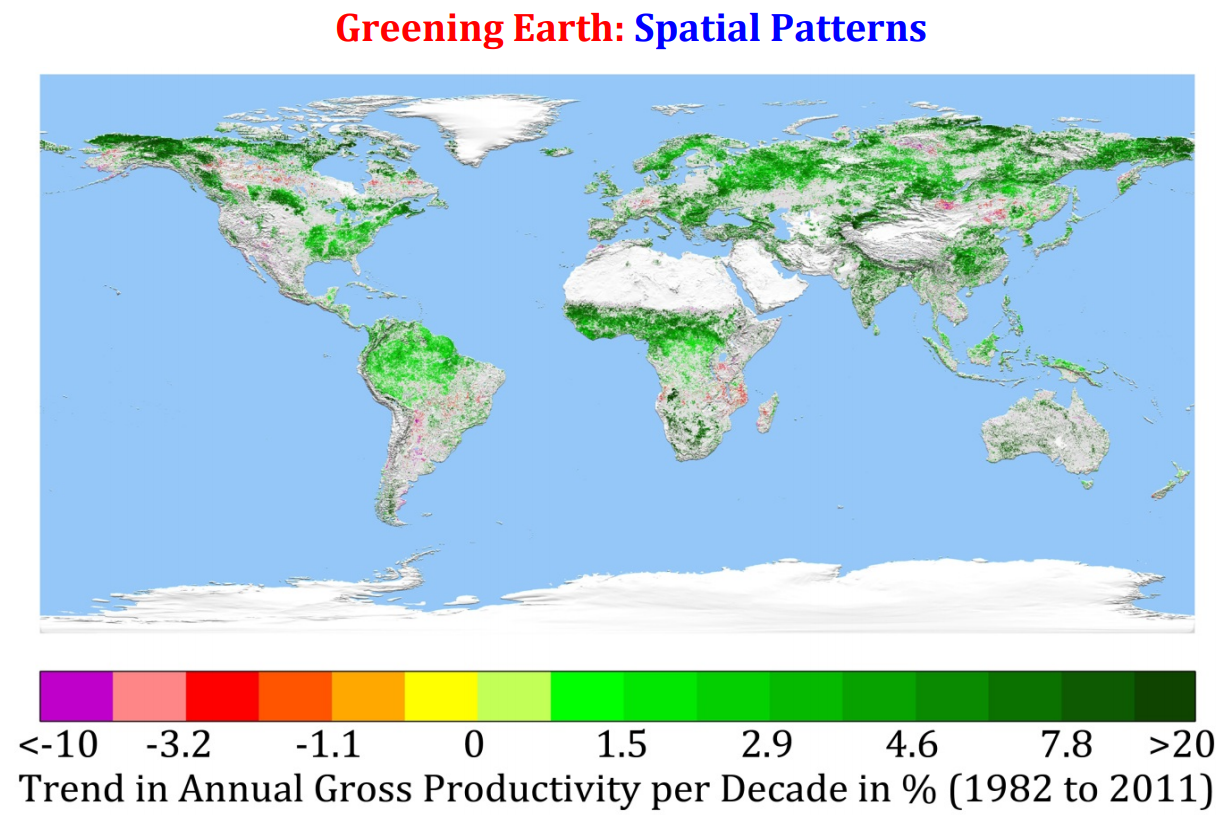
Here’s a National Geographic article, about how even the “Sahara” desert (really the Sahel) is greening:
https://www.sealevel.info/Owen2009_Sahara_Desert_Greening-atGeo30639457.html
Excerpt:
Here’s another article about it, in New Scientist:
https://www.sealevel.info/Pearce2002_Africans_go_back_to_the_land_as_plants_reclaim_the_desert-New_Scientist.html
The New Scientist article mentions dramatic improvements in yields of sorghum and millet, both of which are C4 crops. They are often grown in semi-arid regions, because of their low water requirements and high drought-resistance — which are greatly enhanced by eCO2, as this study reports:
https://phys.org/news/2015-11-high-co2-sorghum-drought-seeds.html
Over 31,000 American scientists (including engineers in relevant disciplines) have signed a Petition affirming our conviction that:
Chief among those “beneficial effects” is healthier, faster-growing plants, due to “CO2 fertilization.” A 2013 study found that in warm and arid environments over a 28 year period (1982-2010), as CO2 levels increased by 14%, foliage cover increased by 11%.
https://agupubs.onlinelibrary.wiley.com/doi/full/10.1002/grl.50563
NASA measures the greening trend, from satellites:
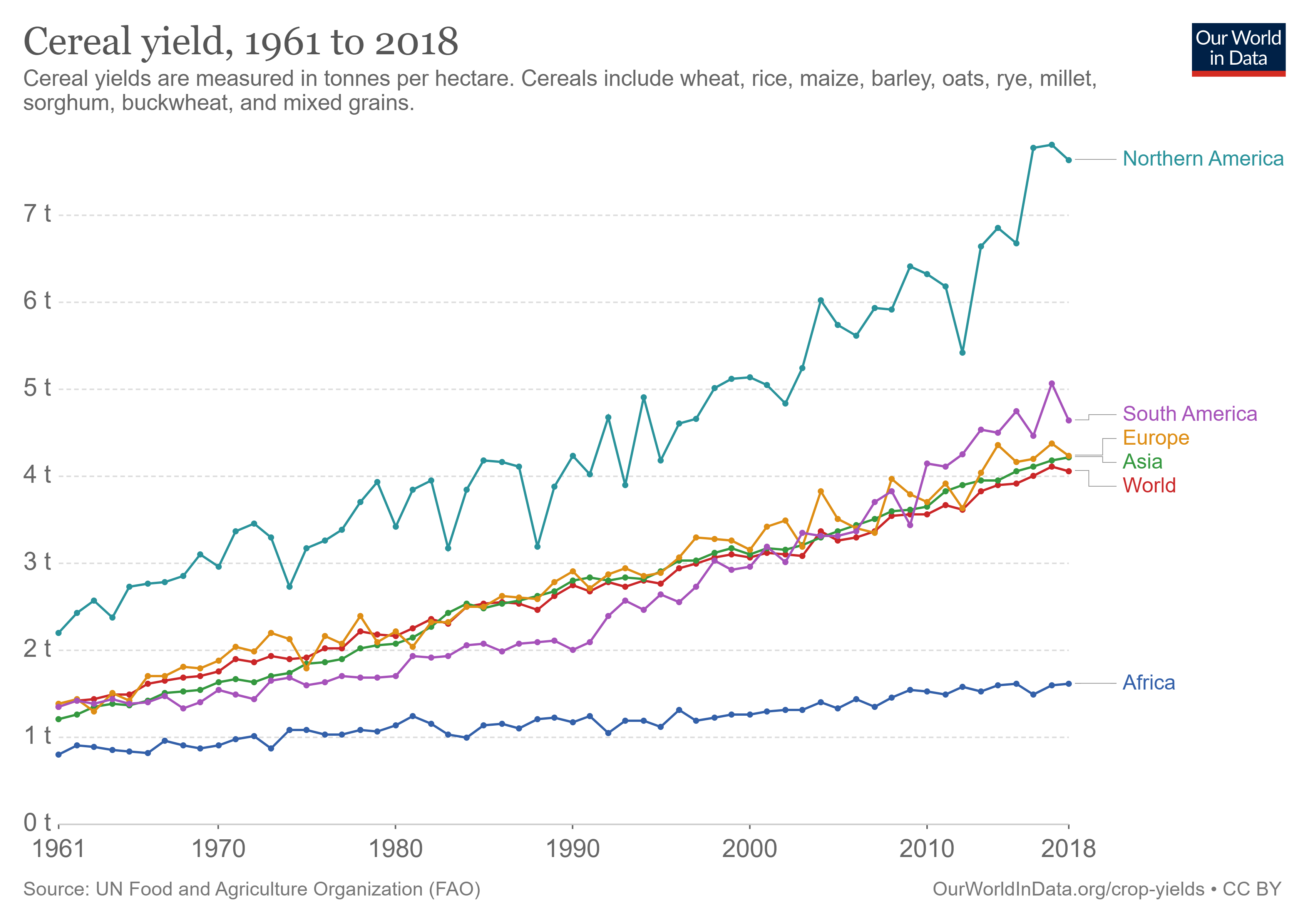
Through all of human history until recently, famine was one of the great scourges of mankind. It was the Biblical “Third Horseman of the Apocalypse,” and the reason the Israelites fled their homeland for Egypt. But, thankfully, widespread famines are becoming a distant memory, and the rising atmospheric CO2 concentration is one of the major reasons for that blessing:
Here’s a paper about how elevated eCO2 benefits wheat:
https://www.ncbi.nlm.nih.gov/pubmed/26929390
Perennial plants also benefit. Here’s what elevated CO2 levels do for pine trees:
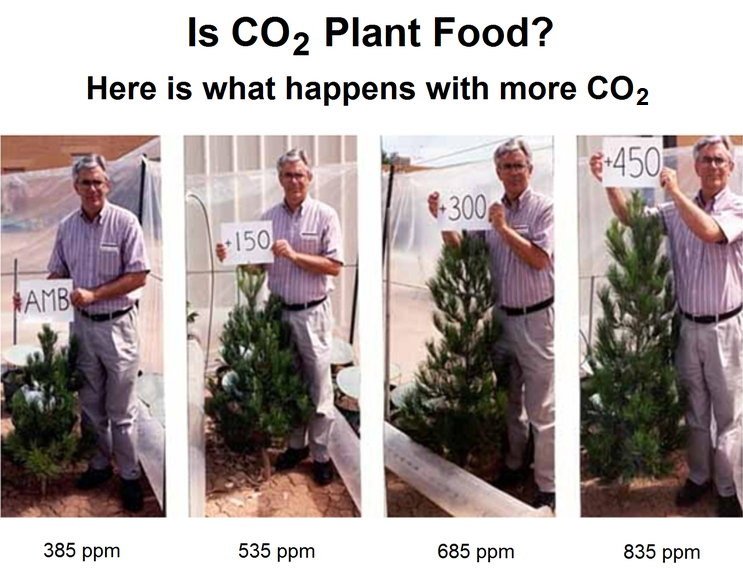
A 2011 University of Michigan study found that trees grow an average of 26% faster at 570 ppm, even with phenotypes optimized for current CO2 levels.
https://news.umich.edu/future-forests-may-soak-up-more-carbon-dioxide-than-previously-believed-helping-to-buffer-climate-change/
eCO2 is most beneficial for C3 crops, but here’s a paper about how eCO2 benefits corn, even though corn is a C4 crop:
https://www.tandfonline.com/doi/abs/10.1080/00103624.2018.1448413
eCO2 is especially beneficial for legumes, like beans, peas, and alfalfa, which are grown for their protein content. So eCO2 helps mitigate protein shortages in poor countries. Here’s a paper:
https://www.frontiersin.org/articles/10.3389/fpls.2017.01546/full
In fact, thousands of studies show that eCO2 is highly beneficial for ALL major crops. CO2 Science (a wonderful non-profit charity, very deserving of your support, BTW!) has a fantastic resource indexing for papers on the subject:
http://co2science.org/data/plant_growth/plantgrowth.php
Scientific evidence is compelling that manmade climate change is modest & benign, and CO2 emissions are beneficial, not harmful. The major harms from CO2 are all hypothetical, and mostly implausible. The major benefits are measured, and very large.
https://sealevel.info/learnmore.html
Was this guy from the “real” Cornell University, or the one that Keith Olberman attended?
What a load of rubbish, from Ariel Ortiz-Bobea, an economist at Cornell University,
Such a pity because Cornell University deserves better than that?
For those interested , one valuable site is Extension Toxicology Network.
E X T O X N E T -explanation – links –Extension Toxicology Network
http://pmep.cce.cornell.edu/profiles/extoxnet/index.html
E X T O X N E T
Extension Toxicology Network
A Pesticide Information Project of Cooperative Extension Offices of Cornell University, Michigan State University, Oregon State University, and University of California at Davis. Major support and funding was provided by the USDA/Extension Service/National Agricultural Pesticide Impact Assessment Program.
EXTOXNET: The Extension Toxicology Network
PMEP Home Page file:///C:/Users/user/AppData/Local/Temp/msohtmlclip1/01/clip_image001.pngPesticide Active Ingredient Information
This is jaw dropping ignorance. The optimal level of CO2 for most plants and crops is around 900 PPM, more than double the current level………as shown by thousands of studies on plants.
https://www.marketforum.com/forum/topic/62784/
If we were to send the atmosphere back into a time machine and have it return to pre industrial age levels, 1 billion people would starve to death within 3 years because of the plunge in crop yields/food production. Prices would more than triple as we rationed excessive demand for the insufficient supplies of most crops/food.
The greatest global warming is happening in the coldest places, especially during the coldest times of year. When the planet stops massively greening…………THEN, we will know that conditions have become unfavorable.
Authentic climate science, biology and agronomy tell us that we are a long way from that happening.
“If we were to send the atmosphere back into a time machine and have it return to pre industrial age levels, 1 billion people would starve to death within 3 years because of the plunge in crop yields/food production. Prices would more than triple as we rationed excessive demand for the insufficient supplies of most crops/food.”
Given other things these “climate scientists” say, I suspect that’s what they want.
“Even if Summer temperatures rise beyond the tolerance of some crops, the solution is plant a little earlier.”
Shade cloth can help, too. Summers here often get too hot for tomatoes to produce, at least for a few weeks. A 40% shade cloth over them keeps them producing through the heat. Doesn’t seem to hurt anything else under it, either.
I am concerned that there may be a serious error in this paper. The authors may have failed to take into account the radical increase in yields per hectare since the 1960s. To produce the total annual yield of the 1960s would require 70% less agricultural land today. Using the same area of land today would produce 3 times the total mass of crops produced in the 1960s. Yields per hectare have been spiralling upwards since then thanks largely to radical improvements in machinery, farming practices, fertilisers, pesticides, less frost damage due to moderately warmer nights along with extended growing seasons, enhanced fertilisation from slightly elevated atmospheric CO2 which also reduces irrigation demands. Hence the numbers suffering hunger and starvation have plummeted worldwide over recent decades. The findings of the authors seem to be completely at odds with the official data with respect to the continuing reduction in the area of agricultural land accompanied by a continuing rise in annual yields due to the widely recognised rise in yields per hectare. If my concerns are valid the authors may have caused unnecessary anxiety in the young and vulnerable which would be difficult to redress.
I have a feeling his model is based on crop damage caused by every flood, drought, and forest fire, ascribing them all to manmade climate change, and comparing that to a world in which none of those events happened. Logically, if climate change is responsible for all those thing, then none of them could have happened prior to said climate change. Simply ignore the reality that they did.
First, and I’m sorry I didn’t do a screen save of this, there was once a UK science textbook online discussing the impact of CO2 on UK wheat (I think) crops. It said that on high-growing days, wheat stopped growing in the afternoon due to local CO2 levels dropping too low (imagine acres and acres of crops gulping all the CO2 they could get). I can no longer find it, but it certainly hit home why higher levels of CO2 increased crop yields.
Secondly, food production has been rising faster than population growth. We now produce enough food to feed the world. That some areas suffer famine is primarily due to civil wars, or tinpot dictators interfering with charitable food distribution, selling it on the black markets.
But the ultimate bottom line is: if we needed more food we would be growing more food. Anything now would be surplus, possibly going to waste.That’s why we can divert crops to fuel production, or build vast solar farms on arable land.
Another April Fool joke.
From the research paper:
Yup! They start with cherry picked data and it only gets worse.
Know a lot of tropical countries that have 500 years of harvest/temperature data? Data that the researchers can ‘average’?
Average T? Over the sample period?
Again, cherry picking using faux data.
Ten thousand reshuffled datasets? Now we’re playing the hide the pea shell game.
Cherry picking at it’s worst.
Worse, this is just a disguise for using far better reporting of storms, damages and crop losses as bait and switch proxy for diminishing crops.
I stopped reading at this point. Just another economist playing demigod pushing abused data while making claims opposite to observations.
The current co2 concentration limits plant growth. Higher temperatures help plant growth. It’s almost as if they don’t know greenhouses work. How obtuse. FYI all. Plants evolved at 2500PPM Co2. In a greenhouse Co2 can make up for low light, poor temperature, drought, high humidity, and also limits plant disease. It’s literally the perfect tonic.
P.S. I;m a year round greenhouse grower.
I have sent my questions to Ariel, and don’t expect a response.
I have never received an answer to these questions from any Climate Scare Warrior: What should the earth’s perfect temperature be and has it ever been and for how long; and what should the correct level of CO2 be and do you believe like some that CO2 is a dangerous pollutant, and most important, if so who amongst us should be forced to hold our breath to stop CO2 from getting into the atmosphere???(considering that we inhale 400ppm and exhale approximately 20,000ppm)
Last but not least, is there a published or otherwise empirical paper or experiment linking CO2 to the Earth’s temperature? I think
NOT.
Someone needs to learn scientific notation.