by Jim Steele
The earth’s energy equilibrium is determined by the balance between incoming solar radiation versus radiative cooling that emits infrared radiation back to space. Water vapor primarily and CO2 can slow radiative cooling via the greenhouse effect. I am most grateful for the greenhouse effect. Without it the earth’s average temperature would hover near 0°F instead of our currently more livable 59°F. But in addition to any radiative effects, the earth’s global average temperature is determined by a variety of climate dynamics, such as the balance between ocean heat storage and heat ventilation. This is well established as climate scientists attributed the slowdown in 21st century global warming was due to increased ocean heat storage associated with a period of more La Ninas. Warming in the northeast Pacific Ocean, famously known as the blob, was not caused by added heat, but by reduced winds that ventilated less heat than normal. Cloud dynamics are also important. Clouds can warm the nights and cool the days. Although increased cloud cover can slow the loss of outward‑bound infrared radiation, clouds also block sunlight to cause more cooling. Modeling studies have shown cloud cover trends are more closely related to decadal variability, and dynamics such as the Pacific Decadal Oscillation, than to any greenhouse gas induced warming.

Changes in land surface conditions are another critical dynamic. For example, given the exact same amount of incoming heat, dry soils will increase surface temperatures twice as fast as moist soils. As expanding human populations drained wetlands, and increasingly shunted rainwater into storm sewers, drier soils have caused abnormally higher temperatures during normally occurring droughts and heat waves. Unfortunately a myopic focus on CO2 hasled to downplaying the vital importance of how climate dynamics affect the global average temperature. But climate dynamics not only offer the best explanation for regional weather extremes, climate dynamics alone can account for 150 years of the earth’s average warming.
Consider that the polar regions are much warmer today than what the physics of radiative heating and cooling would predict. Polar regions should be much, much colder than they are today because they radiate more heat back to space than is absorbed by the sun and the greenhouse effect combined. The dynamic transport of heat from the tropics via ocean and air currents provides the added Arctic “warmth” that’s observed today. While winter temperatures (January) at north pole vary from ‑45°F to ‑15°F, the south pole winter temperatures vary between ‑80°F and ‑67°F. The south pole is so much colder because it is relatively shielded from the warming dynamics of ocean heat transport as well as its higher elevation.
Scientists have noted the warming effects of warm ocean currents travelling poleward to the Arctic for over 100 years. Winds extract heat from the warm poleward bound Gulf Stream and North Atlantic Current and carry that heat across the Atlantic to increase northwest Europe’s temperatures by 9-18°F. Thus it is the strength of those winds which is moderated by the North Atlantic Oscillation, and the volume of heat carried by the ocean currents that are the dynamics determining changes in the average European temperature.
With comprehensive modern measurements, researchers now estimate that inflows of warm Atlantic water “carry enough heat, if released, to melt the Arctic sea ice many times over”. However, when that warm Atlantic water reaches the Arctic Ocean, most sinks below 300‑foot depths due to its greater density caused by its higher saltiness. The dynamics of an overlying layer of fresh water and the thickness of insulating sea ice determine how much of that intruding Atlantic heat radiates back to space. Between 1950 and 1990, air temperatures exhibited a cooling trend over the western Arctic Ocean where insulating sea ice remained intact and inhibited the ventilation of stored heat. The lack of warming suggested no greenhouse effect.

Recent wind‑driven increases in the volume of intruding Atlantic water (as well as intruding Pacific water) have melted more Arctic sea ice. Without ice, more heat ventilates and raises Arctic air temperatures. Increased heat ventilation due to reduced sea ice can also be driven solely by changes in the prevailing wind direction that pushes more ice cover out of the Arctic to melt in the warmer Atlantic. The good news is less ice benefits the Arctic food chains. The loss of sea ice has increased photosynthesis and boosted the productivity of the Arctic Ocean food web 3‑fold.
Such complex interplays of climate dynamics can result in abnormally high Arctic temperatures without a contribution from the greenhouse effect. Yet that “Arctic amplification” biases the global average temperature upwards when then incorrectly gets attributed to rising CO2. Unfortunately as Mark Twain warned long ago, “All colleges have two great functions: to confer, and to conceal, valuable knowledge”. Accordingly despite copious published science by “climate dynamicists”, many scientists protect their pet theories and promote a manufactured CO2‑driven “climate crisis” while downplaying the competing importance of natural climate dynamics. I have university colleagues who teach “global warming policy” without having examined the underlying science. They just blindly trust the crisis narrative. Likewise most journalists and politicians lack the needed scientific background and simply perpetuate the narrative because both profit from promoting crises. As a result, climate science is suffering, and the dynamic control knob of climate change gets veiled from the public.

Winter Weather
The 2021 cold snaps that caused so much misery in the central USA and Europe exemplify the power of climate dynamics. Although Dallas, Texas normally experiences 60°F in mid‑February, temperatures fell by over 50°F to a low of 4°F with the day’s highest temperature only reaching 14°F. This obliterated the 1909 record low of 15°F and day’s record-low maximum temperature of 31°F. But such cold was not unprecedented. In three of the last 40 years Texas witnessed temperatures drop 50°F below normal. It should be noted, there was no compensating 50°F warming in the Arctic. Coincidentally the United Kingdom recorded -9°F, its coldest February night since 1955, while much of Germany saw temperatures fall below -4°F. The greenhouse effect can neither cause nor prevent such widespread devastating cold.
Record‑breaking cold snaps contradict CO2 warming theory. As one climate scientist published, “The recent perceived prevalence of cold waves, exacerbated by heightened media attention to each event, is at odds with a rather obvious first-order hypothesis: a warming climate should lead to warm extremes getting warmer, and cold extremes getting less cold”. Accordingly in the 1990s, climate scientists who promoted global warming argued rapidly warming temperatures during the winter were evidence of a stronger greenhouse effect. But their theories failed to explain the colder weather episodes.
A different hypothesis is proving to be more robust. Instead of arguing a warming climate causes fewer cold snaps, climate dynamics flips cause and effect; fewer cold snaps will increase averaged regional temperatures. Climate scientists published, “Like many places, Canada is not warming, it is just getting less cold.” Indeed, while many maximum temperatures have decreased since the 1930s, the increase in average land temperatures has been due solely to higher minimum temperatures,. Appropriately, regions with rising average temperatures have experienced fewer cold snaps. In contrast, due to the dynamics of quasi‑stationary planetary waves, cold snaps remain common over other regions. In much of the southeastern USA, temperatures have failed to exhibit any warming trend in the past 70+ years, despite urban warming effects. Such regions are classified as warming holes because they fail to exhibit the warming trend predicted by rising CO2.

Heat waves and cold snaps, floods and droughts, are often a function of planetary “waveguides” that shepherd the movements of cold and warm and moist and dry air masses. If there were no continents the “ideal flow” of the polar jet would be in a relatively straight‑line from west to east. The polar jet stream’s strong westerly winds would more readily restrict cold air masses to the polar regions. But due to the high- and low-pressure systems generated by the contrasting temperatures between land and sea, as well as flow altering mountain barriers, the “ideal zonal flow” is disrupted. In combination with the earth’s rotation (Coriolis effect), those disruptions impart a waviness to surface winds and the jet stream. The screenshot below (from https://earth.nullschool.net/) shows the waviness of the jet stream (at 500 mb) on March 25, 2021. The sharp color change reveals the boundary of the cold air which can be thought of as the equatorward limit of the polar vortex.

Cold Arctic air moves towards the equator via the wave troughs while the wave ridges allow warm air to intrude poleward. Due to an extreme trough in February, cold Arctic air reached down through the Great Plains into southern Texas. Due to a somewhat stationary planetary “waveguide”, such a wave trough is most often located between the Rocky Mountains and the Appalachians. That pattern also enables descending cold Arctic air to collide with warm air from the Gulf of Mexico to create Tornado Alley. The same trough dynamics that brought the Texas/Oklahoma cold snaps, brings the world’s highest frequency of tornados to the same region. The focus of that trough will shift with the seasons and over decades. As a result tornado activity is decreasing throughout the southern and northwestern portions of the Great Plains and the northern Midwest but increasing throughout the Southeast and southern portion of the Midwest. Decreasing tornado activity contradicts greenhouse warming predictions but is best explained by the dynamics of natural planetary wave motion.
In contrast, when a less wavy jet stream confines the cold air to the polar region, warmer southern air moves further poleward. Due to such a dynamic, Siberia endured a heat wave from January through May of 2020. At Verkhoyansk, Russia the typical maximum January temperature reaches -44°F, rapidly rising 90°F to an average high of 50°F in May as summer sunshine increases. The heat wave caused monthly temperatures to exceed normal temperatures by 10.8°F . Nonetheless, a Siberian heatwave which raises May maximums to just 61°F shouldn’t be hyped as the “earth on fire”, and I suspect any warming in January would be greatly appreciated. Yet, with the science of climate dynamics obscured, any extreme weather event gets deflected as CO2‑driven “weather weirding”, even though natural climate dynamics provide robust scientific explanations.
Both the Texas cold snap and the Siberian heatwave are the result of changes in the strength of the polar vortex. The vortex and waviness of the jet stream are largely moderated by oscillations in the quasi‑permanent Aleutian Low pressure system, which also regulates changes in the western Arctic sea ice. The Aleutian Low strengthens in the winter and weakens in the summer and its winter-time strength is further moderated by El Nino/La Nina dynamics and the closely related Pacific Decadal Oscillation. Media journalists prefer to avoid explaining the complexity of those basic climate dynamics, because simplistic explanations that are dumbed down are an easier sell. Thus natural climate change remains ambiguous to most people and that’s a problem.
In the 1990s, scientists and environmental groups pushing a CO2‑driven “crisis” hyped decades of the rapidly warming temperatures in Alaska as the fastest warming region on earth. Unexpectedly, Alaska suddenly flipped to become the fastest cooling region. Climate scientists observed, “During the first decade of the 21st century most of Alaska experienced a cooling shift.” Such a shift was inconsistent with the rising CO2 theory, but again easily attributed to the dynamics associated with “a change in the sign of the Pacific Decadal Oscillation (PDO, see graph below).
When the PDO is positive, the Aleutian Low strengthens, and its counter‑clockwise circulation drives more warm air into Alaska and drives more warm water through the Bering Strait increasing sea ice melt. When the PDO turns negative, it weakens the Aleutian Low, reducing the warm air flow into Alaska, so Alaska cools. A weaker Aleutian Low also reduces its disruption of the jet stream which allows the vortex to strengthen. The power of the ~30‑year cycles of the PDO was first recognized in 1997 as scientists noticed it coincided with changing ocean currents and changing productivity of salmon between the Gulf of Alaska and Oregon. The increasing understanding of natural PDO fluctuations has led climate scientists to argue that the “natural internally generated changes in atmospheric circulation were the primary cause of coastal Northeast Pacific warming from 1900 to 2012”.

Summer Weather
When summer arrives in the northern hemisphere, the contrast between colder land and warmer oceans is reduced causing the Aleutian Low to weaken. The growing summer heat causes warmer lands to now contrast with cooler oceans which causes the high‑pressure systems in the northern hemisphere to strengthen in the subtropical Pacific and Atlantic (Pacific or Hawaiian High and the Bermuda or Azore High). These high‑pressure systems block moist ocean winds from bringing summer rains to the west coast of California and the Mediterranean regions. This dynamic causes several months of summer drought each year, making California one of the most fire prone regions globally. La Nina years extend summer droughts into the winter. Simultaneously, due to the clock‑wise circulation of the Pacific high, moisture carrying winds are pushed northward causing wet summers from Oregon to Alaska.

In combination with summer high pressure systems and low-pressure regions formed by rising convection in the tropics, the “ideal zonal flow” of westerly winds is disrupted, causing various jet stream wave patterns across the mid-latitudes. When a pattern of 5 or 7 waves encircles the globe, the waves resonate in such a way they cause storms to be somewhat blocked and move slower than normal. It is slower‑moving storms that generate the longer‑lasting extreme weather events such floods, droughts and heat waves. As seen in the illustration above (from Kornhuber 2020) when a pattern of 5 waves forms, heat waves are 20 times more likely in specific regions (in red) of North America, eastern Europe and eastern Asia. Because a pattern of 5 circum‑global waves tend to precede heat waves by 15–20 days, meteorologists have greatly increased their ability to forecast heat waves by including the state of planetary waves in their analyses. A similar resonance increases extreme weather events when patterns of 7 waves form. Fortunately, there is no evidence to suggest the earth is experiencing an increasing trend in blocking and resulting weather extremes. However, unaware that circum‑global wave guides can cause similar extreme weather around the globe, some climate scientists were misled to think that such extremes (i e. widespread heatwaves) could only be caused by a global blanket of CO2‑driven warming.
Still some events remain unpredictable. When the trough of a jet wave reaches its lowest point, it pinches off to form a “cut-off low” which makes the ensuing extreme weather highly unpredictable. Meteorologists nicknamed the cut-off low, the “weatherman’s woe” because cut-off lows can become stationary or flow against the general direction of the prevailing wind. Such a cut-off low formed over the Sahara Desert in the summer of 2019. The naturally heated desert air then moved northwestward, first bringing a heat wave to western Europe and then to Greenland where it caused extreme melting by raising temperatures 18°F above normal for 3 consecutive days. But yet again that Greenland melting was falsely attributed to amplification by CO2‑driven global warming while the natural climate dynamics were obscured.
El Nino Cycles Drive Global Warming and Modulate Planetary Wave formation
The ocean’s heat content naturally oscillates, discharging enough heat during an El Nino to create a net loss of ocean heat, then recharging and gaining enough heat during a La Nina for a net gain of ocean heat.
However, the heat gained during a La Nina is not completely balanced by the heat discharged during an El Nino. La Nina events usually last twice as long as El Nino events. Some El Ninos don’t fully discharge the ocean’s stored heat. Heat that is not released to the atmosphere remains sequestered below the surface for years and decades, contributing to the long‑term cycles of the Pacific Decadal Oscillation. According to Harvard and MIT oceanographers parts of the deep ocean is still cooling, releasing heat acquired centuries ago. Thus unbalanced El Nino/La Nina cycles will affect the long‑term heating or cooling of the oceans.
First consider the impacts during a La Nina. Climate scientists all agree that “under normal conditions, and even more so with La Nina,” east to west trade winds pile up warm waters in the western tropical Pacific. By removing warm solar‑heated water from the eastern Pacific, trade winds also cause cooler subsurface waters to upwell and replace the surface waters transported to the west. So during a La Nina a large temperature difference is created that further amplifies the trade winds (the Walker Circulation). Counter-intuitively the widespread upwelling of cooler water causes the average global temperature to decline while the ocean is gaining heat at greater depths.
During a La Nina the pile‑up of warm waters in the western Pacific increases the largest body of warm water on earth, aka the Indo-Pacific Warm Pool. Convection increases over the warm pool and strengthens the Asian and Australian summer monsoons. Regions of rising convection also move across the Indian and Pacific Ocean alternating warmer and cooler patches of the oceans every 30 to 60 days (Madden‑Julian Oscillation). Pressure from the growing Pacific warm pool pushes heated water through channels between the Indonesian Islands and increases temperatures in the Indian Ocean. Warmed Indian Ocean water can leak around the southern tip of Africa and adds heat to the Atlantic. Simultaneously, the northward flow of warm water increases along the eastern Asian coast via the Kuroshio current, as well as pushing warm water southward along the Australian west coast via the Leeuwin Current. An especially strong La Nina amplified the warm Leeuwin Current causing a marine heatwave along the western Australian coast in 2011, with severe coral bleaching and devastation to marine fisheries.


After that La Nina ended, the southward flow of warm Pacific water subsided allowing cooler southern waters to then flow equatorward. As a result the region began experiencing cold waves and a strong rebound in marine life from coral to fish. Such oscillating ocean temperatures and marine life productivity exemplifies how naturally dynamic climate change can affect biology. It also contradicts CO2‑driven predictions of steadily increasing warmth and increasing extinctions.
During an El Nino, all the phenomenon associated with a La Nina weaken or reverse. The trade winds weaken and warm waters surge eastward along the equator, causing sea level to fall in the west and rise in the east by as much as 25 cm. Discharging heat warms the ocean surface causing global temperatures to spike upwards. Warm water sloshing eastward reduces the west-east temperature difference, reducing the trade winds which reduces upwelling. During an El Nino the centers of rising warm air shifts eastward. Sometimes the warm El Nino waters only reach the center of the Pacific. At other times the warm waters reach the coast of the Americas and then move poleward up their coasts. In 1998 this caused heavy rains and floods in California. In the 1800s, warm water reaching the coast brought flooding to Ecuador and washed river crocodiles down to Peru, while heavy rains turned Peruvian deserts into grasslands. These constantly changing regions of convection naturally alter atmospheric waves that encircle the earth. Extreme weather events will depend on wave interactions.
During the Little Ice Age, according to Michael Mann and others, the temperature difference between the western and eastern Pacific Ocean was in an El Nino‑like condition. That does not mean the Pacific was constantly discharging heat. It means the La Nina-like or the negative Pacific Decadal Oscillation‑like conditions that are associated with recharging ocean heat were largely absent. This is consistent with observations of low sunspot minimums during the Little Ice Age and solar effects on the trade winds. Although some correctly argue observed changes in energy output during sunspot cycles is too low to directly explain the earth’s warming and cooling, small solar changes are amplified by ocean dynamics. Any decrease in solar irradiance cools the equator far more than higher latitudes. This decreases the north‑south temperature difference that drives the trade winds. Reduced trade winds cannot transport as much warm surface water westward into the warm pool reducing the monsoons and causing mega‑droughts in southeast Asia. Slower trade winds reduced upwelling in the eastern tropical Pacific. As evidenced in sediments along the Peruvian coast, reduced upwelling clearly reduced marine productivity during the Little Ice Age. As solar irradiance increased during the 20th century, so did the El Nino/La Nina cycles. Upwelling and marine productivity increased as the earth gradually warmed, and the earth exited the climate‑driven catastrophes of the Little Ice Age.

Tree ring studies similarly show PDO variability was also weak during the Little Ice Age, but strong during the Medieval Warm Period from 993 and 1300 AD. During the Medieval Warm Period, solar irradiance was higher and strong La Nina‑like conditions existed. With a larger Pacific warm pool, southeast Asian mega-droughts were absent but megadroughts devastated the western United States and Canada. As sunspot activity now wanes from it peaks in the 1950s and 1990s, we are provided with a natural experiment to evaluate how the Pacific Ocean will respond to lower sunspot activity. Will the monsoons and the Pacific Decadal Oscillation weaken as they did during the Little Ice Age?
Unfortunately for now, definitively distinguishing the causes of 20th century warming between greenhouse warming versus warming from climate dynamics is currently impossible. A simple experiment done at home using just an infrared thermometer gun can demonstrate why. Heat up a large pot of water, say to 150°F. Then turn off the heat. Measure the temperature of the pot’s surface water and randomly measure 9 spots on the kitchen floor. The average temperature would compute to about 78°F. That determines the “energy state of the kitchen”. Then scoop out half the water from the pot and throw it across the floor. Then repeat the measurements. The average temperature will be significantly higher, even though there was no added heat to the state of the kitchen. The warmer average was simply due to re-distribution of heat and the way the average surface temperature was calculated. Also notice the temperature of the pot will not have changed. One might argue that the water on the kitchen floor will quickly cool and the average temperature will revert back to the original state. But in real life, solar heated ocean water becomes saltier and denser due to evaporation. The warm water then sinks below the surface where its insulated for years.
Because we performed the experiment, we know that spreading the heat from the pot across the floor caused the average temperature to increase. However in nature we would need to precisely know the volume and degree of heat that has been re‑distributed across 3 dimensions. Our current technology and methods cannot precisely measure that. Scientists recently attempting to measure the discharge of ocean heat during an El Nino and reported quantities but with 25% uncertainty.
Scientists who assume recent global warming is due to rising CO2 concentrations have simply argued “there is no viable alternative explanation”. So they assume every change, warming or cooling, drought or flood, is due to rising CO2 concentrations. But atmospheric physicists have shown that CO2 concentrations in the lower atmosphere are now saturated, and the increased “competition” between greenhouse molecules greatly attenuates any additional greenhouse effect imparted by rising CO2 concentrations. At higher altitudes CO2 is not saturated, but because the stratosphere warms with increasing altitude, any increasing stratospheric CO2 will enhance the export of infrared to outer space and cool the earth. To attribute any global warming to rising CO2, the warming effect of redistribution of heat around the world must be precisely measured and factored out. How the calculation of the global average is affected by heat redistribution must be accurately ascertained. Until then, climate dynamics appear to be the better climate control knob and offer the best explanation for both a warming climate and episodes of extreme weather. And natural oscillations suggest a human caused climate crisis is highly unlikely!
Jim Steele is Director emeritus of San Francisco State University’s Sierra Nevada Field Campus, authored Landscapes and Cycles: An Environmentalist’s Journey to Climate Skepticism, and a member of the CO2 Coalition
Snowstorm and volcan activity in Iceland – live webcam
Wow.
Thanks.
Interesting that the lava spill from the Gildingadalir volcano is not obvious on Ventusky.
“The earth’s energy equilibrium is determined by the balance between incoming solar radiation versus radiative cooling that emits infrared radiation back to space”
Absolutely correct, but it does not determine earth´s equilibrium temperature.
Earth´s outgoing radiation can very well be the same at very different average temperatures. This is a simple fact due to the T^4 dependence in Stefan Boltzmanns law,
E.g. if one lowers the temperatures at the poles and increase the temperature around the equator, that can be consistent with radiation balance. However, the average temperature will be different.
There is no physical law that states anything about earth´s average temperature. Multiple average temperatures are consistent with radiation balance.
This is equivalent to say that earth´s average temperature has a chaotic characteristic (= undefined).
Cloud covered Venus has an albedo of .75, and half cloud covered Earth has an albedo of .3. When you go through the basic equations, it is albedo and hence clouds that control the planet’s radiative temperature. Thermodynamic lapse rate from the equivalent emission altitude to surface is the next step.
From the article: “Warming in the northeast Pacific Ocean, famously known as the blob, was not caused by added heat, but by reduced winds that ventilated less heat than normal.”
I’m elaborating on your statement, Jim.
The Blob was formed by a high-pressure weather system sitting over the same ocean location for a long time.
When a high-pressure system sits over an area for a long time, the area underneath the dome of high pressure increases in temperature and will continue doing so as long as the system sits there.
The Blob warmed the water underneath it to several degress higher than the surrounding ocean but the extra warmth only went a few meters deep. That’s how we know the Blob’s warmth was coming from the atmosphere and not from underwater volcanic activity.
When a high-pressure system stalls over land, it causes heat waves and droughts, and is characterized by very light winds (not good for windmills). When one stalls over the ocean, it causes things like the Blob.
Tom
Area’s of high pressure don’t just cause heat waves, they can also cause intense cold. Because when they form over large extended snow fields like in Russia then most of the heat leaks away into space. Thanks to the snow cover during the day and the clear cloudless sky’s during the long winter nights.So as the high remains in place over many days the air within them becomes colder and colder.
l suspect the cause of The Blob was not just caused by light winds. But also because clear sky’s under the high pressure allowed extended sunshine hours. Which in turn allowed increased amounts of heat to be soaked up by the water under the high.
I agree with you both. The high pressure system over the “blob” in addition to low winds caused clear skies that enhanced solar heating. For many marine heat waves, clear skies allow a greater escape of OLR but is offset by increased solar heating causing a net warming. In the winter the greater escape of OLR under clear skies offsets the reduced warming by low winter sunshine and produces cooling.
Tom Abbott:
I was about to make the same comment.
Although I wonder whether the warming went only a few meters deep. The normal marine life fled the area, and reportedly millions of seabirds starved to death when their food supply vanished.
Burl, yes the warmer water was determined to be just a few meters deep. I looked for a link to that but haven’t found one yet. One argument was that the warming was caused by undersea volcanic activity but that was shown to be wrong.
Here’s a link to a general, hyperbolic, description of the Blob events, but it doesn’t go into detail about the actual ocean warming. Rather, it seems to suggest that the ocean was warmer because of Human-caused climate change, but that doesn’t explain why the surrounding ocean’s temperatures were cooler than the water underneath the high-pressure system.
The link does go into a lot of detail about how wildlife was affected by the Blob.
https://www.sciencemag.org/news/2019/01/ocean-heat-waves-pacific-s-deadly-blob-could-become-new-normal
I found something on the depth of the Blob warming, Burl.
https://en.wikipedia.org/wiki/The_Blob_(Pacific_Ocean)
“Initially the Blob was reported as being 500 miles (800 km) wide and 300 feet (91 m) deep.[1] It later expanded and reached a size of 1,000 miles (1,600 km) long, 1,000 miles (1,600 km) wide, and 300 feet (91 m) deep”
end excerpt
Tom Abbott;
Thanks for the info. .I suspected that it had to be more than a few meters deep to cause the marine life to flee the area.
Yes, I wasn’t precise enough when I referred to the depth as a few meters.
I think what happened was I have seen several reports about the situation over the years and shallower depths were reported at that time but it probably just depends on when you look at it.
In the beginning, the warmth was not so deep, but kept getting deeper as time went along until it reached about 90 meters deep at the end.
That’s a lot of warmth built up by the Sun, isn’t it.
Tom Abbott:
The “Blob” extended from the Gulf of Alaska down to Southern California, and probably also extended over parts of the California coast, as well. It was a stalled high-pressure weather system, which is characterized by cloudless skies and low winds within the system (but high winds at its periphery)
The warming within such a system has been stated to be due to compressive heating from the descent of colder air down to the Earth’s surface. However, once it reaches the surface, there is zero velocity and, hence, no more heating.
So, why do temperatures increase so much within a stalled weather system, exceeding those of normal moving weather outside the system, under the same sun at the same time?
The answer is that our atmosphere contains Megatons of circulating industrial SO2 aerosols, which reflect sunshine, and reduce global temperatures. They settle out rapidly, within a week or so, but since they are constantly being replaced, they are always present.
However ,the atmosphere within a stalled high pressure weather system is isolated, allowing its aerosols to settle out, without being replaced, The resultant cleansed air increases insolation, and temperatures can soar.
(This was also the cause of the heat waves in Europe in 2003 and 2019).. .
“So, why do temperatures increase so much within a stalled weather system, exceeding those of normal moving weather outside the system, under the same sun at the same time?
The answer is that our atmosphere contains Megatons of circulating industrial SO2 aerosols, which reflect sunshine, and reduce global temperatures. They settle out rapidly, within a week or so, but since they are constantly being replaced, they are always present.
However ,the atmosphere within a stalled high pressure weather system is isolated, allowing its aerosols to settle out, without being replaced, The resultant cleansed air increases insolation, and temperatures can soar.”
Now that is an interesting theory. I might buy into something like that.
This article is getting a little old. I know you will see this message but probably not many others will, so why don’t you wait and re-introduce this theory in a future article where appropriate. I would like to hear more about the behavior of aerosols inside high-pressure systems.
Tom Abbott:
I have a published article on the role of SO2 aerosols and their effect upon our climate which you which you might find interesting: It is titled “A Graphical Explanation of Climate Change”
http://www.skepticmedpublishers.com/article-in-press-journal-of-earth-science-and-climatic-change/
And if the Blob, high-pressure system, had stalled out centered over California, instead of out in the Pacific Ocean, then it would have caused a multi-year heatwave and drought in California and surrounding areas.
In the past, California has had droughts that lasted for many decades at a time. Something like the Blob over land is what would cause such a thing.
The next question to ask is what climate circumstances would set up a persistent high-pressure system that would last for decades over the same spot on the Earth (California)?
Tom Abbott:
You ask “what climate circumstances would set up a persistent high pressure system that would last for decades over the same spot on the Earth (California)”
A high pressure weather system is not necessary for periods of high temperature.
All that is necessary is for Atmospheric SO2 aerosols to decrease for warming to occur.. There were very few volcanic eruptions during the MWP, and it was quite warm.
Since the, there have been intervals of about 3 years or more between VEI4, or larger, eruptions, and all have resulted in temperature increases..
Clean Air efforts to reduce industrial SO2 aerosol emissions has also caused temperatures to rise.
.
From the article: “They just blindly trust the [climate change] crisis narrative.”
I think this applies to about 99 percent of alarmists. They started out with an unsubstantiated assumption and have never looked back.
One of these days they will think to themselves: “Everything I thought was true about climate change was wrong!”
Let’s hope they get there before we waste Trillions of dollars trying to fix a problem that doesn’t need fixing.
And you still believe fixing a climate problem is behind the politics?
I don’t know. I think some people are very good at fooling themselves in some circumstances. Even smart people.
Quote: “But atmospheric physicists have shown that CO2 concentrations in the lower atmosphere are now saturated, and the increased “competition” between greenhouse molecules greatly attenuates any additional greenhouse effect imparted by rising CO2 concentrations. At higher altitudes, CO2 is not saturated, but because the stratosphere warms with increasing altitude, any increasing stratospheric CO2 will enhance the export of infrared to outer space and cool the earth.”
CO2 concentration is not saturated in any part of the atmosphere. Saturation would mean that CO2 concentration would not increase anymore. But it is increasing all the time, and there is no practical upper limit for CO2 concentration; the whole atmosphere could be CO2 like in Venus.
Steele probably meant that the absorption by CO2 is saturated in the troposphere, but it is not true either. The increased CO2 concentration in the stratosphere does not increase the outgoing LW radiation (=OLR) even though it is a popular misconception. The OLR must be the same as the incoming net SW radiation from the Sun. The CO2 concentration has nothing to do with the magnitude of the OLR. If CO2 concentration would be able to increase the OLR, from which source this energy would come from?
Antero, you are correct regards saturation. It should have read ” the forcing from CO2 concentrations are saturated.
From the 2020 paper Dependence of Earth’s Thermal Radiation on Five Most Abundant Greenhouse Gases
“at current concentrations, the forcings from all greenhouse gases are saturated. The saturations of the abundant greenhouse gases H2O and CO2 are so extreme that the per-molecule forcing is attenuated by four orders of magnitude with respect to the optically thin values. Saturation also suppresses the forcing power per molecule for the less abundant greenhouse gases, O3, N2O and CH4, from their optically thin values, but far less than for H2O and CO2.”
Regards “The OLR must be the same as the incoming net SW radiation from the Sun”, your statement is incorrect. Energy from the sun and stored in the ocean , cause OLR to be less at least for a while.
It was never argued that CO2 determines the magnitude OLR, only the rate of emission. It is in agreement with current science that CO2 can slow its escape, because temperature determines the rate of emission, in the colder upper troposphere CO2 emits OLR at a slower rate that a warm surface emits OLR, causing warming. A warmer stratosphere emits OLR at a faster rate than the colder upper troposphere, which is why climate scientists expected rising CO2 to cause the straosphere to cool.
Jim, Maybe we are using different terms. My point was – and it remains – that the CO2 concentration does affect the magnitude of OLR, which is about 240W/m2. The cooling of the stratosphere due to the increased CO2 concentration is a fact and there is a scientific reason. The increased CO2 concentration absorbs more LW radiation emitted by the surface and this absorption happens below 1 km altitude. Therefore less LW radiation in the absorption wavelength zone of CO2 is available in the stratosphere and it means a little bit lower temperature.
The observed cooling in the stratosphere from 1980 to 2000 was due mainly to decreased ozone concentration. After 2000 the stratospheric cooling has stopped thanks to the banning of ozone-depleting chemicals.
Antero, Indeed, much of the stratospheric cooling resulted from a decline in UV but I must disagree with your statement “The increased CO2 concentration absorbs more LW radiation emitted by the surface and this absorption happens below 1 km altitude. Therefore less LW radiation in the absorption wavelength zone of CO2 is available in the stratosphere and it means a little bit lower temperature.”
CO2 absorbs then emits LW in less than a thousandth of a second. LW absorption by CO2 does not prevent LW from reaching the stratosphere.
Look at all the energy balance estimations, (with the caveat that different authors have different numbers and there is a high level of uncertainty) Using Stephens 2012 budget, absorption of SW by the surface and atmosphere totals to about 240, while outgoing LW amounts to 239.7 at the top of the atmosphere, which is typically assumed to be the mesopause which is above the stratosphere. Outgoing LW eventually passes through the stratosphere. Stephens budget only finds 0.6 W/m2 imbalance, but the all-sky absorption of LW is only 189.9. Is the overall alleged imbalance due to the tremendous uncertainty in measurements? Heat storage in the oceans? Latent heating contributions is estimated with a 10 W/m2 uncertainty
Antero, you said,
You might be engaging in wishful thinking. 2020 had one of the largest ozone ‘holes’ on record:
https://earthsky.org/earth/antarctic-ozone-hole-2020-among-largest-deepest-in-recent-years
It is low temperatures that facilitates the photo-catalytic destruction of ozone.
Thank you Jim! A ‘Magnum Opus’ of compiling the state of real scientific research regarding climate. Bookmarking this!
La Nina, “pile up warm waters in the western tropical Pacific.” Takes time…
El Nino is a release of that water…. (short and sharp initially, hence the temperature spikes)
….. so “causing sea level to fall in the west and rise in the east by as much as 25 cm”
It would be interesting to see how much of that store potential energy converts to kinetic energy during an El Nino release.
25cm change over a large area is a lot of potential energy. !
Its more than just “warm water”
Most of the population see the global average temperature as the reading of a probe up Gaia’s kyber pass. They need to appreciate that it’s more like measuring the average height of a moving crowd, with sampling that has only become sufficiently widespread in recent times to not be so affected by the society of dwarfs swapping places with the national basketball team.
Meanwhile, the company selling bigger seats and pushing for refurbishment have written an algorithm to take care of that. They found that the crowd has increased in height 1 cm since the stadium was made, and is trending at 0.02 cm/year since 1990, significantly more than determined from an aerial l shot of the crowd.
There is no doubt that people are getting taller in recent times, but the changes to the algorithm over the years have made the trends less consistent with a cyclic trend into one that is, barely, more hyperbolic (that’s a pun, for all you autistic readers).
I would point out that the primary driver of unexpected changes in localized climate on a global scale is morons paving shit over and building shit on it then running power plants. Convection is the enemy of stable climate. CO2 itself cannot cause convection.
From the article: “But atmospheric physicists have shown that CO2 concentrations in the lower atmosphere are now saturated, and the increased “competition” between greenhouse molecules greatly attenuates any additional greenhouse effect imparted by rising CO2 concentrations. At higher altitudes CO2 is not saturated, but because the stratosphere warms with increasing altitude, any increasing stratospheric CO2 will enhance the export of infrared to outer space and cool the earth.”
CO2 cooling the Earth. What a concept!
Somebody ought to tell Biden that CO2 is saturated, and that means we don’t have to worry about CO2 and we don’t need to spend Trillions of dollars trying to reign in CO2.
Biden claims he follows the science.
No money in it! All the money is in Climastrology alarm and unreliable energy; politicians, like pigs, follow their snouts! My apologies to any pigs offended by being likened to politicians!
Labelling the “greenhouse effect” junk science gives it credibility way beyond its due. At best it is a fairy tale. So it is OK to be grateful for the fairy tale but it should not be confused with anything related to Earth’s climate.
The climate on Earth is controlled by two powerful processes. At the poles, sea ice limits the heart loss. At the tropics persistent convective cloud limit the heat input.
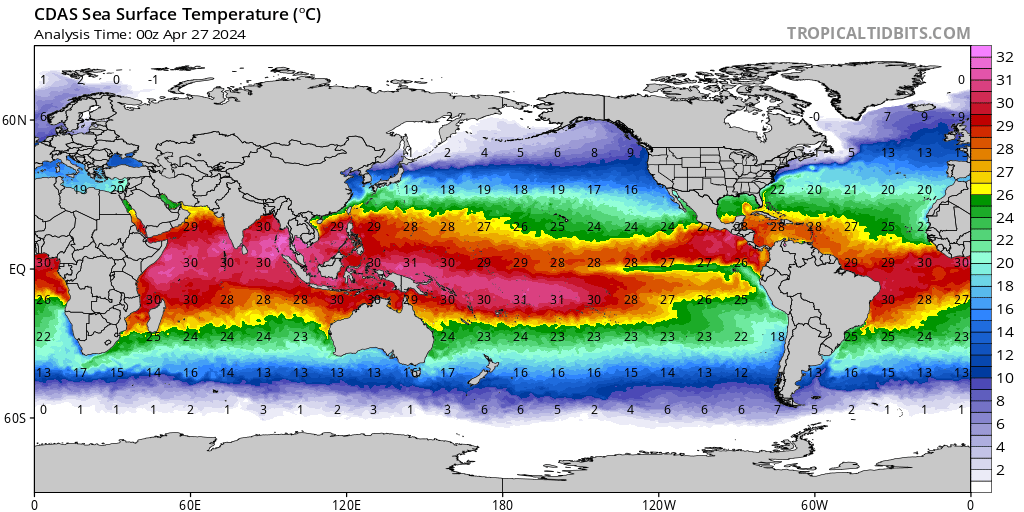
Sea ice forms at -2C and tropical warm pools regulate to 30C so average global surface temperature is 14C or 57F. The result can be observed every day of every year in any century, any millennium or the last million years:
I have concluded from different comments that the key persons of this site do not believe the GH effect. It is a sad observation that this site supports such denying of scientific fact. Many comments show that there are many readers of this site who has the same opinion.
For these deniers, I have a simple question based on reliably measured observations. The Earth’s surface emits radiation about 395…398 W/m2 and the same surface absorbs direct solar radiation about 165 W/m2. How is this possible? How it is possible that the surface radiates more energy than it receives from the Sun (240 W/m2). I have never received any explanations but comments that we cannot rely on any NASA measurements.
The view of many people is that the entire concept of the GHE is faulty. These folks are not denying radiation physics. Clearly, you haven’t looked into the details of what they are saying.
One part of the GHE claims is that downwelling IR is what warms the surfaces. Another view that completely accepts that GHGs absorb and emit IR is that the surface warming is independent of downward IR. It would be exactly the same independent of that IR. The warming is simply due to the absorption of energy from the surface and distribution within a mass with a gravitationally determined structure. You’d get the same temperature with all IR radiation moving towards space.
How about geothermic heat! I grew up caving. Go 50 feet below the surface in WVA and and its 50-55 degrees no matter what the air temperature is. The idea that geothermic heat from the earth’s core has no impact on the surface temperature just makes no sense to me.
No it doesn’t – where do you get this nonsense from?
Find out where and how those alues you quote have been measured and you may gains some significant understanding.
Phys.org: Sydney and Narooma’s hot spot of ocean warming is more than three times the global average.
https://phys.org/news/2021-03-sydney-narooma-hot-ocean-global.html
Another warming three times faster. Places cooling three times faster rarely make the news. It does highlight how much a good measure, rather the dogs breakfast we have, is.
to bed b:
Undoubtedly a stalled high pressure weather system parked there
Happens frequently around Australia.
This is a terrific article from Jim Steele!
I would like to comment on Jim’s second sentence: “Water vapor primarily and CO2 can slow radiative cooling via the greenhouse effect.”
This is the usual statement that is asserted—even by non-AGW-proponent scientists—regarding the radiation effect of water vapor and gaseous CO2 affecting Earth’s total radiation balance, but it is misleading since it fails to tell the whole story of their roles.
Because both water vapor and CO2 have very high molecular collision rates with N2 and O2 (collision frequencies are on the order of 1E+8 to 1E+10 per second, depending on the Boltzmann energy distribution at a given average temperature), together comprising 99% of dry air in Earth’s atmosphere, they actually serve to enhance radiative cooling to deep space when considering Earth’s total radiation balance.
Normally, N2 and O2 being homonuclear diatomic gases without a dipole moment should not, in isolation, be able to absorb or emit EM radiation . . . and thus, should theoretically not be involved in the radiation balance of the atmosphere when considering either incoming solar radiation (mostly visible and near-IR) or outgoing (mostly LWIR) thermal radiation from Earth’s land and ocean surfaces. The commonly-used phrase is that N2 and O2 are “transparent” to LWIR, as they are for incoming solar radiation.
However—and this is the key point that is often not considered—it is the very rapid collisions of LWIR-absorbing (therefore, excited) water and CO2 molecules that enables the “thermalization” of LWIR energy throughout the atmosphere . . . basically, ensuring an essentially equal average temperature of all atmospheric gases for a given altitude above sea-level (neglecting local vertical convection currents, of course). The fundamental reason that this occurs is that molecular-to-molecular collisions do, in fact, cause rapid acceleration/deceleration of each molecule’s shared electron cloud and each atom’s nuclear magnetic moment) at the “instant of collision” and it is this momentary charge acceleration/deceleration that permits the N2 and O2 molecules to emit EM photons that they would otherwise be incapable of doing in isolation from just their molecular symmetrical stretching vibration mode. This type of radiation is most commonly referred to as “thermal radiation from gases” (see https://en.wikipedia.org/wiki/Thermal_radiation ).
Note that such thermal radiation from homonuclear diatomic gases is not classic temperature-dependent blackbody thermal radiation nor is it restricted to discrete spectral absorption/emission lines (such as those that are associated with the binary compounds water vapor and CO2, absent molecule-molecule collisions).
The collision-induced radiation from 99% of the volume of Earth’s atmospheric gases (tied to the Boltzmann distribution of thermal energy of each gas specie) is the predominate source of Earth’s radiation energy going to deep space . . . not that directly from water vapor, not that directly from cloud tops, not that directly from CO2, and not that directly from Earth’s surface.
“Changes in land surface conditions are another critical dynamic. For example, given the exact same amount of incoming heat, dry soils will increase surface temperatures twice as fast as moist soils.“
So, dry soils under the same daylight conditions as ‘wet’ soil will reach a higher temperature. But ‘wet’ soil is wet, as in ‘wet with water’, and as such wouldn’t the wet soil have a much higher heat/energy capacity? So the wet soil, even at a lower temperature, could have absorbed more energy than the dry soil? And I’d guess that the wet soil’s heat transfer coefficient is higher than dry soil, so the temperature gradient would be such that the elevated temperature ‘goes deeper’. Sounds like wet soil would be a much better ‘thermal energy battery’ than dry soil, as far as building an ‘energy charge’.
not to mention that ‘twice as fast’ is just junk terminology.
This article needs to go into Everything Climate
Jim, I’m not a climate scientist. This is the clearest explanation of climate dynamics (and most comprehensive) I’ve read.
However, you say: “These high‑pressure systems block moist ocean winds from bringing summer rains to the west coast of California and the Mediterranean regions. This dynamic causes several months of summer drought each year, making California one of the most fire prone regions globally. La Nina years extend summer droughts into the winter. Simultaneously, due to the clock‑wise circulation of the Pacific high, moisture carrying winds are pushed northward causing wet summers from Oregon to Alaska.”
Well, I’m approaching my 50th consecutive summer in western Oregon where I’ve yet to experience a wet one (despite that the local joke is that you don’t schedule picnics until July 5; that’s when you’re guaranteed to have nice weather). Can you please explain?
My son attended Oregon University (the Ducks) and just by looking at the lowland vegetation it certainly appeared Oregon gets more moisture than California. The precise latitude of blocking would be hard to predict, but from my casual observations driving up into Oregon and Washington, the further north you go the more likely you are to get rain. I dont have the stats to argue quantitatively, but northern Washington and southern Alaska are home to temperate rainforests.
Working in the Sierra Nevada I could be in completely dry, clear-sky weather due to the blocking of moisture from the west due to that Pacific high pressure, but at the same time look across to the Reno area, and watch thunderstorms and rain because those rains are driven by monsoonal activity bringing moisture from the south.
Where do you live? southern Oregon? Since you’re west of the Cascades you should be getting more rain, than at least eastern Oregon. I suggest getting Cliff Mass’s The Weather of the Pacific Northwest for insights to weather in your location and how local circulation affects you.
Jim,
Thanks for your response. Go Ducks!
I live in the southern end of the Willamette Valley. And indeed, your casual observations are correct: you do get more rain the farther north you go. Salem and Portland get more precipitation than Eugene, and it seems like it’s always gray in Seattle.
Counterclockwise lows off the Pacific bring us the rain from October through late spring. Summer clockwise highs bring western Oregon winds from the northwest, and “the skies are not cloudy all day” from the first week in July through September. My casual observation by looking at the satellite pix daily is that the Pacific lows go up over the top of the high into SW Alaska. Western Oregon’s summer climate is essentially the same as California’s, but not nearly so warm as, say, Chico’s or Redding’s. See, e.g.: https://www.usclimatedata.com/climate/eugene/oregon/united-states/usor0118.
If you’re in the Sierra Nevada looking at Reno you’re sitting in the Sierra rain shadow, which is essentially the same as the Cascade rain shadow affecting eastern Oregon.
I also have a home in far south-eastern Oregon, which is susceptible to the same summer monsoonal thunderstorms as Reno, but with usually less moisture. See, e.g.: https://www.usclimatedata.com/climate/adel/oregon/united-states/usor0002.
So, I guess the western Oregon climate is Mediterranean with oceanic influences, or oceanic in the winter, and Mediterranean in the summer. See, e.g.: https://www.climatestotravel.com/climate/united-states/eugene.
Kind regards,
Mike Fox
Born in Eastern Oregon over 70 years ago, I’ve lived in Central and Western Oregon, but not Southern. Also in Southern and Northern CA.
The transition from California’s Mediterranean climate to the Pacific NW’s Western Marine zone is gradual, however there is a movable weather feature distinguishing the two systems.
Unlike their equatorward neighbors, marine west coast climates lie beyond the farthest poleward extent of the subtropical anticyclone. They experience the midlatitude westerlies and traveling frontal cyclones all year. Precipitation totals vary somewhat throughout the year in response to the changing location and intensity of these storm systems, but annual accumulations generally range from 20 to 100 inches, with local totals exceeding 200 inches where onshore winds encounter ranges.
For example, San Francisco averages ~24 inches per year, Eureka 43″, Coos Bay 64″, La Push, WA 100″ (backed by the Olympics rather than the lower Coast Range), Nanaimo 71″ and Ketchikan 140-160″. Anchorage, by contrast, averages only ~17″.
The Willamette and other inland valleys west of the Cascades get less, for example Portland 43″, and of course Central Oregon, in the rain shadow of the volcanic range, is a high desert.
Chile, where I live now, experiences the same transition. I’m in the central, Mediterranean zone, but have also lived in the southern Western Marine zone. A coast range and even higher inland volcanic range, ie the Andes, makes the NH and SH situations similar. The Humboldt Current is however colder than the Kuroshio and California Currents. The equatorward Desert zone here is even drier than Baja. In fact the Atacama rivals the Namib as driest on the planet.
Also lived in England, another western maritime climate, but with a warmer, poleward current offshore, rather than cooler, equatorward flow. All of Britain lies north of the 49th parallel, much of the US-Canadian boundary.
Thanks, John! Very interesting and informative.
~~ MF
For me, this is one of the true man made contributions to warming.
It ain’t global, it ain’t CO2* and it ain’t catastrophic
I also think the changes in land surface conditions and lack of maintenance of surface water drainage contributes a great deal to localised flooding
*beyond normal bounds blah, blah, blah
There is rather new knowledge of Solar Barycenter. The very first calculation using that and measured TSI gives interesting outcome for coming centuries.
Study is paid by public supporters and partly by ”US Airforce grant PRJ02156” and it is reviewed last month and published some days ago.
Some highlights:
”This amount of the extra solar radiation input into the terrestrial atmosphere and ocean has not been yet considered in the current climate models.”
”Hence, in 1600–2600 the Earth will be turning closer to the Sun for up to 25 additional days after the summer solstice, while turned towards the Sun with its Northern hemisphere, before it approaches the local aphelion.”
”the solar irradiance S can vary either because of the variations of intensity I of solar radiation at the Sun itself or because of the variations of a distance d between the Sun and Earth.”
Inverse square law [see picture] -> max irradiance 1411 W/m^2 during the above millenia 1600 – 2600.
”The difference in the irradiance is 1411–1366 = 45 W/m^2, that is 3.3%”
[1366 e.g. by Lean et Al,]
The study:
DOI: 10.5772/intechopen.96450
https://www.intechopen.com/online-first/millennial-oscillations-of-solar-irradiance-and-magnetic-field-in-600-2600
How can you go wrong making a prediction that spans one thousand years, including 580 years into the future?
Go for it!
If you admit that GHG are warming the earth, additional CO2 will bring additional warming , that’s pure logic. We know that the relation between greenhouse effect in watts/m and concentration in ppm, there is a logarithmic function , but the CO2 effect is not saturated according to MODTRAN model…
The big open question is HOW MUCH ??? but we cannot measure it ,even the effect of total CO2 alone …
IPCC over estimates CO2 cause, but we cannot eliminate it , that’s also an error !
The truth is between both …
in 2040, we expect to have solar minimum and also low phase of AMO cycle , this should give us the opportunity to measure the real difference from anthropogenic radiative forcing …
“If you admit that GHG are warming the earth, additional CO2 will bring additional warming , that’s pure logic.”
It would be logical to assume that, unless you have heard of Dr. Happer’s new research paper which claims CO2 has an upper limit to how much warmth it can add to the Earth’s atmosphere, and at current CO2 levels in the Earth’s atmosphere, we are almost there. Adding more CO2 won’t add that much additional warmth. We are home free, if Dr. Happer proves to be correct. And my money is on Dr. Happer. He has a proven track record.
“If you admit that GHG are warming the earth, additional CO2 will bring additional warming , that’s pure logic.”
That “pure logic” is WRONG! There is a common physical process known as reaching an asymptotic limit (aka a physical process becoming “saturated”), wherein adding additional amounts of something known to cause changes in a variable ceases doing so beyond a certain point. A commonly-cited example of such is that dissolving salt in water continues only to a certain salinity level, which is a function of water temperature . . . beyond that salinity point, adding further salt does NOT result in it going into solution.
Wijngaarden and Happer present the scientific evidence that atmospheric CO2 at its present concentration level is very close to—if not already—saturated in its ability to contribute any additional “greenhouse gas” feedback to Earth’s surface temperature (related discussion and link to pre-print at https://wattsupwiththat.com/2020/10/26/study-suggests-no-more-co2-warming/ ).
I dont accept that the oceans can absorb global warming. LW energy from CO2 can not penetrate water to any meaningful depth, a micron or so, and cant climb the uphill temperature gradient.
The SAGE Tangaroa experiments detected, with 100 watts m^-2 of cloud cover IR, a 0.2 C increase in this few micron thick layer.
CO2 is giving 2 watts a sq meter.
And any effect on causing the ocean to retain heat, by raising the skin temp this tiny amount, is heat it got from visible light, that can penetrate water.
So no, the oceans can not absorb global warming, global warming is 15 micron energy from CO2. It cant penetrate water.
Short wave (light) solar radiation can penetrate ocean waters to 100 meters or so, depending on water conditions. Everything radiates IR but IR cannot radiate out of the ocean except at the very surface. Much of the daily absorbed energy is lost from the ocean during the tropics’ nightly overturning and various other processes that depend on convection and conduction but considerable energy can accumulate below the surface. Some of that energy may remain for decades, centuries, perhaps millennia, which are climate lengths of time.
Another excellent and reasoned article by Jim Steele. I have one quibble and this is that journalists and politicians lack the necessary scientific knowledge. I think they lack the necessary intelligence and couldn’t even get close to any scientific understanding. Do you need any scientific knowledge to grasp that the world does not possess enough minerals for all the batteries their policies require even on a national basis let alone worldwide?
You are missing the most important part of the El Nino, La Nina phase change which is variation in wind driven coastal upwelling, As this upwelling water is rich in CO2 ENSO cycles have a profound affect upon the CO2 cycle. During an El Nino upwelling is suppressed, reducing the ocean to air flux of CO2. This is why El Nino years make for poor fishing seasons off the coast of Peru.
El Nino events cause warming in the Nino regions (Nino 1,2,3,3.4, and 4) because the upwelling of cold water is reduced. This has nothing to do with how much energy is absorbed from the sun. This is analogous to what happens in your water heater when you are using hot water, which is replaced by cold water flowing in. When you stop or reduce the flow of water out the flow of cold water in is also stopped or reduced. The result is the temperature of the water in the tank increases.
La Nina events are the opposite of this.
El Nino events result in a net increase in atmospheric CO2 because the increase in CO2 net emissions are greater than the reduction in ocean to air flux.
You need to read this paper concerning what was learned from the OCO-2 satellite launched in 2014.
“During strong El Niño events, there is an overall increase in global atmospheric CO2 concentrations. This increase is predominantly due to the response of the terrestrial carbon cycle to El Niño–induced changes in weather patterns. But along with the terrestrial component, the tropical Pacific Ocean also plays an important role. Typically, the tropical Pacific Ocean is a source of CO2 to the atmosphere due to equatorial upwelling that brings CO2-rich water from the interior ocean to the surface. During El Niño, this equatorial upwelling is suppressed in the eastern and the central Pacific Ocean, reducing the supply of CO2 to the surface.”
https://science.sciencemag.org/content/358/6360/eaam5776
The only thing I am missing is what is your point and what are you disagreeing with?
Thanks Jim – a treasure trove of useful knowledge, as usual!
Jim,
It looks to me that your Fig. 4 is demonstrating a high correlation between US warming and metropolitan urban corridors. That is, it demonstrates how the Urban Heat Island effect is biasing the average temperatures.
Yes, it suggests an urban effect too. Boston to DC, SF, LA and the Tampa areas all stand out for their lack of cooling stations
However the graphic comes from Wickham (2013) Influence of Urban Heating on the Global Temperature Land Average using Rural Sites Identified from MODIS Classification, who claim because rural regions also experienced warming there is no urban heat effect. However their methods use a static division of urban versus rural yet failed to determine if both urban and rural experience increasing population trends that would cause both regions to warm via urbanization effects
An excellent analysis! What this shows is that there are many “control knobs”, some of which can operate in opposite directions simultaneously, and generate unusually hot or dry weather in some areas and unusually cold or wet weather in other areas at the same time, and CO2 concentration is one of the weakest “control knobs”.
Jim Steele correctly points out that the CO2 absorption bands in the IR wavelengths are nearly saturated at low altitudes, and increasing CO2 concentrations would simply cause the same amount of energy to be absorbed closer to the earth. However, at higher altitudes, very little outgoing IR energy is left to be absorbed, and the lower atmospheric pressure means that there are fewer molecules of CO2 per cubic meter than at lower altitudes, so that very little IR energy could be absorbed in the stratosphere.