A new study published in Science reveals that the fertilizing effect of excess CO2 on vegetation is decreasing worldwide
SPANISH NATIONAL RESEARCH COUNCIL (CSIC)
When plants absorb this gas to grow, they remove it from the atmosphere and it is sequestered in their branches, trunk or roots. An article published today in Science shows that this fertilizing effect of CO2 is decreasing worldwide, according to the text co-directed by Professor Josep Peñuelas of the CSIC at CREAF and Professor Yongguan Zhang of the University of Nanjin, with the participation of CREAF researchers Jordi Sardans and Marcos Fernández. The study, carried out by an international team, concludes that the reduction has reached 50% progressively since 1982 due basically to two key factors: the availability of water and nutrients. “There is no mystery about the formula, plants need CO2, water and nutrients in order to grow. However much the CO2 increases, if the nutrients and water do not increase in parallel, the plants will not be able to take advantage of the increase in this gas”, explains Professor Josep Peñuelas. In fact, three years ago Prof. Peñuelas already warned in an article in Nature Ecology and Evolution that the fertilising effect of CO2 would not last forever, that plants cannot grow indefinitely, because there are other factors that limit them.
If the fertilizing capacity of CO2 decreases, there will be strong consequences on the carbon cycle and therefore on the climate. Forests have received a veritable CO2 bonus for decades, which has allowed them to sequester tons of carbon dioxide that enabled them to do more photosynthesis and grow more. In fact, this increased sequestration has managed to reduce the CO2 accumulated in the air, but now it is over. “These unprecedented results indicate that the absorption of carbon by vegetation is beginning to become saturated. This has very important climate implications that must be taken into account in possible climate change mitigation strategies and policies at the global level. Nature’s capacity to sequester carbon is decreasing and with it society’s dependence on future strategies to curb greenhouse gas emissions is increasing”, warns Josep Peñuelas.
The study published in Science has been carried out using satellite, atmospheric, ecosystem and modelling information. It highlights the use of sensors that use near-infrared and fluorescence and are thus capable of measuring vegetation growth activity.
Less water and nutrients
According to the results, the lack of water and nutrients are the two factors that reduce the capacity of CO2 to improve plant growth. To reach this conclusion, the team based itself on data obtained from hundreds of forests studied over the last 40 years. “These data show that concentrations of essential nutrients in the leaves, such as nitrogen and phosphorus, have also progressively decreased since 1990,” explains researcher Songhan Wang, the first author of the article.
The team has also found that water availability and temporal changes in water supply play a significant role in this phenomenon. “We have found that plants slow down their growth, not only in times of drought, but also when there are changes in the seasonality of rainfall, which is increasingly happening with climate change,” explains researcher Yongguan Zhang.
###
Reference article:
Wang S, Zhang YG, Ju W, Chen, J, Ciais P, Cescatti A, Sardans J, Janssens IA, Sardans, J, Fernández-Martínez, M, … Penuelas J (2020). Recent global decline of CO2 fertilization effects on vegetation photosynthesis. Science, DOI: 10.1126/science.abb7772
More Hobgoblins to menace the public school graduates with. And I wonder what, pray tell, the Central Authoritarian Government will be able to do to save us from this Hobgoblin?
CSIC abbreviates “Consejo Superior de Investigaciones Científicas”, which translates literally as “High Council of Scientific Researches”.
It was created in 1939 under Franco to “restore the classical and Christian unity of the sciences destroyed in the 18th century”. Now it’s a local branch of the Church of CACA.
CREAF is the Center for Ecological Research and Forestry Applications (Centro de Investigación Ecológica y Aplicaciones Forestales).
Remember that socialists are in control in Spain.
These people will wright whatever to maintain their high paying job.
If what these ‘scientists’ say would be true, plant life would have extinct a long long long time ago.
Ding ding ding! We have a winner!
History tells us we are far, far from any limits.
So what. Carbon dioxide does not drive climate; in fact, it, and methane, are irrelevant compared to water vapor. Just Google Methane: the Irrelevant Greenhouse Gas.
Yet the models rely on more H2O in the air to achieve ECSs of 3.0 degrees C per doubling of CO2 or higher. Less rain in some places despite more water vapor? What gives?
The study apparently ignores the fact that more plant food in the air means that vegetation need leave its stomata open for less time to get the CO2 needed to make sugar.
The firther greening of the Earth shouldn’t stop until CO2 levels reach about three times as rich as now, ie the 1000 to 1300ppm kept by commercial greenhouses. Besides which, if N, P or any other element limit crop growth, fertilizer and/or N-fixing organiisms can be applied, to include to tree farms.
Yes, yet these “scientists” FOUND that water availability and water supply play a factor in how much CO2 increases plant growth.
I am glad they found this out, because everybody with common sense already knows.
Did they find out that farmers control water supply? Did they find out that additional CO2 makes plants more drought resistant, AND more nitrogen efficient?
All the narrative that fits. None that doesn’t.
Activist advocacy, not science.
It has the EurekAlert! imprimatur— certified falsehood.
Plants need water to grow??
I’ve heard that before. I just don’t remember where.
“You mean like out the toilet?”
https://m.youtube.com/watch?v=-Vw2CrY9Igs
and having plants/tree creates water/rain events that otherwise don t occur
see land cleared for mines changing local weather dramatically as in central qld(firns lives there)
removing old senescing trees always helps too. allows new growth to replaceit
meanwhile in my place Ive noted a very old redgum which usually is light on top and dropping older leaves in this season has masses of new shiny green growth right to the 70ft+ top
rainfalls close the avg for the yr after a drought year at 520mm so far
avg temps day and night are Below by as much as 5c
As I cited long ago elsewhere on WUWT: the characterization of elevated CO2 (eCO2) occasioning reduced stomata openness is a generalization & linear mis-representation. In some plants during their late season growth their stomata are actually relatively more open, despite eCO2.
But what is the overall ratio?… 80/20?, 90/10?, or 95/5?.
The trend dominates the outlier.
This relies on the accepted assumption that plants obtain their CO2 via the stomata. This in turn is based on an old experiment that used distilled water as a proxy for rainfall, as it was assumed that pure water does not readily take up other substances. Since we have first hand knowledge of acid rain, i.e. rain water taking up other substances in it’s travel through the atmosphere, and no one has yet explained, to my knowledge, how it is that water in travelling through soil manages to take up the other nutrients that plants need but not Carbon Dioxide, I am extremely skeptical of that particular conclusion. Given this, I think it’s time someone took a sap sample from a plant and examined it to establish whether CO2 is present or not, something that should be trivial with today’s technology. Should it turn out that the “accepted facts” are incorrect, it will probably change our farming practices, amongst other possibilities…
Tony, CO2 plus water yields carbonic acid, a mild acid.
CO2(aq) plus H20 → H2CO3(aq)
This happens every time the rain falls, and the mildness of the resulting acid can be seen in the fact that we merrily drink rainwater and it doesn’t seem acid at all.
As a result, it would suprise me immensely if there were enough CO2 dissolved in the water to supply the needs of the plant … and that’s apart from the issue of the plant having to somehow remove the CO2 from solution. That takes energy in some form …
w.
Quite so, yet that carbonic acid, together with additional additional CO2 obtained through passage through the soil is credited with creating limestone caves, complete with stalactites and stalagmites, as well as those in chalky soils. The original experiment provided for no dissolved CO2 in the water, yet we have now agreed that there is in fact some CO2 dissolved in the water that the plants take in. If we consider that it is reasonable to assume that the water is saturated by the time it reaches the leaves, an explanation must be sought as to how additional absorption can take place…
True, Tony, but the mildest acids can dissolve limestone over hundreds and thousands of years …
The part that you are leaving out is that the plants are alive. And life can drive just about any reversible chemical reaction in either direction. How do plants do it?
They do it with the help of two things—chlorophyll-related catalysts and solar energy. And when you have those, the saturation state of the water is not an issue. What plants do is:
CO2(gas) plus H20 + sunlight + chlorophyll → C6H12O6 (sugars) + O2
Note that what is happening here is NOT just carbon dioxide dissolving in or bubbling out of water in the reactions we discussed above …
Regards,
w.
I appreciate what you are saying, but you miss the thrust of my argument here. The experiment that determined the current position that plants obtain their Carbon Dioxide directly from the air was based on the assumption that pure water, as a proxy for rainwater, would not accept Carbon Dioxide from the air. Given this, pure water was provided to a leaf and photosynthesis took place at the stomata, hence hey presto, plants must obtain the Carbon Dioxide they require from the air. Since we have just agreed that rainwater does, in fact, take up Carbon Dioxide directly from the atmosphere, is the conclusion drawn from the leaf experiment still valid? Can we still assert that plants get their required CO2 directly from the atmosphere at the stomata when we know the water already contains Carbon Dioxide even before the plant takes it up?
Tony Garcia December 12, 2020 at 9:55 am
Cite? AFAIK, CO2 uptake has been measured many, many times, and in a variety of ways, to determine a host of things about the plants. Where did you get the idea that the experiment has only been done with pure water?
Here’s a forinstance …
There’s three ways to measure CO2 uptake … none of which require pure water. And curiously, one of the ways is to measure how fast CO2 is removed from water by the aquarium plants Elodea …
w.
I appreciate the example you give, yet since it was performed with an aquatic plant, no soil was involved ipso facto. If you can quote an experiment other than the leaf one that indicates that plants rooted in soil obtain their Carbon Dioxide directly from the air via the stomata rather than utilising the Carbon Dioxide that we both agree rainwater collects from the air in it’s fall to earth, I’d be most grateful….
Tony, to date you’ve provided no link to your claim about pure water. Do land plants get some CO2 from water? Likely, although likely very little. Are aquatic plants different from land plants? Sure. So what?
My point remains. The entire photosythesis process has been extensively studied for decades. Not sure what difference you think the error you claim (without evidence) was made would make … there is absolutely not enough CO2 in the amount of water a plant uses to provide more than a tiny part of the CO2 needed. We know this from stomatal measurements. Think about it.
Finally, I pointed out that there are two other ways to measure CO2 used, neither of which require pure water. You’ve flat out ignored that … why?
w.
Perhaps if I explain why I am pursuing the matter, things will become clearer. Due to the experiment with pure water that I refer to, a determination was made that plants obtain their Carbon requirements directly from the air via the stomata. As a result of this, nutrients such as Nitrates will be used to supplement soil used for farming, but no Carbon will be intentionally introduced due to the aforementioned assumption. We have agreed that the water does, indeed, take up Carbon Dioxide from the atmosphere. This alone, in my view, invalidates the experiment with the leaf. There is now the passage of water already containing Carbon Dioxide through the soil until it reaches the plant and is taken up. As you point out, the CO2 obtained by the water from the atmosphere is insufficient for the plant’s needs, so the additional CO2 is either being obtained from the soil or from the atmosphere, the atmosphere being the accepted source. An explanation would now need to be provided as to why no further CO2 is taken up via passage through the soil, as it is more Carbon-rich than the atmosphere. Should it be the case that the additional Carbon is indeed being sourced from the soil, a gradual depletion will take place under intensive farming conditions as it is not being intentionally replaced. What set me off on this search is that on the Innocentive site the US Environmental Protection Agency and US Department of Agriculture are co-sponsoring with other entities a search for the “Nextgen Fertiliser Innovations”, and I was curious as to why apparently traditional fertilisers are no longer deemed ineffective. I will attempt to locate a link relevant to the “pure water” experiment and will provide it when I find it. Many thanks for your input so far, TG
Tony Garcia December 12, 2020 at 7:18 pm
WHICH EXPERIMENT? Sorry for shouting, but I asked before for a link and got nothing …
w.
Yup John, very broad brush….
A single degree of global warming increases the water molecules above the oceans by 7%. Air parcels rising equal air parcels descending, so that is likely to result in 3.5% times 70% ocean coverage or 2.5% more precipitation on a global average. This is within the normal variation everywhere on the planet, so would require a more than 2 climate periods of 30 years to even measure with some statistical confidence. Their basic premise of warmth causing water deficiency is simply wrong.
And I won’t even get into how the 2.5% more precipitation comes from 2.5% more cloud cover, which reflect 2.5% times cloud albedo back into outer space and causes the 1 C increase to become zero C increase over the next day or so…..very broad brushedly speaking of course…..
This is less certain though. The change in albedo is much less certain. It depends on when and where clouds form, their brightness, thickness/height, daytime versus nighttime, etc.
Yup.
https://phys.org/news/2018-01-discrepancies-satellite-global-storage.html
https://archive.news.iupui.edu/releases/2016/02/drylands-global-greening.shtml
That is the most important point. Ample greenhouse data shows unequivocally that plants continue responding to CO2 well beyond current levels. In open environments there will be wet years when moisture is decidedly not limiting and in dry years high CO2 makes low moisture less limiting. Mycorrhizal communities will change under the influence of high CO2, organic bound nutrients in the soil will increase with the higher plant productivity from elevated CO2. Once again a situation too complex to model has been turned into a fear factor in the never ending drive to create a world in a never ending state of anxiety.
Now that Biden is back (probably), the greening of “Climate Scientists'” pockets is just beginning.
Well, to borrow from Joe’s penultimate predecessor (the one who declared “the moment seas stop rising and the planet starts to heal), maybe Joe should now come out and at his inauguration declare –
“This is the moment the CO2 stops fertilizing, and the planet turns to shit”
(Oh wait- apparently that’s already happened 🙁 )
its worse then we thought again!!
it just never ends
You just wonder how life could have survived for so long. Because if what these ‘scientists’ say is true, plant life would have extinct a long long long time ago.
IOW, the greening acceleration, call it “Green double dot”, is decreasing. Okay.
From near logarithmic growth to a steadier linear growth, that’s what biological systems do.
Sahara and other deserts don’t green only because of CO2 but also because of changing weather patters with more rain in dersert regions.
Crocos in oasis today show us, the complete region of the Sahara was a flowering region in warmer times of our history with more rain.
Krishna Gans, check out this video at 20mins.
Apparently, in response to a northerly movement of the monsoon, the greening of the Sahara occurs at or near each interglacial inception and lasts for several thousand years. 7 times in the last 600,000 years.
It is thought this phenomenon contributed significantly to Sapiens evolution.
Yes it’s high obliquity that triggers interglacials (after a 6500 year lag for ocean heating) which make the inter tropical convergence zone wider bringing the monsoon to north Africa.
It’s interesting to speculate if unusually high atmospheric CO2 might induce the Sahara to green over even in the absence of the obliquity driven monsoon.
Rapid end of the Green Sahara 8000 years ago
19 January 2015/Kiel. 9,000 years ago most of the Sahara was not the ultra-arid desert as we know it today. Due to higher precipitation it was covered by large lakes and savannah that were populated by herds of wild game. Scientists from the GEOMAR Helmholtz Centre for Ocean Research Kiel and the Royal Netherlands Institute for Sea Research (NIOZ) now have discovered that vegetation at the end of the Green Sahara disappeared much faster than previously assumed. This probably forced the Neolithic populations to start farming. The study has been published in the international open-access journal PLOS ONE.
At other places they talk about the possible reason.
The Green Sahara, also known as the African Humid Period, was caused by the Earth’s constantly changing orbital rotation around its axis, a pattern that repeats itself every 23,000 years, according to Kathleen Johnson, an associate professor of Earth systems at the University of California Irvine.
Source
Link correction
Rapid end of the Green Sahara 8000 years ago
“These unprecedented results indicate that the absorption of carbon by vegetation is beginning to become saturated. ”
The moment I see the word “unprecedented” it’s a good indication we’re looking at more junk science. Then I look a little further and I see “modeled result”. Now I’m sure I’m being sold another pointless bill of goods. Because it was inarguable that CO2 greening was taking place and that more CO2 was clearly providing benefits, that fact needed to be altered to further the “CO2 bad” narrative and get the “climate change” propaganda back on track.
LOL..
Funny how plants that can into being with MUCH HIGHER CO2 levels, suddenly have issues with not enough micro trace elements
I call BS !!!
On target!
USDA back in the 1950s tested higher CO₂ levels for crop growing.
Plants grew extremely well under higher CO₂ levels.
Except they quickly drained their limited soils of trace elements.
USDA authors surmised that it was the constrained environments preventing plants from absorbing sufficient trace elements.
i.e. people building and managing the constrained environments underestimates what is needed for increased plant growth and fail to supply sufficient nutrients and minerals.
if you take everything OFF farm for sale instead of feeding the grain n hays to ON farm with some sold, not all, and all waste and manures spread on farm as originall happened…
then yes soils deplete what they had.
some soils need extras regardless due to mineral deficiency or xcesses of certain nutrients
its our relience on bringing all fertiliser in to replace what we flog off and going to monocrops not mixed farming thats helped screw it up
Yet another so called science paper that ignores well known science.
As CO2 levels increase, plants need less water.
If the author’s don’t know that, they don’t know enough to be speaking on this subject.
A long time ago I would be surprised when a PhD didn’t know something, related to their field, that I had supposed was common knowledge among educated people. It finally dawned on me that a PhD isn’t actually an education in the sense of the word as I was raised to think of it.
My qualification was not PhD, hardly, but I was told that it was a license to learn.
I did earn it through a long oral defense of my knowledge and abilities. Apocrine sweat rings ruined an expensive dress shirt.
It’s an academic union card.
Having a PhD does not mean that one knows more that is true, only that one knows more. Today’s universities specialize in giving out PhD’s in things that are clearly false and/or capricious! If ‘knowing’ something that is false brings more power and control over people, the false thing is more valuable than the truth at (post) modern universities!
Piled higher and Deeper.
If you’re going there, you need to do the whole sequence:
BS: Bull Shit
MS: More Shit
PhD: Piled higher & Deeper
If the trees grow bigger, they will drop more leaves.
If the trees drop more leaves, then the nutrients taken up by the trees to grow more leaves will be replaced.
Once again, not a problem, unless you are looking for an excuse to trick others into panicing.
And the CARBON CYCLE is further invigorated.
They have also found that nitrogen fixing soil bacteria thrive under increased atmospheric CO2.
“I smell a model approaching,” sez I, as I sat down to read this post. I was not disappointed:
“The study published in Science has been carried out using satellite, atmospheric, ecosystem and modelling information,” sez the post.
I turned off my AGWBS detector and got another cup of coffee.
The ignorance of “experts” is often remarkable, particularly when they publish in Science (or Nature, or PNAS). It is a long-established fact, proven by many studies, that higher CO2 levels reduce plants’ water requirements.
Elevated CO2 (“eCO2”) is also especially beneficial in drought conditions. The incidence of droughts has declined only slightly, but their destructive impact is significantly mitigated by today’s higher CO2 levels, because eCO2 reduces plants’ water requirements. Here’s a paper which mentions it:
http://www.sciencedirect.com/science/article/pii/S0168192310003163
EXCERPT: “There have been many studies on the interaction of CO2 and water on plant growth. Under elevated CO2, less water is used to produce each unit of dry matter by reducing stomatal conductance.”
Here’s a paper about wheat:
https://www.ncbi.nlm.nih.gov/pubmed/26929390
Fitzgerald, et al. Elevated atmospheric [CO2] can dramatically increase wheat yields in semi-arid environments and buffer against heat waves, Glob. Change Biol, vol.22, pp.2269-2284, 2016.
Cheng, L., et al 2017. Recent increases in terrestrial carbon uptake at little cost to the water cycle. Nat Commun 8, 110 (2017). doi:10.1038/s41467-017-00114-5) reports that the global increase in transpiration due to increased foliage has been offset by a decrease in transpiration due to improved water use efficiency, resulting in almost no change in net transpiration. They found that, thanks to rising CO2 levels, “Land plants are absorbing 17% more carbon dioxide from the atmosphere now than 30 years ago… [yet] the vegetation is hardly using any extra water to do it, suggesting that global change is causing the world’s plants to grow in a more water-efficient way.”
Water is both an essential part of plant structure and an essential ingredient in their metabolism. Water use cannot go to zero. If CO2 increases, increasing plant growth, and available water does not increase, there will be a time when the increased plants utilize all the available water. Beyond that point, more CO2 cannot cause more plant growth.
It seems likely that some parts of the earth have so much available water that such a circumstance is unlikely to be reached. Something else will be the limiting factor, such as sunshine for energy or density of plants competing with each other.
Since the majority of greening so far seems to have been in semi-arid regions, water availability may well be the limiting factor.
When humans intervene, such as supplying water through irrigation, the dynamics are changed. With enough energy for useful work, there is an essentially unlimited amount of water over more than 70% of the globe.
AndyHce wrote, “Water use cannot go to zero. If CO2 increases, increasing plant growth, and available water does not increase, there will be a time when the increased plants utilize all the available water.”
Of course it is true that “water use cannot go to zero.” Just as more efficient energy use won’t enable wind & solar power generation to power your factory on windless nights, more efficient use of water is of no use when there’s no water to use.
But I wasn’t talking about what happens when there’s no water at all. When some water is available, but it is in short supply, eCO2 is extremely beneficial. In such conditions, plant growth is limited by the shortage of water, but higher CO2 levels reduce plants’ water requirements, so more plant growth and higher crop yields are achieved from the same limited amount of water.
Andy continued, “there will be a time when the increased plants utilize all the available water. Beyond that point, more CO2 cannot cause more plant growth.”
That is incorrect. The circumstance in which plants are using all the water that they can get is exactly the circumstance in which extra CO2 is most beneficial.
Andy continued, “Since the majority of greening so far seems to have been in semi-arid regions, water availability may well be the limiting factor.”
It’s the other way around: semi-arid regions are greening more rapidly than other places largely because rising CO2 levels make plants more water-efficient and drought-resilient. (In the Sahel, rainfall amounts have apparently improved, as well, but I don’t think anyone knows why.)
Many places have plenty of water. eCO2 is obviously very beneficial in those places, thanks to the “fertilization effect.”
Many other places have chronic or frequent water shortages. eCO2 is even more beneficial in those places.
A few places have basically no water at all. Those are the only places where eCO2 doesn’t do any good. But at the edges of such places, they are typically bordered by areas in which there’s not quite enough rainfall to support plants. eCO2 can enable those places to sustain plant life, despite the short supply of water.
That causes deserts to retreat. Here’s a 2009 National Geographic article (which they’ve removed from their website):
Sahara Desert Greening Due to Climate Change?
EXCERPT:
Likewise, New Scientist reported (also in this revised version) the “remarkable environmental turnaround,” including a “quite spectacular regeneration of vegetation,” and “a 70 per cent increase in yields of local cereals such as sorghum and millet in one province in recent years.”
A 70% improvement in crop yields, where agriculture is difficult, is a very, very big deal.
When I was a child, horrific famines were frequently in the news, in places like Bangladesh, China, and many countries in sub-Saharan Africa. But children these days just don’t know what famine is. Even Bangladesh now has food surpluses, every year.
Graph: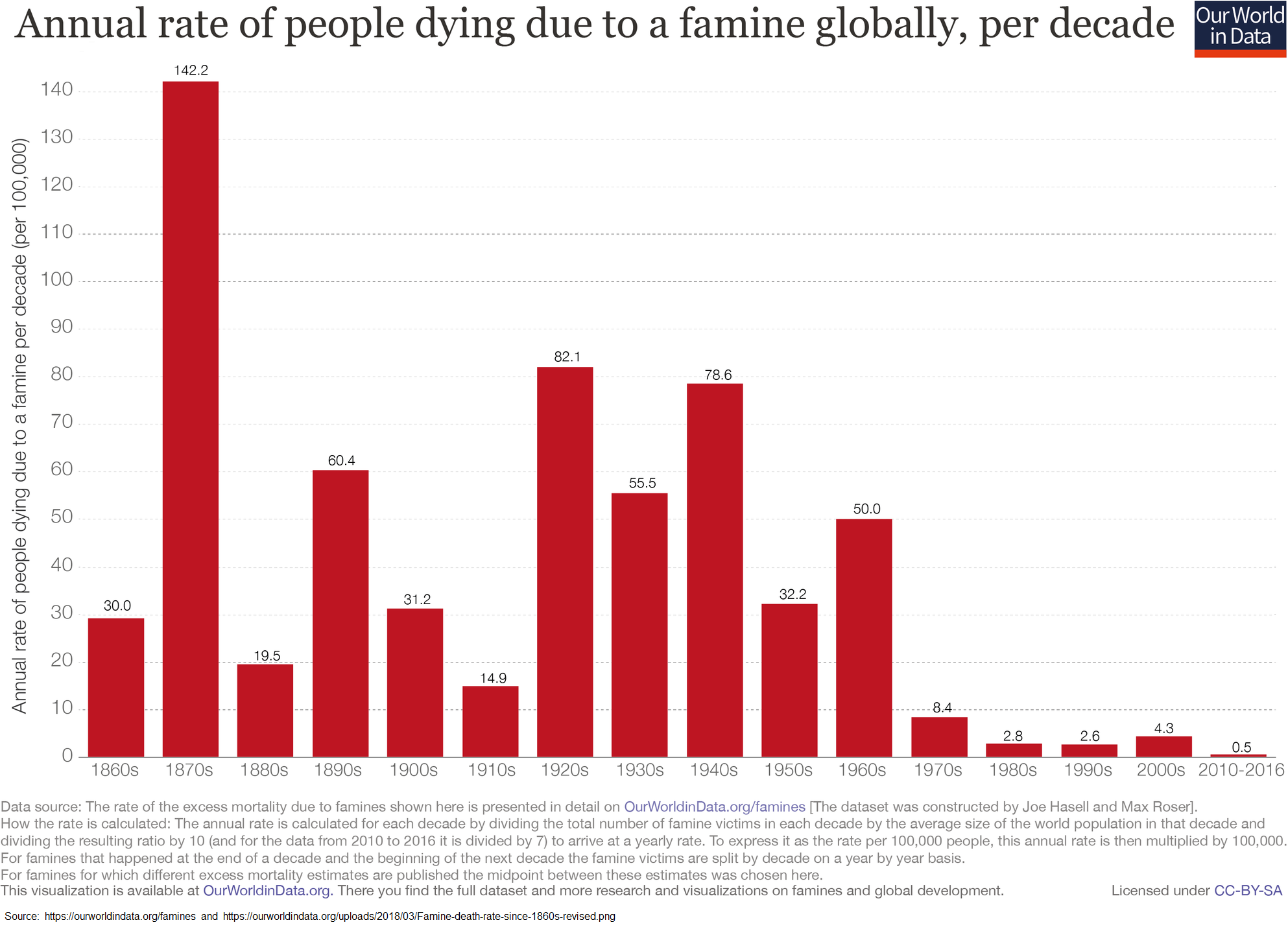
Web page: https://ourworldindata.org/famines
It is just about impossible to overstate the importance of that wonderful change. In Scripture, famine was the “third horsemen of the Apocalypse.” Throughout human history, famines — usually triggered by drought — were among the worst scourges of mankind.
Not anymore.
Rising CO2 level is not the only reason for that welcome change, but it’s one of the important ones. Most obviously, elevated CO2 (eCO2) improves crop yields through “CO2 fertilization,” making food more plentiful. eCO2 is highly beneficial for all major crops, and it is one of the reasons for improving grain yields:
graph: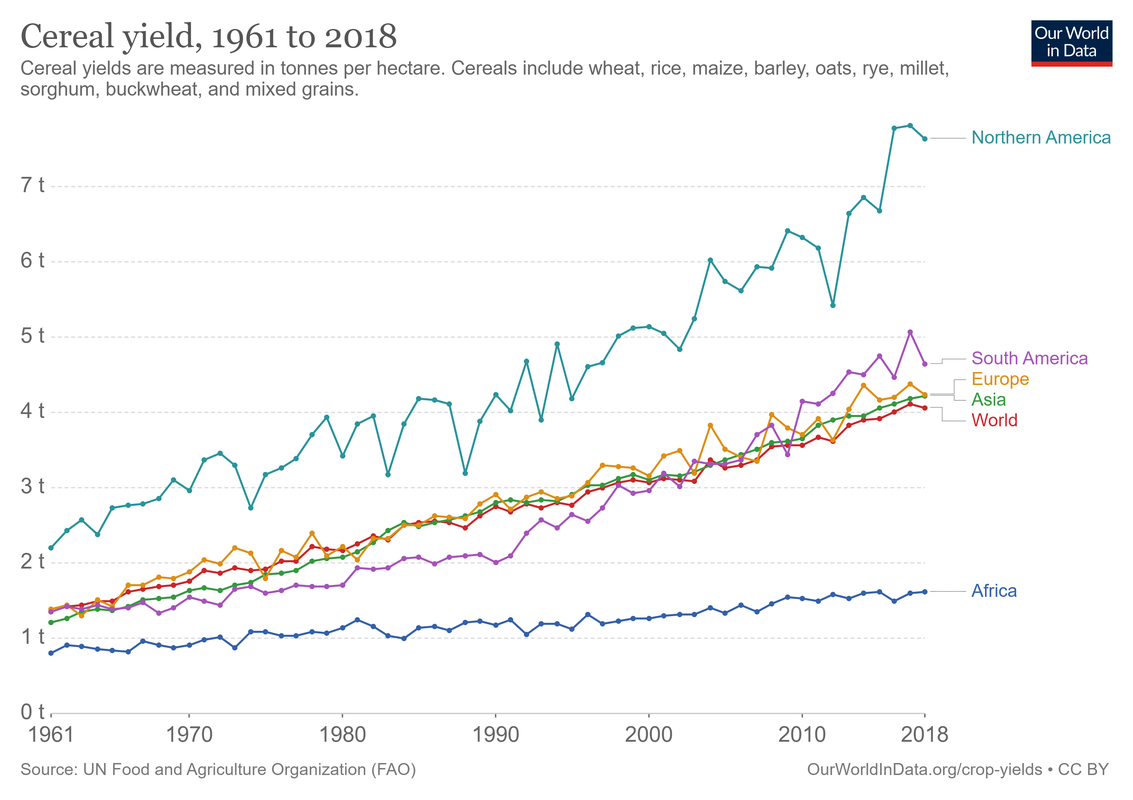
Web page: https://ourworldindata.org/crop-yields
But the beneficial effects of eCO2 for mitigating drought damage might be an even more important contributor to the decline in famines.
Ending famine is a Very Big Deal. comparable to ending war and disease. For comparison:
● The 1918 flu pandemic killed about 2% of world population.
● WWII killed about 2.7% of world population.
● The global drought & famine of 1876-78 killed an estimated 3.7% of world population.
So, even if English children have to endure slightly less frequent sledding weather in coming decades, in my judgment that will be a small price to pay for saving African and Asian children from starvation.
The whole point is that as CO2 levels go up, the plants need less water. As a result there can be more plants in a given area, even if there is no increase in water supply. Plants are also able to grow in places that were too dry before.
BS!!
More’ CO2 bad’ or in this case “not more good” propaganda.
Possibly another example of:
“I like custom-tailored white lab coats, please send money.”
Surely a newly greened peice of land will attract wildlife, birds, mammals, predators some will eat the plants some will eat other animals all these animals will crap on the ground, in autumn the leaves will fall and rot. All this and more puts nutrients back in the soil. Otherwise how does any green area stay green given adaqate rainfall, simplistic but I think I am basically correct.
These “scientists” cannot model an actual biosphere with any accuracy. What you said is 100% accurate. In a natural environment the presence of mycillia from the various fungi as well as minute round worms, called nematodes combined alters the entire system of water and nutrient transport. Such massively complex systems cannot be modeled with any better accuracy than the climate can. It’s just junk science relying on expectation bias.
OK King Canute.
Sea level has been rising for thousands of years, and hundreds of years since we have tide gauges.
No acceleration despite increases in CO2.
Sorry, not a problem to deal with 2-3mm/year that humans have been dealing with for centuries.
The Dutch have figured out how to live below sea level for hundreds of years, humans are smart and can adapt.
Sea levels have dropped at times over the last inter-glacial.
Was that an actual drop or was it isostatic rebound?
Logically the conclusion should be: the Dutch are smart.
Just funning
I have a German friend who like to joke about his Dutch friends and coworkers in Shell
Wooden shoes, wooden head, wouldn’t listen
Then why isn’t Greenland green?
Great response. I’m hoping we do see a green Greenland someday — making Greenland great again.
Hmmm . . . greenhouse growers know that the optimum level of ambient CO2 for maximum yield (aka “greening”) of their plants is between 800 and 1300 ppm (ref: http://www.omafra.gov.on.ca/english/crops/facts/00-077.htm#:~:text=For%20most%20crops%20the%20saturation,well%20as%20for%20lettuce%20production. ), and they intentionally introduce CO2 into their greenhouses to reach levels in that range for maximum yield.
Methinks the the CSIC has overlooked that at the current level of about 410 ppm CO2 in Earth’s atmosphere, there is still a SIGNIFICANT amount of CO2-induced greening to be had around the globe, independent of the amounts of water/moisture and nutrients they assert to be limiting factors.
Note carefully that the “researchers” have only concluded that the rate of greening has decreased by about 50% since 1982, NOT that it has ceased altogether. When one is on an exponentially decaying curve, there is still an awful amount of area under the last 50% of the exponential.
Reality 101.
Ummm…. except that greenhouse growers are also keeping the potash, phosphate, nitrogen and trace mineral concentration in their growing mediums quite elevated from say a boreal forest or tropical rainforest. Quite a bit different.
Indeed: one of the strongest moderating influences on the Brazilian and African equatorial rainforest is the near-aerosol lofting of iron rich dusts from the Sahara, which when circling the globe, deposit themselves as silty rain in the rainforests. Iron and phosphate is BIG. Nitrogen … has a whole lot of other means to be generated in situ. Never underestimate the effects of both lightning and non-glowing coronal discharge. LOTS of nitrogen is ‘fixed’ that way, along with the anaerobic root bacterial routes.
⋅-⋅-⋅ Just saying, ⋅-⋅-⋅
⋅-=≡ GoatGuy ✓ ≡=-⋅
” . . . except that greenhouse growers are also keeping the potash, phosphate, nitrogen and trace mineral concentration in their growing mediums quite elevated from say a boreal forest or tropical rainforest.”
Got any facts to go with assertion . . . as in, what you mean by “quite elevated”.
And BTW, boreal forests and tropical rainforests are NOT widely considered to be the prime areas on Earth for growing essential food crops . . . the soil in these locales is too poor. One of the main reasons that rainforest vegetation is burned when clearing previously forested land is to rapidly provide nutrients to the soil for non-indigenous plants that can’t grow otherwise in the previously-existing soil. Also, the high tree canopies typical of boreal forests and tropical rainforests generally prevent sufficient sunlight from reaching the zone of 0-20 feet above the ground which encompasses nearly all crop plants.
Then too, farmers in the Earth’s prime food productions areas (such as the mid-West plains of the US and the central valleys of California) typically employ fertilizers (to keep the potash, phosphate, nitrogen and trace mineral concentrations in their soils) at levels sufficient for maximum crop production.
You’re right. One of the characteristics most evident in temperate and tropical rain forests are the extremely nutrient poor soils, relying almost completely on primary tree death to re-nourish new growth and the under-story. The notion that some how the great tropical jungles are nutrient rich environments is a myth.
Most of the greening is not in agriculture but in wild plant growth. No one is fertilizing that.
AndyHce posted: “Most of the greening is not in agriculture but in wild plant growth. No one is fertilizing that.”
That statement is not supported by NASA’s data and its conclusions:
“From a quarter to half of Earth’s vegetated lands has shown significant greening over the last 35 years largely due to rising levels of atmospheric carbon dioxide, according to a new study published in the journal Nature Climate Change . . .
“Results showed that carbon dioxide fertilization explains 70 percent of the greening effect . . . The second most important driver is nitrogen, at 9 percent. So we see what an outsized role CO2 plays in this process.”
— source: https://www.nasa.gov/feature/goddard/2016/carbon-dioxide-fertilization-greening-earth (note: data of publication is April 2016)
If you consult the color-coded world map of the greening that NASA documented from satellite observation given in the same referenced article, you will see that the changes in leaf area from 1982 to 2015 exceeded 5% (with many areas exceeding 15%) over most of the AGRICULTURAL areas of the four major food-exporting countries of the world: United States, Germany, United Kingdom, and China.
The above changes in greening (via satellite measurement of leaf area differences from 1982 to 2015) are also true for the world’s five major food-production countries: China, United States, Turkey, India, and Brazil.
This world-wide greening of crop lands (with the associated increase in crop yields) has been a very large factor in preventing mass starvation as the world population continues to grow an annual rate of about 1% per year.
Talking point science.
Totally ignores seaborne photosynthesis of course. Plenty of water there….
“We have found that plants slow down their growth, not only in times of drought, but also when there are changes in the seasonality of rainfall, which is increasingly happening with climate change.”
When one makes climate change the cause of the stated effect, but then clearly implies that climate change is the principal consequence, you get circular thinking, like pulling yourself up by your bootstraps.
Is all that drying also responsible for the water levels of the Great Lakes being record high? That at least is quantifiable.
Why would anyone believe anything a Chinese “researcher” and activists like CREAF have to say? I would be more inclined to believe the opposite given their likely agendas.
Of course the presence of Chinese authors in this travesty of “science” is suspect. It’s a made to order fluff piece intended to set up the counter argument to CO2 “greening” (fertilization) that the AGW true believers need to falsify. It’s a similar device as was M E Mann’s “hockey stick” graph to eliminate the Medieval Warm Period and the Little Ice Age. If they can point to this sort of “science” it reinforces the “consensus”.
This stopped me: However much the CO2 increases, if the nutrients and water do not increase in parallel, the plants will not be able to take advantage of the increase in this gas”, explains Professor Josep Peñuelas.
My response: Hogwash. I don’t believe that the “perfesser” knows anything other than what he’s told to parrot out. It appears that his understanding of plants is missing a few chapters. I’m guessing that he only knows about the pots of plants in his lab, and ignores the O2 and H2O that evaporate out of the tops of plants, adding moisture to the atmosphere, never mind O2.
All I have to do is look at my two Carboniferous epoch fossils ( one alethoptera and one shrimp) and repeat (as David MIddleton has told) that the O2 level was 30% back then and the dead plants were likely horsetails that had gone to sporedom (they reproduce by spores) and possibly those fernlike plants alethopteris that produced seeds, and my fossils are cast in stone.
Not impressed by his statement, and now I think I may go fossil hunting next Spring, just for fun. It would be nice to find a crinoid or another shrimp… or a Tully monster.
Comparisons of plant productivity with epochs where horsetail plants predominated with current plant productivity can not be made solely in the context of C02 levels. This is because horsetail, in comparison to other plants, accumulates high levels of silica.
Silica is relevant because it supports active configuration of the leaf enzyme carbonic an-hydr-ase; this enzyme is essential for changing the CO2 that enters a stomata into HCO3- (bicarbonate). Laymen should understand that all CO2 that a leaf can productively process must 1st (very briefly) form bicarbonate; since bicarbonate crucial to get functioning the initial enzyme in the ensuing process steps culminating in carbon assimilation.
Many agronomic products are marketed for crops that are formulated enriched with silica. Their marketing claims cover many supposed benefits, which I am not repeating & their literature deal probably misses with what I’ve elucidated. I haven’t read the Original Post’s cited research & it presumably has no reference to silica, since silicates are considerably abundant on earth.
However, flowering plants spread during the Cretaceous, from around 120 Ma. CO2 varied during the period, starting out lower in the cooler Early Cretaceous, but reaching an estimated 1700ppm at its warmest c. 90 Ma in mid-period. Two warm spells in the Late Cretaceous enjoyed ~1400ppm.
A doubling of CO2 in the Cretaceous achieved an ECS of only about 0.6 degrees C:
https://www.geosociety.org/gsatoday/archive/13/12/pdf/i1052-5173-13-12-4.pdf
When angiosperms started spreading during the Aptian (~125 to 113 Ma) and early Albian Ages of the Early Cretaceous hothouse, CO2 has been estimated at 1098–1142 ppmv by Carboniferous standardization or 970–1305 ppmv by regression function:
https://www.sciencedirect.com/science/article/abs/pii/S0195667115301324
Angiosperms ( which took lots of land away from those Carboniferous horsetails) significantly evolved their leaves in the Cretaceous. Originally their leaves had a sparser pattern of veins, larger stomata pore sizes & lower stomata density (per square mm leaf area) than their late Albion (~100 Ma) counterparts.
By the late Cretaceous (~60 Ma) angiosperms really had lots of leaf veins & also the size of stoma had gone down. This made it better for them because it brought water closer to where used in the leaf & a parallel evolution was that the density of individual leaf stomata increased per square mm.
In other words, the ambient CO2 was falling & angiosperms changed both the networks of their leaf vein, as well as stomata to be more like we currently think of as the design of flowering plant leaves. A linear comparison of current angiosperms to those ~125 Ma when CO2 was higher overlooks their compensatory adaptation to lower CO2 that allowed angiosperms to thrive.
Hi John, The numbers I have for atmospheric CO2 when the angiosperms evolved are substantially higher, 2500-2800ppm, which also fits into the general decline curve for atmospheric CO2 starting 160 million years ago due to that small matter culminating in 180ppm during the first part of the current ice age, or put another way 20ppm above the death of plants. Interesting with all that that critical thinking and correct application of the scientific method that climate “science” ignores geological history except for the saw tooth pattern of the last 800K years showing degassing and regassing of the Oceans. To ignore all that went before is quite simply to alias the data but then being clever “scientists” they will know about that so it is not done by accident.
Well, you guys contributing to this just proved my point.
Original article available on Sci-Hub here …
w.